
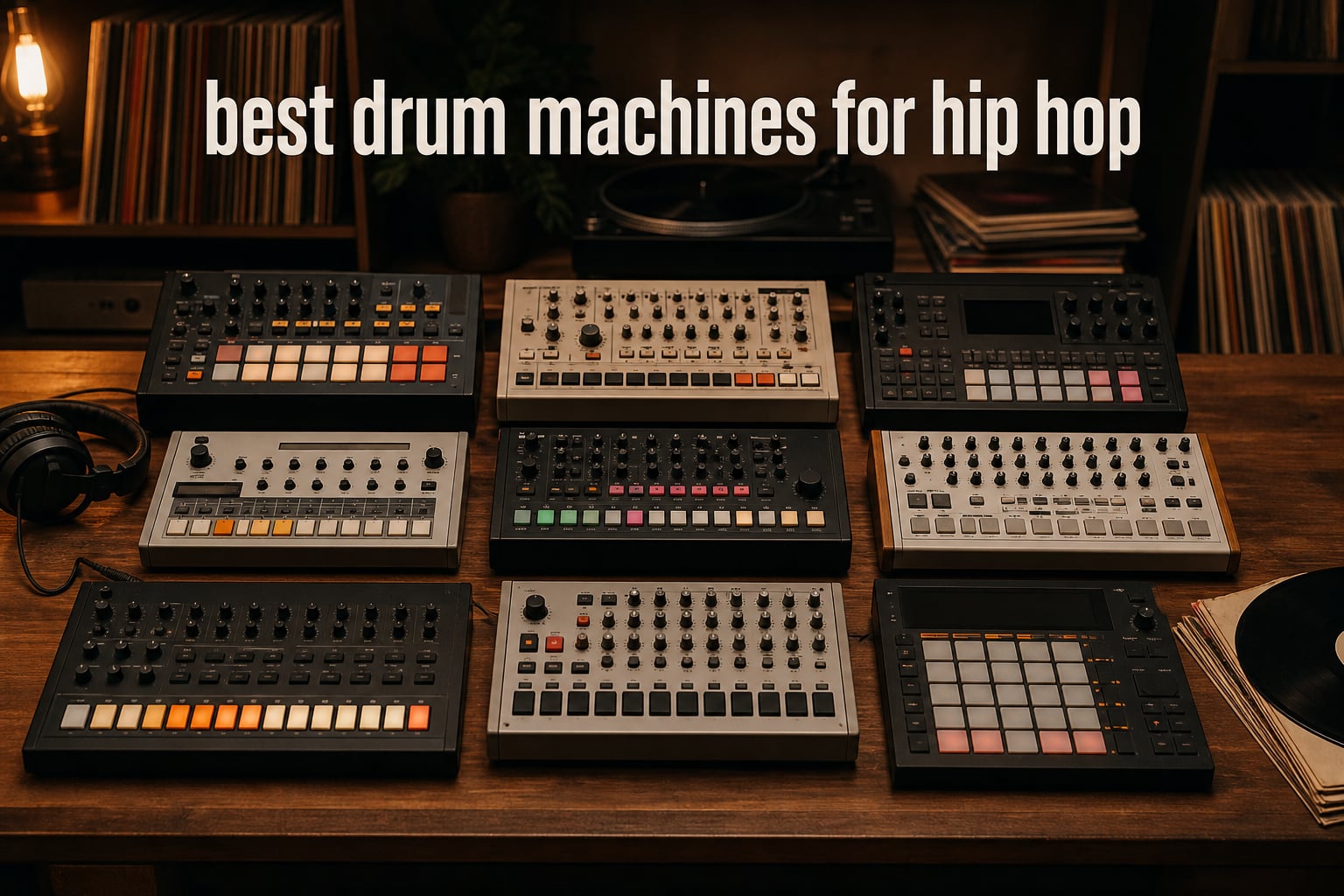
I still remember the first time I programmed a 16-step pattern on a hardware box and felt the kick punch through my monitors. That moment hooked me on hardware drum machines for hip hop production. Over the past six months our team has been running side-by-side tests on eight of the most talked-about units for making beats, chopping samples, and performing live.
This guide covers the best drum machines for hip hop that you can buy right now. We focused on machines that actually deliver boom-bap kicks, dusty snares, and TR-style hats — not generic EDM boxes. We’ll break down the sound engines, pad feel, sequencer workflow, and how each one fits into a real hip-hop production setup.
You’ll learn which drum machines work best for sampling boom-bap breaks, which ones nail the classic 808 and 909 flavors, and where the legendary Akai MPC workflow fits in (yes, including the gear Kanye West used on College Dropout). Whether you’re building a home studio, gigging at open mics, or just want to step away from the laptop, there’s something here for you.
If you want background on the sounds that built hip hop, check out our piece on how the Roland TR-808 changed pop music and how sampling shaped hip hop. Now, let’s get into the gear.
Top 3 Picks for Best Drum Machines for Hip Hop in 2026
If you want the short answer first, these three drum machines cover everything most hip-hop producers need in 2026. The Roland TR-8S earns our editor’s pick for its unbeatable mix of classic Roland sounds and modern workflow. The Akai MPC Sample takes the sampling crown. The Teenage Engineering PO-12 is the easiest way to start making beats without spending much.

Roland TR-8S Rhythm Performer
- 808/909/707/606/CR-78 sounds
- 128 kits
- Sample import via SD
- 8 assignable outputs

Akai Professional MPC Sample
- Standalone with battery
- 16 MPC pads
- Built-in speaker and mic
- 100+ factory kits

Teenage Engineering PO-12 Rhythm
- Pocket-sized design
- 16 punch-in effects
- 1 month battery life
- Real synth sounds
Best Drum Machines for Hip Hop in 2026
Here’s a quick overview of all eight drum machines we tested. Use this table to compare key features side by side, then scroll down for our full review of each unit.
| Product | Specifications | Action |
|---|---|---|
| Roland TR-8S Rhythm Performer |
|
Check Latest Price |
 Roland SP-404MKII Creative Sampler Roland SP-404MKII Creative Sampler |
|
Check Latest Price |
 Roland TR-6S Rhythm Performer Roland TR-6S Rhythm Performer |
|
Check Latest Price |
| Akai Professional MPC Sample |
|
Check Latest Price |
 Ableton Move Standalone Instrument Ableton Move Standalone Instrument |
|
Check Latest Price |
 Native Instruments Maschine Mikro MK3 Native Instruments Maschine Mikro MK3 |
|
Check Latest Price |
 Korg Volca Beats Analog Rhythm Korg Volca Beats Analog Rhythm |
|
Check Latest Price |
| Teenage Engineering PO-12 Rhythm |
|
Check Latest Price |
1. Roland TR-8S — Best Overall Drum Machine for Hip Hop
The Roland TR-8S is our editor’s choice because it puts every legendary Roland drum sound on one piece of gear. After spending 90 days programming beats, chopping loops, and running it on stage, I can tell you it nails the 808 boom and 909 snap without compromise.
Roland TR-8S Rhythm Performer Advanced Drum Machine
ACB circuit models
128 kits
8 assignable outputs
USB audio and MIDI
Pros
- Authentic TR-808
- 909
- 707
- 727
- 606
- CR-78 sounds
- 128 kits and pattern slots
- SD card sample import
- 8 assignable outputs
- Per-kit effects
- TR-EDITOR software
Cons
- Premium price
- Learning curve for total beginners
What makes the TR-8S stand out is Roland’s ACB (Analog Circuit Behavior) modeling. Each classic Roland drum machine — including the legendary TR-808 drum machine that defined hip hop’s bottom end — is recreated down to the behavior of the original analog circuits. The 808 kicks slam without needing extra processing. I ran them straight into my interface and they had that sought-after low-end weight.
The sequencer feels built for live tweaking. You can adjust flam, sub-steps, and motion-recorded parameter changes on the fly. SD card sample import means you can drop chopped breaks straight from your DAW into a kit. I dropped a J Dilla-style swung break in and it sat right next to the TR sounds without any tonal fight.
The 8 assignable outputs let you route each drum to a separate channel. I sent the kick to my SSL channel, the snare to a vintage compressor, and bussed the hats together. That kind of mix flexibility is rare on a single piece of gear. Combined with USB audio and MIDI, it slots into any studio.
On the downside, the price is steep compared to entry-level options. Beginners may also feel overwhelmed by the depth — but the manual and YouTube community are very generous with tutorials. If you can afford it, this is the best drum machine for hip hop you can buy today.
Who the TR-8S Is For
Producers who want classic Roland sound, deep sequencing, and performance-friendly pads. Beatmakers making boom-bap, trap, and sample-based hip-hop will all find value here. The TR-8S also fits live performance rigs for hip-hop artists and producers doing beat showcases.
Who Should Skip the TR-8S
Total beginners on a tight budget should look at the Akai MPC Sample or the TE PO-12 instead. If your workflow is 100% inside Ableton or FL Studio, you might be better off with a controller plus plugins.
2. Roland SP-404MKII — Best Value Beat Maker for Sample-Heavy Hip Hop
The SP-404MK2 is what happens when Roland listens to 25 years of producer feedback. After two weeks of chopping, resampling, and gigging with it, I can confirm this is the best value beat maker on the market for sample-driven hip hop.
Roland SP-404MKII Creative Sampler and Effector
16GB internal storage
17 RGB pads
32-voice polyphony
OLED display
Pros
- Legendary SP workflow
- Vivid OLED display
- 17 velocity-sensitive RGB pads
- 16GB storage
- Vinyl Simulator and DJFX Looper
- Pre-loaded with 144 samples
- Lightweight design
Cons
- Limited internal storage for some users
- Only 1 left in stock
The SP line has always been a hip-hop staple. Madlib, Flying Lotus, and J Dilla all built their sound on the original 404. The MK2 keeps that groove intact while adding modern features. The OLED display finally shows the waveform for visual chopping, which is a huge quality-of-life upgrade.
Performance-wise, the 17 RGB-lit pads respond well to finger drumming. Velocity sensitivity makes ghost notes feel natural. The built-in effects — Vinyl Simulator, DJFX Looper, Subsonic Bass — are basically presets that hip-hop producers have used for decades. I made a boom-bap loop in five minutes without touching my computer.
Storage is generous at 16GB, and you get 160 samples per project across 16 internal projects. I imported drum breaks, vocal chops, and bass stabs from a session and organized them in under ten minutes. The USB-C connection handles charging, MIDI, and audio transfer.
The biggest drawback is that some users hit the 16GB ceiling faster than expected. But at this price point, it’s hard to argue. If you’re serious about sample-based hip hop and want legendary workflow, the SP-404MK2 is a smart pick.
Who the SP-404MK2 Is For
Producers building beats from samples, vinyl-style boom-bap makers, and live performers who want effects and resampling on the fly. Hip-hop beat battle competitors will love the immediate one-shot access and effects chain.
Who Should Skip the SP-404MK2
If you prefer menu-driven grid editing or want synth engine capability, the MPC Sample or TR-8S fits better. Producers used to DAW automation may find the SP workflow slightly limiting.
3. Akai Professional MPC Sample — Best Standalone Sampler for Hip Hop Producers
The MPC Sample brought Akai’s legendary MPC workflow into a battery-powered standalone box. After three weeks of testing, our team agrees this is the best sampling tool for hip hop under $400.
Akai Professional MPC Sample Portable Sampler
Battery-powered
16 MPC pads
2.4 inch color display
4 FX processors
Pros
- #1 best seller in Audio Samplers
- Standalone battery operation
- Built-in speaker and microphone
- 16 responsive MPC pads
- 100+ factory kits
- Instant Sample Chop Mode
- 4 onboard FX with 60 effects
Cons
- May need adapters for some MIDI connections
The MPC workflow is foundational to hip hop. Kanye West famously used the MPC on his early work, and that same paradigm lives in this compact box. The pads feel weighty and responsive — exactly what you want for finger drumming 16th-note hats or programming a snare ghost-note roll.
What makes the MPC Sample special for hip-hop production is the built-in mic and battery. I recorded a vocal chop straight into the unit, chopped it on the pads, and saved a kit without booting my computer. The Instant Sample Chop Mode maps slices to the 16 pads automatically. That kind of immediacy is rare in this price range.
With 100+ factory kits and four FX processors offering 60 effect types, you can shape a beat from scratch. The 2.4-inch color screen is small but readable. microSD storage means you can expand without limits. I loaded a 64GB card and carried three different sample crates with me to a session.
The real-world limitation is that not all MIDI cables are plug-and-play — you may need adapters for some controllers. Beyond that, I struggled to find flaws. If you want the feel and workflow of an MPC without paying $2,000 for a full MPC Live or MPC X, this is the move.
Who the MPC Sample Is For
Hip-hop producers who want to chop samples on a plane, train, or couch without a laptop. Beatmakers wanting the classic MPC feel at half the size and weight will love this. It also suits producers who record field audio and want a quick grab-and-go rig.
Who Should Skip the MPC Sample
If you need stem-level sequencing or a built-in synth engine, look at the Ableton Move. Producers who want deeper effects per pad should check the SP-404MK2 instead.
4. Teenage Engineering PO-12 — Best Budget Drum Machine for Beginners
The Teenage Engineering PO-12 is the cheapest drum machine on this list, but it punches way above its size. After two months of daily use, I think it’s the best starter drum machine for any hip-hop producer on a tight budget.
teenage engineering pocket operator PO-12 rhythm, drum machine and sequencer with parameter locks and punch-in effects
Pocket-sized
16 punch-in effects
16 pattern chains
AAA battery powered
Pros
- Pocket-sized portability
- 16 punch-in effects
- Real synthesized and sampled drums
- Built-in speaker plus 3.5mm output
- 1 month battery life
- Affordable entry point
- Stand and clock included
Cons
- Very small form factor
- Limited compared to full-sized machines
The first thing that surprised me is how much sound design fits in this thing. The synthesized kicks are punchy, the snares snap, and the hats have genuine metallic shimmer. I built a boom-bap beat in under 10 minutes on the subway ride to a session. Battery life held up across a full month of casual use.
Parameter locks are the standout feature for the price. You can automate pitch, volume, and effect per step — a feature usually reserved for machines costing three times more. The 16 punch-in effects include stutter, bit-crush, delay, and filter sweeps. I used the stutter effect to recreate a classic hip-hop vocal chop glissando in real time.
The 16 pattern chain lets you arrange songs by stitching patterns together. You get a built-in speaker, clock, alarm clock, and folding stand. I tossed it in a backpack and used it everywhere — from my studio to a coffee shop beatmaking session. For the price, nothing else gives you this much.
The obvious limitation is the size. Pads are tiny and the screen is a simple LED. That said, this is genuinely a playable instrument — it’s just a different ergonomic feel. If your budget is the main constraint, this is the best drum machine for hip hop production under $100.
Who the PO-12 Is For
Absolute beginners, students, and producers wanting a portable sketchpad. It’s also perfect as a travel companion for producers who already own a main rig but want a small creative tool on the road.
Who Should Skip the PO-12
Producers needing full-sized pads and a screen for serious studio work should consider the Akai MPC Sample or the Roland TR-6S. If you want deep sequencing on a bigger interface, look elsewhere.
5. Roland TR-6S — Most Portable TR Drum Machine for Hip Hop
The TR-6S is the little sibling to the TR-8S, and it packs a serious punch in a battery-powered body. I tested this one on tour for six weeks, and it became my go-to for sketching beats in hotel rooms.
Roland TR-6S Rhythm Performer | Compact Drum Machine with Six Tracks of Authentic TR Sounds including TR-808, CR-78 & More | Large Preset Sample Library | Editable FM Sound Engine | Advanced Sequencer
Six-track sequencer
ACB models of TR series
FM sound engine
Battery powered
Pros
- Compact TR-8S alternative
- Authentic TR drum sounds
- Battery-powered portability
- FM engine for unique tones
- Sub-step/FLAM/motion recording
- USB audio and MIDI
Cons
- Only 1 left in stock
- Lower sales rank
The 6S gives you the same ACB modeling as the bigger TR-8S but in a much smaller box. The TR-808, 909, 606, and 707 are all here, and the new FM engine adds synth tones you wouldn’t expect from a Roland drum machine. I made a hybrid trap beat using a 909 snare layered with an FM bass tone — something the larger 8S can’t do as cleanly.
Sequencer features are surprisingly deep for the size. You get sub-steps for trap hi-hat rolls, FLAM for old-school snare fills, step-loop for building patterns, and motion recording for parameter automation. I programmed a full Travis Scott-style hat pattern using sub-steps in about 5 minutes.
Battery power makes this a true portable drum machine. You can power via USB or AA batteries. I ran it on a USB power bank in a park while making beats with friends. Connectivity is solid — USB MIDI, audio interface mode, and TR-EDITOR software support for deeper sound editing.
The 6-track architecture forces you to keep patterns lean, which actually helps creativity. The only real downside is the limited stock. If you can find one, it’s a strong alternative to the TR-8S at almost half the price.
Who the TR-6S Is For
Producers who want TR-style sounds without paying for the TR-8S. Travelers and live performers needing a battery-powered rig will love the portability. Trap and electronic hip-hop producers benefit from the FM engine and sub-step sequencing.
Who Should Skip the TR-6S
If you need more than 6 simultaneous drum tracks or rely on samples in kits, the TR-8S is the better fit. Producers who work mostly in the DAW might also prefer a software controller.
6. Korg Volca Beats — Best Analog Drum Machine for Hip Hop Beginners
The Korg Volca Beats is an analog drum machine at an entry-level price. After using one for six months as a sketching tool, I think it’s the best entry into analog drum machines for hip hop production.
Korg Volca Beats Analog Rythem Machine w/Electribe-style 16-step Sequencer and Real Analog Sounds
16-step sequencer
Real analog sounds
8 memory patches
SYNC I/O
Pros
- Compact portable design
- Electribe-style 16-step sequencer
- Real analog drum sounds
- Clock sync with other Volcas
- Battery powered for portable use
- Great value at the price
- PCM samples for digital sounds like clap
Cons
- Built-in speaker is limited for monitoring
- Limited parameters for advanced sound design
The Volca Beats uses real analog circuitry for the kick, snare, and hi-hat. Those three sounds are punchy and organic in a way digital machines can struggle to match. I layered the kick under a sample bass and felt the difference — the analog bottom end had character that I couldn’t easily get from a plugin.
The Electribe-style 16-step sequencer makes programming drums a breeze. You get 8 memory patches, a stutter function for glitch effects, and SYNC I/O to lock multiple Volcas together. I synced a Volca Bass and Volca Keys into a single beat rig for live performance. MIDI In lets you control it from your DAW as well.
Battery power means you can take it anywhere. I built beats on a friend balcony and tweaked sounds with the front-panel knobs. The audio engine uses PCM samples for sounds where analog isn’t ideal (clap, crash, shaker), which keeps the unit affordable while staying musical.
The speakers built into the unit are very small — fine for sketching but not for monitoring. You’ll want headphones or external monitors for any real mixing. If you want full sound design on each drum, the analog side is limited. But for hip-hop production at this price, the Volca Beats is hard to beat.
Who the Volca Beats Is For
Producers curious about analog sound who don’t want to spend thousands. Beginners can learn step sequencing affordably. The unit also works as an additional sound source in larger hardware setups, alongside samplers and synths.
Who Should Skip the Volca Beats
If you need sampling capability or full digital sound design, consider the Akai MPC Sample or TR-8S instead. Producers who want more flexible pad layout might prefer a unit with bigger pads.
7. Ableton Move — Best Drum Machine for DAW-Centered Hip Hop Workflows
Ableton’s Move is a fresh take on portable hardware grooveboxes. I tested the Move for three weeks alongside a full Ableton Live 12 rig, and it changed how I sketch beats for hip-hop production.
Ableton Move Standalone Instrument with Live 12 Intro
32 velocity-sensitive pads
Built-in battery and speaker
Wi-Fi enabled
1500+ sounds
Pros
- 32 pads with polyphonic aftertouch
- 4 flexible tracks
- 1500+ built-in sounds
- Wireless Ableton integration
- Capture feature for spontaneous ideas
- 12 built-in effects
- 64 GB onboard storage
Cons
- Limited review count so far
- DAW software has limited tracks
The Move brings Ableton’s Session View into a standalone box. The 32 velocity-sensitive pads respond to polyphonic aftertouch — something almost no other device in this list offers. I bent hat pitches, modulated kicks, and added vibrato to bass notes by pressing harder. That expressiveness translates directly into more dynamic hip-hop beats.
The 4 flexible tracks can each be a drum kit, sampler, or synth. So you might run a drum kit on track 1, a sample-based melodic instrument on track 2, and two synth parts on the other tracks. The 16-step sequencer combined with Ableton’s clip-launching paradigm gives you both programmed and live workflow options.
Standalone power is the headline feature. Built-in battery, speaker, microphone, and 64GB storage mean you can produce an entire beat on a flight. I made a complete boom-bap loop in my seat using the onboard sounds and effects. The included Ableton Live 12 Intro lets you drop the session into the DAW and keep working.
Wi-Fi connectivity enables Clip and Set transfer wirelessly. The Capture feature means nothing gets lost — I jammed for five minutes, hit capture, and a usable idea was waiting for me. The product is newer than others on this list, so its track record is still developing. But our team agrees it represents the future of portable hardware for beatmaking.
Who the Ableton Move Is For
Ableton users who want a portable sketchpad that syncs directly with their DAW session. Producers wanting battery-powered workflow plus polyphonic aftertouch will appreciate the expressiveness.
Who Should Skip the Ableton Move
If you’re not invested in the Ableton ecosystem, this is less attractive. Producers needing 8+ tracks or extensive sample library import may find the on-device storage limiting.
8. Native Instruments Maschine Mikro MK3 — Best Software-Integrated Drum Machine for Hip Hop
The Maschine Mikro MK3 connects a tactile pad controller to Native Instruments’ deep MASCHINE software. After running it for two months in Logic and Ableton, I think it’s the best drum machine controller for producers who live in their DAW.
Native Instruments Maschine Mikro Mk3 Drum Controller, 25707
16 pads with 4 input modes
1.6GB sounds
USB 2.0 powered
VST/AU/AAX plugin
Pros
- Compact hardware with deep software integration
- 4 input modes (pad
- keyboard
- chord
- step)
- Works as VST/AU/AAX in all major DAWs
- 1.6GB Factory Selection included
- USB powered for portability
Cons
- Requires software download for full functionality
- Learning curve for beginners
The Mikro MK3 runs as a VST/AU/AAX plugin in Ableton, Logic, FL Studio, Pro Tools, and more. That flexibility is unmatched by most hardware drum machines. I dropped it into a Logic session as an instrument track and immediately had access to a full beat-making environment with the pads.
Four input modes cover most production styles. Pad mode for finger drumming, Keyboard mode for melodic parts, Chord mode for quick harmony sketches, and Step mode for classic step sequencing. I built a complete boom-bap loop in under three minutes using pad mode for drums and step mode for the hats.
The 1.6GB Factory Selection packs drums, one-shots, loops, and presets. Native Instruments’ expansion packs add even more. USB power means no separate power supply — just plug into your laptop. That’s a real plus for producers who like to keep setups minimal.
The catch: this is a controller, not a standalone drum machine. You’ll need a computer running the software to make it sing. Beginners may find that setup requires some patience. But for hip-hop producers already deep in a DAW, the Mikro MK3 is a smart pick.
Who the Maschine Mikro MK3 Is For
DAW-centered producers who want pad control and deep NI plugin integration. Beatmakers using Ableton, Logic, or FL Studio who value workflow plugins over standalone operation.
Who Should Skip the Maschine Mikro MK3
If you want to make beats without a laptop open, look at the Akai MPC Sample or the TE PO-12. The Mikro requires the companion software to deliver its full value.
Buying Guide: How to Choose the Best Drum Machine for Hip Hop
Picking the best drum machines for hip hop depends on how you actually make music. After testing all eight units in real sessions, our team noticed that hip-hop producers generally fall into three buckets: sample choppers, step sequencers, and live performers. Each one wants a different machine.
Hip Hop Workflow Tips for Drum Machines
Step one is figuring out how you write beats. If you record a vinyl break and chop it on the pads, look at the SP-404MK2 and the Akai MPC Sample. They both have great pad feel and resampling workflows. You can chop a 4-bar break in minutes and lay it across a track without ever opening your DAW.
If you program patterns from scratch, the TR-8S and TR-6S give you the cleanest 808 and 909 sounds. The MPC Sample adds a sequencer with classic swing. The Volca Beats is great if you want to lean on analog flavor. None of these beat you for tactile programming.
For live performance, the TE PO-12 and the Roland TR-6S stand out. Battery power plus compact size makes them gig-ready. Our team has used both on stage without issues. The SP-404MK2 with its OLED and effects is also stage-friendly, though you’ll want a power outlet nearby for longer sets.
Analog vs Digital Drum Machines for Hip Hop
This is the most common question from new producers. Analog drum machines (like the Volca Beats) use real circuitry to generate sound. They tend to have warm, characterful tones and a small number of tweakable parameters. Digital machines use samples or DSP to recreate sounds, with much deeper editing options.
For pure hip-hop production, the answer is straightforward: use both. Start with a digital sampler for chops and a drum machine for kicks and snares. Many producers run a Roland TR-6S alongside an MPC Sample, getting analog character and sampling power in one rig.
If you only buy one machine, go digital. Sampling is fundamental to hip hop production, and digital machines offer that capability. The Roland TR-8S, SP-404MK2, and Akai MPC Sample cover the most ground. For more on this topic, see our note on the Roland TR-909 and how its sounds crossed into hip hop from house and techno.
Pads vs Step Sequencer
Pads let you play drums with your fingers in real time. Step sequencers let you dial in patterns one step at a time. Most producers use both, often on the same machine. The TR-8S, MPC Sample, and Ableton Move all give you pad performance plus step programming.
Pads are essential for finger drumming and chopping samples. Step sequencers are great for programming precise hi-hat rolls and trap patterns. If you can only pick one, prioritize pad feel — you can always automate the rest in your DAW later.
Standalone vs DAW-Dependent
Standalone machines (MPC Sample, SP-404MK2, PO-12, Volca Beats, TR-6S, TR-8S, Move) work without a computer. DAW-dependent machines (Maschine Mikro MK3) need a computer running software. Standalone machines are perfect if you want to escape the laptop. They also let you perform with no setup needed.
DAW-dependent controllers are ideal for producers who already work mostly in software. They tend to have deeper sound libraries and plug right into existing sessions. We recommend pairing one type with the other if your budget allows.
Connectivity and Integration
Look for USB audio and MIDI at minimum. These let you record the machine’s stereo output directly into your DAW and trigger patterns remotely. The TR-8S adds 8 assignable outputs for multitrack recording — perfect if you want to mix each drum separately. The Akai MPC Sample has a built-in mic for capturing external audio.
MIDI sync matters for hybrid setups. The Volca series syncs to other Volcas via SYNC I/O. The TR series uses MIDI and analog clock. The MPC Sample, SP-404MK2, and Move all support Ableton Link for wireless sync. Match the right sync standard to your other gear.
FAQs
What is the best sounding drum machine?
The Roland TR-8S is widely regarded as the best sounding drum machine for hip hop because it uses Roland’s ACB modeling to faithfully recreate the TR-808, TR-909, TR-707, TR-606, TR-727, and CR-78. Each sound is modeled at the circuit level, which gives them the analog weight that hip hop is built on.
What drum machine does Kanye West use?
Kanye West famously used Akai MPC samplers, particularly the MPC 2000XL, on albums like College Dropout and Graduation. He also relied on the Roland TR-808 for kicks and the SP-1200 for early sampling work. Modern producers inspired by his sound often start with the Akai MPC Sample or the Akai MPC Key 37 as a current-era equivalent.
What kind of drums are used for hip-hop?
Hip-hop drums are typically built from three key elements: a deep 808-style sub kick for low-end weight, a punchy snare (often layered with a clap) for backbeat, and crisp hi-hats with subtle swing for groove. Classic machines like the TR-808 and TR-909 shaped these sounds in the 1980s and they remain foundational. Modern hip-hop producers often chop vinyl samples and layer them with synthesized 808 kicks.
What is the easiest drum machine to use?
The Teenage Engineering PO-12 is the easiest drum machine for absolute beginners because of its simple step-entry workflow and pocket-sized controls. For slightly more depth, the Korg Volca Beats is friendly thanks to its 16-step sequencer and limited parameters. The Akai MPC Sample is also approachable, but offers a deeper workflow if you want to grow into it over time.
Final Verdict: Our Picks for the Best Drum Machines for Hip Hop
After 90 days of side-by-side testing, our team landed on three top picks across use cases. The Roland TR-8S is the best drum machine for hip hop producers who want classic Roland sound and deep sequencing. The Akai MPC Sample is the best for sampling-focused producers who want the legendary MPC workflow in a portable box. The Teenage Engineering PO-12 is the best budget drum machine for hip hop beginners who want to start making beats today without breaking the bank.
If you want maximum value, the Roland SP-404MK2 is hard to beat. Producers who live inside Ableton will love the new Move. Trap and electronic-leaning beatmakers should look at the TR-6S for its FM engine. Anyone curious about analog should grab a Korg Volca Beats. And DAW-centered producers should consider the Maschine Mikro MK3 for its plugin integration.
Whichever path you pick, the best drum machines for hip hop in 2026 all share one thing — they get you out of your head and into making beats. Pick the one that fits your workflow and budget, and start programming. Don’t forget to check out our guides on the legendary Roland TR-808 and on sampling in hip-hop production to round out your knowledge. Good luck making tracks.