
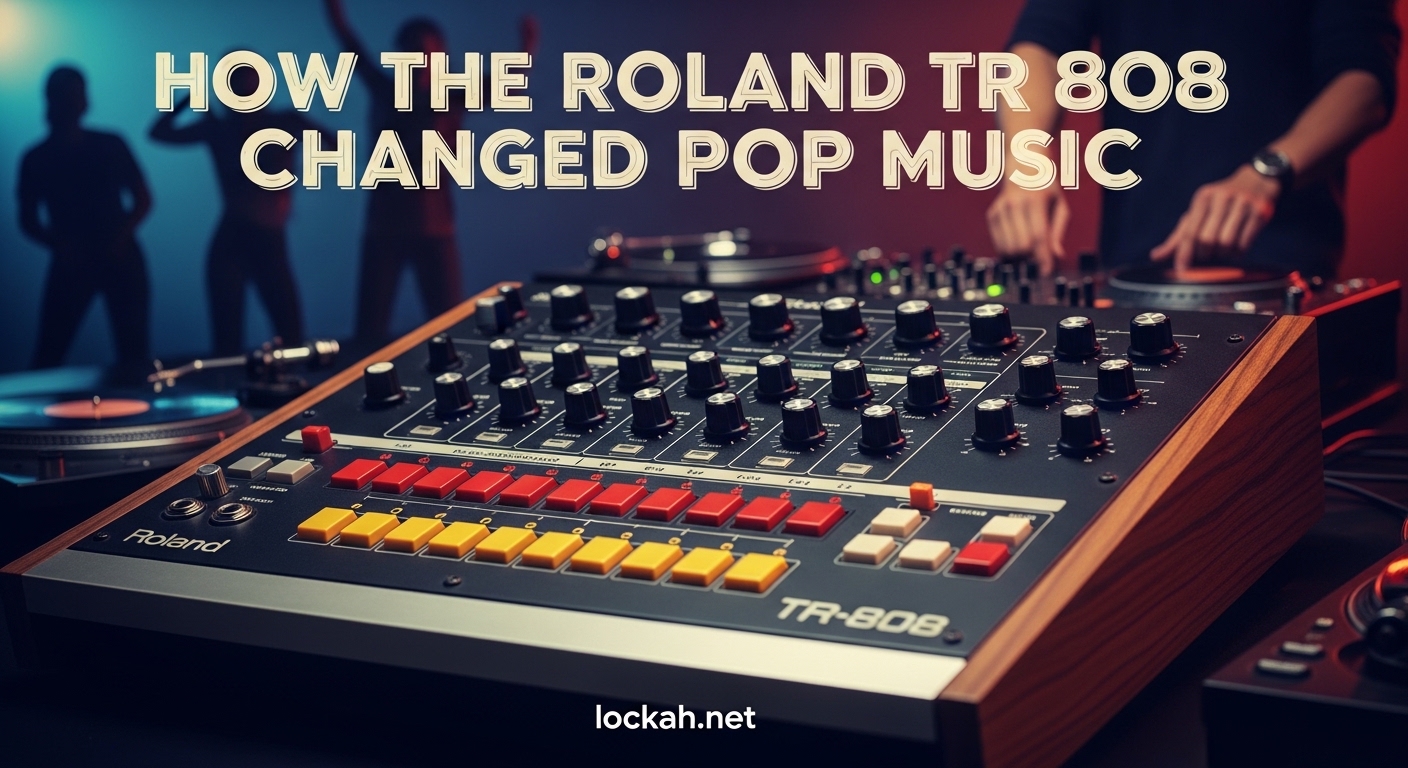
That deep, thundering boom that pulses through your chest at a concert. The synthetic snap of a snare that cuts through a mix like a knife. Those sounds have shaped decades of popular music, yet they all trace back to one unassuming box built in Japan over four decades ago. How the Roland TR 808 changed pop music is one of the most fascinating stories in recording history—a tale of commercial failure transforming into cultural revolution.
In this guide, I will walk you through the complete history of this legendary drum machine. You will discover why the 808 flopped when it first releases, how it found new life in hip-hop and electronic music, and why its influence still echoes through every genre from trap to pop in 2026.
How the Roland TR 808 Changed Pop Music: The Short Answer (2026)
The Roland TR-808 Rhythm Composer revolutionized pop music by democratizing beat production through affordable analog synthesis technology. Unlike sample-based drum machines that played recordings of real drums, the 808 generated sounds electronically, creating a distinctly synthetic tone that producers could manipulate and extend—most notably the booming bass drum that became the foundation of hip-hop, electronic dance music, and modern pop.
Released in 1980 and discontinued just three years later as a commercial failure, the 808 found secondhand homes in the hands of aspiring producers who could not afford real drum kits or recording studios. These innovators turned the machine’s limitations into strengths, programming the repetitive loops and extended bass tones that would define entire genres. From Marvin Gaye’s “Sexual Healing” to Kanye West’s “Love Lockdown,” the 808’s fingerprints are on some of the most important recordings in modern music history.
What Is the Roland TR-808?
The Roland TR-808 Rhythm Composer is a drum machine manufactured by Roland Corporation between 1980 and 1983. Unlike modern drum machines that play digital samples of recorded instruments, the 808 uses analog synthesis—manipulating electrical currents to generate waveforms that mimic drum sounds.
Engineer Tadao Kikumoto designed the 808 with twelve analog sound circuits, each dedicated to a specific percussion voice. The machine includes a bass drum, snare drum, low tom, mid tom, high tom, rimshot, handclap, cowbell, hi-hat, cymbal, and open hi-hat. Each sound is generated through voltage-controlled oscillators, filters, and amplifiers rather than sampled recordings.
The front panel features a grid of sixteen buttons representing steps in a measure, allowing users to program patterns by tapping beats into the step sequencer. This 16-step interface became the standard for drum machine programming and remains influential in music software design today. The 808 also includes DIN sync ports for connecting to other Roland equipment, allowing it to synchronize with early synthesizers and sequencers.
The Birth and Commercial Failure of the 808
Roland Corporation released the TR-808 in 1980 with a retail price of $1,195, positioning it as an affordable alternative to the LinnDrum and other high-end drum machines. Company founder Ikutaro Kakehashi envisioned a machine that would help musicians program realistic drum patterns for demos and songwriting.
The 808’s sounds were never intended to replace a real drummer. Kikumoto deliberately used analog circuits because memory chips for digital sampling were prohibitively expensive in 1980. This technical limitation would prove to be the machine’s greatest strength, though nobody recognized it at the time.
Professional musicians and studios rejected the 808 almost immediately. Critics dismissed its sounds as too artificial, too electronic, too fake. The booming bass drum lacked the subtle dynamics of a real kick. The snare sounded like a handclap with a cold. The cymbals hissed rather than crashed. By 1983, Roland discontinued the 808 after selling only about 12,000 units— respectable numbers that paled compared to the company’s other products.
As dealers cleared remaining inventory, 808s began appearing in secondhand stores and pawn shops at drastically reduced prices. These affordable machines found their way into the hands of young producers in New York, Los Angeles, Detroit, and Chicago—creators who could not afford acoustic drums, studio time, or professional session musicians.
How the 808’s Analog Synthesis Created Magic?
The 808’s bass drum circuit produces its iconic sound through a simple but elegant combination of components. A sine wave oscillator generates the fundamental tone, a low-pass filter shapes the frequency content, and a voltage-controlled amplifier shapes the envelope. The decay knob allows producers to extend the bass drum from a quick thump into a sustained boom that rattles subwoofers.
This analog architecture creates sounds fundamentally different from digital samples. Where a recorded drum has a fixed duration and character, the 808’s oscillators continue generating tone as long as the decay setting allows. The result is that signature 808 sub-bass that can stretch for seconds, becoming as much a melodic element as a percussive one.
The 808’s analog circuits also introduce subtle variations and imperfections that give the machine character. No two bass drum hits are perfectly identical. Filter cutoff frequencies drift slightly with temperature. These quirks create a living, breathing quality that pure digital samples often lack. Producers began embracing these “flaws” as features, using them to add warmth and movement to programmed beats.
How the 808 Sparked a Hip-Hop Revolution?
The 808’s journey from failed product to cultural icon began in the early 1980s when pioneering artists discovered its unique capabilities. Marvin Gaye’s 1982 single “Sexual Healing” marked one of the first prominent uses of the 808 on a mainstream hit, with the machine’s crisp hi-hats and distinctive kick providing the track’s rhythmic foundation.
That same year, Afrika Bambaataa and the Soulsonic Force released “Planet Rock,” a track that would fundamentally reshape popular music. Bambaataa combined 808 beats with elements of European electronic music, creating a fusion that defined electro hip-hop and influenced countless producers. The song’s success proved that synthetic drum sounds could not only work in popular music but could create entirely new sonic palettes.
The 808 arrived at a pivotal moment for hip-hop culture. The genre was transitioning from DJ-driven party music to producer-composed recordings. Young creators in the Bronx, Harlem, and Compton needed affordable tools to make beats. The secondhand 808, available for a few hundred dollars, provided a complete drum kit that fit on a kitchen table. It required no microphones, no acoustic space, no engineering knowledge—just imagination and patience.
This accessibility democratized music production in ways that still resonate today. Before the 808, making professional-sounding drums required expensive equipment and specialized skills. After the 808, anyone with a few hundred dollars and creativity could program beats that competed with major studio productions. The machine helped transform hip-hop from a live performance art into a studio-based production culture.
Crossing Genres: From Hip-Hop to Pop and Electronic (2026)
Electronic Dance Music Foundations
While hip-hop producers embraced the 808’s booming bass, electronic musicians in Detroit and Chicago discovered its potential for four-on-the-floor dance beats. Juan Atkins, Derrick May, and Kevin Saunderson—the Belleville Three who invented techno—used the 808 as a foundation for their futuristic sound. The machine’s precise, programmable rhythms provided the mechanical pulse that defined techno and house music.
Chicago house producers like Marshall Jefferson and Frankie Knuckles layered 808 patterns with synthesizer basslines and soulful vocals, creating tracks that would dominate dancefloors for decades. The 808’s ability to lock perfectly with early analog synthesizers made it an ideal partner for electronic music production.
Pop Music’s Electronic Embrace
By the mid-1980s, mainstream pop artists began incorporating 808 sounds into their productions. Phil Collins used the 808 prominently on his 1985 album “No Jacket Required,” particularly on the hit “Take Me Home.” Whitney Houston’s 1987 album “Whitney” featured 808 programming on multiple tracks, helping bring electronic drum sounds to pop radio.
Producer Rick Rubin built his signature sound around the 808 while working with LL Cool J, Run-DMC, and the Beastie Boys at Def Jam Recordings. Rubin’s sparse, hard-hitting productions proved that drum machines could deliver the power and aggression previously associated only with live rock drumming.
Miami Bass and Southern Hip-Hop
In Miami, producers like Luther Campbell and 2 Live Crew pushed the 808’s bass drum to extremes, creating the Miami Bass sound that would influence Southern hip-hop for generations. These producers discovered that the 808’s decay control could create sub-bass frequencies that physically shook car speakers and club sound systems.
This obsession with bass migrated west to Houston and then south to Atlanta, where producers like Organized Noize, OutKast, and later Lil Jon built entire genres around the 808’s low-end capabilities. The machine’s influence on Southern rap directly shaped the sound of modern trap music.
The Trap Revolution
Modern trap music represents the 808’s most visible contemporary influence. Producers like Lex Luger, Metro Boomin, and 808 Mafia have built billion-streaming careers around the same bass drum sound that Afrika Bambaataa used in 1982. Today’s trap productions use software emulations and sample libraries, but the sonic DNA remains unmistakably 808.
The “trap snare”—a rapid-fire roll of pitched snare hits that climbs upward—derives directly from 808 programming techniques developed in the 1980s. The exaggerated sub-bass that modern hip-hop listeners expect in their headphones traces back to the 808’s extended decay settings. Every modern rap hit owes something to this forty-year-old drum machine.
Artists and Producers Who Defined the 808 Sound?
Rick Rubin stands as perhaps the most influential 808 producer in hip-hop history. His work on LL Cool J’s “Radio” and the Beastie Boys’ “Licensed to Ill” established the hard-hitting, sparse aesthetic that defined Def Jam’s sound. Rubin’s productions stripped hip-hop down to its essentials: booming 808 bass, sharp snare cracks, and aggressive vocals.
In the 1990s and 2000s, Lil Jon brought the 808 to crunk music, using the machine alongside synthesizers to create the high-energy Southern sound that dominated clubs for a decade. His productions for Usher, Ying Yang Twins, and Ciara introduced 808-driven beats to pop audiences who had never heard of analog drum machines.
Kanye West paid explicit tribute to the machine with his 2008 album “808s & Heartbreak,” which used the 808 as its primary sonic foundation. While the album polarized critics initially, its influence proved immense—helping establish the melodic, autotune-heavy sound that would dominate hip-hop and pop through the 2010s.
Contemporary producers continue finding new uses for 808 sounds. Mike Will Made-It, Metro Boomin, and Murda Beatz have all built signature sounds around 808 bass and drums, proving that this decades-old technology still drives modern hit-making. The machine appears on streaming charts daily, even as most listeners have no idea they are hearing sounds generated by analog circuits from 1980.
The 808’s Modern Legacy and Recreations
Original Roland TR-808 units have become prized collectibles, with working examples regularly selling for over $4,000 in 2026. The machine that could not find buyers at $1,195 in 1980 now commands prices that would have seemed impossible forty years ago. This reversal speaks to the 808’s enduring cultural value.
Roland has released several official recreations for producers who want authentic 808 sounds without vintage maintenance headaches. The TR-08, part of Roland’s Boutique series, uses analog circuit behavior modeling to recreate the original’s sound in a compact, affordable package. The larger TR-8S adds modern features like sample import and effects while maintaining the classic 808 sound engine.
Behringer’s RD-8 offers a budget-friendly hardware alternative, using modern components to clone the original 808 circuits at a fraction of vintage prices. While purists debate whether these recreations match the originals, they make the 808 sound accessible to new generations of producers.
Beyond hardware, countless software plugins and sample libraries offer 808 sounds. Native Instruments, Ableton, and Roland’s own Cloud service provide digital versions that run inside modern production software. While these emulations capture the basic character, many producers still seek hardware for the hands-on workflow and subtle analog variations that software struggles to replicate.
Why the 808 Still Matters in 2026?
The Roland TR-808’s influence extends far beyond its technical specifications. The machine represents a pivotal moment when electronic instruments began democratizing music production. Before the 808, recording drums required expensive studios, skilled engineers, and professional drummers. After the 808, bedroom producers could create competitive beats with affordable equipment.
This democratization helped birth hip-hop as a recorded art form, enabled electronic dance music’s global expansion, and established production as a creative discipline equal to performance. The 808 did not just provide sounds—it provided access.
In 2026, the 808’s legacy appears everywhere from Billboard chart-toppers to underground experimental releases. The machine’s sounds have become so ubiquitous that they now function as a universal language across genres. Whether you are listening to trap, pop, techno, or R&B, you are hearing the 808’s influence.
Frequently Asked Questions
What made the Roland TR-808 so special?
The Roland TR-808 was special because it used analog synthesis to generate drum sounds rather than playing samples of real drums. This allowed producers to manipulate sounds in ways impossible with sampled drums, particularly the extended bass drum decay that became the foundation of hip-hop, electronic, and pop music. Its affordability and accessibility also democratized music production for aspiring producers.
Did the 808 kick change music?
Yes, the 808 kick fundamentally changed music by introducing a sub-bass drum sound that became the rhythmic foundation for entire genres. The extended decay control allowed producers to create booming low-end that physically moved listeners, influencing hip-hop, trap, Miami bass, and electronic dance music. The 808 kick remains the defining sound of modern bass-heavy music production.
What famous songs use a TR-808?
Famous songs using the TR-808 include Marvin Gaye’s Sexual Healing (1982), Afrika Bambaataa’s Planet Rock (1982), Whitney Houston’s I Wanna Dance with Somebody (1987), Beastie Boys’ Paul Revere (1986), and Kanye West’s Love Lockdown (2008). The 808 appears on countless hip-hop, pop, and electronic tracks from the 1980s through today.
What is the modern version of the Roland TR-808?
The modern equivalent of the Roland TR-808 is the TR-08 from Roland’s Boutique series, which uses analog circuit modeling to recreate the original sound. The larger TR-8S adds modern features while maintaining 808 sounds. Budget-conscious producers can also consider Behringer’s RD-8 hardware clone or software emulations from Roland Cloud, Native Instruments, and Ableton.
Conclusion
How the Roland TR 808 changed pop music is a story of transformation—of a failed product becoming a cultural touchstone, of technical limitations inspiring creative innovation, and of accessibility democratizing an art form. The 808 did not just provide drum sounds; it provided opportunity.
From its commercial failure in 1983 to its current status as a $4,000 collectible in 2026, the 808 has proven that the best technology does not always win immediately. Sometimes, the right tools need to find the right hands. When the 808 reached aspiring producers in the Bronx, Detroit, and Atlanta, it helped them create entirely new musical languages.
Whether you are a producer seeking to understand your craft’s history, a music fan curious about where those booming bass sounds originate, or simply someone interested in how technology shapes culture, the 808’s story offers lessons about innovation, accessibility, and the unpredictable paths of creative tools. That distinctive boom you hear in modern music is not just a sound—it is the echo of a revolution that began over four decades ago in a small box built in Japan.