
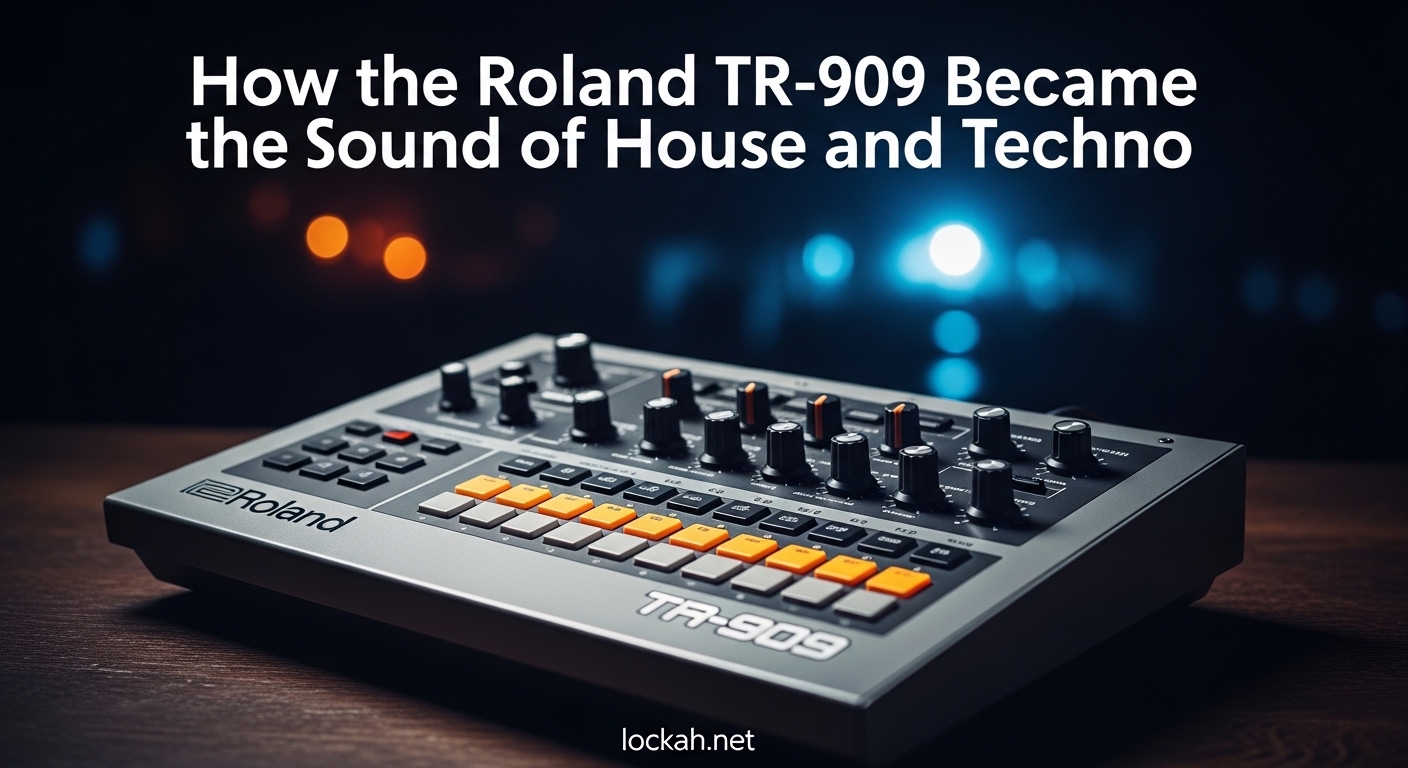
Walk into any club playing house or techno music, and you’ll hear the unmistakable pulse of the Roland TR-909. That punchy kick drum, those crisp hi-hats, the mechanical clap that cuts through the mix – this drum machine has powered more dancefloor anthems than any other piece of equipment in electronic music history. Yet when Roland released the TR-909 in 1983, it was considered a commercial failure, discontinued after just two years with only 10,000 units ever made.
Our team has spent months researching the fascinating story of how this “failed” machine became the backbone of two revolutionary music genres. The journey takes us from Japanese engineering labs to Detroit pawn shops, from Chicago underground clubs to bedrooms around the world where the DIY producer revolution began.
In this guide, I’ll walk you through exactly how the Roland TR-909 became the sound of house and techno music. You’ll learn about the technical innovations that made it unique, meet the pioneers who discovered its potential, and understand why this 40-year-old drum machine still commands thousands of dollars on the used market 2026.
The Failed Machine That Started a Revolution (2026)
The Roland TR-909 Rhythm Composer hit the market in 1983 with a price tag of $1,300. That was serious money in the early 80s, especially for a drum machine that didn’t sound like real drums. Roland designed it as a successor to their popular TR-808, hoping to capture the home musician market with more realistic sounds and advanced features.
The timing couldn’t have been worse. Sample-based drum machines like the LinnDrum were dominating the market, offering recordings of actual acoustic drums rather than synthesized approximations. Professional studios wanted authenticity, not the punchy, artificial sounds the 909 produced. Sales were disappointing, and by 1985, Roland quietly discontinued production.
Only 10,000 units ever left the factory. Most sat in music stores, then pawn shops, then garage sales. The TR-909 seemed destined for the dustbin of music history, another piece of obsolete gear that time forgot.
But something strange happened in the mid-1980s. While mainstream musicians ignored the 909, a new generation of electronic music producers discovered it in secondhand shops across Detroit and Chicago. These weren’t professional studio engineers with big budgets. They were teenagers, college students, and working-class kids who couldn’t afford $5,000 drum machines or studio time.
The 909’s “failure” became its greatest asset. As the units piled up in pawn shops, prices dropped to $50, then $100, then $300. Suddenly, kids who had never touched professional music equipment could own a drum machine. They could take it home, experiment for hours, learn its quirks, and make mistakes without burning through expensive studio time.
This democratization of music production would change everything. The kids buying 909s for pocket change would go on to invent entirely new genres of music.
What Made the TR-909 Technically Revolutionary?
The Roland TR-909 wasn’t just another drum machine. It represented a unique hybrid approach that combined the best of analog and digital technology. Understanding this design helps explain why it sounded so different from everything else on the market.
The 909 used analog circuitry to generate its kick drum, snare, toms, and handclap sounds. These circuits created punchy, aggressive tones with real physical presence. When you hear a 909 kick drum thump through a club sound system, you’re hearing analog circuits generating pure electronic energy.
But Roland took a different approach for the cymbals and hi-hats. These used digital samples played back through 6-bit converters. The crash cymbal, ride cymbal, and open/closed hi-hats were recordings of real instruments, giving them a crisp, metallic quality that cut through mixes. This hybrid approach was revolutionary for 1983.
The 909 was also one of the first drum machines to include MIDI connectivity. This meant it could communicate with other synthesizers and sequencers, syncing perfectly to create complete productions. For electronic music producers building studio setups on limited budgets, this integration was essential.
The built-in 16-step sequencer offered features that encouraged creative programming. The shuffle function added swing and groove to rigid electronic patterns. Individual accent controls let programmers emphasize specific beats. The flam feature created doubling effects on snare hits. These weren’t just technical specs – they were creative tools that shaped how producers thought about rhythm.
Compared to its famous predecessor, the TR-808, the 909 brought a harder, more aggressive character. Where the 808 had a round, booming kick perfect for hip-hop, the 909’s kick was tighter and punchier. The 808’s cymbals were analog and relatively tame; the 909’s digital cymbals sliced through speakers with metallic brilliance. House and techno producers found the 909’s character suited dance music perfectly.
How Detroit Techno Pioneers Discovered the 909?
The story of the TR-909’s rise begins in Belleville, Michigan, a suburban community outside Detroit. Three high school friends – Juan Atkins, Derrick May, and Kevin Saunderson – would become known as the Belleville Three, the founding fathers of techno music. Their discovery of the 909 would shape the sound of electronic music for decades.
In the mid-1980s, Detroit was experiencing economic hardship. The auto industry was declining, and opportunities for young people were scarce. But the city had a thriving radio culture, and Atkins, May, and Saunderson were obsessed with the electronic sounds coming from Europe – Kraftwerk, Yellow Magic Orchestra, Giorgio Moroder.
They started buying cheap synthesizers and drum machines from local pawn shops. Atkins had already been experimenting with the TR-808, creating early tracks that blended electronic rhythms with funk influences. But when the 909 appeared in secondhand stores at bargain prices, everything changed.
Derrick May became particularly associated with the 909. His 1987 track “Strings of Life” (released under the name Rhythim is Rhythim) demonstrated the machine’s potential for creating emotionally powerful dance music. The track combined the 909’s mechanical precision with sweeping strings and soulful piano, proving electronic music could have depth and feeling.
Kevin Saunderson used the 909 to create “Big Fun” and “Good Life” as Inner City, tracks that crossed over from underground clubs to mainstream radio. Juan Atkins continued developing his futuristic sound as Model 500, using the 909’s punchy rhythms to soundtrack his visions of technological utopias and dystopias.
But perhaps no one pushed the 909 further than Jeff Mills. As a member of Underground Resistance and later as a solo artist, Mills transformed the drum machine into a live performance instrument. Watching Mills perform with a 909 is like watching a virtuoso pianist – his hands fly across the controls, manipulating patterns in real-time, creating rhythms that seem impossible to program.
Mills would tune the 909’s kick drum to different pitches, creating melodic basslines from a drum sound. He’d layer patterns, switch between them mid-song, and use the accent controls to create dynamic variations. His 1994 mix album “Live at the Liquid Room, Tokyo” remains a masterclass in 909 performance, showing how the machine could be played like an instrument rather than simply programmed.
The affordability of secondhand 909s was crucial to Detroit’s scene. As producer Tyree Cooper once noted, “We were broke kids making music in our bedrooms. The 909 was the only professional equipment we could afford.” That economic reality shaped techno’s sound and its DIY ethos.
The Chicago House Connection
While Detroit was developing techno, Chicago was simultaneously inventing house music. The two cities are only a few hours apart by car, and artists traveled between them constantly, sharing ideas, equipment, and inspiration. The TR-909 became the common thread connecting both scenes.
According to legend, Derrick May brought a TR-909 to Chicago and either gave it to or sold it to Frankie Knuckles, the godfather of house music. Knuckles was already legendary for his residency at the Warehouse (the club that gave house music its name), where he blended disco, soul, and European electronic music into marathon DJ sets.
Knuckles began using the 909 differently than his Detroit counterparts. Where techno producers emphasized the machine’s mechanical, futuristic qualities, house producers sought warmth and groove. They’d tune the kick drum way down, creating sub-bass frequencies that could be felt physically on club dancefloors. The signature Chicago house kick – that deep, throbbing pulse – came from manipulating the 909’s analog circuits.
House producers also made heavy use of the 909’s hi-hats and ride cymbals. The digital samples provided the crisp, sustained high frequencies that kept dancers moving. Combined with the tuned kick, these elements formed the classic “four-on-the-floor” beat that defines house music – kick on every beat, hi-hats keeping time, claps or snares on the backbeats.
Chicago’s house sound spread through a network of local clubs, then to New York, London, and eventually the world. Tracks like Marshall Jefferson’s “Move Your Body” and Mr. Fingers’ “Can You Feel It” used the 909 as their rhythmic foundation. The machine’s affordability meant bedroom producers across Chicago’s South and West sides could create tracks that competed with major label releases.
The cross-pollination between Detroit and Chicago was constant. Producers from both cities played each other’s records, shared techniques, and developed the 909’s potential in different directions. This creative exchange created the foundations of modern electronic dance music.
How the 909 Changed Music Culture Forever?
The TR-909’s impact extended far beyond specific tracks or artists. It fundamentally changed how music was made and who could make it. Before the 909 and similar affordable drum machines, electronic music production was the domain of professional studios and wealthy artists.
The 909’s secondhand affordability created the “bedroom producer” phenomenon. Teenagers could buy a 909, a cheap synthesizer, and a mixer for under $1,000 total. They could work at home, experimenting for hours without paying for studio time. Mistakes became part of the learning process rather than expensive problems.
This DIY ethos transformed electronic music culture. Producers didn’t need record deals, management, or studio musicians. They could create complete tracks alone, then press their own vinyl or release tapes through underground networks. The democratization of production tools meant electronic music could develop outside the traditional music industry.
The 909 also influenced how people thought about drum sounds. Before its adoption in dance music, producers tried to make drum machines sound like real drums. House and techno producers embraced the artificiality. The 909 didn’t sound like a real drummer because it wasn’t supposed to. It sounded like the future.
By the early 1990s, the 909’s sound had spread globally. Berlin’s techno scene, Manchester’s rave culture, London’s hardcore continuum – all relied heavily on 909 sounds. Even as digital samplers and computer sequencers became available, producers continued seeking that specific 909 character. The sound had become synonymous with dance music itself.
The limited number of original units (remember, only 10,000 made) created a scarcity that increased their mystique. As demand grew through the 90s and 2000s, prices rose from pawn shop bargains to serious investments. The 909 had transformed from failed consumer product to cultural artifact.
Why the TR-909 Still Matters Today?
Forty years after its release, the Roland TR-909 remains relevant in 2026. Original units now sell for $3,000 to $5,000 or more, depending on condition and modifications. That’s nearly four times its original price, and a world away from the $50 deals early Detroit producers found.
The high prices reflect both scarcity and enduring demand. Top producers still seek original 909s for their studios. The analog circuits have aged in ways that affect their sound – some argue vintage units sound better than they did new. The physical interface, with its iconic grid of buttons and knobs, offers a hands-on experience that software can’t replicate.
Roland recognized this continuing interest and has released several modern alternatives. The TR-8S combines 909 sounds with modern sequencing and effects. The TR-09 (part of the Boutique series) offers a compact, affordable hardware version. Roland Cloud provides software emulations for DAW users. Various clone manufacturers like Behringer (RD-9) and numerous modular options have emerged.
Yet the original maintains its mystique. Forum discussions reveal that producers still debate whether software emulations capture the “magic” of the analog circuits. Users describe the original 909’s punch on professional sound systems as “stellar” and “unmatched.” The kick drum, in particular, maintains its reputation as the perfect dance music foundation.
Roland now celebrates the 909’s legacy through “909 Day” – September 9th (9/09) – when they announce new products and celebrate the drum machine’s history. It’s a remarkable transformation for a product that was discontinued as a failure after just two years.
The 909’s story reminds us that commercial success and cultural impact aren’t the same thing. This “failed” drum machine shaped music history more than most successful products ever will. Its punchy kick still drives dancefloors worldwide, a testament to the vision of its creators and the creativity of the pioneers who saw potential where others saw failure.
Frequently Asked Questions
What is the Roland TR-909?
The Roland TR-909 is a hybrid analog/digital drum machine released in 1983. It uses analog synthesis to create kick, snare, and tom sounds while using digital samples for cymbals and hi-hats. It was one of the first drum machines with MIDI connectivity and became the foundation of house and techno music despite only 10,000 units being manufactured.
What’s the difference between the TR-808 and TR-909?
The TR-808 was all-analog with a rounder, deeper kick drum favored in hip-hop and electro. The TR-909 added MIDI connectivity, used digital samples for cymbals and hi-hats, and had a punchier, tighter kick drum better suited for dance music. The 909’s hybrid design and harder sound made it perfect for house and techno production.
How did the TR-909 influence house music?
The TR-909 became central to Chicago house music when Derrick May introduced it to Frankie Knuckles. House producers used the 909’s punchy kick drum and crisp hi-hats to create the genre’s signature four-on-the-floor rhythm, often tuning the kick down to create sub-bass frequencies that could be felt on club sound systems.
Why is the TR-909 important for techno?
The TR-909 defined Detroit techno’s sound through pioneers like Juan Atkins, Derrick May, and Kevin Saunderson. Its mechanical clap, punchy kick, and metallic hi-hats created the futuristic aesthetic techno sought. Jeff Mills later elevated the 909 to a live performance instrument, manipulating it in real-time to create unique rhythms.
When was the TR-909 released?
The Roland TR-909 was released in 1983 and discontinued by 1985, with only 10,000 units manufactured during its brief production run.
Why did the TR-909 fail commercially?
The TR-909 failed commercially because it cost $1,300 in 1983 while competing with sample-based drum machines that sounded more like real drums. The market wasn’t ready for synthesized drum sounds, leading to poor sales and discontinuation after only two years.
How much is a TR-909 worth today?
Original TR-909 units now sell for $3,000-$5,000 or more depending on condition, up from their original $1,300 price and the $50-$300 prices producers paid in pawn shops during the late 1980s.
Conclusion
The story of how the Roland TR-909 became the sound of house and techno is ultimately a story about creative vision overcoming commercial limitations. This drum machine failed by every traditional metric – poor sales, early discontinuation, limited production. Yet it succeeded in ways that matter far more, becoming the foundation of entire music genres and a cultural touchstone that still resonates 2026.
The pioneers who discovered the 909 in pawn shops saw something Roland’s engineers never intended. They heard potential where others heard artificiality. They transformed a consumer product into an instrument, then into a movement. Juan Atkins, Derrick May, Kevin Saunderson, Frankie Knuckles, Jeff Mills – these artists didn’t just use the 909. They unlocked its soul.
Today, whether you’re listening to classic Detroit techno, modern house music, or the latest electronic releases, you’re hearing the TR-909’s influence. Its punchy kick, crisp hi-hats, and mechanical clap remain the DNA of dance music. The “failed” machine that only sold 10,000 units became the most important drum machine in history. Some failures are more successful than success.