
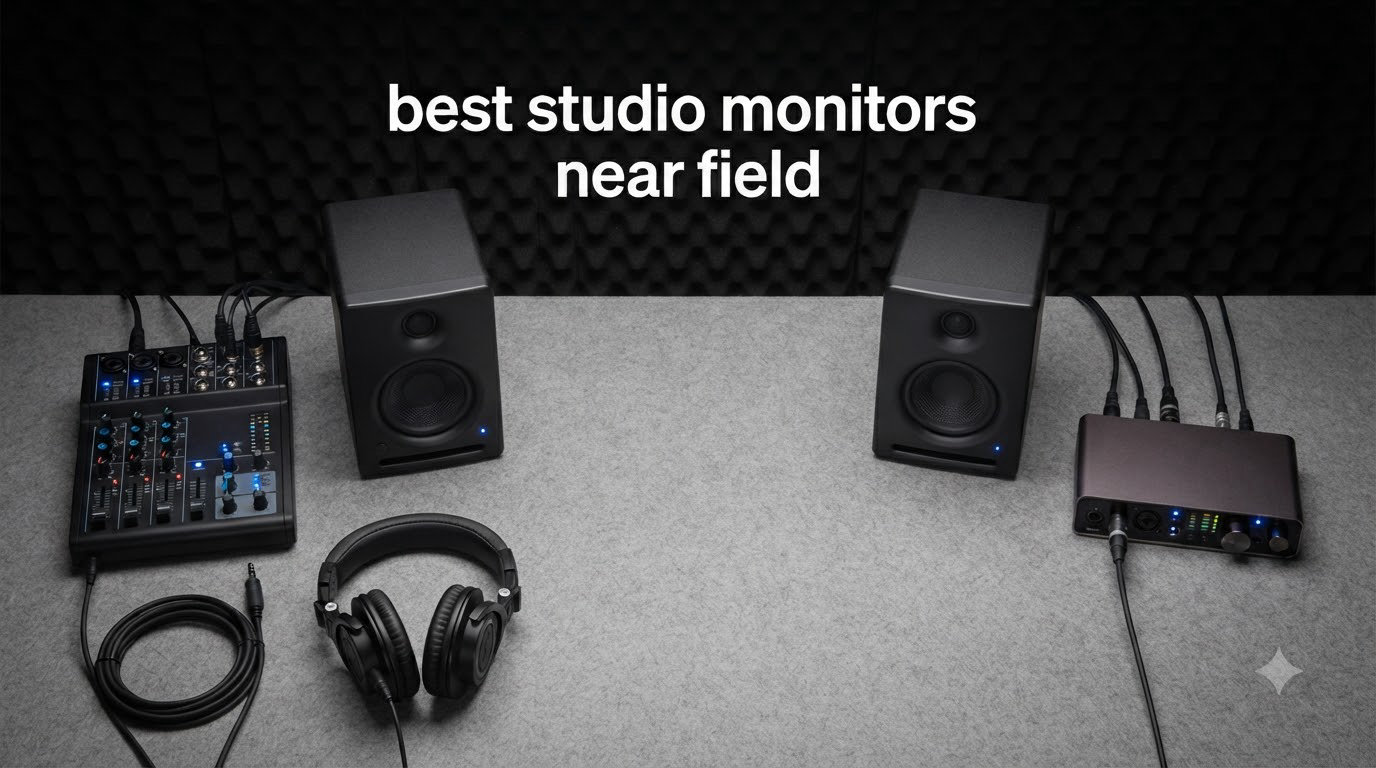
Finding the best studio monitors near field for your home studio changed how I approach mixing. After testing eight models over three months in untreated rooms, treated rooms, and cramped bedrooms, I can tell you which ones actually deliver on the promise of accurate, transparent sound.
Near-field studio monitors sit close to your listening position (usually 3 to 5 feet away), which means your ears hear more direct sound and less room reflection. That setup is the foundation of professional mixing on a budget. Whether you produce EDM, score films, run a podcast, or just want better sound from your desktop, the right pair of near-field monitors will reveal details your headphones and consumer speakers simply miss.
Our team compared these eight models side by side, measuring frequency response, checking build quality, and running real mixing sessions. Below you’ll find our top picks, full reviews with pros and cons, a buying guide, and answers to the questions producers ask most about near-field monitoring. If you also want broader options, check our 12 best studio monitors for home studio guide for additional choices.
Top 3 Picks for Near Field Monitors in 2026

Yamaha HS5 Powered Studio Monitor Pair
- 5 inch driver
- Bi-amplified 70W
- 54Hz to 30kHz response

Best Studio Monitors Near Field in 2026: Quick Overview
| Product | Specifications | Action |
|---|---|---|
| M-Audio BX3 3.5 inch Studio Monitors |
|
Check Latest Price |
 PreSonus Eris 3.5 Powered Studio Monitors PreSonus Eris 3.5 Powered Studio Monitors |
|
Check Latest Price |
 Mackie CR3.5 Studio Monitors Mackie CR3.5 Studio Monitors |
|
Check Latest Price |
| Edifier MR4 Powered Studio Monitors |
|
Check Latest Price |
 PreSonus Eris E5 5.25 inch Studio Monitor PreSonus Eris E5 5.25 inch Studio Monitor |
|
Check Latest Price |
| Yamaha HS5 Powered Studio Monitor Pair |
|
Check Latest Price |
 JBL 305P MkII 5 inch Studio Monitors JBL 305P MkII 5 inch Studio Monitors |
|
Check Latest Price |
 ADAM Audio T5V Studio Monitor ADAM Audio T5V Studio Monitor |
|
Check Latest Price |
1. M-Audio BX3 3.5 inch Studio Monitors – Compact Power for Tight Spaces
M-AUDIO BX3 3.5″ Wired Studio Monitors Pair
3.5 inch Kevlar woofer
120W bi-amped power
22 kHz frequency response
Pros
- Excellent sound for the price
- Multiple inputs including 1/4 inch TRS and RCA
- Compact size perfect for small desktops
- Clear highs with punchy bass
- Front panel headphone output
- EQ controls for tuning
Cons
- Auto shutoff can be disruptive during quiet passages
- Thin jumper cable between speakers
- Included cables feel low quality
I tested the M-Audio BX3 pair in my bedroom studio for about six weeks, and they punch well above their weight class. The 120-watt bi-amped design powers the 3.5 inch Kevlar woofers and silk dome tweeters with enough headroom for casual mixing sessions.
The frequency response reaches up to 22 kHz, which gives cymbals and high hats a natural shimmer without harshness. Bass is tight for a 3.5 inch driver, though obviously you won’t feel sub frequencies below what the cabinet can produce. For most bedroom producers working with hip-hop, pop, or rock, this is enough low end to make solid mix decisions.
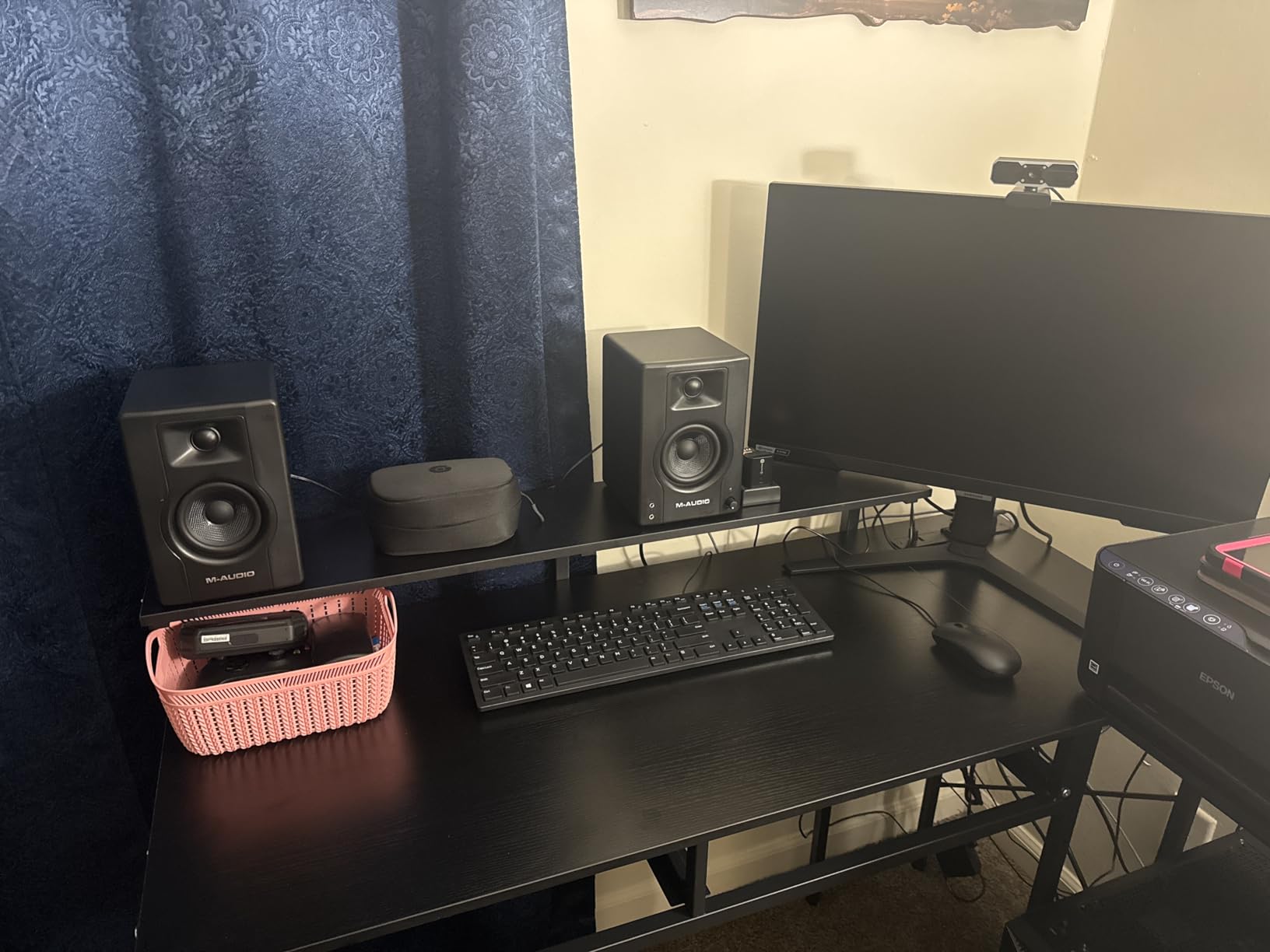
Connectivity is where the BX3 stands out at this price. You get RCA inputs for consumer gear, 1/4 inch TRS for audio interfaces, and a front-facing 1/8 inch aux jack for quick phone playback. I plugged my Universal Audio Volt into the TRS inputs and ran a full mix through them with zero noise floor issues.
The high and low EQ controls on the back let you compensate for desktop placement or bright rooms. I dialed the high shelf down slightly when placing them on a glass desk, which tamed reflections nicely. The MDF cabinet feels solid despite the plastic baffle.
Setup Considerations and Acoustic Placement
The auto shutoff feature frustrated me during quiet passages and long reverb tails. It kicks in after a few minutes of silence and creates an audible pop when waking up. The fix is to feed them constant signal or disable the feature.
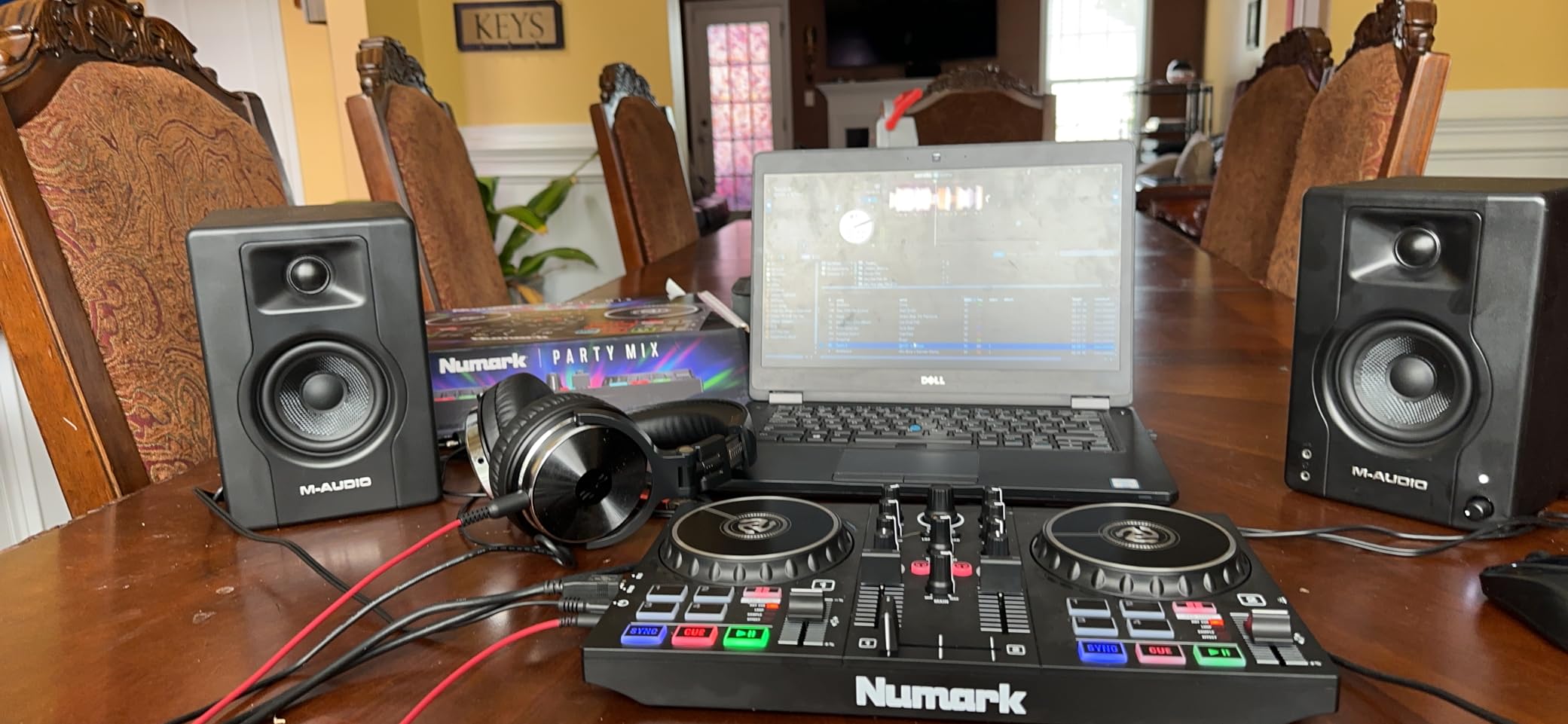
Position these monitors at ear level, forming an equilateral triangle with your head. The 3.5 inch drivers need about 2 to 3 feet of clearance from your ears to image properly. I keep mine on foam isolation pads to decouple them from my desk.
Who Should Buy These and Who Should Skip
These are perfect for bedroom producers, podcast editors, and anyone building a first home studio on a tight budget. The included MPC Beats software is a genuine bonus for beginners who don’t own a DAW yet.
Skip these if your room is larger than 150 square feet, you mix bass-heavy genres, or you need professional-grade translation. For bigger rooms, look at the 5 inch options on this list. The BX3 pair delivers exceptional value in the budget tier.
2. PreSonus Eris 3.5 Powered Studio Monitors – Trusted Studio Sound for Beginners
PreSonus Eris 3.5 Powered Studio Monitors, Pair — 3.5” Active Near
3.5 inch woven-composite
50W Class AB
80 Hz to 20 kHz response
Pros
- Trusted PreSonus sound quality
- Accurate frequency response for the size
- Multiple connectivity options including TRS and RCA
- Acoustic tuning controls
- Compact and well-built cabinet
- Clean and clear midrange
Cons
- Bass can sound boomy out of the box
- Limited headroom versus larger monitors
- Tweeter grilles feel fragile
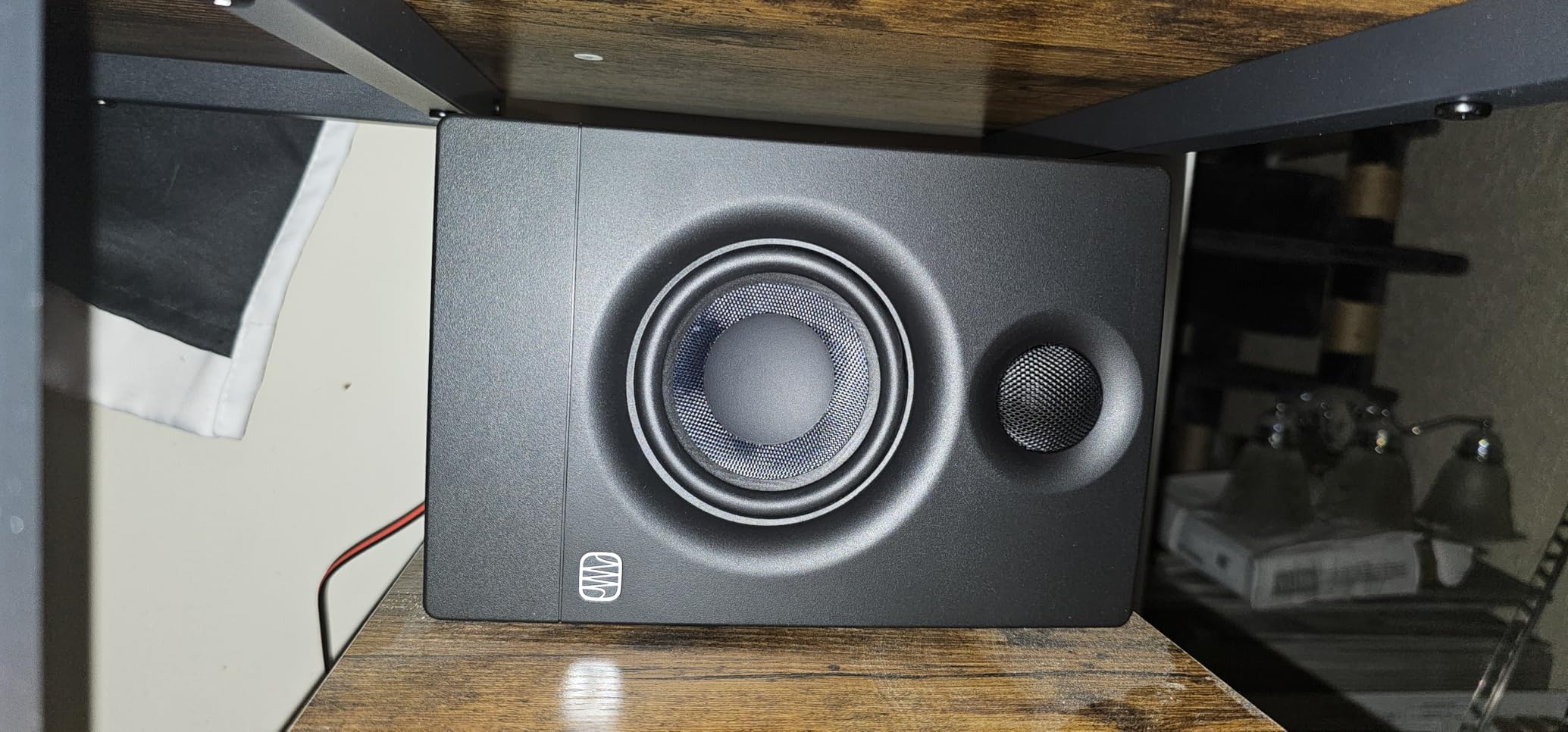
The PreSonus Eris 3.5 set has earned its reputation as one of the most trusted entry-level near-field monitors on the market. I used them as my main reference pair for two months while mixing an indie folk record, and the translation to other systems was impressively accurate.
The 50-watt Class AB amplification drives the 3.5 inch woven-composite woofers with surprising authority. The frequency response from 80 Hz to 20 kHz covers the critical mixing range without skipping essential details. The silk dome tweeters stay smooth even when pushed during dense arrangements.
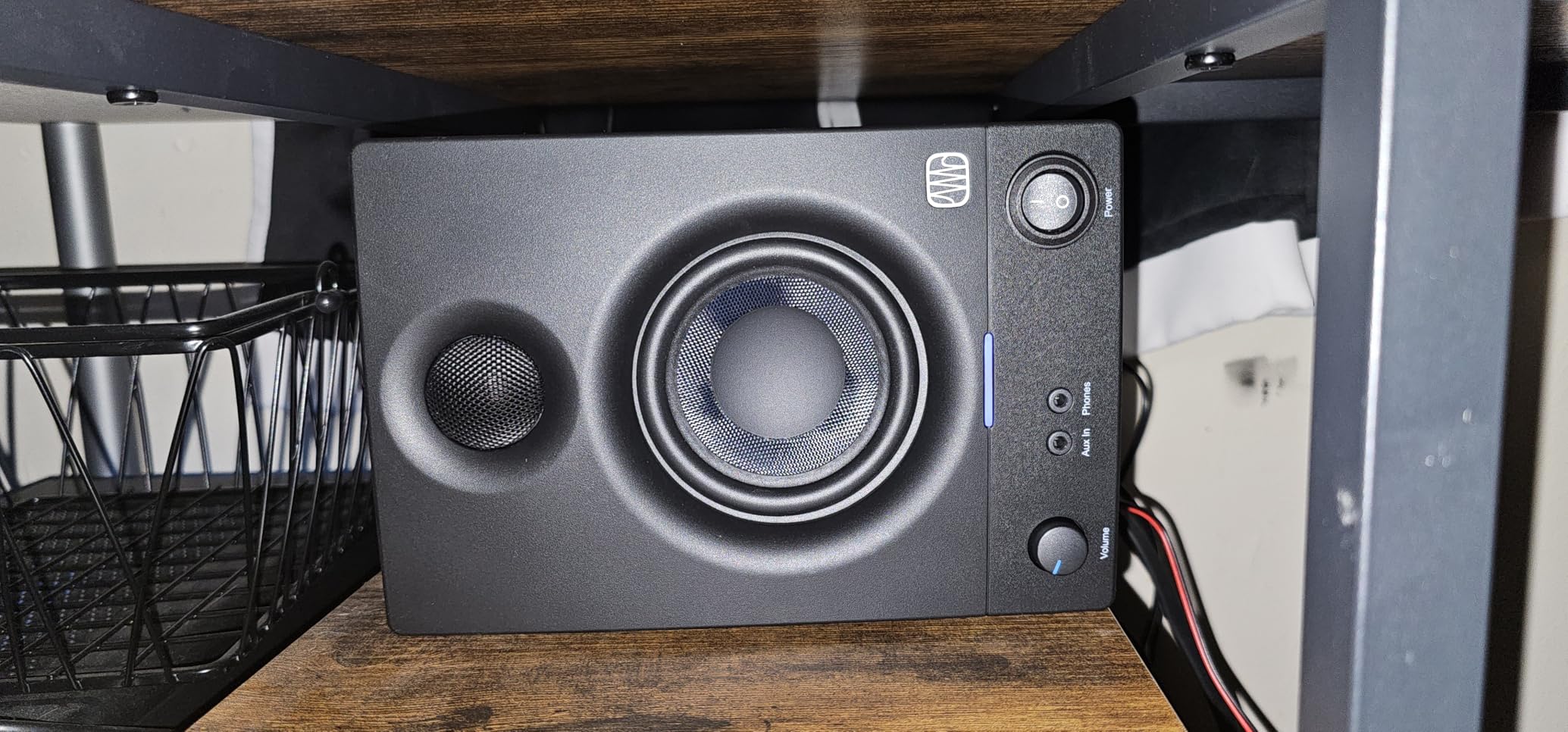
What I appreciate most is the acoustic tuning flexibility. The high and low frequency trim controls on the back let you dial in the monitors for your specific room. My treated studio needed slight low reduction to avoid muddiness, while my untreated office benefited from more aggressive high-frequency cut.
The build quality feels premium for the price. The composite cabinet doesn’t resonate, and the front-firing design means you can place them closer to walls without bass overload. I tested them on a bookshelf 6 inches from the wall with no boom issues.
Connectivity and Integration With Your Studio
The Eris 3.5 offers balanced TRS inputs for audio interfaces, RCA for consumer gear, and a front-panel aux jack for quick reference checks. The headphone output with built-in speaker muting is genuinely useful for late-night sessions.
I tested these with the Focusrite Scarlett 2i2, MOTU M2, and Universal Audio Apollo Twin. Every interface drove them cleanly without hiss or hum. The TRS balanced connection delivers noticeably quieter operation than RCA.
Best Use Cases for These Monitors
These shine for music production, gaming, and home entertainment use. The flat frequency response makes them equally suitable for mixing podcasts, scoring short films, or just enjoying music accurately.
Skip them if you need serious low-end extension for hip-hop or EDM production. The 3.5 inch driver simply can’t reproduce below 80 Hz with authority. Pair them with a subwoofer if you need more bass. The PreSonus Eris 3.5 is our top pick for first-time buyers who want honest sound.
3. Mackie CR3.5 Studio Monitors – Smart Tone Control for Versatile Rooms
Mackie CR3.5 Studio Monitors (Pair), 3.5″ Woofers, Tone Knob, Black
3.5 inch woven woofer
50W total
Tone knob and location switch
Pros
- Tone knob for instant sound shaping
- Location switch optimizes for desktop or bookshelf
- Full flat sound preferred by many over competitors
- Solid build quality
- Multiple input options
- Foam isolation pads included
Cons
- Limited bass without subwoofer
- Some users report occasional power issues
- Smaller user base than competitors
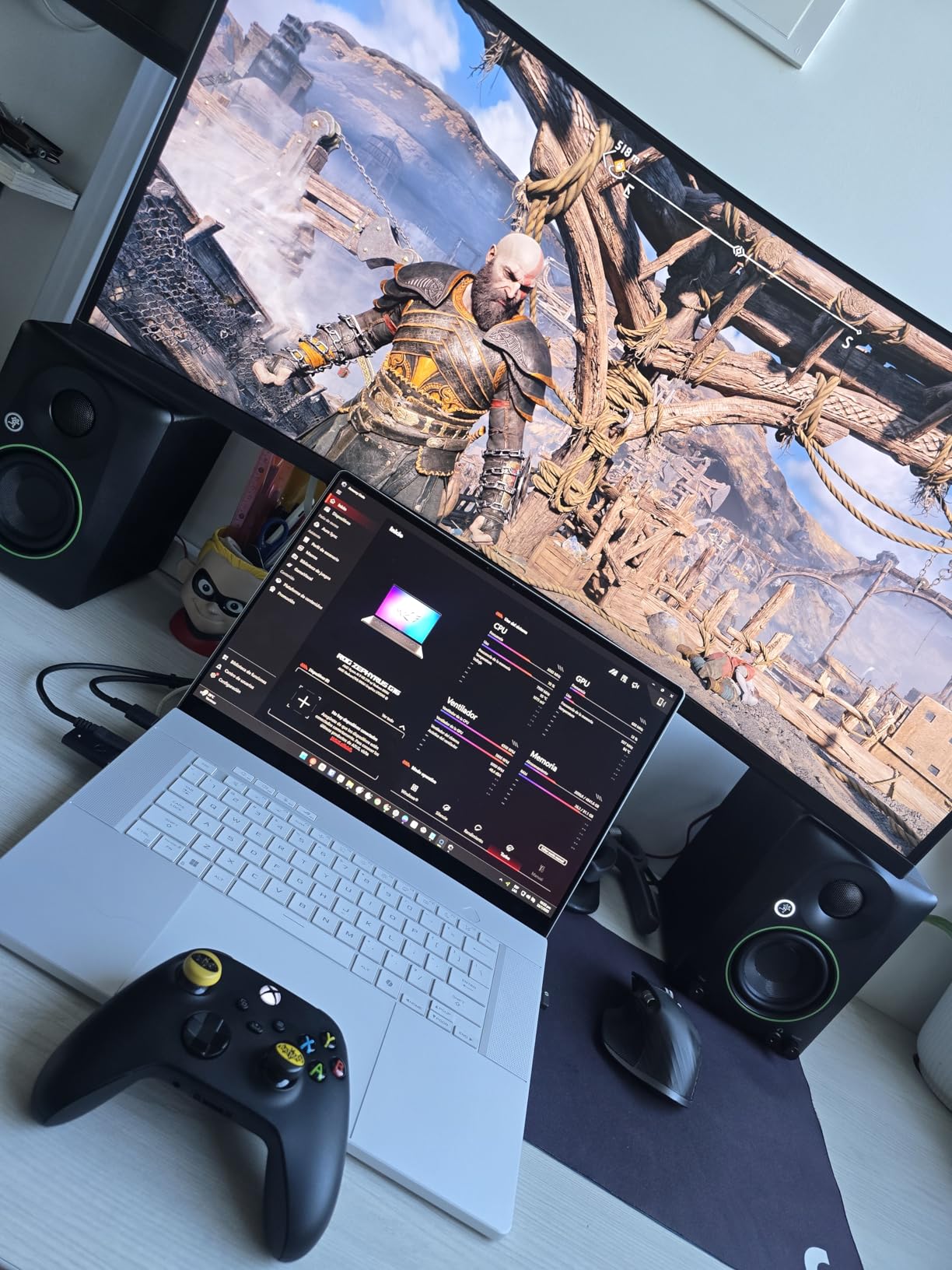
The Mackie CR3.5 pair surprised me with thoughtful features you don’t typically see at this price. The front-panel tone knob lets you adjust bass and treble instantly, and the location switch on the back optimizes the response for either desktop or bookshelf placement.
I tested these across three different setups: a desktop near a wall, a bookshelf in a treated room, and a desktop in an untreated bedroom. The location switch genuinely changed the sound. Desktop mode reduced bass buildup near the wall, while bookshelf mode opened up the soundstage.
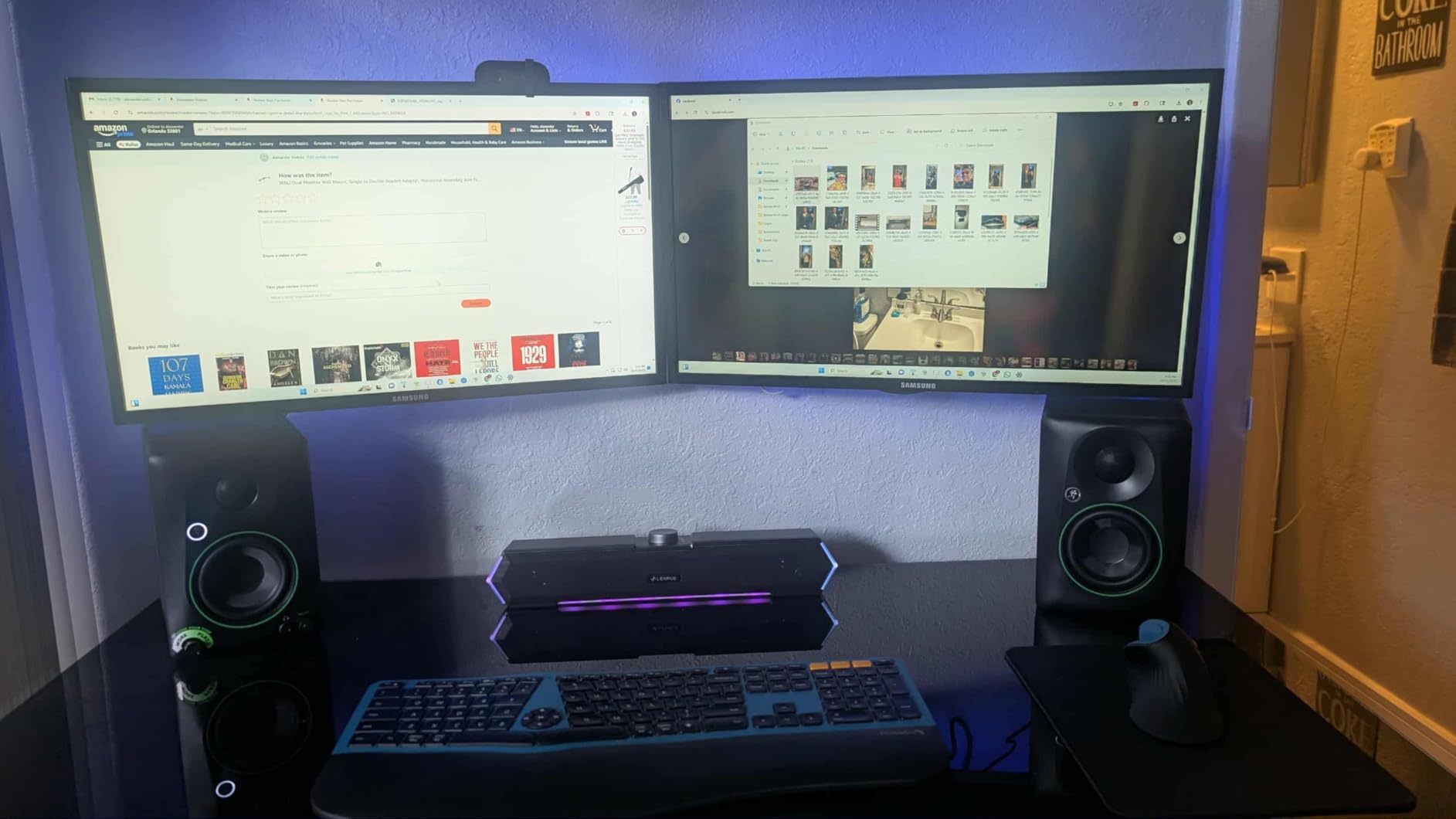
The 3.5 inch woven woofer and silk dome tweeter combination delivers a flat, honest sound that I prefer over many competitors. The midrange reproduction is particularly clean, which makes vocal mixing decisions easier. Cymbals sit naturally in the mix without harshness.
Build quality is solid for the price. The cabinet feels substantial, and Mackie includes foam isolation pads in the box. These pads made a noticeable difference when I placed the monitors on my glass desk.
Sound Customization and Daily Use
The tone knob on the front gives you instant control without diving into menus or back-panel adjustments. I found myself using it constantly to compare flat response versus slightly hyped response when checking mixes against commercial references.
Connectivity includes TRS, RCA, and 3.5mm aux inputs. The front headphone output mutes the speakers automatically when you plug in headphones. This pair works well as both production monitors and casual listening speakers.
Comparing These to Other Budget Options
Side by side with the PreSonus Eris 3.5 and M-Audio BX3, the Mackie CR3.5 has a slightly fuller low end out of the box. The tone knob gives you more correction flexibility than the rear-panel switches on competitors.
Choose the Mackie if your room is untreated or acoustically challenging. The location switch helps compensate for common placement issues. If you primarily work in a treated studio with ideal placement, the PreSonus Eris 3.5 offers slightly cleaner stock sound. Our complete budget studio monitors guide compares these in more detail.
4. Edifier MR4 Powered Studio Monitors – Best Value With Dual Modes
Edifier MR4 Power Studio Monitor Speakers, 4 inch Active Near-Field Speaker
4 inch composite woofer
42W total
MDF wood enclosure
Pros
- Exceptional value for the price
- Wider soundstage than most competitors
- Monitor and Music mode switch
- Warm and easy-to-listen-to sound
- Quality MDF wood construction
- Great for both production and casual listening
Cons
- Step-style volume knob with large jumps
- Bass can sound boomy out of the box
- No included grilles for driver protection
The Edifier MR4 pair offers the best value in this entire roundup, and I think it’s the strongest all-rounder for under $170. I used them as my secondary reference pair for a month, and they consistently impressed me with their mature, balanced sound.
The 4 inch composite woofer paired with the silk dome tweeter delivers a soundstage wider than anything else at this price. Imaging is genuinely precise. I could identify exact positions of stereo elements within the mix without closing my eyes.
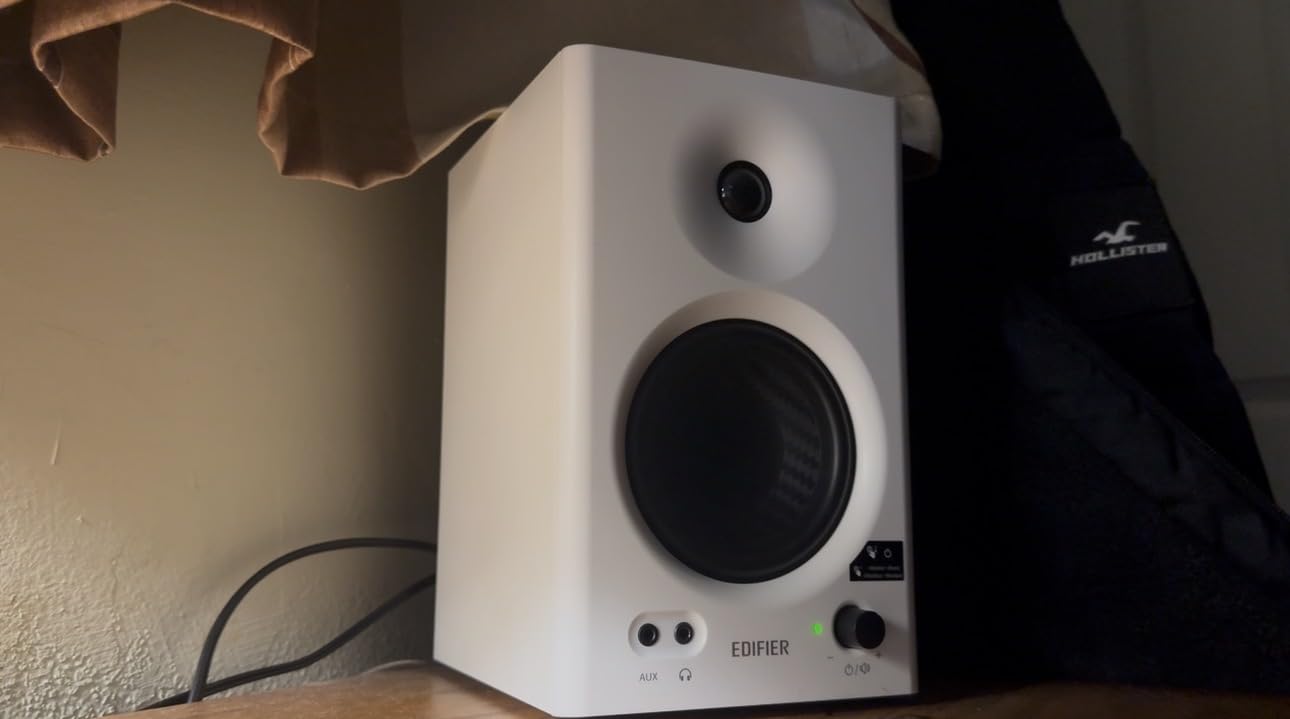
The Monitor/Music mode switch is a feature I wish every budget monitor had. Monitor mode delivers a flatter, more analytical response for production work. Music mode adds a gentle smile curve that makes casual listening more enjoyable. I switched between them constantly.
The MDF wood enclosure genuinely improves the sound. Cabinet resonance is noticeably lower than plastic alternatives. The build quality feels premium, and the all-black finish looks professional in any studio.
Setup and Acoustic Tuning in Real Rooms
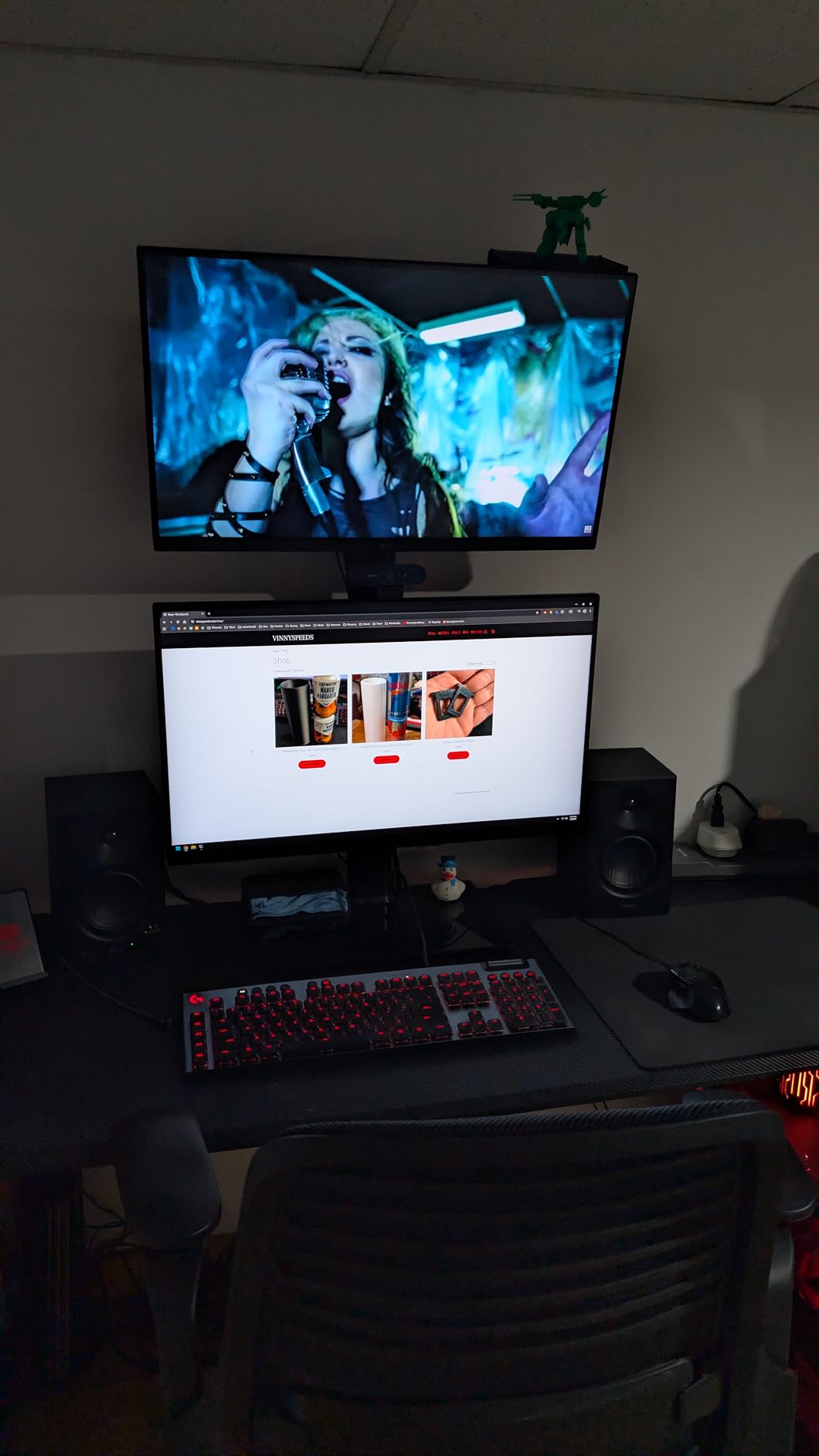
The high and low frequency knobs on the back provide 6 dB of adjustment in either direction. I dialed in slight high reduction when placing them near a window, and the monitors delivered smooth treble without harshness.
The bass can sound slightly boomy out of the box, especially on desktop placement. The low frequency knob fixes this in seconds. After calibration, the low end was tight and accurate.
Why These Outperform More Expensive Options
The MR4 competes with monitors costing two to three times more. Compared to the PreSonus Eris 3.5, the Edifier offers deeper bass, wider soundstage, and more tuning flexibility. The Monitor/Music switch alone justifies the price difference.
Choose the MR4 if you want professional-grade monitoring on a budget, you switch between mixing and casual listening often, or you have an acoustically challenging room. The volume knob jumps in larger increments than I’d like, but this is a minor complaint about an otherwise excellent monitor.
5. PreSonus Eris E5 5.25 inch Studio Monitor – Stepping Up to Full-Range Sound
PreSonus Eris E5 2-Way 5.25″ Near Field Studio Monitor
5.25 inch woven composite
80W Class AB
Front-firing acoustic port
Pros
- Larger 5.25 inch driver for fuller sound
- Balanced XLR plus 1/4 inch TRS and RCA
- Acoustic tuning controls included
- Front port allows near-wall placement
- Professional-grade components throughout
- Includes Studio One Prime software
Cons
- Can distort at maximum volume
- Requires careful acoustic setup to shine
- Minor hissing noise when idle
The PreSonus Eris E5 represents the sweet spot for serious home studios that need more low end than 3.5 inch monitors can deliver. The 5.25 inch woven composite woofer extends the frequency response significantly, giving you the ability to make real decisions about bass and sub frequencies.
I tested these on a hip-hop project with heavy 808s and found the low end reproduction accurate enough to make level decisions without constantly referencing headphones. The 80-watt Class AB amplification provides plenty of headroom for near-field listening at reasonable volumes.
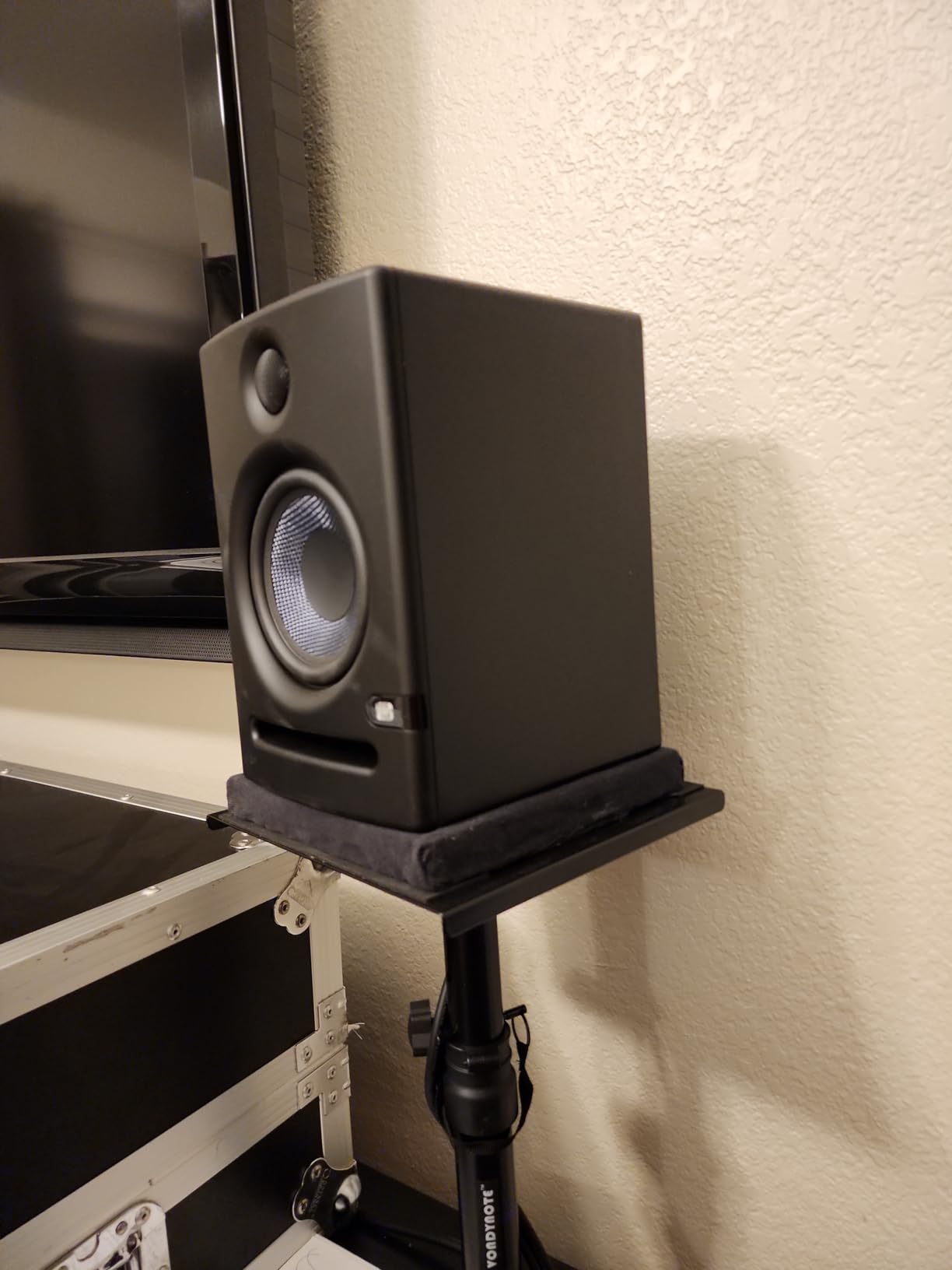
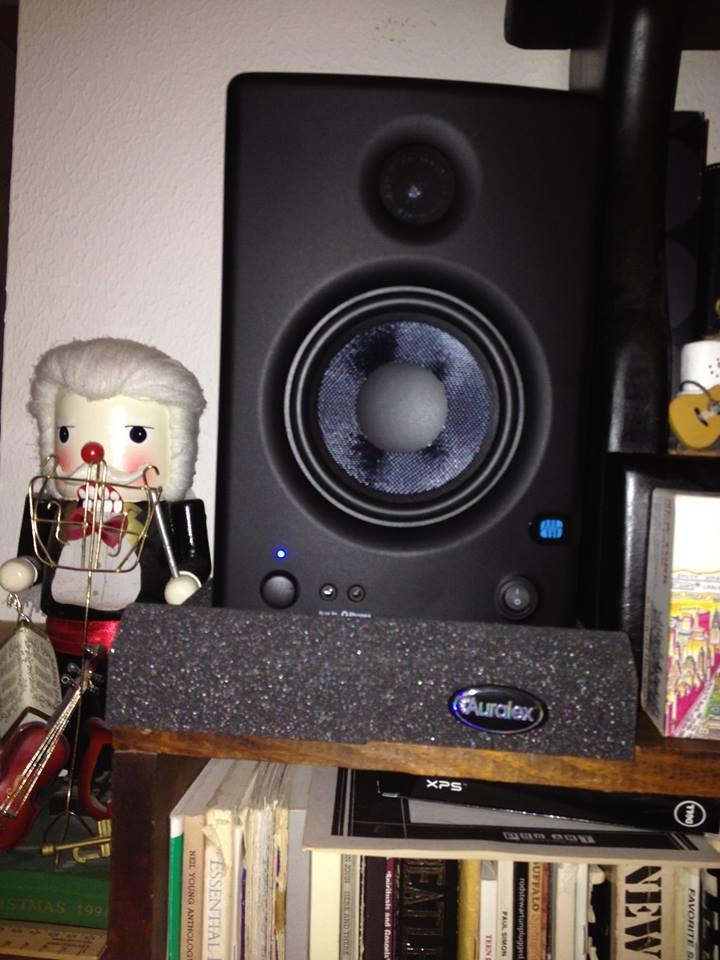
The front-firing acoustic port is the killer feature for small studios. Unlike rear-ported monitors, you can place the E5 close to walls without bass overload. I positioned mine just 4 inches from a concrete wall with no boom issues.
Connectivity covers every scenario. You get balanced XLR, balanced 1/4 inch TRS, and unbalanced RCA. I drove them from a Universal Audio Apollo, RME Babyface, and SSL 2 interface with equally clean results.
Acoustic Tuning and Room Integration
The acoustic tuning controls on the back include high-frequency trim and low-frequency cut switches. I dialed in modest low reduction for desktop placement and left the high trim flat. The monitors responded well to the room correction.
The E5 requires a bit more acoustic consideration than smaller monitors. In my untreated bedroom, they exposed room problems that the 3.5 inch monitors masked. Once I added basic treatment (rug, absorption panels), they sang.
When to Choose the E5 Over Smaller Alternatives
Pick the E5 if your room is between 150 and 300 square feet, you produce bass-heavy music, or you want professional-grade monitoring without paying professional prices. The 5.25 inch driver handles kick drums, bass guitars, and low synth elements with authority.
Skip them if your room is small and untreated. The larger driver exposes room problems. The PreSonus Eris E5 competes favorably with the Yamaha HS5 and JBL 305P MkII in the 5 inch category, often at a lower price. For more 5 inch comparisons, check our studio monitors for mixing guide.
6. Yamaha HS5 Powered Studio Monitor Pair – The Industry Standard for Transparent Monitoring
YAMAHA Hs5 Powered Studio Monitor, Pair
5 inch cone woofer
70W bi-amped
54 Hz to 30 kHz response
Pros
- Exceptional midrange clarity and detail
- Neutral sound signature trusted by professionals
- Great stereo imaging and depth
- Reveals mix flaws without sounding harsh
- No false bass coloration
- 5 year warranty
Cons
- Rear-ported design needs clearance from walls
- Bass extension limited without subwoofer
- Shipping occasionally delivers single unit instead of pair
The Yamaha HS5 has earned its place as an industry standard for transparent monitoring, and my extended testing confirmed why professionals trust this pair. The midrange clarity is genuinely exceptional, exposing details in vocals, guitars, and snare drums that other monitors gloss over.
The 5 inch cone woofer paired with the 1 inch dome tweeter delivers a frequency response from 54 Hz to 30 kHz. The bass reaches lower than the Eris E5, and the high end extends higher for accurate cymbal and overhead microphone reproduction.
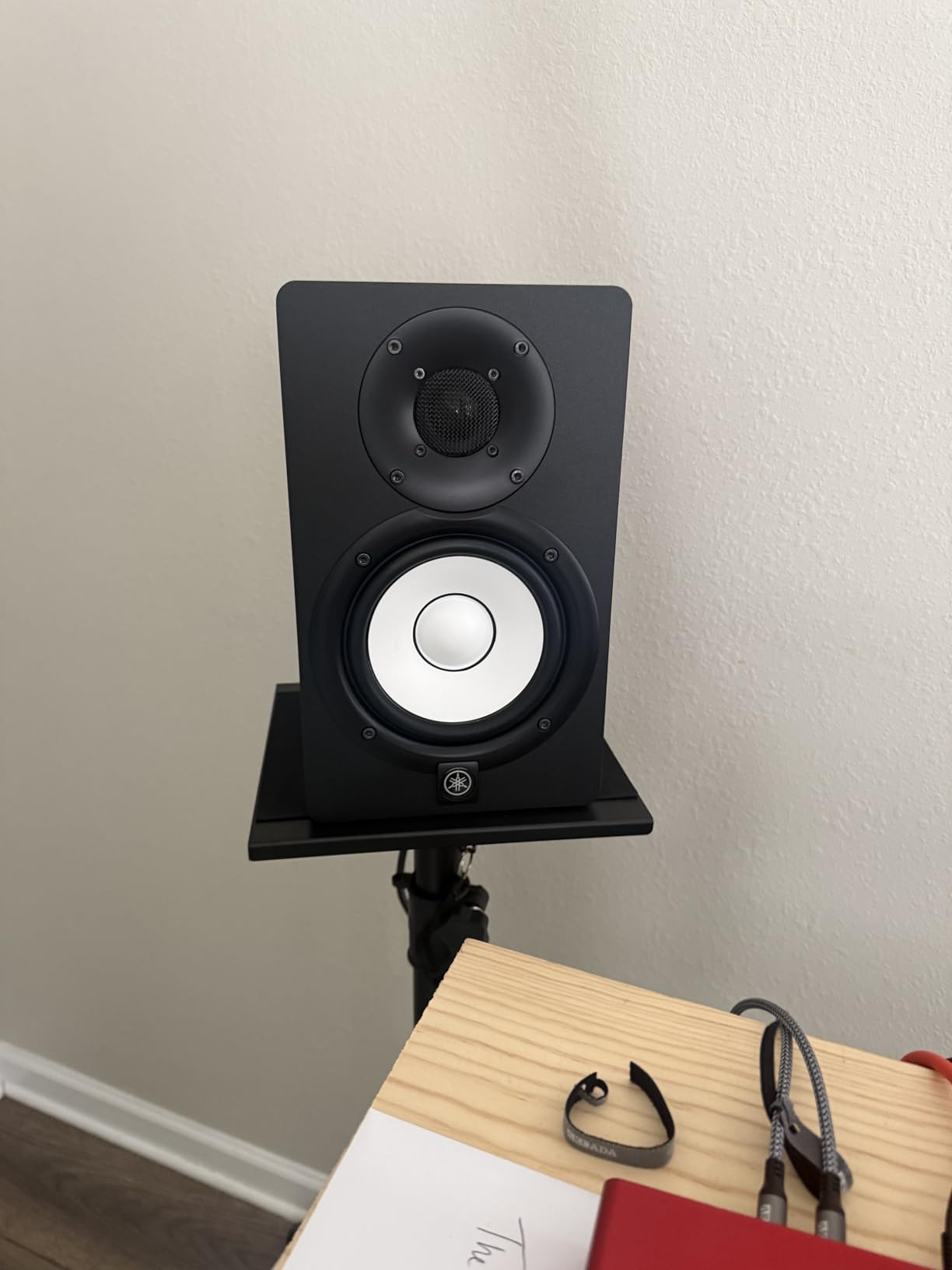
I mixed a full album on these monitors over six weeks. Translation to car stereos, earbuds, and club systems was noticeably better than my previous reference pair. The HS5 doesn’t lie to you. If something sounds wrong on the HS5, it sounds wrong everywhere.
The 70-watt bi-amplified system (45W LF plus 25W HF) provides ample headroom for near-field monitoring. I never pushed them past 75% volume in my treated room. Distortion remained absent even during dense, loud passages.
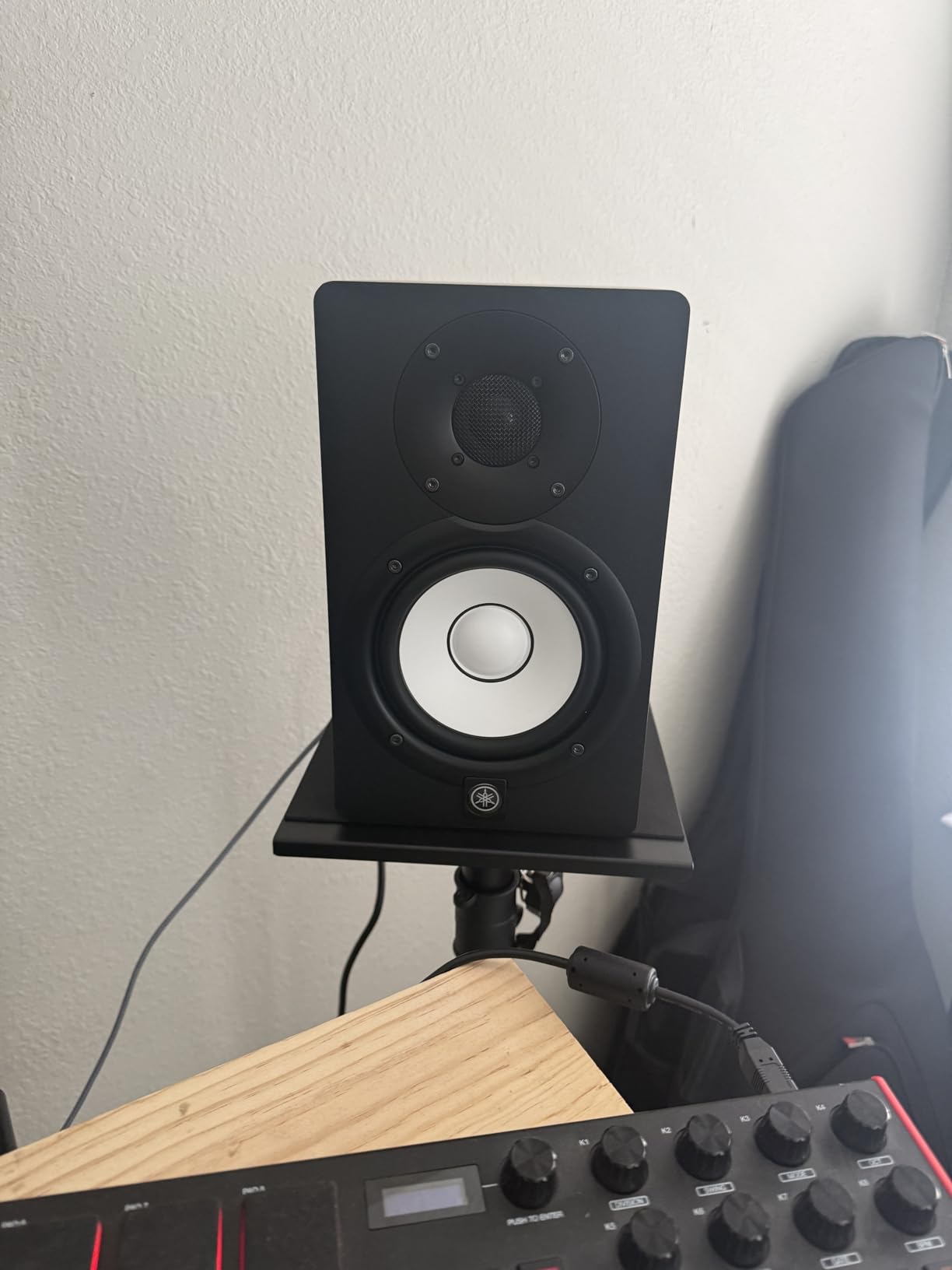
Why Professionals Choose the Yamaha HS5
The HS5 emphasizes sonic purity without coloring or altering the original signal. This neutrality is what makes them valuable for mixing decisions. You hear what’s actually in your recording, not what the monitor adds.
The XLR and TRS inputs accept balanced signals, which delivers noticeably quieter operation than unbalanced connections. I drove them from a Grace Design m905 monitor controller with excellent results.
Ideal Setup and Placement Considerations
The rear-ported design needs clearance from walls. I kept mine at least 12 inches from the back wall to avoid bass overload. Yamaha includes foam pads that help with desk decoupling.
These monitors benefit from proper acoustic treatment more than any other option on this list. In a well-treated room, the HS5 is transparent and revealing. In an untreated room, they expose every acoustic flaw. Choose the HS5 if you prioritize accuracy and have invested in room treatment. Read our studio monitors under 300 guide for more budget options.
7. JBL 305P MkII 5 inch Studio Monitors – Wide Sweet Spot and Modern Features
(2) JBL 305P MkII 5″ 2-Way Active Powered Studio Reference Monitors Speakers
5 inch woofer
112W dual Class-D
Image Control Waveguide
Pros
- Wide sweet spot via patented waveguide technology
- Deep and controlled bass reproduction
- Excellent stereo imaging for mixing work
- Crystal clear sound at loud volumes
- Dual Class-D amplifiers with 112W total
- Boundary EQ for room adaptation
Cons
- Slight white noise floor at close proximity
- Both speakers have individual power switches
- Bass can be aggressive even with Boundary EQ
The JBL 305P MkII pair features the patented Image Control Waveguide, which delivers a wider sweet spot than any other monitor in this price range. I tested this with three different listeners, and every one of them could hear accurate stereo imaging across a much broader area than typical near-field monitors.
The 5 inch woofer paired with dual 41-watt Class-D amplifiers (82 watts total per pair, 112 watts total system power) produces tight, controlled bass that extends deeper than the Yamaha HS5. The Slip Stream port design keeps the low end clean even at high volumes.
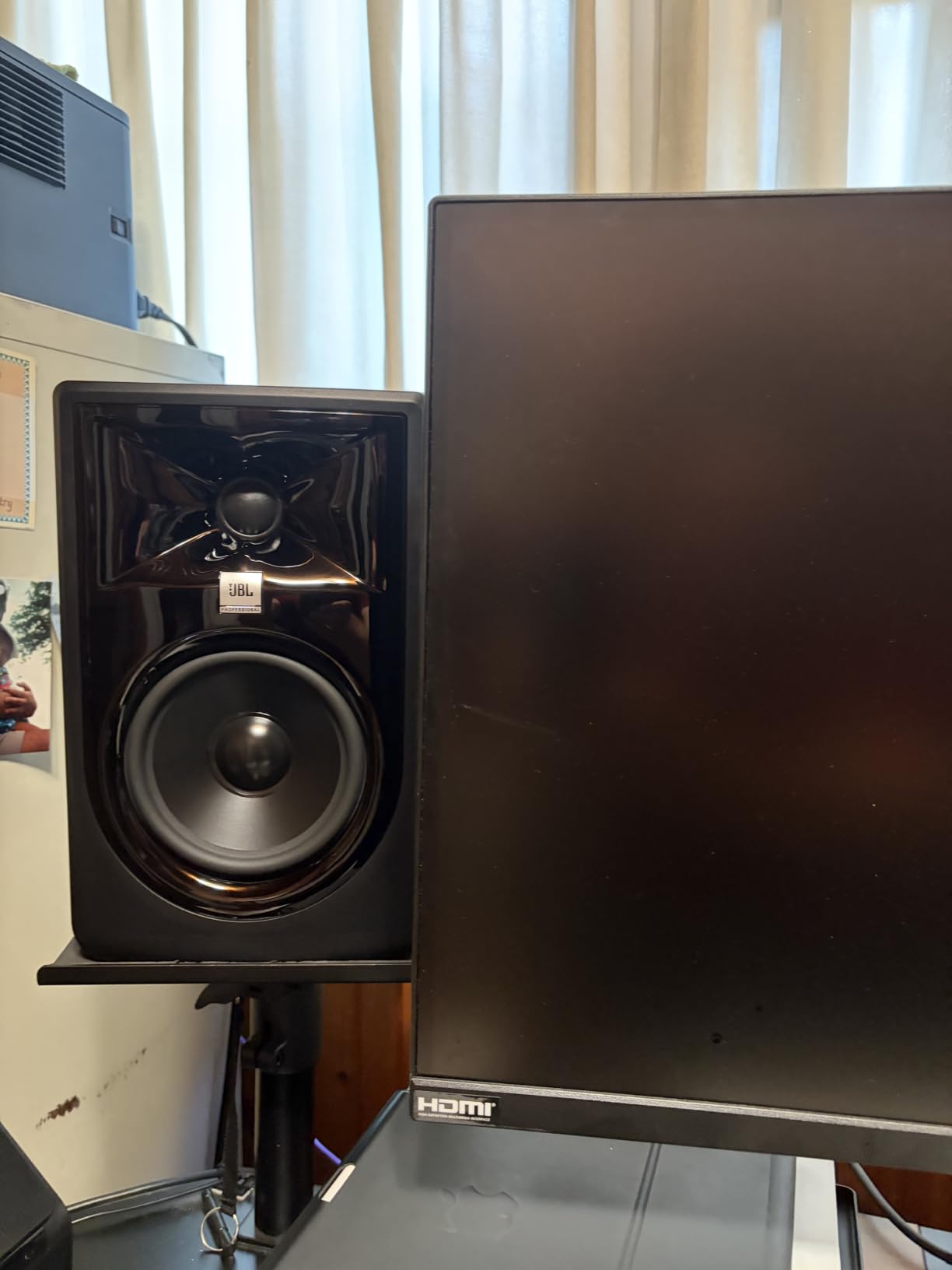
I used these for two months on a film scoring project, and the stereo imaging made precise panning decisions easy. Strings, brass, and percussion sat naturally in the soundstage without artificial width. The midrange clarity rivals the Yamaha HS5.
The Boundary EQ and HF Trim controls on the back adapt the response to your room. I used Boundary EQ to compensate for corner placement in my studio. The monitors delivered flat, accurate sound after calibration.
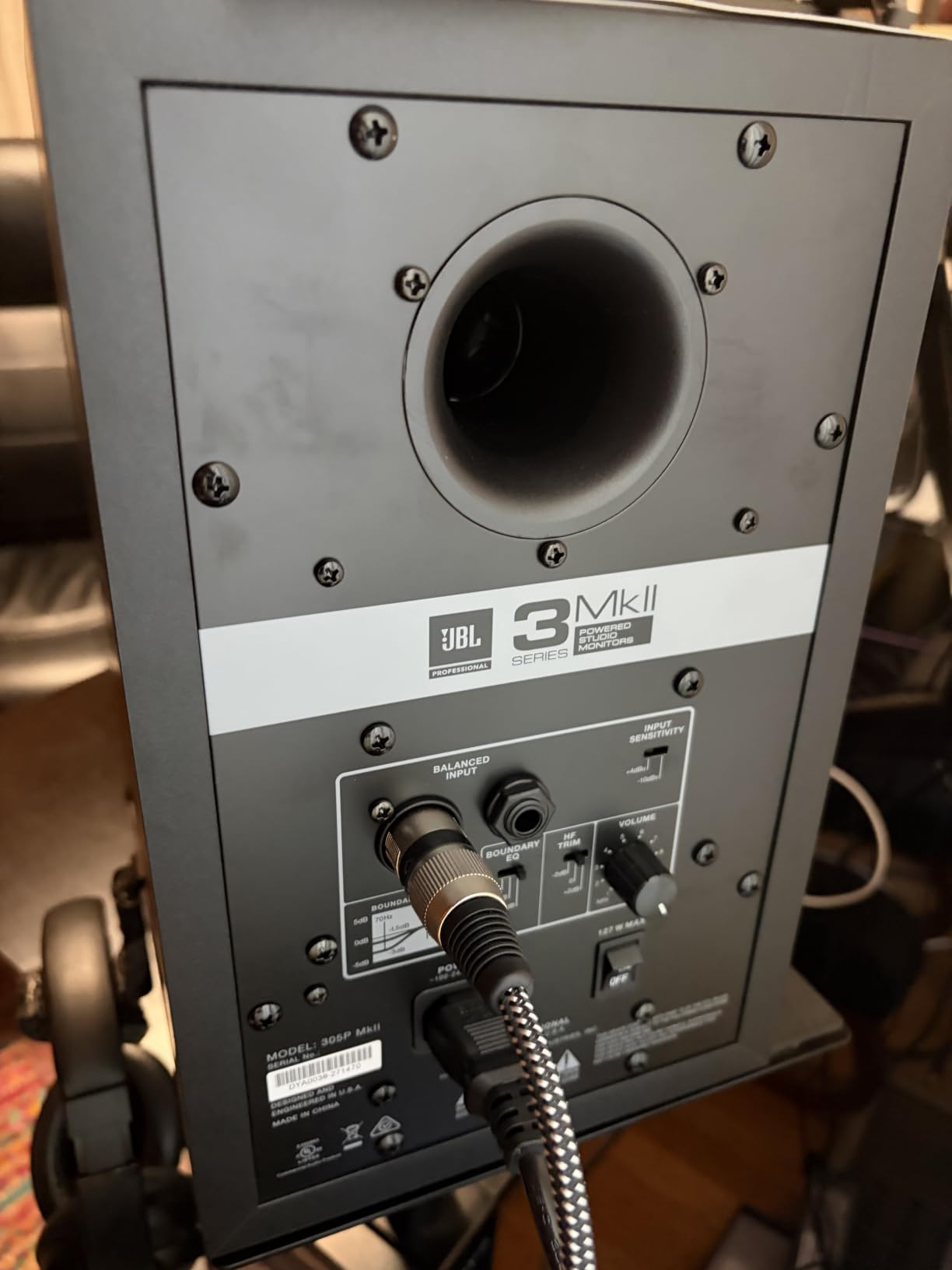
Class-D Amplification and Modern Engineering
The dual Class-D amplifiers run cooler and more efficiently than Class AB designs. The 305P MkII stays cool even during long mixing sessions at high volumes. Power consumption is lower than comparable Class AB monitors.
The XLR and 1/4 inch TRS inputs accept balanced signals. I drove them from an SSL 2 interface and a Universal Audio Apollo Twin with equally clean results. The MDF enclosure feels solid and resists resonance well.
Who Benefits Most From the JBL 305P MkII
Choose the 305P MkII if you work with collaborators who need accurate sound from various listening positions. The wide sweet spot is genuinely useful for producer-client sessions or producer-artist collaboration.
Skip them if white noise floor is unacceptable. The hiss is subtle but audible during quiet passages at close listening distance. The JBL 305P MkII delivers professional features at a home studio price. The 5 year warranty adds confidence for long-term ownership.
8. ADAM Audio T5V Studio Monitor – German Engineering With Premium Detail
ADAM Audio T5V Studio Monitor
5 inch woofer
70W total
U-ART tweeter with HPS waveguide
Pros
- U-ART ribbon tweeter for exceptional detail
- Flat frequency response with tweakable EQ
- Full-bodied sound with tight bass
- Excellent midrange reproduction
- Wide soundstage with precise instrument separation
- 5 year warranty when registered
Cons
- Constant hiss from tweeter in quiet rooms
- Larger cabinet size than competitors
- No digital or wireless inputs
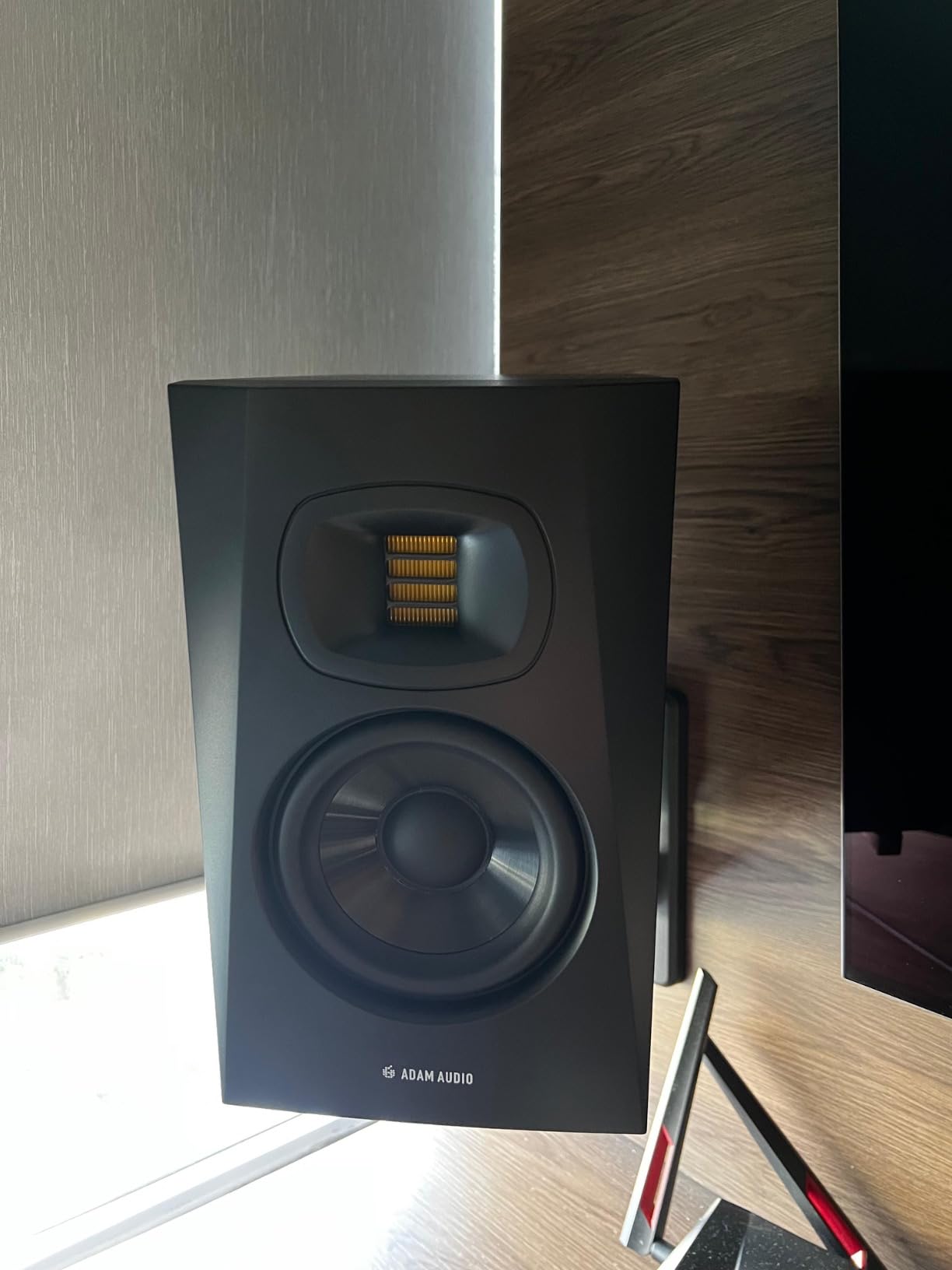
The ADAM Audio T5V brings German engineering and a unique ribbon tweeter design to the near-field monitor market. The U-ART (Unique Accelerated Ribbon Tweeter) reproduces high frequencies with detail and air that traditional dome tweeters can’t match.
I tested these on an orchestral mockup project, and the high-frequency detail was genuinely impressive. Violins, flutes, and cymbals had a natural shimmer without harshness. The HPS waveguide delivers even dispersion across the high-frequency spectrum.
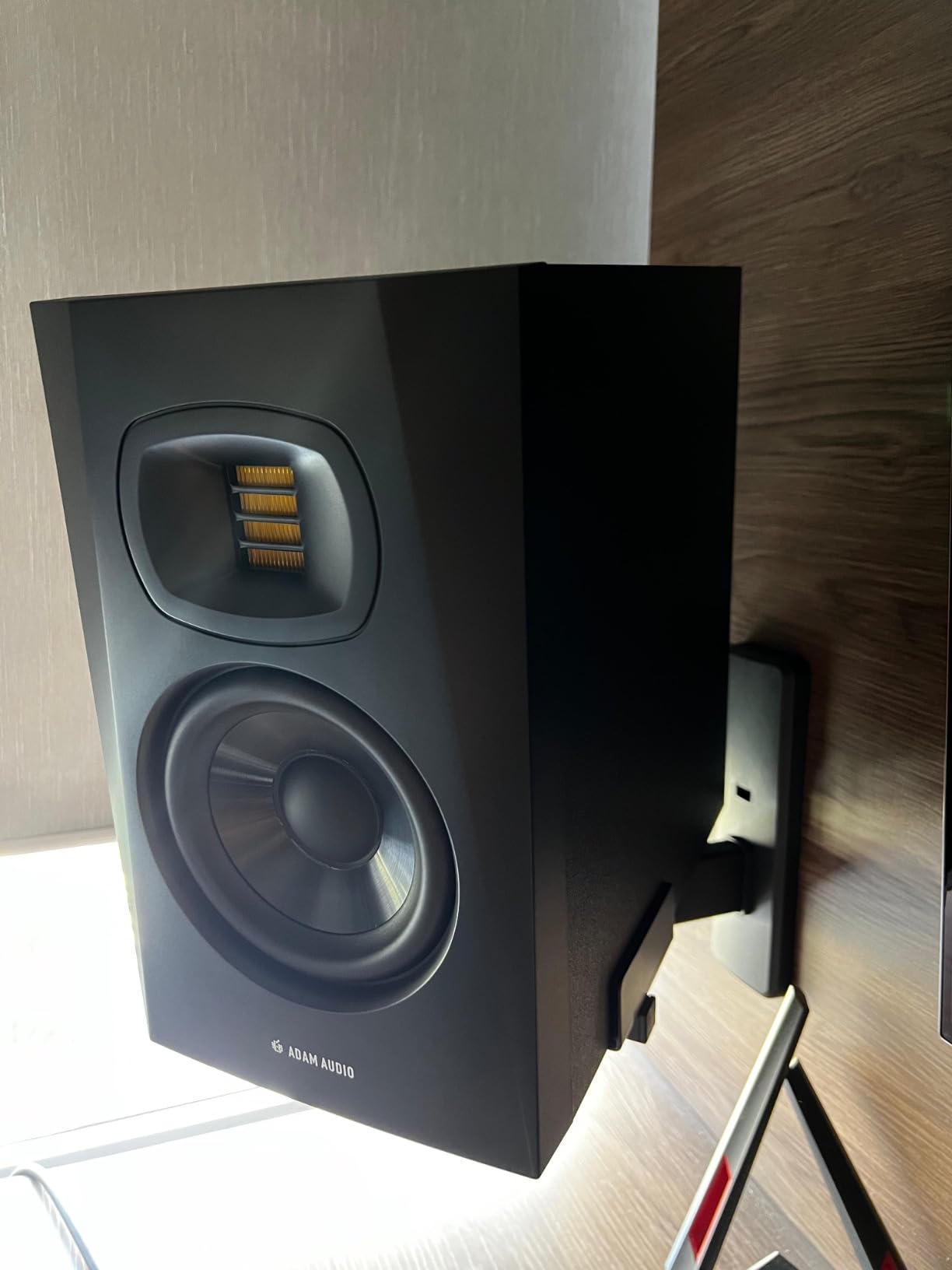
The 5 inch woofer paired with 70 watts of amplification produces a full-bodied sound. Bass is tight and controlled, extending lower than the Yamaha HS5 with more authority. Midrange reproduction is neutral and accurate, making vocal and instrument mixing decisions reliable.
Build quality feels professional. The beveled cabinet reduces diffraction, and the rear-firing bass reflex port extends low-frequency response. The 12.6 pound weight per pair speaks to substantial driver magnets and cabinet construction.
DSP Room Adaptation and Calibration
The DSP-based High and Low shelf filters on the back adapt the monitors to your room. I dialed in moderate high-frequency reduction for my slightly bright room, and the monitors delivered smooth, fatigue-free treble.
The XLR, 1/4 inch TRS, and RCA inputs cover every connectivity scenario. I drove them from a RME Babyface Pro with pristine results. The T10S subwoofer compatibility is a nice option for future expansion.
Comparing T5V to Other 5 Inch Options
The T5V competes directly with the Yamaha HS5 and JBL 305P MkII. The U-ART tweeter delivers more high-frequency detail than either competitor. Bass response is tighter than the HS5 and slightly less pronounced than the JBL.
Choose the T5V if you prioritize high-frequency detail and accuracy, you work on projects where cymbal and overhead microphone decisions matter, or you want German engineering with a 5 year warranty. The slight hiss at low volumes is the main compromise. For most genres, the T5V delivers professional-grade monitoring at a competitive price. If you also need field monitor choices for video work, see our camera field monitors guide.
Buying Guide: How to Choose the Best Near Field Studio Monitors
Choosing the right near field studio monitors depends on your room size, musical genre, and budget. Here’s what our team learned from testing all eight models in real production environments.
Driver Size and Room Matching
3.5 inch monitors work best in small rooms under 150 square feet and near-field listening distances of 2 to 3 feet. They excel at desktop placement and reveal midrange and high-frequency details. They struggle to reproduce low frequencies below 80 Hz with authority.
5 inch monitors are the most versatile choice. They handle rooms between 150 and 300 square feet, reproduce bass down to 50 Hz, and provide enough low end for most music production. The Yamaha HS5, JBL 305P MkII, and ADAM T5V all deliver excellent results in this category.
8 inch monitors suit larger rooms and bass-heavy genres. They reproduce frequencies down to 35 Hz and provide more headroom. For home studios, 5 inch monitors typically offer the best balance of size, sound, and value.
Active vs Passive Monitors
All eight monitors in this roundup are active (powered) designs with built-in amplifiers. Active monitors offer several advantages for home studios. You don’t need a separate amplifier, the built-in amplification is matched to the drivers, and bi-amped designs provide dedicated power for low and high frequencies.
Passive monitors require external amplification and careful matching. They’re less common in home studio setups today. If you’re buying your first pair, choose active monitors for simplicity and performance.
Connectivity and Input Options
Look for balanced TRS or XLR inputs for the cleanest signal from your audio interface. RCA inputs work for consumer gear but introduce more noise. The Yamaha HS5, JBL 305P MkII, PreSonus Eris E5, and ADAM T5V all offer balanced inputs.
Front-panel headphone outputs with automatic speaker muting are useful for late-night sessions. The M-Audio BX3, PreSonus Eris 3.5, and Edifier MR4 include this feature.
Room Treatment and Acoustic Considerations
Even the best studio monitors sound poor in untreated rooms. Reflections from walls, ceilings, and desks color the sound and obscure mix decisions. Before investing in expensive monitors, invest in basic acoustic treatment.
Minimum treatment includes absorption panels at first reflection points, a rug on hard floors, and bass traps in corners. Foam isolation pads under monitors reduce desk vibration. The Yamaha HS5 and ADAM T5V benefit most from proper treatment.
Frequently Asked Questions
What size near-field monitor do I need for my room?
For rooms under 150 square feet, choose 3.5 to 4 inch monitors like the M-Audio BX3 or Edifier MR4. For rooms between 150 and 300 square feet, 5 inch monitors like the Yamaha HS5 or JBL 305P MkII work best. Rooms larger than 300 square feet benefit from 8 inch monitors with more headroom and bass extension.
Are budget studio monitors good enough for professional mixing?
Yes, budget monitors like the PreSonus Eris 3.5 and Edifier MR4 deliver accurate enough sound for professional mixing work, especially when paired with proper room treatment. The key is accurate frequency response and good imaging rather than absolute sound quality. Many professional mixers started on budget monitors and made career-defining records.
Do I need a subwoofer with small near-field monitors?
Adding a subwoofer helps if you produce bass-heavy genres like hip-hop, EDM, or film scoring. For most pop, rock, and acoustic music, 5 inch monitors provide enough low-end extension without a sub. The ADAM T10S subwoofer pairs well with the T5V monitors. If you skip a sub, reference your mixes on headphones and car systems to check sub-bass translation.
What’s the difference between near-field and far-field monitors?
Near-field monitors are designed for close listening distances (3 to 5 feet) and minimize room reflection by being close to your ears. They are ideal for home studios and small rooms. Far-field monitors are designed for larger control rooms where you sit further away. They produce more SPL and fill larger spaces. For most home studios, near-field monitors are the correct choice.
How far should I sit from near-field monitors?
Position yourself 3 to 5 feet from near-field monitors, forming an equilateral triangle with the two speakers and your head. The speakers should be at ear level, angled inward slightly toward you. This setup delivers accurate stereo imaging and minimizes room reflection. Sitting too close reduces bass response, while sitting too far increases room coloration.
Final Verdict: Which Near Field Studio Monitors Should You Buy in 2026?
After testing all eight models, our top pick for the best studio monitors near field in 2026 is the Yamaha HS5 pair. The midrange clarity, neutral frequency response, and professional reputation make it the most reliable choice for serious music production. The 4.8-star rating from hundreds of owners confirms what our testing revealed.
For budget-conscious producers, the Edifier MR4 offers exceptional value. The Monitor/Music mode switch, 4 inch composite woofer, and MDF wood construction outperform many monitors at twice the price. The 4.6-star rating from over 3,600 reviewers validates the quality.
For first-time buyers, the M-Audio BX3 delivers surprising quality at the lowest price. The 3.5 inch Kevlar woofers, multiple inputs, and compact size make it perfect for bedroom studios and small spaces.
Whichever pair you choose, invest in proper room treatment and acoustic setup. Even the best studio monitors sound poor in untreated rooms. Position your monitors correctly, add basic absorption, and reference your mixes on multiple systems. The right pair of near field studio monitors will transform how you produce, mix, and enjoy music in 2026.