
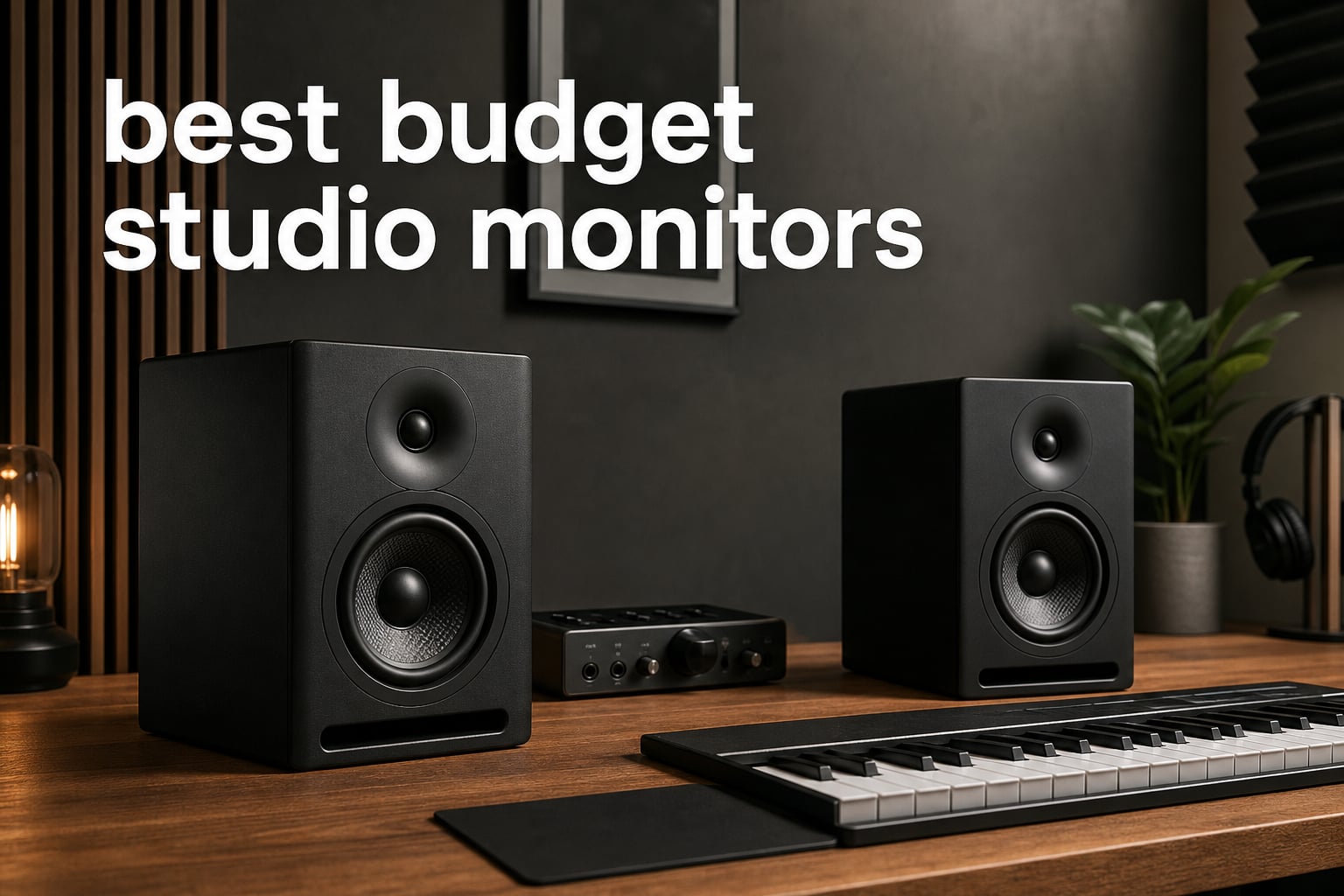
The best budget studio monitors make it easier to hear what is actually in a session: low-end buildup, harsh vocal edges, reverb tails, and panning choices. They are powered nearfield speakers built to give a more revealing reference than typical entertainment speakers, so a mix has a better chance of making sense on earbuds, a car system, and other real-world playback.
For this guide, I compared the eight available models by their stated driver designs, amplification, frequency specifications, inputs, room-tuning options, retailer rating snapshots, and practical desk fit. I have not treated a large woofer, Bluetooth, or a high review score as a shortcut to a better mix; the right choice depends first on how close you sit, how much space surrounds the speakers, and whether you need a direct interface connection.
My short answer is simple: choose compact 3.5- or 4.5-inch monitors for a close desktop position, then move to a 5-inch model only when the room and placement can support it. Every pick below is an active studio monitor, but each has a different route to a useful reference for music production, editing, gaming, or everyday listening.
A pair of monitors cannot correct a bare, reflective room or replace careful referencing. Forum discussions repeatedly point to the same lesson: learn one reliable pair, place it well, and compare your work on headphones and ordinary speakers before calling a mix finished.
Table of Contents
Top 3 Picks Answer Different Studio Needs
The Yamaha HS4 is my editor’s choice for a compact wired setup because it combines a 4.5-inch woofer, room and high-trim controls, and XLR/TRS, RCA, and stereo-mini inputs. The Edifier MR3 is the flexible desktop choice, while the Mackie CR3.5 is the straightforward pick for a very small workstation that needs front-panel headphone access.
Best Budget Studio Monitors in 2026 at a Glance
The comparison below puts all eight picks in one place. Use it to narrow the field, then read the individual notes for the desk size, source devices, and monitoring habits that make each model a sensible match.
| Product | Specifications | Action |
|---|---|---|
 Yamaha HS4 Yamaha HS4 |
|
View on Amazon |
 Edifier MR3 Edifier MR3 |
|
View on Amazon |
 KRK ROKIT 5 G5 KRK ROKIT 5 G5 |
|
View on Amazon |
 ADAM Audio D3V ADAM Audio D3V |
|
View on Amazon |
 Mackie CR3.5 Mackie CR3.5 |
|
View on Amazon |
 PreSonus Eris 3.5 PreSonus Eris 3.5 |
|
View on Amazon |
 Edifier MR5 Edifier MR5 |
|
View on Amazon |
 M-Audio BX5BT M-Audio BX5BT |
|
View on Amazon |
1. Yamaha HS4 Is the Best Compact Wired Monitor Choice
Yamaha HS4 Powered Studio Monitor in Black, Pair (HS4 B)
4.5 inch woofer
60 Hz to 22 kHz
XLR TRS RCA inputs
Pros
- Room and high trim controls
- Multiple wired inputs
- Compact nearfield size
- Includes cables and pads
Cons
- 26 watt output suits small rooms
- Limited deep bass
The Yamaha HS4 is the pick I would start with when the desk is close to a wall and the listening position is roughly an arm’s length away. Its 4.5-inch cone woofer and 1-inch dome tweeter are paired with a stated 60 Hz to 22 kHz response at minus 10 dB, which tells you to expect a compact monitor rather than subwoofer-level bass.
What makes it useful for focused work is its connection set: a combo XLR/TRS input, RCA, and stereo mini input cover an audio interface, mixer, computer, or simple playback source. The included anti-slip pads are welcome, though I would still treat speaker height and a firm desk surface as part of the setup rather than an afterthought.
The rear room-control and high-trim adjustments give you a practical way to respond to a bright room or a boundary nearby. They are small corrective controls, not an automatic room-calibration system, so start at neutral and change one setting at a time while listening to familiar reference tracks.
The listing’s 4.7 out of 5 rating across 2.3k+ reviews is a strong popularity signal, and review feedback specifically credits the connectivity and response. The limitation is output: its stated 26-watt power is tailored to a close nearfield position, not a large untreated room or a loud client playback session.
The HS4 Works Best at a Close Desktop Listening Distance
Put the pair on stands or isolation pads so the tweeters point toward your ears, make an equilateral triangle with your head, and keep the volume modest. That geometry lets the direct sound reach you before a small room adds too much reflected energy.
The HS4 Makes Sense When You Need Several Wired Inputs
Choose this Yamaha when XLR/TRS, RCA, and stereo-mini sources need to coexist without adapters becoming the center of the setup. It is particularly tidy for a bedroom producer with an interface and a computer on the same desk.
2. Edifier MR3 Is the Most Flexible Small Desktop Pick
Edifier MR3 Powered Studio Monitor, Speaker Hi-Res Active Bluetooth Speaker
3.5 inch drivers
52 Hz to 40 kHz
TRS RCA AUX Bluetooth
Pros
- Balanced TRS input
- Bluetooth multi-point
- Monitor and Custom modes
- Headphone output
Cons
- Small woofer limits low bass
- Plastic enclosure may not suit everyone
The Edifier MR3 is aimed at the person whose desk does double duty as a workspace and a listening spot. Its 3.5-inch mid-low drivers and 1-inch tweeters are compact, yet the stated 52 Hz to 40 kHz response and 18 watts per channel RMS show a more monitoring-minded specification than a basic computer speaker.
Balanced TRS, RCA, and AUX inputs make the MR3 easy to connect to an interface or several consumer sources. Bluetooth 5.4 with multi-point connection is convenient for checking a reference from a phone, but I would use the wired balanced path for critical session work when available.
Edifier provides Music, Monitor, and Custom modes through the ConneX app. For mixing, begin with Monitor mode and resist the urge to EQ toward excitement; a flattering low end or top end can convince you to make the wrong corrective move in the DAW.
The MDF cabinet is intended to reduce distortion, and the reported peak SPL is 92.5 dB. The 4.7 rating from 660 reviews supports its appeal as an adaptable pair, but the 3.5-inch drivers still make this a close-range option where kick weight and sub information need a headphone or second-system check.
The MR3 Is Best for Desks That Also Handle Everyday Playback
Its Bluetooth, headphone output, and three input families suit a computer-centered desk where music, editing, calls, and casual playback all happen. That convenience does not stop it from serving as a useful nearfield reference when set to its monitor-focused mode.
The MR3 Requires a Second Check for Very Low Frequencies
Use familiar bass-light and bass-heavy tracks, then compare decisions on headphones before printing the final mix. This approach is sensible with any small monitor and is especially helpful when working on electronic music.
3. Mackie CR3.5 Is the Simplest Small-Desk Starter Pair
Mackie CR3.5 Studio Monitors (Pair), 3.5″ Woofers, Tone Knob, Black
3.5 inch woven woofer
Tone knob
Desktop bookshelf switch
Pros
- Location switch
- Front headphone output
- TRS RCA and 3.5mm inputs
- Foam pads included
Cons
- Small woofer has limited bass
- Subwoofer may help for deep low end
The Mackie CR3.5 keeps the feature set approachable: a 3.5-inch woven woofer, 1-inch silk-dome tweeter, and 50 watts of stated output. It is a logical candidate when a full-size monitor would dominate the desk and the primary need is a compact pair for creating, gaming, streaming, or learning basic mix decisions.
Its most useful distinction is the location switch for desktop or bookshelf placement. That is a direct acknowledgement that nearby surfaces change what you hear, and it is more useful for a novice than pretending every room can be treated like a dedicated control room.
The front headphone output is practical when switching late at night, while TRS, RCA, and 3.5 mm inputs cover common desktop gear. Mackie also includes foam isolation pads, which help decouple the cabinets from a desk, although proper ear-height positioning remains more important than any small accessory.
The tone knob moves from a transparent setting toward enhanced bass and highs. I would leave it as close to transparent as possible for production, then use the enhanced setting only for entertainment if you prefer it; the two tasks demand different judgments.
The CR3.5 Fits Beginners Working in Very Tight Spaces
These are a good physical fit when the speaker-to-listener distance is short and there is no room for stands or wide separation. They can help a beginner hear panning, arrangement balance, and obvious harshness more clearly than laptop speakers.
The CR3.5 Is Not the Right Choice for Bass-Dependent Final Decisions
A 3.5-inch woofer has finite low-frequency reach, so verify bass, kick, and sub relationships elsewhere. Mackie states compatibility with the CR8SBT subwoofer, but a sub also introduces placement and calibration work.
4. KRK ROKIT 5 Generation Five Brings DSP to a 5-Inch Format
KRK RP5G5 ROKIT 5 Generation Five 5″ Powered Studio Monitor
5 inch woofer
Class D amplification
25 DSP EQ combinations
Pros
- Three EQ modes
- Isolation pads included
- Silk dome tweeter
- XLR TRS combo input
Cons
- Requires more desk and room space
- Stock can vary
The KRK ROKIT 5 Generation Five is a serious step up in physical scale from the desktop pairs. It uses a 5-inch woofer, 1-inch silk-dome tweeter, custom Class D amplification, and a low-diffraction baffle design intended to reduce distortion around the front of the cabinet.
For a home studio where the speakers can sit farther apart, the extra driver area makes this format more convincing for bass and lower mids than a 3.5-inch design. That does not mean it belongs in every small room; larger drivers can excite room modes more strongly when placed too close to a wall or corner.
Its integrated DSP offers three equalization modes and 25 stated EQ combinations. FLAT is the logical starting point for production, while the other choices can be useful for learning how a more shaped response changes your perception of a track.
KRK includes acoustic foam wedge isolation pads, and the monitor accepts XLR or 1/4-inch TRS through a combo input. The 4.7 rating across 204 reviews, with an 89% five-star share in the product data, gives this model a favorable early review snapshot.
The ROKIT 5 G5 Fits a Desk With Real Speaker Separation
Choose it when you can place the cabinets symmetrically, keep the listening position off the rear wall, and maintain a proper nearfield triangle. A five-inch pair needs breathing room to show why it is larger than a desktop monitor.
The ROKIT 5 G5 Rewards Careful Use of Its DSP Modes
Start with the neutral mode and use one familiar track to judge every adjustment, not a constantly changing playlist. DSP can reduce a problem you recognize, but it cannot make a poorly positioned speaker behave as though the room does not exist.
5. ADAM Audio D3V Is the Strongest USB-C Desktop Monitor
ADAM Audio D3V Active Desktop Studio Monitor Speakers – Black
D-ART ribbon tweeter
USB-C and TRS
45 Hz passive radiators
Pros
- USB-C plug and play
- DSP room switches
- Extended bass claim
- Detachable angled stands
Cons
- Desktop-sized drivers
- Auto sleep may not suit every workflow
The ADAM Audio D3V addresses a very specific modern setup: a producer or editor who wants a compact monitoring system that can connect directly to a computer over USB-C. Its 3.5-inch aluminum woofers, 1.5-inch D-ART ribbon tweeter, and 80-watt amplification per monitor combine desktop convenience with a design that differs from the usual dome-tweeter pair.
Dual-sided 3.5-inch passive radiators are stated to extend bass to 45 Hz. That is an ambitious low-frequency figure for this size, but I would still interpret it as useful extension rather than permission to skip reference checks on the deepest octave.
The detachable stands angle the speakers 15 degrees, which can be handy when the monitors sit low on a desk. DSP-powered room switches give you a simple adjustment route, and a 20-minute auto-sleep function can be disabled if a production workflow makes automatic sleep annoying.
A 4.6 rating from 352 reviews and an 85% five-star share are solid indicators, with feedback in the dataset praising the USB-C connection and D-ART tweeter. Inputs also include balanced 1/4-inch TRS and RCA, so the D3V can grow from a laptop-only rig into an interface-based workstation.
The D3V Is Best When USB-C Connection Is Part of the Plan
Use its direct computer connection when you want a cleaner desktop and do not need an external interface for recording at the same time. The wired TRS input leaves an upgrade path when you do add one.
The D3V Needs Tweeter Alignment Despite Its Included Stands
Angle the speakers so the ribbon tweeters face your listening position rather than your chest or desk surface. Small changes in vertical aim matter because desktop reflections can blur high-frequency detail.
6. PreSonus Eris 3.5 Is the Proven Compact Home-Studio Option
PreSonus Eris 3.5 Powered Studio Monitors, Pair — 3.5” Active Near
3.5 inch woven woofers
80 Hz to 20 kHz
TRS RCA front aux
Pros
- Acoustic tuning controls
- Front headphone jack
- Flexible desk inputs
- Complete stereo pair
Cons
- 80 Hz low-end limit
- No deep bass monitoring
The PreSonus Eris 3.5 has a familiar compact-monitor recipe: 3.5-inch woven-composite woofers, 1-inch silk-dome tweeters, and 50 watts of built-in amplification. Its stated 80 Hz to 20 kHz response makes the boundary clear: this is for close-range balance and detail, not for hearing the lowest sub bass without cross-checking.
It accepts balanced 1/4-inch TRS, RCA, and a front-panel aux input, with a headphone jack also on the front. That is unusually friendly on a busy desk because switching sources or headphones does not require reaching around the cabinet.
High- and low-frequency acoustic tuning controls let you adapt the response to a desk or a wall-adjacent position. Apply them sparingly, because a large adjustment can solve one familiar track while making another less dependable.
The Eris has the deepest review history among the compact pairs here, with a 4.5 rating over 1.5k+ reviews and a number-one Studio Audio Monitors category position in the provided product data. That popularity does not change its physical limits, but it makes the Eris 3.5 a known quantity for first-time buyers.
The Eris 3.5 Is Best for Learning Nearfield Mixing Habits
It is well suited to learning level balance, stereo placement, and midrange clarity at sane volumes. I would pair it with reference tracks you know intimately and use headphones to validate low-end decisions.
The Eris 3.5 Connects Easily to an Interface or Computer
Balanced TRS is preferable from an interface because it can reject noise over a cable run, while RCA and front aux make simple consumer connections easy. Match the input to the gear you already own rather than buying adapters by default.
7. Edifier MR5 Is the Most Full-Featured Three-Way Option
Edifier MR5 2.0 Studio Monitor Bookshelf Speakers, 110W RMS, Black
3-way active design
46 Hz to 40 kHz
XLR TRS RCA Bluetooth
Pros
- Dedicated mid driver
- Room tuning controls
- 110 watt RMS
- Headphone output
Cons
- Heavy cabinets
- Needs a larger workspace
The Edifier MR5 is the most elaborate speaker architecture in this roundup. Its three-way active crossover divides work among a 5-inch long-throw woofer, 3.75-inch mid driver, and 1-inch silk-dome tweeter, an arrangement designed to give vocals and instruments their own driver range rather than asking a single woofer to cover all mids.
The stated 46 Hz to 40 kHz response, 110 watts RMS Class D amplification, and 101 dB peak SPL place it in a more substantial nearfield category. Those capabilities can be helpful for detailed production work, but they also make careful level control and placement more important in a small room.
Connection options are extensive: XLR, TRS, RCA, AUX, Bluetooth 6.0 multi-point, and a front 3.5 mm headphone output. Wired XLR or TRS is the natural route from an interface; Bluetooth is best regarded as a secondary playback option for checking references.
The rear controls and Edifier ConneX app provide room acoustic tuning, while the MDF cabinets are intended to reduce resonance. This is a heavy pair at 10.38 kilograms in the product specifications, so plan the desk, stands, and cable routing before it arrives.
The MR5 Is Best for a Larger Desk and Multi-Source Setup
Pick the MR5 when you have room for a five-inch cabinet, a sensible listening triangle, and multiple sources to connect. Its three-way layout and connection list are appealing for a studio corner that also serves editing and general listening.
The MR5 Benefits From Physical Placement Before App Tuning
Begin by setting equal distances, tweeter height, and some clearance from walls before touching the app. Room compensation can refine an already sensible position, but it is not a substitute for symmetry.
8. M-Audio BX5BT Is the Most Adjustable 5-Inch Desktop Monitor
M-AUDIO BX5BT 5″ Desktop Studio Monitors Pair
5 inch Kevlar woofer
240 watt bi-amplified
DSP and app EQ
Pros
- FLAT HYPE and CUSTOM modes
- Five-band app EQ
- Bluetooth range
- TRS input and trim controls
Cons
- Desktop mounting only
- Needs room around the pair
The M-Audio BX5BT combines a 5-inch Kevlar woofer, 1-inch silk-dome tweeter with waveguide, and 240 watts of stated bi-amplified power. It is built for creators who want a substantial desktop monitor with DSP flexibility and the option to stream playback wirelessly.
A DSP-tuned crossover and three response modes—FLAT, HYPE, and CUSTOM—form the core of its appeal. For mixing, use FLAT as the reference baseline; HYPE can be useful for understanding a more entertainment-style voicing, while CUSTOM is for a change you can explain and repeat.
The M-Audio Studio Control app provides five-band EQ and saved presets, while rear TRS inputs and trim controls fit an interface-centered setup. Bluetooth 5.0 has a stated 100-foot range, but physical range is less important than keeping the critical monitoring signal wired and level-matched.
The product data reports a 4.4 rating from 1.4k+ reviews, with users highlighting its power, DSP modes, and app control. Treat that high-output capability as headroom rather than a reason to mix loudly; long sessions at excessive volume tire your ears and make balance judgment worse.
The BX5BT Is Best for Creators Who Want DSP Control
Choose this model if you like the idea of a neutral starting mode plus carefully stored adjustments for a particular desk. The app is a convenience, yet the strongest setup habit remains checking every setting against familiar material.
The BX5BT Needs a Stable, Spacious Desktop Position
Its five-inch drivers and desktop-only mounting call for a rigid surface, isolation, and space around each cabinet. Do not push them into corners just to make the desk look tidy, because that position can exaggerate bass.
Choosing Budget Studio Monitors Starts With Your Room and Listening Distance
The most useful buying rule is not “buy the biggest woofer.” Pick the monitor size that lets you create a stable triangle: speaker-to-speaker distance equals the distance from each speaker to your head, with the tweeters aimed at your ears.
A 3.5- or 4.5-Inch Monitor Fits a Close Desktop Position
Compact models such as the Mackie CR3.5, PreSonus Eris 3.5, Edifier MR3, ADAM D3V, and Yamaha HS4 suit a desk where you sit close to the speakers. They will not reproduce the deepest octave with the authority of a larger cabinet, but their size can make placement easier in a small room.
For a bedroom producer, that trade-off is often sensible. If the monitors are too large for the available distance, the room’s bass reflections can be more misleading than the small driver’s limited extension.
A 5-Inch Monitor Fits a Room With More Physical Breathing Space
The KRK ROKIT 5 G5, Edifier MR5, and M-Audio BX5BT give you a 5-inch woofer and more output capability. They make more sense when the desk permits wider separation, the monitors can sit away from corners, and you can listen from a little farther back.
Do not confuse bigger with universally more accurate. A five-inch monitor can reveal more low-mid and bass information, but only a reasonable placement and repeated reference listening turn that information into better decisions.
Balanced Inputs Are Worth Prioritizing With an Audio Interface
Balanced TRS or XLR connections use a signal arrangement that helps reject noise picked up along the cable. If your interface has balanced outputs, select a monitor with matching balanced inputs and use proper balanced cables when possible.
RCA, AUX, and Bluetooth are still useful for phones, computers, and reference playback. They simply are not the first choice for the most critical monitor path when a balanced connection is available.
Placement Matters More Than Small Specification Differences
Start with the monitors and your head forming an equilateral triangle, then raise or angle them until the tweeters point at ear height. Keep both speakers the same distance from nearby side walls where possible, and use isolation pads or stands to reduce desk vibration.
The often-cited 38% rule is a starting point for room layout: position the listening spot about 38% of the room length from the front wall, then adjust by listening. It is not a law, but it can keep you away from the most obvious room-mode trouble zones.
Wall Clearance Depends on the Room and the Speaker
Do not place monitors hard against a wall unless space leaves no alternative. Move them forward in small steps, listen to a familiar bass line, and use the speaker’s room or low-frequency control only after you hear what the position itself is doing.
If a monitor must remain near a boundary, write down the switch or knob position you settle on. Repeatability matters: you want tomorrow’s mix decisions to be based on the same reference as today’s.
Frequency Response Numbers Need Context Rather Than Guesswork
A stated response tells you the claimed range, but the tolerance matters. The Yamaha’s 60 Hz to 22 kHz figure, for example, is qualified at minus 10 dB, while the PreSonus lists 80 Hz to 20 kHz; neither number alone tells you the entire tonal balance at your seat.
Use specifications to understand likely limits, then learn the speakers with songs you know well. Listen for vocal level, snare bite, bass notes, and stereo width rather than hunting for a single “flat” number.
Translation Comes From Repeated Cross-Checks
Budget studio speakers can be accurate enough to learn mixing on if you know their behavior and keep your process consistent. After a mix pass, check it on headphones, a phone, a car system, and any other ordinary speaker you trust, then note patterns instead of chasing every difference.
Forum advice is right on this point: room treatment and familiar references often matter more than stepping up to a more elaborate monitor. Even a few basic absorption panels at reflection points can be more helpful than turning monitors louder.
Budget Studio Monitor Questions Have Straight Answers
What’s the difference between studio monitors and regular speakers?
Studio monitors are designed to give a more revealing, neutral reference for recording, editing, and mixing. Regular speakers often intentionally shape bass or treble for enjoyable casual playback, while monitors aim to expose balance problems that can affect mix translation.
Do I really need studio monitors?
You do not need studio monitors to make music, but they can make panning, level, midrange, and obvious EQ issues easier to hear than laptop speakers. A close, well-placed pair plus familiar headphones is a strong starting reference for home production.
What is the 38% rule for studio monitor placement?
The 38% rule suggests placing the listening position about 38% of the room length away from the front wall. It is a practical starting point intended to avoid obvious bass buildup, then you refine the position by listening and measuring if possible.
Should studio monitors be against a wall?
No, avoid placing studio monitors directly against a wall when you can. Start with some clearance, keep the pair symmetrical, and move them in small increments while listening to familiar bass material; use room controls only as a final adjustment.
How accurate are cheap studio monitors for mixing?
Affordable monitors can be accurate enough for useful mixing when their limits are understood. Small drivers need bass cross-checks, and every budget monitor benefits from correct placement, controlled volume, familiar reference tracks, and a second listen on headphones or common playback systems.
The Best Budget Studio Monitors Depend on How You Work
For the most straightforward compact wired reference, I would choose the Yamaha HS4. The Edifier MR3 is a strong alternative when flexible playback is part of daily desk use, while the Mackie CR3.5 and PreSonus Eris 3.5 make sense when physical space is the main constraint.
Move toward the KRK ROKIT 5 G5, Edifier MR5, or M-Audio BX5BT when a larger workspace can support a five-inch format and you want extra DSP options or connection flexibility. The ADAM D3V remains the clear choice for a USB-C-first desktop production setup.
Among the best budget studio monitors in 2026, the winner is the pair that you can place correctly, connect cleanly, and learn through repeated reference checks. Pick the fit that matches your room, then spend the first weeks listening more critically than you tweak.