
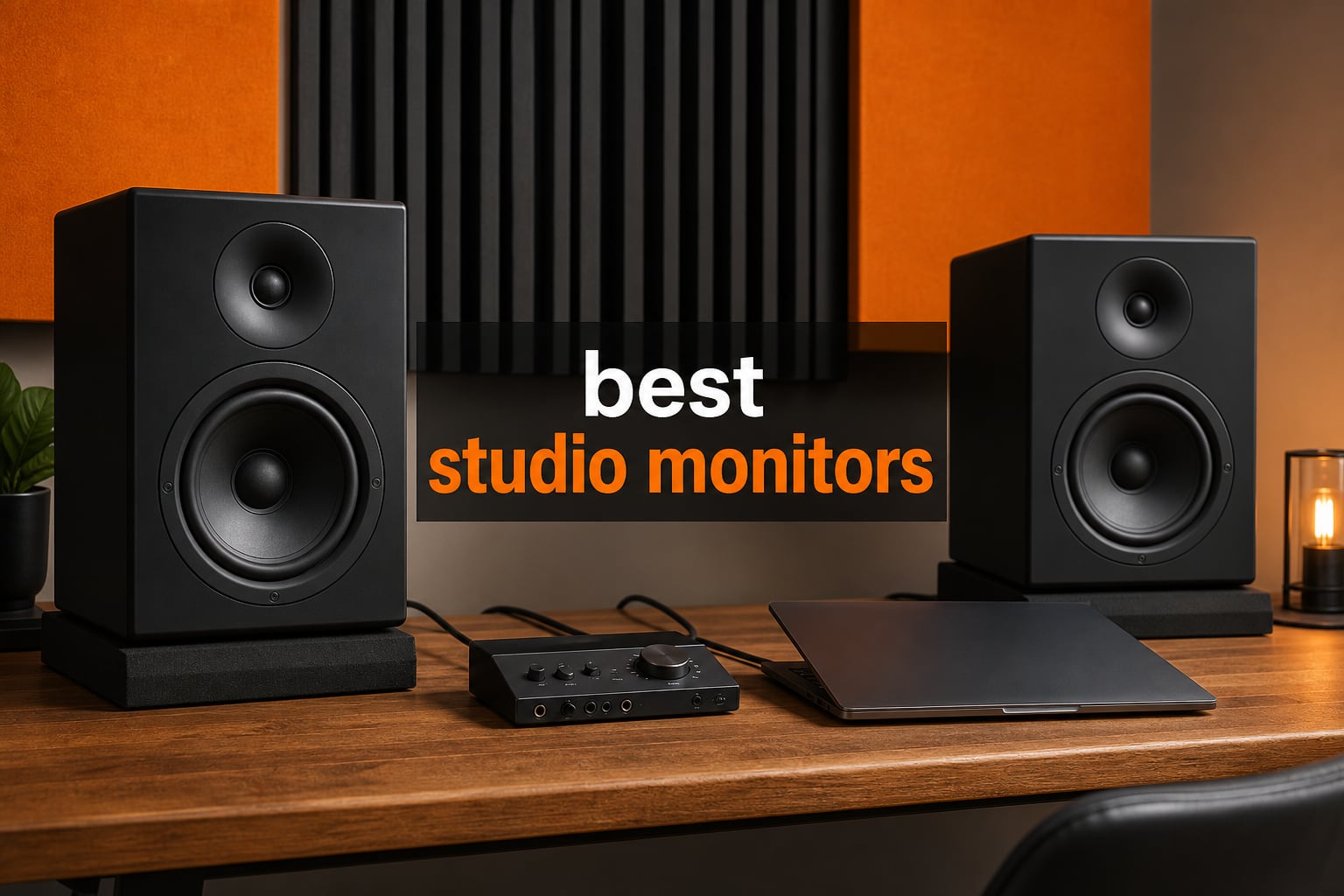
The best studio monitors 2026 are the ones that let you hear mix problems early, fit your room, and connect cleanly to your interface. For most small production spaces, we would start with the KRK ROKIT 5 Generation Five for its DSP room tuning and included isolation pads, then look at the Yamaha HS3 when desk space is tight or the PreSonus Eris 3.5 for an approachable first pair.
Studio monitors are powered reference speakers built to expose rather than flatter a recording. A useful pair gives you a stable stereo image, audible vocal and reverb detail, and bass you can judge without turning every session into a volume contest.
Our selection covers ten active studio monitors with verified product specifications and customer-rating data. We compared driver size, stated frequency response, amplification, input options, onboard tuning, physical footprint, and the ways each model suits a home studio, desktop, or more serious mixing position.
Room fit comes before brand loyalty. Producers in community discussions repeatedly point out that an untreated small room can make low end misleading, while a smaller speaker placed well can produce decisions that translate more reliably to cars, earbuds, and consumer speakers.
Here is the fast answer for readers deciding today:
- Best overall: KRK ROKIT 5 Generation Five for DSP-driven room tuning, a 5-inch Kevlar driver, and focused mixing features.
- Best compact reference pair: Yamaha HS3 for small desks, several wired inputs, and room-control adjustments.
- Best desktop detail: ADAM Audio D3V for USB-C connection, passive radiators, and a D-ART ribbon tweeter.
- Best flexible three-way option: Edifier MR5 for a 5-inch woofer, separate mid driver, room compensation, and broad connectivity.
Top 3 Picks for Studio Monitors in 2026
These three choices cover the most common buying situations: a focused nearfield monitor for mixing, a smaller wired reference pair, and a simple entry point for desktop work. None replaces acoustic treatment or careful placement, but each has features that make setup less guesswork-driven.

The KRK is our first recommendation where a 5-inch nearfield monitor fits the room and the interface has a balanced output. The ADAM is the more specialized desktop option, while the PreSonus makes sense when you need a complete compact pair with conventional wired connections.
Studio Monitors in 2026: Quick Overview
The comparison below keeps the decision focused on information the manufacturers list: driver arrangement, connection types, power, tuning, and distinctive design choices. Stated frequency response is helpful context, but it is not a direct ranking because manufacturers may use different measurement conditions.
| Product | Specifications | Action |
|---|---|---|
 Yamaha HS3 Yamaha HS3 |
|
View Details on Amazon |
 Edifier MR3 Edifier MR3 |
|
View Details on Amazon |
| KRK ROKIT 5 G5 |
|
View Details on Amazon |
 KRK Kreate 3 KRK Kreate 3 |
|
View Details on Amazon |
 PreSonus Eris E5 PreSonus Eris E5 |
|
View Details on Amazon |
 ADAM Audio D3V ADAM Audio D3V |
|
View Details on Amazon |
 Mackie CR3.5 Mackie CR3.5 |
|
View Details on Amazon |
 PreSonus Eris 3.5 PreSonus Eris 3.5 |
|
View Details on Amazon |
 Edifier MR5 Edifier MR5 |
|
View Details on Amazon |
 M-AUDIO BX5BT M-AUDIO BX5BT |
|
View Details on Amazon |
For a small desk, physical speaker size and listening distance matter as much as headline power. For a larger home studio, a 5-inch woofer usually gives more usable low-mid information, yet placement and room modes still decide whether that extra extension helps or harms your mixes.
1. Yamaha HS3 Is the Compact Wired Reference Choice
Yamaha HS3 Powered Studio Monitor in Black, Pair (HS3 B)
3.5 inch woofer
26W output
XLR TRS RCA mini inputs
Pros
- Compact stereo pair
- Room control and high trim
- Four wired input types
- Cables and pads included
Cons
- 70Hz lower stated limit
- No wireless connection
The Yamaha HS3 is the sensible first stop when a full-size monitor pair would overwhelm your desk. Its 3.5-inch cone woofer and 0.75-inch dome tweeter are housed in a two-way bass-reflex design, with a stated response of 70 Hz to 22 kHz at minus 10 dB.
What stands out is the connection flexibility for such a compact pair. Yamaha lists XLR/TRS combo, RCA, and stereo-mini inputs, so we see a clear path from an audio interface, controller, phone, or computer without adding adapters to every session.
The 26-watt output and small woofer set honest limits. It is not the pair we would choose to judge deep sub-bass in electronic music production, but it can make editing, arrangement work, vocal balance, and midrange cleanup easier to hear at a reasonable desktop distance.
Its 4.7 rating from more than 2k reviews is backed by an 84% five-star share in the available review data. That volume of feedback makes the HS3 one of the more proven compact options in this list, though ratings never replace checking your own room.
The Yamaha HS3 Works Best at a Close Desktop Distance
Place the HS3 pair so the tweeters point toward your ears and the speakers plus your head form an approximate triangle. At a close nearfield distance, the direct sound arrives more strongly than the room reflections, which is exactly what a small setup needs.
The included anti-slip pads are a useful start, but we would still avoid putting the cabinets straight against a wall. Begin with some breathing room behind them, then use familiar reference tracks and the room-control setting to make modest changes rather than chasing a dramatic bass boost.
The Yamaha HS3 Is Limited for Deep-Bass Mix Decisions
Because the stated response reaches 70 Hz only at minus 10 dB, kick weight and sub notes below that area need cross-checking. Use a trusted pair of headphones or another playback system before committing to a bass-heavy balance.
This is not a flaw unique to the HS3; it is the tradeoff for a 3.5-inch monitor. Choose it for honest close listening and desk practicality, not for filling a large room or judging the lowest octave without a second reference.
2. Edifier MR3 Is the Small Monitor with Modern Wireless Convenience
Edifier MR3 Powered Studio Monitor, Speaker Hi-Res Active Bluetooth Speaker
52Hz to 40kHz
Bluetooth 5.4
Balanced TRS and RCA
Pros
- Hi-Res certification
- Bluetooth multipoint
- Balanced TRS input
- App sound modes
Cons
- 92.5dB peak SPL
- Small driver limits output
The Edifier MR3 combines a stated 52 Hz to 40 kHz response with a compact 3.5-inch woofer configuration and 18 watts RMS per side. That range is impressive on paper for a small active speaker, but we would treat it as a reason to audition rather than assume it behaves like a bigger nearfield monitor.
Balanced TRS, RCA, AUX, and Bluetooth 5.4 provide unusually broad access for a desktop speaker. Bluetooth multipoint helps when switching casual playback sources, while the balanced TRS input is the connection we would select for production work from an audio interface.
Edifier includes Music, Monitor, and Custom modes through its ConneX app. The presence of a monitor mode is useful, though any app EQ should be set deliberately; changing modes while mixing can make it too easy to compensate for the speaker rather than the source material.
The available data reports a 4.7 rating from 660 reviews, with 81% five-star feedback. We would call this a practical hybrid for a creator who needs monitors for recording and editing but also wants wireless listening between sessions.
The Edifier MR3 Fits a Mixed Computer and Music Setup
The front headphone output, AUX input, and wireless support make the MR3 convenient for a workstation that handles audio, games, calls, and general listening. That flexibility can save space when a desk must serve more than one job.
For mixing, keep the chain simple: interface to balanced TRS, monitor mode selected, and operating level consistent. Use Bluetooth for reference checks or casual playback, not as the only path for decisions where timing and consistent gain matter.
The Edifier MR3 Has Output Limits in a Large Room
Edifier lists a 92.5 dB peak SPL, which is enough for close desktop listening but gives less headroom than several 5-inch options here. A small room can become loud quickly, yet headroom matters when checking transients and dense arrangements without strain.
Its compact scale also means bass translation needs discipline. We would make low-end choices at modest volume, compare against a known track, and listen on headphones before deciding the low bass is truly balanced.
3. KRK ROKIT 5 Generation Five Is the Most Complete Nearfield Pick
KRK RP5G5 ROKIT 5 Generation Five 5″ Powered Studio Monitor Pair
5 inch Kevlar woofer
82W Class D
DSP room tuning
Pros
- DSP tuning options
- Low-diffraction baffle
- Isolation pads included
- 3 year warranty
Cons
- Molded plastic cabinet
- Only analog combo input
The KRK ROKIT 5 Generation Five is our editor’s choice because its feature set directly addresses common home-studio problems. It pairs a 5-inch Kevlar woofer with a new 1-inch silk-dome tweeter, Class D amplification rated at 82 watts, DSP-driven room tuning, and a Brick Wall Limiter.
KRK also supplies acoustic foam wedge isolation pads, a detail that matters more than it sounds. Decoupling the cabinet from a desk reduces unwanted vibration through the furniture, so the bass and lower midrange you hear are less likely to be shaped by the surface below it.
The low-diffraction baffle is intended to support stereo imaging, and this is a strong reason to use the ROKIT as a nearfield pair rather than merely a loud playback system. A stable center image helps when you are setting lead-vocal level, checking double-tracked guitars, or panning electronic percussion.
Customer data shows a 4.7 rating from 204 reviews and an 89% five-star share. That is a smaller review pool than some older models here, but the feedback and the focused monitoring features make it the best all-rounder in this specific selection.
The ROKIT 5 G5 Suits Producers Who Need Room Tuning
DSP room tuning is valuable when the speakers must sit in a bedroom, rented room, or imperfect home office. It cannot correct a severe room null or replace bass traps, but it gives you a starting point for reducing obvious placement-related imbalance.
Start with the monitors symmetrically placed, use the supplied pads, and make one adjustment at a time. We would use familiar spoken voice, a well-known commercial mix, and a bass-light acoustic recording to hear whether a setting is helping across different material.
The ROKIT 5 G5 Requires a Balanced Source for Best Results
The listed input is an XLR and quarter-inch TRS combo connection, which is a normal studio connection but less plug-and-play for consumer devices. An audio interface with balanced outputs is the cleanest match and gives you a practical volume-control point.
The 5-inch format needs more physical space than a tiny desktop pair. If your speakers have to be extremely close to a rear wall or your ears are only a short arm’s length away, a smaller model may be easier to position consistently.
4. KRK Kreate 3 Is the Straightforward Compact Bluetooth Option
KRK Kreate 3 Powered Studio Monitors Pair
3.5 inch woofer
Textile dome tweeter
Bluetooth input
Pros
- Compact design
- Bluetooth streaming
- Glass Aramid woofer
- 3 year warranty
Cons
- Limited review history
- Small woofer bass limits
The KRK Kreate 3 gives the brand’s compact option a 3.5-inch Glass Aramid woofer, a 1-inch textile-dome tweeter, and Bluetooth streaming. It is designed for a simple stereo desktop setup where easy everyday playback belongs alongside basic music-making tasks.
Its woven glass-fiber-composite woofer is a noteworthy material choice in an entry-size speaker. Material alone does not tell us how a monitor will sound in a room, but the pairing with a textile dome is aimed at controlled lows and clear highs within a small cabinet.
The product data notes multiple audio inputs, though it does not specify each connector in the technical details provided. We would confirm the exact physical inputs needed for your interface or controller before purchasing rather than assume every compact monitor has a balanced connection.
The Kreate 3 holds a 4.7 rating from 52 reviews, with 88% five-star feedback. That early response is encouraging, but the smaller sample is why we place it behind models with more established review histories when long-term confidence is the main concern.
The Kreate 3 Is Best for a Small Multiuse Desk
Bluetooth makes it easy to move from a phone or laptop to music playback without interrupting a workday. That convenience is useful for checking how a rough mix feels in a less formal listening mode, provided your final mix decisions return to the primary wired setup.
Use a compact pair like this at close range and at moderate volume. The goal is not to make a small cabinet behave like a large monitor; it is to build a consistent reference you learn well over time.
The Kreate 3 Needs a Second Check for Sub-Bass Work
No frequency-response figure is included in the supplied product data, so we would not make claims about its low-end reach. The 3.5-inch woofer alone says it should be treated cautiously for sub-heavy genres and cinematic effects work.
Cross-check kick and bass choices on headphones, a car system, or another familiar playback system. That routine is helpful with any small monitor and protects you from overcompensating for low frequencies you cannot hear clearly.
5. PreSonus Eris E5 Is the Front-Ported Five-Inch Workhorse
PreSonus Eris E5 Pair 2-Way 5.25” Near Field Studio Monitors
5.25 inch woofer
80W Class AB
Front-firing port
Pros
- Front port placement
- Acoustic tuning
- Three analog input types
- Protection circuits
Cons
- No Bluetooth
- Lower review rating than top picks
The PreSonus Eris E5 uses a 5.25-inch woven-composite woofer, a 1-inch ultra-low-mass silk-dome tweeter, and 80 watts of Class AB bi-amplification. It is one of the more conventional studio-speaker designs here, which is a positive for someone who wants a clear monitor-first feature set.
A front-firing acoustic port is particularly relevant for rooms where rear clearance is limited. It does not mean the speakers can be pushed hard against a wall without consequences, but it reduces one complication compared with a rear-ported cabinet in a cramped workstation.
PreSonus lists XLR, quarter-inch TRS, and RCA inputs, so the E5 can work with a proper balanced interface while still accepting consumer hardware. Acoustic tuning controls give you a practical way to trim the speaker response to a room after careful placement.
The available customer data shows a 4.6 rating from more than 1k reviews. Its 102 dB maximum continuous SPL and extensive protection circuits also make it a grounded choice for listeners who want headroom and a more substantial monitor than a 3.5-inch desktop pair.
The Eris E5 Helps When Rear Clearance Is Tight
Put the E5 on firm stands or isolation pads, not directly on a resonant desk if you can avoid it. The front port helps, but the boundary behind the speaker still changes bass response, so leave practical clearance and test your usual listening position.
Use the acoustic controls as correction rather than tone enhancement. A small adjustment after placement can be worthwhile; a large boost or cut is often a sign the room or position needs attention first.
The Eris E5 Is Better for Wired Studio Chains
There is no wireless connection listed, and that keeps the product focused on interface, mixer, controller, and instrument workflows. A direct balanced connection is a strong fit for recording studio monitors because it can reject noise picked up along a cable run.
Listeners who want Bluetooth for easy phone playback may prefer the Edifier or M-AUDIO choices. For a regular home-studio chain with an interface and conventional audio cables, the E5 is easier to categorize: set it up, level-match it, and learn it.
6. ADAM Audio D3V Is the USB-C Desktop Detail Specialist
ADAM Audio D3V Active Desktop Studio Monitor Speakers – Black
USB-C and balanced TRS
D-ART ribbon tweeter
45Hz bass extension
Pros
- USB-C plug and play
- Ribbon tweeter detail
- Passive radiators
- DSP room switches
Cons
- No Bluetooth
- Compact cabinet limits room filling
The ADAM Audio D3V is the clearest answer for a computer-based desktop producer who wants USB-C without giving up a balanced TRS input. It uses 3.5-inch aluminum woofers, dual-sided passive radiators, an 80-watt amplification system, and ADAM’s 1.5-inch D-ART ribbon tweeter.
The passive radiators are designed to extend bass in the compact cabinet, with a stated response reaching 45 Hz. That specification is appealing, though room position and listening level still determine whether low notes are clear enough to mix rather than simply more noticeable.
ADAM includes DSP-powered room-acoustics switches, detachable stands angled at 15 degrees, a front headphone socket, and a volume knob. Those are genuinely desktop-aware touches because they help aim the sound at ear level and keep common controls within reach.
Its 4.6 rating comes from 352 reviews, and the supplied review summary highlights customer appreciation for its USB-C connection and small footprint. We recommend it for close monitoring where high-frequency detail, simple computer routing, and desk ergonomics matter more than sheer output.
The D3V Is Excellent for USB-C Production Desks
A USB-C connection can simplify a laptop-centered writing, editing, or production station by cutting out an extra connection stage. If you already use an audio interface, the balanced TRS input remains available and may be the better choice for a more complete recording chain.
The removable angled stands support sensible tweeter alignment on a desk. Check the angle from your seated position, because a ribbon tweeter still benefits from being aimed at your ears rather than firing below or above them.
The D3V Is Not a Substitute for a Larger Nearfield Pair
Its passive-radiator bass extension is useful, but the D3V is still a compact desktop system with 3.5-inch woofers. A producer working far from the speakers or in a larger room should not expect the same effortless headroom as a 5-inch monitor.
There is no Bluetooth listed, so wireless playback is not part of this model’s purpose. Pick it for wired computer integration and detailed nearfield monitoring rather than as an all-purpose living-room speaker.
7. Mackie CR3.5 Is the Adaptable Desktop Reference Pair
Mackie CR3.5 Studio Monitors (Pair), 3.5″ Woofers, Tone Knob, Black
3.5 inch woven woofer
50W total
Tone and location controls
Pros
- Desktop location switch
- Tone adjustment
- Headphone output
- Foam pads included
Cons
- Only two location modes
- No stated frequency range
The Mackie CR3.5 is a compact creative-reference pair that puts its main controls on simple setup choices. It has a 3.5-inch woven woofer, 1-inch silk-dome tweeter, 50 watts total output, a tone knob, and a location switch for desktop or bookshelf placement.
Those controls acknowledge a real problem with small rooms: speakers can sound quite different on a desk from how they sound on shelves. The location switch will not solve room acoustics, but it gives a quick way to adapt the speaker to two common physical positions.
TRS, RCA, and 3.5 mm auxiliary inputs make connection uncomplicated, and Mackie includes foam isolation pads. The headphone output is another useful desktop feature for late-night editing or checking a mix without changing your software’s routing.
The supplied data reports a 4.6 rating from 300 reviews, with 81% five-star feedback. We see the CR3.5 as a flexible first monitor for creators who need a small pair that can move between practical listening and basic production work.
The CR3.5 Makes Placement Changes Easier to Hear
Use the location switch after placing the monitors, not before. Start with the speakers symmetrical, keep their tweeters near ear level, and listen to the same reference track in both settings to identify which one produces the more believable vocal and bass balance.
The tone knob also needs restraint for mixing. A more enhanced sound can be fun when listening, but a more neutral setting makes it easier to notice whether your project itself needs work.
The CR3.5 Does Not Publish a Frequency-Response Figure Here
The product specifications supplied for this roundup do not state a frequency-response range. That absence makes it inappropriate to compare its bass extension numerically against monitors that do publish one.
For critical low-end work, build a translation routine rather than relying on the compact woofer alone. Check on headphones and an everyday consumer speaker, take notes on recurring mistakes, and use those notes to improve the next session.
8. PreSonus Eris 3.5 Is the Established Entry-Level Stereo Pair
PreSonus Eris 3.5 Powered Studio Monitors, Pair — 3.5” Active Near
3.5 inch woofers
50W total
80Hz to 20kHz response
Pros
- Complete stereo pair
- Acoustic tuning
- TRS RCA aux inputs
- Front headphone jack
Cons
- 80Hz stated low end
- Bluetooth limitations reported
The PreSonus Eris 3.5 is an established small-pair option with 3.5-inch woven-composite woofers, 1-inch silk-dome tweeters, and 50 watts total amplification. It is sold as a complete stereo pair, which removes the ambiguity that can come with monitor listings sold one cabinet at a time.
PreSonus states an 80 Hz to 20 kHz frequency response and includes high- and low-frequency acoustic tuning controls. That low-frequency figure sets appropriate expectations: it is a speaker for close-range composition, edits, balance, and basic mixing, not a self-contained sub-bass solution.
TRS, RCA, front-panel aux, and a front headphone jack cover common desktop sources. The supplied listing also names Bluetooth connectivity, although the review summary notes that some users report Bluetooth limitations, so wired input remains our recommendation when consistency is important.
With more than 1.5k reviews and a 4.5 rating, the Eris 3.5 has the deepest feedback history among the compact pairs in this group. It is the kind of familiar, uncomplicated reference that beginners can learn while developing good placement and translation habits.
The Eris 3.5 Helps Beginners Build a Repeatable Reference
Use one familiar playlist that includes a vocal track, an acoustic track, and a bass-led track. Listen at the same modest volume for a few days before trying to judge your own mix; consistency teaches you more than switching among many sound modes.
Its acoustic tuning lets you make a measured response adjustment after you learn the basic character of the pair. Keep notes on whether your mixes come out too bright, too dark, too thin, or too bass-heavy on other systems.
The Eris 3.5 Needs Help Below Its Lowest Useful Range
The stated 80 Hz lower point means sub-bass and the weight of very low kick notes need another reference. A subwoofer is not automatically required, especially in a tiny untreated room, because adding one can introduce more placement and crossover problems.
A better first move is often headphone cross-checking and acoustic improvements. Once the room is more controlled and the monitor position is working, you can decide whether your musical work genuinely needs a larger speaker or a properly integrated sub.
9. Edifier MR5 Is the Flexible Three-Way Desktop Monitor
Edifier MR5 2.0 Studio Monitor Bookshelf Speakers, 110W RMS, Black
3-way active design
110W RMS
46Hz to 40kHz response
Pros
- Separate mid driver
- App room compensation
- XLR TRS RCA inputs
- Bluetooth 6.0
Cons
- Heavy cabinet
- App settings need discipline
The Edifier MR5 is the most technically ambitious design in this roundup: a three-way active system with a 5-inch long-throw woofer, 3.75-inch mid driver, 1-inch silk-dome tweeter, and 110 watts RMS of Class D amplification. Its stated response is 46 Hz to 40 kHz.
A separate mid driver can be attractive for dense arrangements because so much musical information sits in the midrange: vocals, guitars, synth bodies, snare crack, and melodic elements. The design does not erase the role of room acoustics, but it gives the MR5 a different driver layout than the two-way models here.
Connection options include XLR, TRS, RCA, AUX, and Bluetooth 6.0 with multi-point support. The EDIFIER ConneX app adds room compensation, while the front-panel volume control and headphone output make day-to-day desktop use more convenient.
The MR5 has a 4.5 rating from 302 reviews, with a 76% five-star share in the provided data. It makes sense for a producer who wants bigger-driver bass reach, conventional studio connections, and consumer convenience in one physically substantial pair.
The MR5 Is Strong for Layered Arrangements and Hybrid Use
Three-way active design is most relevant when you want to follow separate parts through a busy mix without relying solely on level. A project with layered pads, vocal stacks, percussion, and bass can benefit from a monitor that gives midrange information its own driver path.
Keep wired XLR or TRS as your main production route. Bluetooth with LDAC support is useful for personal listening and reference checks, but the controlled studio chain should remain simple and repeatable.
The MR5 Needs a Stable Placement Surface
At 10.38 kilograms, each listed unit is heavier than a typical tiny desktop monitor. Use stands, a desk, or shelves that are genuinely stable, and use isolation where appropriate to reduce vibration transfer into furniture.
Its 5-inch woofer and stated 46 Hz reach can excite room modes more easily than a very small speaker. Do not assume more bass is automatically more accurate; take time to find a listening position where notes do not disappear or boom unpredictably.
10. M-AUDIO BX5BT Is the Feature-Rich App-Controlled Monitor
M-AUDIO BX5BT 5″ Desktop Studio Monitors Pair
5 inch Kevlar woofer
240W bi-amplified
DSP reference modes
Pros
- High power rating
- Flat Hype Custom modes
- 5-band app EQ
- 100 foot Bluetooth range
Cons
- 4.4 customer rating
- Only TRS listed for wired input
The M-AUDIO BX5BT aims at producers who want a conventional 5-inch Kevlar woofer paired with extensive digital control. It is rated at 240 watts bi-amplified and adds a 1-inch silk-dome tweeter with a waveguide, DSP crossover modes, Bluetooth 5.0, and app-based EQ.
The most useful mode for mixing is plainly labeled FLAT, with HYPE and CUSTOM available for different listening preferences. This separation is helpful because it gives a producer a route to keep a more reference-oriented setting while still having alternative voicings for casual use.
M-Audio’s Studio Control App offers five-band EQ and custom presets, while Bluetooth is listed with a 100-foot range and ultra-low latency. The product also includes isolation pads, a speaker interconnect cable, and TRS inputs with trim controls.
Its 4.4 rating from more than 1.4k reviews is lower than the rest of this list, with 71% five-star feedback. We would not hide that difference, but the large review count and unusually full feature list can still make the BX5BT compelling for someone who values DSP and flexible playback.
The BX5BT Gives You Clear Listening-Mode Separation
Use FLAT as the default when you are balancing a mix, then check HYPE only as an additional consumer-style perspective. That distinction prevents a common mistake: brightening or boosting a mix to compensate for a deliberately enhanced listening setting.
The app’s five EQ bands can help make small response changes after placement. We would avoid building a dramatic custom curve, since strong corrections can mask a physical setup problem and leave mixes less predictable elsewhere.
The BX5BT Is Best When You Want Features and Headroom
The 240-watt bi-amplified specification and 5-inch Kevlar woofer suggest a monitor built for more headroom than compact desktop pairs. You do not need to monitor loudly to benefit; clean dynamic peaks at moderate volume are often more useful for mixing.
The available wired connection data lists TRS, so verify the cable path from your interface before ordering. For a studio speaker, a secure balanced route and sensible gain staging are more important than the longest wireless range.
The Right Studio Monitor Depends First on Your Room and Listening Distance
Start with the room, not the biggest woofer you can fit. In a compact untreated room, a 3.5-inch monitor placed correctly can be easier to trust than a larger speaker that pours extra energy into the room’s worst bass resonances.
For most desk-based music production, nearfield monitors are meant to be close enough that direct sound dominates the sound bouncing from walls, desk, ceiling, and floor. Put the pair symmetrically where possible, aim the tweeters at ear height, and begin with an equilateral or nearly equilateral triangle between both speakers and your head.
A Smaller Monitor Is Usually Better for a Tight Desk
Choose a 3.5-inch class monitor when you sit very close, need a low-profile pair, or have little space behind the speakers. Yamaha HS3, ADAM D3V, KRK Kreate 3, Mackie CR3.5, and PreSonus Eris 3.5 all suit that role, but each makes different choices about wired inputs, wireless support, and tuning.
A 5-inch or 5.25-inch woofer is often a more comfortable choice when the desk and room give you a little more distance. KRK ROKIT 5 G5, PreSonus Eris E5, Edifier MR5, and M-AUDIO BX5BT add cabinet volume and low-frequency potential, which makes placement more important rather than less.
Placement Matters More Than a Famous Brand Name
A practical starting point is to keep speakers away from corners, leave some space behind them, and avoid an exactly centered sitting position between the front and back walls. Those steps can reduce exaggerated bass buildup and deep cancellations caused by reflected sound.
The so-called 38% rule is a starting location, not a law. It suggests placing the listening position about 38% of the room length from the front wall, then moving in small increments while listening to bass notes, vocal clarity, and stereo center stability.
Do not put monitors flat on the desk if you can avoid it. Stands or dense isolation pads reduce physical coupling, and a slight upward or downward angle can put the tweeter axis directly at your ears instead of your chest.
Balanced Connections Are the Best Default for an Interface
XLR and quarter-inch TRS are balanced connections commonly used between an audio interface and active studio monitors. They can reject noise picked up along the cable, which is helpful near computers, power supplies, and longer cable runs.
RCA and stereo mini inputs are useful for consumer gear, controllers, and quick references. They are not automatically bad, but a balanced route is usually the cleanest default when the monitor and interface both support it.
USB-C on the ADAM D3V is a useful exception for a computer-centered desktop. It can reduce cable clutter, while a separate interface still makes sense when you need microphones, instruments, dedicated monitor control, or more flexible routing.
Room Treatment Improves Mix Translation Before a Speaker Upgrade
Community discussions are consistent on this point: room treatment can produce a bigger improvement than changing from one decent monitor to another. First-reflection absorption at side walls, sensible desk placement, and bass control can make stereo imaging and low-mid balance easier to judge.
That does not require turning a rented bedroom into a permanent construction project. Start with movable broadband panels where reflections are strongest, thick curtains only where they genuinely help, and fewer hard parallel surfaces around the listening position.
Test translation after every major change. Listen to a finished reference track, make a short mix adjustment, then check on earbuds, a car system, and a basic consumer speaker; the recurring pattern tells you far more than a single impressive listening session.
A Subwoofer Is Optional and Can Make Small Rooms Harder
You do not need a subwoofer merely because a compact monitor cannot reproduce the deepest frequencies. A sub adds crossover setup, level matching, phase alignment, and another low-frequency source for the room to react to.
For electronic music production, a sub can become worthwhile once the main monitors are positioned well and the room has some bass control. Until then, high-quality headphones plus systematic reference checks are often the more predictable way to judge sub-bass.
Immersive Mixing Starts with a Dependable Stereo Reference
Immersive and Dolby Atmos work uses multiple speakers, but the basic listening rules remain the same: matched monitors, known response, stable placement, and a room that does not obscure the mix. A good stereo pair is still the foundation for writing and checking core balances.
If immersive work is your future goal, select a monitor ecosystem you can repeat consistently and learn the calibration requirements of your playback format. Do not choose a speaker only because it sounds exciting; accurate decisions across a group of channels matter more.
Studio Monitor Questions Have Straight Answers
What studio monitors would you recommend?
For a versatile 5-inch nearfield pair, we recommend the KRK ROKIT 5 Generation Five because it combines a Kevlar woofer, DSP room tuning, isolation pads, and a balanced combo input. Choose the Yamaha HS3 or ADAM Audio D3V instead when the desk is very small; choose based on room size and connection needs.
Is it worth getting studio monitors?
Yes, studio monitors are worthwhile for music production because they are designed to reveal balance, panning, harshness, and low-end problems instead of flattering the music. They will not fix an untreated room, so place them carefully and learn them with reference tracks and playback checks.
What size studio monitor should I get for my room?
A 3.5-inch monitor is often easier to place on a close desktop in a small room, while a 5-inch to 5.25-inch monitor can provide more low-mid and bass information when there is extra space. Pick the size around listening distance, room behavior, and placement clearance, not output alone.
Should studio monitors be against a wall?
No, do not place studio monitors directly against a wall unless the manufacturer specifically designs for that placement. Start with clearance behind the speakers, keep them away from corners, and move them gradually while using familiar reference tracks. A front-ported model may be easier to position, but it still benefits from space.
Do I need one or two studio monitors?
You need two studio monitors for normal stereo mixing because a matched left and right pair lets you judge panning, width, phase, and the center image. One monitor can be useful as an extra mono reference, but it does not replace a properly placed stereo pair.
The Best Studio Monitors in 2026 Are the Ones You Learn Well
For the strongest all-purpose choice in this group, choose the KRK ROKIT 5 Generation Five when your room can accommodate a 5-inch nearfield pair and you want DSP room tuning. Choose the ADAM Audio D3V for a USB-C desktop production space, the Yamaha HS3 for compact wired monitoring, or the PreSonus Eris 3.5 for a familiar entry-level stereo pair.
The best studio monitors 2026 will not make a bad room disappear, and they will not replace careful reference listening. Set your pair up with symmetry and modest volume, make small placement changes, and check your work on several everyday systems before calling a mix finished.