
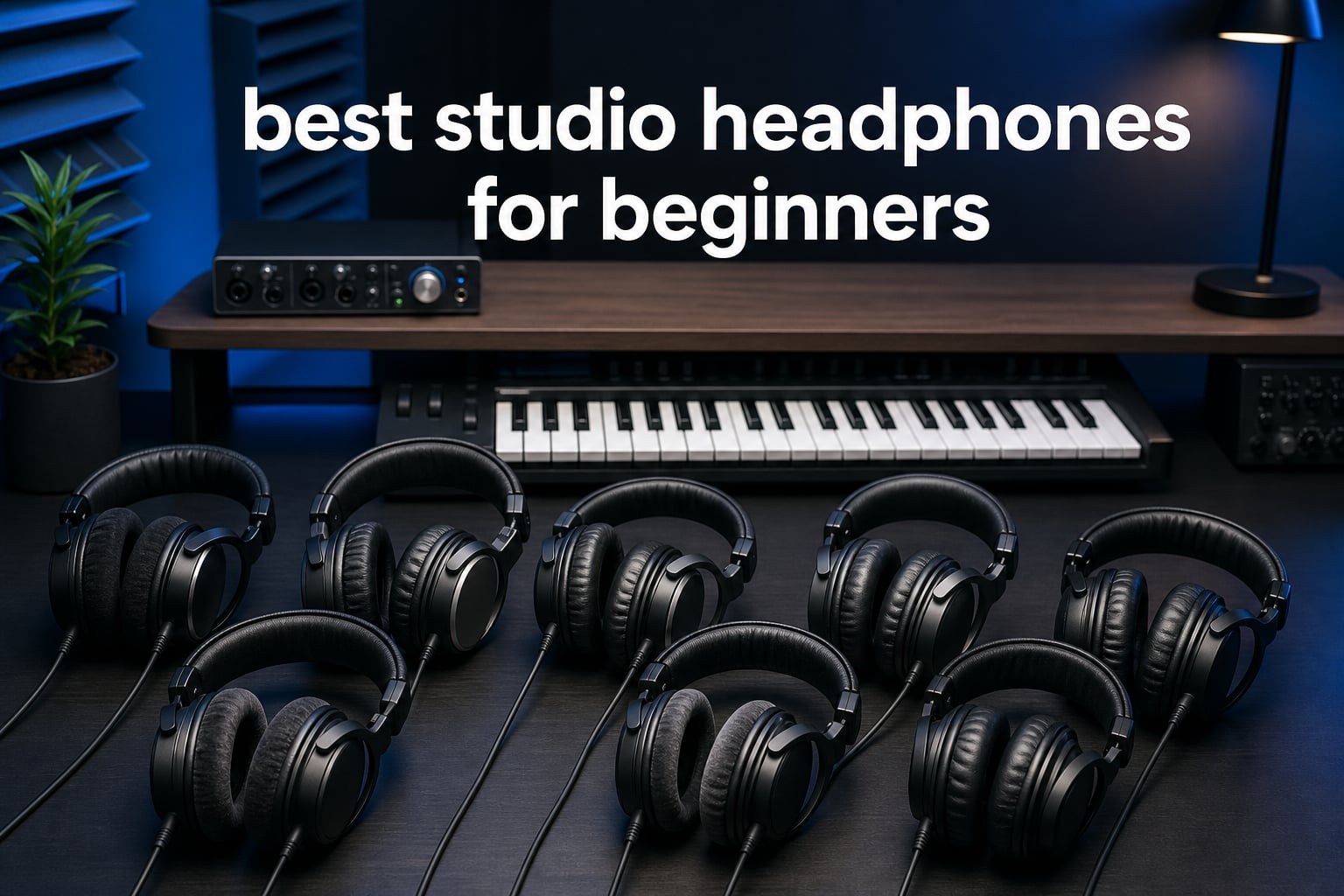
The best studio headphones for beginners are wired, comfortable models that make it easier to hear the balance of a recording without adding Bluetooth delay or relying on an untreated room. For most first-time producers, a closed-back pair with modest impedance is the easiest starting point because it works for both private practice and recording.
Our practical first choice is the Audio-Technica ATH-M50x for its 45 mm drivers, 38-ohm load, detachable cable system, folding frame, and swiveling earcups. The Sony MDR-7506 is a close alternative if you want a lighter folding workhorse with a long fixed cable, while the ATH-M20x makes sense when the goal is simply to begin tracking and learning.
This guide compares eight wired studio headphones using the published product specifications and customer-feedback summaries in our research. We focus on what a newcomer can act on: isolation, fit, cable arrangement, sensitivity, impedance, portability, and whether a model fits recording, monitoring, or early mixing practice.
There is no single frequency response number that tells you whether a headphone will make a mix good. A useful beginner pair is one you can wear often, connect reliably to your existing gear, and learn by repeatedly checking familiar commercial tracks alongside your own work.
Table of Contents
The top 3 picks give beginners the clearest starting point
Choose the ATH-M50x if you want the most rounded studio tool, the MDR-7506 if a compact proven monitor with a long cable suits your desk, and the ATH-M20x if you want a simple entry point with isolation. All three are wired closed-back options, so they are better suited to tracking vocals than open designs that let more sound escape.
- Audio-Technica ATH-M50x: closed-back, 38 ohms, 45 mm drivers, detachable cables, and folding earcups for the broadest beginner workflow.
- Sony MDR-7506: closed-ear, 63 ohms, 40 mm drivers, a 9.8-foot fixed cord, and a light folding build for focused monitoring.
- Audio-Technica ATH-M20x: circumaural isolation, 47 ohms, 40 mm drivers, and a single-side cable for a straightforward first setup.
All eight studio headphones for beginners are compared here
The quick view below puts the connection-relevant facts ahead of vague claims. Treat it as a shortlist, then read the individual notes to match the headphone to your recording space and daily workflow.
| Product | Specifications | Action |
|---|---|---|
 Audio-Technica ATH-M50x Audio-Technica ATH-M50x |
|
Check Latest Price |
 Sony MDR-7506 Sony MDR-7506 |
|
Check Latest Price |
 Audio-Technica ATH-M20x Audio-Technica ATH-M20x |
|
Check Latest Price |
 Audio-Technica ATH-M40x Audio-Technica ATH-M40x |
|
Check Latest Price |
 Sennheiser HD 280 Pro Sennheiser HD 280 Pro |
|
Check Latest Price |
 AKG K92 AKG K92 |
|
Check Latest Price |
 MAONO MH601 MAONO MH601 |
|
Check Latest Price |
 OneOdio Pro-10 OneOdio Pro-10 |
|
Check Latest Price |
1. Audio-Technica ATH-M50x is the best all-round first studio headphone
Audio-Technica ATH-M50X Professional Studio Monitor Headphones, Black, Professional Grade, Critically Acclaimed, with Detachable Cable
45 mm drivers
38 ohms
Detachable cables
Pros
- 45 mm drivers
- Three included cables
- Foldable frame
- Swivel earcups
- Sound isolation
Cons
- Wired only
- Not water resistant
The ATH-M50x is the easiest recommendation when you need one pair for beat-making, editing, tracking, and ordinary listening. Its 38-ohm impedance and 99 dB sensitivity point to an approachable load for common computer and mobile outputs, while the closed, isolating design suits a shared home.
Audio-Technica specifies proprietary 45 mm dynamic drivers with rare-earth magnets and copper-clad aluminum wire voice coils. The published details also call out extended-range clarity and deep bass response, so I would use it to hear arrangement weight and low-end relationships, then cross-check every important decision on familiar reference tracks.
Practical details separate this model from a generic consumer pair. It folds, has 90-degree swiveling earcups for one-ear monitoring, and comes with three detachable cables, which gives a beginner options without immediately buying extras.
The buyer-feedback summary is unusually broad, with a 4.7 rating across more than 33k reviews and 83% five-star ratings in the supplied data. That does not replace your own ears, but it is meaningful community validation for a model that forums repeatedly point beginners toward.
The ATH-M50x works best for one-pair studio setups
Pick it if your first headphones must cover vocal tracking, beat construction, instrument practice, and transport between rooms. Isolation helps keep a click track or backing track contained when a microphone is open nearby.
The included cable choices also suit a changing setup. A shorter run feels tidier at a laptop, while a longer option is more comfortable when an interface sits away from the keyboard.
The ATH-M50x needs reference-track discipline for mixing
No closed-back headphone should be treated as a complete replacement for monitors or a second reference. Spend time switching between several tracks you know well and your mix at a safe volume.
If you mainly mix late at night and never record, a more spacious open-back design may be worth considering later. This list contains closed options because they ask less of a beginner’s room and recording routine.
2. Sony MDR-7506 is the focused monitoring workhorse
Sony MDR7506 Professional Large Diaphragm Headphone
40 mm drivers
63 ohms
9.8 foot fixed cord
Pros
- Detailed sound
- Closed-ear isolation
- Folding design
- Soft case included
- Long cable
Cons
- Cable is not detachable
- 90 day warranty
The Sony MDR-7506 is a familiar name in recording environments because it keeps the formula simple: 40 mm dynamic drivers, a closed-ear fit, folding earcups, and a 9.8-foot cable. It is especially appealing to a learner who records at a desk but needs room to step toward a mic stand.
Its 63-ohm impedance is higher than the Audio-Technica M-series options here, yet it remains a plausible match for a computer or interface in a modest home setup. Try the actual output you own before assuming that impedance alone dictates volume; source power and sensitivity matter too.
Sony describes neodymium magnets and 40 mm drivers intended for detailed sound, with external-noise reduction from the closed construction. The supplied data lists a gold-plated plug, an included quarter-inch adapter, and a soft case, all of which make the package direct and studio-ready.
One limitation is impossible to miss: the long cord is fixed rather than detachable. Plan the cable path before buying, because the length is useful around a vocal position but can feel busy at a compact workstation.
The MDR-7506 is right for long-cable recording tasks
Choose this Sony if you track vocals, guitar, podcasts, or spoken-word takes and want a long reach without adding an extension lead. The folding construction and supplied case also suit creators who move between a bedroom studio and another recording space.
Customer feedback in the supplied research gives it a 4.7 rating from more than 28k reviews. That long-running popularity aligns with the forum view of the MDR-7506 as a dependable monitoring workhorse.
The MDR-7506 is less tidy for minimal desktop rigs
A fixed 9.8-foot cable is not as convenient as a detachable lead if your entire setup is a small laptop table. You cannot swap cable lengths to suit the moment.
The listed 90-day warranty is also shorter than the two-year coverage shown for several alternatives. If replaceable parts and longer stated coverage matter most, compare it with the HD 280 Pro or an Audio-Technica M-series model.
3. Audio-Technica ATH-M20x is the sensible basic closed-back choice
Audio-Technica ATH-M20x Professional Studio Monitor Headphones, Black
40 mm drivers
47 ohms
Single-side cable
Pros
- Sound isolation
- Light 210 g build
- Low-frequency tuning
- Two-year warranty
- Single-side cable
Cons
- Wired only
- No detachable cable
The ATH-M20x gives a beginner the core studio-headphone features without adding folding hardware or cable choices to think through. Its circumaural design targets isolation, and its 210 g weight is among the clearest comfort-friendly facts in the supplied specifications.
Audio-Technica lists 40 mm drivers with rare-earth magnets, copper-clad aluminum wire voice coils, and enhanced low-frequency tuning. That can make kick and bass enjoyable to monitor, but beginners should still compare low-end choices on speakers, a car system, or another trusted playback source.
The 47-ohm impedance and 96 dB sensitivity make this a rational first wired pair for laptop-based music production. A single-side, tangle-free cable exit is also helpful when you are learning keyboard shortcuts, reaching for a MIDI controller, and keeping one side of the desk clear.
It has a 4.6 rating across more than 26k reviews in the data supplied to us. That scale of feedback supports its role as a practical starter rather than a flashy all-purpose upgrade.
The ATH-M20x fits first-time tracking and practice sessions
Use it when you want isolation for vocal takes, guitar practice, or building a first project in a noisy room. The closed circumaural shell is more useful for that job than a headphone chosen mainly for an airy soundstage.
It is also a clean route for anyone who wants to learn basic monitoring habits before deciding which sound signature they prefer. Play familiar tracks, write down what seems bass-heavy or harsh, and return to those notes after a week.
The ATH-M20x has fewer convenience features than higher models
This is not the M-series option to choose if detachable cables and one-ear swivel monitoring are priorities. Those details appear on the ATH-M40x and ATH-M50x instead.
The model is wired-only, as are all eight selections. That is intentional for production work: forum discussions often warn beginners that wireless connections add latency concerns during timing-sensitive recording.
4. Audio-Technica ATH-M40x is the flexible cable-and-swivel option
Audio-Technica ATH-M40x Professional Studio Monitor Headphone, Black, with Cutting Edge Engineering, 90 Degree Swiveling Earcups, Pro-Grade Earpads/Headband, Detachable Cables Included
40 mm drivers
35 ohms
Detachable cable system
Pros
- 35 ohm load
- Swivel earcups
- Detachable cables
- Carrying case
- Comfortable materials
Cons
- Wired only
- Not water resistant
The ATH-M40x is a strong choice for beginners who know they want detachable cables and one-ear monitoring from day one. It has 40 mm drivers, a 35-ohm impedance, 98 dB sensitivity, and 90-degree swiveling earcups in the supplied product data.
That low impedance means it is a sensible candidate for a laptop or a small interface, subject to normal output-volume testing. The stated included coiled cable and protective case add real workflow usefulness if you record standing up or pack your gear away after each session.
Audio-Technica specifies professional-grade ear pad and headband material, plus 40 mm drivers with rare-earth magnets and copper-clad aluminum voice coils. It is a closed, isolating product, so it belongs more naturally in recording and focused practice than in a quiet-room mixing-only role.
The feedback summary records a 4.6 rating from more than 16k reviews. Its appeal is not that it promises a shortcut to a finished mix; it gives a new producer flexible physical tools for repeated work.
The ATH-M40x is best for creators who switch tasks often
Choose this model when your session can move from programming drums to recording a vocal, then to one-ear cueing. The swivel design and detachable system are helpful details in that kind of stop-and-start workflow.
It is also a sensible middle ground for a creator who wants to store cables separately or replace a worn lead rather than tie the entire headphone to one permanent cord.
The ATH-M40x does not make room acoustics irrelevant
Closed-back headphones reduce outside noise, but they do not teach you how a mix will translate to speakers. Check your work on more than one playback system before calling it finished.
If your only goal is quiet reference listening at a fixed desk, the added cable flexibility may not matter as much. Start with the fit, isolation requirement, and source device you actually use.
5. Sennheiser HD 280 Pro is the isolation-first recording choice
Sennheiser HD 280 Pro Headphone, Black
64 ohms
Up to 32 dB attenuation
Replaceable parts
Pros
- Up to 32 dB attenuation
- Replaceable pads
- Collapsible earcups
- Warm natural sound
- Two-year warranty
Cons
- Heavier 1.28 lb build
- Listed tablet compatibility
The Sennheiser HD 280 Pro should be near the top of your list when sound from the room is the central problem. Sennheiser specifies a dynamic closed-ear design with up to 32 dB attenuation of outside sound, a 64-ohm impedance, and collapsible earcups.
That amount of stated attenuation is useful context for a bedroom near household activity, a busy rehearsal space, or a vocalist who needs a more contained cue mix. It also means you should stay aware of your surroundings rather than treating isolation as a reason to raise monitoring volume.
What stands out in the details is repair-minded practicality: earpads, headband padding, and the audio cord are described as easily replaceable. For a beginner who plans to use one pair frequently, that can matter more over time than an extra feature on a spec sheet.
The supplied buyer summary gives it a 4.5 rating across more than 11k reviews and describes warm, natural reproduction. At 1.28 pounds, however, it is notably heavier than several picks here, so fit is a decision factor rather than an afterthought.
The HD 280 Pro is strongest where outside noise interrupts work
Choose it for tracking and monitoring in a space where household sound or nearby instruments break your concentration. Better isolation can help you hear the cue mix at a safer level.
The collapsible earcups make it practical for transport, while replaceable contact parts give it a sensible maintenance story for frequent use.
The HD 280 Pro needs a comfort check for longer sessions
Its listed weight means that personal fit should come before a long session. Wear breaks are normal and useful, especially when you are still learning to judge balances without ear fatigue.
The supplied listing primarily names tablets under compatible devices, so verify your plug and adapter needs for your own interface, computer, or controller before committing.
6. AKG K92 is the lightweight, low-impedance comfort pick
AKG K92 Closed-back studio headphones
40 mm drivers
32 ohms
Self-adjusting headband
Pros
- 32 ohm impedance
- Self-adjusting band
- Light 0.2 kg build
- 3 m cable
- Quarter-inch adapter
Cons
- No microphone
- Not water resistant
The AKG K92 makes a clear case for a beginner who values a low 32-ohm load and a light 0.2 kg specification. Its closed-back circumaural cups, self-adjusting headband, and three-meter cable create a straightforward home-studio package.
AKG lists 40 mm professional drivers, 113 dB sensitivity, and a frequency range stated as 16 Hz to 20,000 Hz in product details, with technical details also citing 16 Hz to 22 kHz. The practical lesson is not to chase the endpoint number; listen for whether familiar vocals, cymbals, and bass feel intelligible at normal volume.
The included 3.5 mm to quarter-inch screw adapter removes one common beginner frustration when connecting to an interface. This model can therefore suit a creator moving between a laptop output and a device with a larger headphone jack.
Customer feedback in the supplied research gives the K92 a 4.5 rating across more than 5k reviews, with praise summarized around detail, isolation, and the self-adjusting band. Those are useful signals for a learner who wears headphones throughout arrangement and editing sessions.
The AKG K92 works well for easy-device compatibility
Select the K92 if you want an easy-to-drive 32-ohm pair and an adapter included in the box. It is a practical fit for a modest laptop, controller, or audio-interface setup.
The self-adjusting headband is worth special attention if conventional notched headbands never seem to sit correctly on you. Comfort encourages the repeat listening that helps you learn a monitoring reference.
The AKG K92 is not a substitute for checking mix translation
A stated neutral sound signature can be helpful, but it does not remove the need to check your mix on speakers and everyday devices. Use references from the genre you make and listen for repeatable patterns.
It also has no built-in microphone, so plan a separate microphone if your work includes calls, streaming, or vocal recording. Studio headphones and a recording microphone serve different jobs.
7. MAONO MH601 is the comfort-led creator headphone
MAONO MH601 Wired Studio Headphone for Podcast Recording Stream DJ Mixing
50 mm driver
32 ohms
9.8 foot detachable cable
Pros
- 50 mm driver
- Detachable spring cable
- Swivel earcups
- Soft earmuffs
- Foldable frame
Cons
- No built-in microphone
- Separate mic needed
The MAONO MH601 focuses on creator-friendly physical features: a 50 mm driver, 32-ohm impedance, 90-degree swiveling earcups, foldable design, and a detachable 9.8-foot spring cable. The supplied data also describes ultra-soft protein earmuffs and zero-latency wired connection.
That specification mix makes it worth considering for vocal tracking, podcast editing, and instrumental practice where comfort and cable reach shape the session. Its 103 dB sensitivity and 32-ohm load suggest a friendly starting point for common sources, though you should always test your own output level.
MAONO says the closed construction blocks 85% of ambient noise. Treat that figure as a manufacturer claim rather than a universal measurement, but the closed design itself is the relevant feature for keeping cue audio contained around a microphone.
The research summary shows a 4.5 rating across more than 3k reviews, with feedback emphasizing immersive sound, cushions, and swivel functionality. It is particularly sensible for a creator whose first projects combine spoken voice and music rather than mixing alone.
The MH601 suits long tracking and podcast sessions
Choose it when a soft fit, a long detachable cable, and single-ear monitoring will make you more likely to finish sessions. The 50 mm driver and wired setup also keep the signal path simple.
The detachable cable ending in 3.5 mm and 6.35 mm connections can make the transition between compact devices and studio gear less awkward.
The MH601 needs a separate plan for voice capture
It has no built-in microphone, so it cannot replace a dedicated USB or XLR mic for podcasting and calls. That is normal for monitoring headphones, but it is easy to overlook when building a first setup.
For mix decisions, avoid assuming larger drivers automatically mean more accurate monitoring. Use familiar songs and translation checks to decide whether the presentation works for your ears.
8. OneOdio Pro-10 is the flexible entry-level DJ and practice option
OneOdio Wired DJ Hi-Res Over-Ear Headphones for PC, Keyboard Guitar – Black
50 mm drivers
32 ohms
Share audio port
Pros
- 50 mm drivers
- 32 ohm impedance
- Swivel cups
- Detachable cable
- Share port
Cons
- Wired only
- Water resistant not waterproof
The OneOdio Pro-10 is positioned as a wired over-ear monitor and mixing headphone with 50 mm neodymium-driver units, 32-ohm impedance, 110 dB sensitivity, and 90-degree swiveling cups. It is the practical pick for a beginner interested in DJ-style cueing, practice, or sharing a listening session.
Its detachable cable system accepts 3.5 mm and 6.35 mm connections, and the share-audio port can connect another pair. Those are helpful conveniences when you are working with a friend, taking a lesson, or moving between a controller and a regular device.
The product details state a 20 Hz to 40 kHz frequency range, soft padded cushions, a flexible self-adjusting headband, and a foldable build. The published buyer summary emphasizes powerful bass, clear vocals, and crisp highs, so use it as a general creative tool rather than assuming a particular bandwidth figure guarantees neutral mixing.
It holds a 4.4 rating in the supplied data from more than 76k reviews. That is a large feedback pool, but the model’s DJ-oriented features mean it is best chosen for a matching workflow, not merely because it has many reviews.
The Pro-10 is a good match for cueing and shared practice
Pick it if you want single-ear monitoring for DJ practice, two common plug sizes, and a way to share audio with another listener. The 32-ohm impedance also keeps device pairing simple for many beginner rigs.
Its folded form and padded cushions fit the creator who wants one wired pair for practice, casual listening, and early controller work.
The Pro-10 should be checked carefully for mix neutrality
The supplied feedback calls out powerful bass, which can be enjoyable but is a reason to use reference tracks before setting low-end levels. Compare your kick and bass decisions on at least one other system.
As with the rest of this guide, wired operation is a feature for timing-critical work. It avoids the wireless latency concern that beginner producers often mention after trying to record or cue in real time.
Beginners should choose closed-back headphones before chasing specifications
Closed-back headphones place a solid outer shell behind the driver. They reduce the sound that reaches your ears from the room and reduce the sound leaking outward, which makes them the safer choice for recording vocals, practicing beside other people, and working in a typical bedroom.
Open-back headphones have ventilated outer cups. They can feel more spacious and can make it easier to judge stereo placement in a quiet room, but they leak sound and let room noise in, so they are a poor choice when recording into an open microphone.
Every selection in this guide is a wired closed-back or closed-ear design. That is deliberate: for a first pair, isolation and predictable recording behavior solve more immediate problems than an open-back soundstage.
Impedance tells beginners how demanding a headphone may be
Impedance, measured in ohms, describes part of the electrical load a source sees. It is not a quality score, and it cannot by itself tell you how loud a headphone will play, because sensitivity and the power of your laptop, phone, controller, or interface also matter.
The 32-ohm AKG K92, MAONO MH601, and OneOdio Pro-10 are the lowest-impedance models here. The ATH-M40x at 35 ohms and ATH-M50x at 38 ohms also sit in a beginner-friendly range, while the Sony MDR-7506 and Sennheiser HD 280 Pro are each listed at 63 or 64 ohms.
Start by connecting the headphone directly to the equipment you own and listening at a moderate level. If it cannot reach a comfortable, clean level, or if an interface manual specifies a suitable headphone range, then consider a more capable headphone output or dedicated amp rather than buying one by default.
Frequency response is a listening tool rather than a scorecard
Frequency response describes the span of frequencies a headphone is specified to reproduce. It does not show every peak or dip, and a wider printed range does not automatically mean a more dependable mixing reference.
For beginner mixing headphones, listen for practical clues: can you identify vocal level changes, hear whether a snare is too sharp, and notice when bass crowds the kick? Compare the same three to five professionally mixed songs each session, preferably from the genres you make.
Write down what you hear rather than relying on memory. After several sessions, you may notice that your headphones make you consistently under- or over-estimate a range; that knowledge is what producers mean when they say they have learned their headphones.
A beginner setup should stay wired, simple, and repeatable
Connect a wired headphone to your computer, controller, or audio interface with the correct adapter. Keep the volume low before playback, then raise it only enough to hear detail without fatigue.
For recording vocals, set up the performer with a closed-back pair, use a cable route that will not catch a chair or mic stand, and check for headphone bleed before the take. The Sony MDR-7506 and MAONO MH601 offer long cable runs; the ATH-M40x and ATH-M50x offer detachable-cable flexibility.
Use an audio interface when you need microphone inputs, direct monitoring, or a more purposeful desktop connection. You do not need an expensive interface simply because you own studio headphones, and you do not need a headphone amp unless your source cannot provide adequate clean level.
Genre and task should decide the final shortlist
For vocal recording and podcast work, prioritize isolation, cable reach, and a comfortable seal. The HD 280 Pro, MDR-7506, ATH-M40x, ATH-M50x, and MH601 fit that description in different ways.
For beat-making and general music production, the ATH-M50x offers the most complete feature set in this group, while the ATH-M20x creates a simpler starting point. If you work from a laptop or basic controller, the 32-ohm K92, MH601, and Pro-10 are logical models to audition.
For DJ practice and cueing, swivel cups and connection options matter more than a marketing label. The OneOdio Pro-10, MH601, ATH-M40x, and ATH-M50x each include one-ear monitoring through 90-degree swivel earcups.
A short checklist prevents the most common first purchase mistakes
- Choose wired: direct cable monitoring avoids the latency worry that appears repeatedly in beginner production discussions.
- Choose closed-back for recording: it limits headphone bleed and helps in a shared or noisy room.
- Check the plug: identify whether your device needs 3.5 mm, quarter-inch, or an adapter before the headphones arrive.
- Check the cable path: decide whether you need a long fixed cable, a coiled lead, or a detachable option.
- Check the fit: a headphone you cannot wear for a full editing session is not the right monitoring tool for you.
- Build a reference habit: use the same familiar tracks, a second playback system, and sensible listening levels.
Do not make the common mistake of choosing only by driver size, advertised frequency range, or review count. Those facts can narrow a shortlist, but your room, source device, recording needs, and physical comfort decide whether you will actually use the pair enough to learn it.
The answers below solve the main beginner studio-headphone questions
What are the best studio headphones for beginners?
The Audio-Technica ATH-M50x is the best all-round beginner pick because it combines 45 mm drivers, a 38-ohm load, detachable cables, folding earcups, and closed-back isolation. The Sony MDR-7506 suits long-cable monitoring, while the ATH-M20x is a simpler entry-level closed-back choice.
Are cheap headphones good enough for studio work?
A basic wired closed-back headphone can be good enough to start tracking, editing, and learning references if it is comfortable, connects properly, and you check mixes on other systems. Do not expect any first pair to replace translation checks or consistent practice.
What is the difference between open-back and closed-back headphones for mixing?
Open-back headphones let sound in and out and can feel more spacious in a quiet room. Closed-back headphones isolate better and leak less sound, making them the more practical choice for recording vocals, shared rooms, and a beginner’s first studio pair.
Do I need a headphone amp for studio headphones?
No. Start with the headphone output on your laptop, controller, or audio interface. Consider a more capable output or amp only if your current source cannot deliver a comfortable clean level, and check impedance and sensitivity together rather than using impedance alone.
How much should a beginner spend on studio headphones?
Choose based on fit, isolation, cable needs, and compatibility instead of a spending target. A modest wired closed-back model can teach useful monitoring habits when you use familiar reference tracks and check your work on more than one playback system.
The best final choice is the pair that fits your first studio routine
For the broadest mix of beginner needs in 2026, choose the Audio-Technica ATH-M50x. Pick the Sony MDR-7506 for a long-cable monitoring workflow, the ATH-M20x for a straightforward entry point, or the HD 280 Pro when isolation is the priority.
The best studio headphones for beginners are not a magic answer to mixing. Choose a wired pair you can wear often, build a reference-track routine, and check every important project on another playback system before you publish it.