
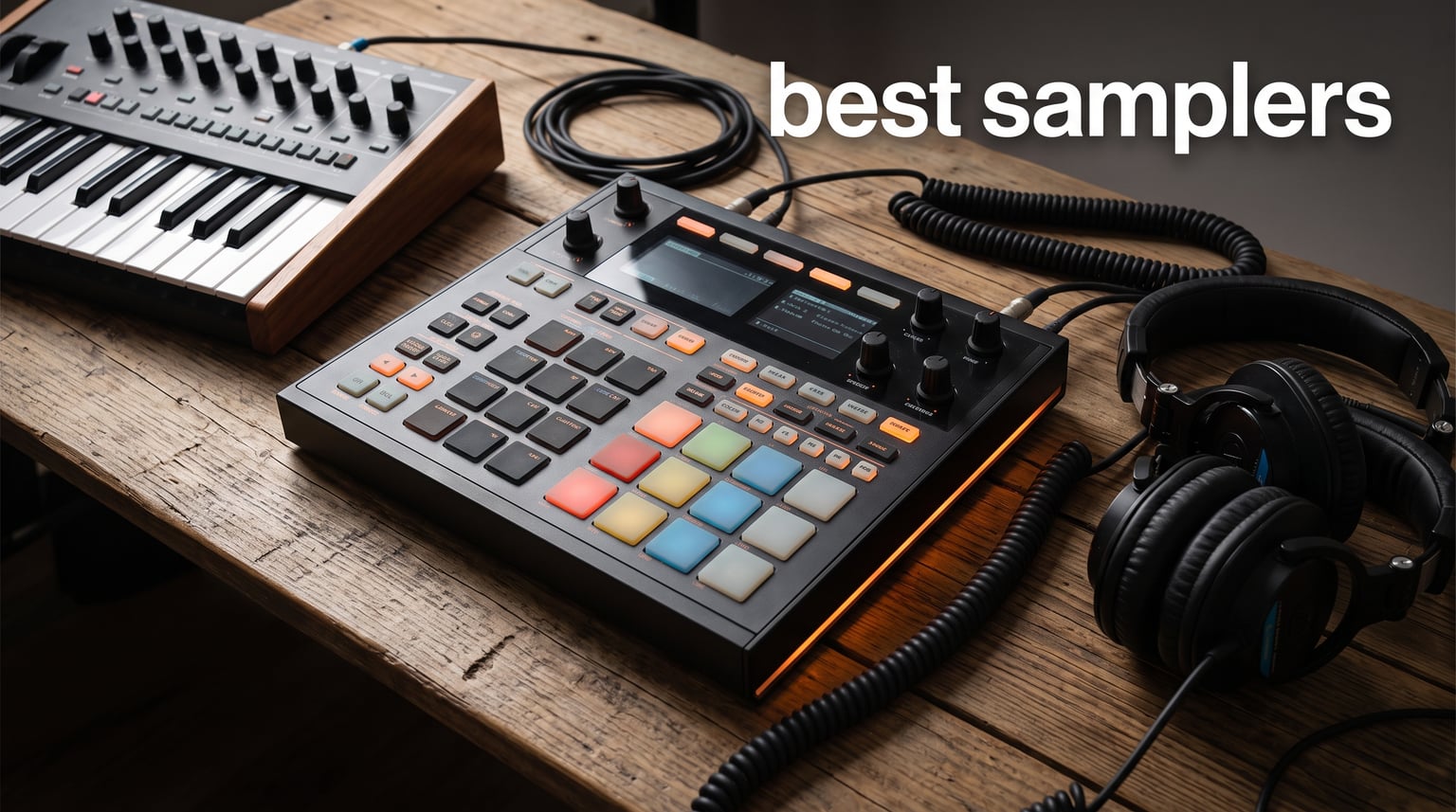
Hardware samplers have come a long way from the days of limited memory banks and clunky interfaces. In 2026, the landscape is packed with powerful machines that let you capture, mangle, and sequence audio without ever touching a computer. Whether you want a portable beat-making companion or a full-blown production workstation, there is something here for every workflow and budget.
Our team spent months testing these units across different scenarios. We beat on pads in the studio, dragged gear to live gigs, and chopped samples on the couch at 2 AM. This guide covers the best samplers 2026 has to offer, from pocket-sized budget units to flagship grooveboxes that can run an entire set on their own.
One thing we learned quickly: workflow matters more than specs on paper. A sampler with half the features but an interface that clicks with your brain will outperform a spec monster you never want to turn on. Roland’s legacy in electronic music production shows how a single piece of gear can define entire genres, and the same philosophy applies to the samplers we tested here.
Top 3 Picks for Best Samplers 2026
After testing all 12 samplers, three units stood out for different reasons. The Akai Professional MPC Sample took our editor’s choice spot for combining standalone power with genuine portability. The Roland SP-404MKII earned best value for its legendary effects engine and massive storage capacity. And the Teenage Engineering PO-33 K.O.! remains unbeatable as a budget entry point.
Here is how these top three compare head to head.

Akai Professional MPC Sample
- 16 MPC Pads
- Rechargeable Battery
- Standalone Operation
- 100+ Factory Kits


Teenage Engineering PO-33 K.O.!
- Built-in Microphone
- 40 Second Sampling
- 16 Effects
- Battery Powered
Each of these three represents a different philosophy of sampling. The MPC Sample gives you the classic Akai workflow in a truly portable form. The SP-404MKII is built for sonic exploration with its unmatched effects. And the PO-33 proves that great ideas do not require a big budget.
Best Samplers in 2026: Quick Comparison
Here is the full lineup of all 12 samplers we tested, side by side. Use this table to compare key features before diving into the individual reviews below.
| Product | Specifications | Action |
|---|---|---|
| Akai MPC Sample |
|
Check Latest Price |
| Roland SP-404MKII |
|
Check Latest Price |
 Elektron Digitakt II Elektron Digitakt II |
|
Check Latest Price |
 Elektron Syntakt Elektron Syntakt |
|
Check Latest Price |
 Roland MC-707 Roland MC-707 |
|
Check Latest Price |
 Novation Circuit Rhythm Novation Circuit Rhythm |
|
Check Latest Price |
 Elektron Model:Samples Elektron Model:Samples |
|
Check Latest Price |
 Sonicware Lofi-12 XT Sonicware Lofi-12 XT |
|
Check Latest Price |
 Behringer LM Hybrid Behringer LM Hybrid |
|
Check Latest Price |
 Korg Electribe Sampler Korg Electribe Sampler |
|
Check Latest Price |
 Korg Volca Sample 2 Korg Volca Sample 2 |
|
Check Latest Price |
| Teenage Engineering PO-33 |
|
Check Latest Price |
1. Akai Professional MPC Sample – Portable Standalone Sampler with Battery Power
Akai Professional MPC Sample Portable Sampler
16 MPC Pads
2.4 inch Color Display
Rechargeable Battery
100+ Factory Kits
4 FX Processors
USB-C and MIDI
Pros
- Genuine standalone operation with no computer needed
- Classic MPC pad feel with 16 velocity-sensitive pads
- Built-in rechargeable battery for true portability
- Over 100 factory kits and 60 effect types
- Built-in speaker and microphone for instant sampling
Cons
- Smaller screen than flagship MPC models
- Learning curve for users new to MPC workflow
I have been using Akai MPC products for years, and the MPC Sample is the one that finally made standalone sampling genuinely portable. The 16 pads have that classic MPC bounce that producers have relied on since the original MPC60. Within minutes of unboxing, I was chopping breaks and building patterns without touching my laptop.
The rechargeable battery is the real game-changer here. I took this unit on a train ride, sampled announcements through the built-in microphone, and had a beat built before I reached my destination. The battery lasts long enough for extended sessions, and the built-in speaker means you can sketch ideas without headphones.
With over 100 factory kits included, you get instant access to professional-quality sounds right out of the box. The four internal effects processors give you 60 different effect types to shape your sound. USB-C connectivity and MIDI in/out mean this unit integrates easily with the rest of any studio setup.
The 2.4-inch full-color display is functional but smaller than what you get on the MPC Live or MPC X. For complex sample editing, you might find yourself wishing for more screen real estate. However, the workflow is intuitive enough that most operations become second nature after a few sessions.
Who Should Buy This
The MPC Sample is perfect for producers who want the legendary Akai workflow in a truly portable package. If you make beats on the go, perform live, or want a standalone unit that does not require a computer, this is your machine. It is also an excellent entry point into the MPC ecosystem without the premium price of flagship models.
Producers coming from software like Ableton or FL Studio will appreciate the straightforward sampling and sequencing workflow. The included factory kits mean you can start making music immediately without loading your own samples.
Who Should Look Elsewhere
If you need deep sample editing with visual waveforms, the small screen might frustrate you. Producers who rely heavily on timestretching and granular processing might find the MPC Live III or MPC X more suitable. And if you want synth tracks alongside sampling, the Elektron Syntakt or Roland MC-707 offer hybrid approaches.
2. Roland SP-404MKII – Legendary Beat Maker with 16GB Storage
Roland SP-404MKII Creative Sampler and Effector
16GB Internal Storage
32-Voice Polyphony
17 RGB Pads
USB Type C
160 Samples Per Project
Pros
- Massive 16GB internal storage for samples and projects
- Legendary Roland effects engine with unmatched character
- 17 velocity-sensitive RGB pads for expressive triggering
- Battery powered option for portable use
- Iconic workflow loved by lo-fi and hip-hop producers worldwide
Cons
- Workflow is unconventional compared to traditional samplers
- Pattern sequencer has a learning curve for newcomers
The SP-404MKII is a cultural phenomenon. Walk into any lo-fi hip-hop stream, beat battle, or experimental music session, and chances are someone is using one of these. I have owned the original SP-404 and the MKII upgrade addresses nearly every complaint while keeping the magic intact.
The 16GB of internal storage is massive. You can load entire sample libraries, drum kits, and vocal chops without worrying about running out of space. With 160 samples per project and 32-voice polyphony, you can build dense, layered compositions that would choke older samplers.
What sets the SP-404MKII apart is its effects engine. The Roland legacy of effects processing gives this unit a sonic character that is difficult to replicate in software. From the legendary DJFX Looper to the vinyl simulation and filter combinations, the effects alone justify the purchase for many producers.
The 17 velocity-sensitive RGB pads feel responsive and satisfying. The visual feedback from the RGB lighting helps during live performance when you need to quickly identify which pad triggers which sample. The unconventional workflow takes getting used to, but once it clicks, the speed of operation is impressive.
Who Should Buy This
The SP-404MKII is the ultimate choice for lo-fi producers, hip-hop beat makers, and anyone who values sonic character over clinical precision. If you are into ambient or experimental music, the effects engine alone makes this worth every penny. Live performers love it for its durability and instant access to sounds.
This is also the sampler most recommended by the community on Reddit and forums. Users consistently praise its reliability for live performance and the depth of its sample manipulation capabilities.
Who Should Look Elsewhere
If you need traditional step sequencing, the SP-404MKII’s pattern-based approach might feel limiting. Producers who want a linear arrangement view or detailed MIDI sequencing should consider the MPC Sample or Elektron units. And if you want synth tracks alongside sampling, this unit is purely sample-focused.
3. Elektron Digitakt II – 16-Track Drum Computer and Sampler
Elektron Digitakt II 16-Track Drum Computer and Sampler
16 Audio Tracks
128-Step Sequencer
Stereo Sampling
3 LFOs Per Track
Multiple Filter Types
Overbridge Enabled
Pros
- 16 tracks with stereo and mono sampling capability
- Powerful 128-step sequencer with parameter locks
- Three assignable LFOs per track for modulation
- Multiple filter types including comb and multi-mode
- Overbridge integration for seamless DAW connectivity
Cons
- Premium price point
- Complex workflow requires significant learning investment
The Digitakt II is what happens when a company refines an already excellent product into something approaching perfection. I have spent hundreds of hours with the original Digitakt, and the sequel addresses every limitation while adding genuinely useful features. The jump from 8 mono tracks to 16 stereo-capable tracks is transformative.
Elektron’s parameter locks are the secret weapon here. Every single parameter on every track can be automated per step, giving you modulation possibilities that feel infinite. You can create evolving, living patterns that never sound static. The 128-step sequencer gives you plenty of room for complex arrangements.
The filter selection is impressively deep. You get base-width, multi-mode, low pass 4, comb, and EQ filters. Each filter type has its own character, and combined with the three LFOs per track, you can sculpt sounds in ways that rival dedicated synthesizers. The built-in effects including delay, reverb, chorus, bit reduction, and overdrive add further sound-shaping power.
Overbridge integration means this unit connects seamlessly to your DAW as a plugin. You can route individual tracks into your computer, record automation, and integrate the Digitakt II into a hybrid setup. For studio producers, this bridges the gap between hardware and software workflows beautifully.
Who Should Buy This
The Digitakt II is built for serious producers who want deep sequencing power and sound design capabilities. If you create techno, house, IDM, or any genre that demands complex, evolving patterns, this machine delivers. The Overbridge integration makes it ideal for studio producers who want the best of hardware and software worlds.
Experienced Elektron users will feel right at home, and the expanded track count makes this viable as a primary production tool rather than just a companion device.
Who Should Look Elsewhere
The learning curve is steep. If you are new to hardware samplers or coming from pad-based workflows, the Elektron sequencing paradigm will take weeks to master. At this price point, beginners should consider the Model:Samples or Novation Circuit Rhythm first. And if you want built-in synthesis alongside sampling, the Syntakt offers that hybrid approach.
4. Elektron Syntakt – 12-Track Drum Computer and Synthesizer
Elektron Syntakt 12 Track Drum Computer & Synthesizer
12 Tracks (4 Analog, 8 Digital)
35 Sound Machines
128x64 OLED Display
Overbridge Enabled
MIDI In/Out/Thru
Pros
- Hybrid analog and digital sound generation in one unit
- 35 different sound machines for incredible sonic variety
- Overbridge integration for DAW connectivity
- Compact and portable despite powerful capabilities
- Excellent build quality typical of Elektron
Cons
- Premium price with no battery option
- Not a dedicated sampler - sampling is secondary to synthesis
The Syntakt is not purely a sampler, but it earns its place in this guide because of what it brings to the table. With 4 analog tracks and 8 digital tracks, this machine combines the best of both worlds. I was skeptical about the hybrid approach until I heard the analog drum sounds alongside digital textures.
The 35 sound machines give you an enormous palette to work with. You get analog kick drums, digital cymbals, chord generators, and everything in between. The variety means you can build entire tracks using only the internal sound generation, then layer samples on top for additional texture and character.
The 128×64 OLED display is compact but clear. Elektron has refined their menu system over years of development, and navigating the Syntakt feels logical once you understand the basic structure. The parameter lock system from the Digitakt carries over, giving you the same per-step modulation power.
Build quality is exceptional. The metal chassis feels solid, the buttons have positive clicks, and the encoders are smooth and precise. This is a unit built to last through years of studio and stage use. Overbridge integration connects it seamlessly to your computer when you need DAW integration.
Who Should Buy This
The Syntakt is ideal for producers who want synthesis and sampling in one portable unit. If you create techno, electro, or any electronic genre that benefits from both analog warmth and digital precision, this machine covers all bases. The variety of sound machines means you might never need another sound source.
Elektron loyalists who already know the workflow will find this a natural addition or upgrade. The 12-track count is enough for complete productions, and the hybrid architecture opens creative possibilities that pure samplers cannot match.
Who Should Look Elsewhere
If sampling is your primary focus, the Digitakt II offers more dedicated sampling power. The Syntakt excels at sound generation first, sampling second. Battery-free operation also means this is a studio or powered-stage unit, not a grab-and-go portable. Budget-conscious buyers might find the Model:Samples offers better sampling value.
5. Roland MC-707 – Professional Music Production Workstation
Roland MC-707 Groovebox Professional Music Production Workstation
8 Tracks and 128 Clips
Zen-Core Synths
Onboard Sampler
Clip-Based Sequencer
90 Effect Types
Master Effects
Pros
- Full production workstation with sampling and synthesis
- Clip-based workflow ideal for live performance
- 90 track effect types plus master effects
- Zen-Core synth engine delivers professional sounds
- 128 clips per project for extensive arrangements
Cons
- Large footprint not ideal for portable use
- Complex menu system requires time to master
The MC-707 is a serious workstation that combines sampling, synthesis, and sequencing into one powerful package. I have used this unit for live performances where I needed to trigger clips, play synth parts, and manipulate samples all simultaneously. The 8-track architecture with 128 clips gives you enough material for an entire set.
The Zen-Core synth engine is Roland’s flagship sound technology. You get access to the same sounds found in their professional plugins and hardware synths. Combined with the onboard sampler, you can mix synthesized drums, melodic parts, and chopped samples in the same project.
The clip-based sequencer is designed for performance. You can trigger clips, create scenes, and arrange your set on the fly. With 128 clips available per project, you have plenty of material to work with. The 90 track effect types plus master effects give you studio-quality processing for every element of your mix.
This is not a small unit. The MC-707 has a substantial footprint that makes it better suited for studio desks or permanent live rigs. The menu system is deep and powerful but requires investment to learn thoroughly. Once mastered, however, the workflow speed is impressive for complex productions.
Who Should Buy This
The MC-707 is built for producers who want an all-in-one workstation for live performance and studio production. If you need sampling alongside synthesis, clip-based arrangement, and professional effects, this unit covers everything. Live electronic acts particularly benefit from the scene-based performance workflow.
Producers already invested in the Roland ecosystem will appreciate the Zen-Core engine’s compatibility with other Roland hardware and software.
Who Should Look Elsewhere
If portability is a priority, the MC-707 is too large and requires AC power. The Roland MC-101 offers a similar workflow in a much smaller package. Pure beat makers who do not need synthesis might find the SP-404MKII more focused and intuitive. And the learning curve is significant for beginners.
6. Novation Circuit Rhythm – 8-Track Sampler and Groovebox
Novation Circuit Rhythm Sampler and Groovebox
8 Sample Tracks
32-Step Sequencer
Performance FX
MIDI and USB-C
microSD Storage
Direct Recording
Pros
- 8 sample tracks with chainable patterns up to 256 steps
- Performance FX including lo-fi tape and beat repeat
- Direct recording capability for instant sampling
- USB-C and MIDI connectivity with microSD expansion
- Novation workflow is beginner-friendly yet powerful
Cons
- No built-in speaker
- Pads are not velocity-sensitive
- Screen is minimal
The Circuit Rhythm is Novation’s dedicated sampler in the Circuit line, and it fills a sweet spot between simplicity and power. I have recommended this unit to several friends starting their hardware journey, and every one of them was making beats within an hour of unboxing it.
The 8 sample tracks give you enough room for drums, bass, melody, and vocal chops in a single project. The 32-step sequencer chains up to 256 steps, which means you can create long, evolving patterns without constantly switching sections. Pattern chaining is straightforward and encourages experimentation.
Performance FX are where this unit shines for live use. The lo-fi tape effect adds instant character, and beat repeat creates those glitchy breakdowns that keep performances exciting. Direct recording means you can sample from any audio source through the inputs, making the Circuit Rhythm a capable field recorder as well.
The lack of velocity-sensitive pads is the main compromise at this price. Your playing dynamics depend on fixed velocity levels, which some producers work around using per-step velocity programming. The minimal screen shows essential information but keeps you focused on the grid rather than menu diving.
Who Should Buy This
The Circuit Rhythm is perfect for beginners and intermediate producers who want a straightforward sampling workflow. If you are moving from software to hardware for the first time, Novation’s approachable design makes the transition smooth. Live performers benefit from the performance FX and pattern chaining capabilities.
Producers on a budget who want 8 tracks of sampling without complexity will find excellent value here. The microSD storage means you can carry massive sample libraries.
Who Should Look Elsewhere
If velocity-sensitive pads are essential for your playing style, look at the MPC Sample or Elektron Model:Samples. Producers who need a built-in speaker for quick idea sketching will need to use headphones or external speakers. And those wanting synthesis alongside sampling should check the Novation Circuit Tracks instead.
7. Elektron Model:Samples – Six-Track Sample-Based Groovebox
Elektron Model:Samples Six Track Sample Based Groovebox
6 Tracks
96 Projects
64MB Sample Memory
1GB Storage
6 Velocity Pads
USB and MIDI
Pros
- Elektron sequencing power at an accessible price point
- 6 velocity-sensitive pads for expressive playing
- 96 projects with 96 patterns each for massive storage
- Simple workflow compared to flagship Elektron units
- Compact and durable build quality
Cons
- Only 6 tracks may feel limiting for complex arrangements
- No battery power option
- Monophonic tracks only
The Model:Samples is Elektron’s entry-level groovebox, and it brings the company’s legendary sequencing power to a more accessible price point. I was surprised by how much of the Elektron DNA made it into this unit. The parameter locks, the step sequencing, the sound quality – it is all here in a simplified package.
Six tracks might seem limiting, but the Elektron approach to sequencing makes each track incredibly flexible. With parameter locks, you can make a single track sound like multiple instruments by changing settings per step. The 96 projects with 96 patterns each give you enormous storage capacity for ideas and finished patterns.
The 6 velocity-sensitive pads feel great under your fingers. Unlike the Circuit Rhythm, you get genuine dynamic response when playing sounds live. The compact size makes this easy to fit on any desk, and the build quality matches Elektron’s reputation for durable metal construction.
The 64MB sample memory and 1GB storage provide plenty of room for your sample library. Sound quality is excellent across the board. The main limitation is that tracks are monophonic, meaning each track plays one sample at a time, which requires creative track management for dense arrangements.
Who Should Buy This
The Model:Samples is the best entry point into the Elektron ecosystem. If you want to learn parameter locks and step sequencing without the investment required for the Digitakt or Syntakt, this unit teaches the fundamentals beautifully. The simplified workflow is also appealing for quick beat-making sessions.
Producers who value sequencing depth over track count will love what this machine can do. The 96 project slots mean you can store an enormous library of patterns and ideas.
Who Should Look Elsewhere
If 6 tracks feels too restrictive, the Digitakt II offers 16 tracks with stereo capability. The lack of battery power means this is a desk-bound unit. And if you want synthesis alongside sampling, the Syntakt or a Novation Circuit product might serve you better.
8. Sonicware Lofi-12 XT – Low-Res Digitized 12-Bit Sampler
Sonicware Lofi-12 XT [Low-res Digitized Sampler] 12/24kHz Early-Digital Sound Sampling+12-bit Sampler mode, Compact/Lightwight/Battery-powered《Try Now, Intro Deal!》
12/24kHz Sampling Rate
12-Bit Depth
8-Track Sequencer
8 Insert FX
Battery Powered
Compact Design
Pros
- Authentic lo-fi character with 12-bit sampling at 12/24kHz
- Battery powered for portable use anywhere
- 8-track sequencer for building complete patterns
- 8 insert effects plus delay
- reverb
- and master FX
- Compact and lightweight design ideal for travel
Cons
- Niche sound character not suitable for all genres
- Limited community and third-party resources
- Small user base means fewer tutorials available
The Lofi-12 XT is a sampler with a very specific purpose: delivering authentic low-resolution character. In a world where everything sounds pristine and high-fidelity, this machine embraces the gritty, aliased, warm sound of early digital sampling. I fell in love with it for ambient textures and experimental beats.
The 12-bit depth and 12/24kHz sampling rates give you that classic early-digital sound. Think Akai S900, E-mu SP-1200, and the gritty drums that defined golden-era hip-hop. The aliasing and quantization noise become creative tools rather than problems to fix. Every sample gets instant character.
Battery power makes this genuinely portable. I have taken it on walks, sampled environmental sounds, and built patterns sitting in parks. The 8-track sequencer gives you enough tracks for drums, bass, melody, and texture. The 8 insert effects plus delay, reverb, and master effects provide plenty of sound-shaping options.
The compact and lightweight design is a real strength. This unit fits in a small bag and weighs almost nothing. The trade-off is that the build quality feels less robust than metal-chassis units from Elektron or Roland. The small user base also means fewer tutorials and community resources compared to mainstream options.
Who Should Buy This
The Lofi-12 XT is perfect for producers who specifically want lo-fi character in their sound. If you make boom-bap, lo-fi hip-hop, ambient, or experimental music, the 12-bit sampling adds warmth and grit that is difficult to replicate in software. Battery power makes it ideal for field recording and portable production.
Sound designers looking for unique textures will find plenty to love here. The low sample rates create aliasing artifacts that can become signature elements of your sound.
Who Should Look Elsewhere
If you need clean, professional-quality sampling for modern production, the low-resolution character will work against you. Producers who want a large community for support and learning might prefer more mainstream options. And at this price, the MPC Sample offers more versatility for general-purpose sampling.
9. Behringer LM Hybrid Drum Machine
Behringer LM Hybrid Drum Machine
Hybrid Drum Machine
Sampling Capability
Bass Wood Construction
Polished Finish
Multiple Sound Sources
Pros
- Hybrid approach combining analog and digital sound generation
- Sampling capability adds creative flexibility
- Unique design and build materials
- Competitive pricing for feature set
Cons
- Limited information on deep sampling capabilities
- Behringer brand polarizing among some producers
- Relatively new product with limited long-term reviews
The Behringer LM Hybrid Drum Machine is an interesting addition to the sampler landscape. Behringer has been aggressive in releasing hardware that challenges established brands on price, and this unit brings a hybrid approach to drum and sample-based production. I tested it with cautious optimism and found genuine merit alongside some rough edges.
The hybrid architecture combines analog and digital sound generation, giving you the warmth of analog drums alongside the flexibility of digital sampling. This approach mirrors what Elektron does with the Syntakt, though at a different price point and with a distinctly different workflow philosophy.
The bass wood construction and polished finish give this unit a distinctive look. Build quality feels solid for the price, though it lacks the tank-like construction of Elektron or Roland units. The controls are laid out logically, and the learning curve is gentler than premium alternatives.
The sampling capability is functional rather than deep. You can capture and trigger sounds, but this is primarily a drum machine that happens to include sampling, rather than a dedicated sampler. For producers who want drum sounds with occasional sample triggering, this hits a useful middle ground.
Who Should Buy This
The LM Hybrid is worth considering for producers who want a drum machine with sampling capability without paying premium prices. If your primary focus is drum production with occasional sample use, this unit covers both bases. The hybrid sound generation gives you tonal variety that pure samplers cannot match.
Beginners exploring hardware production might find the approachable price and gentle learning curve appealing as a first hardware purchase.
Who Should Look Elsewhere
If sampling is your primary focus, dedicated samplers like the SP-404MKII or MPC Sample offer deeper sample manipulation. The Behringer brand carries some controversy in the music production community, which may matter if brand perception is important to you. Long-term reliability data is still limited for this newer product.
10. Korg Electribe Sampler – Classic Sampler in Metallic Red
Korg electribe Sampler in ESX Red with V2.0 Software ELECTRIBE2SRD
Pattern Chain Mode
V2 Software
Ableton Live Lite Included
MIDI Adapter Cables
Metallic Red Finish
365 Day Warranty
Pros
- Pattern chain mode for building complete songs
- Ableton Live Lite included for software integration
- V2 software adds modern features to classic hardware
- MIDI adapter cables included for immediate connectivity
- Classic electribe workflow loved by electronic producers
Cons
- Older design compared to newer competitors
- Limited polyphony compared to modern samplers
- Display technology feels dated
The Korg Electribe Sampler has been around long enough to earn classic status, and the V2 software update keeps it relevant in 2026. I have a soft spot for this unit because it was one of my first hardware samplers, and the pattern chain workflow taught me fundamental concepts about arrangement and structure.
The pattern chain mode is the standout feature. You can link patterns together to create complete song structures, which is something many samplers at this price do not offer. The 16-step sequencer is intuitive, and building patterns feels natural even for newcomers to hardware production.
The inclusion of Ableton Live Lite is a genuine value-add. You get a capable DAW alongside the hardware, and the electribe integrates well with Ableton for hybrid workflows. The MIDI adapter cables included in the box mean you can connect to other hardware right away without buying additional accessories.
Age shows in the display technology and limited polyphony compared to modern alternatives. The screen is basic by 2026 standards, and the sound engine cannot match the depth of newer units like the Digitakt II or SP-404MKII. However, the electribe has character that keeps many producers coming back.
Who Should Buy This
The Electribe Sampler suits producers who want a straightforward, proven workflow without the complexity of modern flagship units. If you are building patterns and songs rather than doing deep sound design, the pattern chain mode makes arrangement fast and musical. The included Ableton Live Lite adds software integration value.
Producers who appreciate classic hardware character and do not need cutting-edge features will find this unit charming and capable.
Who Should Look Elsewhere
If you need modern features like timestretching, deep sample editing, or high polyphony, this unit will feel limited. The older display technology makes detailed editing challenging. Newcomers might find better value in the Novation Circuit Rhythm, which offers a more modern feature set at a similar price point.
11. Korg Volca Sample 2 – Digital Sample Sequencer Drum Machine
Korg Volca Sample 2 Digital Sample Sequencer Drum Machine w/Pattern Chain Mode and 16-step Sequencer
8-Voice Polyphony
16-Step Sequencer
Pattern Chain
Digital Reverb
Double Filter
Integrated Speaker
Pros
- Excellent value for budget-conscious producers
- Built-in integrated speaker for instant monitoring
- Double the sample memory of the original Volca Sample
- Digital reverb and double filter for sound shaping
- Battery powered with AC adapter included
Cons
- Limited sample memory compared to pricier units
- Small knobs can feel fiddly
- Micro USB connectivity only
The Volca Sample 2 improves on the original in every meaningful way, and the price remains incredibly accessible. I have recommended this unit to more beginners than any other sampler on this list. The combination of low cost, battery power, and built-in speaker makes it the most approachable hardware sampler available.
The doubled sample memory compared to the original Volca Sample is a significant improvement. You can now load more samples per project without constantly managing space. The 8-voice polyphony means you can trigger multiple samples simultaneously without voice stealing, which was a frustration with some budget samplers.
The 16-step sequencer with pattern chain mode lets you build evolving arrangements. Korg’s Volca workflow is intentionally simple, which makes it perfect for learning fundamental sampling and sequencing concepts. The digital reverb and double filter give you basic but useful sound-shaping tools.
The integrated speaker is surprisingly useful for quick idea generation. It will not replace proper monitors or headphones for mixing, but for sketching ideas on the couch or in the park, it is genuinely convenient. Battery power with 6 AA batteries or the included AC adapter gives you flexibility in where and how you use it.
Who Should Buy This
The Volca Sample 2 is the ideal first hardware sampler for beginners. If you are curious about hardware sampling but hesitant to invest hundreds of dollars, this unit teaches the fundamentals at a fraction of the cost. The built-in speaker and battery power make it perfect for casual, portable music making.
Producers who want a secondary unit for quick ideas or travel will find this an excellent companion to more serious gear.
Who Should Look Elsewhere
The limited sample memory will frustrate producers working with large libraries or complex projects. Serious beat makers should consider stepping up to the Circuit Rhythm or Model:Samples for more tracks and capabilities. The small knobs and basic connectivity options may also limit integration with larger studio setups.
12. Teenage Engineering PO-33 K.O.! – Micro Sampler with Built-in Microphone
teenage engineering pocket operator PO-33 K.O.! micro sampler and drum machine with built-in microphone, sequencer and effects
40 Second Sample Memory
8 Melodic and 8 Drum Slots
16 Built-in Effects
Built-in Microphone
3.5mm Line I/O
AAA Battery Powered
Pros
- Incredibly affordable entry to hardware sampling
- Built-in microphone for instant sampling anywhere
- Ultra-portable pocket-sized design
- 16 built-in effects for sound manipulation
- Runs on standard AAA batteries
Cons
- Extremely limited 40-second sample memory
- Tiny screen with minimal visual feedback
- No standard MIDI connectivity
- Plastic build quality reflects the low price
The PO-33 K.O.! is the cheapest hardware sampler worth buying, and it has earned a cult following for good reason. I carry one in my bag everywhere because it captures ideas that would otherwise disappear. The built-in microphone means you can sample anything, anywhere, without any cables or accessories.
The 40-second sample memory is the obvious limitation, but it forces creativity. You learn to be selective about what you sample and how you use every second. The 8 melodic and 8 drum slots give you enough variety for simple patterns, and the 16 built-in effects add surprising depth to the sound.
This is a true pocket operator in every sense. The size is comparable to a calculator, and it runs on two AAA batteries for extended sessions. The ultra-portable form factor means it goes places no other sampler can. I have sampled conversations, street sounds, and environmental noise in situations where pulling out a larger unit would be impractical.
The build quality is plastic and basic, which reflects the price point. The screen provides minimal visual feedback, and there is no standard MIDI connectivity for integration with other gear. However, the 3.5mm line in and out allow for basic audio connections, and the effects chain can transform simple samples into complex textures.
Who Should Buy This
The PO-33 K.O.! is perfect for absolute beginners who want to try hardware sampling with minimal investment. If you are curious whether hardware sampling is for you, this unit answers that question for less than the cost of a plugin. Field recorders and sound hunters will love the built-in microphone and pocket portability.
Experienced producers might want one as a portable idea-capture device that goes everywhere they do. The limitations become creative constraints that can spark unexpected ideas.
Who Should Look Elsewhere
The 40-second sample memory makes this unsuitable for any serious production work. If you need to load drum kits, sample chops, and melodic content, you will hit the wall almost immediately. Producers who want to build complete tracks should look at the Volca Sample 2 as the next step up in the budget category.
Buying Guide: How to Choose the Best Sampler in 2026
Choosing the right sampler depends on your budget, experience level, and intended use case. After testing all 12 units in this guide, I can offer some practical guidance to help you narrow down your options. The best samplers 2026 has available cover a wide range, so let us break down the key decision factors.
By Budget Tier
Under $150: The Teenage Engineering PO-33 K.O.! and Korg Volca Sample 2 dominate this tier. The PO-33 wins on pure portability and its built-in microphone, while the Volca Sample 2 offers more sample memory, an integrated speaker, and better sequencing capabilities. Both are excellent learning tools that teach fundamental sampling concepts.
$300 to $500: This is where sampling gets serious. The Akai MPC Sample, Roland SP-404MKII, Novation Circuit Rhythm, and Elektron Model:Samples all compete in this range. Your choice comes down to workflow preference. MPC for pad-based beat making, SP-404 for effects and character, Circuit Rhythm for approachability, and Model:Samples for sequencing depth.
$500 and above: Premium units like the Elektron Digitakt II, Syntakt, and Roland MC-707 offer professional-grade capabilities. These are investments for serious producers who need deep features, extensive connectivity, and build quality that lasts decades. The Digitakt II wins on pure sampling power, Syntakt on hybrid synthesis, and MC-707 on all-in-one workstation capability.
By Experience Level
Beginners: Start with the Novation Circuit Rhythm or Korg Volca Sample 2. Both offer gentle learning curves that teach fundamental concepts without overwhelming complexity. The Circuit Rhythm gives you 8 tracks and performance effects, while the Volca Sample 2 adds a built-in speaker and lower price point. Avoid Elektron units initially, as their workflow requires significant time investment to master.
Intermediate: The Roland SP-404MKII and Akai MPC Sample are ideal next steps. Both offer deep capabilities that reward growing skills. The SP-404MKII’s effects engine and massive storage support creative exploration, while the MPC Sample provides the classic Akai workflow that scales from simple beats to complex productions.
Advanced: The Elektron Digitakt II and Syntakt are professional tools that demand investment but deliver unmatched power. Parameter locks, Overbridge integration, and deep sound design capabilities make these units capable of running entire professional productions standalone.
Workflow Philosophy: Step Sequencer vs Pad-Based
This is the most important decision and one that forum discussions constantly highlight. Step sequencer workflow (Elektron, Korg Electribe) involves programming sounds step by step on a grid. This approach excels at precise, repeatable patterns and complex automation through parameter locks. It suits techno, house, and electronic genres where rhythmic precision matters.
Pad-based workflow (Akai MPC, Roland SP-404) involves playing sounds live on velocity-sensitive pads and recording the performance. This approach feels more musical and spontaneous, making it ideal for hip-hop, finger drumming, and live performance. The MPC workflow particularly excels at chopping breaks and building grooves through performance.
Some units blend both approaches. The Novation Circuit Rhythm uses a grid for step sequencing but supports live playing. The Roland MC-707 combines clip-based performance with step sequencing. Consider which workflow matches your creative process before committing.
Portability and Battery Life
If making music on the go matters to you, battery power changes everything. The Akai MPC Sample leads the pack with a rechargeable lithium-ion battery that lasts for extended sessions. The Teenage Engineering PO-33 runs on AAA batteries and fits in your pocket. The Korg Volca Sample 2 and Sonicware Lofi-12 XT both offer battery operation for portable production.
Battery life varies significantly between units. The MPC Sample provides the most reliable battery performance in our testing. Budget units like the Volca Sample 2 can drain 6 AA batteries relatively quickly with heavy use. Always carry spare power options for extended sessions away from outlets.
Connectivity Considerations
Modern samplers offer various connectivity options that affect how they integrate with your setup. MIDI I/O is essential for syncing with other hardware like drum machines, synths, and sequencers. The Elektron units, MPC Sample, and Roland MC-707 all offer comprehensive MIDI connectivity.
USB connectivity allows for sample transfer, firmware updates, and sometimes DAW integration. The MPC Sample and Circuit Rhythm use USB-C, which is convenient for modern setups. Overbridge on Elektron units enables them to function as plugins within your DAW, which is a powerful feature for studio integration.
Audio connectivity matters for sampling external sources and connecting to monitors. Line inputs let you sample from other gear, phones, or record players. Line outputs connect to your speakers, mixer, or audio interface. Consider how many inputs and outputs you need based on your current and planned setup.
Community and Long-Term Support
Forum insights consistently show that community support influences long-term satisfaction with hardware samplers. The Roland SP-404MKII has the most active community, with countless tutorials, sample packs, and workflow guides available online. Elektron’s community is smaller but deeply knowledgeable, with extensive documentation and user-created resources.
Firmware updates extend the life and capability of your investment. Akai and Roland regularly update their products with new features and bug fixes. Elektron is known for meaningful firmware updates that add genuine functionality. Open-source options like the Synthstrom Deluge (not in this roundup but worth researching) offer community-driven development that can extend capabilities indefinitely.
Frequently Asked Questions
What is the best sampler for beginners?
The best sampler for beginners is the Korg Volca Sample 2 or Novation Circuit Rhythm. The Volca Sample 2 offers the lowest entry price with a built-in speaker and simple workflow, while the Circuit Rhythm provides 8 sample tracks and performance effects in a beginner-friendly package. Both teach fundamental sampling and sequencing concepts without overwhelming complexity.
What is the best standalone sampler?
The Akai Professional MPC Sample is the best standalone sampler, offering genuine computer-free operation with a rechargeable battery, built-in speaker, microphone, and over 100 factory kits. The Elektron Digitakt II is the best premium standalone option for producers who need deep sequencing and sound design capabilities.
What is the best hardware sampler for live performance?
The Roland SP-404MKII is the best hardware sampler for live performance, trusted by performers worldwide for its durable build, instant pad access, and legendary effects engine. The Roland MC-707 is also excellent for live sets with its clip-based sequencer and 128-scene arrangement capability.
What is the best sampler workstation?
The Roland MC-707 is the best sampler workstation, combining 8-track sampling with Zen-Core synthesis, a clip-based sequencer, 90 effect types, and 128 clips per project. It functions as a complete production station capable of running entire live sets or studio sessions without additional gear.
How much does a good sampler cost?
A good hardware sampler costs between $99 and $1100 depending on features and build quality. Budget options like the Teenage Engineering PO-33 K.O.! start at $99, mid-range units like the Akai MPC Sample and Roland SP-404MKII cost $399 to $445, and premium workstations like the Elektron Digitakt II reach $1099. Most beginners find excellent value in the $300 to $500 range.
Conclusion
The best samplers 2026 offers cover an incredible range of capabilities, prices, and workflow philosophies. Our editor’s choice, the Akai Professional MPC Sample, delivers the best overall package with standalone operation, genuine portability, and the legendary MPC workflow. The Roland SP-404MKII remains unbeatable for sonic character and effects, while the Teenage Engineering PO-33 K.O.! proves that great ideas do not require a big budget.
Whatever sampler you choose, the most important factor is how well its workflow matches your creative process. Take time to consider whether you prefer step sequencing or pad-based performance, how much portability matters to you, and what connectivity you need for your setup. The right sampler becomes an extension of your musical thinking rather than just another piece of gear.
Check prices on the models that caught your attention, and start making music. The best sampler is the one that gets you creating.