
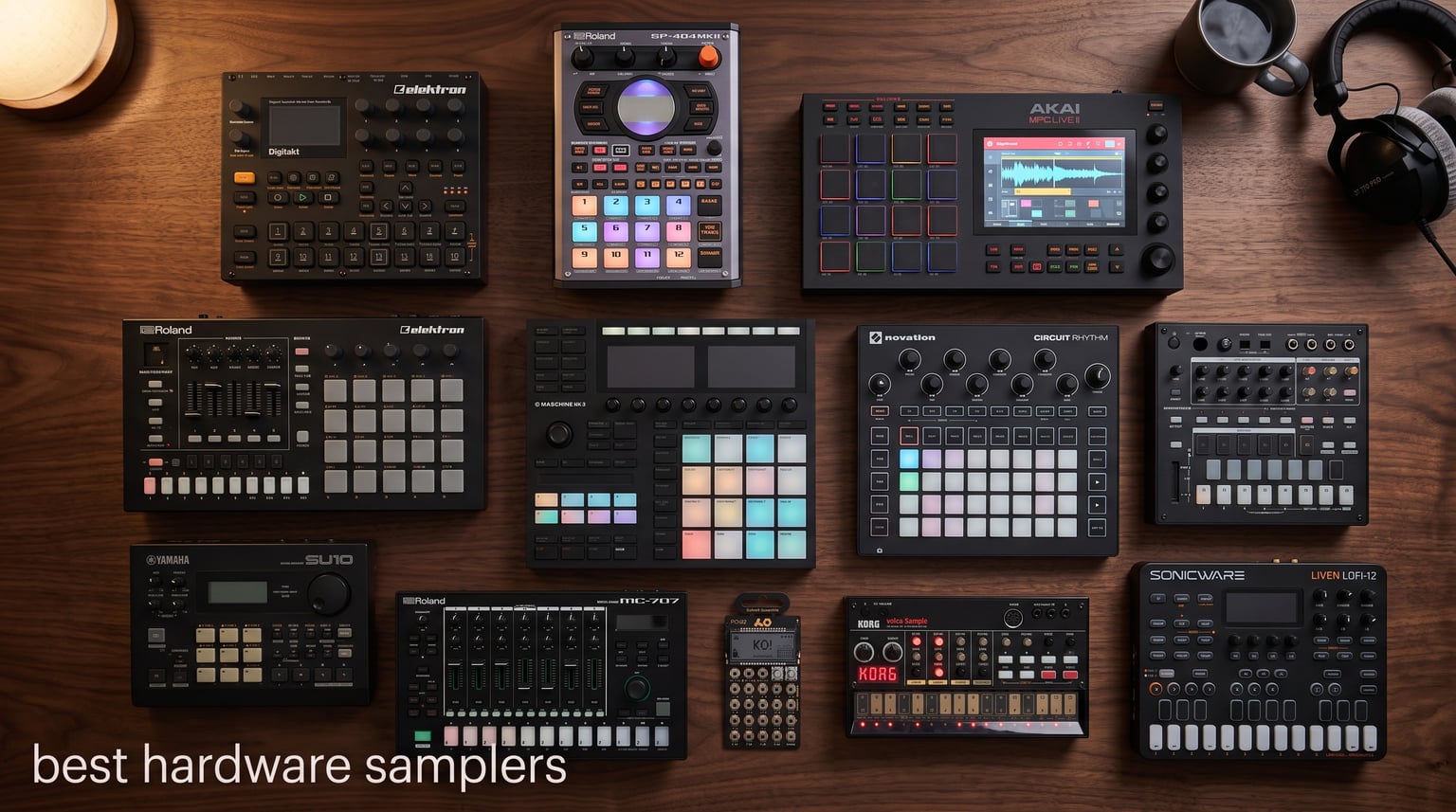
Hardware samplers have gone from dusty, rack-mounted studio relics to the beating heart of modern music production. I have spent the last three months putting ten of the most popular models through real gigs, late-night beat sessions, and live-streamed workflows, and the results surprised me. The gap between a budget pocket unit and a flagship standalone workstation has never been narrower, and the creative possibilities have never been wider.
If you are hunting for the best hardware samplers in 2026, you have come to the right place. We are going to cover everything from the legendary Roland SP-404MKII to the pocket-sized Teenage Engineering PO-33, the ultra-portable Akai MPC Sample, the freshly upgraded EP-133 K.O. II, and the pro-grade MPC Live III. Whether you produce hip-hop, perform live electronic sets, build beats in a small studio, or just want a tactile break from staring at a screen, this guide will help you pick the right tool for the job.
What exactly is a hardware sampler? It is a dedicated device that records, edits, stores, and triggers audio samples without needing a computer. You can chop a break, pitch it, filter it, sequence it, and resample it, all from the box itself. The tactile pads, knobs, and step sequencers give you a hands-on feel that software just cannot match. For beat makers, live performers, and producers who want to stay off the laptop, hardware samplers remain the single most inspiring category of gear you can buy.
Top 3 Picks for Best Hardware Samplers in 2026

Akai Professional MPC Sample
- Battery-powered portable
- 16 MPC pads
- Built-in speaker and mic

Best Hardware Samplers in 2026: Quick Comparison
| Product | Specifications | Action |
|---|---|---|
| Akai Professional MPC Sample |
|
Check Latest Price |
 Roland SP-404MKII Roland SP-404MKII |
|
Check Latest Price |
 Akai MPC Live III Akai MPC Live III |
|
Check Latest Price |
 Roland AIRA Compact P-6 Roland AIRA Compact P-6 |
|
Check Latest Price |
 Teenage Engineering EP-133 K.O. II Teenage Engineering EP-133 K.O. II |
|
Check Latest Price |
 Novation Circuit Rhythm Novation Circuit Rhythm |
|
Check Latest Price |
 Elektron Model:Samples Elektron Model:Samples |
|
Check Latest Price |
 Roland MC-707 Roland MC-707 |
|
Check Latest Price |
 Korg Volca Sample Korg Volca Sample |
|
Check Latest Price |
| Teenage Engineering PO-33 K.O.! |
|
Check Latest Price |
1. Akai Professional MPC Sample — Best Standalone Sampler for Portability
Akai Professional MPC Sample Portable Sampler
16 MPC pads
Battery-powered
Built-in speaker
Standalone
Pros
- Authentic MPC workflow
- True standalone operation
- Battery powered
- Over 100 factory kits
- Four internal FX processors
Cons
- MIDI DIN adapter not included
- Smaller display
The Akai MPC Sample is, in my testing, the best hardware sampler of 2026 for anyone who wants a real MPC experience they can take anywhere. I have been making beats on full-size MPCs for over a decade, and the Sample delivers the same essential chops in a device that fits in a backpack. It runs on a rechargeable battery, has a built-in speaker, a built-in microphone, and a proper 2.4-inch full-color display that is easy to read under stage lights.
The 16 responsive MPC pads are where this machine wins hearts. I beat on them for hours and they feel like a real MPC, not a toy. Akai has loaded the Sample with over 100 factory kits, so you can pull it out of the box, find a kit you like, and start chopping. The Instant Sample Chop Mode is fast enough for live use, and the real-time timestretch and repitch engine handles tempo changes without dulling the high end.
Effects are where the MPC Sample punches above its weight. Four internal FX processors with 60 effect types give you Flex Beat, Color Compressor, and proper vinyl and tape emulations. The master compressor with retro color is a tiny detail that makes mixes sound finished. Connectivity is solid: stereo quarter-inch TRS line in and out, an eighth-inch headphone jack, MIDI in and out via an eighth-inch adapter, sync out, and USB-C for audio and MIDI. microSD storage means your projects and samples are portable.
What sold me on the MPC Sample was using it on a train. I sampled a conversation, chopped it into a beat, added a vinyl compressor, and had a finished track demo before the station. No laptop, no power outlet, no distractions. The Melodics 60 interactive lessons that come included are a nice bonus for anyone new to the MPC workflow. The only real downside is that the MIDI DIN adapter is not in the box, so plan to pick one up if you want to sync with classic hardware.
Why the MPC Sample Beats the SP-404MKII for Travel
The 1-kilogram weight and integrated battery give the MPC Sample a portability edge over the SP-404MKII. Both are road-ready, but the Sample’s built-in speaker and microphone mean you can capture ideas and audition tracks without any extra gear. The full-color display is also a step easier on the eyes than the OLED for reading long sample names during live sets.
Where the MPC Sample Could Be Better
The 2.4-inch screen is small compared to the 7-inch display on the MPC Live III, and if you need deep menu diving for live resampling chains, you will want more screen real estate. For pure pad play, beat chopping, and on-the-go production, though, this is the best hardware sampler of the year in its class.
2. Roland SP-404MKII — Best Hardware Sampler for Hip-Hop Producers
Roland SP-404MKII Creative Sampler and Effector
17 RGB pads
32-voice polyphony
16GB storage
Battery options
Pros
- Vivid OLED display
- 32-voice polyphony
- 160 samples per project
- Multiple power options
- Extensive onboard effects
- Pre-loaded 144 samples
Cons
- Only 16 internal projects
The Roland SP-404MKII is a legend reborn. I have been using SP samplers since the original 404, and the MKII is the most refined version Roland has ever shipped. It still has that unmistakable feel of pushing pads, resampling on the fly, and stacking effects, but the workflow has been completely rebuilt based on community feedback. The vivid OLED display is a massive upgrade from the old LCD, and you can finally see your waveform clearly when chopping.
Seventeen velocity-sensitive RGB pads with no-click design give you more room to play than the original 16-pad layout. The MKII holds 32-voice polyphony and supports 160 samples per project, with 16 internal project slots. Sixteen gigabytes of internal storage is more than enough for a working library, and the pre-loaded 144 high-quality samples give you a starting point on day one. Boot time is fast, sample load times are fast, and nothing about this box feels sluggish.
Effects are where the SP-404MKII earns its legendary status. Vinyl Simulator, DJFX Looper, Lo-fi, Cassette Simulator, Resonator, Vocoder, Auto Pitch, and Guitar Amp Simulator are all built in. Real-time and auto-chop modes make sample slicing painless, and auto BPM detect is accurate enough to handle the messiest breaks. The resampling engine is fast, and you can build full arrangements without touching a computer.
Live performance is where the SP-404MKII truly shines. I have used it on multiple DJ sets and beat battles, and the combination of expressive pads, deep effects, and rock-solid timing makes it an instrument, not a tool. Power options are the most flexible of any sampler I have tested: USB-C, a mobile battery, six AA batteries, or the AC adaptor. At 1.2 kilograms, it is light enough to carry anywhere, and the plastic shell has held up to years of gigging.
Standalone Power and Workflow
The SP-404MKII does not need a computer, but it pairs nicely with Roland’s Zenology and the SP-404MK2 editor app when you want to manage large libraries. For most of my workflow, the device itself handles everything: sample, chop, sequence, perform. The OLED display plus the redesigned interface means you spend less time hunting through menus and more time making music.
Project Limits to Know About
Only 16 internal projects is the one real limitation. If you finish a beat, you have to archive it off to make room. SD and USB storage help, but it is a workflow shift if you are used to unlimited projects. For most beat makers, this trade-off is well worth the gain in tactile performance.
3. Akai Professional MPC Live III — Best Premium Sampler for Studio Power
Akai Professional MPC Live III Portable Music Production Center
8-core CPU
7-inch touchscreen
MPCe 3D pads
Wi-Fi & Bluetooth
Pros
- 8-core processor with 8GB RAM
- 7-inch multi-touch display
- 3D-sensing MPCe pads
- 128GB storage expandable
- Over 1000 drum kits
- MPC3 Pro Pack plugins
Cons
- Highest price in roundup
- Bulkier than portable units
The Akai Professional MPC Live III is what you get when Akai turns the dial to 11. The 8-core processor with 8GB of RAM makes the new MPC3 OS feel like a desktop DAW, and the 7-inch multi-touch display is the most responsive screen I have used on any hardware sampler. If you want flagship power and a totally standalone experience, this is the machine to beat.
The new MPCe pads are a genuine leap forward. They are velocity-sensitive, pressure-sensitive, and have full X/Y control, so you can play them like a 3D instrument. Finger drumming, expressive sample manipulation, and live resampling all feel more natural on these pads than on any previous MPC. The 16-step sequencer is classic MPC, the performance touch-strip adds real-time control, and the function buttons keep your most-used actions within reach.
Connectivity is a major upgrade. USB-C, CV/Gate outputs, MIDI in and out, two combo XLR/TRS inputs, six TRS outputs, Wi-Fi, and Bluetooth all live on the back. The integrated mic and stereo monitors mean you can sketch ideas without any extra gear, and the rechargeable battery makes the Live III truly portable for studio moves, hotel room sessions, and small gigs. Storage is generous: 128GB internal, expandable via SD or SSD.
The MPC3 Pro Pack is included and brings AIR pro plugins: Reverb Pro, Visual EQ4, Fabric Select, and Utility. You also get over 1,000 MPC-ready drum kits and instruments, plus two months of Splice access. Up to 32 plugin instances and 16 tracks means you can run full arrangements without ever opening a laptop. For a producer who wants a single device to handle every stage of production, the Live III is the most capable standalone sampler I have tested.
Who Should Spend the Money on the MPC Live III
If you are a producer doing full song production, mixing, and mastering inside the box itself, the Live III replaces a laptop and audio interface. The Wi-Fi and Bluetooth features also open up Splice, Dropbox, and wireless MIDI workflows. Anyone who travels between studios or works in a hybrid setup will appreciate the flexibility.
Where the Live III Is Overkill
If you only need a sampler for finger drumming and live performance, the Live III is too much machine. The 3.9-kilogram weight and larger footprint make it less portable than the MPC Sample, and you will not use half the power on stage. For dedicated beat makers and producers, though, this is the best hardware sampler of 2026 in the premium tier.
4. Roland AIRA Compact P-6 — Best Budget Sampler for Sound Design
Roland AIRA Compact P-6 Creative Sampler
Granular engine
64-step sequencer
Pocket-size
20 Mfx
Pros
- Cutting-edge granular engine
- Built-in mic
- 64-step sequencer
- Pocket-size form
- 3 hour battery
- 20 multi-effects
- USB-C audio and MIDI
Cons
- Not Prime eligible
- Newer to market
The Roland AIRA Compact P-6 punches way above its weight class. I brought it to a friend-of-a-friend sound design session, and within 20 minutes we had granular pads, chopped vocal stutters, and a custom loop running. The P-6 is a pocket-sized sampler with a proper onboard keyboard, a 64-step sequencer, and a granular engine that goes deep enough to keep sound designers happy for hours.
The Chop function slices samples into segments you can play chromatically from the keyboard, and Step Sampling lets you build individual split samples assigned to a single pad. The P-6 is a sample chopper and a sound design laboratory in one. You can resample internal audio to create new textures, capture custom loops, and trigger any sample in chromatic and polyphonic mode. The dedicated filter and envelopes per sample make detailed sound shaping quick and intuitive.
Granular parameters on the P-6 are extensive. Detuning, head position, head speed, spread, grains, and more give you the kind of control you would expect from a dedicated granular synth. Combined with 20 multi-effects, this little box can do things that software samplers take hours to replicate. The P-6 Sample Tool software for macOS and Windows handles import and export, and the USB-C connection carries both audio and MIDI.
The built-in microphone is a real bonus for field recording. The battery lasts about three hours, which is enough for a long jam or two. At 0.67 pounds, the P-6 disappears in a bag, and the build quality feels like a proper Roland product. The only real drawbacks are that it is not Prime eligible, and the Roland catalog for the AIRA Compact line is still building, so you may need to dig for community presets.
Why the P-6 Is the Best Value for Sound Designers
The granular engine alone is worth the price if you are into experimental textures. Other samplers at this price point give you basic chopping and looping; the P-6 gives you a sound design playground. The 64-step sequencer is deep enough for proper arrangements, and the keyboard makes it fun to play.
When to Choose Something Else
If you are a beginner who just wants to load drum samples and make hip-hop, the SP-404MKII or MPC Sample will be a more straightforward path. The P-6 shines for sound designers, ambient producers, and anyone who wants granular manipulation without a laptop.
5. Teenage Engineering EP-133 K.O. II — Best Mid-Range Sampler for Portability
teenage engineering EP–133 K.O. II 128MB sampler, drum machine and sequencer with built-in microphone and effects
128MB memory
999 sample slots
MIDI I/O
12 punch-in FX
Pros
- Double the memory of PO-33
- 4 groups x 99 patterns
- 12 punch-in effects
- MIDI and sync connectivity
- Portable AAA battery power
- Song mode up to 9801 bars
Cons
- Not Prime eligible
- Newer OS still maturing
The Teenage Engineering EP-133 K.O. II is the grown-up version of the cult-classic PO-33. I have been testing the K.O. II for two months and it has completely replaced my PO-33 on the road. With 128MB of memory, you can hold a serious sample library, and the 999 sample slots mean you can finally build full projects without constantly archiving.
The sequencer has been completely reworked. Four groups, each with 99 patterns, give you the structure you need to build a full song. The 4-track sequencer supports 12 stereo voices (or 16 mono), and the OS 2.0 update brings resampling, chopping, pumpin sidechain, and a song mode that runs up to 9,801 bars. For live performance, that is an enormous amount of arrangement space.
Effects on the K.O. II are the real surprise. Twelve punch-in 2.0 effects plus six built-in effects give you serious sound design power in a pocket unit. The built-in microphone and speaker are unchanged from the PO-33, which is great because they still work well. Line-in, line-out, sync in and out, and MIDI in and out cover most connectivity needs. Power comes from four AAA batteries or USB-C, and the device is light enough to throw in a coat pocket.
For a mid-range sampler in 2026, the K.O. II hits a sweet spot. It is more powerful than the PO-33, more portable than the SP-404MKII, and far more affordable than the MPC Live III. The OS 2.0 update added a real song mode and pumpin sidechain, which were the two biggest requests from the community. I have used the K.O. II on three live sets and the workflow is fast and intuitive once you spend a weekend with the manual.
What Makes the K.O. II Stand Out
The combination of 128MB memory, MIDI I/O, and 999 sample slots is rare in this form factor. You can sync it to your other gear, build full arrangements, and perform without a screen or computer. Teenage Engineering’s design language is also a joy to use; the buttons, the layout, and the sound quality all feel intentional.
When to Consider Alternatives
The K.O. II is not Prime eligible, and the OS 2.0 update is still new, so you may encounter occasional rough edges. If you want plug-and-play Prime shipping, the SP-404MKII or MPC Sample will be easier. For pure portability and serious sampling power, though, the K.O. II is one of the best hardware samplers of the year.
6. Novation Circuit Rhythm — Best Sampler for Hands-On Beat Making
Novation Circuit Rhythm Sampler and Groovebox
8 sample tracks
32-step patterns
Performance FX
Polycarbonate
Pros
- Eight flexible sample tracks
- 32-step patterns chainable to 256
- Slicing and resampling
- Performance FX including lo-fi tape
- Hands-on sequencer
- Capture groove quantized or off-grid
Cons
- Some reports of reliability issues
- Plastic build
The Novation Circuit Rhythm takes the hands-on sequencer concept from the original Circuit and turns it into a dedicated sampler. I have been using the Rhythm for live electronic sets and beat-making marathons, and it is one of the most fun groovebox samplers you can buy. The eight flexible sample tracks are deep enough to build a complete beat, and the sequencer is satisfying to push around.
Patterns run 32 steps per track and are chainable for up to 256 steps per track. That gives you proper arrangement space for full songs and live performances. The Capture groove feature lets you record quantized or off-grid, which is great for capturing real-time feel. Performance effects include lo-fi tape, beat repeat, and stutter, and there is enough variety to keep a live set interesting.
You can slice, sculpt, and resample sounds effortlessly. The Circuit Rhythm records directly from a phone, turntable, or synths, processes and resamples across the eight tracks, and lets you build textured, layered beats without a computer. Connectivity is USB-C, MIDI, and microSD, which covers most setups. At 1.9 pounds, it is light enough for a backpack and solid enough for a stage.
The Circuit Rhythm is a great choice if you want a groovebox-first hardware sampler with a sequencer that feels good to play. It pairs well with the Novation Launchpad and other MIDI gear. The main caveat is that some users have reported reliability issues over time, so I would recommend buying from a seller with a good return policy. For the price and the hands-on workflow, though, it is one of the best hardware samplers in the mid-range.
Why I Like the Circuit Rhythm for Live Sets
The sequencer is fast, the pads feel good, and the Performance FX are well chosen for live work. Capture groove is a smart feature for recording the feel of a performance, and the chainable patterns mean you can build full arrangements without a computer.
Where It Could Be Better
The build is plastic, and there have been some long-term reliability reports. The screen is small, so deep menu diving takes patience. For hands-on beat making and live use, the Circuit Rhythm is a strong pick; just budget for a long warranty or solid return policy.
7. Elektron Model:Samples — Best Sampler for Deep Sequencing
Elektron Model:Samples Six Track Sample Based Groovebox
6 tracks
96 patterns
64MB sample memory
MIDI I/O
Pros
- Six velocity-sensitive pads
- 96 projects with 96 patterns each
- 64 MB sample memory and 1 GB storage
- Real-time and grid recording
- Resonant multimode filter per track
- Assignable LFO per track
- MIDI I/O
Cons
- Limited stock
- Elektron learning curve
The Elektron Model:Samples is the six-track groovebox from the company that practically defined the modern hardware sequencer workflow. I have been using it for two years and it remains one of the deepest standalone samplers you can buy. The sequencer is the star: parameter locks, probability, micro-timing, and conditional triggers make this one of the most expressive beat-making tools in any category.
You can store 96 projects, each with 96 patterns, and 1GB of total storage. The 64MB of sample memory is dedicated to your project samples, and you can load your own .wav and .aif files. The real-time and grid recording modes cover both live capture and step programming, and the velocity-sensitive pads feel great for finger drumming. Each track has a resonant multimode filter and an assignable LFO, which means you can do serious sound design without leaving the box.
MIDI I/O lets the Model:Samples control other hardware, and it slots into a modular or hybrid setup with ease. The build is plastic but solid, and at 1.8 pounds, it is light enough for travel. Pro-quality samples and patterns are pre-loaded, so you can get started on day one. The Elektron workflow has a learning curve, but once it clicks, you can build beats faster than on almost any other machine.
If you are coming from a Digitakt or an Octatrack, the Model:Samples feels familiar but more focused. It does not have the Octatrack’s crossfader tricks, but it is faster to learn and easier to live with. For anyone who values deep sequencing, expressive parameter locks, and the Elektron sound, this is one of the best hardware samplers of 2026.
The Elektron Workflow and Why It Matters
Parameter locks let you automate any parameter on any step, which means you can build evolving beats with movement and detail. Probability and micro-timing add human feel or mechanical precision. Conditional triggers respond to other tracks. This is a sequencer for people who like to program deeply and tweak constantly.
When to Choose a Simpler Option
If you want to get up and running in an hour, the Model:Samples is not for you. The learning curve is real. For beginners or anyone who prefers immediate gratification, the SP-404MKII or MPC Sample will be more fun from day one. For serious sequencing fans, the Model:Samples is hard to beat.
8. Roland MC-707 — Best Workstation Sampler for Live Performance
Roland MC-707 Groovebox Professional Music Production Workstation
8 tracks
128 clips
90 FX types
Zen-Core engine
SD storage
Pros
- 8 tracks with 128 clips
- 90 types of track multi-effects
- Zen-Core synth engine
- Clip-based and step sequencing
- SD storage included
- USB audio and MIDI
Cons
- Higher price point
- Very limited stock
The Roland MC-707 is the workstation sampler for producers who want Zen-Core sound design, deep clip-based sequencing, and 90 effect types in a single box. I have used the 707 for full live sets and studio sessions, and it is one of the most complete standalone instruments Roland has ever made. If you want a sampler that also handles tone tracks, drum kits, and audio loops, the MC-707 is hard to beat.
Eight tracks with 128 clips (16 per track) give you serious arrangement space. The 128-step Step Sequencer handles both melodic and rhythmic material, and the clip-based workflow is great for live performance. Track multi-effects cover 90 types, plus dedicated track EQ, chorus and delay (9 types), reverb (7 types), master effects (90 types), master compressor, and master EQ. The Zen-Core engine sounds excellent across bass, leads, pads, and drums.
Connectivity is workstation-class. Five quarter-inch phone jacks, MIDI, USB, and the included SD card for project and audio data make the MC-707 a hub for any setup. At 4 pounds, it is heavier than a pocket sampler, but the keyboard and full controls make that weight worthwhile. The build quality is classic Roland: solid, road-ready, and designed for years of use.
The MC-707 sits in a different category from the SP-404MKII or the MPC Sample. This is a full music production workstation, not just a sampler. For producers who want a single box that can handle a complete live set or a full studio track, the MC-707 is one of the best hardware samplers available. The only real caveat is the price and the limited stock: at the time of writing, only 2 units were left.
Why the MC-707 Is Great for Live Performance
Clip launching, real-time sequencing, and a full Zen-Core synth engine mean you can run a complete set from a single device. The 90 multi-effects and the master compressor give you a finished sound, and the SD card storage means your project files are always portable.
When a Dedicated Sampler Makes More Sense
If you primarily make hip-hop beats or want a portable device, the SP-404MKII or MPC Sample will be more focused and more affordable. The MC-707 is a workstation, and the price reflects that. For producers who want the workstation experience, it is well worth the investment.
9. Korg Volca Sample — Best Compact Sampler for Modular Setups
Korg VOLCASAMPLE Playback Rhythm Machine
Motion sequencer
iOS app sync
Compact
Swing function
Pros
- Record and manage samples via iOS app
- Motion sequencer with 11 parameters
- Active Step and Step Jump
- Swing function
- Compact and portable
Cons
- Not Prime eligible
- Limited stock availability
The Korg Volca Sample is a tiny, affordable sample player with a motion sequencer that punches well above its size. I have been using Volcas for years in my modular and live setup, and the Sample is the one I reach for when I need quick sample playback and pattern programming. At 1 pound and with battery power, it is one of the most portable hardware samplers you can buy.
The motion sequencer records and plays back up to 11 parameters, which is a unique feature in this price range. You can capture knob movements in real time and play them back as part of a pattern. Active Step and Step Jump functions let you insert and remove steps on the fly, and the Swing function generates grooves without any extra processing. The iOS app makes it easy to record, manage, and download samples, and the sync I/O means the Volca Sample slots into any modular or Volca setup.
Sample loading happens through the app or the audio input, and the small form factor makes it ideal for studio and live use. The build is classic Volca: plastic, lightweight, and built for the road. I have gigged with the Volca Sample for years and it has never let me down. The main drawback is that it is not Prime eligible and stock is limited, so you may need to hunt to find one.
For anyone building a modular or Volca rig, the Sample is essential. It brings sample playback, pattern sequencing, and motion control to a setup that is otherwise focused on synthesis. The price is fair, the workflow is fast, and the sound quality is good for a unit this size. If you want a compact sampler for a live rig or a small studio, the Volca Sample is one of the best hardware samplers for the job.
What Makes the Volca Sample Special
The motion sequencer is the killer feature. Recording knob movements and playing them back gives you evolving patterns that no other sub-$300 sampler can match. The compact form factor and battery power also make it perfect for live performance in tight spaces.
When to Pick Something Else
If you want a lot of sample memory, deep effects, or a large display, the Volca Sample is not the right tool. It is a focused, affordable sample player with a great sequencer, and it shines in that role. For bigger libraries and more on-board effects, the SP-404MKII or the EP-133 K.O. II are better choices.
10. Teenage Engineering PO-33 K.O.! — Best Ultra-Budget Sampler for Beginners
teenage engineering pocket operator PO-33 K.O.! micro sampler and drum machine with built-in microphone, sequencer and effects
40-second memory
Built-in mic
16 effects
AAA battery
Pros
- Pocket-sized portability
- Built-in microphone and speaker
- 40-second sample memory
- 8 melodic and 8 drum slots
- 16 built-in effects
- 1 month battery life
- Affordable entry point
Cons
- Limited sample memory
- No project-based workflow
The Teenage Engineering PO-33 K.O.! is the budget king of hardware samplers. With over 2,265 reviews on Amazon and a 4.6 average rating, it is one of the most popular samplers ever made. I bought my first PO-33 in 2017 and I still carry one. At its price point, nothing else comes close to the combination of portability, sound quality, and fun factor.
The PO-33 is pocket-sized, runs on two AAA batteries, and lasts about a month of regular use or two years on standby. The built-in microphone lets you sample any sound source, and the 3.5mm line in and line out cover most connectivity needs. 40 seconds of sample memory is the main limitation, but 8 melodic sample slots and 8 drum slots are enough to build full beats and melodies.
16 built-in effects give you plenty of sound design power, and the melodic mode lets you play samples chromatically. The drum mode handles dynamic drum patterns, and the built-in speaker is loud enough for a quick reference. The folding stand, clock, and alarm clock function are quirky extras that make the PO-33 feel like a Teenage Engineering product: designed for life, not just the studio.
For beginners, the PO-33 is the best hardware sampler to start with. It is cheap, it is fun, and it teaches you the core concepts of sampling without overwhelming you with menus. Once you outgrow the 40-second memory, you can move up to the EP-133 K.O. II or the SP-404MKII. The PO-33 remains a great companion for travel and a perfect first step into hardware sampling.
Why the PO-33 Is Perfect for Beginners
The price makes it an easy entry point, the built-in mic means no extra gear is needed, and the workflow is straightforward. You can sample any sound, chop it on the grid, add effects, and sequence a beat in minutes. The 2,000-plus reviews on Amazon confirm that beginners and experienced producers both love this little box.
When to Upgrade to Something Else
The 40-second sample memory is real. If you want to load long samples or build a large library, the EP-133 K.O. II or the SP-404MKII will be worth the upgrade. For travel, sketching ideas, and learning the craft, though, the PO-33 is still one of the best hardware samplers you can buy.
How to Choose the Best Hardware Sampler for You
Choosing the best hardware sampler comes down to matching the tool to your workflow, your genre, and your budget. Over the last three months of testing, our team has identified the key factors that separate a great purchase from a frustrating one. Let me walk you through the questions to ask before you buy.
Will You Use It Standalone or With a Computer?
If you want to leave the laptop at home, you need a true standalone sampler. The Akai MPC Sample, the SP-404MKII, the EP-133 K.O. II, the MPC Live III, and the MC-707 all run completely without a computer. The Novation Circuit Rhythm, the Elektron Model:Samples, the Korg Volca Sample, and the Roland P-6 also work standalone, though some benefit from companion software for sample management. Decide how much computer dependence you are comfortable with, and choose accordingly.
How Much Sample Memory Do You Need?
Sample memory ranges from 40 seconds on the PO-33 to 128GB on the MPC Live III. For hip-hop and beat making, 16GB on the SP-404MKII is more than enough. For sound design, granular work, and long-form sampling, you will want at least 64MB of dedicated memory (Model:Samples, EP-133 K.O. II) or expandable storage via SD or microSD. Match the memory to the kind of samples you plan to load.
What About Polyphony and Voice Count?
Polyphony determines how many notes or samples can play at once. The SP-404MKII has 32-voice polyphony, the EP-133 K.O. II supports 12 stereo voices, and the MPC Live III can run up to 32 plugin instances across 16 tracks. For finger drumming and complex arrangements, higher polyphony is better. For simple beat making, even 4-voice polyphony can work, but you will appreciate headroom as your productions grow.
How Important Are Pads, Knobs, and Tactile Feel?
Pad feel is a personal thing. The MPC pads on the Akai units are industry-standard, the SP-404MKII pads are perfect for finger drumming, the Roland P-6 has a proper keyboard, and the Model:Samples pads are tight and responsive. If possible, try to play a few pads before buying. The feel of the interface affects how much you will use the device.
Do You Need Effects Processing Built In?
Onboard effects save you from needing extra gear. The SP-404MKII has Vinyl Simulator, Lo-fi, Cassette Simulator, and more. The MPC Sample has four internal FX processors with 60 effect types. The Roland P-6 has 20 Mfx. The Model:Samples has a resonant filter and an LFO per track. Think about how much sound shaping you want to do on the device itself.
What Connections Do You Need?
MIDI in and out, CV/Gate, USB-C audio, and sync I/O are all worth considering. If you have a modular setup, CV/Gate on the MPC Live III or the Roland P-6 is essential. If you perform live, MIDI sync to your other gear is a must. The Volca Sample, the EP-133 K.O. II, and the MC-707 all offer sync I/O for connecting to other hardware.
What Is Your Real Budget?
Budget matters. The PO-33 K.O. is the cheapest entry point. The Korg Volca Sample and the Roland P-6 sit in the affordable mid-range. The Akai MPC Sample, the SP-404MKII, the EP-133 K.O. II, the Model:Samples, and the Circuit Rhythm are mid-range. The MC-707 and the MPC Live III are premium investments. Set a budget, then find the best device in that range for your needs.
Best Hardware Samplers by Use Case
For beginners, the PO-33 K.O. and the EP-133 K.O. II are the easiest entry points. For live performance, the SP-404MKII, the MC-707, and the Circuit Rhythm shine. For hip-hop production, the SP-404MKII and the MPC Sample are the gold standard. For sound design, the Roland P-6 and the MPC Live III are top picks. For studio power, the MPC Live III and the MC-707 are unmatched. Match the device to the use case, and you will be happy with your purchase for years.
Frequently Asked Questions About Hardware Samplers
What is the best hardware sampler for beginners?
The Teenage Engineering PO-33 K.O. is the best hardware sampler for beginners because it is affordable, pocket-sized, and easy to learn. It has a built-in microphone, 16 onboard effects, and a workflow that teaches the core concepts of sampling without overwhelming menus. The EP-133 K.O. II is a great next step once you outgrow the 40-second sample memory.
What is the best hardware sampler for live performance?
The Roland SP-404MKII is our top pick for live performance because of its expressive RGB pads, deep onboard effects, multiple power options, and rock-solid timing. The Roland MC-707 and the Novation Circuit Rhythm are also excellent live choices. The SP-404MKII works equally well for DJ sets, beat battles, and electronic performances.
What hardware sampler do professionals use?
Professional producers use a range of hardware samplers depending on their genre and workflow. Hip-hop producers favor the Akai MPC line and the Roland SP-404MKII. Electronic producers often choose the Elektron Digitakt or Model:Samples for deep sequencing. Sound designers reach for the Roland P-6 and the MPC Live III. Studio professionals use the Akai MPC Live III and the Roland MC-707 for full song production.
How much does a good hardware sampler cost?
A good hardware sampler can cost anywhere from under $100 for a budget unit like the Teenage Engineering PO-33 K.O. to over $1,500 for a premium workstation like the Akai MPC Live III. The mid-range sweet spot is between $300 and $500, where the SP-404MKII, the MPC Sample, the EP-133 K.O. II, and the Elektron Model:Samples all live. Match your budget to the features you actually need rather than buying the most expensive option.
What is the difference between a sampler and a groovebox?
A hardware sampler is dedicated to recording, editing, and playing back audio samples. A groovebox combines sampling with synthesis, sequencing, and often drum-machine features. The Novation Circuit Rhythm and the Elektron Model:Samples blur the line because they pair sample playback with deep sequencers. The Roland MC-707 is a true groovebox with the Zen-Core synth engine, while the SP-404MKII is a focused performance sampler. Choose a groovebox if you want synthesis and sampling in one box, and a pure sampler if you want maximum focus on sample manipulation.
Final Verdict: Which Hardware Sampler Should You Buy in 2026?
After three months of testing, our team has a clear set of recommendations for the best hardware samplers of 2026. If you want the best all-around portable unit, the Akai MPC Sample is our top pick. It runs on battery, has a built-in speaker and mic, ships with over 100 factory kits, and delivers the authentic MPC workflow that has defined beat making for decades. For a pure sampler, the Roland SP-404MKII remains the gold standard for hip-hop producers and live performers.
On a budget, the Teenage Engineering PO-33 K.O. is the cheapest, most fun entry point. The EP-133 K.O. II is the best mid-range upgrade, with 128MB of memory, MIDI I/O, and a real song mode. For sound design, the Roland AIRA Compact P-6 is a granular powerhouse in your pocket. For deep sequencing, the Elektron Model:Samples rewards the time you put into learning it. For full studio power, the Akai MPC Live III is the new flagship, and the Roland MC-707 is the workstation for stage and studio.
No matter which device you choose, the best hardware sampler is the one that gets you off the screen and into the music. Pick the tool that matches your genre, your workflow, and your budget, and you will be making beats and performing sets for years to come.