
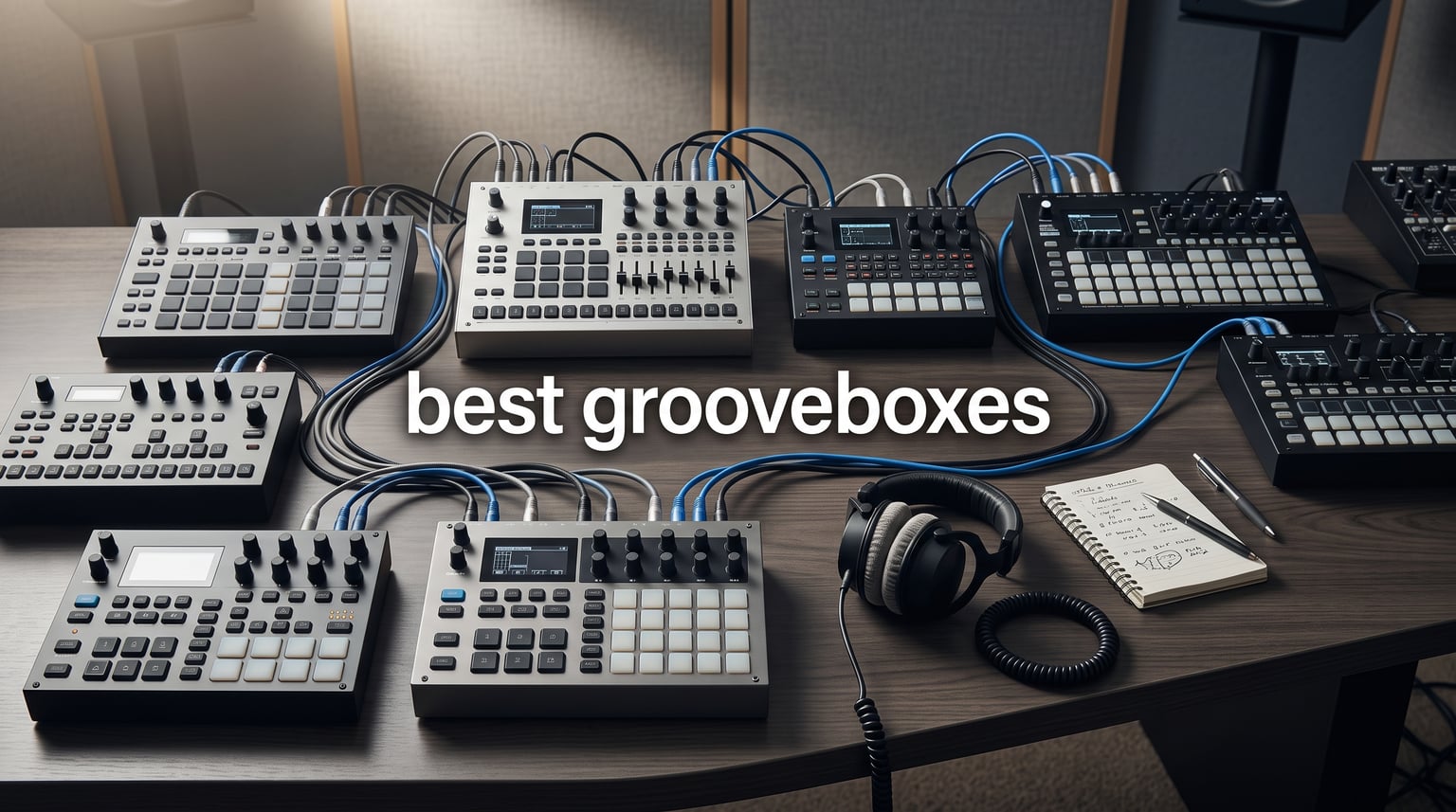
The best grooveboxes 2026 turn a blank bar into a beat, bass line, and arrangement without asking you to open a laptop. A good one combines a drum machine sequencer with samples or synth sounds, then puts enough controls under your hands to keep the idea moving.
This roundup covers eight real, currently listed machines that range from tiny rhythm boxes to full standalone production centers. I assessed them by their documented sound sources, tracks, sequencing, storage, physical controls, connections, portability, and the strengths and limits called out in customer feedback.
A groovebox is not one fixed thing. Some of these picks are sample-first beat maker machines, some start with drum and bass synthesis, and some can run the middle of a DAWless setup with MIDI, CV/Gate, and external audio.
My short answer is simple: choose the workflow before the spec count. Community discussions often return to the same point: a machine that makes you finish eight bars is more useful than one with a longer feature list that feels hard to approach.
Table of Contents
The top three grooveboxes answer three different needs
Best overall: Akai MPC Live III Retro is the fullest standalone production center here, with 16 tracks, a 7-inch touchscreen, expressive MPCe pads, expandable storage, audio inputs, outputs, MIDI, and CV/Gate.
Best portable sampler: Akai MPC Sample packs 16 pads, sampling, chopping, effects, a built-in speaker and microphone, battery operation, and USB-C audio/MIDI into a compact unit. Best compact rhythm box: Roland AIRA Compact T-8 is the direct choice for TR drums and TB-303-style bass sequencing in a battery-powered format.
The best grooveboxes in 2026 cover eight distinct workflows
The overview below separates the eight models by what they actually do. Read the full reviews if you need to decide between a focused portable instrument and a machine that can command several external pieces of hardware.
| Product | Specifications | Action |
|---|---|---|
 Akai MPC Sample Akai MPC Sample |
|
Check Latest Price |
 Ableton Move Ableton Move |
|
Check Latest Price |
 Roland AIRA Compact T-8 Roland AIRA Compact T-8 |
|
Check Latest Price |
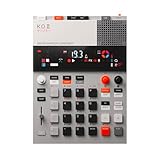 teenage engineering EP-133 K.O. II teenage engineering EP-133 K.O. II |
|
Check Latest Price |
 Yamaha SEQTRAK Yamaha SEQTRAK |
|
Check Latest Price |
 Akai MPC Live III Retro Akai MPC Live III Retro |
|
Check Latest Price |
 Elektron Digitakt II Elektron Digitakt II |
|
Check Latest Price |
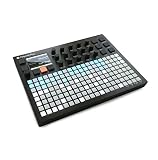 Polyend Play Polyend Play |
|
Check Latest Price |
1. Akai MPC Sample is the best portable sampling workflow
Akai Professional MPC Sample Portable Sampler
16 MPC pads
Battery, speaker and mic
60 effects
USB-C audio MIDI
Pros
- Compact MPC workflow
- Built-in sampling tools
- Four FX processors
- Rechargeable battery
Cons
- MIDI adapter not included
- microSD card not included
The Akai MPC Sample is the pick I would start with when a portable groovebox needs to do real sampling rather than only trigger preset sounds. It gives you the familiar 16-pad layout, a color display, a built-in microphone and speaker, plus a rechargeable battery in a 0.9-kilogram body.
Its product feedback is unusually strong in this group: it carries a 4.8 average from 332 reviews, with the supplied review summary pointing to its compact MPC workflow and beginner-friendly value. That does not make it a full replacement for a large production station, but it makes the path from recorded sound to playable kit unusually direct.
Sampling is where its feature set makes the most sense. Instant Sample Chop Mode, real-time timestretch or repitch, and internal resampling let a short vocal, record snippet, or instrument phrase become material for a new pattern without leaving the device.
Four internal effects processors cover 60 effect types, and the master compressor adds a retro color option. For a small unit, the stereo 1/4-inch TRS line input and output, headphone output, microSD storage, and USB-C audio/MIDI give it a serious route into a studio or a small live rig.
The MPC Sample suits producers who want captured sounds to become beats fast
I would put this in front of beatmakers who enjoy chopping, finger drumming, and resampling more than building every sound from synthesis. The included factory kits and the 60 Melodics lessons also give a new owner material to play with before building a personal sample library.
It works especially well for hip-hop sketches, house drum edits, and travel sessions where a built-in speaker is more useful than studio-grade monitoring. USB-C audio/MIDI can also make it a compact front end for a computer-based session later.
The MPC Sample asks you to supply a few small essentials
The listed package does not include a microSD card, so longer-term sample storage needs an extra card. Its MIDI connection also uses a 1/8-inch-to-DIN adapter, and that adapter is not included.
Those are manageable limitations, but they matter when planning a first DAWless kit. If DIN MIDI gear is central to your setup from day one, account for the adapter rather than discovering the gap after unpacking.
2. Ableton Move is the best standalone sketchpad for Ableton Live users
Ableton Move Standalone Instrument with Live 12 Intro
4 flexible tracks
32 polyphonic aftertouch pads
64 GB storage
Wi-Fi and Link
Pros
- Ableton Live 12 Intro included
- Expressive pads
- Standalone battery operation
- Wireless Ableton integration
Cons
- Four tracks only
- Full software features need a computer
Ableton Move makes the strongest case when your ideas may begin away from a computer but eventually land in Ableton Live. It is a standalone instrument with a rechargeable battery, speaker, microphone, USB-C audio interface, onboard Wi-Fi, and Link Audio support.
The control surface is a major reason to consider it. Its 32 velocity-sensitive pads support polyphonic aftertouch, while nine touch-sensitive endless encoders give each sound and effect a more immediate feel than a button-only design.
Move has four flexible tracks, and each one can be assigned as a drum kit, sampler, or synthesizer. That is enough for a disciplined loop with drums, bass, chords, and a lead, although it is also the firmest ceiling in this eight-machine list.
The included sound library has more than 1,500 sounds, and its 64 GB of onboard storage gives sampling room. On-device slicing, high-quality timestretching, full Drift synth editing, arpeggiation, Repeat, and Capture are thoughtful tools for getting past the first-loop stage.
Ableton Move suits writers who want a clear path from handheld loop to Live set
I would choose Move for a producer already comfortable with Ableton’s clip-based thinking or someone who wants that ecosystem as a destination. The included Ableton Live 12 Intro and Control Live Mode establish a documented bridge instead of treating the computer as an afterthought.
Its wireless Ableton integration and Link Audio are appealing for a setup that needs tempo coordination without a tangle of extra sync boxes. It is also a strong candidate for melodic electronic music because the pad layout offers 16 Pitches for bass lines and melodic drums.
Ableton Move limits arrangements to four active tracks at a time
Four tracks can make a focused composition easier, yet producers who layer large arrangements will reach that limit. Treat Move as an idea instrument or a compact performance voice, not a miniature copy of every Live session.
The product listing says the software license needs Windows or Mac for full features. That is a fair trade for people who want computer integration, but it is less suitable for someone committed to a strictly hardware-only routine.
3. Roland AIRA Compact T-8 is the best compact rhythm and bass machine
Roland AIRA Compact T-8 Beat Machine
TR drums and TB-303 bass
64 user patterns
32-step sequencing
4.5 hour battery
Pros
- Authentic Roland sound set
- Direct TR-REC workflow
- Portable battery design
- USB-C audio MIDI
Cons
- Focused drum and bass role
- Random color designation
The Roland AIRA Compact T-8 is not trying to be a broad synthesizer workstation. It is a deliberately focused rhythm and bass machine built around TR-808, TR-909, and TR-606 drums alongside TB-303 bass sounds.
That focus is why I would recommend it for acid lines, electro, techno, and stripped-down house patterns. A 16-step TR-REC drum sequencer is easy to understand if you have watched classic drum-machine programming, and each of the 64 user patterns can run up to 32 steps.
Roland’s Analog Circuit Behavior technology is used for its vintage sound recreations. The sequencer adds probability, sub step, last step, and velocity controls, so a basic grid can develop movement without requiring a deep menu system.
Performance functions include step loop, mute, fill, reload, and pattern shift, while delay, reverb, overdrive, and sidechain compression shape the finished groove. Audio, MIDI, and sync I/O, AIRA Link, and class-compliant USB-C audio/MIDI make the T-8 easier to pair with other gear than its small frame suggests.
The T-8 suits players who want familiar Roland rhythms and bass in one device
I would select this one for the person whose music begins with kick, snare, hats, and a bass sequence. It has the directness forum users often value in a groovebox: the purpose is clear, and the controls support quick pattern changes.
The listed 4.5-hour battery life supports sessions away from a desk. It can also act as a compact specialist beside a sampler, synth, or DAW rather than carrying every part of a full arrangement itself.
The T-8 suits focused genres better than sample-heavy production
The listed sound identity is all about Roland drums and bass rather than onboard sampling or many independent tracks. A producer who needs vocal chops, long audio clips, or several melodic parts should pair it with another machine or choose a broader sampler.
The product details label its skill level as beginner, which fits the accessible step workflow. Yet the advanced rhythm functions reward players who keep exploring after the first straightforward pattern is finished.
4. teenage engineering EP-133 K.O. II is the best fast sample-based sketchpad
teenage engineering EP–133 K.O. II 128MB sampler, drum machine and sequencer with built-in microphone and effects
128 MB memory
4 tracks and 999 slots
Built-in mic and speaker
AAA or USB-C power
Pros
- Quick sampling and chopping
- Punch-in effects
- Song Mode
- Portable power choices
Cons
- Plastic construction
- Smaller review sample
The teenage engineering EP-133 K.O. II is designed for turning rough samples into a beat before the moment passes. It combines a 4-track sequencer, 128 MB of memory, 999 sample slots, line input, built-in microphone, built-in speaker, and a large multifunctional fader.
I see it as the fast, characterful option for producers who enjoy committing to a loop instead of organizing a large project immediately. Its supplied review summary calls out a strong workflow for fast beat creation, and the 4.6 average is drawn from 31 reviews.
The sequencing structure provides four groups with 99 patterns each. With 12 stereo voices or 16 mono voices, it can hold a compact arrangement while leaving space to change samples, effects, and performance moves from one pattern to the next.
It includes 12 punch-in 2.0 effects and six master effects, while the OS 2.0 feature list includes resampling, chopping, pumpin sidechain, and Song Mode. Song Mode can reach up to 9,801 bars, which gives a surprisingly long arrangement path for such a portable sampler.
The EP-133 K.O. II suits producers who treat sampling as performance
I would use its fader as the reason to pick it over a more conventional pad device. The controller is documented as multifunctional, and its punch-in effects are designed for immediate changes rather than a passive background polish.
Its line input and microphone make found sound, a record, another instrument, or a spoken phrase viable starting material. AAA batteries or USB-C power let the same compact workflow work at a table, in a rehearsal room, or away from mains power.
The EP-133 K.O. II asks for comfort with compact limits
The plastic construction and four-track structure are part of its portable design, not signs that it should handle every production task. Producers who need many separate channels and expansive storage may find a larger MPC or a 16-track Digitakt II more appropriate.
The available review count is also smaller than the count for the MPC Sample or T-8, so I would give extra weight to the workflow fit rather than treating its rating as the whole buying decision. MIDI in and out plus sync in and out still leave room to grow the system around it.
5. Yamaha SEQTRAK is the best preset-rich mobile ideastation
Yamaha SEQTRAK Mobile Music Ideastation – All-in-One Music Production Studio with Two Sound Engines, Onboard Sampling, Integrated Speaker and Rechargeable Battery – Black
Two sound engines
2,000+ presets
44.1 kHz sampling
Battery, mic and speaker
Pros
- All-in-one sound sources
- Large preset library
- Onboard sampling
- Lightweight portable body
Cons
- Seven sample sound slots
- Niche review base
Yamaha SEQTRAK is an all-in-one mobile music ideastation for writers who want a broad sound palette ready before they start sampling. It combines drums, synths, sound design, sequencing, and sampling through two sound engines and more than 2,000 presets.
I would point beginners toward SEQTRAK when blank-slate sound design feels like a barrier. Its three-area user interface separates the job of shaping a groove into clearer zones, and Yamaha describes its workflow as fast rather than built around one deep editing page.
The sampler records at 44.1 kHz and 16-bit, with seven sound slots. That is useful for bringing in a few personal sounds, but it signals that the machine’s core identity is the supplied sound engines and preset library rather than a huge sample archive.
An integrated speaker, microphone, rechargeable battery, and 0.65-kilogram weight fit the portable groovebox brief well. Integrated real-time controllers provide a hands-on way to change a pattern while it plays rather than only preparing it beforehand.
The SEQTRAK suits writers who want a wide sound palette without external gear
I would choose it for mobile electronic music sessions where drums, synth textures, and a few samples must all live in a single compact instrument. The preset count creates a practical starting point for ambient layers, dance-music sketches, and melodic ideas.
The microphone and speaker make it possible to capture and audition a quick idea without a separate interface or monitor pair. Future app updates are listed as a source of additional content, which may appeal to people who welcome a companion-app route.
The SEQTRAK suits a concise sample role rather than large sample projects
Its seven sampling sound slots establish a clear boundary. A producer whose work relies on many long clips, chopped records, or detailed sample manipulation should look more closely at the MPC Sample, EP-133 K.O. II, Digitakt II, or Polyend Play.
The product’s review base is 29 reviews, so its 4.6 rating is a useful signal but not a substitute for thinking through the interface. Its appeal rises sharply when the listed sound engines and preset-led approach match how you prefer to begin a track.
6. Akai MPC Live III Retro is the best complete standalone production center
Akai Professional MPC Live III Retro Portable Music Production Center
16 tracks
8-core processor and 8 GB RAM
MPCe pads
CV Gate and XLR TRS I O
Pros
- Powerful standalone production
- Expressive MPCe pads
- Deep I O and storage
- Touchscreen and monitors
Cons
- 3.9 kilogram body
- Steeper learning curve
The Akai MPC Live III Retro is the one I would choose when the groovebox must become the center of a serious standalone studio. Its 8-core processor, 8 GB RAM, 16 tracks, support for up to 32 plugin instances, and 7-inch multi-touch display put it in a different class from the small portable sketchpads.
It has 128 GB of internal storage that can expand through SD or SSD, a rechargeable battery, integrated microphone, and stereo monitors. That combination makes it capable of beginning an idea without extra hardware while still leaving room for larger sound libraries and more complex projects.
The MPCe pads add 3D sensing for velocity, pressure, and X/Y control, and the performance touch-strip supplies another real-time control surface. Its next-generation clip launch matrix and 16-step sequencer make it suitable for both pattern work and a more clip-oriented performance flow.
Connection options are extensive: USB-C, Wi-Fi, Bluetooth, MIDI I/O, CV/Gate outputs, two combo XLR/TRS inputs, and six TRS outputs. MPC3 OS and the included AIR plugins, including Reverb Pro, Visual EQ4, Fabric Select, and Utility, broaden the instrument into a self-contained music production hardware hub.
The MPC Live III Retro suits producers who need one machine to run a larger rig
I would recommend it for a producer who records outside sound sources, runs modular or MIDI instruments, and wants audio routing flexibility without using a computer for every session. The two combo inputs and six outputs are a real advantage over compact devices with a single headphone jack and USB connection.
It also suits expressive pad players. The extra dimensions of MPCe control give finger-drumming and melodic parts more nuance than conventional velocity-only pads can provide.
The MPC Live III Retro asks for desk space and learning time
At 3.9 kilograms, this is portable in the sense that it has a battery, not in the sense that it disappears into a small bag. It is a better fit for moving between rooms, rehearsals, or shows than for ultra-light travel production.
The supplied customer feedback notes a learning curve, which makes sense given the processor, tracks, plugins, routing, storage, and screen-based options. I would set aside time to make a simple four-part project first, then add recording and routing functions one at a time.
7. Elektron Digitakt II is the best deep sampler sequencer for detailed patterns
Elektron Digitakt II 16-Track Drum Computer and Sampler
16 stereo or mono tracks
128-step sequencer
3 LFOs per track
Song Mode and Euclidean tools
Pros
- Deep sequencing
- 16 flexible audio tracks
- Per-track effects and filters
- Durable aluminum build
Cons
- No battery or speakers
- Steep beginner learning curve
Elektron Digitakt II is the detailed-programming choice in this guide. It supplies 16 audio tracks that can use stereo or mono samples, or MIDI, along with Elektron’s 128-step sequencer and MIDI capability on all tracks.
I would choose it when the goal is to make a repeating pattern evolve through modulation, trigs, filters, and effects. It is a drum computer and sampler, but its sequencing depth makes it more than a place to place kicks and snares on a grid.
Each track has three assignable LFOs, and per-track effects include delay, reverb, chorus, bit reduction, sample reduction, and overdrive. Swappable filter choices include Base-width, Multi-mode, Low pass 4, Comb, EQ, and Legacy LP/HP options.
The Euclidean sequence generator, four trig modes, and Song Mode create several routes from a short loop toward an arrangement. Cast aluminum construction and a three-year manufacturer warranty support its professional, desktop-focused position.
The Digitakt II suits producers who enjoy shaping small details into movement
I would put it first for techno, experimental beats, and any music where a pattern needs controlled variation rather than a static loop. The 128-step sequencer gives more space to develop a phrase, while the Euclidean generator can produce rhythmic structures that do not begin as simple straight steps.
It also makes sense as the sampling and sequencing brain of a larger MIDI setup. Sixteen tracks with MIDI ability can organize external sound sources alongside its own samples, provided you are happy to work through its particular Elektron workflow.
The Digitakt II suits prepared setups rather than casual headphone-free sessions
There is no listed battery, built-in speaker, or monitor system. You need external monitoring, and the supplied feedback also flags an external audio interface as a requirement for monitoring.
The learning curve is the other practical boundary. I would not choose it solely because it has the most modulation options; choose it when parameter-focused sequencing sounds inspiring rather than like paperwork.
8. Polyend Play is the best hybrid audio and MIDI sequencer
Polyend Play Audio and MIDI Sampler, Sequencer, and Groovebox
8 audio and 8 MIDI tracks
64-step sequencer
8 mixer channels
Per-track effects
Pros
- Audio plus MIDI track split
- 64-step sequencing
- Included microSD and cables
- Two-year warranty
Cons
- No built-in speakers
- Smaller review base
- Mac support not listed
Polyend Play is for the producer who wants the groovebox to sequence both internal audio and external MIDI instruments in equal measure. It has eight polyphonic audio tracks, eight polyphonic MIDI tracks, a 64-step sequencer, eight mixer channels, and per-track effects.
I would consider it a practical bridge between an all-in-one sampler and a hardware sequencer at the middle of a DAWless setup. The even split between audio and MIDI tracks gives it a defined role: arrange samples while steering synths, drum modules, or other MIDI-capable devices.
The product includes a 16 GB microSD card, USB-C cable, 3.5 mm TRS-to-dual-1/4-inch audio cable, and a 3.5 mm-to-DIN MIDI adapter. That bundle directly addresses the common beginner frustration of having a device with connections but not the right cable to use them.
USB connectivity and listed Ableton Live compatibility offer a computer path when needed. Its stainless-steel construction and two-year warranty are reassuring details for a machine that may be used often as the physical center of a performance table.
The Polyend Play suits hybrid rigs that need audio patterns and external MIDI
I would select Play when an existing synth or sound module needs to be part of the composition from the start. Eight MIDI tracks leave room to divide duties across external parts, while its eight audio tracks handle samples and per-track effects within the same pattern workflow.
The 64-step sequencer gives enough length for variation, and the compact ergonomic design supports hands-on pattern building. It is particularly relevant to a player who has already outgrown a single-box workflow but does not want every device controlled from a laptop.
The Polyend Play suits a monitored workspace instead of a self-auditioning device
There are no built-in speakers, so it needs headphones or an external monitoring path. That is normal in a more connected hardware setup, but it makes it less spontaneous than an MPC Sample, Move, EP-133 K.O. II, or SEQTRAK.
The available feedback comes from 13 reviews, the smallest review count here, and the listing does not name Mac support. I would verify the exact computer workflow you intend to use and put more emphasis on its audio-plus-MIDI architecture than on the headline rating alone.
The right groovebox depends on workflow, sound source, and connections
A groovebox is an all-in-one electronic instrument that combines a drum machine, sampler, synthesizer, and sequencer for creating beats, melodies, and full arrangements without a computer. Not every unit contains every one of those parts in equal depth, so the right first question is what you need it to do on day one.
The sound source should match the music you make first
Choose a sampler if your tracks begin with records, field recordings, vocals, drum breaks, or your own instruments. The MPC Sample, EP-133 K.O. II, Digitakt II, and Polyend Play make sampling central, although their capacities and track structures differ greatly.
Choose a synth and drum approach if you want ready-to-play electronic sounds with less sample preparation. Roland T-8 focuses on TR drums and TB-303 bass, while SEQTRAK offers two sound engines and more than 2,000 presets for a broad starting palette.
Choose a broad production center if recorded audio, plugins, pads, arranged tracks, and routing all need to happen in one place. MPC Live III Retro has the listed processing, display, I/O, and storage to take on that larger job.
The sequencing depth should match your learning appetite
A 16-step sequence is direct and musical for a first drum pattern. Roland’s TR-REC layout on the T-8 is a good example, while Ableton Move makes its 16-step sequencer playable through pads and encoders.
Longer or denser sequencing is valuable when you want a groove to change without copying the same bar repeatedly. Digitakt II provides 128 steps, three LFOs on every track, trig modes, and Euclidean pattern generation; Polyend Play has 64 steps across its audio and MIDI structure.
More options are not automatically better. Forum users regularly point to menu complexity and too few hands-on controls as reasons a technically capable groovebox can sit unused, so I would pick the shallowest workflow that still makes the music you hear in your head.
The track count should match the arrangement you can finish
Four flexible tracks on Ableton Move or four tracks on EP-133 K.O. II can be an advantage if limits help you commit. A drum part, bass part, chord or sample part, and lead can already make a complete sketch.
Sixteen audio tracks on Digitakt II or 16 tracks on MPC Live III Retro offer more room for detailed arrangements. The tradeoff is that more tracks ask for better naming, sample management, level balancing, and a clearer plan for finishing a song.
For external instruments, count MIDI tracks separately from internal sound tracks. Polyend Play’s eight audio and eight MIDI tracks are appealing because they make the split explicit, while Digitakt II can use its 16 tracks for samples or MIDI.
The outputs and monitoring define whether the setup works away from a desk
Built-in speakers and batteries make an instrument immediately usable in a park, hotel room, sofa session, or backstage writing break. MPC Sample, Ableton Move, EP-133 K.O. II, SEQTRAK, and MPC Live III Retro list both portable power and built-in sound output, though their scale and full feature sets are different.
Digitakt II and Polyend Play need external monitoring, which is not a flaw if they live on a studio desk or performance table. It does mean you should include headphones, a mixer, an interface, or speakers in the setup plan rather than assuming the device will audition itself.
If you own hardware synths or modular equipment, connection types matter just as much as pads and presets. MPC Live III Retro lists MIDI I/O, CV/Gate, two combo inputs, and six TRS outputs; the T-8 lists audio, MIDI, and sync I/O; Polyend Play includes a DIN MIDI adapter.
The DAW connection should support the hardware habit rather than replace it
USB-C audio/MIDI on MPC Sample and T-8 can carry audio and MIDI to a computer with a single connection. Ableton Move adds an especially direct Ableton Live route through its included Live 12 Intro, Control Live Mode, Wi-Fi, and Link Audio.
For a DAWless setup, MIDI DIN, sync, or CV/Gate are the language shared by separate pieces of gear. Start with one clock source, one drum pattern, and one external part before adding more cables, because the common problem is not a missing feature but losing track of which device is controlling tempo and notes.
For a studio workflow, record a short loop first and judge the transfer process before committing to a device. If moving stems, samples, or MIDI into your DAW feels awkward after one test project, additional features will not fix the daily friction.
The best first session is a short repeatable loop, not a full song
Start with a kick, snare, hi-hat, bass line, and one melodic or sampled layer. Build an eight- or 16-step pattern, change one parameter, then save it before experimenting with effects or extra sections.
For house, begin with a steady kick and use the T-8’s bass, effects, and pattern functions or the MPC Sample’s chopped drums. For techno, Digitakt II’s modulation, filters, and Euclidean generator can create controlled motion; for hip-hop, MPC Sample and EP-133 K.O. II put sampling, chopping, and pad-oriented performance first.
For ambient or melodic electronic music, Move’s Drift editing and aftertouch pads or SEQTRAK’s two engines and preset library give a natural sound-led starting point. The point is not to follow genre rules, but to choose a machine whose first five minutes sound like your musical instinct.
The common groovebox questions have practical answers
What is the best groovebox for beginners?
The Roland AIRA Compact T-8 is the most direct beginner choice here if you want drum and bass patterns, because it uses a 16-step TR-REC sequencer with recognizable Roland sounds. Yamaha SEQTRAK is another approachable option for writers who want drums, synths, 2,000+ presets, sampling, a speaker, and battery operation in one compact unit.
What is the best affordable groovebox?
The Akai MPC Sample is the strongest compact sampler pick for buyers who want 16 pads, a battery, speaker, microphone, chopping, resampling, 60 effect types, and USB-C audio/MIDI. The Roland T-8 is the focused alternative when TR-style drums and TB-303 bass are more important than sampling.
Which groovebox is best for live performance?
Akai MPC Live III Retro is the best live-performance choice when a set needs 16 tracks, expressive MPCe pads, a touchscreen, clip launching, audio inputs and outputs, MIDI, CV/Gate, battery operation, and built-in monitors. For a smaller specialist role, the Roland T-8 adds pattern functions, effects, audio, MIDI, and sync I/O.
What is the best Roland groovebox?
The Roland AIRA Compact T-8 is the best Roland option in this roundup for a portable drum-and-bass workflow. It combines TR-808, TR-909, and TR-606 drum sounds with TB-303 bass sounds, a 16-step TR-REC sequencer, 64 user patterns, effects, USB-C audio/MIDI, and a listed 4.5-hour battery life.
What is the best portable groovebox?
Akai MPC Sample is the best portable groovebox for sample-based beatmaking because it has 16 responsive pads, a rechargeable battery, built-in speaker and microphone, microSD storage, effects, line I/O, and USB-C audio/MIDI in a 0.9-kilogram unit. Ableton Move, EP-133 K.O. II, and Yamaha SEQTRAK are also portable choices with different workflows.
The best groovebox is the one that keeps you writing
For the most complete all-in-one production route, choose Akai MPC Live III Retro. For compact sampling, choose Akai MPC Sample; for direct Roland drums and bass, choose the T-8; and for deep programmed variation, choose Elektron Digitakt II.
The best grooveboxes 2026 are not ranked by track count alone. Pick the sound source, controls, power arrangement, and connections that make you want to record the next pattern, then use that machine long enough to learn its particular musical habits.
When two choices look close, start with the smaller question: do you want to sample, synthesize, sequence external gear, or perform pads? That answer will lead you to the groovebox that fits your music instead of just its specification list.