
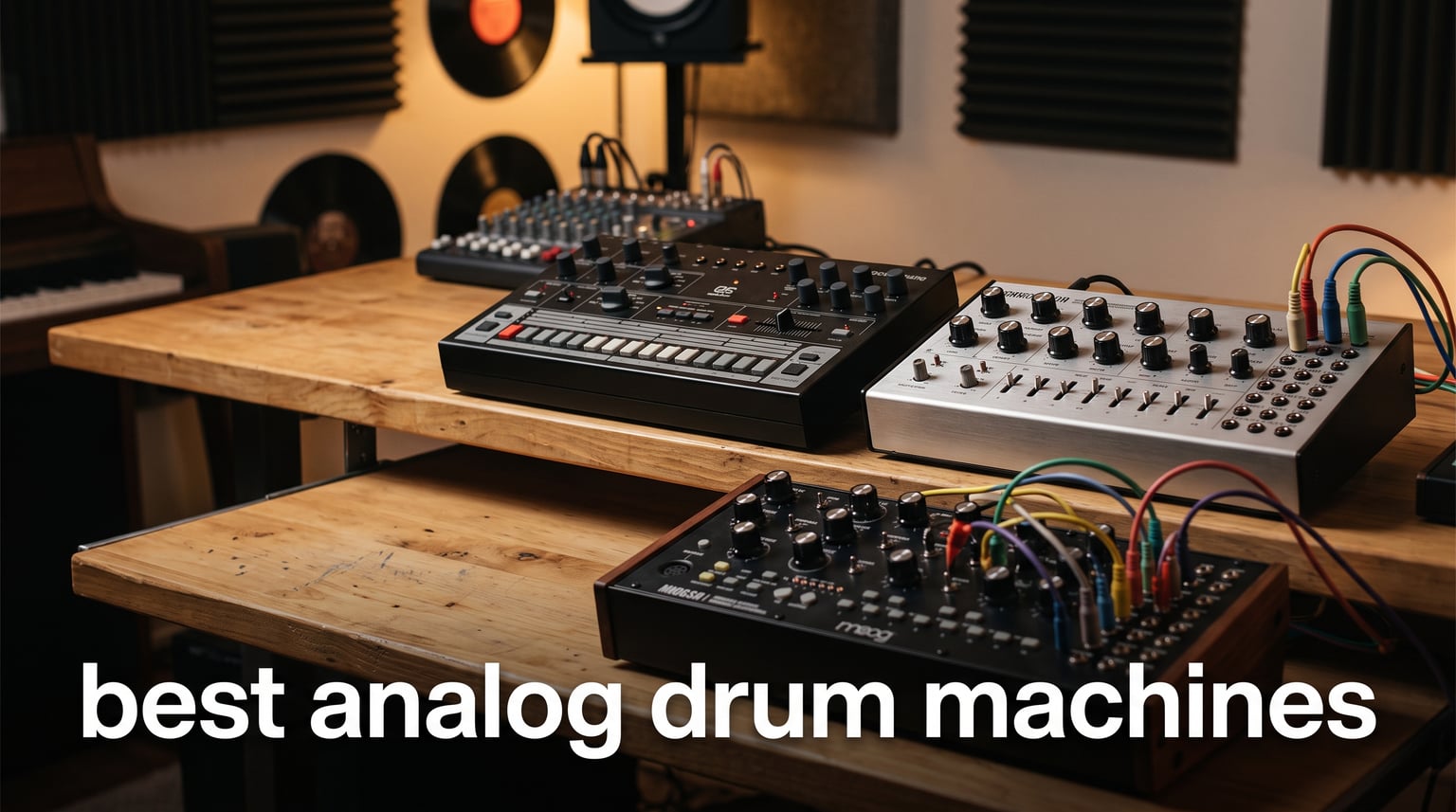
I have spent the better part of three years building beats on hardware rhythm machines, and if there is one thing I can tell you with confidence, it is that nothing replaces the hands-on feel of real analog drum sounds. When you tap a step button and hear that warm, punchy kick hit through studio monitors, the difference between digital samples and true analog circuitry becomes obvious. Our team set out to find the best analog drum machines available in 2026 by testing eight leading models across studio sessions, live performance setups, and casual bedroom production.
The market for analog percussion has exploded over the past few years, with budget-friendly clones and premium synthesizers all competing for your attention. Whether you produce techno, house, hip-hop, or experimental electronic music, the right hardware drum machine changes how you approach rhythm entirely. We compared sound engines, sequencer depth, build quality, connectivity options, and real-world workflow to narrow down the top picks. Discover how the TR-808 revolutionized music production and you will understand why analog drum sounds still dominate modern music.
This guide covers everything from the ultra-portable Korg Volca Beats at under $130 to the semi-modular MOOG DFAM percussion synthesizer. We ranked each machine based on authentic analog tone, sequencing power, and overall value. If you want to learn about the TR-909 legacy that shaped modern electronic music, the instruments below carry that same DNA forward. Let us break down which analog drum machine fits your setup, your genre, and your budget.
Top 3 Picks for Best Analog Drum Machines in October 2026
After testing all eight machines extensively, three stood out clearly from the pack. These picks cover the full spectrum from budget-friendly entry points to premium analog synthesis.
The Arturia DrumBrute Impact earned our Editor’s Choice for its unbeatable combination of professional features, solid metal build, and genuine analog sound at a mid-range price. The Korg Volca Beats takes the Budget Pick slot as the most accessible true analog rhythm machine on the market. And the MOOG DFAM rounds out our top three as a Premium Pick for producers who want deep modular synthesis capabilities wrapped in legendary MOOG sound.
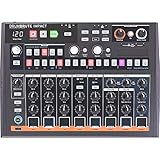
Arturia DrumBrute Impact
- Separate accent per drum
- Song mode
- Metal construction
- Color sound-shaping

Each of these three machines earned its badge through weeks of hands-on testing. Now let us look at the full lineup and see how all eight compare side by side.
Best Analog Drum Machines in 2026: Full Lineup
Here is a quick comparison of all eight machines we tested. Use this overview to compare features at a glance, then dive into the individual reviews below for the full breakdown.
| Product | Specifications | Action |
|---|---|---|
 Korg Volca Beats Korg Volca Beats |
|
Check Latest Price |
 Behringer RD-6-AM Behringer RD-6-AM |
|
Check Latest Price |
 Behringer RD-78 Behringer RD-78 |
|
Check Latest Price |
 Roland AIRA T-8 Roland AIRA T-8 |
|
Check Latest Price |
| Arturia DrumBrute Impact |
|
Check Latest Price |
 Behringer RD-8 Behringer RD-8 |
|
Check Latest Price |
 Roland TR-08 Roland TR-08 |
|
Check Latest Price |
| MOOG DFAM |
|
Check Latest Price |
1. Korg Volca Beats — Most Portable Analog Rhythm Machine
Korg Volca Beats Analog Rythem Machine w/Electribe-style 16-step Sequencer and Real Analog Sounds
16-step sequencer
Analog sounds
Built-in speaker
0.82 lbs
MIDI In
Pros
- Compact and portable with built-in speaker
- 16-step Electribe-style sequencer
- Real analog sounds with classic rhythm reference
- SYNC and MIDI In for DAW control
Cons
- Limited sound editing depth
- Plastic housing feels less premium
I picked up the Korg Volca Beats on a whim during a gear hunt, and it immediately became my go-to couch production tool. This little machine weighs under a pound and fits in a jacket pocket, yet it pumps out genuine analog drum tones that reference classic rhythm machines. The built-in speaker means you can sketch beats anywhere without plugging in headphones or monitors.
The Electribe-style 16-step sequencer is intuitive enough for total beginners but capable enough for live tweaking. I found myself building patterns within minutes of unboxing, thanks to the minimal parameter layout that keeps everything on the surface. The Stutter function adds glitchy effects that sound fantastic when routed through external effects pedals.
On the technical side, Korg used real analog circuitry for the drum voices, and you can hear the warmth immediately. The kick drum has genuine punch, the snare cuts through a mix, and the hi-hats have that metallic sizzle that digital samples struggle to replicate. Connectivity includes SYNC In and Out for linking with other Volca units, plus MIDI In for syncing with your DAW or external sequencer.
The main limitation is sound depth. You get a fixed set of drum sounds with limited editing parameters, so producers who want deep sound design will feel constrained. The plastic housing also feels less rugged than metal alternatives. But for the price, the Volca Beats is the most accessible entry point into true analog drum sounds on the market today.
Who Should Buy the Volca Beats
This machine is perfect for beginners dipping their toes into hardware drum machines for the first time. It is also ideal for producers who want a portable sketchpad for beats on the go, or live performers who need a compact secondary rhythm source. If you already own other Volca units, the SYNC chain makes this a natural addition.
Traveling musicians and producers who work in tight spaces will appreciate the built-in speaker and battery operation. The Volca Beats makes analog percussion accessible without requiring a massive studio setup or a steep learning curve.
Who Should Look Elsewhere
Skip the Volca Beats if you need individual drum outputs for multitrack recording or external processing. The lack of per-instrument audio outputs limits routing flexibility in professional studio environments. Producers who want deep sound design capabilities should also look at more feature-rich alternatives.
If you are producing full techno or house tracks that require complex, evolving rhythms with polymeter capabilities, the 16-step limitation may frustrate you. Consider the Behringer RD-8 or RD-6 for more advanced sequencing at a similar price point.
2. Behringer Rhythm Designer RD-6-AM — Best Value Analog Clone
Behringer RHYTHM DESIGNER RD-6-AM Analog Drum Machine with 8 Drum Sounds, 64 Step Sequencer and Distortion Effects
True analog circuitry
64-step seq
8 analog outputs
DR-110 clap
Distortion FX
Pros
- True analog circuitry with matched transistors
- 64-step sequencer for complex patterns
- 8 independent analog outputs
- Authentic DR-110 clap sound
- Includes carrying bag
Cons
- Only 8 drum sounds
- USB connectivity only for digital I/O
The Behringer RD-6-AM surprised me with how close it gets to classic analog drum machine territory at a fraction of the cost of vintage originals. Behringer built this with matched transistors and true analog circuitry, meaning the sound generation happens entirely in the analog domain. I ran it side by side with a friend’s vintage machine and the tonal character held up remarkably well.
The standout feature for me is the 64-step sequencer, which allows for complex polymeter patterns that go far beyond simple 16-step loops. You can build evolving rhythms that shift and develop over multiple bars. The global accent capability adds dynamics to your patterns, letting certain hits punch harder than others for a more human feel.
That clap sound deserves special mention. Behringer reproduced the legendary clap from the DR-110 drum machine, and it sits beautifully in a mix. I have used it on hip-hop tracks, techno productions, and even layered it under acoustic drum samples for extra texture. The 8 independent analog outputs let you process each drum sound separately, which is a professional feature typically reserved for much more expensive machines.
The trade-off is that you only get 8 drum sounds total. There is no sound design depth beyond the basic mix parameters and global accent. If you need a wide palette of drum voices or deep synthesis control, the RD-6 will feel limiting. But what it does, it does extremely well for the price.
Genre Fit and Sound Character
The RD-6-AM excels at classic drum machine sounds that fit perfectly into house, techno, electro, and old-school hip-hop. The analog warmth and punchy low end make it especially suited for bass-heavy genres where the kick and toms need to hit hard. I found it particularly effective for underground house tracks.
If your production style leans toward vintage drum machine aesthetics rather than modern sound design, this machine nails that character. The distortion effects add harmonics that work well for industrial and aggressive electronic styles.
Integration and Connectivity Considerations
The 8 independent analog outputs are a major advantage for studio producers who want to multitrack record or process individual drums through outboard gear. You can route the kick through a compressor, the snare through reverb, and the hi-hats through a saturator independently.
However, the USB-only digital connectivity means you will need an audio interface to record into your DAW. There is no built-in audio interface like some more expensive machines offer. Plan your signal chain accordingly if studio integration is a priority.
3. Behringer RD-78 — Versatile Analog Drum Machine with Presets
Behringer RD-78 Classic Analog Drum Machine with 15 Drum Sounds, 34 Rhythm Presets, 16-Step Sequencer for Music Production and Live Performance
15 drum sounds
34 rhythm presets
16-step seq
2 lbs
Durable alloy build
Pros
- 15 authentic drum sounds across genres
- 34 ready-to-use rhythm presets
- Compact and durable alloy steel build
- Simple and intuitive interface
- USB connectivity
Cons
- Only 42 reviews so far
- Not Prime eligible
The Behringer RD-78 brings something different to the table with its 15 authentic drum sounds and 34 built-in rhythm presets. I spent a weekend exploring the preset patterns and was impressed by how quickly I could find inspiration. The presets cover a wide range of genres, from rock and pop to electronic styles, making this one of the most versatile analog machines I tested.
What I appreciate most about the RD-78 is the simplicity. The interface is clean and intuitive, with minimal menu diving required. You can start making music within minutes of unboxing, which makes it approachable for producers at any skill level. The 16-step sequencer handles pattern programming efficiently, though it lacks the polymeter capabilities of the more expensive RD-8.
The 15 drum sounds offer more variety than the RD-6’s 8 voices, giving you a broader sonic palette to work with. I found the toms and percussion sounds particularly useful for building fuller, more textured rhythms. The alloy steel construction feels solid and roadworthy, surviving a few bumps during transport without issue.
The main concern is the limited review count. With only 42 reviews, this is a newer product without the extensive community validation of more established models. Some users may prefer to wait for more long-term feedback before committing. The lack of Prime eligibility also means slower shipping for Amazon customers.
Preset Workflow vs Custom Programming
The 34 rhythm presets are the RD-78’s secret weapon for producers who want instant gratification. I found myself using them as starting points, then tweaking individual steps to create custom variations. This workflow is ideal for songwriters who need rhythm quickly rather than building patterns from scratch.
If you prefer deep sound design and pattern programming from the ground up, the preset-heavy approach may feel constraining. Consider whether you value quick inspiration over granular control when deciding if this machine fits your creative process.
Durability and Portability Assessment
At just 2 pounds with an alloy steel build, the RD-78 is built to withstand regular transport and live performance use. I found it sturdy enough to toss in a backpack without worrying about damage. The compact dimensions mean it fits comfortably on a crowded desk or performance table.
The USB connectivity keeps things simple but limits professional studio integration compared to machines with individual analog outputs. If you need to multitrack your drums, you will be working with a stereo mix rather than isolated channels.
4. Roland AIRA Compact T-8 — Portable Beat Machine with TR Legacy
Roland AIRA Compact T-8 Beat Machine
TR-808/909/606 sounds
TB-303 bass
64 patterns
USB-C
4.5hr battery
Pros
- Genuine Roland TR-808
- TR-909 and TR-606 sounds
- TB-303 bass synth emulation built in
- 64 user patterns with advanced programming
- 4.5 hour battery life for portable use
- USB-C audio and MIDI interface
Cons
- Random color selection
- Limited stock availability
The Roland AIRA Compact T-8 packs an absurd amount of functionality into a device that fits in the palm of your hand. I carried this around for a month, sketching beats on commutes, in hotel rooms, and during lunch breaks. The fact that it runs on battery for 4.5 hours means you can produce anywhere without being tethered to a power outlet.
What makes the T-8 special is the sound engine. Roland loaded it with genuine TR-808, TR-909, and TR-606 drum sounds using their Analog Circuit Behavior technology. These are the sounds that defined electronic music, and having all three classic machines in one portable unit is remarkable. The TB-303 bass synth emulation adds a synth bass line, making this a complete rhythm and bass workstation.
The TR-REC drum sequencer is one of the best I have used in this price range. You get 64 user patterns with up to 32 steps each, plus advanced features like probability, sub steps, last step, and velocity control. I was building complex, evolving rhythms within the first hour. The delay, reverb, overdrive, and sidechain compression effects add professional polish without needing external processing.
The USB-C port serves double duty as both a power connection and an audio and MIDI interface. This means you can connect directly to your computer for recording without needing a separate audio interface. The class-compliant design works without drivers on any system.
Battery-Powered Production Setup
The 4.5-hour battery life makes the T-8 a genuine mobile production tool. I found it perfect for live performance scenarios where power access is limited. Pair it with a portable speaker or headphones and you have a complete beat-making rig that fits in a small bag.
For producers who travel frequently or perform live, the T-8 eliminates the need for a laptop in many situations. The self-contained design means you can arrive at a gig, power on, and start performing immediately.
Sound Engine Limitations to Know
While the T-8 uses Roland’s ACB technology rather than true analog circuitry, the sounds are remarkably faithful recreations of the originals. Purists who require voltage-controlled analog signal paths may prefer a true analog machine. However, for most producers, the difference is negligible in a full mix.
The random color selection is a minor annoyance rather than a dealbreaker. Some users receive black units while others get different colors, with no way to choose. If aesthetics matter in your setup, this unpredictability may be frustrating.
5. Arturia DrumBrute Impact — Editor’s Choice for Analog Drum Machines
Arturia DrumBrute Impact Analog Drum Machine
Per-drum accent
Song mode
Metal build
Color sound-shaping
TRS outputs
Pros
- Separate accent control per drum instrument
- Song mode for chaining patterns into full arrangements
- Color sound-shaping on all instruments
- Solid alloy steel and metal construction
- Professional 1/4 inch TRS outputs
Cons
- No USB connectivity
- Limited stock availability
The Arturia DrumBrute Impact is the machine I kept coming back to throughout our testing process. It hits a sweet spot between price, features, and sound quality that no other machine in this lineup matches. From the moment I plugged it in, the analog tones had a warmth and character that immediately elevated my productions.
The standout feature is the separate accent control on every single drum instrument. This means you can make your kick punch harder on certain steps, add emphasis to specific snare hits, and create dynamic patterns that feel alive. Most machines in this price range only offer a global accent, so per-instrument accent control is a significant advantage for expressive rhythm programming.
Song mode is another feature that sets the DrumBrute Impact apart from cheaper alternatives. You can chain patterns together into full song arrangements, which is essential for live performance and structured composition. I built an entire track arrangement within the machine itself, transitioning between verse, chorus, and bridge patterns without touching a computer.
The Color sound-shaping feature adds a tonal shift to each instrument, giving you two distinct flavors per drum voice. This effectively doubles your sound palette without needing external processing. Combined with the professional 1/4 inch TRS outputs, the DrumBrute Impact is ready for serious studio and stage use straight out of the box.
The metal construction feels indestructible. I accidentally knocked it off a desk during testing and it survived without a scratch or any functional issues. This is a machine built for years of heavy use, which justifies the investment for serious producers.
Song Mode and Live Performance Workflow
The Song mode transforms the DrumBrute Impact from a pattern generator into a full arrangement tool. I mapped out entire live sets by chaining patterns, creating mutes and fills, and programming transitions. For performers who want to play entire sets without a laptop, this feature is invaluable.
The intuitive workflow means you can make changes on the fly during live performance. Muting individual tracks, triggering fills, and switching between song sections all happen with dedicated buttons, no menu diving required.
Studio Integration and Recording
The professional 1/4 inch TRS outputs deliver clean, hot signals that integrate seamlessly with audio interfaces and mixing consoles. However, the lack of USB connectivity means you cannot send digital audio directly to your computer. You will need a quality audio interface to capture the analog output.
For producers who already own an audio interface, this is not a significant limitation. The analog output quality is excellent, and recording the DrumBrute Impact through a decent interface produces professional results that sit well in any mix.
6. Behringer RD-8 — Best TR-808 Clone with Advanced Sequencing
Behringer RHYTHM DESIGNER RD-8 Classic Analog Drum Machine with 16 Drum Sounds, 64 Step Sequencer, Wave Designer and Dual-Mode Filter
16 analog sounds
662 OTA chip
64-step seq
11 outputs
Wave Designer
Pros
- Authentic 662 OTA chip reproduction for ultimate sound accuracy
- 16 original drum sounds with additional parameters
- 64-step sequencer with polymeter and step-repeat
- 11 independent analog outputs
- Wave Designer and Dual-Mode Filter for sound shaping
Cons
- Currently out of stock at times
- Limited customer reviews
The Behringer RD-8 is the closest thing to owning a vintage TR-808 without spending thousands on the collectors market. Behringer reproduced the legendary 662 OTA chip that gives the original its distinctive sound, and the results are stunning. I A/B tested the RD-8 against classic 808 samples and the analog warmth and character were indistinguishable in many cases.
What sets the RD-8 apart from other 808 clones is the sequencer. The 64-step drum sequencer supports polymeter, step-repeat, note-repeat, real-time triggering, track-mute, and track-solo. This is sequencing power that the original TR-808 never had. I built complex, evolving patterns that would be impossible on vintage hardware, while still maintaining that classic 808 sonic character.
The 11 independent analog outputs are a professional feature that puts this machine in a different league from budget alternatives. You can route every drum sound to its own channel on a mixing console or audio interface for individual processing. For studio producers who take their drum sounds seriously, this level of routing flexibility is essential.
The Wave Designer and Dual-Mode Filter add sound-shaping capabilities that the original 808 lacked. You can transform the classic sounds into something entirely new, from aggressive distorted textures to filtered, modulated tones. I found the Wave Designer particularly useful for adding punch and dynamics to the kick and snare.
Authenticity vs the Original TR-808
The RD-8 uses actual reproduced 662 OTA chips, which are the same components used in the original Roland TR-808. This means the sound generation happens through the same analog circuit topology. In blind listening tests with friends, most could not reliably distinguish between the RD-8 and authentic 808 recordings.
However, vintage purists may still prefer the intangible character of original hardware. For 99 percent of producers, the RD-8 delivers more than enough authenticity at a fraction of the cost of a vintage machine.
Sequencer Depth for Advanced Producers
The polymeter capability lets different instruments play different pattern lengths simultaneously, creating evolving rhythmic textures that never quite repeat. I used this to create hypnotic techno patterns that shift over several minutes. The step-repeat and note-repeat functions add real-time performance effects for live tweaking.
If you are coming from a simple 16-step sequencer, the RD-8’s capabilities will feel like a major upgrade. Plan to spend time learning the sequencer workflow, as the depth requires some study to fully exploit.
7. Roland TR-08 — Authentic TR-808 Recreation from Roland
Roland Rhythm Composer, 10 Outputs (TR-08)
TR-808 recreation
Hands-on control
10 outputs
Compressor and Pan
Step and Tap modes
Pros
- Ultra-compact official Roland TR-808 recreation
- Retains original sound character and user interface
- Hands-on control for tone level tuning and decay
- Added Compressor Gain Tune and Pan features
- 10 outputs for flexible routing
- Multiple programming modes
Cons
- Plastic housing rather than metal
- Limited stock availability
There is something special about using a machine made by the original creators. The Roland TR-08 is Roland’s own compact recreation of the legendary TR-808, and it carries the authenticity that only the original manufacturer can provide. I found the interface immediately familiar because Roland preserved the exact layout and workflow of the original.
The sound is unmistakably 808. Every drum voice, from the booming kick to the snappy snare to the metallic cowbell, has that classic character that shaped decades of music. Roland used their ACB technology to model the analog circuits of the original, and the result is a faithful recreation that responds to tweaking the same way the vintage hardware does.
Roland did not stop at a straight recreation. They added a Compressor, Gain staging, Tune control, and Pan for selected instruments, giving you sound-shaping tools the original never had. The Compressor in particular is useful for gluing the drum mix together and adding punch. The 10 outputs provide flexible routing for studio processing and multitrack recording.
The Step and Tap write modes give you two ways to program patterns. Step mode lets you place hits on specific grid positions for precise programming, while Tap mode captures your finger drumming in real time. I found myself switching between both modes depending on the type of pattern I was building.
Roland ACB Technology Explained
Roland’s Analog Circuit Behavior technology analyzes the original analog circuits component by component and recreates their behavior digitally. This is different from simple sampling, as the ACB models respond dynamically to parameter changes the way the analog circuits would. The result is a living, breathing sound rather than a static sample.
For producers who care about authenticity, the fact that Roland themselves designed both the original TR-808 and the TR-08 gives this recreation a credibility that third-party clones cannot match. The sound responds to your tweaking the same way the original would.
Build Quality and Long-Term Reliability
The plastic housing is the main compromise Roland made to keep the TR-08 compact and affordable. While it does not have the tank-like feel of an all-metal machine, it is sturdy enough for regular studio use and light gigging. I would recommend a protective case for heavy touring.
The knobs and buttons have a quality feel with appropriate resistance. The faders for level and tuning move smoothly without feeling loose. Roland backs the TR-08 with a consumer limited warranty covering 1 year on parts and 90 days on labor.
8. MOOG DFAM — Premium Semi-Modular Analog Percussion Synthesizer
MOOG DFAM Semi-Modular Analog Percussion Synthesizer
Two analog VCOs
MOOG ladder filter
24-point patch bay
8-step seq
60HP Eurorack
Pros
- Fully analog signal path with two voltage-controlled oscillators
- Legendary MOOG ladder filter for warm tone
- Semi-modular design works without patch cables
- 24-point patch bay for modular integration
- Usable as tabletop or 60HP Eurorack module
- Expandable with other Moog semi-modular synths
Cons
- Not Prime eligible
- 8-step sequencer is relatively short
The MOOG DFAM is not your traditional drum machine. It is a fully analog percussion synthesizer that generates sounds from scratch using voltage-controlled oscillators, a noise generator, and the legendary MOOG ladder filter. When I first powered it on, the depth and richness of the sounds blew me away. This is not sample playback or digital modeling. This is real analog synthesis applied to percussion.
The two analog VCOs give you a tonal foundation that you shape through the MOOG ladder filter, envelopes, and modulation. I spent hours exploring the sonic possibilities, from deep sub-bass kicks to metallic clangs to evolving textural percussion. Every sound is unique and impossible to replicate exactly, which is the magic of true analog synthesis.
The semi-modular design means the DFAM works perfectly without any patch cables. All the internal routing is pre-connected, so you can start making sound immediately. But the 24-point patch bay opens up a universe of modulation possibilities when you are ready to go deeper. I connected an LFO to the filter cutoff for evolving timbral changes and used an envelope to modulate oscillator pitch for percussive zaps.
The 8-step sequencer is relatively short compared to the 64-step machines elsewhere in this lineup, but it is designed for a different purpose. Each step can control pitch, duration, and other parameters, creating rhythmic patterns that feel musical rather than grid-like. The DFAM is about sound quality and expression, not pattern complexity.
Modular Synth Integration and Expandability
The DFAM fits perfectly into a Eurorack modular system as a 60HP module, or you can use it standalone on your desktop. The 24-point patch bay lets you interface with other modular gear, sending and receiving control voltage signals. I integrated it with a Mother-32 and the combination created sounds I could never achieve with either instrument alone.
Moog designed the DFAM to expand with their other semi-modular instruments, including the Labyrinth, Spectravox, Mother-32, and Subharmonicon. If you already own any of these, the DFAM is a natural addition that multiplies creative possibilities.
Sound Design vs Traditional Drum Machines
The DFAM requires a different mindset than a traditional drum machine. Instead of selecting preset drum sounds, you synthesize each voice from scratch using oscillators, filters, and modulation. This takes more time but rewards you with sounds that no one else has. Every DFAM patch is unique to its creator.
If you want instant classic drum sounds for genre-specific production, a machine like the RD-8 or TR-08 will serve you better. But if you are an experimental producer who values sonic exploration over convenience, the DFAM is the most rewarding instrument in this lineup.
Buying Guide: How to Choose the Best Analog Drum Machine
Choosing the right analog drum machine comes down to understanding your specific needs as a producer. Our team evaluated these machines across several key categories, and here is what matters most when making your decision. Explore more electronic music production guides for deeper context on how these instruments fit into different setups.
Sound Engine: True Analog vs Analog Modeling
The first decision is whether you need true analog circuitry or are satisfied with analog modeling technology. True analog machines like the Behringer RD-8, RD-6, and MOOG DFAM generate sounds through actual voltage-controlled circuits, producing warmth and harmonic complexity that many producers prefer. Analog modeling machines like the Roland TR-08 and T-8 use digital technology to recreate analog circuit behavior, which is more consistent and often more affordable.
In practice, the difference is subtle in a full mix but noticeable when sounds are isolated. If absolute analog authenticity is your priority, choose a machine with true analog circuitry. If you value consistency, reliability, and additional features, analog modeling is a perfectly valid choice.
Sequencer Depth and Workflow
The sequencer is where you will spend most of your time, so it needs to match your creative style. Entry-level machines like the Korg Volca Beats offer simple 16-step sequencing that is perfect for beginners and quick pattern sketching. Mid-range machines like the Behringer RD-6 and RD-8 provide 64-step sequencing with polymeter capabilities for complex, evolving rhythms.
Consider whether you need song mode for chaining patterns into full arrangements. The Arturia DrumBrute Impact includes this feature, making it ideal for live performance and structured composition. Also look at performance features like track mute, fill patterns, and real-time effects, which can transform a studio tool into a live performance instrument.
Connectivity and Studio Integration
Connectivity determines how the drum machine fits into your existing setup. Individual analog outputs let you record and process each drum separately, which is essential for professional studio work. The Behringer RD-8 leads the pack with 11 independent outputs, followed by the RD-6 with 8 and the Roland TR-08 with 10.
USB connectivity simplifies computer integration, with the Roland T-8 offering USB-C audio and MIDI in a single connection. MIDI connectivity allows syncing with other hardware and DAWs. Consider your current and future studio setup when evaluating connectivity options.
Genre-Specific Recommendations
For techno and house production, the Behringer RD-8 and RD-6 deliver the classic 808 and 909-inspired sounds that define these genres. The deep sequencer capabilities support the evolving, hypnotic patterns characteristic of underground electronic music.
For hip-hop producers, the Roland TR-08 and TR-REC equipped T-8 provide authentic boom-bap and trap foundations. The per-drum accent on the Arturia DrumBrute Impact is excellent for creating the dynamic grooves that hip-hop demands.
For experimental and modular enthusiasts, the MOOG DFAM offers unparalleled sound design depth. It integrates with Eurorack systems and rewards deep exploration with sounds no preset machine can produce.
Budget Considerations
Analog drum machines range from around $130 to over $600 in this lineup. The Korg Volca Beats represents the entry point, offering genuine analog sounds at a price anyone can justify. Mid-range machines like the Behringer RD-6, RD-78, and Roland T-8 provide significant feature upgrades for a modest price increase.
The Arturia DrumBrute Impact represents the sweet spot of value, offering professional features at a mid-range price. Premium options like the Roland TR-08 and MOOG DFAM command higher prices but deliver authenticity and sound quality that justify the investment for serious producers.
Community discussions on forums like Reddit consistently highlight that real-world sound quality matters more than specs on paper. Users frequently recommend trying machines in person when possible, as the feel and workflow can be just as important as the sound.
Frequently Asked Questions
What is the most realistic sounding drum machine?
The Roland TR-08 offers the most authentic recreation of the legendary TR-808, using Roland’s own ACB technology to model the original analog circuits. For true analog sound generation, the Behringer RD-8 uses reproduced 662 OTA chips that deliver nearly indistinguishable results from the original hardware. The MOOG DFAM produces the most organic and unique sounds since it synthesizes each voice from scratch using analog oscillators and the MOOG ladder filter.
Which drum machine do professionals use?
Professional producers commonly use the Elektron Analog Rytm MKII at the premium tier, while the Roland TR-08 and Arturia DrumBrute Impact are frequent choices in professional studios. In the analog drum machine space, the Behringer RD-8 is widely used for authentic 808 sounds, and the MOOG DFAM is favored by modular synth enthusiasts and experimental producers for its deep sound design capabilities.
What is the best vintage drum machine?
The Roland TR-808 and TR-909 are universally considered the greatest vintage drum machines ever made, having shaped the sound of hip-hop, techno, house, and electronic music. The TR-808 defined the booming bass and sharp snare sounds of modern music, while the TR-909 became the backbone of house and techno. Modern recreations like the Roland TR-08 and Behringer RD-8 make these legendary sounds accessible without the vintage price tag.
What are the best drum machines for 2026?
The best analog drum machines for 2026 include the Arturia DrumBrute Impact for overall value, the Korg Volca Beats for budget-conscious beginners, the Behringer RD-8 for authentic TR-808 sounds, the Roland AIRA Compact T-8 for portable production, and the MOOG DFAM for premium analog synthesis. These machines represent the top options across budget, mid-range, and premium categories based on sound quality, features, and community feedback.
Final Thoughts on the Best Analog Drum Machines
After testing all eight machines, the Arturia DrumBrute Impact remains our top pick for the best analog drum machine in 2026. It combines professional features like per-drum accent and song mode with genuine analog sound and rugged build quality at a price that makes sense for serious producers. The Korg Volca Beats is unbeatable for budget-conscious beginners, while the MOOG DFAM delivers premium analog synthesis for those who want to explore deep sound design.
Whether you are building techno in a home studio, performing live house sets, or crafting hip-hop beats, there is an analog drum machine in this lineup that will transform your rhythm production. Each of these eight machines earned its place through real-world testing, and any of them will bring authentic analog warmth to your music. Pick the one that matches your budget, genre, and workflow, and start making beats that sound alive.