
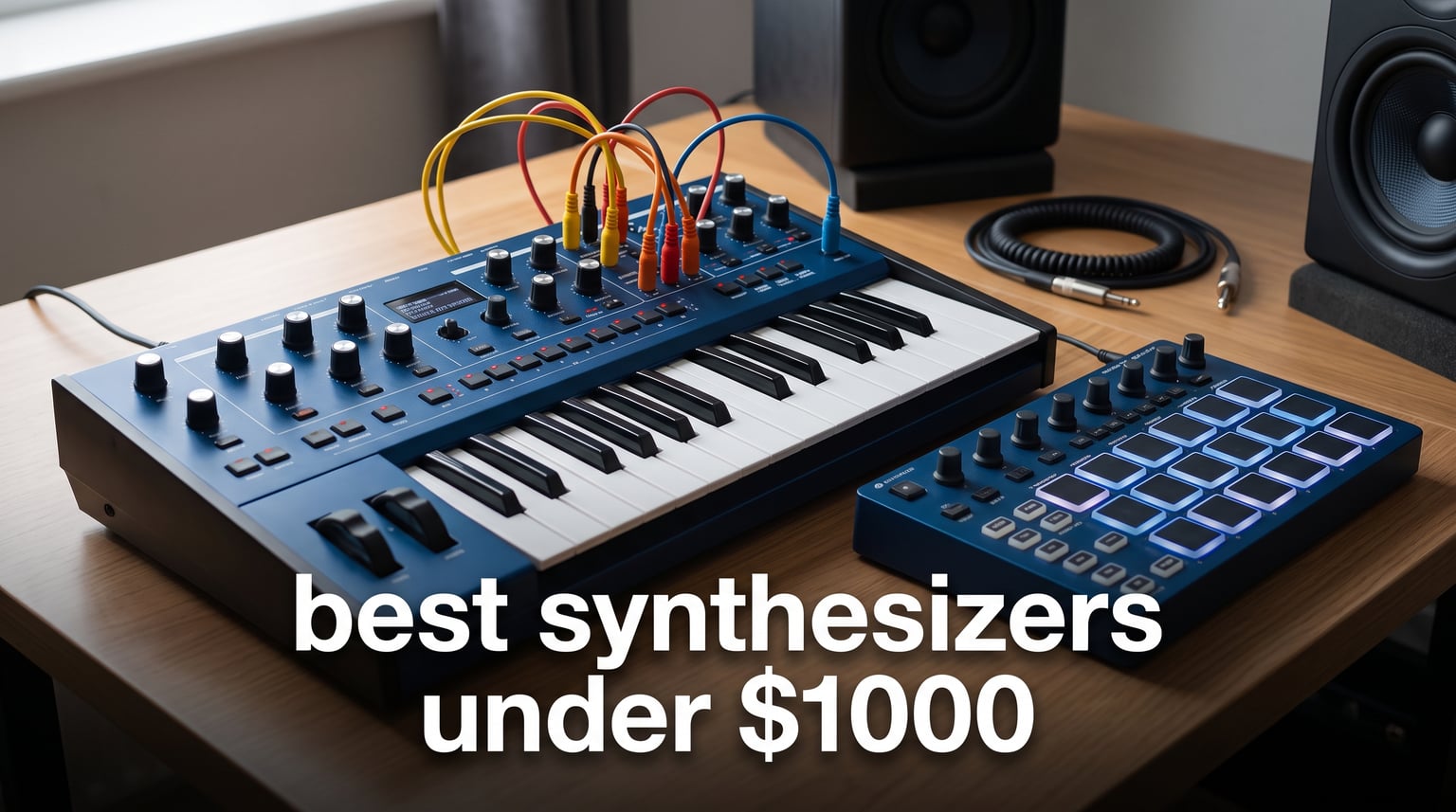
The best synthesizers under $1000 are not one-size-fits-all instruments. My short answer is to choose the MOOG Messenger when a hands-on monophonic analog voice is the priority, the Arturia MiniFreak when six-voice hybrid sound design matters more, and the Roland AIRA Compact S-1 when a small, battery-powered synth is the real need.
This list covers ten selected products, but it also separates standalone sound generators from keyboards and controllers that serve a wider production setup. That distinction saves a common first-buy mistake: a MIDI controller can be a great front end for software or modular gear, yet it does not replace a hardware synthesizer with its own sound engine.
I have kept the focus on published product specifications, feature sets, review feedback, and practical workflow rather than pretending every player needs the same thing. If your goal is electronic music made at home, the story of affordable equipment that enabled bedroom producers is a useful reminder that a focused setup often beats a room full of gear.
Table of Contents
The top 3 picks answer three different synth needs
For a direct starting point, pick the Messenger for a dedicated analog keyboard voice, the MiniFreak for layered hybrid patches and aftertouch, or the S-1 for a compact four-voice instrument with a sequencer. Those choices cover the three questions I hear most often: “Do I want analog character, broad sound design, or something I can take anywhere?”
These are the best synthesizers under $1000 in 2026 at a glance
The complete comparison below puts the key distinction first: voice count and sound architecture tell you more about the musical role than a long preset list alone. Keyboard players should also scan the key count, while producers who already own a controller should look closely at the module, micro-synth, and sequencer options.
| Product | Specifications | Action |
|---|---|---|
 MOOG Messenger MOOG Messenger |
|
Check Latest Price |
 Arturia MiniFreak Arturia MiniFreak |
|
Check Latest Price |
 Akai MPK Mini Plus Akai MPK Mini Plus |
|
Check Latest Price |
 Yamaha CK61 Yamaha CK61 |
|
Check Latest Price |
 Roland GO:KEYS 3 Roland GO:KEYS 3 |
|
Check Latest Price |
 Roland AIRA Compact S-1 Roland AIRA Compact S-1 |
|
Check Latest Price |
 Behringer PRO-800 Behringer PRO-800 |
|
Check Latest Price |
 Korg multipoly Korg multipoly |
|
Check Latest Price |
 Yamaha SEQTRAK Yamaha SEQTRAK |
|
Check Latest Price |
 Roland JUNO-D6 Roland JUNO-D6 |
|
Check Latest Price |
1. The MOOG Messenger is the clearest pick for a dedicated monophonic analog keyboard
MOOG Messenger Monophonic Analog Synthesizer
32 full-size keys
2 VCOs plus sub
64-step sequencer
Pros
- Classic MOOG analog sound
- 32 full-size keys
- RES BASS compensation
Cons
- Monophonic only
I would put the Messenger at the head of a shortlist when one expressive lead, bass, or sequence at a time is enough. Its 32 semi-weighted, full-size keys include velocity and aftertouch, which makes it a more direct keyboard experience than a mini-keyboard sketch tool.
The published 4.8 rating from 52 reviews is encouraging, but the useful facts are the layout and the voice architecture. Two VCOs offer sync and FM, a sub-oscillator adds another source, and the instrument remains intentionally monophonic rather than presenting itself as a pad machine.
The filter can operate in 4- or 2-pole low-pass, band-pass, and high-pass modes, with RES BASS compensation designed to retain a full-bodied result across the spectrum. That range makes it sensible for someone who wants to learn subtractive synthesis by touching a control for each function.
A 64-step sequencer with probability-based generative behavior gives the Messenger an idea-building role beyond manual playing. Its 256 presets help recall a starting point quickly, while CV and MIDI connectivity leave room for a larger hardware setup.
The Messenger fits bass, leads, and one-note sequences
Choose it when the part needs focus instead of chords. A monophonic synth asks you to commit to the line, which is often exactly what a bass part or lead melody needs in a busy arrangement.
I would not choose it as the only keyboard for players who need full chords and moving pads from one instrument. Its strength is the single voice and the controls around it, not a large polyphony count.
The Messenger connects well to a hands-on rig
The combination of comprehensive CV and MIDI connectivity suits a musician who may add drum machines, modular equipment, or a DAW later. The 64-step sequencer also means the synth can keep generating a part while your hands move to another instrument.
At 5.14 kilograms, it is portable enough to move between a desk and rehearsal, though its listed dimensions still make it a real keyboard rather than a pocket device. Measure the space before treating it as a travel instrument.
2. The Arturia MiniFreak is the strongest hybrid choice for six-voice exploration
Arturia MiniFreak 37 Key Polyphonic 6-Voice Hybrid Synthesizer Keyboard (Standard, 37 Key)
6-voice hybrid
37 aftertouch keys
64-step sequencer
Pros
- Six voices
- Hybrid engine
- Portable lightweight build
Cons
- Slim keys may not suit all
- Limited availability reported
The MiniFreak is the first instrument I would consider for a player who wants more than one synthesis flavor in a compact keyboard. Its hybrid digital/analog engine, two engines, and SVF filter give it a broader starting canvas than a straightforward analog mono synth.
Six voices let you play chords and layered parts, and the 37 slim velocity-sensitive keys include aftertouch. That matters because aftertouch gives a player another expressive input after the note has started, rather than limiting every change to a knob or wheel.
The included MiniFreak VST counterpart is a particularly practical bridge between a hardware synthesizer and computer-based production. You can keep the tactile keyboard workflow while also working with the related software counterpart in a studio session.
Its 64-step sequencer and three FX slots make it a solid music production synth for patterns, texture, and quick patch variation. The product listing reports a 4.7 rating from 140 reviews, and forum discussion in the research repeatedly points to MiniFreak versatility as a reason users recommend it.
The MiniFreak works best for chords and changing textures
Pick this one when polyphonic playing is non-negotiable and you want room to explore beyond a single analog voice. Six notes will cover many chord, pad, arpeggio, and stacked-part situations without forcing you into a desktop module.
The slim keys deserve an honest try before a long-term keyboard purchase if you are used to full-size action. They help keep the instrument compact, but key feel is personal and affects whether you reach for it every day.
The MiniFreak gives DAW users a practical bridge
The VST counterpart makes this a sensible option for a producer who switches between standalone playing and a software session. It does not remove the need to learn routing in your recording setup, but it offers a clear connection between the instrument and its companion software.
I would set it up first with a simple MIDI track, then learn the sequencer and effects once the basic workflow feels familiar. That staged approach answers the beginner worry that a feature-rich affordable synth will become confusing before it becomes useful.
3. The Akai Professional MPK Mini Plus is a controller, not a standalone synthesizer
Akai Professional MPK Mini Plus 37-Key USB MIDI Keyboard Controller
37 mini keys
8 RGB MPC pads
64-step sequencer
Pros
- Versatile pads
- MIDI and CV connectivity
- NKS integration
- Includes MPC Beats
Cons
- Mini keys
- One USB port
The MPK Mini Plus belongs in this comparison only with a clear label: it is a USB MIDI keyboard controller, not a keyboard with an onboard synth engine. I included it because it can be the central performance surface for software instruments, MIDI hardware, or a modular system.
Its 37 mini keys cover three octaves, and the eight RGB MPC pads are velocity-sensitive. That is a useful combination for a producer who writes basslines and chords on keys but also wants finger drumming or clip-style performance input from the same compact unit.
The 64-step sequencer, MIDI, and CV/Gate I/O are the product details that make this more than a basic controller. CV and Gate are especially relevant if you plan to drive compatible analog or modular gear from a keyboard-and-sequencer workflow.
NKS integration and included MPC Beats software speak directly to computer-based production. The reported 4.6 rating comes from 2,121 reviews, a much larger review sample than several newer standalone instruments in this group.
The MPK Mini Plus suits a software-first producer
Choose it if your sounds already live in a DAW or plugin collection and you need playable controls. It is a practical answer for someone asking whether hardware is worth it versus software, because it adds physical input without duplicating the instruments they already own.
Do not buy it expecting a self-contained hardware synthesizer. It needs a computer, compatible external sound source, or connected hardware to produce the actual synth voice.
The MPK Mini Plus reaches beyond USB MIDI
MIDI/CV/Gate I/O lets it speak to more than a laptop, which is a meaningful upgrade path for a small studio. Start with USB MIDI if that is familiar, then add CV or Gate only when the connected instrument calls for it.
The mini-key format and one USB port are the limits to factor in. For detailed two-hand playing, a larger keyboard may feel better; for a tight desk, the small footprint is the point.
4. The Yamaha CK61 is a broad stage-keyboard alternative with built-in speakers
Yamaha CK Series 61-Key Stage Keyboard with Built-In Speakers, Black (CK61)
61 full-size keys
Built-in speakers
Three-zone split
Pros
- 61 full-size keys
- Built-in speakers
- Diverse sound set
Cons
- Not Prime eligible
- Limited availability reported
The CK61 is best understood as a stage keyboard with synth sounds rather than a deep knob-per-function synthesizer. I would recommend it to a player who needs piano, organ, strings, brass, keyboard sounds, and synth sounds within one 61-key instrument.
Its 61 full-size keys immediately make it more suitable for traditional keyboard parts than the compact choices above. Built-in speakers and battery or corded power also reduce setup friction for a practice room, writing session, or stripped-back performance.
Three-zone split capability is the headline performance feature. It gives a player a way to divide the keyboard into three areas, which can support separate sound roles without bringing several keyboards to the same set.
USB connectivity supports DAW integration, so the CK61 can have a place in a computer-centered studio as well as on a stand. The 4.6 rating from 138 reviews is useful context, but the instrument makes the most sense when breadth and full-size keys outrank deep synthesis programming.
The CK61 serves a live set with many keyboard roles
Choose the CK61 when one song calls for piano-like playing, another needs organ, and another needs a synth layer. A wide sound set and zoning solve that practical set-list problem better than a dedicated mono synth.
I would skip it if your main goal is learning oscillators, filters, envelopes, and LFOs through a dense control panel. The product is oriented toward a range of playable sounds, not a narrowly focused sound-design lesson.
The CK61 keeps practice and small setups simple
Built-in speakers mean you can hear the instrument without first connecting monitors or headphones. Battery or corded operation adds another option when the location changes from a home studio to a rehearsal space.
The trade-off is size: 61 full-size keys are useful, but they need more room than a 32- or 37-key board. Decide whether regular two-hand parts matter enough to justify that footprint.
5. The Roland GO:KEYS 3 is the easiest route to guided song creation
Roland GO:KEYS 3 Music Creation Keyboard, Dark Red
61 velocity keys
1000+ ZEN-Core sounds
Bluetooth MIDI
Pros
- 1000+ sounds
- Built-in speakers
- Bluetooth
- Battery powered
Cons
- Not as deep for pros
- Limited availability reported
The GO:KEYS 3 is the beginner-friendly choice for someone who wants to make complete musical ideas instead of starting with a blank synth patch. Its 61 velocity-sensitive keys, built-in stereo speakers, and battery-powered operation support immediate play without a separate sound system.
Roland lists more than 1,000 ZEN-Core sounds, over 200 auto-accompaniment styles, and more than 300 chord sequencer presets. Those are strong tools for a songwriter who wants rhythm, accompaniment, and a harmonic prompt while they work out a melody.
Bluetooth audio and MIDI are useful for a casual home setup. You can treat the keyboard as an instrument first, while its connectivity still gives it a path into a recording or learning workflow.
The reported 4.5 rating from 221 reviews supports its position as an accessible music-creation keyboard. The limitation is equally clear in the listing: it is not as deep for professional sound programming as the MiniFreak, Messenger, or a dedicated analog module.
The GO:KEYS 3 helps a beginner finish ideas
Choose this keyboard if chord progressions, song sections, and accompaniment are more immediate goals than synthesis theory. The chord sequencer presets and auto-accompaniment styles can turn a rough idea into something you can evaluate and develop.
That makes it a credible first instrument for a beginner who is overwhelmed by choices. It offers many sounds and structured support rather than asking the player to design every sound from an oscillator upward.
The GO:KEYS 3 fits flexible home listening
Built-in stereo speakers and battery power make it easy to practice away from a studio desk. Bluetooth audio and MIDI extend the setup without making a cable-heavy rig mandatory on day one.
A dedicated hardware synthesizer is a better fit if the main ambition is detailed filter, envelope, or modulation work. Think of the GO:KEYS 3 as a broad writing keyboard with synth sounds, not a replacement for a deep sound-design instrument.
6. The Roland AIRA Compact S-1 is the best portable four-voice micro polysynth
Roland AIRA Compact S-1 Tweak Synth
4-voice micro synth
64-step sequencer
USB-C audio MIDI
Pros
- Portable
- D-Motion control
- Battery powered
- USB-C audio MIDI
Cons
- Limited polyphony
The S-1 is the answer when desk space, bag space, and standalone sequencing rank above full-size keys. It is a four-voice micro polysynth with a 64-step sequencer, a stated battery life of up to 4.5 hours, and USB-C audio and MIDI.
I like the clarity of that role: it is not trying to be a stage keyboard. It is a small sound-making unit for quick patterns, compact electronic-music sessions, and a rig where a larger controller or keyboard already exists.
Roland lists D-Motion sound control along with Osc Draw and Chop features. Those controls point to a performance-minded approach to changing sound and sequence material rather than a conventional keyboard-led workflow.
The 4.5 rating from 200 reviews gives it solid user feedback in this group. Four voices are enough for many short chords and sequenced parts, but the voice count remains a constraint for players who want large sustained pad voicings.
The S-1 belongs in a portable electronic-music setup
Choose the S-1 when you want a battery-powered sound source that can move with a laptop, headphones, or a small groovebox setup. USB-C audio and MIDI reduce the number of separate connections needed for a compact recording path.
The 64-step sequencer lets the instrument carry its own repeating part. That is helpful for live performance or writing, because you can adjust sound parameters while the pattern continues.
The S-1 needs a realistic view of micro-synth limits
The compact format means there is no full-size playing surface built into the product. If expressive two-hand keyboard parts are central, pair it with a controller or select a keyboard synth from this guide.
Four voices also mean choices about note priority. For short motifs and rhythmic sequences that is often manageable; for dense chords, a higher-polyphony instrument is more comfortable.
7. The Behringer PRO-800 is the eight-voice analog option for a MIDI-based setup
Behringer PRO-800 Classic Analog 8-Voice Polyphonic Synthesizer with 2 VCOs, Classic VCF, Arpeggiator, Sequencer and 400 Program Memories in Eurorack Format
8-voice analog
2 VCOs per voice
400 program memories
Pros
- Classic analog sound
- Two VCOs per voice
- 400 memories
Cons
- Temporarily out of stock
The PRO-800 is the direct answer for a producer who wants an eight-voice analog synthesizer and already has a way to send notes. It is modeled as an authentic reproduction of the Prophet 600 and uses a pure analog signal path according to the product information.
Each voice has two VCOs, which totals 16 oscillators in Unison mode. That specification is more meaningful than a generic “fat sound” claim because it tells you why the module can stack a substantial number of oscillator sources for one played part.
Its 400 program memories are a practical advantage for a multi-song setup. Patch storage means a player can save working sounds and return to them instead of rebuilding every setup from the front panel.
The product has a reported 4.5 rating from 30 reviews, but its stock status was temporarily out of stock in the supplied data. I would treat availability as something to check at the moment you are ready to buy, not as a reason to compromise on the workflow you need.
The PRO-800 makes sense when you already own keys
This is a keyboard-less synth module, so it fits a desk with an existing MIDI controller or a sequencer. That can be more efficient than buying another keyboard if your current keys already feel right.
It is not the simplest first purchase for someone who wants a single box they can immediately play without other gear. A keyboard synthesizer reduces the number of decisions in a beginner setup.
The PRO-800 favors stored polyphonic analog parts
Eight voices give it a useful advantage for chords and layered harmonic material over monophonic instruments. Unison then changes the emphasis from several notes at once to a single note with multiple oscillator sources.
The 400 memory locations help when a project needs repeatability. I would name and organize patches early, because a saved sound is much easier to recall in a later session than a panel setting remembered from memory.
8. The Korg multipoly is the high-polyphony analog-modeling pick for layered sound
Korg multipoly Analog Modeling Synthesizer w/Four Oscillators, 60 Voices and built-in KAOSS Pad
60 voices
Four oscillators
KAOSS Pad
Pros
- 60 voices
- KAOSS Pad
- Four oscillators
- Dual filters
Cons
- Plastic body
- Limited availability reported
The Korg multipoly is the most direct answer for a buyer whose priority is high polyphony in a synthesizer-focused instrument. It is an analog-modeling synth with 60 voices, four stacked oscillators, dual filters, insert effects, and a built-in KAOSS Pad.
That combination gives it a different identity from the MOOG Messenger or PRO-800. Rather than putting the focus on one monophonic line or an eight-voice analog module, it offers a large voice count and several layers for thick, changing harmonic material.
The four stacked oscillators are central to its sound-design appeal, and the KAOSS Pad supplies a direct performance interface. I would look at it when hands-on movement during a part matters as much as simply selecting a preset.
The supplied listing shows a 4.4 rating from 24 reviews, so there is less review volume than with long-established products in this group. It also describes a plastic body, a fair consideration for anyone who expects a very heavy-duty stage chassis.
The multipoly handles wide chords and layered arrangements
Sixty voices make this the best polyphony answer among the listed standalone synthesizers. That headroom is useful when sustained chords, overlapping notes, or layered textures are part of the music rather than an occasional effect.
More voices do not automatically make a synth easier for a beginner. Pick it because you need the sonic capacity and the oscillator-plus-filter architecture, not because the largest number on a spec sheet feels safer.
The multipoly rewards performance-oriented sound shaping
The built-in KAOSS Pad offers a distinct way to manipulate sound in real time. That is appealing for a performer who wants a visible, touch-based control surface as part of a live electronic-music set.
Dual filters and insert effects add further patch-shaping tools. Set aside time to learn one oscillator layer and one filter behavior at a time, then add the other elements after the basic sound is working.
9. The Yamaha SEQTRAK is the all-in-one choice for portable sketches with drums and sampling
Yamaha SEQTRAK Mobile Music Ideastation, Advanced Sequencer, Onboard Sampling, Built-In Speakers and Microphone, Orange
Drums and synths
Onboard sampler
Rechargeable battery
Pros
- All-in-one workflow
- Portable
- Built-in mic and speaker
Cons
- Lower review rating
The SEQTRAK is for a musician who wants to create a complete sketch away from a keyboard-and-monitor setup. Yamaha describes it as an all-in-one music creation unit with drums, synths, sound design, sequencing, onboard sampling, a rechargeable battery, and USB-C connectivity.
Its built-in speaker and microphone strengthen that mobile role. You can start with a rhythm, add synth material, capture a sound, and build a sequence without treating a laptop or external audio interface as the first requirement.
I would approach it as an ideastation rather than a substitute for a 61-key performance synth. The focus is on arranging and sequencing several musical elements in a compact unit, not on playing large keyboard voicings with two hands.
The reported 4.1 rating from 82 reviews is the lowest of the listed group, so it deserves a more deliberate fit check. Its feature set is appealing when portability and all-in-one composition are priorities, but it is not automatically the right answer for a player seeking one deep synthesizer voice.
The SEQTRAK lets an idea become a small arrangement
Choose it if drums, synths, sampling, and sequencing need to live in one portable workflow. That setup can move an idea past a single patch and toward a structured piece of music.
The onboard sampler and microphone make sound capture part of the process. A producer who likes turning nearby sounds into material will find that more relevant than another bank of keyboard presets.
The SEQTRAK favors sequencing over traditional key playing
The lack of a conventional full-length keyboard is an intentional form-factor decision. It works for pattern construction and compact production, while a keyboard player may still want a separate controller for expressive note entry.
USB-C provides a connection path to a computer-based setup when a project needs to move beyond the device. Start with its self-contained tools, then connect it to a DAW only when that adds a real benefit to the song.
10. The Roland JUNO-D6 is the full-size ZEN-Core performance keyboard for broad sound access
Roland JUNO-D6 Synthesizer, 61-Note Keyboard
61 synth-action keys
3800+ sounds
USB-C audio MIDI
Pros
- 3800+ sounds
- 61 keys
- USB-C audio MIDI
- WAV import
Cons
- Lower review rating
- Not Prime eligible
The JUNO-D6 is the full-size performance-keyboard answer for someone who wants extensive ZEN-Core sound access and direct computer connection. It has 61 synth-action keys, a ZEN-Core engine with more than 3,800 sounds, and USB-C audio/MIDI.
Roland also lists more than 800 onboard sounds, sample import for WAV files, and Roland Cloud support. Those features make it a broad platform for a player who needs to cover many sound categories and bring their own samples into the instrument.
I would choose it for a set where switching between parts matters more than programming a single analog signal path from scratch. The 61-note layout supports two-hand playing, and the synth-action keybed suits fast keyboard parts and synth performance.
The listed rating is 4.1 from 34 reviews, so the current feedback sample is limited and not as high as several compact contenders. That does not invalidate its features; it means the decision should be led by the 61-key ZEN-Core workflow, not by a rating alone.
The JUNO-D6 covers a varied live keyboard role
Choose the JUNO-D6 when a set demands a lot of different sounds from one full-size keyboard. Its extensive engine and onboard selection are useful for moving among synth, keyboard, and sample-based parts without changing instruments.
The 61 synth-action keys are a better fit for regular playing than mini keys or a desktop box. They do take up more space, so this is a conscious choice for a performance-oriented setup.
The JUNO-D6 links samples and DAW sessions
USB-C audio and MIDI simplify connecting the keyboard to a computer for recording and control. WAV import also gives a player a route to bring custom sample material into their hardware-based workflow.
Roland Cloud support is another part of its connected ecosystem. Consider it if you want a broad, expandable sound source; choose a simpler analog instrument if direct oscillator-and-filter learning is the stronger goal.
The right synthesizer follows your playing method, sound goal, and setup
Start by separating sound source from controller. The Messenger, MiniFreak, S-1, PRO-800, multipoly, and SEQTRAK generate or organize synth-focused sound within their own stated designs, while the MPK Mini Plus controls software or external gear and the CK61, GO:KEYS 3, and JUNO-D6 cover wider keyboard roles.
Analog and digital choices answer different creative questions
An analog synthesizer uses analog circuitry in its sound path; the Messenger is listed as monophonic analog, and the PRO-800 is listed as an eight-voice analog instrument. An analog-modeling, hybrid, or engine-based instrument takes a different approach, as shown by the multipoly, MiniFreak, and Roland ZEN-Core keyboards.
Neither label makes one automatically better. Choose analog if the specific analog architecture and immediate control layout draw you in; choose hybrid, modeling, or engine-based options when their voice count, layers, effects, or broad sound set matches the parts you write.
Polyphony decides whether the instrument can carry chord work
Polyphony is the number of notes a synthesizer can sound at once. Monophonic instruments such as the Messenger prioritize one note, the S-1 offers four voices, the MiniFreak offers six, the PRO-800 has eight, and the multipoly lists 60 voices.
For bass, lead, and sequenced melodies, one voice can be a feature rather than a limit. For pads, chords, and sustained overlapping notes, start with at least the level of polyphony your playing actually asks for instead of hoping a mono synth will cover every job.
Keyboard size changes what you will play
Full-size keys on the Messenger, CK61, GO:KEYS 3, and JUNO-D6 suit players who want conventional keyboard spacing. The MiniFreak and MPK Mini Plus trade that space for slim or mini keys, while the S-1, PRO-800, multipoly, and SEQTRAK call for another form of note input or sequencing.
I would prioritize a comfortable keybed if you play two-hand chords, piano-like parts, or long rehearsals. Choose compact keys and desktop designs when portability, a tight desk, or an existing controller matters more than a traditional playing surface.
Sequencing and connectivity decide how the synth joins a production
Several products offer 64-step sequencing, including the Messenger, MiniFreak, MPK Mini Plus, and S-1. A sequencer can run a repeating musical pattern while you shape sound, play another keyboard, or focus on arrangement decisions.
For DAW work, check the connection named in the product data rather than assuming every device behaves identically. USB MIDI appears on several choices, USB-C audio and MIDI are listed for the S-1 and JUNO-D6, the CK61 has USB, and the MPK Mini Plus adds MIDI/CV/Gate I/O for a wider hardware path.
Hardware is worth it when hands-on work changes your process
Software can offer enormous sound variety and recall, while hardware puts physical controls, a dedicated interface, and standalone operation in front of you. The better choice is the one that gets you writing, learning, or performing more often, not the one with the longest feature list.
For a beginner synthesizer, I would favor a clear first task: guided songwriting with GO:KEYS 3, compact hybrid patch exploration with MiniFreak, or focused monophonic subtractive learning with Messenger. Community discussion in the research backs the MiniFreak for range and repeatedly calls the Minilogue XD a budget favorite, but this selected product set does not include the Minilogue XD, so I would not pretend it was reviewed here.
These answers address the most common synthesizer questions
What is the best synthesizer under $1000 for beginners?
The Roland GO:KEYS 3 is the simplest starting point for a beginner who wants guided song creation, built-in speakers, 61 velocity-sensitive keys, and a large sound library. Choose the Arturia MiniFreak instead if learning a six-voice hybrid synth with aftertouch and a sequencer is the real goal.
Which synthesizers under $1000 offer the best value?
The Arturia MiniFreak offers six voices, two engines, aftertouch, a sequencer, effects, and a VST counterpart. The Roland AIRA Compact S-1 offers a compact four-voice, battery-powered option, while the MOOG Messenger focuses on a dedicated analog mono-synth experience with 32 full-size keys and a 64-step sequencer.
What are the most versatile synths under $1000?
The Arturia MiniFreak is versatile for hybrid patch design, sequences, effects, and polyphonic playing. The Korg multipoly offers 60 voices, four oscillators, dual filters, effects, and a KAOSS Pad; the Roland JUNO-D6 offers broad ZEN-Core sound access, 61 keys, WAV import, and USB-C audio/MIDI.
What is the best analog synthesizer under $1000?
Choose the MOOG Messenger for a keyboard-based monophonic analog synth with two VCOs, a sub-oscillator, several filter modes, presets, and sequencing. Choose the Behringer PRO-800 when eight-voice analog polyphony, 400 program memories, and an existing MIDI keyboard or sequencer are a better fit.
Which budget synth offers the best polyphony under $1000?
Among the listed dedicated synthesizers, the Korg multipoly has the highest stated count at 60 voices. The Behringer PRO-800 offers eight analog voices, the Arturia MiniFreak offers six hybrid voices, and the Roland AIRA Compact S-1 offers four voices; pick based on whether polyphony, architecture, and form factor matter most.
The best final choice is the one that matches your first musical task
For 2026, I would start with the MOOG Messenger for a direct monophonic analog keyboard, the Arturia MiniFreak for broad hybrid polyphonic work, and the Korg multipoly when very high polyphony and a KAOSS Pad are the deciding factors. The best synthesizers under $1000 become much easier to choose once you decide whether your next part is a bassline, a chord bed, a full song sketch, or a live keyboard performance.
Read the comparison once more, choose the form factor you will actually play, and then follow the relevant product button for current availability. A focused first instrument is a better foundation than a feature list chosen for someone else’s workflow.