
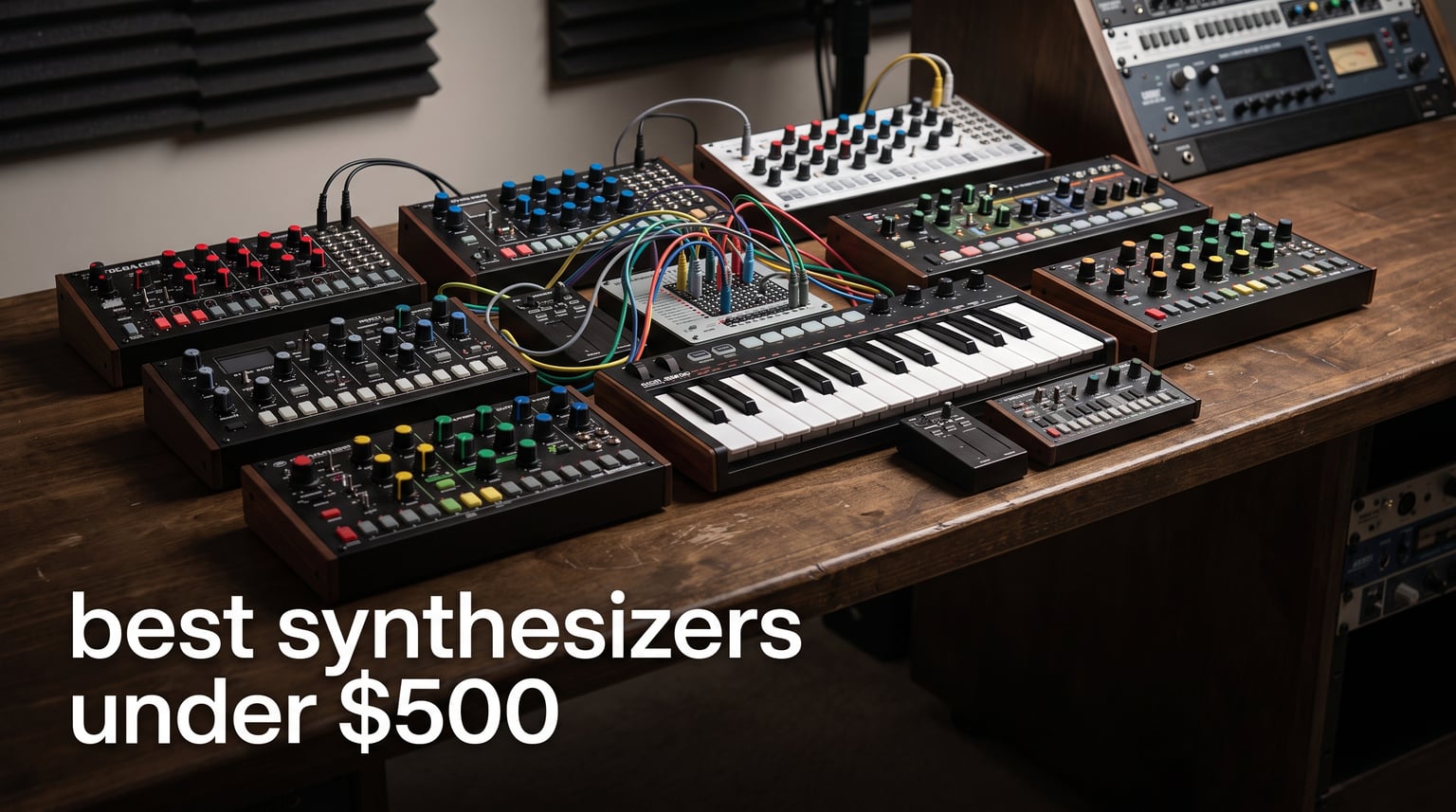
The best synthesizers under $500 are not one-size-fits-all instruments. My short answer is to start with the Behringer Pro VS Mini when compact vector-style sound design is the goal, the Roland AIRA Compact J-6 when chords and song sketches matter most, or the Stylophone GENX-2 when tactile analogue experimentation is the point.
This group includes hardware synthesizers, music-creation keyboards, compact bass machines, and semi-modular instruments. I compared every selection by sound engine, voice count, hands-on controls, sequencing, and how it connects to a studio or live rig.
That distinction matters more than a crowded feature list. Synth forum discussions keep returning to the same problems: analog versus digital, full keyboard versus desktop box, and whether patch points will help or distract; this guide puts those decisions first for 2026.
Table of Contents
The Top 3 Picks Answer Different Synth Needs
These standouts cover three different ways of making music. Choose the Pro VS Mini for compact wavetable and vector-morphing ideas, the J-6 for chord-led songwriting with a JUNO-60-derived engine, and the GENX-2 for a portable analogue voice with CV and Gate outputs.
These Are the Best Synthesizers Under $500 in 2026
The overview above puts all 12 choices in one place before the detailed notes. Use it to narrow a shortlist by sound approach rather than assuming a monophonic synth, polyphonic synth, and 61-key music keyboard solve the same job.
| Product | Specifications | Action |
|---|---|---|
 Roland AIRA Compact J-6 Roland AIRA Compact J-6 |
|
Check Latest Price |
 Behringer Pro VS Mini Behringer Pro VS Mini |
|
Check Latest Price |
 Arturia MicroBrute UFO Arturia MicroBrute UFO |
|
Check Latest Price |
 Roland GO:KEYS 3 Roland GO:KEYS 3 |
|
Check Latest Price |
 Roland AIRA Compact S-1 Roland AIRA Compact S-1 |
|
Check Latest Price |
 Donner Essential B1 Donner Essential B1 |
|
Check Latest Price |
 Stylophone GENX-2 Stylophone GENX-2 |
|
Check Latest Price |
 Behringer PRO-800 Behringer PRO-800 |
|
Check Latest Price |
 Behringer Grind Behringer Grind |
|
Check Latest Price |
 Roland GO:KEYS 5 Roland GO:KEYS 5 |
|
Check Latest Price |
 MOOG Mavis MOOG Mavis |
|
Check Latest Price |
 Stylophone Theremin Stylophone Theremin |
|
Check Latest Price |
The Roland AIRA Compact J-6 Is the Chord-Sketching Choice
Roland AIRA Compact J-6 CHORD SYNTH Portable Song Creation Machine
4 voices
JUNO-60 ACB engine
64-step chord patterns
Pros
- JUNO-60 sound engine
- 100 chord sets
- 64 user patterns
- USB-C audio MIDI
Cons
- Four-voice limit
- Compact controls
The J-6 makes the strongest case when a blank page is the problem rather than a lack of synthesis depth. Its 100 chord sets and nine arpeggio styles, each with 12 variations, offer a fast way to turn a harmonic idea into a rhythmic phrase.
Roland pairs that writing workflow with a four-voice JUNO-60 engine built with Analog Circuit Behavior technology. There are 64 ready-to-play presets, filter and envelope controls, plus delay and reverb, so a sequence does not have to remain a dry sketch.
This Is Best When Chords Need to Become Patterns Quickly
The programmable chord sequencer stores 64 user patterns of up to 64 steps each. That is a meaningful advantage for a writer who wants recurring chord motion without playing every part live.
This Fits a USB-C Studio Better Than a Full Keyboard Setup
Class-compliant USB-C audio and MIDI can connect the J-6 directly to compatible computer or mobile workflows without drivers. Audio, MIDI, and sync I/O also make it sensible beside other AIRA Compact gear.
The Behringer Pro VS Mini Is the Compact Sound-Design Pick
Behringer Pro VS Mini Portable 5-Voice Hybrid Synthesizer with 4 Vector Morphing Oscillators Per Voice, Analog Low-Pass Filter, 16-Step Sequencer and Arpeggiator
4 voices
16 Vect oscillators
Analog low-pass filter
Pros
- Vector morphing
- Analog low-pass filter
- Wavetable synthesis
- USB or battery power
Cons
- 27 keys
- Availability can vary
The Pro VS Mini is the pick I would make for someone drawn to movement inside a sound. Four vector-morphing oscillators per voice let you work with changing wavetable combinations instead of treating each patch as a fixed waveform.
Its analogue low-pass filter adds a familiar subtractive-synthesis control point after the digital oscillator section. A 16-step sequencer, arpeggiator, and dedicated filter, amplifier, and oscillator envelopes provide a compact but credible sound-design toolkit.
This Works Best for Small Desks and Mobile Sketches
The 27-key format and battery or USB-powered operation make this easy to keep within arm’s reach. It is a desktop synth first, so players who need two-handed parts should add an external MIDI controller.
This Rewards Players Who Want to Learn Wavetable Motion
Vector morphing is the deciding feature here, not merely the small footprint. It gives a beginner a direct route into evolving digital textures while the analog filter keeps cutoff and resonance behavior approachable.
The Arturia MicroBrute UFO Is the Hands-On Analog Choice
Arturia MicroBrute UFO Analog Synthesizer
100 percent analog
Steiner-Parker filter
Patchable mod matrix
Pros
- Analog Brute oscillators
- Distinctive filter
- Patchable matrix
- Hands-on controls
Cons
- Monophonic voice
- Limited review history
The MicroBrute UFO is a direct answer for players who want a single analogue voice they can shape with their hands. Arturia’s Brute oscillators and Steiner-Parker filter point it toward forceful percussion, lead parts, and bass-focused sound design rather than polite background pads.
What separates it from a basic monophonic synth is the patchable modulation matrix. Stackable patch cables let you route modulation sources to destinations, which makes the signal path visible and teaches cause and effect better than a deep menu.
This Suits Learners Who Want Every Control in Front of Them
The stated hands-on workflow avoids menu-driven operation. I would choose this format when the goal is to understand an oscillator, filter, envelope, and modulation connection by hearing one change at a time.
This Connects Naturally to Patch-Cable Gear
The modulation matrix makes external connections part of the instrument rather than an add-on. That gives it a useful bridge between a standalone keyboard synth and a more experimental modular direction.
The Roland GO:KEYS 3 Is the Easiest Full-Keyboard Starting Point
Roland GO:KEYS 3 Music Creation Keyboard, 61-Note, Turquoise
61 touch keys
1000 plus ZEN-Core sounds
Speakers and Bluetooth
Pros
- 61 touch-sensitive keys
- Over 1000 sounds
- Built-in speakers
- USB audio MIDI
Cons
- 16-pound body
- Keyboard-first format
The GO:KEYS 3 is the clearest starter recommendation for a person who wants to play songs as well as create them. Its 61 touch-sensitive keys, built-in stereo speakers, and more than 1,000 ZEN-Core sounds remove barriers that a tiny desktop synth leaves in place.
More than 200 onboard music styles and over 300 chord-sequencer presets put accompaniment under your fingers quickly. It is a music-creation keyboard rather than a dedicated knob-per-function analog synth, but that broader role is why it can keep a beginner playing.
This Is Best When You Need Real Keyboard Range
Sixty-one touch-sensitive keys are a practical difference for two-handed chords, bass notes, and melody. The onboard speakers also mean a first session does not depend on separate monitoring gear.
This Is Strong for Computer and Phone Music Work
Bluetooth audio and MIDI support streaming and wireless control, while the USB audio/MIDI interface works with music software. Battery or corded operation adds flexibility for practice away from a desk.
The Roland AIRA Compact S-1 Is the Portable Polysynth Choice
Roland AIRA Compact S-1 Tweak Synth
4-voice micro synth
64-step sequencer
USB-C audio MIDI
Pros
- Four-voice polyphony
- Osc Draw and Chop
- 64-step sequencer
- Battery operation
Cons
- Compact format
- Four-voice ceiling
The S-1 is the right small-format choice if you want polyphonic notes rather than a single bassline at a time. Four voices make chord stabs and short pad-like figures possible, while Osc Draw and Chop give the compact engine a more experimental edge.
The 64-step sequencer is long enough to create a complete repeating idea, not only a one-bar loop. D-Motion Sound Control adds another performance-oriented element, giving the instrument a way to shape sound beyond conventional knob turns.
This Is Best for Carrying a Sequencer and Synth Together
The one-pound body and 4.5-hour battery specification make the S-1 suited to portable sessions. It is built around concise patterns and direct manipulation, so it rewards short, intentional parts.
This Integrates Cleanly with a Digital Recording Setup
USB-C audio and MIDI reduce the number of adapters needed at a computer-based setup. For someone choosing among the best synthesizers under $500 for travel, that connection is as important as the voice count.
The Donner Essential B1 Is the Pattern-Driven Bassline Choice
Analog Bass Synthesizer and Sequencer, Donner Essential B1 with Intuitive User Interface, 128 Patterns Memory, Saturation & Delay Effects, Make for Classic Acid Sound
Analog signal path
128 presets
Step sequencer and effects
Pros
- Analog signal path
- 128 presets
- Haptic pads
- MIDI and sync I O
Cons
- Single VCO
- Sequencer takes practice
The Essential B1 targets the part many electronic tracks need first: a repeating, characterful bass line. Its fully analog signal path uses one VCO, one VCF, and one VCA, then adds analog saturation and delay for shaping a sequence into something less plain.
Unlike a minimal acid-style box, it stores 128 presets and includes an eight-mode arpeggiator. The haptic pads use dynamic color-changing backlights, and Song Mode can chain patterns, so there is room to develop ideas after the first loop works.
This Fits Groove-Based Electronic Music Best
The intuitive step sequencer and dedicated low-frequency focus make this a natural companion for drum machines and clocked hardware. One oscillator narrows the palette, but it also keeps bass programming focused.
This Has the Connections Needed for a Hardware Rig
USB-C, MIDI I/O, and sync I/O allow the B1 to communicate with a computer and external instruments. That matters when a bass sequencer must lock to the rest of a live or studio pattern.
The Stylophone GENX-2 Is the Portable Analogue Experiment Pick
Stylophone GENX-2 Portable Analogue Synthesizer with Built-in Speaker, LFO, Filter, Analogue Delay and CV/Gate Output | Synthesizer Keyboard | Synth Musical Instrument
Analogue voice
Resonant filter and PWM
CV Gate outputs
Pros
- Built-in speaker
- CV and Gate outputs
- Analog delay
- Expression strip
Cons
- Two-octave layout
- Stylus technique takes adjustment
The GENX-2 is more than a retro novelty because its control set is genuinely synthesis-focused. It combines an LFO with square and triangle waves, a resonant low-pass filter, attack and decay shaping, pulse-width modulation, and dual sub-octave switches.
I like its clear separation of playful playing methods and serious routing options. The built-in analogue delay, finger-sensitive expression strip, speaker, and battery operation invite immediate experiments, while CV and Gate outputs mean the instrument can grow into a modular setup.
This Is Best When a Self-Contained Instrument Matters
The internal speaker and portable operation let you explore without connecting an amp or computer. A two-octave interface limits conventional keyboard playing, so it favors riffs, drones, and sound effects.
This Gives a Small Rig a Route to CV and Gate
CV and Gate outputs are the important technical detail for modular users. They allow the GENX-2 to take part in voltage-controlled equipment rather than sit apart as a toy-like secondary instrument.
The Behringer PRO-800 Is the High-Voice Analog Pad Choice
Behringer PRO-800 Classic Analog 8-Voice Polyphonic Synthesizer with 2 VCOs, Classic VCF, Arpeggiator, Sequencer and 400 Program Memories in Eurorack Format
8 voices
2 VCOs per voice
400 program memories
Pros
- Eight analog voices
- Two VCOs per voice
- Unison mode
- 400 memories
Cons
- Desktop module format
- Availability can vary
The PRO-800 answers the call for genuine polyphonic analog architecture in a desktop module. Eight voices with two VCOs per voice give it room for layered chord voicings and detuned sounds that a four-voice instrument can run out of quickly.
Its unison mode combines the architecture into thick 16-oscillator lead and bass sounds. The classic VCF design, arpeggiator, sequencer, six simultaneous oscillator shapes, and 400 program memories make it far more than a single-sound machine.
This Is Best When Polyphony Is the Non-Negotiable Feature
Eight voices are the headline because they support longer-release chords without stealing notes as quickly. Choose it for pad and chord roles where a monophonic synth would force too many compromises.
This Requires an External Way to Play Notes
The PRO-800 is a synthesizer module, not a full keyboard. Plan to control it with MIDI from a keyboard, sequencer, or computer so the wide voice architecture is actually playable.
The Behringer Grind Is the Multi-Engine Semi-Modular Choice
Behringer Grind Semi-modular Hybrid Multi-engine Synthesizer
14 synth engines
Analog ladder filter
32-step sequencer
Pros
- Fourteen sound engines
- Digital oscillators
- Analog ladder filter
- 32-step sequencer
Cons
- Semi-modular learning curve
- No full keyboard
The Grind is the most purpose-built experimental machine in this list. It combines 24 digital oscillators, 10 percussion and noise engines, and 14 total synth engines with an analog ladder filter, so it has more than one route to unusual timbres.
A 32-step sequencer turns those engines into patterns without needing a computer. This hybrid approach will appeal to someone who wants digital source variety but still wants an analog filter to shape brightness, resonance, and weight.
This Is Best When Percussion and Noise Are Part of the Sound
The dedicated percussion and noise engines set the Grind apart from straightforward keyboard synthesizers. I would shortlist it for textured electronic music, rhythmic sound design, and sequences where conventional sawtooth leads are not the goal.
This Is a Better Fit for Curious Tinkerers Than First-Day Players
Semi-modular design opens more routing choices, and that comes with a learning curve. It makes sense for a buyer willing to explore a signal path rather than one seeking an immediate piano-style keyboard experience.
The Roland GO:KEYS 5 Is the All-in-One Song-Creation Choice
Roland GO:KEYS 5 Music Creation Keyboard, 61-Note, Graphite
61 touch keys
1000 plus ZEN-Core sounds
Mic input and speakers
Pros
- Over 1000 sounds
- 61 touch-sensitive keys
- Microphone input
- Bluetooth and USB audio
Cons
- 16.5-pound body
- Keyboard-first workflow
The GO:KEYS 5 extends the GO:KEYS concept for a creator who wants a complete song-making station. It has the broad ZEN-Core sound library, 61 touch-sensitive keys, accompaniment styles, chord-sequencer presets, Bluetooth audio/MIDI, and USB audio/MIDI support.
The big differentiator is its microphone input with onboard vocal effects, plus stereo speakers with a passive radiator. That makes it a better fit for writing around a sung idea or for a self-contained performance than many focused desktop synths.
This Is Best When Songs Need More Than Synth Patches
More than 1,000 sounds and over 200 music styles cover a much wider range than a conventional single-engine synth. The keyboard can support chords, accompaniment, melody, and a microphone-based performance from one instrument.
This Rewards Players Who Need Built-In Sound Output
The stereo speakers with passive radiator make the GO:KEYS 5 more self-sufficient than a module or tabletop synth. Its 16.5-pound weight is the trade-off for that broader all-in-one layout.
The MOOG Mavis Is the Eurorack Gateway Choice
MOOG Mavis Semi-Modular Analog Synthesizer
Analog oscillator and filter
Diode wavefolder
44HP Eurorack module
Pros
- Moog analog circuits
- Wavefolder
- Eurorack integration
- Full ADSR
Cons
- Assembly required
- Monophonic design
Mavis is the answer for someone who specifically wants to enter modular synthesis without starting from loose modules. It is a build-it-yourself kit with a 100 percent analog design, a Moog oscillator and ladder filter, full ADSR, sample and hold, attenuators, mults, and a diode wavefolder.
The wavefolder changes its character from a familiar Moog-style subtractive voice into a more harmonically rich sound tool. A small built-in keyboard with glide and keyboard scaling provides a starting point before external controllers or voltage sources join the system.
This Is Best When Eurorack Expansion Is the Destination
Mavis can operate as a standalone instrument or be removed from its case for Eurorack connectivity. That keeps the first purchase useful on its own while giving future patching options real purpose.
This Requires a Willingness to Assemble the Instrument
The included kit supplies the chassis, PCB, tools, patch cables, power supply, instructions, and dust cover, but assembly is part of ownership. I would not pick it for a buyer who wants a plug-in-and-play keyboard on day one.
The Stylophone Theremin Is the Expressive Drone and Glide Choice
Stylophone Theremin – Award-Winning Portable Touch-Sensitive Synthesizer with Retro Analog Sound, Built-In Speaker, Delay & Vibrato Effects, Slider Control, Compact Battery-Powered Design
Pitch antenna and touch slider
Delay and vibrato
Portable built-in speaker
Pros
- Pitch antenna
- Precision touch slider
- Delay and vibrato
- Battery-powered speaker
Cons
- Unconventional playing method
- Plastic construction
The Stylophone Theremin is the unusual choice, and that is its reason to exist. It joins a pitch theremin antenna with a touch slider, giving you both freehand pitch movement and a more controlled route to notes and smooth glides.
Its retro analog sound, delay, vibrato, built-in speaker, headphone output, and battery-powered body create a complete small performance object. It can make sustained drones, triggered notes, and moving modulation that would be awkward to imitate with a conventional keyboard.
This Is Best for Cinematic Textures and Experimental Phrases
The pitch antenna, slider, and effects favor gestures over chord voicings. Choose it for sound effects, ambient motion, and expressive lines where imprecision can become part of the performance.
This Connects Easily to Headphones, Pedals, and Recording Gear
A headphone output supports quiet practice, while the audio output can feed amps, pedals, or recording equipment. That makes its compact speaker a convenience rather than the only way to hear it.
The Right Synth Depends on How You Want to Make Music
Start with physical format. A 61-key instrument such as the GO:KEYS 3 or GO:KEYS 5 is the comfortable answer for a player who thinks in chords, scales, and two-handed parts; a desktop synth such as the PRO-800 assumes you already have a MIDI controller or sequencer.
Compact instruments change the question again. The J-6, S-1, Pro VS Mini, B1, GENX-2, and Theremin are focused idea machines: each is easy to place in a small setup, but each gives up some keyboard range or all-purpose breadth.
Analog Is Best When Immediate Tone Shaping Matters Most
An analog synth generates or processes sound with analog circuitry. In this group, the MicroBrute UFO, Essential B1, PRO-800, Mavis, and GENX-2 give you analog paths or circuits, with VCO, VCF, VCA, filter cutoff, resonance, and envelope shaping at the center of the experience.
Analog does not automatically mean better. It means the workflow and sound character suit a particular goal, such as direct bass, leads, resonant sweeps, or patch-cable exploration; polyphony and memory capacity vary by model.
Digital Is Best When Sound Variety and Recall Matter Most
Digital and hybrid choices can provide distinct oscillator behaviors, stored sounds, and production-friendly connections in a small body. The Pro VS Mini’s vector/wavetable approach, the S-1’s performance tools, and the Roland ZEN-Core keyboards’ broad sound libraries show that advantage.
Preset memory is not a substitute for learning synthesis, but it keeps a useful patch available when a session moves quickly. If recall, USB audio, Bluetooth MIDI, or a large sound library rank above analog circuitry, digital is often the clearer answer.
Polyphony Is Best Chosen Before Extra Features
Polyphony is the number of notes a synth can sound at once. Four-voice models such as the J-6 and S-1 can play compact chords, while the eight-voice PRO-800 gives more room for sustained chord changes and layered intervals.
A monophonic synth plays one note at a time, which is not a defect when you need a bassline, lead, drone, or percussion part. Avoid a monophonic machine when your actual goal is wide pads or piano-style accompaniment.
Connectivity Is Best Matched to the Rest of Your Rig
USB MIDI lets an instrument exchange note and control data with a computer, while USB audio can carry sound into compatible music software. Bluetooth MIDI is useful for cable-free control, and traditional MIDI I/O remains valuable for linking hardware sequencers and keyboards.
CV and Gate are voltage-control connections used by modular and semi-modular systems. The GENX-2 and Mavis make sense if that is a direction you plan to explore, while the J-6, S-1, GO:KEYS models, and Pro VS Mini have stronger digital-studio roles.
A Beginner Should Choose One Clear Musical Job First
My practical decision path is simple: choose GO:KEYS 3 for playable keys and broad sounds, J-6 for instant chord ideas, MicroBrute UFO for learning a hands-on analog signal path, or Pro VS Mini for compact digital sound design. Choose Mavis or Grind only when patching itself is part of what you want to learn.
That framing responds to a common community concern: specifications look impressive until they do not serve the next piece of music. A focused instrument that you use every week beats a feature-heavy box that never fits your process.
These Answers Settle Common Synth Questions
What is the best affordable synthesizer?
The Behringer Pro VS Mini is a strong affordable synthesizer choice for compact sound design because it combines vector-morphing wavetable oscillators, an analog low-pass filter, a sequencer, and USB or battery power. Choose the Roland AIRA Compact J-6 instead if chord sequencing and JUNO-60-derived sounds are your priority.
What is the best sounding synthesizer?
The best sounding synthesizer depends on the sound you need. The Arturia MicroBrute UFO favors forceful analog leads and filter character, the MOOG Mavis adds an analog ladder filter and wavefolder, and the Behringer PRO-800 is the better match for wide eight-voice analog chords.
What is the best starter synth?
The Roland GO:KEYS 3 is the best starter synth for many players because it has 61 touch-sensitive keys, built-in speakers, more than 1,000 ZEN-Core sounds, chord-sequencer presets, and USB audio/MIDI. The Arturia MicroBrute UFO is the stronger first choice when learning an analog signal path is the goal.
What is the best cheap synthesizer?
The Stylophone GENX-2 is a compelling compact choice when portability, a built-in speaker, analog-style controls, and CV/Gate outputs matter. The Behringer Pro VS Mini is another focused option for players who want wavetable and vector-morphing sound design in a small keyboard format.
Is analog or digital better under 500?
Analog is better when you want direct oscillator, filter, and envelope shaping, while digital is better when broad sound variety, preset recall, USB audio, or Bluetooth MIDI matter more. The best choice is the one that fits the musical part you want to make, not a technology label.
The Best Choice Matches Your Playing Style
For the best synthesizers under $500, there is no honest single winner because each instrument answers a different musical need. I would choose the Pro VS Mini for animated compact sound design, the J-6 for chord-based writing, the MicroBrute UFO for hands-on analog learning, the PRO-800 for eight-voice analog parts, and GO:KEYS 3 for a first full keyboard.
Read the shortlist once more with your next track in mind: bass sequence, chord progression, pad, lead, drone, or modular patch. That one decision will make the right synthesizer much clearer in 2026.