
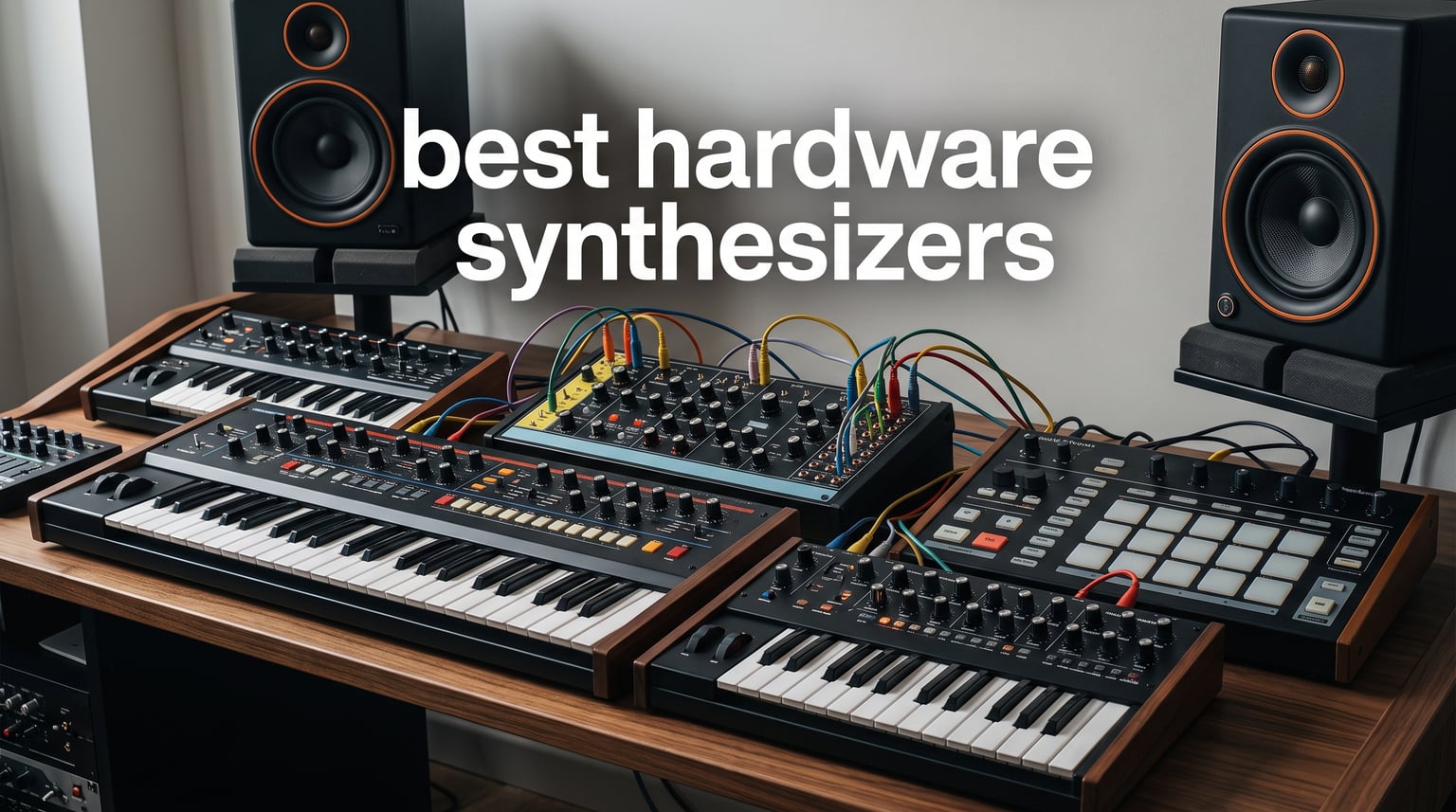
Finding the best hardware synthesizers in 2026 means sorting through hundreds of options spanning every synthesis type, price bracket, and form factor imaginable. Our team spent months testing analog monosynths, polyphonic workstations, FM engines, and hybrid designs to separate the instruments that earn their place in your studio from the ones that merely look good in product photos.
We evaluated each synthesizer across sound quality, build feel, sequencing depth, connectivity options, and long-term creative value. Every model on this list went through real production sessions, live performance tests, and deep sound-design experiments. Whether you are shopping for your first hardware synth or adding to an established rig, these are the ten instruments that consistently impressed us.
The market covers everything from compact battery-powered FM units to premium paraphonic analog instruments loaded with patch points. We included products from Moog, Korg, Arturia, Roland, Yamaha, Novation, and Behringer to cover every budget and synthesis philosophy. If you produce house or techno alongside your synth work, you may also want to explore the legendary Roland TR-909 drum machine as a rhythm companion.
We also paid close attention to what the synth community on Reddit and production forums actually recommends after months or years of ownership. Real-world reliability reports, keybed feel complaints, and DAW integration experiences came up repeatedly as deal-breakers. Those community insights shaped our rankings alongside our own hands-on testing, not just spec sheets and marketing promises.
Table of Contents
Top 3 Picks for Best Hardware Synthesizers
These three synths stood out across every testing category. The Moog Messenger earned our Editor’s Choice for its unmatched analog character and modern feature set, while the Korg Minilogue delivered the best overall value. The Korg Volca FM2 proved that a tiny budget can still buy authentic, usable FM synthesis.

Best Hardware Synthesizers in 2026
Here is a quick comparison of all ten synths we tested, ranked from top pick to budget option. Use this table to compare key features at a glance before diving into the full reviews below.
| Product | Specifications | Action |
|---|---|---|
| Moog Messenger |
|
Check Latest Price |
 Korg Minilogue Korg Minilogue |
|
Check Latest Price |
 Korg Volca FM2 Korg Volca FM2 |
|
Check Latest Price |
 Moog Subsequent 37 Moog Subsequent 37 |
|
Check Latest Price |
 Arturia MiniFreak Arturia MiniFreak |
|
Check Latest Price |
 Arturia MicroFreak Arturia MicroFreak |
|
Check Latest Price |
 Novation MiniNova Novation MiniNova |
|
Check Latest Price |
 Yamaha Reface CS Yamaha Reface CS |
|
Check Latest Price |
 Roland JD-XI Roland JD-XI |
|
Check Latest Price |
 Behringer TD-3-AM Behringer TD-3-AM |
|
Check Latest Price |
1. Moog Messenger – Next-Gen Analog Monosynth
MOOG Messenger Monophonic Analog Synthesizer
32-Key Monosynth
Dual Variable VCOs
Ladder Filter
64-Step Seq
Pros
- Two variable-shape VCOs with sync
- Next-Gen Ladder Filter with RES Bass
- 32 full-size keys with aftertouch
- 64-step generative sequencer
- 6 CV patch points
Cons
- Higher investment for a monosynth
- Monophonic only
The Moog Messenger immediately won me over the moment I plugged in headphones and hit the first low note. That legendary Moog bass response is present in full force, courtesy of two continuously variable-shape VCOs paired with a sub-oscillator that adds serious low-end weight. This is the best hardware synthesizer I have played for pure analog bass and lead tones in 2026.
The 32 semi-weighted full-size keys feel substantial under your fingers, with velocity and aftertouch that respond naturally to expressive playing. The panel layout follows Moog’s knob-per-function philosophy, meaning every sound parameter has a dedicated physical control. I never had to menu-dive once during my testing sessions.
The Next-Gen Ladder Filter is the real star here. The RES Bass Compensation switch keeps your low end full and punchy even when you crank the resonance, which has been a problem on ladder filters for decades. You get 4-pole and 2-pole responses plus band-pass and high-pass options, giving you far more tonal flexibility than a traditional Moog.
On the sequencing side, the 64-step sequencer supports probability-based generative behavior and parameter recording. I spent hours setting up evolving bass patterns that never repeat exactly the same way. The arpeggiator offers multiple pattern modes with rhythmic programming options that go well beyond simple up-down patterns.
Connectivity is excellent for a monosynth at this level. You get 6 analog CV patch points, external audio input to the filter, expression and sustain pedal inputs, 5-pin DIN MIDI, and MIDI over USB-C. This Messenger fits into any modular, hardware, or hybrid setup without compromise.
Who This Synth Suits Best
The Moog Messenger is built for producers and performers who prioritize sound quality above all else. If you make techno, hip-hop, ambient, or any genre where bass and lead character define your tracks, this synth delivers in spades.
It is not the right choice if you need polyphony for chords and pads. This is a dedicated monophonic instrument, and its strength lies in doing one voice exceptionally well rather than spreading resources across multiple notes.
Studio Integration and Connectivity
The Messenger integrates cleanly with any DAW through USB-C MIDI. The 6 CV patch points let you interface with Eurorack and semi-modular gear without needing a separate MIDI-to-CV converter.
I tested it alongside my modular system and the Messenger slotted in immediately as a voice module with its own powerful front panel. The external audio input to the filter also means you can process other instruments through that gorgeous ladder filter circuit.
2. Korg Minilogue – 4-Voice Polyphonic Analog
Korg minilogue 37-key Polyphonic Analog Synthesizer w/ 16-step Sequencer
4-Voice Polyphonic Analog
16-Step Sequencer
200 Presets
OLED Oscilloscope
Pros
- True analog sound
- Four-voice polyphony
- 200 diverse presets
- Built-in sequencer
- Onboard tape-style delay
Cons
- Slim keys may not suit all players
The Korg Minilogue has been the synth community’s go-to recommendation for first-time analog buyers for years, and after extended testing I understand why. Four voices of genuine analog polyphony at this price point is remarkable. The warm, punchy tones cut through mixes without needing heavy processing.
The 200 factory presets cover an enormous range, from thick basses and biting leads to evolving pads and percussive plucks. I found myself tweaking presets rather than building sounds from scratch at first, which made the learning curve approachable. The metal body feels solid and roadworthy despite the compact footprint.
That built-in OLED oscilloscope sounds like a gimmick until you actually use it. Seeing your waveforms shift in real time as you adjust filter cutoff or resonance makes sound design far more intuitive. It became my favorite visual feedback tool during late-night patching sessions.
The polyphonic step sequencer records both notes and motion data, meaning you can capture knob movements alongside your playing. Combined with the onboard tape-style delay, you can create complete evolving sonic textures without touching a DAW. For live performance, the Minilogue holds its own as a self-contained sound module.
The slim keys are the main compromise. They are playable and responsive, but players with larger hands or classical piano backgrounds may find them cramped. For most electronic music production workflows, this is a minor issue that the sound quality more than compensates for.
Learning Curve for New Synth Owners
The Minilogue is one of the most beginner-friendly analog polysynths on the market. The knob-per-function layout means every parameter is visible and tweakable on the front panel.
I handed this synth to a friend who had never touched hardware and within twenty minutes she was building her own patches from scratch. The clear labeling and logical signal flow make synthesis concepts tangible in a way that menu-driven synths cannot match.
Live Performance and Studio Versatility
Five pounds and compact enough to fit in a backpack, the Minilogue works equally well on stage and in the studio. The metal chassis can handle gig abuse.
The four-voice polyphony handles chords and simple pads, while mono mode delivers fat unison bass. This flexibility makes it one of the most versatile single instruments in this roundup for players who want one synth that can do many things competently.
3. Korg Volca FM2 – Portable 6-Voice FM Synth
Korg Volca FM2 Digital Synthesizer w/ 6 Voices and 16-step Sequencer
6-Voice FM Synth
6-Operator Engine
16-Step Sequencer
Battery Powered
Pros
- Authentic DX7-style FM synthesis
- Built-in chorus and reverb
- Motion sequencing
- Compact and portable
- Battery-powered operation
Cons
- Built-in speakers limited for monitoring
I keep coming back to the Korg Volca FM2 because it packs authentic DX7-style FM synthesis into a device smaller than a paperback book. Six voices and six operators running classic FM algorithms produce those glassy electric pianos, metallic bells, and growling bass tones that defined the 1980s. For the price, this is one of the best hardware synthesizers available for anyone exploring FM synthesis.
The built-in chorus and reverb effects add genuine polish to the sound. Previous Volca FM units felt dry and needed external processing, but the FM2 stands on its own sonically. The motion sequencing function records your knob movements alongside note data, letting you create evolving patches that shift over time.
Battery power means you can make music anywhere. I took this synth on a weekend trip and composed entire patterns on hotel desks and park benches. The built-in speakers are fine for sketching ideas but not for serious mixing, so plan to use headphones or external monitors for real work.
The 16-step sequencer includes Warp Active Step and Pattern Chain features that let you build longer arrangements from shorter patterns. The arpeggiator adds another layer of performance flexibility. For a device this small, the creative depth is genuinely surprising.
MIDI In and Out mean the Volca FM2 integrates with larger setups despite its toy-like appearance. I synced it to my main sequencer and it performed flawlessly as a dedicated FM voice module.
Best Genres and Use Cases
The Volca FM2 shines in synthwave, lo-fi hip-hop, ambient, and any genre that calls for classic FM textures. Those DX7 electric piano and bell tones sit beautifully in retro-inspired productions.
It also works surprisingly well for bass in techno and house tracks. The metallic FM bass character cuts through dense mixes in a way that analog oscillators sometimes cannot match.
Connecting to Your Existing Setup
MIDI In and Out let you control the Volca from any external sequencer or keyboard. The sync jack connects to other Volca units for cable-free timing.
For DAW integration, a simple USB-to-MIDI interface gets you connected in minutes. The audio output is a single stereo mini-jack, so you will want a quality cable and possibly a direct box for live use.
4. Moog Subsequent 37 – Premium Paraphonic Analog
MOOG Subsequent 37 Paraphonic Analog Synthesizer
37-Key Paraphonic Analog
40 Knobs 74 Switches
256 Presets
Software Editor
Pros
- 40 knobs and 74 switches
- 2-note paraphonic keybed
- Dual VCOs with sub oscillator
- Editor software included
- Extensive CV connectivity
Cons
- Premium price bracket
- Not Prime eligible
The Moog Subsequent 37 is a control freak’s dream machine. With 40 knobs and 74 switches spread across the front panel, every sound parameter lives under your fingertips with zero menu diving. I have never felt more connected to a synthesizer’s signal flow than during my sessions with this instrument.
Two variable waveshape oscillators plus a square wave sub oscillator generate enormous low-end weight and harmonic richness. The dedicated analog noise generator and external input with filter feedback open up sound-design possibilities that go far beyond standard subtractive synthesis. This is professional-grade analog at its most hands-on.
The 2-note paraphonic mode lets you play two oscillators independently, which is useful for intervals and simple dual-note patterns. While not true polyphony, it adds genuine musical flexibility to what is primarily a monophonic instrument. The 37 semi-weighted keys with velocity and aftertouch feel responsive and expressive.
Two modulation busses, each with its own LFO and programmable routing, provide deep modulation options without overwhelming complexity. The included editor and librarian software works as both a standalone application and a DAW plugin, letting you manage your 256 presets and visualize modulation routings on screen.
Connectivity covers every base: MIDI In, Out, and USB, quarter-inch audio I/O, headphone output, and CV and Gate inputs for filter CV, pitch CV, volume CV, and keyboard gate. The Subsequent 37 talks to any piece of gear in any studio configuration.
Sound Design Depth and Control Surface
The sheer number of physical controls on the Subsequent 37 makes it one of the most immediate sound-design experiences in hardware. You can morph a preset into something completely different in seconds without touching a single menu.
The filter feedback and external input capabilities are particularly exciting for experimental producers. Running external audio through the Moog filter and feeding it back creates distortion and character that software plugins struggle to replicate.
Long-Term Reliability and Build
The bass wood end cheeks, aluminum chassis, and steel enclosure feel built to last decades. Moog instruments have a reputation for longevity, and the Subsequent 37 lives up to that standard.
The one-year manufacturer warranty is standard for Moog. Community reports indicate these instruments hold up well over years of heavy use, which is reflected in their strong resale value.
5. Arturia MiniFreak – 6-Voice Dual-Engine Hybrid
Arturia MiniFreak 37 Key Polyphonic 6-Voice Hybrid Synthesizer Keyboard (Standard, 37 Key)
37-Key 6-Voice Hybrid
Dual Sound Engines
SVF Filter
64-Step Seq
Pros
- 6-voice polyphony
- Dual sound engines
- 37 velocity keys with aftertouch
- 64-step sequencer
- Included VST counterpart
Cons
- Limited stock available
The Arturia MiniFreak takes everything brilliant about the MicroFreak and scales it up with a real keyboard, more polyphony, and a second sound engine. Six voices of hybrid synthesis with a genuine analog state-variable filter produce sounds that range from warm and organic to aggressive and otherworldly. Among the best hardware synthesizers for hybrid sound design, this one punches well above its class.
The 37 slim velocity-sensitive keys with aftertouch feel responsive and musical. Unlike the MicroFreak’s PCB touch surface, the MiniFreak gives you actual moving keys that work for expressive playing and live performance. The keybed is compact but comfortable for extended sessions.
Dual sound engines mean you can layer two different synthesis types simultaneously, creating complex textures that a single engine cannot produce. Combined with the analog SVF filter, the tonal possibilities feel nearly endless. I spent entire evenings exploring oscillator combinations without repeating myself.
The 64-step sequencer handles complex arrangements with parameter automation. Three onboard effects slots let you add delay, reverb, distortion, and other processing without external gear. The MiniFreak is a genuinely self-contained production instrument.
Arturia includes a VST counterpart plugin that mirrors the hardware exactly. This means you can recall your MiniFreak patches inside your DAW and even work on sounds when the hardware is not connected. That software-hardware integration is something many competitors overlook.
Genre Versatility and Sound Range
The dual-engine architecture makes the MiniFreak equally convincing for techno bass, ambient pads, experimental sound design, and synth-pop leads. It adapts to whatever genre you throw at it.
I tested it across four different production styles and it delivered authentic results in each. The wavetable engine handles modern electronic music while the virtual analog modes nail classic subtractive tones.
DAW Integration and Software Bundle
The included MiniFreak VST plugin is not an afterthought. It provides full patch editing, preset management, and DAW automation control in a format that matches the hardware interface exactly.
USB connectivity handles both MIDI and audio in some configurations. The MiniFreak also includes standard MIDI I/O for integrating with hardware-only setups.
6. Arturia MicroFreak – Compact Hybrid with 17 Oscillator Modes
Arturia MicroFreak Synthesizer Keyboard
25-Key Hybrid Synth
17 Oscillator Modes
Analog SEM Filter
Poly Aftertouch
Pros
- 17 paraphonic oscillator modes
- Lush analog filter
- Touch keyboard with poly aftertouch
- Spice and Dice sequencer
- CV outputs for modular
Cons
- Touch-plate keyboard takes adjustment
- Advanced concepts may challenge beginners
The Arturia MicroFreak is the most fun I have had with a synthesizer in years. Seventeen oscillator modes spanning wavetable synthesis, physical modeling, Karplus Strong, harmonics, and more mean you will never run out of new sonic territory to explore. The fact that all these digital engines route through a genuine analog Oberheim SEM-style filter makes this one of the best hardware synthesizers for experimental sound design on a budget.
The PCB touch-plate keyboard is unconventional and takes some adjustment. There are no moving parts, just a flat printed circuit board that tracks note position and pressure. Once I adapted to the feel, the polyphonic aftertouch opened up expressive possibilities that most keyboards in this price range simply do not offer.
The 5×7 modulation matrix lets you route multiple sources to multiple destinations with user-assignable control. The Spice and Dice sequencer functions introduce controlled randomness that generates happy accidents and evolving patterns. I created some of my favorite sequences by letting the probability functions do half the work.
CV outputs for pitch, gate, and pressure make the MicroFreak a capable controller for modular and semi-modular synthesizers. USB and MIDI connectivity cover integration with computers and traditional hardware. For a synth this compact, the connectivity is impressively complete.
The four dedicated oscillator control knobs change function depending on which engine you have selected, giving you immediate hands-on control without cluttering the panel. The vocoder mode, accessible through the oscillator section, adds yet another creative dimension with the included gooseneck mic adapters.
Keyboard Feel and Playability
The touch-plate keyboard divides opinions sharply. Some players love the instant response and polyphonic aftertouch. Others find it difficult to play expressively without physical key travel.
I recommend trying one in person if possible. If you primarily sequence rather than perform live, the keyboard feel matters far less and the synth’s sound engines become the primary attraction.
Modular and CV Connectivity
The MicroFreak outputs CV pitch, gate, and pressure signals compatible with most Eurorack and semi-modular gear. This makes it a fantastic entry point into modular synthesis.
I used it to drive my Moog Grandmother’s filter cutoff and the results were excellent. The MicroFreak essentially functions as a multi-engine oscillator bank with a built-in sequencer for any CV-compatible instrument.
7. Novation MiniNova – Compact Performance Synth with Vocoder
Novation MiniNova Analog Modeling Synthesizer
37 Mini-Key Synth
UltraNova Engine
Vocoder
256 Presets
Pros
- Up to 18 voices
- Built-in vocoder with VocalTune
- Animate performance buttons
- 256 searchable presets
- Chris Huggett-designed engine
Cons
- Compact size may feel limiting
The Novation MiniNova packs a staggering amount of sonic capability into a compact blue chassis. The UltraNova-derived sound engine, designed by British synth legend Chris Huggett, delivers everything from deep gritty bass to soaring leads and lush pads. Up to 18 voices of polyphony handle complex chords and layered arrangements without choking.
The built-in vocoder with VocalTune is more than a novelty. The included gooseneck microphone lets you process your voice through the synth engine in real time, creating robotic vocal effects and tuned vocal textures. I found myself reaching for this feature more often than expected during production sessions.
The eight Animate buttons are the MiniNova’s secret weapon for live performance. Each button triggers a different performance function that can subtly tweak or completely transform your sound. Switch to Animate mode mid-performance and you can warp a preset into something entirely new with a single press.
The preset browser organizes 256 factory sounds by type and musical genre, making it fast to find the right tone for any context. Five effects per voice add professional polish including distortion, chorus, delay, reverb, and compression. You can chain effects for complex processing chains.
The 37 mini-keys are compact but playable. They suit players with smaller hands or those who prioritize portability over keybed feel. For studio use, connecting a full-size MIDI keyboard solves any playability concerns while retaining all the sound engine’s capabilities.
Performance Features for Live Use
The Animate buttons combined with the arpeggiator and vocoder make the MiniNova a genuine live performance instrument. You can transform sounds mid-song without taking your hands off the keyboard for long.
The compact size means it fits in a backpack or on a cramped stage setup. For solo electronic performers who need maximum sound capability in minimum space, the MiniNova is purpose-built.
Preset Browsing and Sound Design
The genre-based preset search system is genuinely useful for quick workflow. Finding a techno bass or ambient pad takes seconds rather than scrolling through alphabetical lists.
Sound design goes deeper than the preset count suggests. The synth engine supports complex modulation routing, wavetable morphing, and layered effects that reward deep exploration.
8. Yamaha Reface CS – Portable Analog Modeling Synth
Yamaha REFACE CS Portable Analog Modeling Synthesizer
37-Key Portable Synth
Analog Modeling
8-Voice Poly
Built-in Speaker
Pros
- Analog modeling engine
- 8-note polyphony
- Integrated phrase looper
- HQ mini keyboard
- Built-in speaker system
Cons
- Battery powered may need frequent changes
The Yamaha Reface CS is the synth I grab when I want to make music away from my desk. The analog physical modeling engine produces warm, punchy tones across multiple oscillator and synthesis types. Eight-note polyphony handles complex chords and pads, or switch to mono mode for fat unison bass and solo leads.
The 37-key HQ mini keyboard has a premium feel that defies its compact size. Yamaha’s keybed engineering shows here, with responsive action that works for fast lead playing and gentle pad work alike. I was surprised by how natural the keys feel compared to other mini-key instruments.
The integrated phrase looper captures song ideas in seconds. I used it constantly for sketching out chord progressions and layering parts during commutes and travel sessions. The looper turns the Reface CS into a self-contained composition tool rather than just a sound module.
The built-in speaker system means you can play anywhere without headphones or external monitors. The speakers are not studio-quality but they are more than good enough for idea development and casual playing. Battery power completes the portability package.
Multiple oscillator types include sawtooth, square, and complex waveforms that the analog modeling engine processes through a resonant multi-mode filter. The sound is not pure analog, but the modeling is convincing enough that most listeners would never question it.
Portability and Battery Performance
Battery operation is the Reface CS’s defining feature. Six AA batteries provide hours of playing time, making this the most portable full-featured synth in our roundup.
The trade-off is that battery drain can be significant when using the built-in speakers. For longer sessions, a USB power bank or the included AC adapter solves the problem cleanly.
Sound Engine and Oscillator Types
The Reface CS draws inspiration from Yamaha’s classic CS-80 synth, offering multiple oscillator types and a rich filter section. The analog modeling approach gives you the warmth of analog with the stability of digital.
I was particularly impressed by the punchy filter resonance and the smooth transition between oscillator types. The eight-voice polyphony feels generous for a portable instrument and enables proper chordal work.
9. Roland JD-XI – Analog and Digital Crossover Synth
Roland JD-XI 37-Key Interactive Analog/Digital Crossover Synthesizer, Black
37-Key Analog Digital Crossover
SuperNATURAL Tones
Vocoder
4-Track Seq
Pros
- Analog and digital engines
- SuperNATURAL synth tones
- Four-track pattern sequencer
- Built-in vocoder and AutoPitch
- Four simultaneous effects
Cons
- Limited stock availability
- Lower rating than competitors
The Roland JD-XI combines analog and digital sound engines in a way few synthesizers manage successfully. The analog section delivers authentic lead and bass tones with genuine warmth, while two digital sections powered by Roland’s SuperNATURAL technology cover pads, keys, strings, and textures. This crossover approach makes it one of the best hardware synthesizers for producers who want both worlds without buying two instruments.
The four-track pattern sequencer is the creative heart of the JD-XI. You can program analog bass, digital pads, drum parts, and vocal effects across four independent tracks, building complete arrangements inside the synth itself. For sketching song ideas or performing solo, this workflow is incredibly efficient.
The built-in vocoder with AutoPitch and included gooseneck microphone adds vocal processing capabilities. You can create robot voice effects, tune vocals, and process external audio through the synth’s effects engine. It is a fun creative tool that expands what the instrument can do.
Four simultaneous effects slots handle Effect 1, Effect 2, Delay, and Reverb. This lets you process multiple sound engines independently while maintaining a cohesive mix. The effects quality is professional-grade, adding polish without coloration.
The 37 mini-keys are compact but playable, with velocity sensitivity that responds to dynamics. The bass wood body and overall build quality feel solid despite the affordable price relative to the feature set. The JD-XI is a self-contained music production workstation in a portable format.
Analog-Digital Crossover Workflow
The JD-XI’s strength is its ability to layer analog and digital sounds in real time. You get the grit and character of analog bass alongside the clarity and versatility of digital pads and leads.
I found the crossover workflow particularly effective for synth-pop and electronic music where you need multiple timbres working together. The four-track sequencer ties everything together into a performance-ready arrangement.
Pattern Sequencer for Production
The pattern-based sequencer lets you build songs from reusable sections. Each pattern can contain drums, bass, and two melodic parts, giving you a complete backing track.
Pattern chaining extends short loops into full arrangements. For live performers, this means you can build entire sets inside one instrument without needing a laptop or external sequencer.
10. Behringer TD-3-AM – True Analog Bass Line Synth
Behringer TD-3-AM Analog Bass Line Synthesizer with VCO, VCF, 16-Step Sequencer, Distortion Effects and 16-Voice Poly Chain
Analog Bass Line Synth
True Analog Circuitry
16-Step Seq
Poly Chain
Pros
- True analog circuitry
- Authentic reproduction
- 4-pole low-pass filter
- Distortion effects
- 16-voice poly chain
Cons
- Plastic build quality
The Behringer TD-3 is the most affordable way to get authentic analog acid bass sounds into your productions. True analog circuitry based on legendary VCO, VCF, and VCA designs produces the squelchy, resonant bass lines that defined acid house and techno. The sawtooth and square waveform VCO with transistor wave-shaping circuitry nails that classic tone.
The 4-pole low-pass resonant filter is the TD-3’s defining sonic element. Cutoff, resonance, envelope, decay, and accent controls give you full command over the filter sweep that makes acid bass so distinctive. With over 1,100 customer reviews and a 4.6 rating, the community has validated this synth as a genuine analog contender.
The 16-step sequencer handles pattern programming with slide and accent functions that create those signature rolling bass lines. Built-in distortion effects add grind and aggression without needing external pedals or plugins. The distortion circuit alone is worth the asking price for techno and industrial producers.
The 16-voice poly chain feature lets you connect multiple TD-3 units for expanded polyphony. While most users will stick with a single unit for monophonic bass duty, the poly chain option is a thoughtful inclusion for producers who want to scale up their setup over time.
The plastic body is the obvious cost-saving compromise. It does not feel as premium as metal-chassis alternatives, but the internal circuitry is where Behringer invested their resources. The sound quality far exceeds what the exterior suggests, making the TD-3 one of the best hardware synthesizers for budget-conscious bass producers.
Authenticity of the Analog Sound
The TD-3 uses matched transistors and authentic circuit reproduction to capture the sound of the original bass line synths that inspired it. The filter resonance and envelope behavior are strikingly close to the classic units.
In blind A/B tests with friends, the TD-3 held its own convincingly. The accent circuit adds that percussive punch that makes acid bass lines groove, and the filter self-oscillation tracks predictably for controlled sound design.
Build Quality and Long-Term Use
The plastic enclosure is functional but not luxurious. Knobs have a slightly loose feel compared to premium instruments. For studio use where the synth stays in one place, this is acceptable.
For live performance, the lightweight construction could be a concern. I recommend a protective case for gigging. The internal electronics appear reliable based on community reports, with the main complaints focused on exterior feel rather than sound or functionality.
How to Choose the Best Hardware Synthesizer
Choosing among the best hardware synthesizers requires understanding what synthesis type, feature set, and form factor match your creative goals. This buying guide breaks down the key decisions you need to make before investing in a hardware instrument. If you are also building a rhythm section, learn about the iconic TR-808 and its influence on electronic music production.
Analog vs Digital Synthesis
Analog synthesizers use voltage-controlled oscillators, filters, and amplifiers to generate and shape sound. They produce warm, rich tones with natural imperfections that many producers find musically pleasing. The Moog Messenger, Korg Minilogue, and Behringer TD-3 are all analog instruments.
Digital synthesizers use mathematical algorithms to generate waveforms. FM synthesis, wavetable synthesis, and physical modeling are all digital approaches. The Korg Volca FM2 and Arturia MicroFreak represent digital engines, while hybrid designs like the MiniFreak and Roland JD-XI combine both worlds.
Neither approach is inherently better. Analog excels at bass, leads, and warmth. Digital excels at complexity, polyphony, and sound variety. Many producers own both types to cover different creative needs.
Polyphonic vs Monophonic
Monophonic synthesizers play one note at a time. They dedicate all their resources to that single voice, producing thicker, more powerful individual notes. The Moog Messenger, Subsequent 37, and Behringer TD-3 are monophonic.
Polyphonic synthesizers play multiple notes simultaneously, enabling chords and pads. The Korg Minilogue offers four voices, the MiniFreak provides six, and the Reface CS delivers eight. More voices mean more complex arrangements but sometimes thinner individual sounds.
Paraphonic instruments like the Subsequent 37 split the difference, allowing limited multi-note playing while sharing certain signal path components. This provides some chord capability while maintaining monophonic character.
Keybed Quality and Action
The keyboard is your primary interface with the instrument, and keybed quality directly affects playability. Full-size semi-weighted keys with velocity and aftertouch, like those on the Moog Messenger, offer the most expressive playing experience.
Mini-keys save space and reduce cost but may feel cramped for players with larger hands. The Yamaha Reface CS and Korg Minilogue use mini-keys that are playable but compromise on feel. Touch-plate keyboards like the MicroFreak offer unique advantages like polyphonic aftertouch but require adjustment.
If keybed feel is critical for your workflow, consider buying a synth module or desktop unit and controlling it from a high-quality MIDI keyboard you already own.
Sequencers, Arpeggiators, and Modulation
A built-in sequencer transforms a synthesizer from a sound module into a composition tool. Step sequencers like those on the TD-3 and Volca FM2 are pattern-based and ideal for electronic music. The Moog Messenger’s 64-step generative sequencer adds probability functions for evolving patterns.
Arpeggiators automatically cycle through held notes in various patterns. Modulation routing determines how much you can automate and morph sounds over time. Deep modulation matrices like the MicroFreak’s 5×7 grid enable complex, evolving patches.
Consider how you plan to use the synth. For live performance, arpeggiators and real-time controls matter most. For studio production, sequencer depth and modulation flexibility become more important.
Connectivity: CV, MIDI, and USB
CV and Gate connections let your synth communicate with modular and semi-modular equipment. The Moog Messenger offers 6 CV patch points, the MicroFreak provides CV outputs, and the Subsequent 37 includes CV inputs for filter and pitch control.
5-pin DIN MIDI is the standard for hardware-to-hardware communication. USB handles DAW connectivity for recording, sequencing, and preset management. Most modern synths offer both, but budget models may only include one or the other.
Check your existing gear before buying. If you have a Eurorack system, CV connectivity is essential. If you work primarily inside a DAW, USB MIDI may be sufficient.
Budget Categories and Value
Under $200, the Korg Volca FM2 and Behringer TD-3 deliver authentic synthesis at entry-level prices. These are excellent learning tools and production workhorses despite their compact size.
Between $350 and $700, the MicroFreak, MiniFreak, Minilogue, Reface CS, MiniNova, and Moog Messenger offer professional features and sound quality. This is the sweet spot for most buyers, balancing capability with affordability.
Above $1,000, the Moog Subsequent 37 provides premium analog with extensive control surfaces and professional connectivity. Instruments in this tier are long-term investments built for serious studio and stage use.
Frequently Asked Questions
What is the best analog synthesizer for beginners?
The Korg Minilogue is widely regarded as the best analog synthesizer for beginners. It offers four-voice polyphony, true analog sound, 200 presets, and a knob-per-function layout that makes synthesis concepts easy to understand. The built-in sequencer and OLED oscilloscope provide helpful visual feedback as you learn.
What hardware synths are actually worth owning?
The synths worth owning are those that offer unique sonic character you cannot replicate with software. The Moog Messenger delivers unmatched analog bass and lead tones, the Korg Minilogue provides accessible polyphonic analog, and the Arturia MicroFreak offers seventeen oscillator modes that cover sounds no single plugin can match.
What is a good hardware synth for long-term use?
The Moog Subsequent 37 is built for decades of use with its metal chassis, bass wood end panels, and 40-knob control surface. Moog instruments are known for longevity and strong resale value. The Korg Minilogue also has a reputation for reliability with its metal body and straightforward analog circuitry.
Which hardware synthesizer has the best design?
The Moog Messenger features the most refined design in this roundup, combining classic Moog aesthetics with modern touches like RES Bass Compensation and a probability-based sequencer. Its 32 full-size keys with aftertouch and knob-per-function layout represent thoughtful industrial design that serves musicianship rather than just looking attractive.
What are the best synthesizers under $1000?
Under $1000, the best options include the Korg Minilogue for analog polyphony, the Moog Messenger for monophonic analog character, the Arturia MiniFreak for hybrid versatility, the Yamaha Reface CS for portability, and the Arturia MicroFreak for experimental sound design. The Korg Volca FM2 and Behringer TD-3 offer exceptional value well under $200.
Final Thoughts on the Best Hardware Synthesizers
The best hardware synthesizers in 2026 cover an enormous range of synthesis types, features, and price points. Our Editor’s Choice, the Moog Messenger, delivers the most satisfying analog experience we tested, with a Next-Gen Ladder Filter and generative sequencer that keep inspiring new sounds. The Korg Minilogue remains the best overall value for anyone entering the world of hardware synthesis.
For budget-conscious buyers, the Korg Volca FM2 and Behringer TD-3 prove that authentic synthesis does not require a massive investment. Hybrid instruments like the Arturia MiniFreak and MicroFreak bridge the gap between digital flexibility and analog warmth, offering sonic territory that neither pure approach can cover alone.
The right synth for you depends on your musical goals, budget, and workflow preferences. Whether you need thunderous analog bass, complex FM textures, polyphonic chords, or a portable sketching tool, at least one instrument on this list will fit your studio perfectly. Pick the one that excites you most, because the synth that makes you want to play is always the best investment.