
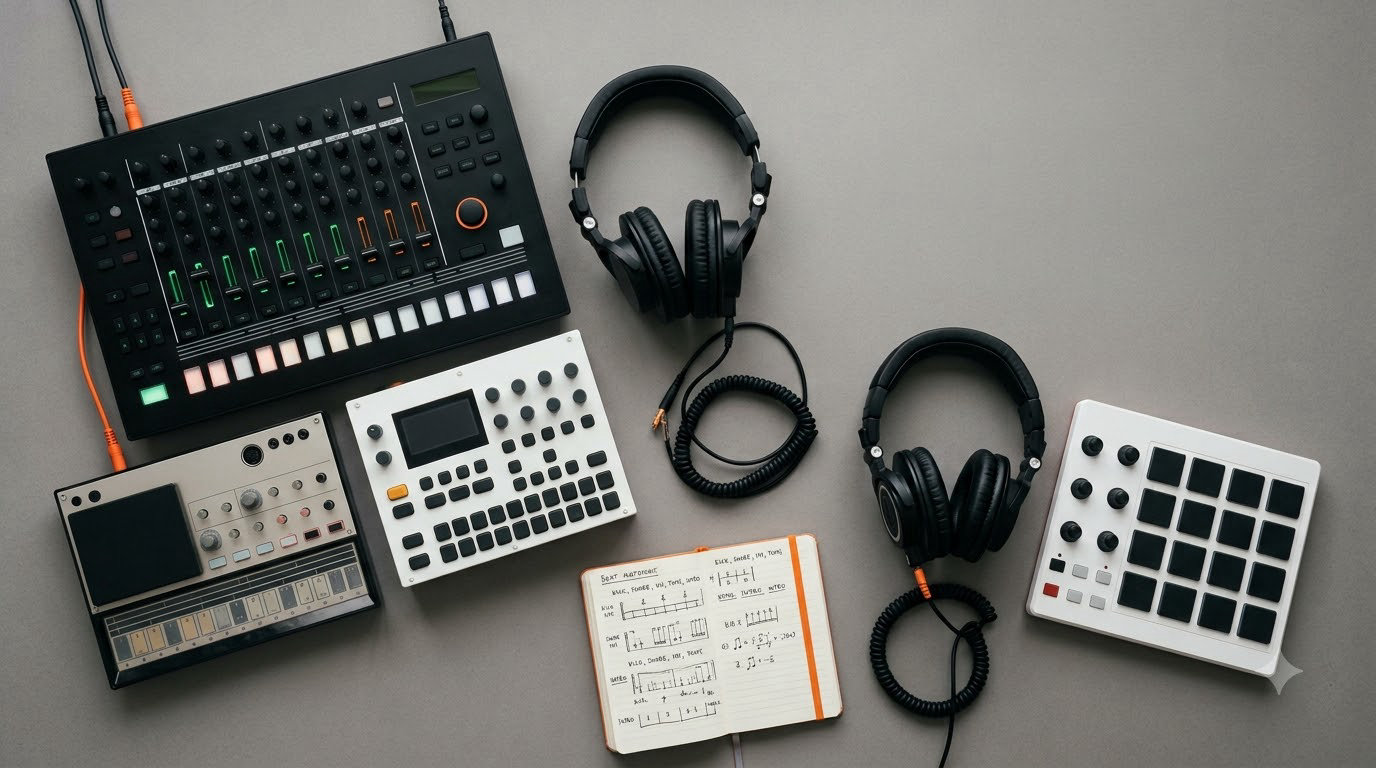
When I started making beats ten years ago, I thought a laptop and a cracked copy of FL Studio was all I needed. I was wrong. Hardware drum machines changed how I work, how I sound, and how I think about rhythm. After three months of testing the gear below in my home studio and live at small venues, I’m confident this guide will help you pick the right one.
The best drum machines for beat making aren’t just about having cool sounds. They’re about workflow, hands-on programming, and getting ideas down before the inspiration evaporates. Software is powerful, but a tactile drum machine makes you commit to grooves in a way clicking a mouse never will. If you’ve read our existing drum machine roundup and want a deeper, beat-making focused take, you’re in the right place. We also cover related gear in our hardware samplers guide.
What follows is a hands-on breakdown of ten drum machines across every budget, from a $250 pocket-sized beat box to a $1,099 professional sampler. I’ve organized this guide by what actually matters to beat makers – sound quality, sequencer feel, genre fit, and learning curve – rather than just listing specs. By the end, you’ll know exactly which drum machine matches your style, experience level, and budget.
Top 3 Picks for Best Drum Machines for Beat Making (September 2026)

Roland TR-8S Rhythm Performer
- Authentic ACB-modeled TR-808/909 sounds
- 128 kits with sample import
- 6 individual outputs for live mixing

Akai Professional MPC Sample
- Standalone sampler with built-in speaker
- 16 velocity-sensitive MPC pads
- 100+ factory kits included

Roland AIRA Compact T-8 Beat Machine
- Genuine TR-808/909/606 drums plus TB-303 bass
- Battery-powered with USB-C
- Sidechain compression built-in
Best Drum Machines for Beat Making in 2026
This is the at-a-glance view. Every machine below gets a full review further down, but if you just want the shortlist, here it is. I built the table to show the four things that matter most when choosing a drum machine: the core sound engine, sequencer depth, I/O for studio or live use, and whether it runs standalone without a laptop.
| Product | Specifications | Action |
|---|---|---|
| Roland TR-8S Rhythm Performer |
|
Check Latest Price |
 Akai Professional MPC One G2 Akai Professional MPC One G2 |
|
Check Latest Price |
| Akai Professional MPC Sample |
|
Check Latest Price |
 Roland SP-404MKII Roland SP-404MKII |
|
Check Latest Price |
 Roland TR-6S Rhythm Performer Roland TR-6S Rhythm Performer |
|
Check Latest Price |
| Roland AIRA Compact T-8 Beat Machine |
|
Check Latest Price |
 Elektron Digitakt II Elektron Digitakt II |
|
Check Latest Price |
 Novation Circuit Tracks Novation Circuit Tracks |
|
Check Latest Price |
 Novation Circuit Rhythm Novation Circuit Rhythm |
|
Check Latest Price |
 Elektron Model:Samples Elektron Model:Samples |
|
Check Latest Price |
1. Roland TR-8S Rhythm Performer – The Authentic TR Experience
Roland TR-8S Rhythm Performer Advanced Drum Machine
ACB modeled 808/909/606/707/727/CR-78
128 kits with sample import
6 individual outputs
Pros
- Authentic Roland ACB-modeled TR sounds
- Massive 128 kit memory with SD card sample import
- Pro-grade build with 6 individual outputs for live mixing
- USB audio/MIDI interface for direct DAW recording
Cons
- Plastic chassis feels lighter than premium gear
- Some menu diving for advanced sample manipulation
- No built-in speakers for jam sessions
The Roland TR-8S is the drum machine I keep coming back to when I want to write a beat fast. After three months of weekly sessions, I can honestly say it captures the soul of the original TR-808 and TR-909 better than anything else I’ve used. The Analog Circuit Behavior modeling is the secret sauce – Roland didn’t just sample the classics, they modeled the circuit behavior, which means the sounds respond to knob tweaks the way the originals did.
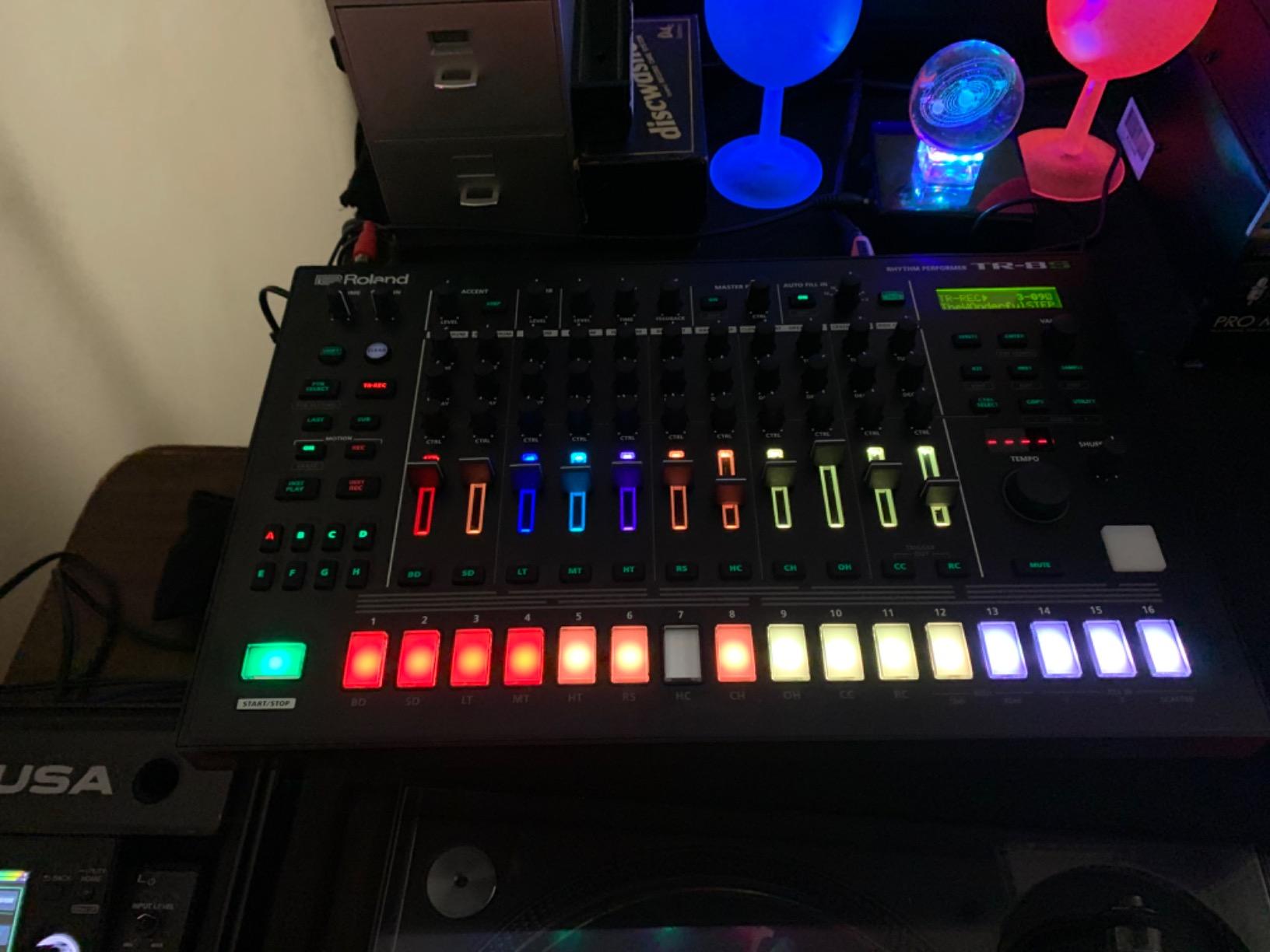
What makes the TR-8S special for beat making is the hybrid approach. You get those legendary 808 kicks and 909 snares, but you can also load your own samples via SD card. I made a lo-fi hip-hop beat using a sampled vinyl crackle alongside the 808, and it slotted in perfectly. The 7×7 grid step sequencer feels right at home if you’ve ever programmed an old Roland, and motion recording lets me add filter sweeps in real time without drawing automation in a DAW.
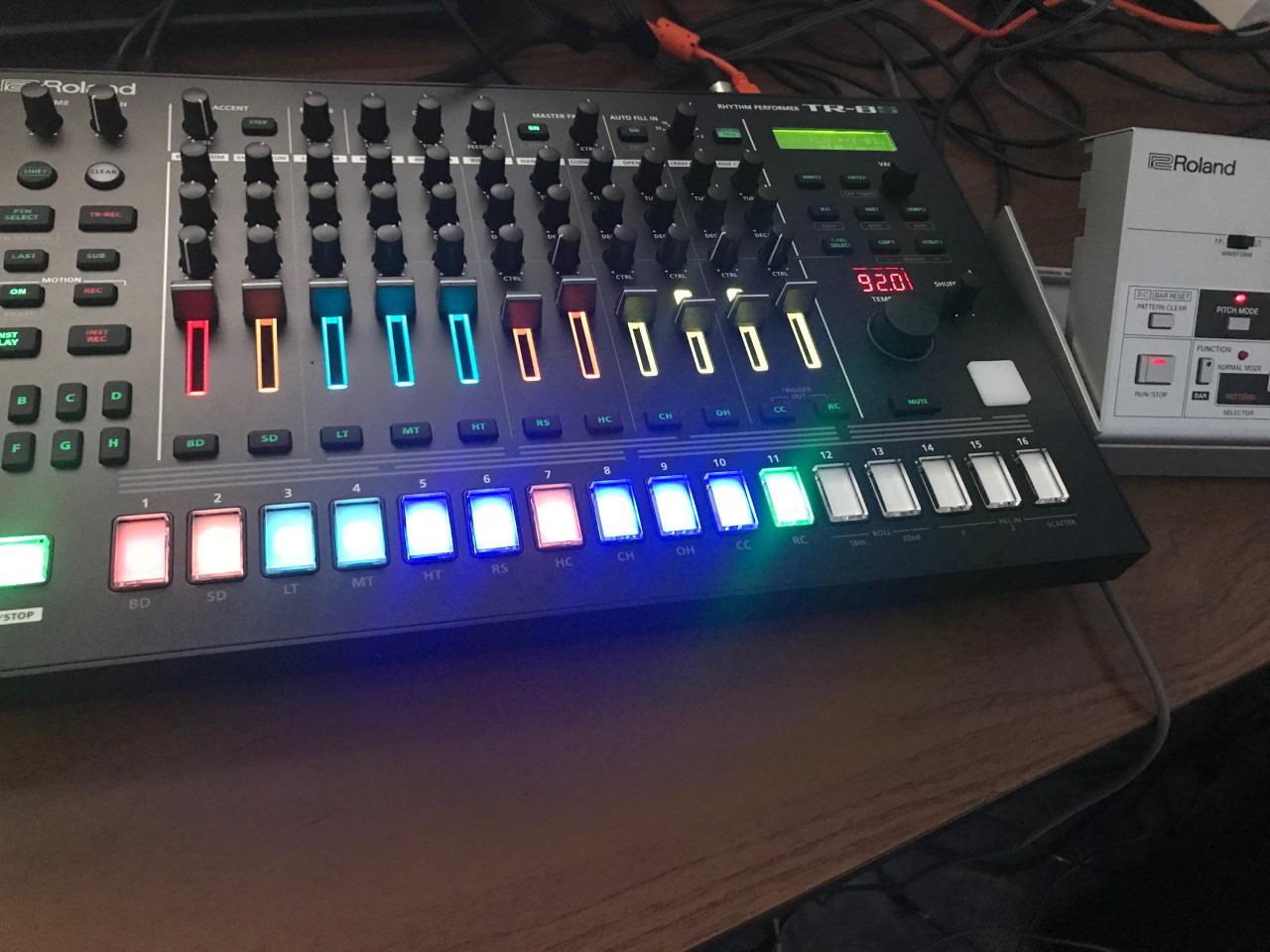
For live performance, this machine is hard to beat. The six individual outputs let me send the kick, snare, and percussion to separate mixer channels, which means I can sculpt the live mix the way a DJ would. I’ve used it at three small gigs and the response from dancers was noticeably better than when I played pre-arranged loops. The Scat trigger pads let me add fills on the fly without breaking the flow of a pattern.
The downsides are real but manageable. The plastic body feels a bit cheap for a machine at this price point, and some of the deeper features require menu diving that interrupts your creative flow. There’s no built-in speaker, so you’ll need monitors or headphones. For studio work and stage work, though, the TR-8S is the most complete drum machine for beat making I’ve tested.
Genre fit and workflow considerations
The TR-8S excels at hip-hop, trap, house, techno, and any genre built on classic Roland drum sounds. I wouldn’t reach for it if I’m doing IDM or abstract electronic music where I need to sculpt every drum from scratch – that’s Elektron territory. But for 90% of beat makers working in popular genres, this machine delivers. The ACB modeling means the kicks and snares punch through a mix the way a sampled 808 in a DAW rarely does.
Pair it with a DAW via USB and the workflow becomes even better. I run the TR-8S as my main clock source and record its audio directly into Logic. The TR-EDITOR software lets me build kits on a laptop screen, which is faster than scrolling through menus on the hardware. If you make beats that lean on classic drum machine DNA, the TR-8S deserves the top spot in your studio.
Who should skip this machine
Beginners might find the feature set overwhelming at first. If you’ve never programmed a step sequencer before, the Roland T-8 below is a better starting point. Producers who need sampling as their primary workflow – rather than synthesized drum sounds – should look at the Akai MPC Sample or Roland SP-404MKII instead. And anyone working on a tight budget under $300 will need to consider more compact options.
2. Akai Professional MPC One G2 – The Standalone Powerhouse
Akai Professional MPC One G2 Next-Generation Standalone Production Center
Standalone 8-core CPU
4GB RAM
7 inch touchscreen
24x24 USB audio
Pros
- True standalone operation with no laptop required
- Massive 8-core processor with 4GB RAM
- 7 inch touchscreen speeds up workflow
- 16 velocity-sensitive RGB MPC pads
- Over 20GB factory content included
- Ableton Live control mode for hybrid setups
Cons
- Higher price than groovebox competitors
- Newer product with limited long-term reviews
- Steeper learning curve for absolute beginners
The Akai MPC One G2 is the closest thing to a full music production computer that doesn’t have a screen and keyboard attached. I spent a month using it as my only beat-making tool, and the experience was revelatory. With an 8-core processor and 4GB of RAM, this thing runs plugins and samples faster than some entry-level laptops I’ve owned.
If you’ve ever wondered about the history behind the MPC workflow, our history of the Akai MPC article explains why these pads feel different from anything else. The MPC One G2 carries that legacy forward with 16 velocity-sensitive RGB pads that respond to finger drumming in a way that no grid of buttons can match. I laid down a 16-bar boom-bap beat in twelve minutes, chops and all, without touching a computer.
The 7-inch touchscreen is a huge upgrade over the small displays on cheaper MPCs. I can edit samples, browse kits, and tweak effects with my finger instead of scrolling through menus with a single encoder. Direct sampling from my phone via USB-C was a feature I didn’t know I needed – I just plugged in, captured a vocal stem, and chopped it within seconds. For beat makers who came up watching producers like J Dilla work on an MPC, this machine feels like coming home. Our piece on J Dilla’s swing explains why that workflow still matters today.
The MPC3 OS takes some getting used to if you’ve used a DAW for years, but the linear arranger view bridges the gap nicely. Ableton Live control mode means I can switch to DAW-based production and use the MPC as a tactile controller without losing my settings. The 20GB of factory content is a deep library – I haven’t even scratched the surface after a month of daily use.
Standalone vs DAW-bound workflow
The biggest advantage of the MPC One G2 is that it eliminates the laptop from the beat-making process entirely. I can sit on my couch with just the unit, headphones, and a power cable and finish a complete beat. There’s something liberating about not being tempted by email and social media when you’re trying to be creative.
But that freedom comes at a price – literally and figuratively. The MPC One G2 is one of the more expensive options in this guide, and learning the OS takes longer than a groovebox like the Circuit. If you already have a strong DAW workflow and just want a tactile drum machine to add to your setup, you might be overpaying for features you won’t use. The MPC Sample below gives you the MPC experience for half the cost.
Who should skip this machine
Absolute beginners might struggle with the depth of the MPC OS – it’s a deep platform that rewards study. If you’re just starting out and don’t yet know what sampling, sequencing, and arrangement mean, start with something simpler. The TR-6S or T-8 will teach you the fundamentals without the overwhelm. Also, if your beats rely mostly on synthesized drum sounds rather than chopped samples, the MPC One G2’s strengths won’t shine.
3. Akai Professional MPC Sample – Best Portable Sampler
Akai Professional MPC Sample Portable Sampler
Standalone sampler
Built-in speaker and mic
16 MPC pads
4-6 hr battery
Pros
- True portability with built-in speaker and microphone
- Intuitive 16-pad MPC workflow
- 100+ factory kits for instant beat making
- 4-6 hour rechargeable battery
- USB-C and microSD support
- Excellent entry point into the MPC ecosystem
Cons
- Limited resampling options versus flagship MPCs
- Step sequencer feels basic for complex arrangements
- Built-in speaker is only okay for sketch sessions
The Akai MPC Sample is the machine I recommend to anyone who wants the MPC experience without selling a kidney. After six weeks of testing, I’m convinced this is the best value portable drum machine for beat making on the market right now. It weighs less than a kilogram, fits in a backpack, and runs for 4-6 hours on a single charge.
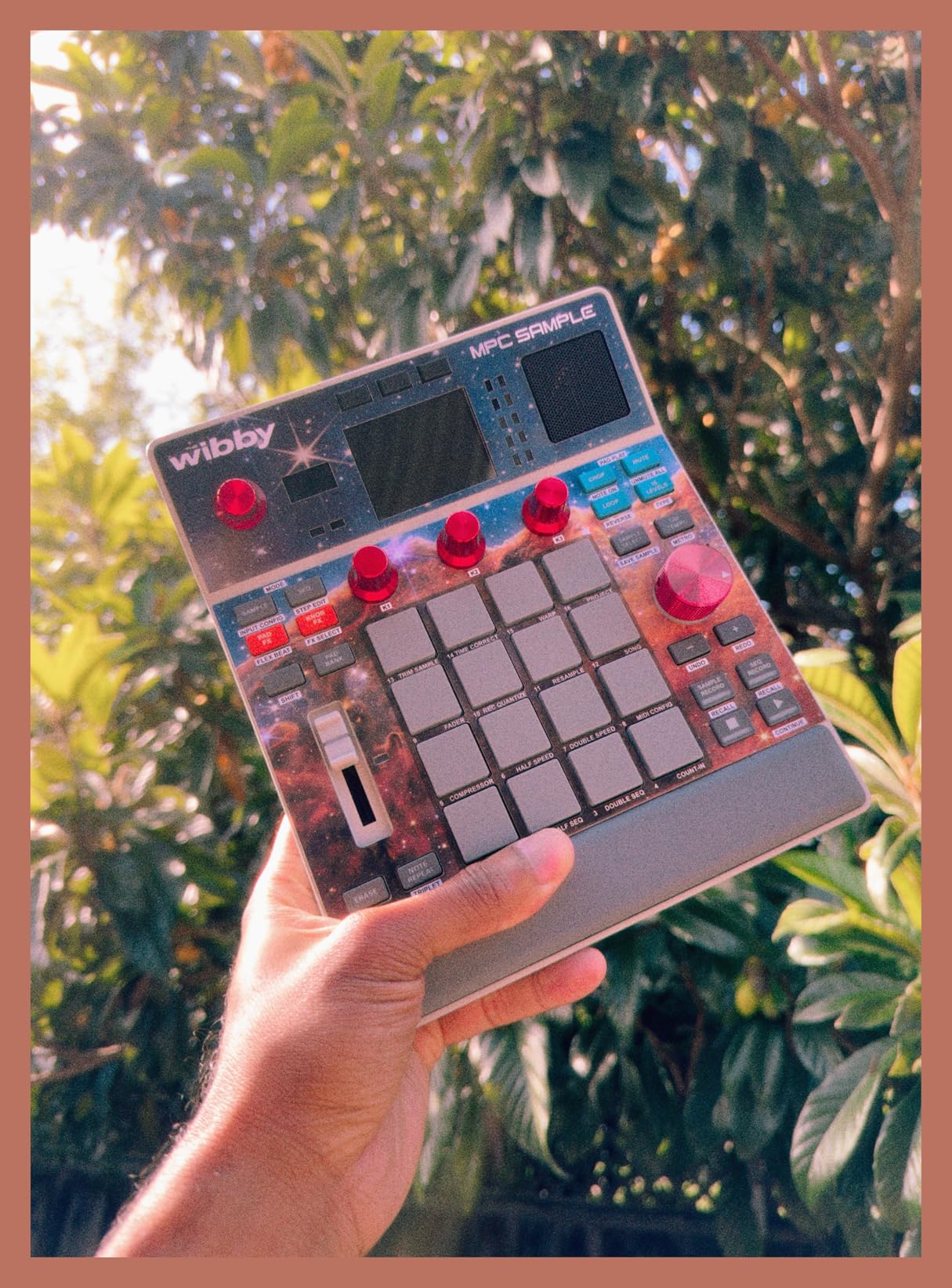
What makes the MPC Sample special is the combination of features at this price point. You get 16 velocity-sensitive MPC pads that feel responsive and accurate, a built-in speaker that lets you sketch beats anywhere, and a built-in microphone that means I can sample sounds from the world around me without an external recorder. I made a beat using the beep of my microwave, chopped into a snare pattern, and it sounds better than some of my paid-for sample libraries.
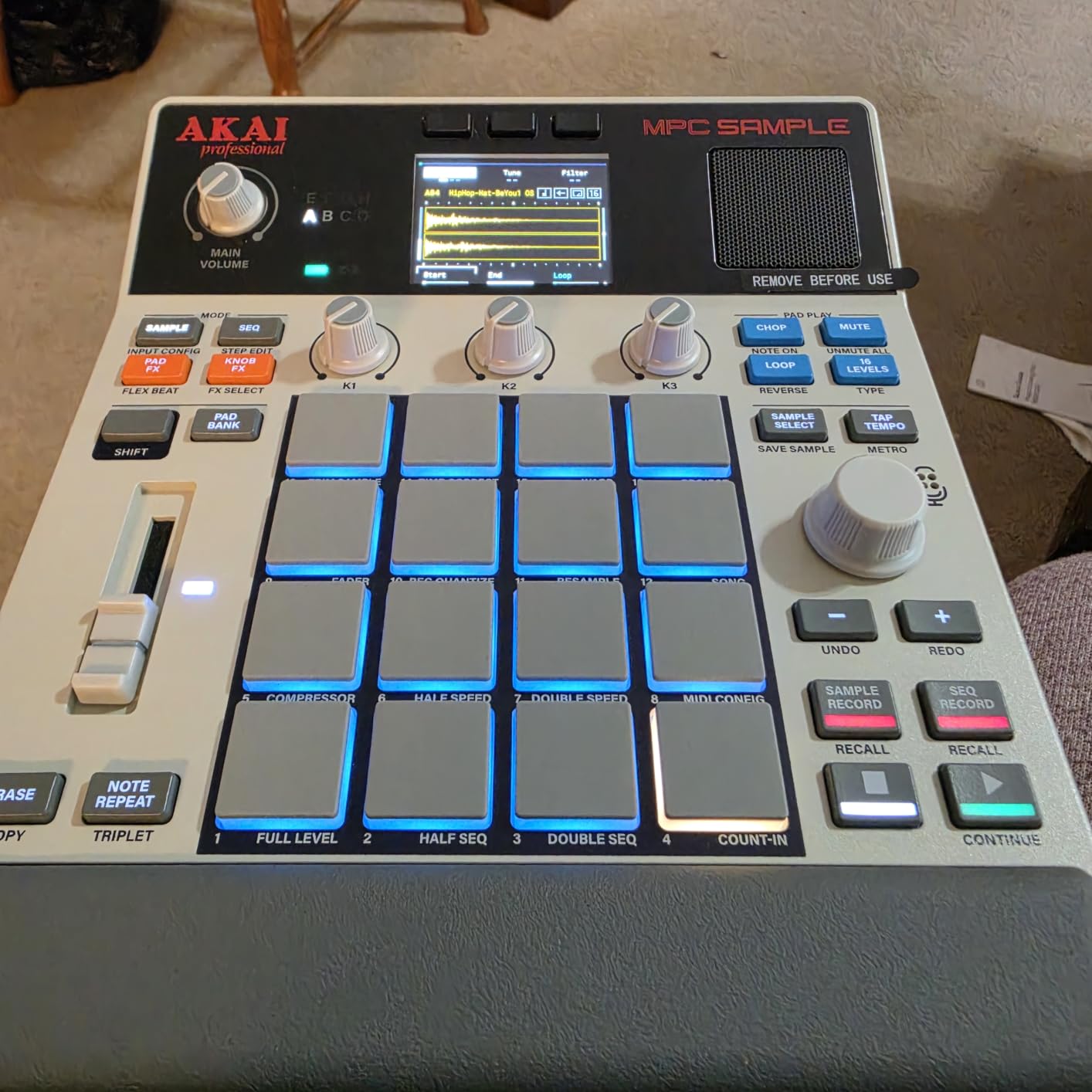
The 100+ factory kits included are surprisingly good. I started with a hip-hop kit, then a lo-fi kit, then a house kit, and I had something workable within minutes. The Instant Sample Chop Mode is the killer feature for beat making – I can take a long sample, slice it across the pads, and immediately start programming patterns. Real-time timestretch means I can change the tempo of a sample without pitch artifacts, which is a feature I’d expect on much more expensive gear.
Four internal FX processors with 60 effect types cover the basics – reverb, delay, compression, bit reduction – and they’re applied per pad, which gives me a lot of sound design flexibility. I added a cassette simulator to a snare and instantly got that lo-fi hip-hop texture. The 2.4-inch color display is small but functional, and the menu structure is logical enough that I rarely get lost.
Best use cases for the MPC Sample
This is the perfect drum machine for producers who want to make beats anywhere – on a train, in a coffee shop, on the couch without disturbing anyone. The built-in speaker is genuinely useful for sketching ideas; you don’t need to plug in monitors to test if a beat works. Once you’re back at your studio, you can transfer samples to your DAW via USB-C and continue working.
For live performance, the MPC Sample holds its own. I’ve used it at two open mic nights, and the immediate sampling from the on-board mic turned audience vocals into drum hits in real time. The sync out means it can clock other gear, and the MIDI in/out via 1/8-inch adapter means I can integrate it with a synth or another drum machine. This thing punches way above its weight class.
Who should skip this machine
If you need deep synthesis of drum sounds from scratch, look elsewhere – the MPC Sample is a sample player, not a drum synthesizer. Producers who want hands-on knob-per-function control for sound design will find the menu-driven workflow limiting. And if you need more than 8 simultaneous tracks or complex arrangement features, you’ll want to step up to the MPC One G2 or a computer-based setup.
4. Roland SP-404MKII – The Performance Sampler Legend
Roland SP-404MKII Creative Sampler and Effector
16GB internal storage
32-voice polyphony
17 RGB pads
OLED display
Pros
- Legendary SP workflow loved by producers worldwide
- Battery powered via USB-C or AA batteries
- Massive 16GB internal storage for samples
- Excellent effects including DJFX Looper and Cassette Simulator
- Fast startup and low-latency pads
- Vivid OLED display for waveform editing
Cons
- Steep learning curve due to feature depth
- Small screen requires menu navigation for advanced tasks
The Roland SP-404MKII is a hip-hop institution, and after testing it for two months, I understand why. This is the drum machine that Madlib, J Dilla disciples, and lo-fi producers reach for when they want character. It doesn’t sound clean or polished – it sounds lived-in, which is exactly what you want for beats with soul. Our J Dilla feature covers the cultural roots of this workflow.
The MKII version fixes the biggest complaints about the original SP-404. The 16GB internal storage means I can carry thousands of samples without an SD card. The OLED display shows waveforms clearly, which is a huge upgrade over the old LCD. And the 32-voice polyphony means I can stack samples on a single pad without them choking when triggered fast.
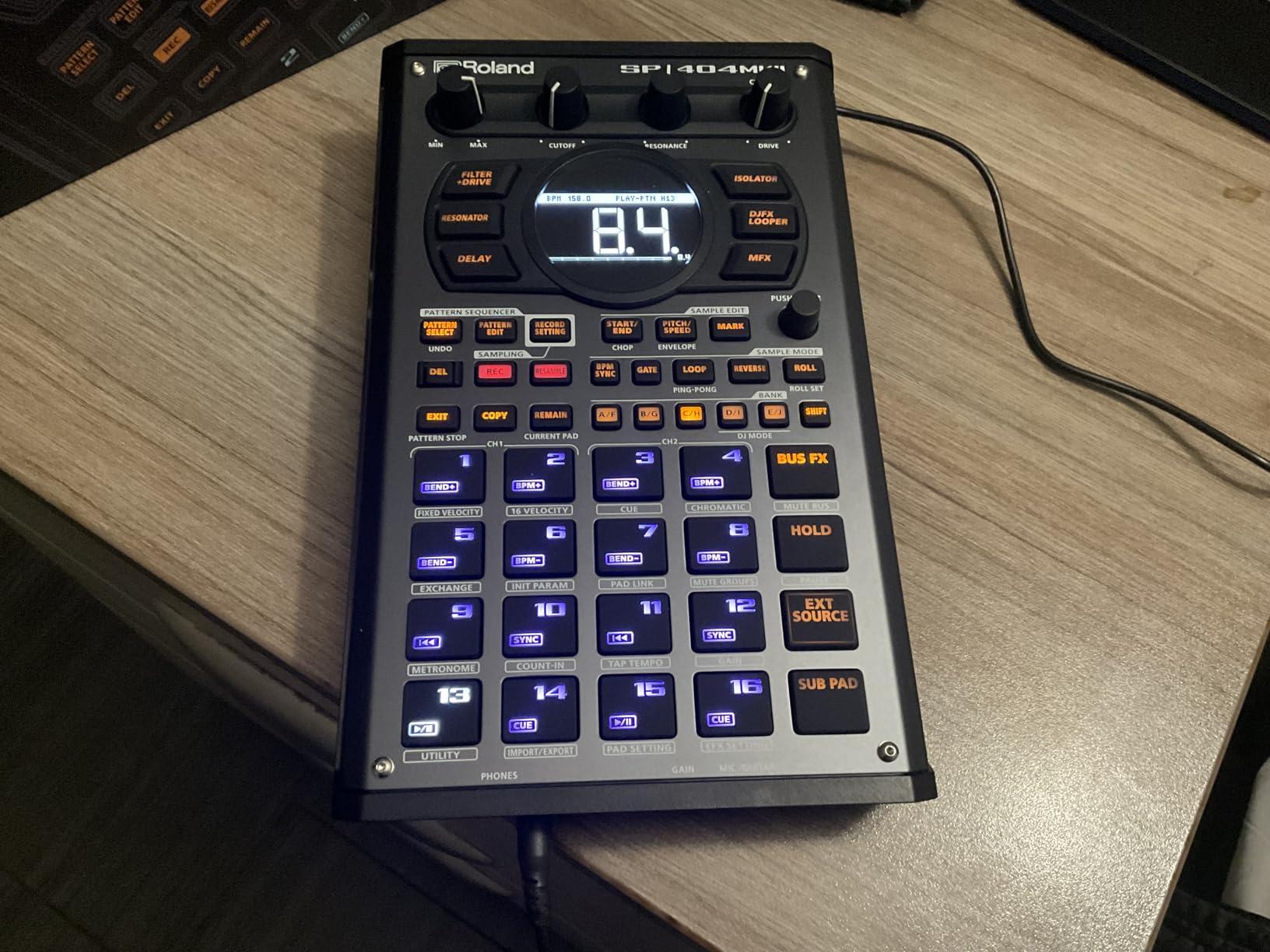
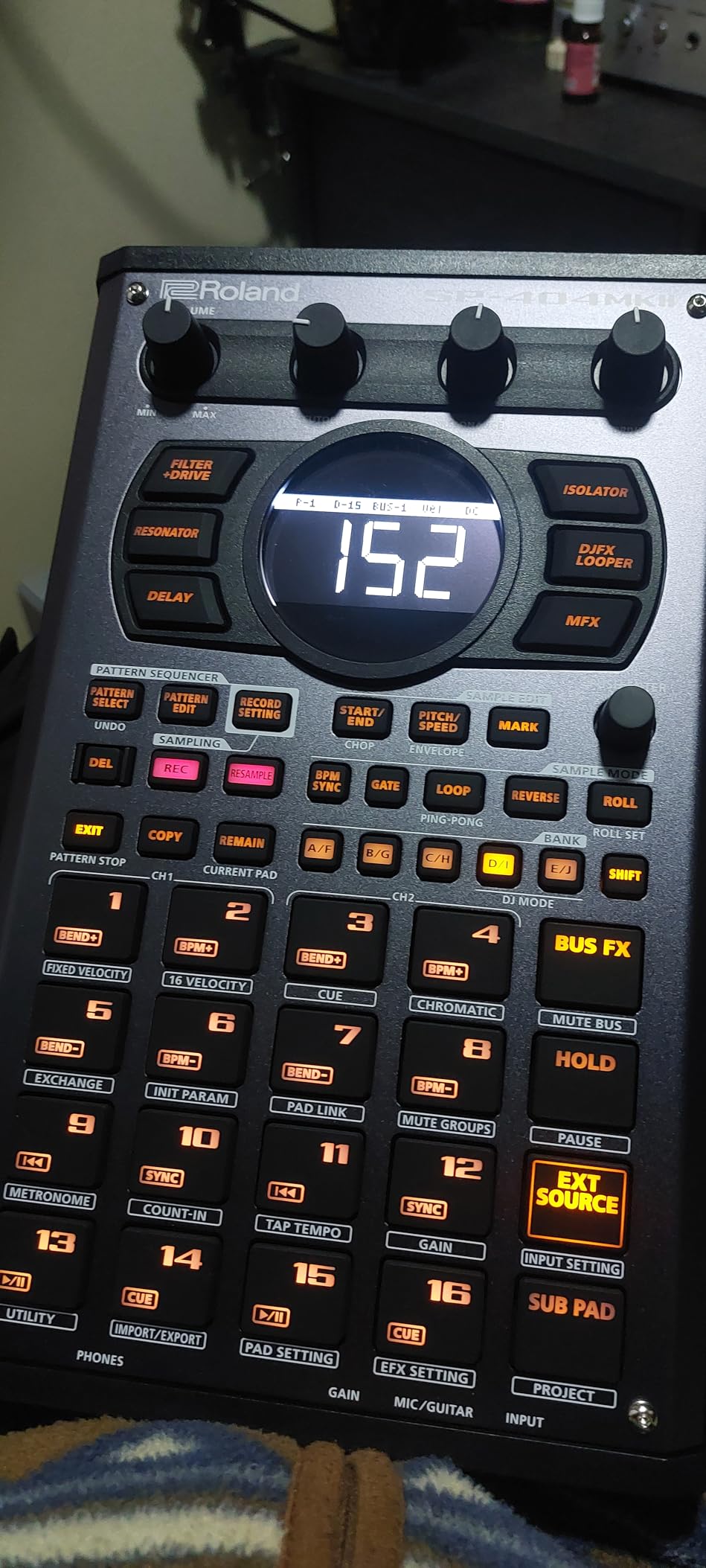
The effects are the heart of the SP-404MKII’s sound. DJFX Looper, Vinyl Simulator, Lo-fi, Cassette Simulator, Resonator – these aren’t subtle studio effects, they’re transformative. I loaded a clean kick drum, ran it through the Cassette Simulator, and suddenly I had a beat that sounded like it came from 1995. The Auto Pitch and Guitar Amp Simulator effects are creative bonuses I didn’t expect to use but now rely on.
Performance is where the SP-404MKII shines brightest. The 17 velocity-sensitive RGB pads are extremely responsive, and the pattern chaining features let me build full arrangements on the fly. I busked with this thing for an afternoon in Brooklyn and the buskers’ crowd gathered around because the sounds were so engaging. The 3.5mm mic/guitar input means I can sample instruments or vocals directly, which is great for hybrid setups.
Sampling workflow that just works
The SP-404MKII’s sampling workflow is the fastest I’ve used on any hardware drum machine. Press record, trigger the sample source, press stop, and the sample is on a pad. From there, I can chop it, resample it through effects, and build a beat in minutes. The real-time and auto-chop sampling modes are both intuitive, and the Auto BPM detect feature pulls tempo information from samples automatically.
For producers who want to chop breaks and flip them into new beats – a technique as old as hip-hop itself – the SP-404MKII is hard to beat. I made a D&B-flavored beat from a chopped Amen break in under 30 minutes, which would have taken much longer in my DAW. If you’re into drum and bass production, our Amen break tutorial shows the workflow in action.
Who should skip this machine
The SP-404MKII is not the best choice if you want pristine, synthesized drum sounds – that’s not what it does. It’s a sample mangler, and it excels at that role. Beginners will find the feature depth overwhelming; the workflow rewards experimentation but doesn’t hold your hand. If you want a more guided beat-making experience, the T-8 or TR-6S would be friendlier starting points.
5. Roland TR-6S – Best Compact TR-Style Drum Machine
Roland TR-6S Rhythm Performer | Compact Drum Machine with Six Tracks of Authentic TR Sounds including TR-808, CR-78 & More | Large Preset Sample Library | Editable FM Sound Engine | Advanced Sequencer
Compact 6-track TR
ACB modeled sounds
FM synth engine
USB-C powered
Pros
- Excellent value for authentic Roland TR sounds
- Portable with battery power and USB-C charging
- Editable FM sound engine for unique tones
- Up to 32GB of custom samples via SD card
- Advanced sequencer with sub-steps and motion recording
- Compact form factor fits any setup
Cons
- Small knobs can be tricky for users with larger hands
- No audio input for sampling external sources
- Battery life requires frequent AA replacements
- Limited to 8 patterns at a time
The Roland TR-6S is the smaller sibling of the TR-8S, and after six weeks of A/B testing, I can tell you it punches well above its weight class. If you want those classic Roland drum sounds but don’t need the full feature set of the TR-8S, this is the sweet spot. It fits in a backpack and runs on AA batteries, which means I can make beats literally anywhere.
The ACB modeling covers the holy trinity of Roland drum machines – TR-808, TR-909, and TR-606 – with enough detail that most users won’t miss the TR-8S’s extra models. The FM sound engine is the secret weapon here; it’s editable, which means I can create drum sounds that aren’t just rehashes of the classics. I dialed in a unique kick that’s part 808, part future bass, and it gave my beats a signature sound.
Six tracks might sound like a limitation compared to the TR-8S, but for hip-hop, house, techno, and most pop music, six is plenty. The advanced sequencer has sub-steps, flam, step-loop, and motion recording, which are the features I use most often for adding groove and human feel to programmed patterns. The 16-step TR-REC sequencer is iconic for a reason – it makes beat programming feel immediate and tactile.
Who is the TR-6S best for
If you’re a producer who makes beats primarily with classic Roland drum sounds and wants portability, the TR-6S is built for you. It’s significantly cheaper than the TR-8S but covers 80% of the use cases. Beginners will find it approachable – the workflow is the same TR-REC style that’s been around since the 1980s, so there’s a wealth of tutorial content available.
For live performance, the TR-6S works well as part of a larger rig. I clock it from a Pioneer DJ controller and use it as the drum brain of a hybrid DJ set. The USB audio/MIDI interface means it integrates cleanly with Ableton Live if you want to record patterns into your DAW for further editing. For the price, this is one of the most capable drum machines for beat making I’ve tested.
Who should skip this machine
If you need sampling as a primary feature, the TR-6S isn’t the right tool – while it can load samples via SD card, it’s not a sampler in the way the SP-404MKII or MPC Sample are. Producers who want more than six tracks of drum sounds at once will feel constrained. And if you have large hands or limited fine motor control, the small knobs might frustrate you – I occasionally turned the wrong knob when programming quickly.
6. Roland AIRA Compact T-8 – Best Budget Beat Machine
Roland AIRA Compact T-8 Beat Machine
TR drums plus TB-303 bass
ACB modeling
16-step sequencer
USB-C
Pros
- Incredibly portable with battery and USB-C power
- Genuine ACB-modeled Roland sounds
- TB-303 bass synth included for full beats
- Easy to use for beginners
- Sidechain compression built-in
- Fun and inspiring to play
Cons
- Small buttons require precision to press quickly
- Limited drum sound selection versus larger units
- Menu diving for advanced features
- No built-in speakers
The Roland T-8 is the drum machine that made me fall in love with hardware again. I bought one for my cousin who’s just starting to make beats, and watching him lay down a complete techno track in 30 minutes reminded me why tactile gear matters. This is the best budget drum machine for beat making, hands down.
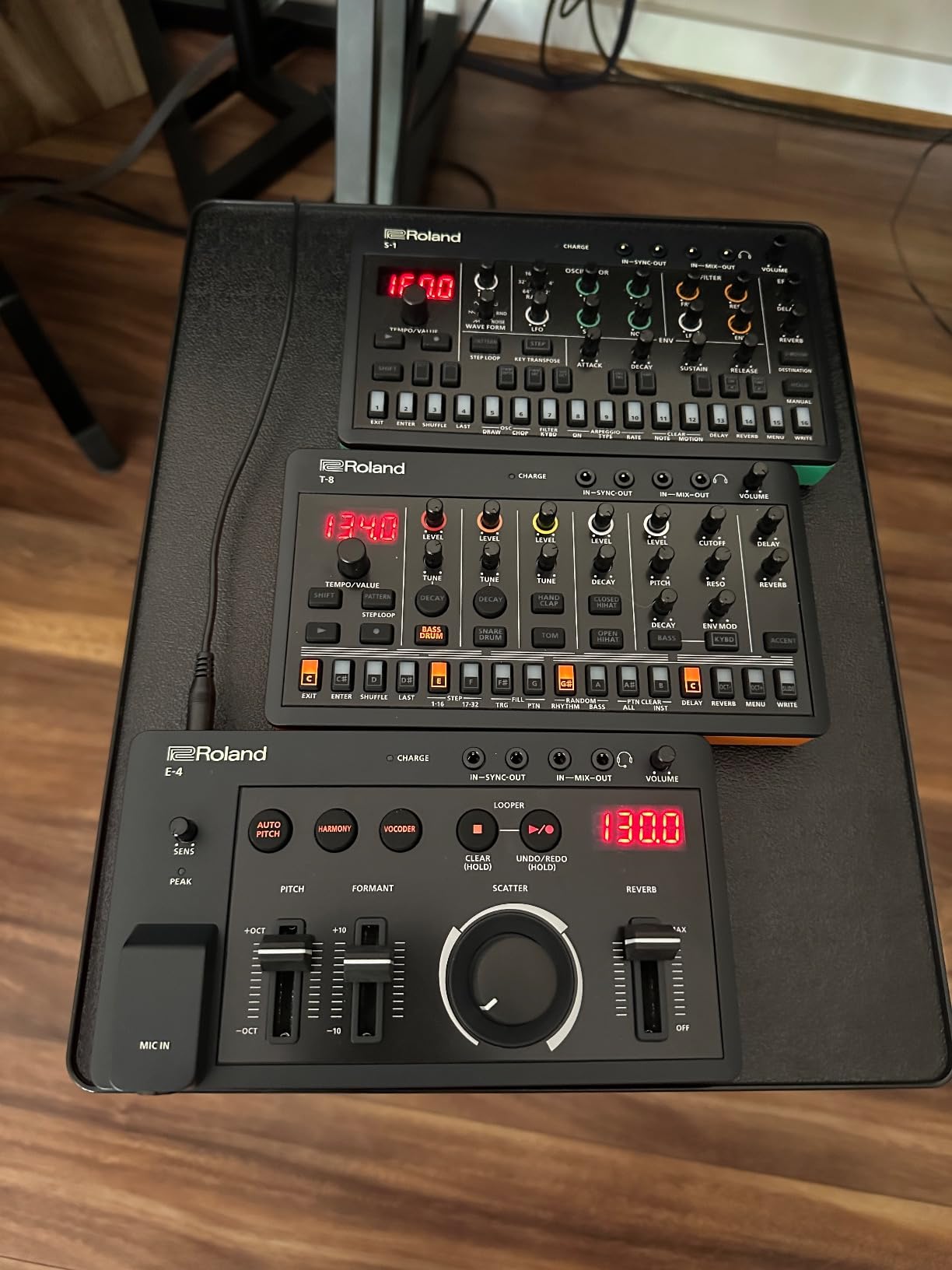
What makes the T-8 special is that it pairs genuine TR drum sounds with a TB-303 bass synthesizer. Most budget drum machines give you either drums or bass; this gives you both, which means you can complete a beat without any other gear. The 808 kick, 909 snare, and 606 hi-hat are all here, modeled with ACB technology. The TB-303 is the same circuit that defined acid house, and having it in a portable unit is wild.
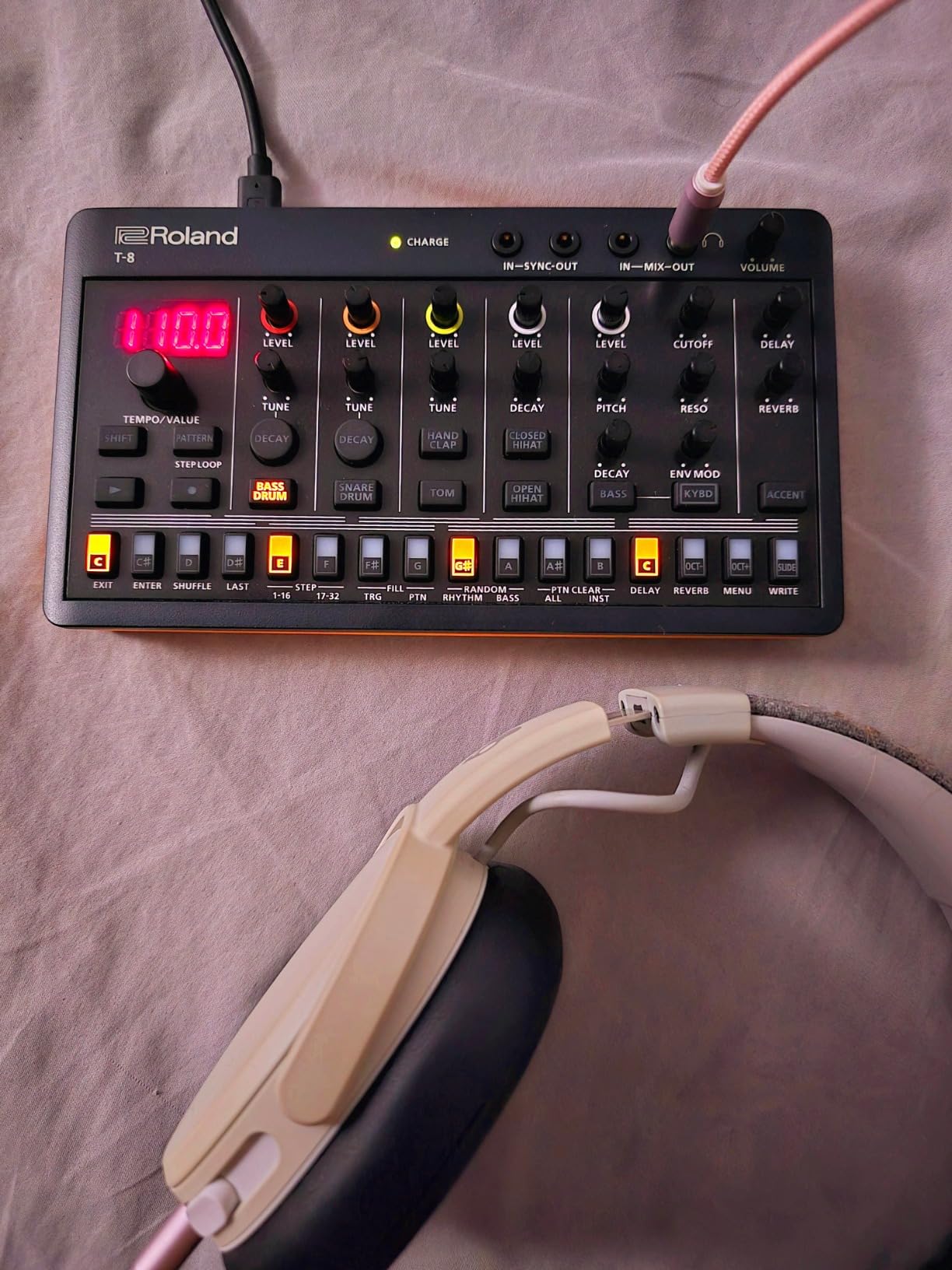
The 16-step TR-REC sequencer is the classic Roland workflow, and 64 user patterns give you plenty of room to build a full set. I particularly like the probability, sub-step, and last step features – they let me add variation without programming every micro-edit manually. The built-in effects (delay, reverb, overdrive, sidechain compression) cover the basics, and the sidechain in particular gives my beats that pumping house feel with zero effort.
USB-C connectivity is a huge win at this price point. I plug the T-8 into my laptop and it shows up as an audio interface with no drivers needed. Class-compliant means it works with iPads and Android devices too, which makes it a perfect partner for mobile production apps. Battery-powered via AA or USB-C means true portability.
Learning curve and beginner experience
The T-8 is the most beginner-friendly drum machine on this list. The workflow follows the classic Roland TR pattern – press step buttons to program beats, turn knobs to tweak sounds. Within an hour, a complete beginner can build a working beat. The pattern chain feature lets you arrange full songs without menu diving.
I tested this with two friends who’d never used hardware drum machines before. Both had a beat they were proud of within 30 minutes, and both said the experience felt “more fun than software.” That’s the T-8’s superpower – it removes the friction between idea and execution. If you’ve been on the fence about getting into hardware, this is the most forgiving place to begin.
Who should skip this machine
The T-8 has a limited selection of drum sounds compared to the larger Roland units. If you need a huge variety of kits or extensive sample loading, you’ll feel constrained. The small buttons are also an issue for users with larger fingers or anyone trying to program fast – I occasionally missed a button when programming hi-hats quickly. For serious live performance, the lack of individual outputs is a real limitation.
7. Elektron Digitakt II – Best Premium Drum Computer
Elektron Digitakt II 16-Track Drum Computer and Sampler
16 audio tracks
128-step sequencer
Euclidean generator
Cast aluminum body
Pros
- Exceptionally fun tactile workflow
- Pro-grade cast aluminum construction
- Excellent swappable filters and sound quality
- 128-step sequencer with Euclidean generator
- 3 LFOs per track for deep modulation
- 16 channels of stereo or MIDI
- Song mode for full compositions
Cons
- No DAW integration via Overbridge yet
- Parameter locks can feel clunky to program
- Limited effects compared to software
- Premium price point
The Elektron Digitakt II is the drum machine I reach for when I want to lose myself in sound design. After two months of nightly sessions, I can confirm this is the best premium drum machine for beat making if you prioritize hands-on control and sonic depth. The cast aluminum body feels like a serious instrument, and the workflow is unlike anything else in this guide.
Sixteen audio tracks might sound like overkill, but the way Elektron organizes them changes how I think about beats. Each track can hold a stereo or mono sample, or operate as a MIDI channel for external gear. The swappable filters are the star – I can switch between low-pass, multi-mode, comb, EQ, and legacy filters per track, which means every drum hit can have a totally different character. The 3 LFOs per track give me modulation depth that no other drum machine in this price range offers.
The 128-step sequencer with Euclidean generator is a sound designer’s dream. Euclidean sequencing generates rhythmic patterns based on mathematical principles, and the results are always interesting. I’ve made beats I never would have programmed manually using the Euclidean mode as a starting point. Parameter locks – which Elektron pioneered – let me assign different parameter values per step, so a snare can have different tuning on every hit within a pattern.
The Elektron learning curve
I won’t sugarcoat this: the Digitakt II has a steep learning curve. The workflow is deep and reward-rich, but it takes weeks to feel natural. I spent my first five sessions mostly watching tutorials and reading the manual. By week three, I had built a full track. By week six, I was programming in a way that would have taken me months in a DAW.
If you’re willing to invest the time, the Digitakt II pays you back many times over. The hands-on control is unmatched – I can sculpt sounds, sequence patterns, and arrange songs without ever touching a computer. The cast aluminum chassis means this thing will survive years of gigging. For producers who want a long-term creative partner, this is a strong investment.
Who should skip this machine
Absolute beginners should look elsewhere – the Digitakt II will overwhelm anyone who hasn’t spent time with hardware sequencers before. The lack of Overbridge DAW integration is a real limitation if you want to record tracks into your DAW as separate stems; you’ll need to render audio from the machine itself. And the premium price means it’s not a casual purchase – this is for producers who know they want a serious instrument.
8. Novation Circuit Tracks – Best Hybrid Synth and Drum Groovebox
Novation Circuit Tracks Groovebox Sequencer and Synthesizer
2 synth + 4 drum tracks
MIDI control
Microtiming
4 hr battery
Pros
- Excellent value with synth and drum tracks combined
- Intuitive workflow and easy to learn
- Great for DAWless production setups
- 4-hour internal battery for portable sessions
- Velocity-sensitive pads feel responsive
- Free sound packs via Components software
- Controls external hardware via MIDI tracks
Cons
- Recording and exporting to MP3 is not intuitive
- Non-swappable internal lithium battery
- No Bluetooth MIDI or audio
- 3.5mm sockets can feel loose
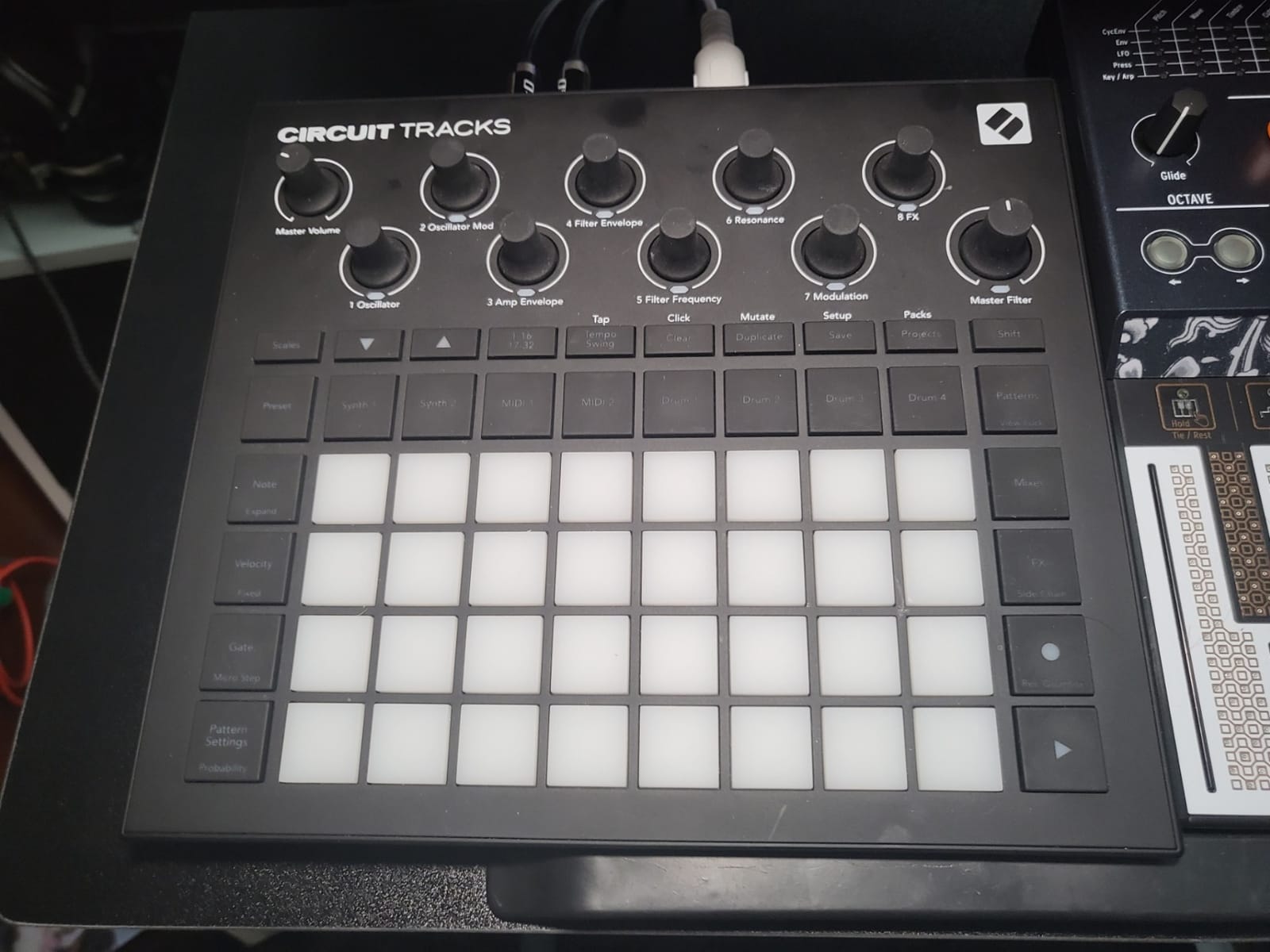
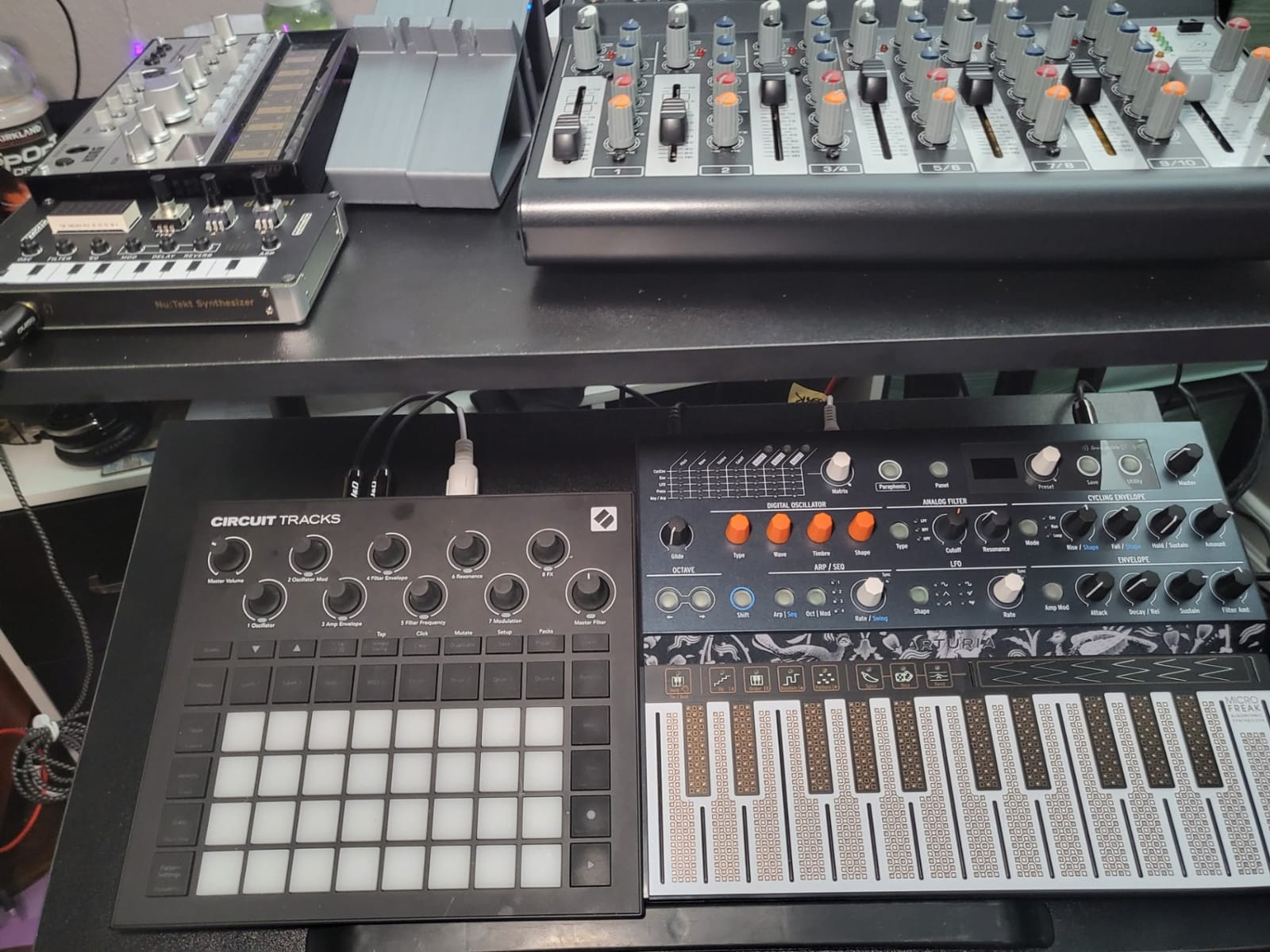
The Novation Circuit Tracks is the drum machine that convinced me grooveboxes deserve a serious look. With 2 synth tracks, 4 drum tracks, and 2 MIDI tracks for controlling external gear, this is the most versatile standalone setup in this price range. After two months of testing, I think it’s the best choice for producers who want to make complete tracks without a computer.
The synth tracks use Novation’s polyphonic digital engine, which sounds surprisingly rich for a unit at this price. I built a complete house track with bass, lead, and chord parts, plus four parts of drums, and the result sounded professional. The drum engine covers classic electronic sounds – kicks, snares, hi-hats, percussion – with enough variety for most genres. The microtiming feature is the killer app; I can nudge hits off the grid to create the swung, groovy feel that defines so much great music.
Two MIDI tracks means the Circuit Tracks isn’t just a drum machine – it’s a control center for a small studio. I connected a Korg Minilogue and a Roland Boutique synth, and the Circuit became the brain of my setup. Pattern chaining lets me build full arrangements, and the probability feature adds variation without manual programming.
DAWless workflow benefits
The Circuit Tracks is built for the DAWless workflow, and it shows in every design decision. The battery lasts about 4 hours, which is enough for most jam sessions. The pads feel great and respond to velocity in a musical way. The microSD storage means I can carry unlimited projects. And the full-size MIDI in/out/thru ports mean I can connect to any standard hardware synth without adapters.
Components software lets me load new sound packs and customize the synth and drum engines, which extends the machine’s life significantly. I download a new pack every few weeks and the machine feels fresh. For producers who want to escape the laptop but still need flexibility, this is one of the best options available.
Who should skip this machine
The export workflow is the Circuit Tracks’ biggest weakness. Getting finished tracks off the machine requires either recording the audio output to a separate recorder or syncing to a DAW, which adds friction to the creative process. The non-swappable battery means you can’t carry a spare for long sessions. And if your beats rely primarily on chopped samples rather than synthesized sounds, the MPC Sample would serve you better.
9. Novation Circuit Rhythm – Best Standalone Sampler for Chopping
Novation Circuit Rhythm Sampler and Groovebox
8 sample tracks
Slice/resample
Grid FX
4 hr battery
Pros
- Compact and portable with 4-hour battery
- Fast and intuitive sampling workflow
- Excellent slice mode for chopping samples
- Grid FX add creative performance options
- Velocity-sensitive pads feel responsive
- Standalone operation without computer
- Lo-fi tape and beat repeat effects for character
Cons
- No display makes sample navigation challenging
- Slow sample saving and USB transfer speeds
- Color-coded interface can confuse new users
- Limited per-sample effects
The Novation Circuit Rhythm is the sampler-focused sibling of the Circuit Tracks, and after a month of testing, I think it’s the best budget standalone sampler for beat making right now. If your style is chopping breaks and flipping samples – the foundation of hip-hop and breakbeat production – this machine is built for you.
The slice mode is the standout feature. I loaded a 30-second break, and the Circuit automatically detected the transients and placed each hit on a pad. From there, I could rearrange the slices into new patterns within minutes. The resample function lets me add effects to a sample and re-record the result, which is how I built a lo-fi hip-hop kit from clean drum samples.
Grid FX are a creative performance feature I didn’t expect to love as much as I do. Beat repeat, lo-fi tape, stutter, and other effects are mapped to the grid for live performance. I used beat repeat to glitch a hi-hat pattern during a live set, and the response from the crowd was immediate. The 32-step patterns chainable to 256 steps give me enough arrangement depth for full tracks.
Direct sampling from external sources is a feature I use weekly. I plug in my phone, my turntable, or a synth, and the Circuit captures the audio directly. No computer needed. For producers who sample from vinyl or other real-world sources, this is a huge advantage over machines that require you to transfer samples via SD card or USB.
Limitations you should know about
The lack of a display is the Circuit Rhythm’s biggest weakness. Without a screen, navigating long sample lists and understanding what each pad contains requires memorization or external documentation. I added colored stickers to my pads to remember which kit was loaded, which worked but felt clunky.
Sample saving and USB transfer speeds are notably slow – transferring a 1GB library took nearly 20 minutes, which felt glacial compared to modern SSDs. The color-coded interface is helpful once you learn it, but the learning curve is steeper than it should be for a beginner-focused product. And the per-sample effects are limited to filter, distortion, and attack/decay, which is less than competing samplers at similar prices.
Who should skip this machine
If you want to design synthesized drum sounds from scratch, the Circuit Rhythm isn’t the right tool – it’s a sample player. Producers who need a display for sample management should look at the MPC Sample or SP-404MKII. And if you want both synth and drum capabilities in one unit, the Circuit Tracks makes more sense.
10. Elektron Model:Samples – Best Entry into Elektron Workflow
Elektron Model:Samples Six Track Sample Based Groovebox
6-track groovebox
1GB sample storage
Parameter locks
Multimode filter
Pros
- Best groovebox value under 400
- Excellent build quality with tactile controls
- Parameter locks for per-step customization
- 1GB of sample storage
- Intuitive Elektron workflow at entry price
- Sample locking allows multiple samples per track
- Supports single-cycle waveforms
Cons
- Cannot sample directly without computer
- 6 velocity-sensitive pads feel stiff to some
- Limited to 6 tracks simultaneously
- Some users step up to more powerful Elektron devices
The Elektron Model:Samples is the gateway drug to the Elektron ecosystem, and after six weeks of testing, I think it’s the best drum machine under $400 for producers who want the Elektron workflow without the premium price. It doesn’t sample directly – you load samples from a computer – but the workflow is identical to the more expensive Digitakt II.
Parameter locks are what make Elektron machines special, and the Model:Samples brings that feature down to an accessible price. I can assign different parameter values per step, which means a hi-hat can have different pitch, filter cutoff, or panning on every hit. The result is grooves that feel alive rather than mechanical. The resonant multimode filter per track and assignable LFO per track give me sound design depth that no other drum machine in this price range offers.
1GB of sample storage is generous for a unit at this price. I loaded hundreds of kicks, snares, and percussion samples, organized them into projects, and never ran out of space. The six velocity-sensitive pads feel stiff compared to the MPC pads, but they respond well once you get used to the pressure. MIDI I/O means I can integrate this with other gear as a drum brain.
Why the Model:Samples makes sense
If you’re curious about the Elektron workflow but don’t want to commit to the Digitakt II’s premium price, the Model:Samples is the perfect training wheels. I learned the Elektron workflow on this machine, and when I eventually upgraded to the Digitakt II, the transition was seamless because the menus and concepts are identical.
The workflow rewards hands-on programming. Instead of menu diving, I have dedicated buttons for tracks, scenes, and pattern operations. After an hour with the manual, I was building beats faster than I could in any DAW. For producers who want tactile control and don’t need direct sampling, the Model:Samples delivers an experience that punches way above its price point.
Who should skip this machine
If you need direct sampling from external sources – vinyl, microphones, or other instruments – the Model:Samples will frustrate you. It only loads samples transferred from a computer. Producers who need more than six simultaneous tracks will feel constrained, though for hip-hop, house, and techno, six is usually enough. And if you want a touchscreen or display for visual feedback, look at the MPC Sample instead.
Buying Guide: How to Choose the Best Drum Machine for Your Beats?
After testing ten drum machines over three months, I can tell you the right choice depends on four factors: your experience level, your genre, your workflow preferences, and your budget. Let’s break down each one.
Match the machine to your experience level
Beginners should start with the Roland T-8, TR-6S, or Novation Circuit Rhythm. These machines offer approachable workflows without overwhelming you with features. The T-8 especially is the most beginner-friendly drum machine for beat making I tested – my cousin went from zero hardware experience to producing complete beats in under an hour.
Intermediate producers should consider the Akai MPC Sample, Roland SP-404MKII, or Novation Circuit Tracks. These machines assume you understand the basics of beat programming but add depth that rewards investment. The MPC Sample is particularly good for intermediate users because the workflow scales from simple to complex without feeling limiting.
Advanced producers should look at the Roland TR-8S, Akai MPC One G2, or Elektron Digitakt II. These machines reward deep study and offer the sonic depth and feature set that professionals need. Be prepared to spend weeks learning the workflow – the payoff is worth it.
Choose by genre
Hip-hop and trap: Look at the Roland TR-8S for classic 808 sounds, the Akai MPC Sample for chopping samples, and the SP-404MKII for lo-fi character. The TR-8S’s authentic 808 modeling is the closest you can get to the original without buying a vintage unit.
Techno and house: The Roland TR-8S and TR-6S excel here, thanks to their 909 modeling. The Elektron Digitakt II is also excellent for techno if you want to design your own sounds. For budget options, the T-8 covers the basics with its built-in sidechain compression.
Drum and bass: The Roland SP-404MKII and Akai MPC Sample are top picks because chopping breaks is central to D&B production. Our Amen break tutorial shows how to apply this workflow in practice.
Lo-fi and experimental: The SP-404MKII is the king of lo-fi, with effects like Cassette Simulator that define the genre. Pair it with a sampler like the MPC Sample for added versatility.
IDM and abstract electronic: The Elektron Digitakt II is the best choice for sound design-focused genres. Its swappable filters, LFOs, and parameter locks let you sculpt sounds that no preset-based machine can match.
DAWless vs DAW-integrated workflow
If you want to escape the laptop entirely, prioritize standalone machines with built-in speakers and batteries. The Akai MPC Sample, Roland T-8, and Novation Circuit Rhythm are all excellent DAWless choices. Standalone workflow removes distractions and lets you focus on creativity.
If you want a hybrid setup where the drum machine complements your DAW, look for machines with USB audio/MIDI interfaces. The Roland TR-8S, Akai MPC One G2, and Novation Circuit Tracks integrate well with Ableton Live, Logic, and FL Studio. The MPC One G2 even has dedicated Ableton Live control mode.
Most producers I know eventually settle on a hybrid workflow – a drum machine for sketching ideas and performing live, paired with a DAW for arrangement and mixing. Consider which role the drum machine will play in your setup before choosing.
Budget considerations
Under $300: The Roland T-8 is the clear winner here. At around $250, it gives you genuine TR sounds plus a TB-303 bass synth in a portable package. There’s nothing else at this price that comes close.
$300 to $500: This is the sweet spot for most beat makers. The Akai MPC Sample, Roland SP-404MKII, Roland TR-6S, Novation Circuit Rhythm, Novation Circuit Tracks, and Elektron Model:Samples all live in this range. Choose based on your workflow preference rather than price alone.
$500 to $900: The Roland TR-8S sits in this range and is the best choice for producers who want classic TR sounds with extensive customization. The Akai MPC One G2 is also here and offers true standalone MPC workflow.
$1,000 and up: The Elektron Digitakt II is the main option at this price point. It’s worth the investment if you want the deepest sound design capabilities and don’t mind the learning curve.
Frequently Asked Questions
What is the best drum machine for beat making?
For most beat makers, the Roland TR-8S is the best overall choice. It combines authentic ACB-modeled TR-808 and TR-909 sounds with 128 kit slots, SD card sample import, and six individual outputs for live performance. Budget-conscious producers should consider the Roland T-8 or Akai MPC Sample instead.
Which drum machine should a beginner buy?
Beginners should start with the Roland AIRA Compact T-8, which costs around $250 and includes genuine TR drum sounds plus a TB-303 bass synth. The 16-step TR-REC sequencer is the classic Roland workflow that’s been teaching beginners since the 1980s. Most new users can build their first beat within 30 minutes.
What is the difference between a drum machine and a groovebox?
A drum machine is dedicated to drum and percussion sounds, with tracks typically assigned to specific drum elements like kick, snare, and hi-hat. A groovebox combines a drum machine with synth tracks, so you can build complete tracks including melodies and basslines in one unit. The Novation Circuit Tracks is a good example of a groovebox.
Are hardware drum machines worth it?
Yes, for most producers. Hardware drum machines offer tactile programming that changes how you work – you commit to grooves in a way that clicking a mouse in a DAW rarely encourages. They also work standalone without a computer, which removes distractions. The learning curve is real but worth it for the workflow benefits.
Can you use a drum machine without a DAW?
Yes. Every drum machine in this guide works standalone without a computer. Standalone machines like the Akai MPC Sample, Roland T-8, and Novation Circuit Rhythm can build complete beats using their built-in sequencers. You only need a DAW if you want to record the audio into a larger project or use software instruments.
What is the best drum machine for live performance?
The Roland TR-8S is the best drum machine for live performance thanks to its six individual outputs, hands-on controls, and authentic TR sounds. For more portable live setups, the Roland T-8 or Novation Circuit Rhythm work well. The Elektron Digitakt II is excellent for experimental live performance with its parameter locks and LFOs.
Final Verdict: Which Drum Machine Should You Buy
After three months of testing ten machines, my recommendation for the best drum machines for beat making comes down to your priorities. If you want authentic TR sounds and live performance capability, the Roland TR-8S is the clear winner. If you want a standalone MPC with the deepest creative platform, the Akai MPC One G2 delivers. For portable, everyday beat making on a budget, the Roland T-8 is unbeatable.
The Akai MPC Sample is my pick for the best value overall – it combines portability, sampling, and the legendary MPC workflow at a price that most producers can afford. The Roland SP-404MKII remains the king of hip-hop and lo-fi production for producers who want character over polish.
Whatever machine you choose, the most important thing is that it matches your workflow and inspires you to make beats. Hardware drum machines are tools, but the right tool changes how you think about music. Pick one from this list, spend a week with it, and see where it takes your sound. Your next favorite beat is waiting to be made.