
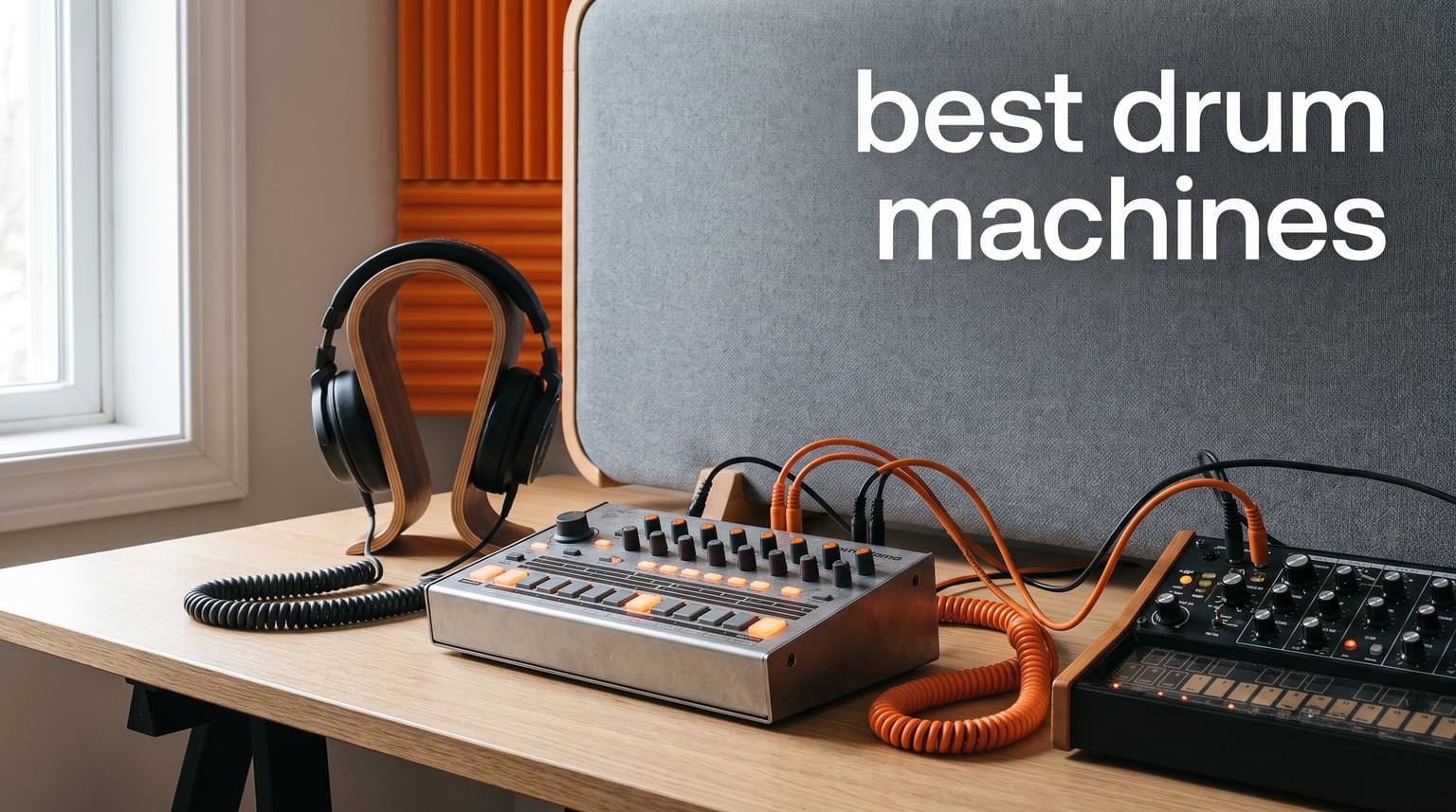
A good drum machine turns a vague rhythm idea into something you can hear, mute, reshape, and perform without opening another plug-in window. The best drum machines 2026 range from compact beat machines with classic modeled sounds to deep hardware instruments that build a full song one programmed step at a time.
For this list, I compared all eight available products on their verified sound engines, sequencers, connections, physical format, published ratings, and review counts. I kept the choice practical: do you need fast pattern entry, sample-based detail, classic dance-music character, direct outputs for a mixer, or a compact machine that can leave the desk?
A drum machine makes percussion with analog circuits, digital synthesis, samples, or a mix of those approaches, then records those sounds into a step sequencer. Analog and digital are not a quality ranking; they are different ways to get from an idea to a kick, snare, hi-hat, and moving groove.
If vintage Roland character is what brought you here, the history behind the legendary TR-808 explains why its voice still matters. If you want ideas beyond drums after choosing a machine, our electronic music production guides offer a useful next stop.
Community discussions show why this category can feel harder than it first appears: beginners report spending hours comparing options, while experienced players care about whether a sequencer invites jamming rather than slowing it down. I have therefore separated the picks by task, called out the learning curve, and kept a clear line between verified specifications and my buying advice.
The top 3 best drum machines 2026 fit distinct workflows
These are the fastest answers for most buyers. The Elektron Syntakt is the all-round hardware drum synthesizer; the Roland AIRA Compact T-8 is the small grab-and-go beat and bass machine; and the Behringer RD-78 is the plain-speaking pick for an uncomplicated analog-style rhythm box.
- Best all-rounder: Elektron Syntakt combines four analog tracks, eight digital tracks, 35 sound-generating machines, and Overbridge support.
- Best compact performance unit: Roland AIRA Compact T-8 pairs ACB drum sounds with a TB-303 bass synth, effects, and USB-C audio/MIDI.
- Best direct analog option: Behringer RD-78 keeps 15 drum sounds, 34 rhythm presets, and a 16-step sequencer in a simple layout.
The best drum machines 2026 cover eight clear use cases
The overview below puts every analyzed model in one place. Read the individual reviews when sequencing depth, sound generation, and integration with a DAW or other hardware will decide the purchase.
| Product | Specifications | Action |
|---|---|---|
 Elektron Syntakt Elektron Syntakt |
|
Check Latest Price |
 Roland AIRA Compact T-8 Roland AIRA Compact T-8 |
|
Check Latest Price |
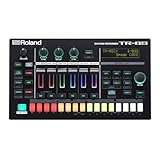 Roland TR-6S Roland TR-6S |
|
Check Latest Price |
 Behringer RD-78 Behringer RD-78 |
|
Check Latest Price |
 Behringer RD-9 Behringer RD-9 |
|
Check Latest Price |
 Elektron Digitakt II Elektron Digitakt II |
|
Check Latest Price |
 Behringer LM Behringer LM |
|
Check Latest Price |
 Korg drumlogue Korg drumlogue |
|
Check Latest Price |
1. The Elektron Syntakt Is the Best All-Round Drum Synthesizer
Elektron Syntakt 12 Track Drum Computer & Synthesizer
4 analog + 8 digital tracks
35 machines
Overbridge DAW integration
Pros
- Hybrid analog and digital tracks
- 35 sound machines
- Overbridge support
- Per-track filters and LFOs
Cons
- Deep workflow takes practice
- Only 37 published reviews
The Syntakt is my first recommendation for a producer who wants one compact box to cover drums, percussion, and melodic duties. Its four analog tracks and eight digital tracks are not just a large track count; they give you two different sound-making approaches inside one pattern workflow.
Elektron lists 35 sound-generating machines, 48 kHz/24-bit D/A and A/D conversion, multimode filters, and assignable LFOs per track. That combination makes this less of a fixed-kit drum machine and more of a drum synthesizer that can keep changing as the track develops.
The published 4.7 average from 37 reviews is strong, though it is a smaller review pool than the Roland compact options below. I would treat that as a positive signal rather than a shortcut past learning the interface, because Elektron sequencing rewards deliberate time with the buttons and encoders.
The hybrid sound engine gives one box a broad role
Use the analog tracks when you want the physical behavior of analog sound generation, then use the digital machines for other percussion and synth roles. That split is useful for techno, industrial patterns, or IDM-style sequences where a single repeated kit can become too predictable.
High-resolution encoders and durable backlit buttons support detailed parameter work, while the 128×64 OLED gives visual feedback without relying on a computer. I would choose this over a simpler groovebox when creating the sound is as important as placing the rhythm.
The Overbridge connection makes DAW work more practical
Overbridge support is the deciding feature for producers who finish arrangements in a DAW. The Syntakt also has USB, MIDI In/Out/Thru, and DIN Sync out, so it can sit between a computer session and a hardware clocked setup.
That connection set gives studio production a clear path without making the machine dependent on a computer. The tradeoff is cognitive load: this is a capable instrument, not the quickest route to a first four-on-the-floor loop.
2. The Roland AIRA Compact T-8 Is the Best Portable Beat-and-Bass Machine
Roland AIRA Compact T-8 Beat Machine
ACB TR drums and TB-303
64 patterns
USB-C audio MIDI
Pros
- Classic Roland ACB sounds
- TB-303 bass synth
- Battery-powered
- USB-C audio MIDI
Cons
- Random color is not selectable
- Small format limits hands-on space
The Roland AIRA Compact T-8 is the one I would choose when a drum machine has to be genuinely easy to carry and still do more than a metronome-sized loop. It combines modeled TR-808, TR-909, and TR-606 drum sounds with a TB-303 bass synth in a 1.3-pound unit.
Roland specifies Analog Circuit Behavior technology, 64 user patterns, and up to 32 steps per pattern. Its 4.6 average across 197 reviews is the largest review count in this group, so there is more buyer feedback behind that rating than most of the list.
Its battery-powered operation is rated for 4.5 hours, which makes couch writing, travel, and a small live rig realistic uses. I like the clarity of the premise: make a drum-and-bass pattern quickly, then move the audio or MIDI into a larger system.
The TR-REC sequencer makes fast programming the main appeal
The T-8 offers real-time recording alongside TR-REC programming and goes beyond a plain 16-step loop with probability, sub step, last step, and velocity controls. Step loop, mute, fill, reload, and pattern shift functions give performance moves without needing a second controller.
That is a useful balance for house and techno sketches because the pattern can change while the basic grid stays readable. A beginner can get a beat running first, then introduce probability and sub-steps later instead of confronting a menu-heavy machine at the start.
The USB-C and sync connections make a small rig workable
Class-compliant USB-C audio/MIDI lets the T-8 connect directly to a computer, and Roland also lists audio, MIDI, sync I/O, and AIRA Link. The effects section includes delay, reverb, overdrive, and sidechain compression, so a dry pattern has a few ways to gain motion before recording.
The small chassis does mean less physical space than a full-size tabletop drum machine. Choose it for portability and immediate Roland-style rhythm programming, not for extensive individual-output routing or a large screen.
3. The Roland TR-6S Is the Best Compact Machine for Hybrid Kits
Roland TR-6S Rhythm Performer | Compact Drum Machine with Six Tracks of Authentic TR Sounds including TR-808, CR-78 & More | Large Preset Sample Library | Editable FM Sound Engine | Advanced Sequencer
Six drum tracks
Samples and FM engine
USB audio MIDI
Pros
- TR circuit models
- Custom sample support
- FM sound engine
- Motion recording
Cons
- Plastic body
- Short published warranty
The TR-6S is a compact rhythm performer for someone who wants recognizable Roland drum circuit models but does not want to be limited to a vintage-style kit. It supplies six tracks, circuit models of the TR-808, TR-909, TR-606, and TR-707, a preset sample library, custom user sample support, and an FM sound engine.
That specification gives the TR-6S a practical answer to the analog-versus-digital question: mix them in the same kit when the song needs it. A modeled kick, a personal sample, and an FM percussion layer can each have a job rather than forcing the whole track into one sound family.
It has a 4.6 average from 138 reviews and can run on batteries. I see it as a concise performance tool for producers who want to carry their sound palette with them but still expect deeper sequencing than a basic 16-step device.
The layered sound sources let one kit cover more ground
Roland’s circuit models supply the classic foundation, while the FM engine gives a route to sharper, more futuristic tones. The large preset sample library and support for custom user samples make it possible to build hybrid drum kits around recordings or favorite one-shots.
This is especially attractive for electronic music production that moves between house, hip-hop, and more synthetic percussion. I would select it when familiar drum-machine identity matters, but a fixed recreation of a single vintage instrument would feel too narrow.
The advanced sequencer favors movement over static loops
Sub-steps, flam, step-loop, and motion recording give the six sequenced tracks several ways to shift across a performance. USB audio/MIDI and the TR-EDITOR software extend the workflow to a computer without removing the hands-on pattern entry that makes dedicated hardware appealing.
The plastic construction and limited published warranty are the main reservations in the supplied data. If rugged full-size controls or many individual audio outputs matter more than compactness, the RD-9 below is the more routing-focused direction.
4. The Behringer RD-78 Is the Best Straightforward Analog Drum Machine
Behringer RD-78 Classic Analog Drum Machine with 15 Drum Sounds, 34 Rhythm Presets, 16-Step Sequencer for Music Production and Live Performance
15 analog drum sounds
34 rhythm presets
16-step sequencer
Pros
- 15 drum sounds
- 34 rhythm presets
- Simple interface
- Compact steel body
Cons
- Limited support details
- No detailed routing listed
The Behringer RD-78 makes sense when the goal is not a giant feature list but a direct route to programmed rhythm. Its verified specification is focused: 15 authentic analog drum sounds, 34 rhythm presets, a 16-step sequencer, USB connectivity, and an interface described as simple and intuitive.
That focus can be a relief after reading about machines with multiple synthesis engines, song modes, and layers of parameter control. The RD-78 has a 4.6 average from 42 reviews, and its alloy-steel construction keeps the physical proposition compact rather than flimsy on paper.
I would start here for a first hardware drum machine if you want to learn the relationship between steps, accents, and a repeating beat before adding deeper sound design. It is also a sensible dedicated rhythm partner for a keyboard or guitar setup that already handles melody and harmony.
The 16-step layout keeps the first learning task clear
A 16-step sequencer maps naturally to a bar of common dance rhythms, making it easy to hear what changes when a kick moves or a snare lands early. The 34 rhythm presets give a starting point, while the sound set remains bounded enough that the front panel should stay understandable.
Community advice repeatedly warns against buying a complicated machine before knowing what kind of programming you enjoy. The RD-78 answers that pain point with a short, legible feature list rather than requiring you to compare several engines before making a sound.
The sound set suits rhythm-first arrangements
Fifteen drum sounds are sufficient for a defined drum-machine part, but they do not make this the choice for sample chopping or broad sound-library work. USB connectivity is present, yet the available specifications do not list MIDI routing, individual outputs, onboard effects, or sample import.
That limitation is not a hidden drawback if your music benefits from commitment and repetition. I would pass on it only when the plan already calls for detailed DAW audio integration, multiple external instruments, or extensively changing kits.
5. The Behringer RD-9 Is the Best TR-909-Inspired Routing Machine
Behringer RD-9 Analog Drum Machine
11 drum sounds
10 individual outputs
MIDI and 3 trigger outs
Pros
- TR-909-inspired sound
- 10 individual outputs
- MIDI In Out Thru
- Three trigger outs
Cons
- Heavier tabletop format
- Only 35 published reviews
The Behringer RD-9 is the clearest choice here for a producer building a mixer-and-hardware rig around 909-inspired drums. It has 11 drum sounds, an Analog Filter Wave Designer effects section, 10 individual outputs, MIDI In/Out/Thru, and three trigger outputs.
Those 10 individual outputs change the practical role of the machine. Instead of printing one combined drum mix, you can route separate voices to mixer channels or external processing, which makes sense for performance mixing and recording sessions that treat kick, snare, and hats differently.
The RD-9 has a 4.5 average from 35 reviews and weighs 8.3 pounds, so I would think of it as a proper tabletop instrument rather than a travel companion. Its design speaks to the enduring pull of the influential TR-909 in house and techno.
The individual outputs support a serious external-mixer workflow
Ten individual outputs provide more control than the stereo-only pathways common on compact boxes. You can send parts to separate channels, use outboard processing where it helps, and build transitions with the mixer rather than relying only on internal effects.
The three trigger outs are also relevant for a hardware setup that needs timed signals beyond MIDI. I would favor the RD-9 when the drum machine must become a central clocked piece of a rig instead of a self-contained sketchpad.
The focused 909-style voice favors dance-music commitment
The 11-sound design is deliberately focused compared with the Syntakt or Digitakt II. Its analog Filter Wave Designer effects reinforce a drum-machine workflow built around character, repetition, and direct changes rather than a large inventory of samples.
That makes it a strong fit for techno and house, where a small number of assertive voices can carry a track. It is less appropriate if you need a lightweight machine, a large sample library, or a broad palette of melodic digital synthesis from the same enclosure.
6. The Elektron Digitakt II Is the Best Deep Sample-Based Drum Computer
Elektron Digitakt II 16-Track Drum Computer and Sampler
16 audio or MIDI tracks
128-step sequencer
Song Mode
Pros
- 16 flexible tracks
- 128-step sequencer
- Three LFOs per track
- Per-track effects
Cons
- Deep feature set needs practice
- Only 28 published reviews
The Elektron Digitakt II is the answer when your drum machine needs to organize samples into complete, changing arrangements. Its 16 tracks can be configured for stereo or mono samples, or MIDI, and the 128-step Elektron sequencer gives patterns much more room than a short one-bar loop.
This is not an analog drum synthesizer in the Syntakt sense; it is a sample-based drum computer designed to reshape recorded sounds. The 4.4 average from 28 reviews is lower than the Syntakt’s published rating, but the supplied review insight still describes 85% five-star ratings and praises the cast-aluminum build and feature depth.
I would pick the Digitakt II for sound design that starts with found sound, drum samples, or carefully selected one-shots. It is also the Elektron option I would choose when finishing a sequence into a longer composition matters as much as creating a satisfying eight-bar pattern.
The 16-track structure makes detailed arrangements possible
Each of the 16 tracks can handle stereo or mono samples or MIDI, creating room for drums, textures, vocal fragments, and external gear control in the same project. Song Mode supports creating, editing, and playing full compositions, which is a meaningful distinction for writers who want more than live pattern switching.
The 128-step sequencer suits patterns that need slow evolution, extra phrases, or uneven accents across several bars. That depth can make the first session slower, yet it gives ambitious electronic music production more space before the arrangement has to move into a DAW.
The per-track modulation supports sample transformation
Three assignable LFOs per track, a base-width filter plus swappable filter choices, and four Trig modes make the Digitakt II more than a playback device. Delay, reverb, chorus, bit reduction, sample reduction, and overdrive are listed per track, giving each sound a path toward its own texture.
That is a strong case for IDM, experimental beat making, and producers who want compression or saturation in context before judging a sound. If you want to dial in analog drum voices from scratch instead, the Syntakt is the better match from this list.
7. The Behringer LM Is the Best Simple Hybrid-Sampling Consideration
Behringer LM Hybrid Drum Machine
Hybrid sampling drum machine
Bass wood body
Limited verified specifications
Pros
- Hybrid sampling approach
- Bass wood construction
- Compact published dimensions
Cons
- Limited technical data
- Only 13 published reviews
The Behringer LM deserves a cautious place on this list because the available product data confirms a hybrid sampling drum machine but does not describe its sequencer, outputs, MIDI implementation, number of voices, or effects. That is a much smaller verified technical picture than the other choices provide.
Its listing reports a bass wood body, polished finish, 3,240-gram weight, and a 4.4 average from 13 reviews. The review insight characterizes it as a practical hybrid-sampling choice, but the low review count means I would put more effort into hearing a current demo and confirming its connections before buying.
I include it because a hybrid sampling direction may suit someone who wants a physical drum-machine format without committing to purely analog synthesis. Still, this is a selection where restraint matters: the missing specifications should shape your decision rather than be filled in by assumptions.
The verified hybrid approach is the reason to investigate it
Hybrid sampling suggests a workflow centered on recorded drum material rather than a strictly analog voice architecture. That can be appealing for beat makers who prefer the character of samples but want a dedicated hardware surface instead of clicking through a software drum rack.
The supplied information does not state how samples are loaded, edited, sequenced, or routed. I would ask those exact questions before making this machine the center of a live set or a DAW-focused production setup.
The limited specification sheet calls for a careful purchase check
Compared with the detailed track counts and connection lists for the Elektron, Roland, and Korg models, the LM documentation in this dataset is brief. It also has the smallest review count in this guide, which limits what the published average can tell you about longer-term ownership.
Watch a full demonstration that shows programming, pattern changes, audio routing, and sound editing in one continuous session. Forum users make a useful point here: a sound demo with compression or saturation in context tells you more than isolated hits alone.
8. The Korg drumlogue Is the Best Open Hybrid Sound-Design Platform
KORG drumlogue Hybrid Drum Machine (DRUMLOGUE)
Analog digital and Multi Engine
11 parts,64 steps
USB-C and DIN MIDI
Pros
- Threefold hybrid engine
- Open User Oscillator support
- Per-part effects
- Wide connectivity
Cons
- Mixed published reviews
- One-year warranty
The Korg drumlogue is the most explicitly open-ended sound-design choice in the group. Korg describes a threefold hybrid architecture of analog, digital, and Multi Engine sources, including open-source User Oscillator and Effects support as well as Noise and VPM options.
It offers 11 parts and a 64-step sequencer, front-panel tuning and attenuation controls, dedicated volume knobs for each part, per-part reverb and delay, and master effects. On the connectivity side, it lists stereo plus four assignable outputs, USB-C, audio input, DIN MIDI In/Out, and Audio Sync.
The 3.8 average from 35 reviews is the lowest published rating here, and the supplied review data specifically notes mixed feedback and potential usability or reliability concerns. I would not ignore that signal, even though the feature list is one of the most adventurous in the roundup.
The threefold engine favors producers who want to build unusual kits
Analog, digital, and Multi Engine sources make the drumlogue attractive for producers who want conventional drums next to stranger synthesized percussion. The support for third-party effects through the Multi Engine adds another reason to see it as a platform rather than only a preset drum box.
Front-panel knobs for commonly used tuning and attenuation tasks help turn that depth into direct physical control. I would choose it for ambient, experimental, or hybrid electronic work where making a distinctive voice matters more than reaching a standardized classic kit quickly.
The connections and assignable outputs suit a growing hardware setup
Stereo plus four assignable outputs, USB-C, audio input, DIN MIDI, and Audio Sync make the drumlogue one of the more flexible partners for other instruments. Loop and Chain functions add a way to build performances or songs from its 64-step patterns.
The prudent choice is to verify the current support experience and spend time with the operating flow before relying on it for deadline-driven work. Buyers who want less uncertainty and a more defined workflow may be happier with the Syntakt, TR-6S, or RD-9.
The right drum machine matches your sound source and workflow
The best buying decision begins with the kind of sound you want to shape, not a brand name or a long specification sheet. Make one short list of the rhythms you create most often, then choose the engine and sequencer that make those rhythms easier to finish.
The sound engine should match the sounds you want to shape
Analog synthesis creates percussion through electronic sound-generation circuits and controls such as tuning, filters, and envelopes. A model like the RD-78 or a 909-inspired instrument such as the RD-9 suits a player who wants a focused drum voice and direct adjustment.
Digital machines can model classic circuits, produce FM tones, play samples, or combine several approaches. The T-8 uses Roland ACB modeling, the TR-6S mixes circuit models, samples, and FM, the Digitakt II focuses on samples, and the drumlogue combines analog, digital, and Multi Engine sources.
Neither approach wins by default. Choose analog when a narrower physical sound character and immediate controls fit your music; choose digital or hybrid when the project needs sample variety, precise recall, more types of synthesis, or effects-based transformation.
The sequencer should make patterns easy to finish
A step sequencer places events on a repeating grid, and a plain 16-step layout remains one of the quickest ways to learn drum programming. The RD-78 makes that grid central, while the T-8 adds probability, sub steps, last step, and velocity to introduce variation without leaving the pattern view.
Longer sequencing is useful when a beat needs internal movement before it becomes an arrangement. The Digitakt II provides 128 steps and Song Mode, the drumlogue has 11 parts with 64 steps plus Loop and Chain, and the Syntakt offers Elektron’s deep track-based sequencing environment.
Before buying, program a simple beat on any available demo unit or watch a complete programming video rather than only a sound montage. Community members consistently advise hearing machines in musical context, and that is sound advice when workflow matters as much as the raw kick sound.
The connections should fit the rest of your studio
USB audio/MIDI is useful when you want a hardware machine to enter a DAW session with minimal extra interface routing. The T-8 and TR-6S explicitly include USB audio/MIDI, while the Syntakt adds Overbridge plus USB and MIDI In/Out/Thru.
MIDI ports and sync are more important if the drum machine must run beside sequencers, synths, or modular gear. The RD-9 lists MIDI In/Out/Thru and three trigger outs, and the drumlogue adds audio input, DIN MIDI, Audio Sync, stereo outputs, and four assignable outputs.
Individual audio outputs matter when each drum voice needs separate processing or mixer treatment. The RD-9’s 10 individual outputs are a clear reason to choose it for a routing-heavy live or studio system, while the smaller Roland machines make more sense when a compact stereo-and-USB workflow is enough.
The live-performance choice should favor reachable control
For live performance, ask what you need to change with one hand: mutes, fills, pattern changes, effects, or mixer levels. The T-8 supplies step loop, mute, fill, reload, and pattern shift functions in a battery-powered format, while the drumlogue supplies dedicated volume controls and assignable outputs for a broader rig.
The RD-9 is a better fit when external mixing and trigger routing are central, even though its 8.3-pound weight makes it less mobile. The Syntakt is a strong choice for a compact but deep performance brain, but I would learn the workflow at home before expecting to improvise confidently on stage.
Portability does not only mean weight. Battery operation, USB connections, the number of cables, and whether the machine needs a mixer all affect how quickly a setup can go from bag to soundcheck.
The beginner choice should start with a clear first task
For a beginner, the Roland AIRA Compact T-8 and Behringer RD-78 are the most direct places to start from this selection. The T-8 provides a familiar 16-step approach plus classic drum and bass voices, while the RD-78 keeps its verified feature set centered on 15 sounds, 34 presets, and 16 steps.
Choose the T-8 if USB-C audio/MIDI, effects, and a bass synth are part of the immediate goal. Choose the RD-78 if a straightforward rhythm machine is more appealing and you would rather learn one focused task before moving into samples, modulation, or multi-engine synthesis.
Do not assume a deeper instrument is a better first instrument. A machine that gets you to a finished two-bar pattern today can teach timing, arrangement, and listening more effectively than a feature-rich device that stays in its box.
These drum machine FAQs give direct buying answers
What is the best drum machine for beginners in 2026?
The Roland AIRA Compact T-8 is the most approachable all-in-one beginner choice here because it combines a 16-step TR-REC sequencer, modeled Roland drum sounds, a TB-303 bass synth, effects, battery operation, and USB-C audio/MIDI. Choose the Behringer RD-78 instead if you want a more focused 15-sound, 16-step rhythm machine with fewer stated features to learn.
How much should I spend on a drum machine?
Spend according to the job you need it to do rather than treating a larger feature list as automatically better. A focused machine such as the RD-78 suits basic rhythm programming, compact Roland models add effects and computer integration, and higher-spec Elektron or Korg units add deeper sequencing, sound design, or track flexibility. Do not buy capability you will not use in your next few tracks.
What is the difference between analog and digital drum machines?
Analog drum machines generate percussion with electronic circuits, while digital drum machines use technologies such as samples, FM synthesis, or modeled circuits. Analog is useful for a focused physical character; digital offers broader recall, sample handling, and varied sound engines. Hybrid instruments combine approaches, as shown by the Syntakt, TR-6S, and drumlogue.
Which drum machine do professionals use?
Professionals use different hardware according to the job: the Elektron Syntakt for hybrid synthesis and DAW integration, the Digitakt II for detailed sample sequencing and Song Mode, and the RD-9 for 909-inspired drums with 10 individual outputs. A professional choice is the one that integrates with the studio or live rig and makes finished music easier to create.
Are hardware drum machines worth it?
Hardware drum machines are worth it when tactile step entry, immediate performance controls, and a dedicated sound engine help you write more music. They can also offer MIDI, sync, USB audio, individual outputs, or sample-based production without relying on a mouse. They are less useful if you prefer editing entirely inside a DAW and do not need a hands-on rhythm workflow.
The Elektron Syntakt is the strongest all-round choice
The Elektron Syntakt is the strongest single recommendation because its four analog tracks, eight digital tracks, 35 sound-generating machines, filters, LFOs, and Overbridge support cover the broadest set of real production tasks. Pick the T-8 for portable Roland-style drums and bass, the RD-9 for 909-inspired routing, the Digitakt II for deep sample work, or the RD-78 for a simple first hardware step.
The best drum machines 2026 are the ones that turn your preferred rhythm into a repeatable working process. Start with the model whose sound engine and connections fit the next track you want to finish, then spend time learning its sequencer well.