
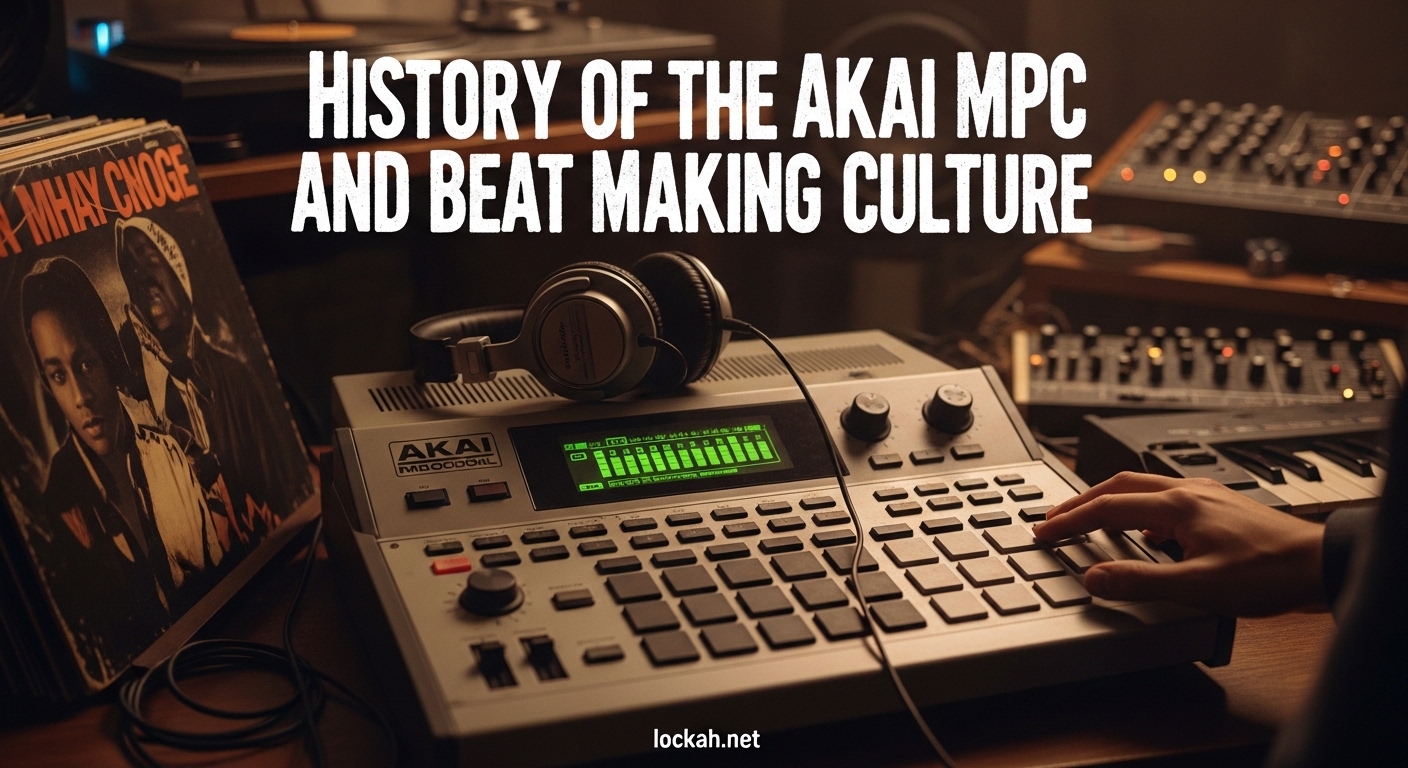
In November 2008, during his appearance on Saturday Night Live, Kanye West did something that would have seemed impossible just two decades earlier. Standing alone on stage with nothing but a barely visible device, he reconstructed his hit song “Love Lockdown” in real-time. He triggered samples, built drum patterns, and created an entire musical arrangement live before millions of viewers. That device was the Akai MPC.
This single moment crystallized everything the MPC represented. It was not just a drum machine or sampler. It was an instrument that could hold an entire stage by itself. It was the culmination of a revolution that had begun 20 years earlier in a collaboration between a Japanese electronics company and an American engineer who believed music production could be intuitive, accessible, and revolutionary.
The history of the Akai MPC and beat making culture is not merely a story about electronic equipment. It is the story of how a single piece of technology democratized music creation, birthed an entire culture of producers, and fundamentally changed how we think about rhythm, sampling, and the very definition of musicianship. From bedrooms to stadiums, the MPC created a bridge between the studio and the stage that had never existed before.
In this comprehensive guide, we will explore how the MPC came to be, why it captured the imagination of a generation of beat makers, and how it continues to influence music production 2026. Whether you are a producer looking to understand your roots, a music historian tracing the evolution of hip-hop, or simply curious about how technology shapes culture, this is the complete story of the Akai MPC and the beat making culture it spawned.
The Music Production Landscape Before the MPC (2026)
The late 1980s represented a unique moment in music history. Hip-hop had emerged from the Bronx and was spreading globally. Sampling technology existed but remained cumbersome and expensive. The E-mu SP-1200, released in 1987, had begun to show what was possible with drum machines and samplers, but its limitations were significant. You could sample only seconds of audio, and the workflow required multiple pieces of equipment chained together.
Studio time cost a fortune. Recording at a professional facility could run hundreds of dollars per hour, putting serious music production out of reach for most young creators. If you wanted to make beats, you needed access to expensive equipment, technical knowledge to operate complex machinery, and the financial resources to rent studio space. The barriers to entry were enormous.
Drum machines like the Roland TR-808 and TR-909 had become staples of electronic music and early hip-hop, but they were limited to synthesized sounds. If you wanted to sample a breakbeat from a vinyl record, you needed a separate sampler. If you wanted to sequence those samples, you needed yet another device. The typical production setup involved a maze of cables connecting multiple boxes, each with its own learning curve and quirks.
Producers worked around these limitations with creativity and determination. Pete Rock famously used the SP-1200’s limitations to his advantage, pitching samples down to stretch them further and creating the gritty, filtered sound that defined golden-era hip-hop. But the workflow was never smooth. You could not see your samples arranged visually. Editing was tedious. The creative flow constantly hit technical walls.
This was the world that awaited disruption. The pieces were there: sampling technology existed, sequencing was understood, and the desire to create beats was exploding across urban America and beyond. What was missing was an instrument that brought everything together in a way that felt musical rather than mechanical. Someone needed to bridge the gap between the drum machine’s immediacy and the sampler’s creative potential.
The Creation Story: Roger Linn and the Birth of the MPC60
Roger Linn was already a legend in music technology before the MPC existed. In 1980, he had created the LM-1 Drum Computer, the first drum machine to use digital samples of real acoustic drums. Prince used it extensively. Peter Gabriel owned one. The LM-1 proved that musicians wanted the sound of real drums with the convenience of electronic programming. But Linn’s company struggled financially, and by 1986, he was looking for his next chapter.
Akai Professional, a Japanese electronics company known for reel-to-reel tape recorders and affordable samplers, approached Linn with a proposition. They wanted to create a new kind of music production device, something that combined sampling, sequencing, and drum programming into a single, intuitive instrument. They had seen Linn’s work on the LinnDrum and LM-1. They believed he was the person who could make their vision real.
Linn brought something crucial to the collaboration: a philosophy that music technology should serve musicians, not the other way around. He believed that electronic instruments should be playable, immediate, and responsive. The design process focused obsessively on the user experience. Every button placement, every screen display, every workflow decision was tested against a simple question: does this help someone make music?
The result was the MPC60, released on December 8, 1988. It was not the first sampler. It was not the first drum machine. It was not the first sequencer. But it was the first device to combine all three functions in a way that felt like playing an instrument rather than operating machinery. The 16 pressure-sensitive pads arranged in a 4×4 grid became instantly iconic. The LCD screen showed your samples as waveforms you could edit. The built-in sequencer could record your performances with the human feel intact.
The MPC60 cost $5,000 at launch, which was not cheap but was significantly less than the cost of buying separate samplers, drum machines, and sequencers. More importantly, it was a complete studio in a box. You could sample from vinyl, chop those samples into pieces, arrange them into patterns, and build entire songs without touching another piece of equipment. For the first time, a single device could take you from idea to finished beat.
Linn’s design philosophy manifested in details that seemed small but proved revolutionary. The pads responded to velocity and pressure, so playing softly or hard actually affected the sound. The note repeat function let you create rapid-fire hi-hat rolls by holding a pad. The swing function could add subtle timing variations that made programmed beats feel human. These were not just features. They were invitations to express yourself.
Technical Innovations That Changed Everything
The MPC’s 16 pressure-sensitive pads redefined how producers interacted with sampled sound. Before the MPC, triggering samples meant pressing small buttons on rack-mounted units or playing keys on a keyboard. Neither felt right for drums. The 4×4 grid of rubber pads invited a different kind of playing, one that mimicked the layout of traditional drum kits but added new possibilities for finger drumming and performance.
The pressure sensitivity mattered enormously. When you hit a pad softly, the sample played quietly. When you slammed it, the sample blasted. This dynamic response meant you could program beats with real expression, adding accents and ghost notes just like an acoustic drummer. For hip-hop producers who wanted their programmed drums to feel like breakbeats played by real drummers, this was transformative.
The swing function became legendary. Roger Linn had studied how human drummers played slightly ahead or behind the beat to create groove. The MPC’s swing control let you apply these subtle timing variations to your programmed patterns. At 50%, beats played straight on the grid. At 54%, you got the loping feel of J Dilla’s signature sound. At 58%, you approached the loose shuffle of classic soul records. Producers discovered that swing settings could define their entire aesthetic.
Quantization, the process of snapping notes to the timing grid, worked differently on the MPC than on previous devices. You could quantize selectively, keeping some elements tight while leaving others loose. You could record in real-time and quantize after the fact, preserving the feel of your performance while cleaning up timing mistakes. Or you could turn quantization off entirely and embrace the human imperfection that gave beats character.
The sampling capabilities expanded what producers could do with audio. You could sample up to 13 seconds of stereo audio, which was generous for 1988. But more important than the length was how you could manipulate those samples. The MPC let you truncate samples to remove silence, loop sections for continuous playback, and assign samples to any pad in any combination. You could build entire drum kits from vinyl breaks or chop a vocal phrase into syllables and reconstruct it into something new.
Real-time editing meant the creative process stayed fluid. You could adjust sample start points while the beat played, hearing immediately how the change affected the groove. You could mute and unmute tracks to build arrangements on the fly. The LCD screen visualized your patterns as a grid, making it easy to see where hits landed and how patterns related to each other. Everything was designed to keep you creating rather than calculating.
The sequencer recorded your pad performances as MIDI data, meaning you could go back and edit individual hits, change velocities, or shift timing without re-recording. You could copy patterns and make variations, building verse and chorus sections from a single foundation. Songs emerged from the interplay between patterns, with the MPC holding everything in memory and playing it back perfectly every time.
The Hip-Hop Revolution in 2026?
When the MPC arrived in 1988, hip-hop was already a vibrant culture with turntablists, MCs, and producers working within defined creative boundaries. The MPC did not just expand those boundaries. It erased them entirely. Producers who had worked within the limitations of previous equipment suddenly found themselves with a tool that could realize any rhythmic idea they could imagine.
Dr. Dre was among the first to recognize the MPC’s potential. Working with the MPC60 and later the MPC3000, he built the sonic foundation of West Coast hip-hop. His production on N.W.A.’s “Straight Outta Compton” and his own “The Chronic” demonstrated how the MPC could create sounds that felt simultaneously rooted in funk and entirely new. Dre’s signature G-funk sound relied heavily on the MPC’s ability to chop samples into micro-pieces and resequence them into laid-back, melodic grooves.
Pete Rock brought the MPC into the realm of jazz-infused hip-hop. His work with CL Smooth and his solo productions showcased the MPC’s ability to layer multiple samples into complex, harmonically rich arrangements. Rock’s technique of filtering samples to create warmth and his use of the MPC’s pads to trigger horn stabs and vocal snippets became hugely influential. He proved that the MPC could handle sophisticated musical ideas while maintaining hard-hitting drums.
But no producer embodied the MPC spirit more completely than J Dilla. His approach to the MPC3000 became legendary for its humanity and innovation. Dilla famously refused to quantize his beats, leaving the timing loose and organic. He developed techniques for chopping samples so precisely that he could reconstruct entire compositions from tiny fragments. His use of the MPC’s swing function created a rhythmic feel that influenced generations of producers who followed.
Dilla’s MPC3000 now sits in the Smithsonian National Museum of American History, recognized not just as a piece of technology but as a cultural artifact that changed music. The machine that traveled with him through his final years, on which he created some of his most beloved work, represents the pinnacle of what the MPC enabled. A single producer, working alone with a sampler, could create art that moved millions.
Kanye West’s relationship with the MPC defined an era of mainstream hip-hop production. His early work on Jay-Z’s “The Blueprint” and his own “The College Dropout” showcased the MPC’s ability to create lush, soulful soundscapes from vintage samples. West’s performances with the MPC, building beats live on television and in concert, demonstrated that the device was not just a studio tool but a performance instrument. He made the MPC visible to mainstream audiences who had never considered how hip-hop beats were made.
The MPC’s influence extended beyond individual producers to shape the sound of entire regional scenes. Southern hip-hop producers used the MPC to create the booming 808-heavy sound that defined crunk and trap. East Coast producers pushed sampling techniques to new levels of sophistication. West Coast producers developed their own distinct approaches to drum programming and sample chopping. The MPC became the common language connecting these diverse styles.
Beat Making Culture Emerges
The MPC did not just change how beats were made. It changed who could make them. Before the MPC, music production was largely the domain of studios, engineers, and musicians with access to expensive equipment. The MPC democratized beat making, putting professional-quality production tools within reach of anyone with a few thousand dollars and the dedication to learn.
The concept of the bedroom producer emerged directly from the MPC era. You no longer needed a studio. You needed a power outlet, a pair of headphones, and your record collection. Entire albums could be created in small rooms, with the MPC as the central hub of creativity. This accessibility transformed hip-hop from a performance culture into a production culture, where the person making the beats was as important as the person rapping over them.
The producer-musician hybrid became a recognized creative identity. MPC producers were not just technicians operating equipment. They were musicians who played the sampler as an instrument. The best MPC beat makers developed signature styles recognizable within seconds of hearing their work. Their manipulation of samples, their drum programming choices, their use of swing and timing, all became as distinctive as a guitarist’s tone or a singer’s voice.
Communities formed around MPC culture. Online forums like MPC-Forums.com and Gearspace became gathering places where producers shared techniques, debated the merits of different models, and helped newcomers learn the MPC workflow. YouTube tutorials demystified complex sampling techniques. Beat battles showcased MPC skills in competitive settings. The knowledge that previous generations had to discover through trial and error became freely shared.
The culture developed its own language and values. “Chopping” meant breaking samples into pieces. “Flipping” meant transforming a sample into something new. “Digging in the crates” described the vinyl hunting that fed the MPC’s appetite for source material. The MPC workflow became a mindset, an approach to music that valued tactile interaction with sound over mouse-clicking in software.
Sampling culture flourished with the MPC as its primary tool. Producers approached vinyl records as treasure troves of sound to be excavated and recontextualized. Obscure records became valuable not for their original artistic merit but for the breakbeats and melodies they contained. The MPC made it possible to lift a three-second drum break from a forgotten soul record and build an entirely new composition around it.
The learning curve became a rite of passage. Mastering the MPC required dedication. You had to understand sampling rates, MIDI implementation, and memory management. You had to develop the timing to play pads in real-time. You had to train your ears to hear how samples would fit together. This difficulty was part of the culture’s appeal. The skills you developed were earned, not given, and the community respected those who put in the work.
Live performance with the MPC became its own art form. Producers who had created beats in isolation discovered they could perform those beats in real-time, triggering samples and manipulating arrangements on stage. The MPC moved from studio to stage, with producers standing alongside traditional instrumentalists as legitimate performers. AraabMuzik’s virtuosic MPC performances demonstrated that finger drumming could be as impressive as any instrumental technique.
Model Evolution and Legacy
The MPC60 established the template, but Akai continued developing the platform throughout the 1990s and beyond. Each new model refined the workflow while maintaining the core philosophy of intuitive, hands-on production.
The MPC3000, released in 1994, became the most beloved model in the series. It offered 32 voices of polyphony, up from the MPC60’s 16, allowing for more complex arrangements. The sampling time increased dramatically. The sound quality improved. Most importantly, the swing and timing felt right in a way that producers recognized immediately. J Dilla, Pete Rock, and countless others made the MPC3000 their primary instrument.
The MPC2000 and MPC2000XL brought the platform into the late 1990s with modern connectivity options and expanded memory. The XL version added features like multiple time signatures and more sophisticated editing functions. These models became workhorses for producers who needed reliability and compatibility with the emerging digital audio workstation ecosystem.
The MPC1000 and MPC2500 of the 2000s represented attempts to make the MPC more portable and affordable. These compact units brought MPC workflow to producers who could not afford or did not need the larger models. The MPC500 went even smaller, fitting MPC functionality into a battery-powered unit that could be used anywhere.
The MPC Renaissance, released in 2012, marked a significant shift by integrating hardware with computer software. The hardware controller provided the familiar pad interface while the software running on your computer handled the audio processing. This hybrid approach divided the MPC community. Some embraced the expanded capabilities. Others felt it lost the standalone immediacy that made the MPC special.
Modern MPCs like the MPC One, MPC Live, and MPC X offer standalone operation with the option of computer integration. They add features like touchscreen displays, wireless connectivity, and massive internal storage. The pads remain, the workflow remains, but the technology has evolved dramatically. You can now carry an MPC that holds more samples than a room full of vintage units.
Throughout this evolution, the MPC maintained its cultural significance. Even as software samplers and DAWs offered similar functionality, producers returned to the MPC for its feel, its workflow, and its connection to hip-hop history. The MPC became more than a tool. It became a symbol of authenticity, of dedication to craft, of membership in a culture that valued tactile creativity over convenience.
The MPC in Modern Beat Making Culture
The MPC’s influence extends far beyond the hardware itself. Every major digital audio workstation includes drum pads and sampling workflows that trace directly back to the MPC interface. Ableton Live’s drum racks, FL Studio’s FPC, Logic’s Drum Machine Designer, all owe their existence to the MPC’s template. The 4×4 grid of pads has become the universal language of beat making.
Software emulations attempt to capture the MPC experience for producers working entirely on computers. Akai’s own MPC Software recreates the workflow with modern conveniences. Third-party plugins model the specific sonic characteristics of vintage MPC models. Producers debate whether these digital versions capture the magic of the hardware, but their existence proves the MPC’s enduring relevance.
The vintage MPC market tells its own story about the device’s cultural value. MPC60s and MPC3000s in good condition command prices far exceeding their original retail cost. Collectors and working producers compete for well-maintained units. Replacement parts have become valuable commodities. The machines have become investments as well as instruments, their value appreciating with their cultural significance.
Modern producers often use the MPC as one tool among many in hybrid setups. They might chop samples on an MPC, process them through analog gear, record into a DAW, and arrange the final track with software. The MPC remains the starting point for many creative processes, the place where ideas begin before moving to other environments for completion.
The beat making culture that emerged around the MPC continues to thrive. Beat makers share their work on Instagram and TikTok, posting videos of their hands on MPC pads for audiences of millions. The ASMR-like quality of pad hits and sample chops has become its own genre of content. New producers discover the MPC through these videos and enter the culture that has been building for over three decades.
Educational resources for MPC production have exploded. Online courses teach the MPC workflow to beginners. Universities offer classes in beat making that center the MPC’s history and techniques. Books and documentaries explore the cultural impact of the device and the producers who used it. The knowledge that once passed through informal networks now exists in formal educational structures.
The MPC’s influence on music extends across genres. Electronic music producers use MPC workflows for house and techno. Pop producers draw on MPC techniques for radio hits. Experimental musicians push the device’s capabilities into avant-garde territory. The boundaries of what constitutes MPC music have expanded far beyond hip-hop while remaining rooted in the culture that created the device.
FAQs
What is the history of the Akai MPC?
The Akai MPC was created in 1988 through a collaboration between Japanese electronics company Akai Professional and American engineer Roger Linn. The first model, the MPC60, combined sampling, sequencing, and drum programming in a single device with 16 pressure-sensitive pads. It revolutionized music production by making professional beat making accessible to home producers and became the foundation of hip-hop production culture.
How did the MPC change music production?
The MPC changed music production by democratizing access to professional tools. Before the MPC, creating beats required expensive studio time and multiple pieces of equipment. The MPC put a complete studio in a box that anyone could learn to use. Its intuitive pad interface made programming drums feel musical rather than mechanical. The swing function added human feel to programmed beats. Most importantly, it enabled the producer-musician hybrid who could create entire tracks alone.
Who created the Akai MPC?
The Akai MPC was designed by Roger Linn in collaboration with Akai Professional. Linn was already famous for creating the LM-1 Drum Computer, the first drum machine to use digital samples of real drums. He brought his philosophy of intuitive, musician-friendly design to the MPC project. The first MPC60 was released on December 8, 1988, establishing the template that would define the series for decades.
Why is the MPC important to hip-hop?
The MPC is important to hip-hop because it defined the sound and workflow of the genre’s production. It enabled the sampling culture that transformed hip-hop from a performance-based art to a production-based art. Legendary producers like J Dilla, Dr. Dre, Pete Rock, and Kanye West used the MPC to create their signature sounds. The device made beat making accessible to bedroom producers who could not afford studios, democratizing hip-hop production and enabling regional scenes to develop.
What made the MPC interface unique?
The MPC interface was unique for its 16 pressure-sensitive pads arranged in a 4×4 grid. Unlike buttons on other drum machines or keys on keyboards, these rubber pads invited a different kind of playing that felt more like drumming. The pressure sensitivity allowed for dynamic expression, playing samples softly or loudly based on how hard you hit. The LCD screen visualized samples and patterns. The real-time editing capabilities kept the creative flow going without stopping to navigate menus.
How did J Dilla use the MPC?
J Dilla used the MPC3000 to develop a signature sound that influenced generations of producers. He famously refused to quantize his beats, leaving the timing loose and organic to create a human feel. He pioneered sophisticated sample chopping techniques, breaking records into tiny fragments and reconstructing them into entirely new compositions. His use of the MPC’s swing function created a rhythmic feel that became widely imitated. Dilla’s MPC3000 is now in the Smithsonian as a recognition of his cultural impact.
Is the MPC still used today?
Yes, the MPC is still used today both in hardware form and as an influence on software design. Akai continues to release modern MPC models like the MPC One, MPC Live, and MPC X that combine standalone operation with computer integration. Software DAWs include MPC-inspired drum pads and sampling workflows. Many producers still seek out vintage MPC60s and MPC3000s for their specific sound and feel. The MPC remains a cultural icon and practical tool in contemporary music production.
Conclusion
The history of the Akai MPC and beat making culture represents one of the most significant intersections of technology and art in modern music. What began as a collaboration between an innovative engineer and an electronics company became a movement that transformed how music is created, performed, and understood. The MPC did not just provide new tools. It created new possibilities for who could be a musician and what music could be.
From Roger Linn’s design philosophy to J Dilla’s unquantized masterpieces, from bedroom producers making their first beats to stadium performances reconstructing hits in real-time, the MPC’s influence spans every aspect of contemporary music production. The culture that emerged around this device values creativity over technical perfection, tactile interaction over mouse clicks, and community knowledge over gatekeeping secrets.
Today, as you scroll through social media watching producers tap out beats on pads, as you hear the influence of MPC techniques in chart-topping hits, as you see vintage units commanding prices that would have seemed impossible in 1988, the legacy is undeniable. The Akai MPC was not just a drum machine. It was a democratization engine that put the power of music creation into millions of hands.
The beat making culture that the MPC spawned continues to evolve, adapting to new technologies while honoring the principles that made the original device revolutionary. Whether you make beats on vintage hardware, modern controllers, or software emulations, you are participating in a culture that began with 16 pressure-sensitive pads and a vision that music production could be intuitive, accessible, and transformative. The history of the Akai MPC is still being written, one beat at a time.