
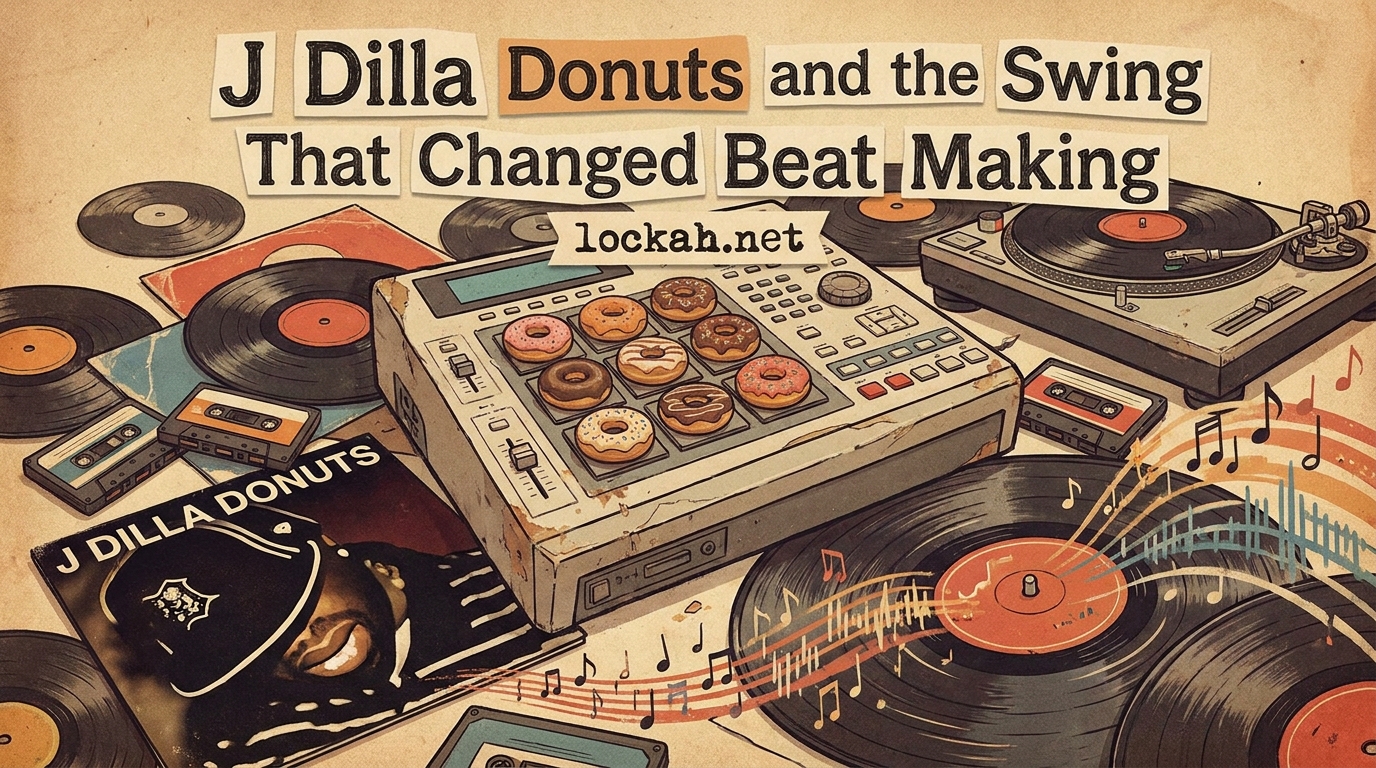
There is a moment in “So Far to Go” from J Dilla’s Donuts when the hi-hats drift just behind the beat, the snare snaps a millisecond early, and your head nods without your brain understanding why. That is Dilla swing in action – the rhythmic fingerprint that changed beat making forever.
Released in February 2006, three days before his death, Donuts contains 31 instrumental tracks, most under two minutes, that sound nothing like the quantized, grid-locked hip-hop that dominated the era. James Yancey, known professionally as J Dilla, created a rhythm language that felt drunk, lived-in, and profoundly human.
In this guide, we will explore how J Dilla Donuts and the swing that changed beat making created a new rhythmic vocabulary that producers still struggle to replicate nearly two decades later. You will learn what Dilla swing actually is, why it defies conventional music theory, and how it continues to influence hip-hop production 2026.
Who Was J Dilla? The Detroit Beat-Making Legacy (2026)
James Dewitt Yancey grew up in Conant Gardens, Detroit, surrounded by the sounds of Motown, Parliament-Funkadelic, and the emerging hip-hop movement. Born on February 7, 1974, he started collecting records before his teens, digging through crates at local spots while other kids played sports.
By the early 1990s, he was working with Slum Village alongside Baatin and T3, crafting the underground classic Fantastic, Vol. 2 (2000). During this period, he operated under the name Jay Dee, producing tracks for A Tribe Called Quest, De La Soul, Common, Erykah Badu, and The Pharcyde. Questlove once said that Dilla’s drums made him “question everything I knew about time.”
What separated Dilla from his peers was his complete disregard for the quantization button. While producers locked their drums to rigid grids, Dilla played everything by hand on his MPC3000. The result was timing that breathed – imperfect by digital standards but perfect for human ears. His move to Los Angeles in the early 2000s connected him with Madlib, leading to their collaborative Jaylib project and expanding his influence beyond Detroit.
In 2002, Dilla was diagnosed with a rare blood disorder and lupus. By 2005, he was hospitalized, yet continued making music from his bed with an MPC and a Boss SP-303 sampler. Friends smuggled in records. Nurses heard beats through walls. This context makes Donuts more than a masterpiece – it is a final statement from an artist racing mortality.
What Is Dilla Swing? Understanding the Off-Grid Revolution
Dilla swing is not swing in the traditional jazz sense, where eighth notes are played with a long-short triplet feel. It is something more complex and harder to define – a deliberate displacement of drum hits away from the rigid timing of digital sequencers.
Most hip-hop beats from the 1990s and early 2000s were quantized. Producers placed kicks, snares, and hi-hats exactly on the grid lines of their software or hardware sequencers. The result was mathematically perfect but emotionally flat. Dilla rejected this entirely.
On a standard MPC grid, each beat divides into 16 steps. Dilla would place hi-hats not on step 4, 8, or 12, but somewhere between them. Sometimes he pushed drums slightly ahead of the beat. Other times he dragged them behind. The inconsistency was intentional – and magical.
The Quintuplet Theory
Music theorists have analyzed Dilla’s timing and discovered he often used quintuplet subdivisions – dividing beats into five equal parts instead of the standard four or eight. This creates a polyrhythmic tension that makes the groove feel elastic.
Try counting “1-2-3-4-5” while a standard 4/4 beat plays. Dilla’s drums often land on the “and-of-1” in quintuplet space – somewhere between the standard 16th notes but not quite a triplet. This explains why producers say his beats feel “drunk” or “swimming” – the timing exists in a different rhythmic dimension than conventional hip-hop.
Here is what makes this technique revolutionary: Dilla did not calculate these placements. He played them by hand on his MPC pads in real-time. The slight variations in his finger timing created organic micro-timing that no algorithm could replicate. When you try to quantize a Dilla beat – snapping those off-grid hits to the nearest grid line – the groove disappears completely.
The Donuts Album: Creation from a Hospital Bed
Donuts was recorded during the final months of Dilla’s life while he was hospitalized in Los Angeles. The album’s circumstances are inseparable from its sound. Thirty-one tracks. Thirty-one glimpses into an artist’s final thoughts.
Equipment and Technique
Dilla worked primarily with an Akai MPC3000 and a Boss SP-303. The MPC3000 provided the sequencing and sampling capabilities. The SP-303 added effects and allowed him to resample and manipulate sounds. He worked with records brought by friends – 45s, obscure soul samples, jazz cuts, and anything that caught his ear.
The SP-303 was particularly crucial. Its lo-fi 12-bit sampling added warmth and grit to the tracks. Dilla would sample records at 33 RPM, then pitch them back up to create unique textures. He chopped samples with surgical precision, taking brief fragments and rearranging them into entirely new compositions.
The Circular Structure
One of Donuts‘ most fascinating elements is its circular structure. The album begins with “Donuts (Outro),” a track that sounds like an ending. It ends with “Welcome to the Show,” which uses the same sample that opens the album. This is not accidental.
The circularity reflects themes of mortality and cycles – death leading to rebirth, endings becoming beginnings. Tracks like “Stop” sample commands to halt, while “The Twister (Huh, What)” plays with the idea of being spun around. Dilla was creating a sonic meditation on time, memory, and finality.
Why the Tracks Are So Short
Most Donuts tracks last between one and two minutes. This brevity serves the album’s artistic vision. These are not incomplete sketches – they are complete ideas expressed with maximum efficiency. Dilla took the concept of the “beat tape” – collections of short instrumentals producers made for rappers – and elevated it to high art.
The short duration also reflects his physical limitations. Recording from a hospital bed with limited energy, Dilla focused on capturing the essential feel of each beat without overworking. The result is an album where every second matters. There is no filler, no extended intros, no unnecessary repetition.
Technical Breakdown: How Dilla Swing Actually Works
To understand Dilla swing, you need to visualize drum programming differently. Most producers see a grid with horizontal lines representing time. They place sounds on these lines. Dilla saw the spaces between the lines as fair game.
Hi-Hat Placement
Dilla’s hi-hats often follow what producers call “drunk” patterns. Instead of evenly spaced 16th notes, he varies the timing subtly. Some hits arrive early. Others late. The variation is not random – it follows an internal logic of feel. When transcribed onto a MIDI piano roll, these hi-hats look like a zigzag pattern rather than straight lines.
Snare Displacement
The snare drum in a Dilla beat rarely sits exactly on beats 2 and 4. It might land 10-20 milliseconds early, creating anticipation. Or it might drag slightly, creating a laid-back feel. This displacement varies throughout tracks. The snare might be early in one bar and late in another.
Kick Drum Independence
Dilla’s kicks often ignore the snare placement entirely. While conventional production locks kick and snare timing together, Dilla treated them as independent voices. The kick might be perfectly on time while the snare floats. Or vice versa. This creates a conversational quality between the drums.
The key insight from analyzing his beats: Dilla thought like a drummer, not a programmer. A real drummer never hits the snare at exactly the same micro-time position every beat. There is natural variation. Dilla recreated this human variation deliberately, but with a hip-hop producer’s sensibility for sample manipulation.
Key Tracks That Showcase Dilla Swing
Certain Donuts tracks demonstrate Dilla’s rhythmic approach more clearly than others. Here are the essential listening examples that producers study.
“So Far to Go”
This track features one of the most analyzed Dilla swing patterns. The hi-hats play a pattern that feels like triplet swing but is not – it uses quintuplet subdivision. Listen at 0:08 when the main groove enters. The hats seem to float behind the beat while the kick anchors everything. This tension between floating and grounded elements defines the Dilla feel.
“Say It”
Built from a manipulated vocal sample, “Say It” demonstrates how Dilla used swing with non-drum elements. The chopped vocal hits land with the same off-grid timing as his drums. The result is a track where every element breathes together. The swing here is aggressive – hits arrive noticeably late, creating a relaxed, head-nodding groove.
“U-Love”
This track opens with a filtered sample before the drums drop at 0:15. When they do, notice how the snare feels slightly behind where you expect it. The hi-hats play a pattern that seems to drift and catch up. This is Dilla swing in its purest form – drums that feel alive rather than programmed.
“Workinonit”
Perhaps the most energetic track on Donuts, “Workinonit” shows Dilla could create intense swing at faster tempos. The drum pattern here is deceptively simple – kick, snare, hat – but the timing makes it feel complex. At 0:32 when the main sample fully enters, the drums interact with it in ways that create constant subtle variation.
How Donuts Changed Beat Making Forever?
The influence of Donuts on hip-hop production cannot be overstated. Before Dilla, instrumental hip-hop was largely seen as background music – beats waiting for rappers. After Donuts, the instrumental album became a legitimate art form.
The Quantize Backlash
Dilla’s rejection of quantization inspired a generation of producers to turn off the grid. Software developers noticed. Modern DAWs now include “humanize” functions specifically designed to recreate the feel Dilla achieved naturally. But as any producer will tell you, algorithmic humanization does not capture the intentionality of Dilla’s timing.
The Beat Tape as Art Form
Before Donuts, beat tapes were promotional tools – collections of unfinished ideas sent to rappers. Dilla elevated the format to standalone art. Albums like Knxwledge’s HX.DBE series, the entire lo-fi hip-hop movement, and countless Bandcamp beat tapes trace their lineage directly to Donuts.
Modern Producers Carrying the Torch
Several contemporary producers explicitly build on Dilla’s rhythmic foundation. Madlib collaborated with Dilla and continues exploring unconventional sample manipulation. Knxwledge creates beat tapes with similar brevity and swing feel. Kaytranada blends Dilla’s off-kilter timing with house music structures. Flying Lotus incorporates Dilla’s sense of rhythmic surprise into electronic music frameworks.
Even producers not directly influenced by Dilla work in a landscape he shaped. The idea that beats can feel “loose” while remaining powerful, that imperfection can be expressive, that instrumental music can stand alone – these concepts permeate modern production.
Practical Applications: Developing Your Dilla Ears
Understanding Dilla swing intellectually is one thing. Hearing it and replicating it is another. Here are practical steps for producers and listeners wanting to internalize this approach.
Exercise 1: Grid Deactivation
Open your DAW and turn off the grid snap. Record a simple drum pattern by hand using MIDI pads or keyboard. Do not quantize after recording. Listen to the variations. Notice where your fingers naturally place hits. This is the beginning of developing organic timing.
Exercise 2: Swing Percentage Exploration
Most DAWs offer swing or groove templates. Start at 50% (no swing). Move to 60%. Then 66% (triplet feel). Then try values between these standards – 54%, 58%, 62%. These “between” percentages approximate the quintuplet feel Dilla used. Find what feels right for each beat rather than using the same setting every time.
Exercise 3: Sample Chopping
Take a soul record and chop a 4-bar drum break into individual hits. Rearrange them into a new pattern without snapping to grid. Focus on the feel rather than the technical accuracy. Layer your chopped drums with the original break to hear how timing differences create texture.
For Listeners: Developing the Ear
Listen to Donuts alongside a conventionally produced hip-hop album from the same era. Try to notice when your head nods more naturally to Dilla versus the quantized beats. Focus on the hi-hats specifically. Can you hear when they float behind or rush ahead? This awareness develops with repeated, focused listening.
Frequently Asked Questions
What does J Dilla use to make beats?
J Dilla primarily used an Akai MPC3000 for sequencing and sampling, along with a Boss SP-303 sampler for effects and resampling. He worked with vinyl records as his sound source, chopping samples and arranging them into new compositions. For Donuts specifically, he used this minimal setup from his hospital bed.
What did J Dilla use to make Donuts?
For the Donuts album, J Dilla used an Akai MPC3000 and a Boss SP-303 sampler. He worked from a hospital bed in Los Angeles during the final months of his life. Friends smuggled in 45s and records for him to sample. The SP-303’s lo-fi 12-bit sampling contributed significantly to the album’s warm, gritty sound.
What’s so special about Dilla’s beats?
Dilla’s beats are special because of their off-kilter timing, often called Dilla swing. He deliberately placed drum hits off the digital grid, creating a human feel that makes listeners nod their heads. His technique of playing drums by hand on MPC pads rather than programming them created organic micro-timing variations. Additionally, his sample chopping was surgical and creative, transforming source material into something entirely new.
How does Dilla swing work?
Dilla swing works by placing drum hits at irregular intervals away from the rigid grid lines of sequencers. Dilla often used quintuplet subdivisions – dividing beats into five parts instead of four. His hi-hats might drag behind the beat while snares hit slightly early. This creates a drunk, swimming feel that cannot be achieved through standard quantization. The timing varies throughout tracks, creating constant subtle variation that keeps the groove alive.
What is Dilla Time?
Dilla Time refers to the unique rhythmic approach pioneered by J Dilla where drums are intentionally placed off the quantized grid. It encompasses the concept of playing by feel rather than by mathematical precision. The term was popularized by Dan Charnas’s book Dilla Time, which explores how Dilla’s approach to rhythm changed music production. It represents a philosophy where human imperfection becomes an expressive tool.
Why is Donuts considered a masterpiece?
Donuts is considered a masterpiece because it elevated the beat tape format to high art. Recorded during Dilla’s final months from a hospital bed, the album’s 31 tracks demonstrate unparalleled creativity in sampling and rhythm. Its circular structure, emotional weight, and complete lack of filler make every second meaningful. The album proved instrumental hip-hop could stand alone as art rather than existing only as accompaniment for rappers. Its influence on modern production is immeasurable.
Conclusion: The Enduring Legacy of J Dilla Donuts and the Swing That Changed Beat Making
J Dilla’s Donuts represents more than a collection of beats. It is a manifesto for rhythmic freedom. The swing that defines this album – that drunken, floating, alive quality – changed how producers think about time itself.
Before Dilla, quantization was the goal. Perfect timing was professional. After Dilla, producers began to understand that perfect timing could be perfectly boring. The human element – the micro-variations in timing that create feel – became something worth preserving rather than correcting.
The lessons of J Dilla Donuts and the swing that changed beat making extend beyond hip-hop. Electronic music producers, jazz drummers, pop beat makers – anyone working with rhythm – now operates in a world Dilla helped create. The idea that imperfection can be expressive, that feel trumps precision, that instrumental music can stand as complete art – these are Dilla’s gifts to music.
As we continue listening to and learning from Donuts in 2026, the album remains as fresh and confounding as the day it was released. New producers still struggle to replicate its feel. Listeners still discover new details in its 31 brief tracks. The swing remains elusive, human, and utterly irreplaceable.
If you have never listened to Donuts with focused attention on the drums, do it now. Put on headphones. Close your eyes. Listen to how the hi-hats drift, how the snares surprise you, how your body responds before your mind understands why. That is Dilla swing. That is the sound that changed beat making forever.