
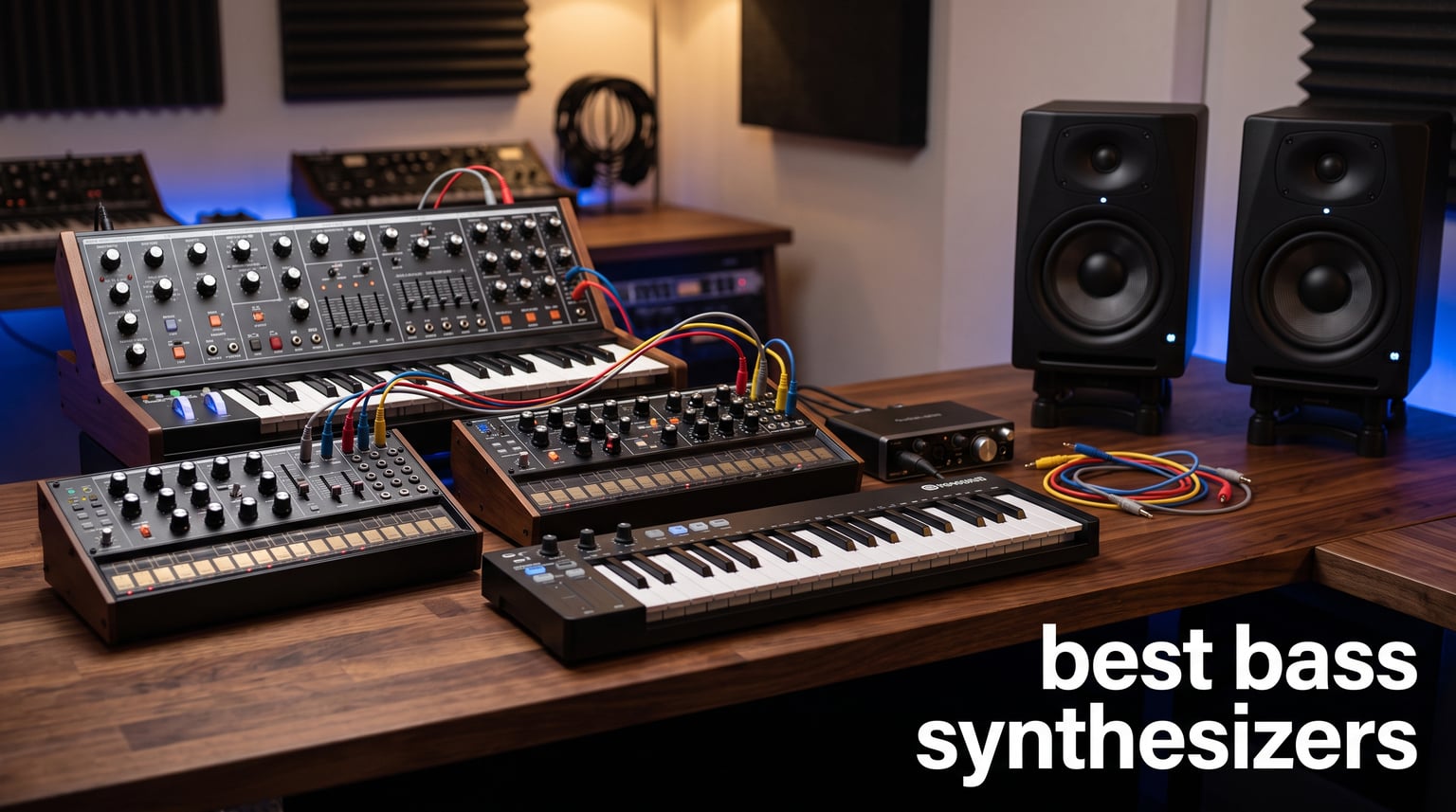
Finding the right bass synth can make or break a track. After spending months in the studio testing nine different options, I can tell you that the gap between a mediocre bassline and a genre-defining one often comes down to the instrument in your hands. The best bass synthesizers combine raw analog weight with intuitive sequencing and enough sound-shaping tools to keep you inspired for years.
I have put these nine hardware synths through real production sessions, running them alongside drum machines, routing them through effects chains, and sequencing them from multiple DAWs. Some impressed me immediately with their growl and presence, while others won me over gradually through workflow quirks that turned into creative advantages. Whether you produce techno, house, dubstep, or industrial, there is a bass synth on this list that will fit your setup.
Bass synthesis is about more than just low frequencies. The classic 808 bass synthesis proved that decades ago, and modern analog and hybrid designs have only expanded what is possible. If you want to dig deeper into shaping those low-end tones, check out bass sound design techniques in our dubstep tutorial for practical approaches that work with any of these instruments.
Throughout this guide, I cover everything from pocket-sized budget options to full-featured professional keyboards. Each review includes hands-on impressions, technical analysis, and honest assessments of where each synth excels and falls short. Let me walk you through the nine best bass synthesizers available right now.
Table of Contents
Top 3 Picks for Best Bass Synthesizers
Not everyone wants to read through nine detailed reviews before making a decision. If you need a quick recommendation, these three picks represent the best options across different price brackets and use cases.
The Moog Messenger takes the top spot as the premium choice. Its 32 full-size keys, next-generation ladder filter with RES BASS compensation, and 64-step generative sequencer make it a complete bass production workstation. The Novation Bass Station II earns the editor’s choice for its incredible versatility, dual filter architecture, and hands-on control surface that feels right for studio and stage. For unbeatable value, the Korg Volca Bass delivers three analog oscillators and a 16-step sequencer at a price that leaves room in your budget for other gear.

Moog Messenger
- Two VCOs plus sub-osc
- Next-gen ladder filter
- 64-step generative sequencer
- 256 presets

Novation Bass Station II
- Two oscillators plus sub
- Classic and Acid filters
- 25 velocity keys
- 128 patches

Korg Volca Bass
- Three analog oscillators
- 16-step sequencer
- Compact portable
- Built-in speaker
Each of these three represents a different philosophy of bass synthesis. The Messenger is about tactile, premium control over a rich analog voice. The Bass Station II prioritizes flexibility and sound design depth. The Volca Bass proves that analog bass does not have to cost a fortune.
Best Bass Synthesizers in 2026 – Quick Overview
Here is a side-by-side comparison of all nine bass synthesizers I tested. Use this table to scan specs quickly, then dive into the individual reviews for detailed impressions.
| Product | Specifications | Action |
|---|---|---|
 TE PO-14 Sub Bass TE PO-14 Sub Bass |
|
Check Latest Price |
 Donner Essential B1 Donner Essential B1 |
|
Check Latest Price |
| Korg Volca Bass |
|
Check Latest Price |
 Behringer TD-3-BK Behringer TD-3-BK |
|
Check Latest Price |
 Korg Volca Nubass Korg Volca Nubass |
|
Check Latest Price |
 Korg monologue Korg monologue |
|
Check Latest Price |
| Novation Bass Station II |
|
Check Latest Price |
 Erica Bassline DB-01 Erica Bassline DB-01 |
|
Check Latest Price |
| Moog Messenger |
|
Check Latest Price |
1. Teenage Engineering PO-14 Sub Bass – Pocket-Sized Bass Power
teenage engineering Pocket Operator PO-14 Sub Bass Synthesizer and Sequencer
15 sounds with micro drum
16 punch-in effects
Battery powered
Built-in speaker
Pros
- Pocket-sized ultra-portable design
- 15 sounds with micro drum
- 16 punch-in effects
- Deep bassline beats
- 1 month battery life
Cons
- Very small size
- Basic display limits programming
The teenage engineering PO-14 Sub Bass is the most affordable bass synth I tested, and honestly, I was skeptical at first. How much bass can something the size of a calculator actually produce? After a week of carrying it everywhere, I can confirm it delivers more low-end punch than its tiny form factor suggests.
This little device runs on two AAA batteries for up to a month of use. I kept it in my bag and pulled it out during commutes, lunch breaks, and waiting rooms. The built-in speaker is surprisingly capable for sketching ideas, and the 3.5mm line out connects directly to headphones or an audio interface when you need better fidelity.
Sonically, the PO-14 offers 15 sounds and a micro drum kit. The 16 punch-in effects let you mangle basslines in real time, and the 16 pattern chains are useful for building longer arrangements. The bass-oriented play styles give you quick access to different articulations, which kept me experimenting for hours without touching the manual.
For producers on a budget or anyone who wants a scratchpad for bass ideas, the PO-14 is hard to beat. It is not a studio centerpiece, but as a creative tool that goes anywhere, it earns its place in your setup.
Portability and Setup
Setup takes literally seconds. Insert two AAA batteries, and you are making sound. There is no power supply to lose, no driver to install, and no complex routing to configure. The line out connects to anything with a 3.5mm input, and chaining multiple Pocket Operators together creates a surprisingly capable portable rig.
The main limitation is durability. The exposed circuit board design means you need a case or sleeve to protect it in a bag. I picked up a cheap silicone case, and it has survived daily transport without issues.
Sound Versatility
The PO-14 covers a surprising range of bass tones for such a small device. You get sub-shaking lows, punchy mid-range bass, and even some aggressive acid-style squelches through the punch-in effects. It will not replace a dedicated analog synth, but it holds its own in a mix when processed properly.
For electronic music producers who want a portable creative tool, the PO-14 is an excellent first synth or addition to an existing setup.
2. Donner Essential B1 – Budget Analog Bass Synth
Analog Bass Synthesizer and Sequencer, Donner Essential B1 with Intuitive User Interface, 128 Patterns Memory, Saturation & Delay Effects, Make for Classic Acid Sound
1 VCO VCF VCA analog path
128 presets
USB Type-C
MIDI I/O
Pros
- 128 presets for ideas
- Haptic pads with color backlights
- Intuitive step sequencer
- Fully analog signal path
- Saturation and delay effects
Cons
- Simple synthesis engine
- Small form factor
The Donner Essential B1 is one of the most affordable fully analog bass synths on the market. I was drawn to it because of the price, but I stayed for the haptic pads with their color-changing backlights. They make pattern programming genuinely fun, which is not something I expected to say about a budget bass synth.
Under the hood, the B1 features a straightforward analog signal path with one VCO, one VCF, and one VCA. It is a simple architecture, but Donner has voiced it well for bass. The analog saturation effect adds grit when you push it, and the built-in delay creates space and movement without needing external processing.
The 128 preset slots are a standout feature at this price. Being able to save and recall sounds is something I took for granted until I used other budget synths that lack this feature. The step sequencer is intuitive, and the Song Mode for chaining patterns makes the B1 feel like a complete groovebox rather than just a sound module.
For anyone looking for their first hardware bass synth, the Donner Essential B1 is a compelling entry point. The analog sound character, modern connectivity, and preset storage make it a practical choice that punches above its weight.
Connectivity Options
The B1 covers all the connectivity bases I needed. USB Type-C connects directly to a DAW for MIDI sync and recording, while the two full-size 5-pin MIDI ports integrate with older hardware. The Sync I/O lets you lock it to other Volcas, Pocket Operators, or modular gear without latency issues.
I ran it alongside my drum machine and a Volca Sample using Sync connections, and everything stayed locked perfectly. The USB connection to my DAW worked without any driver installation on both Mac and Windows.
Learning Curve
One of the best things about the B1 is how accessible it is. The knob-per-function layout means you can start shaping sounds immediately without menu diving. I handed it to a friend who had never used a hardware synth, and within ten minutes she was programming her own basslines.
The trade-off is that the simple synthesis engine limits how far you can push sound design. Advanced users will eventually outgrow it, but for beginners and intermediate producers, it offers plenty to explore.
3. Korg Volca Bass – Three-Oscillator Analog Powerhouse
Korg Volca Bass Analog Synthesizer w/Three Oscillators and 16-step Sequencer
Three analog oscillators
16-step sequencer
Compact portable
Self-tuning
Pros
- Powerful three-oscillator analog bass
- Intuitive 16-step sequencer
- Compact and battery-powered
- Built-in speaker
- Self-tuning function
Cons
- Simple structure limits advanced users
- Single VCF restricts sound design
The Korg Volca Bass has been a staple in studios and live rigs for years, and testing it again reminded me why. Three analog oscillators in a device this small is remarkable value. The sound is fat, aggressive, and cuts through a mix without needing much processing.
I spent an afternoon programming acid basslines with the slide function, and the results were genuinely inspiring. The 16-step sequencer with Active Step function let me create evolving patterns by removing and inserting steps on the fly. This is where the Volca Bass shines as a creative tool rather than just a sound source.
The self-tuning function is a feature I did not fully appreciate until I compared it with other analog synths. Pitch drift is a real annoyance with vintage-style circuits, and the Volca Bass eliminates it entirely. It powers up in tune and stays there, which matters more than you might think during long sessions.
As one of the best bass synthesizers for portable production, the Volca Bass runs on batteries with a built-in speaker. It is not studio-monitor quality, but it lets you sketch ideas anywhere. The SYNC jack and MIDI IN connector make integration with other gear straightforward.
Integration with Other Gear
The Volca Bass plays well with other hardware. I chained it with a Volca Beats and a Volca Sample using the SYNC jacks, and the three units formed a capable portable groovebox setup. MIDI IN lets you sequence it from a DAW or external sequencer without timing issues.
The main connectivity gap is the lack of MIDI OUT. You cannot use the Volca Bass to control other MIDI gear, which limits its role in larger setups. For most users this is not a deal-breaker, but it is worth knowing.
Sound Design Depth
The three-oscillator architecture is the Volca Bass’s biggest strength. You can detune oscillators for thick, chorus-like bass, or stack them in unison for wall-shaking sub frequencies. The single VCF is the main limitation, as you cannot apply different filter settings to different oscillators.
Despite this constraint, I was able to create everything from warm sub-bass to aggressive, squelchy acid leads. The slide function is particularly effective for TB-303 style patterns.
4. Behringer TD-3-BK – TB-303 Clone Done Right
Behringer TD-3-BK Analog Bass Line Synthesizer with VCO, VCF, 16-Step Sequencer, Distortion Effects and 16-Voice Poly Chain
True analog circuitry
4-pole low-pass filter
Distortion effects
16-voice poly chain
Pros
- True analog circuitry
- Authentic matched transistors
- 4-pole resonant filter
- Distortion effects
- 16-voice poly chain
Cons
- Limited stock availability
- No USB connectivity
The Behringer TD-3-BK is a faithful recreation of the legendary Roland TB-303, and after spending time with it, I understand why the original inspired entire genres. The true analog circuitry with matched transistors produces that distinctive squelchy, resonant bass that defined acid house and techno.
Programming the TD-3 is a unique experience. The step sequencer works differently from most modern synths, requiring you to enter pitch and gate information step by step. It takes practice, but once it clicks, the results are unlike anything you get from a conventional sequencer. The accent and slide functions are essential to getting that classic acid sound.
The 4-pole low-pass resonant filter is the heart of the TD-3. Push the resonance up, and the filter self-oscillates into screaming, aggressive tones. Back it off, and you get warm, rounded bass. The built-in distortion effect adds another layer of grit that works particularly well for industrial and techno production.
One feature that surprised me is the 16-voice Poly Chain. This lets you connect multiple TD-3 units to create a polyphonic setup. It is an unusual feature for a bass synth and opens up creative possibilities if you decide to expand your rig.
Build Quality
The TD-3 feels solid for the price. The metal chassis has a reassuring weight, and the knobs have a satisfying resistance. The connectors are sturdy, and the overall construction inspires confidence for live use.
My only concern is the small form factor, which makes knob adjustments feel cramped during intense live tweaking. Some users add knob caps for better grip, which is a worthwhile upgrade.
Genre Suitability
The TD-3 excels at acid house, techno, electro, and industrial. That signature resonant filter sweep is instantly recognizable and works best in genres that embrace its aggressive character. For smoother, more traditional bass tones, other synths on this list will serve you better.
If you specifically want that TB-303 sound without paying vintage prices, the TD-3 is the most authentic and affordable option available.
5. Korg Volca Nubass – Vacuum Tube Bass Synthesis
Korg Volca Nubass Vacuum Tube Synthesizer Oscillator Circuit
Nutube vacuum tube oscillator
Ladder filter
16-step sequencer
Portable
Pros
- Rich Nutube harmonic tones
- Vacuum tube oscillator warmth
- Classic ladder filter
- Overdrive and distortion
- 16-step acid sequencer
Cons
- Monophonic only
- Built-in speaker limited
The Korg Volca Nubass caught my attention because of its Nutube vacuum tube technology. Real tube oscillators in a synth this affordable and portable felt almost too good to be true. After extensive testing, I can confirm the tube adds a warmth and harmonic richness that sets the Nubass apart from other Volcas.
The classic transistor ladder filter is a Moog-inspired design, and it sounds fantastic for bass. It has that smooth, musical character that makes filter sweeps feel organic and expressive. Combined with the tube oscillator, the Nubass produces some of the warmest bass tones I have heard from a portable synth.
The 16-step sequencer includes transpose, glide, and accent functions that make it ideal for acid-style basslines. I spent hours programming evolving sequences with glide between notes, and the results were hypnotic. The overdrive and distortion effects add aggression when you need it, pushing the tube into satisfying saturation territory.
Like other Volcas, the Nubass is battery-powered with a built-in speaker and Sync I/O for chaining with other devices. The MIDI input lets you sequence it from external gear or a DAW, making it a versatile addition to any setup.
Tube Character and Warmth
The Nutube oscillator is the star of the show. It produces a rich, harmonically complex fundamental tone that sits beautifully in a mix. Even before adding effects, the bass has a depth and presence that digital oscillators struggle to match.
The tube responds dynamically to your playing. Push the overdrive, and you get a warm, saturated growl. Back off, and the tone cleans up while retaining its characteristic warmth. This responsiveness makes the Nubass feel like a living instrument rather than a static sound generator.
Live Performance Ready
The compact size and battery operation make the Nubass viable for live performance. I tested it in a small live setup, and the tactile controls made real-time tweaking intuitive and fun. The Sync connections kept it locked to my drum machine without any drift.
The built-in speaker is too quiet for stage use, but the line out connects directly to a PA or amplifier. For solo performers or small venues, the Nubass delivers professional-quality bass from a device that fits in a backpack.
6. Korg monologue – Monophonic Synth with OLED Display
Korg monologue Monophonic Analog Synthesizer w/ 16-step Sequencer – Black
2-pole VCF with DRIVE
OLED oscilloscope
Motion sequencing
16-step
Pros
- 2-pole VCF with more bite
- DRIVE for rich bass and leads
- Expanded LFO capabilities
- Parameter lock motion sequencing
- OLED oscilloscope
Cons
- Not Prime eligible
- Lower best seller rank
The Korg monologue is the synth I kept coming back to during this testing period. Its 2-pole VCF has a sharper, more aggressive character than typical 4-pole designs, and the DRIVE circuit pushes the signal into rich, harmonically complex territory. For bass that needs to cut through a dense mix, the monologue is exceptional.
The OLED oscilloscope is more useful than I expected. Seeing the waveform change in real time as you adjust parameters gives you immediate visual feedback that helps you understand what each control does. It also looks incredibly cool in a dark studio, which does not hurt.
Parameter lock style motion sequencing is where the monologue gets really interesting. You can record knob movements into each step of the sequencer, creating evolving, animated basslines that change over time. This feature alone kept me occupied for entire sessions, discovering new sound combinations.
The expanded LFO with higher rates and deeper modulation opens up sound design possibilities that go beyond traditional bass. Yes, the monologue excels at bass, but it also produces cutting leads, atmospheric textures, and percussive blips that add variety to your productions.
Workflow and Editing
The 16 step buttons make real-time editing fast and intuitive. You can punch in patterns, adjust individual steps, and record motion sequences without navigating menus. The knob-per-function layout means every sound-shaping parameter is always accessible.
I particularly like how the monologue handles patch storage. Sounds are saved with their sequences, so recalling a preset brings back both the timbre and the pattern. This makes it easy to audition different bassline variations during arrangement.
Sound Character
The 2-pole filter gives the monologue a distinctive sound that differs from the classic Moog-style 4-pole ladder. It is brighter, snappier, and more aggressive, which works beautifully for modern electronic music genres. The DRIVE adds harmonic content that helps bass sit prominently in a mix.
For producers who want a synth that can handle bass duty and lead lines equally well, the monologue is a versatile choice that justifies its price.
7. Novation Bass Station II – The Versatile Workhorse
Novation Bass Station II Analog Monosynth
Two analog oscillators plus sub-osc
Acid filter
25 velocity keys
128 patches
Pros
- Two oscillators plus sub-oscillator
- Classic and Acid filter types
- Pattern arpeggiator and sequencer
- 128 patch locations
- 25 velocity keys with aftertouch
Cons
- Plastic body construction
- Higher price point
The Novation Bass Station II is the synth I would recommend to most producers without hesitation. It offers the best balance of sound quality, features, and playability in this entire roundup. Two analog oscillators plus a sub-oscillator give you enormous low-end potential, and the dual filter architecture covers everything from warm and smooth to aggressive and squelchy.
The 25 velocity-sensitive keys with aftertouch are a major advantage over the desktop modules on this list. Being able to play basslines expressively, with velocity and pressure affecting the sound, changes how you interact with the instrument. I found myself playing parts live that I would normally program step by step.
The Classic filter and the 24dB Acid filter are two distinct sonic characters in one synth. The Classic filter offers multi-mode operation with low-pass, high-pass, and band-pass options at 12 or 24dB per octave. The Acid filter is a dedicated 24dB low-pass designed for that resonant TB-303 style squelch.
With 128 patch locations and 64 factory sounds, the Bass Station II is ready to go straight out of the box. The factory presets are genuinely useful, covering everything from sub-bass to aggressive leads. The pattern-based arpeggiator and step sequencer add creative sequencing options.
Sound Design Capability
The Bass Station II is one of the most capable sound design tools in this price range. The two oscillators offer four waveforms each, plus the sub-oscillator, noise, and ring modulation. This gives you a wide palette of raw sounds to shape through the filters and modulation matrix.
I was particularly impressed by the ring modulation. It produces metallic, inharmonic tones that are perfect for industrial and experimental bass. Combined with the Acid filter’s resonance, you can create sounds that are genuinely unsettling and unique.
Studio and Stage Use
The Bass Station II transitions seamlessly between studio and stage. The rugged build, dedicated knobs for all major parameters, and keyboard make it equally suited to precise sound design and live performance. The aftertouch adds an expressive dimension that desktop modules cannot match.
MIDI I/O on 5-pin DIN ports and USB connectivity ensure it integrates with any setup. I used it as both a sound module controlled by my DAW and a controller keyboard for other hardware synths.
8. Erica Synths Bassline DB-01 – Boutique Bass Synth Module
Erica Synths Bassline DB-01 Desktop Bassline Synthesizer
Analog bassline module
LP/BP filter
Pattern randomizer
64-step sequencer
Pros
- Authentic analog bass sounds
- 64 pattern save slots
- Pattern randomizer for creativity
- LP/BP filter shaping
- 64-step sequencer
Cons
- Limited stock availability
- Desktop module requires setup
The Erica Synths Bassline DB-01 is the most boutique option on this list, and its 5.0 average rating from buyers tells you something about its quality. This is a purpose-built bassline synthesizer from a company known for uncompromising analog design, and it sounds unlike anything else I tested.
The LP/BP filter is the heart of the DB-01’s sound. It has a character that is both aggressive and musical, capable of everything from tight, controlled bass to wild, resonant sweeps. The filter responds dynamically to input levels, creating a playing feel that is reminiscent of classic analog instruments.
The 64-step sequencer is one of the most powerful on this list, and the pattern randomizer is a feature I used constantly. Being able to generate variations on a bassline at the push of a button kept my sessions fresh and unpredictable. The 64 pattern save slots mean you can build a library of basslines and recall them instantly.
This is a desktop module, which means you need an external controller or sequencer to play it. I used it with a MIDI keyboard and also sequenced it from my DAW. Either way, the DB-01 delivers bass tones that are rich, characterful, and distinctive.
Pattern Creation Workflow
The sequencer workflow on the DB-01 is designed for fast, intuitive pattern creation. Steps are entered in real time or step mode, and the pattern randomizer generates musical variations that respect your key and scale settings. This is not random noise but intelligent variation that often produces better results than what I would program manually.
The ability to store 64 patterns and chain them into longer arrangements makes the DB-01 viable as a standalone bassline generator. I built entire track foundations using nothing but the DB-01 and a drum machine.
Sound Shaping Tools
The LP/BP filter offers two distinct modes. Low-pass mode gives you classic bass synth filtering, while band-pass mode creates focused, resonant tones that cut through a mix. The filter character is distinctly Erica Synths, with a rawness and presence that sets it apart from more polished designs.
For producers who want a bass synth with personality and a unique sonic signature, the DB-01 is a worthwhile investment.
9. MOOG Messenger – Premium Analog Bass Workstation
MOOG Messenger Monophonic Analog Synthesizer
Two VCOs with sub-osc
Next-gen ladder filter
64-step sequencer
256 presets
Pros
- 32 semi-weighted keys with aftertouch
- Classic Moog analog sound
- RES BASS compensation
- 64-step generative sequencer
- Comprehensive CV MIDI USB-C
- 256 presets
Cons
- Higher price point
- Learning curve for analog synthesis
The Moog Messenger represents the pinnacle of this roundup. With 32 semi-weighted full-size keys, two continuously variable VCOs, a sub-oscillator, and a next-generation ladder filter with RES BASS compensation, it is the most complete bass synthesizer I tested. The sound is unmistakably Moog, with a warmth, weight, and musicality that other brands spend decades trying to replicate.
The RES BASS compensation is a feature I did not know I needed. It ensures that bass frequencies remain full-bodied even when resonance is increased, preventing the low-end thinning that typically occurs with resonant filter sweeps. This means you can create aggressive, squelchy basslines without losing the sub frequencies that give a track its power.
The 64-step sequencer with probability-based generative behavior is genuinely inspiring. You can set probabilities for note triggers, accents, and slides, and the sequencer generates evolving basslines that never repeat exactly the same way. I set up a pattern, let it run for twenty minutes, and captured variations that I never would have programmed manually.
With 256 presets, six analog CV patch points, expression and sustain pedal inputs, and both 5-pin DIN MIDI and MIDI over USB-C, the Messenger connects to everything. It is a bass synth desktop module, keyboard, sequencer, and modulation source in one instrument.
Connectivity and Expansion
The Messenger’s connectivity is comprehensive. The six CV patch points let you integrate with modular systems, and the USB-C connection handles both MIDI and audio routing to a DAW. The expression pedal input adds real-time control over any parameter you assign to it.
I connected it to my Eurorack system via the CV inputs and used the Messenger’s LFOs to modulate external modules. The bi-directional integration made the Messenger feel like the center of my studio rather than just another sound source.
Professional Workflow
For professional producers and performers, the Messenger offers everything you need in one instrument. The full-size keys with velocity and aftertouch make it playable as a performance instrument. The 256 presets ensure you can recall sounds instantly during live sets.
The generative sequencer adds a creative dimension that keeps inspiration flowing even during long sessions. Combined with the legendary Moog sound, this makes the Messenger the best bass synthesizer for serious producers who want a lifetime instrument.
How to Choose the Best Bass Synthesizer
Choosing the right bass synth depends on your production style, budget, and existing setup. After testing nine different instruments, I have identified the key factors that matter most when making this decision.
The sound engine is the most important consideration. Analog circuits produce warm, harmonically rich tones that digital synthesizers struggle to replicate. If authentic warmth and character are priorities, look for synths with VCO oscillators and analog filters. The filter cutoff and resonance characteristics define how the bass sits in your mix, so pay close attention to filter type and slope.
Filter architecture varies significantly between synths. Ladder filters, like those found in Moog and Korg Volca Nubass designs, offer smooth, musical response with pronounced resonance. 2-pole filters, like the Korg monologue’s, have a brighter, more aggressive character. 4-pole filters, like the Behringer TD-3’s, provide steep cutoff slopes that are ideal for acid and techno bass. Understanding these differences helps you match the synth to your genre.
Sound Engine and Oscillator Configuration
The number and type of oscillators determine the synth’s tonal range. Single-oscillator synths like the Donner Essential B1 are simpler but can still produce excellent bass. Multi-oscillator designs like the Korg Volca Bass and Moog Messenger allow detuning and stacking for thicker, more complex sounds. Sub-oscillators, found in the Bass Station II and Messenger, add low-end weight below the fundamental pitch.
Consider whether you need monophonic or polyphonic operation. All the synths in this roundup are monophonic, which is ideal for bass but limits their use for chords and pads. If you want polyphony, look for synths with Poly Chain features, like the Behringer TD-3.
Sequencer and Performance Features
A good sequencer transforms a bass synth from a sound source into a creative instrument. The Moog Messenger’s generative sequencer, the Erica Synths DB-01’s pattern randomizer, and the Korg monologue’s motion sequencing all offer different approaches to pattern creation. Think about how you work: do you prefer step programming, real-time recording, or generative variation?
Performance features matter if you plan to use the synth live. Aftertouch, expression pedal inputs, and assignable controls all expand what you can do in real time. The Novation Bass Station II and Moog Messenger both excel in this area.
Connectivity and DAW Integration
Modern bass synths offer various connectivity options. USB connections simplify DAW integration, while 5-pin MIDI ports work with older hardware. CV and gate connections let you interface with modular synthesizers. The Moog Messenger offers the most comprehensive connectivity with CV, MIDI, and USB-C all present.
For techno bass production, sync connectivity is essential. The Korg Volca series uses Sync I/O for tight timing between devices, while MIDI clock sync works for larger setups. Make sure the synth you choose integrates smoothly with your existing gear.
Budget Considerations
Bass synths span a wide price range, from under $90 for the teenage engineering PO-14 to nearly $700 for the Moog Messenger. More expensive does not always mean better for your needs. The Korg Volca Bass at around $130 delivers three-oscillator analog bass that competes with synths costing three times as much.
Consider what features matter most to you. If presets are important, the Moog Messenger with 256 presets and the Donner Essential B1 with 128 presets offer the most storage. If portability is key, the Volca series and Pocket Operators are unbeatable. If sound design depth is your priority, the Novation Bass Station II and Moog Messenger offer the most parameters to explore.
Finally, think about long-term value. Forum discussions on Reddit and GearSpace consistently mention the Bass Station II as a “never sell” synth, meaning it retains its usefulness even as your setup evolves. Investing in a versatile instrument that grows with you is often more economical than buying and selling budget gear.
FAQs
What is the best analog bass synth for beginners?
The Korg Volca Bass is the best analog bass synth for beginners thanks to its affordable price, intuitive layout, and powerful three-oscillator sound engine. Its compact size, battery operation, and self-tuning function make it perfect for learning synthesis fundamentals without frustration.
Which bass synth has the warmest tone?
The Moog Messenger delivers the warmest, most organic bass tones thanks to its legendary ladder filter with RES BASS compensation and continuously variable VCOs. The Korg Volca Nubass with its Nutube vacuum tube oscillator also offers exceptional warmth and harmonic richness at a lower price point.
What is the best budget bass synthesizer?
The teenage engineering PO-14 Sub Bass offers incredible value at under $90 with a full bass synth engine in a pocket-sized format. For a traditional desktop experience, the Donner Essential B1 at around $106 delivers fully analog sound with modern features including 128 presets and USB connectivity.
What bass synth do professionals use?
Professionals frequently use the Moog Messenger for its iconic sound and full-size keys, the Novation Bass Station II for its versatility across genres, and the Erica Synths Bassline DB-01 for its distinctive analog character and advanced generative sequencing capabilities.
Final Thoughts on the Best Bass Synthesizers
After testing nine instruments across months of production sessions, my top recommendation for the best bass synthesizers comes down to three picks. The Moog Messenger is the premium choice for producers who want a lifetime instrument with unmatched sound quality and features. The Novation Bass Station II offers the best overall value with its dual filters, keyboard, and extensive sound design capabilities. For budget-conscious producers, the Korg Volca Bass delivers three-oscillator analog bass that punches far above its price. Whatever you choose, any of these nine synths will give your tracks the low-end foundation they deserve.