
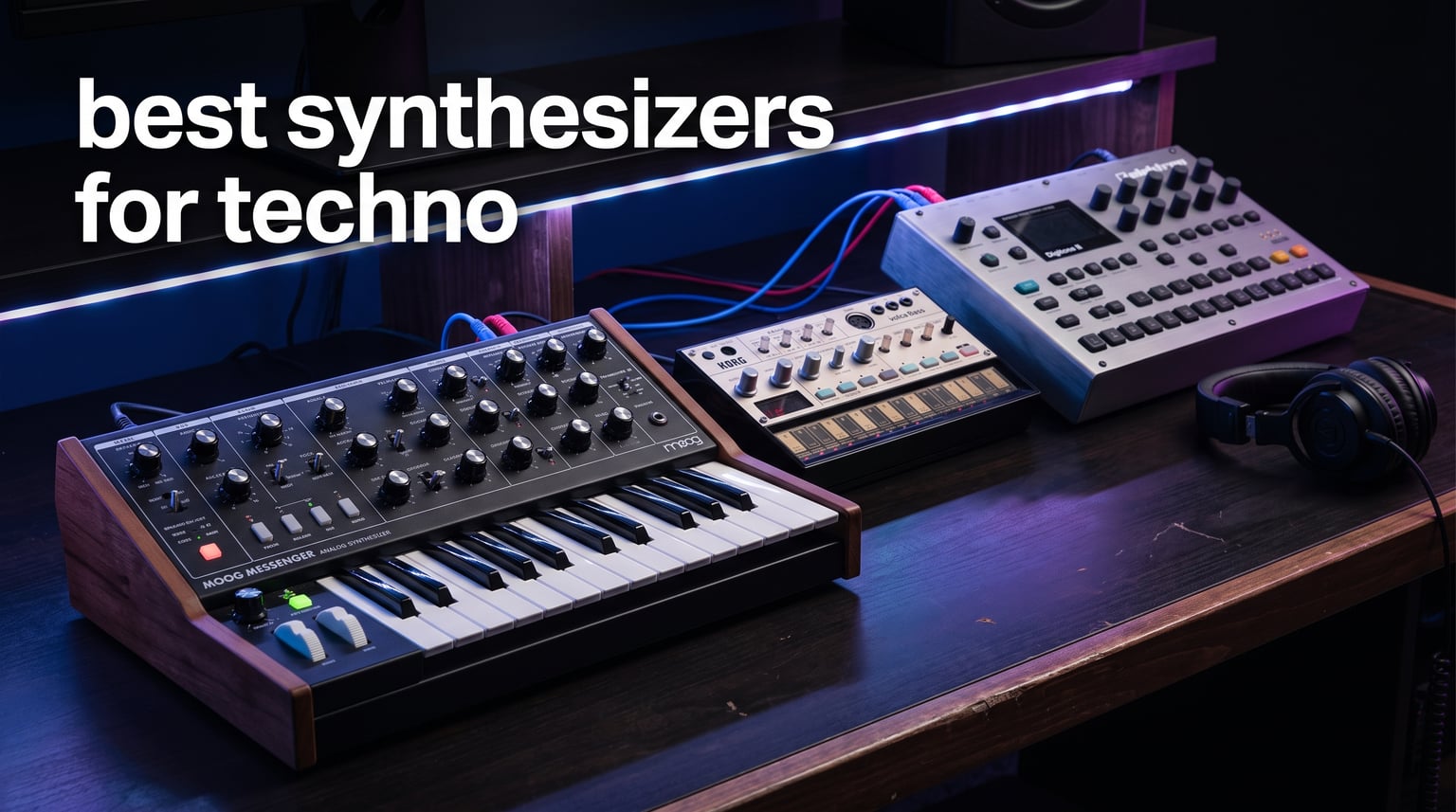
Techno lives and dies by its synthesizers. The right synth can transform a simple kick drum into a hypnotic trip through dark warehouses and endless nights. After testing dozens of hardware synthesizers for techno production, I’ve found that filter character, bass response, and sequencer capabilities matter more than raw specification counts.
The best synthesizers for techno share specific traits that set them apart from general-purpose instruments. They need aggressive filters that can scream without falling apart, oscillators that stay thick in the low end, and hands-on control that lets you tweak sounds in real time. Whether you’re crafting oldschool bleepy techno or modern industrial sounds, your choice of hardware shapes everything.
In this guide, I’ll walk you through 8 synthesizers that excel at techno production. Each has been evaluated for its filter performance, bass capabilities, workflow, and overall value for techno producers. From the legendary Moog ladder filter to creative digital engines, these synths cover every budget and style.
Top 3 Picks for Best Synthesizers for Techno (September 2026)

These three synths represent the best options for different techno producers. The Moog Messenger delivers that unmistakable analog warmth with a modern feature set, making it our top pick for serious producers. The Bass Station II has been a forum favorite for years, offering dual filters and an Acid filter that’s perfect for squelchy techno basslines. For those just starting out, the Korg Volca Bass provides genuine analog bass at an unbeatable price point.
Best Synthesizers for Techno (September 2026)
| Product | Specifications | Action |
|---|---|---|
 Korg Volca Bass Korg Volca Bass |
|
Check Latest Price |
 Roland AIRA S-1 Roland AIRA S-1 |
|
Check Latest Price |
 Arturia MicroFreak Arturia MicroFreak |
|
Check Latest Price |
| Novation Bass Station II |
|
Check Latest Price |
 ASM Hydrasynth Explorer ASM Hydrasynth Explorer |
|
Check Latest Price |
 Korg Minilogue Korg Minilogue |
|
Check Latest Price |
 Moog Messenger Moog Messenger |
|
Check Latest Price |
 Elektron Digitone II Elektron Digitone II |
|
Check Latest Price |
This comparison shows all 8 synths side by side. Each brings something different to techno production, from the straightforward bass focus of the Volca to the complex digital architecture of the Digitone II. Read on for detailed reviews of each instrument.
1. Korg Volca Bass – Three-Oscillator Analog Power
Korg Volca Bass Analog Synthesizer w/Three Oscillators and 16-step Sequencer
3 Oscillators
16-Step Sequencer
Analog Bass
Battery Powered
Pros
- Powerful analog bass sounds
- Three oscillators for thick tones
- Self-tuning eliminates pitch drift
- Compact and portable
- Battery operation for anywhere
Cons
- Limited to bass sounds only
- Built-in speaker is basic
I’ve spent countless hours with the Korg Volca Bass, and it continues to impress me with how much analog power it packs into such a small frame. The three oscillators can create massive stacked sounds that cut through any techno mix. When you’re building basslines that need to sit alongside heavy kick drums, this little synth delivers the weight you need.
The Electribe-inspired sequencer changed how I approach techno basslines. The 16-step pattern structure feels natural for four-on-the-floor music, and the slide function creates those signature acid techno glides that make basslines feel alive. I found myself building variations quickly, mutating patterns until they became something entirely new.
What surprised me most was the self-tuning function. Vintage analog synths drift, which can add character but also frustration in the studio. The Volca Bass handles this automatically, keeping your techno tracks locked in tune during extended sessions. For the price, this feature alone makes it a practical choice for producers who want reliable analog sound.
The filter on the Volca Bass has genuine attitude. Push the resonance and it screams without collapsing into useless noise. This aggression matters for hard techno and industrial styles where you need sounds that fight back. Combined with the three oscillators, you can sculpt everything from subby rumble to aggressive mid-range growl.
Techno Bass Applications
The Volca Bass excels at driving techno basslines that anchor your track. The three oscillators can be detuned for thickness or tuned in unison for power. I’ve used it for everything from minimal techno sub hooks to acid-inspired squelches, and it handles both extremes well. The sequencer’s Active Step function generates unexpected variations that often become the hook of the track.
Integration and Portability
Battery operation means you can sketch techno ideas anywhere. I’ve written entire basslines on train rides and in hotel rooms, later syncing them to my main setup via MIDI. The compact size makes it easy to integrate with other gear, and the SYNC jack connects to other Volca units or modular systems. For techno producers building their first hardware rig, this synth pairs perfectly with drum machines like the legendary Roland TR-909 drum machine.
2. Roland AIRA Compact S-1 Tweak Synth
Roland AIRA Compact S-1 Tweak Synth
4-Voice Polyphonic
64-Step Sequencer
USB-C MIDI
Portable Design
Pros
- Very portable size
- 4-voice polyphony
- D-Motion control innovation
- 64-step sequencer
- USB-C connectivity
Cons
- Limited stock availability
- Battery life could be longer
The Roland AIRA Compact S-1 Tweak Synth caught my attention for its unique approach to sound design. The D-Motion control lets you manipulate sounds by physically moving the instrument, which creates a performance aspect that works beautifully for live techno sets. This isn’t just a synth you program, it’s an instrument you play with your whole body.
Four-voice polyphony opens up chord possibilities that monophonic synths can’t touch. I found myself playing sustained techno pads and arpeggiated textures alongside bass duties. The 64-step sequencer provides enough length for evolving techno patterns that develop over time, essential for creating the hypnotic loops the genre demands.
The Osc Draw feature lets you sketch waveforms directly, giving you sound design control that goes beyond knob tweaking. For techno producers who want unique textures, this hands-on approach generates results that preset browsers can’t match. I created metallic, industrial tones that would take hours to program on traditional synths.
Battery life at 4.5 hours covers most live sets and jam sessions. The USB-C connectivity handles both audio and MIDI, simplifying setup for gigs. Roland has clearly designed this for the modern techno producer who moves between studio, stage, and everywhere in between.
Live Performance Features
The S-1’s portability and battery operation make it ideal for live techno performances. The D-Motion control turns physical movement into musical expression, letting you interact with your sound in ways traditional synths don’t allow. For techno artists who want to perform rather than just trigger sequences, this synth creates a genuine connection between movement and music.
Sound Design Flexibility
Beyond typical subtractive synthesis, the S-1 offers waveform drawing and chop features that generate unusual textures. I created broken, glitchy sounds perfect for industrial techno and experimental styles. The polyphonic architecture means you can layer these textures alongside more traditional bass and lead sounds, all from one compact device.
3. Arturia MicroFreak – Hybrid Synthesis Powerhouse
Arturia MicroFreak Synthesizer Keyboard
17 Oscillator Modes
Hybrid Synth
SEM Filter
CV Outputs
Pros
- 17 oscillator modes provide variety
- Unique PCB touch keyboard
- 5x7 modulation matrix
- CV outputs for modular
- Compact with powerful features
Cons
- PCB keyboard feels unusual
- Advanced features need learning
The Arturia MicroFreak redefined what a budget synth could do when it arrived. With 17 different oscillator modes spanning everything from digital wavetables to physical modeling, it covers sonic territory that takes multiple specialized synths to match. For techno producers who need variety, this hybrid instrument delivers sounds that pure analog synths simply can’t create.
The PCB touch keyboard initially felt strange under my fingers, but the polyphonic aftertouch quickly became essential for expressive techno performances. Each key responds to pressure independently, letting you add dynamics to arpeggiated patterns. For hypnotic techno sequences that need subtle variation, this expressiveness adds depth that static MIDI notes lack.
The State-Variable SEM filter brings analog character to the digital oscillators. I pushed the resonance into self-oscillation for screaming techno leads, then backed off for warm, filtered basslines. This filter has the versatility techno demands, handling both aggressive sounds and smooth textures with equal authority.
The 5×7 modulation matrix opened sound design possibilities I hadn’t explored on other synths in this price range. Routing LFOs to oscillator parameters, filter cutoff, and even sequencer values creates evolving, unpredictable sounds. For techno that needs to surprise listeners, this routing flexibility becomes a creative tool rather than just a technical specification.
Genre-Expanding Oscillator Modes
The 17 oscillator modes cover synthesis approaches from simple waves to complex algorithms. I used the Karplus-Strong mode for plucked, percussive sounds that complemented techno rhythms. The vocoder mode added robotic, industrial textures. This variety means the MicroFreak adapts to whatever techno style you’re producing, from minimal to hard.
Modular Integration Potential
CV outputs let the MicroFreak communicate with modular systems and other analog gear. I patched it to control filter cutoff on external synths, creating evolving techno textures that no single instrument could produce alone. For producers building modular rigs or integrating multiple synths, the MicroFreak serves as both sound source and control hub.
4. Novation Bass Station II – Forum Favorite for Techno
Novation Bass Station II Analog Monosynth
Dual Oscillators
Acid Filter
32-Step Sequencer
128 Patches
Pros
- Two oscillators plus sub-oscillator
- Dual filter types including Acid
- 32-step sequencer
- 128 patch locations
- MIDI and USB connectivity
Cons
- Plastic construction feels less premium
- Only 25 keys
The Novation Bass Station II has earned its reputation in techno production communities through consistent performance and genuine character. Forum threads dedicated to techno synthesis regularly recommend this synth as the best first hardware purchase, and after extensive use, I understand why. The combination of two analog oscillators with the Acid filter creates the squelchy, aggressive sounds that define so much techno bass work.
The dual filter architecture sets this synth apart. The classic multi-mode filter handles standard synthesis duties, but the dedicated 24dB Acid filter brings that instant Roland TB-303 character without the vintage price tag. For techno producers chasing that acid sound, this filter alone makes the Bass Station II worth considering.
I’ve used the 32-step sequencer to build countless techno basslines. The pattern-based approach feels natural for the genre’s loop-oriented structure. Each step can have its own notes, slides, and accents, creating evolving patterns that develop over multiple repetitions. For minimal techno especially, this sequencer workflow matches how the genre thinks about bass.
The sub-oscillator adds low-end weight that techno bass needs. Layering it with the main oscillators creates sounds that hold their own against heavy kick drums. I found the bass response particularly effective for dark, warehouse-style techno where the low end needs to feel physical rather than just audible.
Acid and Oldschool Techno Sounds
The Acid filter captures the essence of squelchy, resonant basslines that defined early techno and continue to influence the genre. Push the resonance and engage the 24dB slope for sounds that tear through mixes. Combined with the slide function, I created acid lines that stood shoulder-to-shoulder with classic tracks while remaining distinctly modern.
Build and Workflow Considerations
The plastic construction keeps the weight down for gigging, though it doesn’t feel as premium as metal-cased alternatives. The 25-key keyboard limits chord work but fits the monophonic bass focus perfectly. For techno producers who prioritize sound over build materials, the Bass Station II delivers exceptional value that competes with synths costing twice as much.
5. ASM Hydrasynth Explorer – Digital Depth for Techno
ASM Hydrasynth Explorer Synthesizer
8-Voice Polyphonic
Wave Morphing
MPE Compatible
Poly Aftertouch
Pros
- 8-voice polyphony
- Polyphonic aftertouch
- 3 oscillators with mutators
- MPE compatibility
- High build quality
Cons
- Premium price point
- Limited stock sometimes
The ASM Hydrasynth Explorer brings 8-voice polyphony and wave morphing synthesis to techno producers who want depth beyond traditional subtractive architecture. Each voice carries three oscillators and four mutators, creating sounds that evolve and transform in ways static waveforms can’t match. For techno that needs atmospheric depth alongside driving bass, this synth covers both territories.
Polyphonic aftertouch on the 37-key keyboard opened expressive possibilities I hadn’t experienced on hardware before. Each key responds independently to pressure, letting you shape notes within chords and arpeggios individually. For evolving techno pads that need movement without constant knob tweaking, this feature does the work for you.
MPE compatibility means the Hydrasynth Explorer integrates with modern controllers and software that use MIDI Polyphonic Expression. This future-proofs the instrument while providing immediate creative benefits. I connected it to MPE controllers and gained precise control over individual notes within techno sequences, adding subtle expression that made programmed parts feel performed.
The wave morphing oscillators generate sounds that shift and transform over time. Rather than static waveforms, these oscillators move through timbral space, creating the evolving textures that modern techno often demands. Combined with the mutators, I crafted sounds that never quite repeated the same way twice, perfect for hypnotic techno that rewards close listening.
Techno Texture and Atmosphere
Beyond bass duties, the Hydrasynth Explorer excels at the atmospheric sounds that give techno depth. The 8-voice polyphony supports layered pads, evolving drones, and complex textures that sit behind driving rhythms. For producers who want their techno to have sonic depth rather than just rhythmic intensity, this synth provides the palette.
Professional Build and Connectivity
The metal construction and quality keybed feel ready for professional use. MIDI, USB, and audio connections integrate easily with existing setups. The microtuning support via MIDI Tuning Standard files allows alternative tunings for techno producers exploring non-western scales or experimental microtonal work.
6. Korg Minilogue – Analog Polyphony for Techno
Korg minilogue 37-key Polyphonic Analog Synthesizer w/ 16-step Sequencer
4-Voice Analog
200 Presets
OLED Display
Motion Sequencer
Pros
- True analog sound quality
- Four-voice polyphony
- 200 diverse presets
- Built-in motion sequencer
- OLED oscilloscope display
Cons
- Slim keys take adjustment
- Limited effects section
The Korg Minilogue established itself as a benchmark for affordable polyphonic analog synthesis. Four voices of genuine analog oscillators and filters deliver warmth and character that digital emulations struggle to match. For techno producers who want chords, pads, and layered sounds alongside bass, this synth provides the polyphony that monophonic instruments can’t offer.
The OLED oscilloscope display gave me visual feedback I didn’t know I needed. Watching waveforms change as I tweaked parameters connected my eyes to my ears, helping me understand synthesis more intuitively. For learning sound design and confirming what you’re hearing, this display becomes an educational tool as much as a visual feature.
I worked through the 200 preset sounds and found many useful starting points for techno production. Rather than generic sounds, these presets show off the synth’s capabilities while providing practical foundations. Tweaking them into personal sounds happened quickly, thanks to the logical knob-per-function layout.
The motion sequencer records knob movements alongside note information. For techno that needs evolving filter sweeps and parameter changes, this feature automates what would otherwise require manual performance. I programmed slow filter openings that transformed minimal techno basslines over eight-bar loops, adding development without constant hands-on control.
Techno Composition Capabilities
Four voices enable chord progressions and layered sounds that monophonic synths can’t produce. I created techno tracks with bass, lead, and pad elements all coming from the Minilogue, demonstrating its versatility. For producers working in smaller setups, one Minilogue can cover multiple sonic roles in a techno track.
Visual Feedback and Learning
The OLED display shows real-time waveform visualization, helping you understand synthesis by seeing what you hear. For techno producers learning sound design, this visual feedback accelerates the learning curve. The tape-style delay effect adds movement to sounds without requiring external processing, keeping your signal path simple.
7. Moog Messenger – Iconic Sound for Techno
MOOG Messenger Monophonic Analog Synthesizer
2 VCOs
Ladder Filter
64-Step Sequencer
256 Presets
Pros
- Iconic Moog ladder filter
- 32 semi-weighted keys
- 64-step sequencer with probability
- 6 CV patch points
- 256 presets for recall
Cons
- Monophonic only
- Premium investment
The Moog Messenger delivers that unmistakable Moog sound in a modern, feature-rich package. Two voltage-controlled oscillators feed into the legendary ladder filter, producing bass and lead sounds that have defined electronic music for decades. For techno producers seeking authentic analog character, this synth provides the genuine article rather than emulation.
The RES BASS compensation on the ladder filter solves a classic Moog challenge. When you push resonance on traditional ladder filters, bass frequencies diminish, thinning the sound. Moog’s solution maintains low-end weight even at high resonance settings, keeping techno basslines powerful while still getting that aggressive filter character.
I connected the Messenger to my modular system through the six CV patch points, creating evolving techno textures that combined the synth’s oscillators with external processing. The semi-weighted keys with velocity and aftertouch felt substantial under my fingers, encouraging expressive performance rather than just note entry.
The 64-step sequencer includes probability-based generative behavior that creates variations automatically. For techno that needs subtle development over long loops, this generative approach produces results that feel composed but not predictable. I set probability on certain steps and let the synth create variations I wouldn’t have programmed manually.
Authentic Analog Bass for Techno
The Moog ladder filter has shaped techno since the genre began. Its musical resonance and smooth rolloff create sounds that sit perfectly in electronic mixes. Combined with the sub-oscillator, bass frequencies extend deep enough to vibrate club sound systems. For techno that needs physical bass presence, the Messenger delivers weight that digital alternatives can’t match.
Modern Features on Classic Architecture
While the sound remains classically Moog, features like 256 preset locations and USB-C connectivity bring the design into modern workflows. Storing and recalling sounds happens instantly, essential for live techno sets where you need sounds quickly. The arpeggiator with multiple pattern modes creates rhythmic variations that drive techno sequences forward.
8. Elektron Digitone II – Digital Workstation for Techno
Elektron Digitone II – 16-Track Polyphonic Digital Synthesizer
16-Track
16-Voice
4 Synth Engines
128-Step Sequencer
Pros
- Four distinct synth engines
- 16-voice polyphony
- 128-step sequencer
- Deep modulation routing
- Overbridge DAW integration
Cons
- Steep learning curve
- Some reliability concerns noted
The Elektron Digitone II packs four distinct synth machines into one unit, providing sound design flexibility that covers nearly every techno style. Wavetone, Swarmer, FM Tone, and FM Drum engines each generate different timbral families, letting you build complete techno tracks from this single instrument. For producers who want maximum sonic variety in minimal space, this digital workstation excels.
Sixteen-voice polyphony across 16 tracks means the Digitone II can function as a complete techno production environment. I created entire tracks with bass, leads, pads, and percussion all coming from this box. The internal mixing and effects kept everything cohesive, producing finished-sounding results without external processing.
The 128-step sequencer with parameter locks captures every detail of techno patterns. Each step can have unique parameter values, creating evolving sequences that develop over time. Combined with Euclidean mode and per-step probability, I programmed complex rhythmic patterns that would take hours to draw in a DAW.
Overbridge integration streams all 16 tracks over USB to your DAW, eliminating audio interface cables and simplifying recording. For techno producers who work in software but want hardware sound and workflow, this bridge between worlds removes friction. Recording stems and mixing inside my DAW happened without a hitch.
Complete Techno Production System
With four synth engines and built-in effects, the Digitone II can produce full techno tracks without additional gear. I created bass with the FM engine, textured pads with Wavetone, and percussive elements with FM Drum. The internal delay, reverb, and chorus effects added finishing polish, delivering complete productions from one compact unit.
Advanced Sequencing for Hypnotic Techno
Elektron’s parameter lock system lets you program different parameter values for each step, creating sequences that evolve rather than loop statically. For hypnotic techno that rewards extended listening, this level of control produces the subtle variations that keep loops fresh over minutes of repetition. The learning curve is steep, but the creative payoff justifies the effort.
How to Choose the Best Synthesizer for Techno
Choosing the right synthesizer for techno production requires understanding how different features affect the genre’s characteristic sounds. Filter quality, oscillator architecture, and sequencer capabilities each play specific roles in crafting techno that works on the dancefloor.
Filter character matters most for techno. The filter shapes your sound’s personality, determining whether basslines growl or purr, whether leads cut through or blend. Understanding filter cutoff and resonance characteristics helps you evaluate whether a synth will deliver the aggressive, musical tones techno demands. Look for filters that self-oscillate musically and maintain bass at high resonance.
Analog versus digital versus hybrid synthesis each offer different advantages. Analog synths like the Moog Messenger and Korg Minilogue provide warmth and character that comes from real circuits. Digital synths like the Elektron Digitone II offer precision and variety impossible with analog. Hybrid instruments like the Arturia MicroFreak combine analog filters with digital oscillators, capturing benefits of both worlds. Your choice depends on whether you prioritize character or flexibility.
Sequencer capabilities affect workflow significantly. Techno relies on loop-based composition, making the sequencer your primary creative tool. Step sequencers like those on the Bass Station II and Volca Bass match techno’s grid-oriented thinking. Longer sequences with parameter locks, found on the Digitone II and Moog Messenger, enable evolving patterns that develop over time. Consider whether you need quick pattern creation or deep, evolving sequences.
Connectivity determines integration with your existing setup. MIDI ports connect to other hardware, CV outputs interface with modular systems, and USB handles DAW communication. The Novation Bass Station II offers all three, providing maximum flexibility. The Moog Messenger’s six CV patch points excel for modular integration. Match connectivity to your current and planned gear.
Budget allocation should prioritize sound quality over features. A simpler synth with an excellent filter serves techno better than a feature-packed synth with mediocre sound. The Korg Volca Bass costs far less than competitors but delivers genuine analog bass that works perfectly for the genre. Spend your budget on sound character rather than specifications you might not use.
Frequently Asked Questions About Techno Synthesizers
What synths do EDM producers use?
EDM producers use a wide variety of synthesizers, with popular choices including the Moog Subsequent series for analog bass, the Novation Peak for digital versatility, and the Elektron Digitone for FM textures. Techno producers specifically favor synths with aggressive filters and powerful sequencers like the Moog Messenger and Novation Bass Station II.
What is the best synth for electro music?
The best synth for electro music depends on your style, but instruments with punchy envelopes and versatile filters work best. The Moog Messenger delivers the analog character electro often needs, while the Hydrasynth Explorer provides the digital flexibility for modern electro sounds. The Novation Bass Station II with its Acid filter excels at electro basslines.
What is the best instrument for techno music?
The best instrument for techno music is a synthesizer with an expressive filter, solid bass response, and hands-on controls. Hardware synthesizers like the Moog Messenger, Novation Bass Station II, and Elektron Digitone II consistently rank among techno producers’ favorites. The most important features are filter character, sequencer capabilities, and integration with drum machines like u003ca href=u0022https://lockah.net/how-the-roland-tr-808-changed-pop-music/u0022u003ethe Roland TR-808u003c/au003e.
Can I make professional techno with budget synthesizers?
Yes, you can make professional techno with budget synthesizers. The Korg Volca Bass and Arturia MicroFreak both cost under $350 and deliver sounds used in released techno tracks. Techno emphasizes sound design and rhythm over expensive equipment, making budget synths viable for professional production when used creatively.
Should I choose analog or digital synths for techno?
Choose analog synths for techno if you prioritize warmth, character, and filter musicality. Choose digital synths if you need versatility, precise control, and diverse sound engines. Many techno producers use both: analog for bass and leads, digital for textures and atmosphere. Hybrid synths like the Arturia MicroFreak offer a middle ground.
Final Thoughts on the Best Synthesizers for Techno
The best synthesizers for techno share essential qualities: expressive filters that can scream without falling apart, solid bass response that holds up against heavy kicks, and sequencers that match techno’s loop-oriented workflow. From the budget-friendly Korg Volca Bass to the premium Elektron Digitone II, each synth in this guide offers something valuable for techno production.
For beginners starting in techno, the Korg Volca Bass or Arturia MicroFreak provide affordable entry points with genuine character. Intermediate producers ready to invest should consider the Novation Bass Station II for its versatile dual filters or the Moog Messenger for that iconic analog sound. Advanced producers building complete setups will find the Elektron Digitone II capable of producing entire techno tracks from a single unit.
In the end, the best synthesizer for techno is the one that inspires you to create. Test these instruments if possible, read user experiences on forums, and choose based on sound character rather than specification lists. Techno rewards creativity and commitment more than equipment cost, so pick a synth that feels right and start building your sound.