
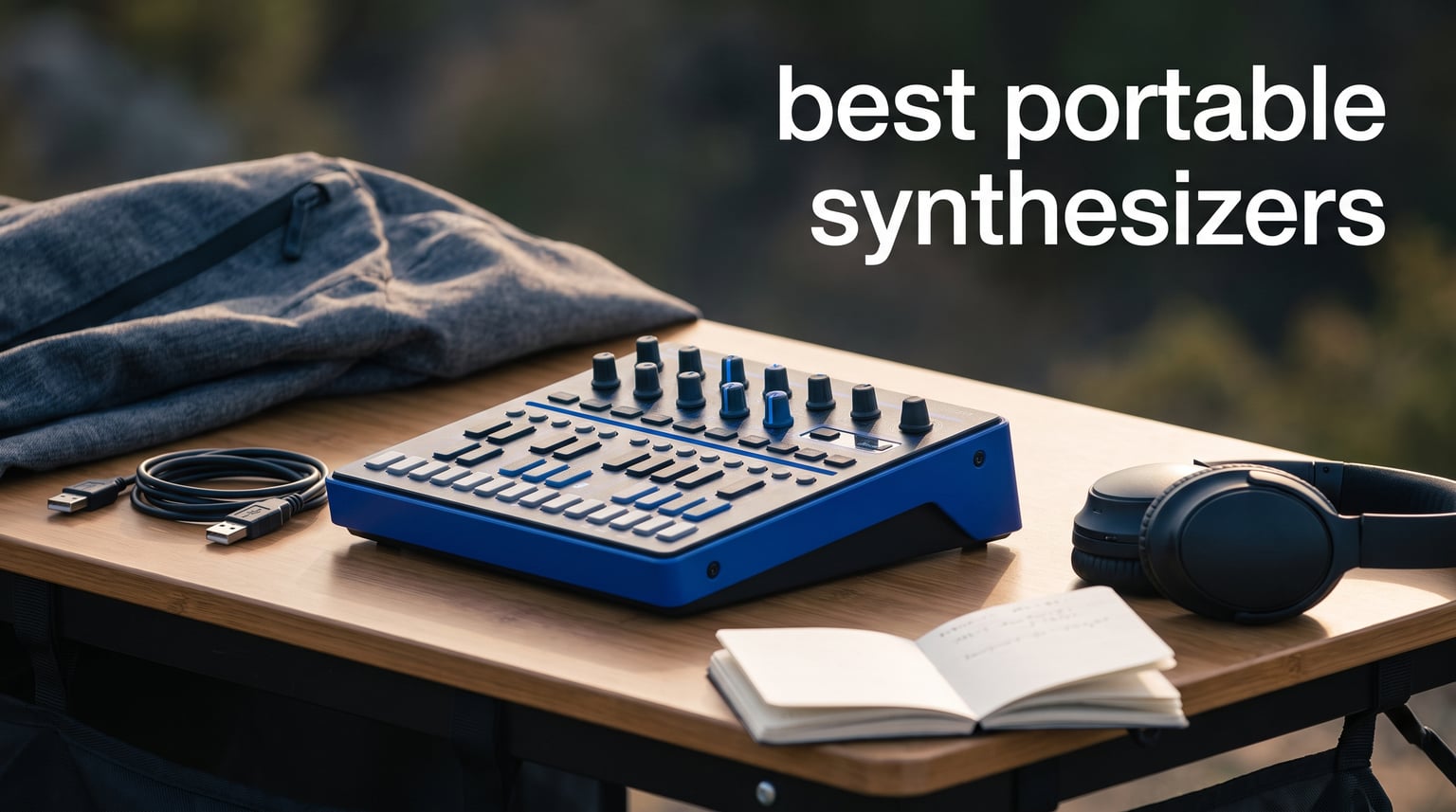
The best portable synthesizers let you make a real musical idea away from a desk, not merely poke at a tiny novelty instrument. For this 2026 list, I compared the 10 verified models supplied for sound engine, physical size, power method, speaker or headphone practicality, sequencing, and the way each one starts a session.
A portable synthesizer is a compact, battery-powered or USB-powered instrument that makes and shapes electronic sound with oscillators, filters, envelopes, or digital sound engines. The strongest picks also give you a workable output, a fast route to a pattern or melody, and controls you can understand without interrupting the idea.
My first choice is the MOOG Messenger when you want a 32-key, hands-on analog instrument with serious connections. The Sonicware Liven Evoke makes more sense for cinematic sketching from acoustic-like tones, granular processing, chords, and a built-in speaker, while the MicroKits Synth-a-Sette is the easiest pocket-sized starting point.
There is no single definition of travel-ready. A synth that fits a backpack can still need headphones, an adapter, or a wall supply; a battery-powered synth can be better for a hotel room yet less useful on a silent flight if it has no confirmed headphone output. I call out those distinctions rather than treating every small synth as interchangeable.
One limitation matters before we begin: USB-C connectivity does not by itself prove that a unit can run from a power bank. Where the supplied product data confirms battery operation, I say so; where it only lists USB-C or USB power, I treat power-bank use as unconfirmed and recommend checking the manual before travel.
These Are the Top 3 Picks for Portable Synthesizers (September 2026)
The MOOG Messenger earns the editor’s choice badge because its 32 semi-weighted full-size keys, velocity, aftertouch, two VCOs, sub-oscillator, ladder filter, and 64-step sequencer form a complete player’s instrument. I would choose it for bass, leads, and hands-on patch shaping when a small tabletop box is not enough.
The Liven Evoke is the more unusual travel synth: its Acoustronic Flux Oscillator combines 34 acoustic tones, 20 wavetables, and two noise types, then routes them through grain processing and 10 reverbs. Its documented battery power and speaker make it one of the clearest self-contained choices here.
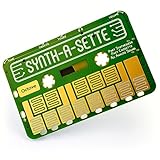
The Synth-a-Sette has far fewer musical roles, but that is exactly why it works as a first mini synthesizer or a playful carry-anywhere companion. A cassette-sized analog body, 13-key touchpad, speaker, line out, and conductive-object clips give it a clear identity instead of pretending to be a studio workstation.
These 10 Portable Synthesizers Give You a Quick 2026 Overview
The comparison below includes every verified model in this guide. Use it to narrow the field by interface and sound direction, then read the individual notes for the limitations that matter in a backpack or headphone session.
| Product | Specifications | Action |
|---|---|---|
 MOOG Messenger MOOG Messenger |
|
Check Latest Price |
 Sonicware Liven Evoke Sonicware Liven Evoke |
|
Check Latest Price |
 MicroKits Synth-a-Sette MicroKits Synth-a-Sette |
|
Check Latest Price |
 Roland AIRA Compact J-6 Roland AIRA Compact J-6 |
|
Check Latest Price |
 Behringer Pro VS Mini Behringer Pro VS Mini |
|
Check Latest Price |
 Roland AIRA Compact S-1 Roland AIRA Compact S-1 |
|
Check Latest Price |
 Donner Essential B1 Donner Essential B1 |
|
Check Latest Price |
 Stylophone GENX-2 Stylophone GENX-2 |
|
Check Latest Price |
 Otamatone Regular Otamatone Regular |
|
Check Latest Price |
 teenage engineering OP-1 field teenage engineering OP-1 field |
|
Check Latest Price |
1. MOOG Messenger Is a Strong Pick for Hands-On Analog Leads
MOOG Messenger Monophonic Analog Synthesizer
32 full-size keys
2 VCOs plus sub
64-step sequencer
Pros
- Full-size aftertouch keys
- Variable-shape VCOs
- RES BASS ladder filter
- CV MIDI and USB-C
- 256 presets
Cons
- Monophonic only
- Weighs 5.14 kilograms
The Messenger is the closest thing here to a compact performance keyboard rather than a micro-synth. Its 32 semi-weighted full-size keys have velocity and aftertouch, which gives a played bassline or lead more expression than touch strips and miniature pads can offer.
I like the sound-building layout on paper because MOOG specifies two continuously variable-shape VCOs with sync and frequency modulation, plus a sub-oscillator. That is a direct route to a broad bass voice, a sharp synced lead, or a thicker monophonic line without needing a computer.
The filter is unusually flexible for this type of instrument: it offers 4- or 2-pole low-pass, band-pass, and high-pass responses, with RES BASS compensation. Two loopable ADSR envelopes and two LFOs give you room to make a patch move over time instead of stopping at a single static tone.
The 64-step sequencer has probability-based generative behavior, so it can turn a short phrase into a less predictable pattern. With 256 presets, you can also start from a stored sound rather than building every patch from zero, which addresses the common wish for fast startup when jamming.
Full-size keys make this a better travel keyboard than a pocket device
The Messenger measures 27.6 by 16.8 by 8.4 inches and weighs 5.14 kilograms. That is portable in the sense of carrying it between rooms, rehearsals, or a vehicle, but I would not call it an airplane-seat synth or a casual daypack option.
Its advantage is that the extra bulk buys a keyboard you can actually play with both hands. If key feel is your biggest frustration with small synths, that trade is easy to understand.
CV and MIDI make this a better hub for hardware players
Six analog CV patch points, 5-pin DIN MIDI input and output, MIDI over USB-C, plus expression and sustain inputs make the Messenger ready for a mixed rig. I would pair it with a sequencer, a drum machine, or a modular voice when the travel setup grows beyond one instrument.
The listing names USB-C connectivity but does not state power-bank operation. Treat it as a connected keyboard synth, not a confirmed battery-powered synth, and plan power accordingly.
2. Sonicware Liven Evoke Is the Best Pick for Cinematic Portable Sketches
Sonicware Liven Evoke [Acoustronic Synthesizer with Granular Effect] – Portable Synthesizer for Cinematic Ambient and Post-Classical Music Production, Battery-Powered, Built-In Speaker
Battery power and speaker
34 acoustic tones
4-track sequencer
Pros
- Acoustronic sound engine
- Granular processing
- Built-in speaker
- One-finger chords
- 10 reverbs
Cons
- Few customer reviews
- Plastic body
The Liven Evoke is built around a sound palette that does not begin with standard subtractive synth language. Its Acoustronic Flux Oscillator supplies 34 acoustic instrument tones, 20 wavetables, and two noise types, so it is aimed at ambient, post-classical, and cinematic layers rather than only bass and lead duties.
Its Grain FX works with up to 12 grains and adds tempo-synced harmonization and randomization. I would reach for this when a basic pad needs movement or when a plucked, bowed, or acoustic-like texture needs to become less literal.
The supplied data confirms battery power and a built-in speaker, two features that make the Evoke exceptionally practical away from a desk. A 4-track sequencer supports step and real-time recording with parameter locking, while the one-finger chord mode offers 16 chord styles for getting harmonic material down quickly.
Ten deep, multi-dimensional reverbs are a meaningful part of the instrument rather than an afterthought. The review record is small at 16 ratings, so I would treat the 4.8 rating as encouraging but less settled than a score supported by hundreds of buyers.
Built-in sound and battery operation make this a self-contained option
The 6.93 by 11.69 by 1.89 inch body and 790 gram weight are travel-friendly figures. Because the listing confirms both a speaker and battery power, this is one of the few choices I can recommend for a quiet hotel-room sketch without adding another device.
For a silent flight or shared space, bring headphones or confirm your preferred output setup from the manual; the supplied listing calls out an auxiliary connector but does not describe a dedicated headphone specification. That small check prevents an avoidable travel mistake.
Four tracks make this better for composed loops than single-note practice
The sequencer can capture step or real-time parts, and parameter locking lets a sound change within a pattern. LINE IN also lets external audio enter the unit for processing, which opens useful combinations with another small synth or a phone-based sound source.
SYNC and MIDI are named in the connection list, so the Evoke can sit beside rhythm hardware rather than operating alone. Its USB power behavior is not specified, so power-bank compatibility remains unconfirmed despite the confirmed battery option.
3. MicroKits Synth-a-Sette Is the Best Pocket-Size Analog Starter
MicroKits Synth-a-Sette: The Original Cassette Sized Analog Synthesizer
Cassette-sized analog synth
13-key touchpad
Speaker and line out
Pros
- Extremely small
- Analog sound
- Conductive-object play
- Speaker and line out
- 2-year warranty
Cons
- Monophonic only
- Basic sound engine
The Synth-a-Sette is refreshingly honest about what it is: a cassette-sized analog synthesizer designed for quick melodies and experimentation. At 4 by 2.6 by 0.5 inches and 150 grams, it is the one model here that can reasonably stay in a jacket pocket.
Its 13-key monophonic touchpad, octave-up button, and optional vibrato switch keep the voice simple. I would not buy it as a complete production instrument, but I would buy it for the moment when making a sound matters more than opening a large setup.
The standout feature is conductivity play. The included 10 alligator clips let you turn conductive everyday objects into a keyboard, which makes the product useful for musical play and STEM-style learning rather than just another small noisemaker.
A built-in speaker and line out cover the two basic listening paths, and battery power is confirmed. Its 4.7 rating is based on 237 reviews, a comparatively broad record in this list, with user feedback praising its portability and creative play value.
Cassette dimensions make this the easiest synth to carry every day
This is the travel synth I would keep available for a spare five minutes rather than pack only for a planned music session. The tiny body avoids the weight and case question that comes with even the compact keyboard instruments.
The touchpad is not a substitute for conventional keys, and the voice is monophonic. Those limits are not faults if your aim is single-note melodies, sound experiments, or a compact way to learn how pitch and vibrato respond.
Conductive-object play makes this a better learning tool than a conventional mini synth
Connecting clips to objects creates a direct cause-and-effect lesson: touch the object and you trigger pitch. I think that makes the Synth-a-Sette an inviting first encounter with analog sound and an engaging tool for collaborative play.
Use the line out when you want to record or hear it through external gear. The product lists USB-C as its connector, but it does not state that a power bank can run it, so battery power is the confirmed mobile plan.
4. Roland AIRA Compact J-6 Is a Fast Route to JUNO-Style Chords
Roland AIRA Compact J-6 CHORD SYNTH Portable Song Creation Machine
4-voice JUNO-60 engine
100 chord sets
Battery and USB-C audio
Pros
- JUNO-60 ACB sound
- 100 chord sets
- Chord sequencer
- Delay and reverb
- Battery included
Cons
- Four voices only
- Small rubber pads
The J-6 makes harmonic ideas its main job. Roland gives it a 4-voice JUNO-60 synth engine using Analog Circuit Behavior, 64 ready-to-play synth presets, and 100 chord sets across classic and contemporary styles.
I would choose it when I want to explore chord progressions without needing advanced keyboard technique. Nine arpeggio styles with 12 variations each can push a held chord into a moving part, while the filter and envelope controls let you move beyond a fixed preset.
The 64-pattern chord sequencer stores patterns of up to 64 steps. Built-in delay and reverb matter here because chord-based parts often need space before they sound finished, and the J-6 puts those effects directly in the compact unit.
The supplied data confirms a built-in lithium-ion battery and class-compliant USB-C audio/MIDI, which reduces setup friction when working with a tablet or computer. It is a sound-and-sequence tool, not a full-sized keyboard, so its pads favor programming and triggering over two-handed playing.
Chord sets make this a friendly choice for songwriters who do not play keys
The 100 chord sets give you a structured vocabulary from the start, and the one-button workflow can get you to a musical progression quickly. That is a practical answer to the forum complaint that complex menus can stop a jam before it starts.
Four voices place a ceiling on dense harmony, so players who need larger sustained chord stacks may want a different instrument. For compact pop, electronic, or lo-fi progressions, the focused voice count is still usable.
AIRA Link and USB-C make this a practical member of a small Roland rig
Audio, MIDI, sync input and output, AIRA Link, and class-compliant USB-C audio/MIDI are all listed. I would consider it a natural partner for a portable drum machine or another synced AIRA Compact unit.
Battery operation is documented, while external power-bank support is not. Carry headphones for private sessions and verify the specific output connection you plan to use before a flight.
5. Behringer Pro VS Mini Is a Capable Five-Voice Vector Synth
Behringer Pro VS Mini Portable 5-Voice Hybrid Synthesizer with 4 Vector Morphing Oscillators Per Voice, Analog Low-Pass Filter, 16-Step Sequencer and Arpeggiator
5-voice hybrid
16 vector oscillators
Battery or USB power
Pros
- Five-note polyphony
- Vector morphing oscillators
- Analog low-pass filter
- Sequencer and arpeggiator
- Battery or USB power
Cons
- 2.5mm jack may need adapter
- Availability can vary
The Pro VS Mini packs an unusual amount of synthesis into a small body. It is a five-voice hybrid synth with four Vector Morphing Oscillators per voice, for 16 total vector oscillators, followed by an analog low-pass filter.
That architecture makes it a more adventurous option than a straightforward analog mono synth. I would use the morphing oscillator approach for shifting digital colors, then use the analog filter to tame or darken the result.
A 16-step sequencer and arpeggiator give the sound engine a practical way to become a pattern. The product data also lists separate filter, amplifier, and oscillator envelopes, so modulation is part of the design rather than an added effect.
Battery or USB power is explicitly named, which is good news for mobile sessions. The unit measures 8.45 by 5.45 by 2.35 inches, a compact footprint that should fit beside headphones, a small recorder, and cables in a modest bag.
Five voices make this more useful for chords than most tiny synths
Five-note polyphony gives you room for basic chord work, layered intervals, and an arpeggiator that does not collapse to one note. That is a meaningful distinction if your portable music relies on harmony rather than a bassline alone.
The small keyboard format still changes how you play. I would program a sequence or use it as a sound module before expecting it to replace a conventional keyboard.
Battery or USB power gives this more flexible travel planning
Unlike several USB-C-equipped products here, the listing actually says battery or USB powered. That gives you two confirmed power paths, although the supplied data does not specifically name a power-bank input rating.
The 2.5 mm jack connection can require an adapter in a conventional studio or headphone setup. Put the needed adapter in the case before leaving home, because it is a small omission that can make an otherwise portable synth unusable.
6. Roland AIRA Compact S-1 Is a Small Polysynth for Pattern Makers
Roland AIRA Compact S-1 Tweak Synth
4-voice micro polysynth
64-step sequencer
4.5-hour battery
Pros
- Four-voice polyphony
- D-Motion control
- Osc Draw and Chop
- USB-C audio and MIDI
- 4.5-hour battery
Cons
- Tiny interface
- Four voices limit layers
The S-1 is an ultra-portable four-voice micro polysynth with an explicitly listed 64-step sequencer. It is a compact sound-design machine for players who like transforming a sequence as much as entering notes.
Roland’s D-Motion Sound Control, Osc Draw, and Osc Chop functions set it apart from basic preset players. I would favor it for short, animated electronic phrases where hands-on motion can change the character of the pattern.
The supplied specification confirms a 4.5-hour battery life, USB-C audio, and MIDI. At one pound, it is one of the more realistic bag-friendly instruments for people who need a full synth voice, sequencing, and computer connection in a light package.
Its rating is 4.5 from 200 reviews, which is a useful amount of customer feedback. The small interface will reward a player willing to learn its control system, not someone seeking large keys and immediate traditional performance technique.
Four and a half hours of battery life suits planned mobile sessions
The stated 4.5-hour figure is concrete enough to plan around. I would still recharge before a long travel day and bring a backup listening option, because actual time can change with volume, connections, and use.
It is a good fit for a train, hotel desk, or park session where a limited run time is acceptable. The data says USB-C audio and MIDI, but it does not independently confirm power-bank operation.
Motion controls make this more rewarding for experimental electronic patterns
The S-1 gives you a four-voice sound engine plus oscillator drawing and chopping tools, so it has room to move beyond static digital tones. That is especially useful when a 64-step sequence needs variation without adding a second machine.
USB-C audio/MIDI also simplifies recording into compatible devices. For a first synth, I would compare its compact workflow with the larger-key Messenger or the chord-led J-6 before deciding which control style feels more natural.
7. Donner Essential B1 Is a Focused Analog Acid Bass Machine
Analog Bass Synthesizer and Sequencer, Donner Essential B1 with Intuitive User Interface, 128 Patterns Memory, Saturation & Delay Effects, Make for Classic Acid Sound
Analog bass signal path
128 pattern memory
Saturation and delay
Pros
- Fully analog signal path
- 128 pattern memory
- Haptic color pads
- Saturation and delay
- USB-C MIDI and sync
Cons
- Sequencer takes practice
- Focused bass role
The Essential B1 is not trying to cover every synth role. Its single VCO, VCF, and VCA analog signal path is focused on classic acid-style bass material, with analog saturation and delay to push the sound further.
I would pick it for a portable dance-music sketchpad where a bassline is the center of the idea. Its sound profile is described as warm and rich with emphasized lower frequencies, which aligns with that narrowly defined job.
It stores 128 patterns, includes an eight-mode arpeggiator, and has a Song Mode for chaining patterns. Those features turn it from a one-riff device into a unit that can hold multiple ideas and arrange them into a longer sequence.
The haptic pads use dynamic color-changing backlights, and the supplied reviews describe the sequencer as intuitive overall. There is still a learning curve with any step sequencer, so I would spend an evening learning its pattern entry before relying on it at a jam.
Pattern memory makes this better for building a set of bassline ideas
One hundred twenty-eight pattern slots give you somewhere to keep variations instead of overwriting the last good sequence. Song Mode then lets you order those stored patterns, which is useful for a compact live sketch or a longer writing session.
The B1’s small 9.6-ounce weight helps portability, but its narrow bass purpose means it works best alongside a chord, melody, or drum source. It is a specialist, and that focus is its appeal.
MIDI and sync make this easy to place beside other compact hardware
The listing names USB Type-C connectivity, 5-pin MIDI input and output, and sync input and output. I would use those ports to lock the bass sequence to a rhythm box or feed notes from a keyboard controller.
USB-C is a connection feature in the supplied data, not a stated battery or power-bank claim. Plan to verify its power requirements before treating it as an off-grid travel synth.
8. Stylophone GENX-2 Is a Portable Analog Voice with CV Output
Stylophone GENX-2 Portable Analogue Synthesizer with Built-in Speaker, LFO, Filter, Analogue Delay and CV/Gate Output | Synthesizer Keyboard | Synth Musical Instrument
Battery synth with speaker
Analog delay and filter
CV and Gate output
Pros
- Built-in speaker
- Resonant low-pass filter
- Analog delay
- CV and Gate output
- Headphones included
Cons
- Stylus technique takes practice
- Two-octave layout
The GENX-2 takes the familiar Stylophone playing method into a more developed analog instrument. You use a stylus keyboard, but the voice adds an LFO with square and triangle waves, a resonant low-pass filter, attack and decay control, pulse-width modulation, and dual sub-octave switches.
I would choose it for an immediate monophonic line with a tactile character unlike mini keys or pads. The stylus asks for a little practice, yet it also makes slides and expressive, imperfect phrasing feel natural.
Battery operation and a built-in speaker are both confirmed, and headphones are included. That makes the GENX-2 unusually ready to use straight out of the case, whether the goal is a private session or a quick audible sketch.
The built-in analogue delay adds space without external effects, while the metal construction and 339 gram weight give it a more substantial travel feel than a toy-like pocket instrument. It has a 4.5 rating from 110 reviews in the supplied data.
Speaker and included headphones make this ready for solo practice
This is one of the easiest choices for switching between audible play and quiet listening because both a speaker and headphones are named. That is a real benefit when portable music sessions move between private rooms, shared spaces, and outdoor breaks.
The two-octave stylus layout does not behave like a piano keyboard. I would try it if you enjoy learning a distinctive interface, not if traditional key action is non-negotiable.
CV and Gate output make this useful beyond casual portable play
CV and Gate outputs allow the GENX-2 to communicate with compatible modular or analog hardware. That connection adds a second life after the initial portable phase, since its control signals can drive or synchronize a larger experimental setup.
The listing confirms battery operation but does not describe power-bank support. Keep the battery plan simple, and use its analogue delay and filter as the core of a compact mono voice.
9. Otamatone Regular Is a Playful Travel Instrument for Simple Melodies
Otamatone Japanese Electronic Synthesizer Musical Instrument Toy – Butter
Touch stem melody control
Wah effect
Three pitch settings
Pros
- Very lightweight
- Simple touch control
- Expressive wah effect
- Multiple pitch modes
- English instructions included
Cons
- Needs 3 AAA batteries
- Synthetic tone is distinctive
The Otamatone Regular is the least conventional instrument in this guide, and it deserves that label. You press or slide along its stem to play notes, then squeeze its cheeks for the signature wah effect.
I would treat it as a portable melody instrument and a route into playful performance, not as a replacement for a programmable synth. Its sound profile is described as synthetic, unique, and intentionally off-key, which will delight some players and rule it out for others.
Low, medium, and high pitch settings plus multiple octave support give it more range than its simple appearance suggests. At 6.4 ounces and 5 by 4 by 13 inches, it is light enough to bring along when the point is fun and interaction rather than detailed sound design.
The product requires three AAA batteries, which are not included. Put that requirement on your packing checklist, because a portable instrument with no installed batteries is not much use at the destination.
Touch-and-slide control makes this accessible for non-keyboard players
The stem gives a visual, physical way to find notes through pressing and sliding. I would choose it for a child, a curious adult, or a group session where a formal keyboard layout might feel less inviting.
Fine intonation takes practice, so it is not the best choice when you need precise fast passages. Its charm comes from embracing the voice, slides, and wah articulation rather than demanding conventional synth behavior.
AAA power makes this independent from USB cables but less rechargeable
Three AAA batteries free you from a USB cable and wall outlet during use. That can be convenient for spontaneous play, but it also means carrying replacement cells if the trip is long.
No power-bank claim is present in the supplied data. For a simple, lightweight, self-contained sound maker, the Otamatone’s battery method is clear and its sonic personality is the deciding factor.
10. teenage engineering OP-1 field Is a Portable All-in-One Music Workstation
teenage engineering OP-1 field portable synthesizer, sampler and drum machine with built-in speaker, microphone, effects and vocoder
12 synth engines and sampler
Drum machine and tapes
Speaker microphone and Bluetooth MIDI
Pros
- Complete portable studio
- 12 synth engines
- Sampler and drum machine
- Built-in speaker and microphone
- USB-C and Bluetooth MIDI
Cons
- Deep workflow takes learning
- Mixed review record
The OP-1 field is the broadest music-making system in this group. It combines 12 synth engines, a sampler with 20 seconds of sample time, a drum machine, sequencer, four digital tapes with more than 160 minutes of recording, eight effect styles, and a vocoder.
I would choose it for a musician who wants to write an entire sketch in one object rather than connect several small boxes. Its built-in speaker and microphone mean you can generate, capture, sequence, and listen without immediately building a separate rig.
The velocity-sensitive keyboard is joined by USB-C and Bluetooth MIDI, and the system works with iOS, macOS, and Windows. At 589 grams and 11.81 by 4.72 by 0.79 inches, it has a notably slim format for something that also records and sequences.
Its 4.1 rating from 57 reviews is lower than several simpler picks here, and the review data notes a learning curve and mixed value feedback. That tells me to buy it for its particular all-in-one workflow, not simply because it has the longest feature list.
Sampler, drum machine, and tape recording make this a complete writing tool
The four digital tapes hold more than 160 minutes of recording, while the sampler can capture short sounds and the drum machine supplies rhythm. Those pieces make it possible to build a layered travel demo without opening a laptop.
The included microphone expands the idea further: record a sound around you, then turn it into source material. That is a meaningful difference between a portable keyboard synth and a portable music workstation.
Rechargeable battery and wireless MIDI make this a flexible mobile center
The listing confirms a rechargeable battery along with USB-C and Bluetooth MIDI. I would use Bluetooth MIDI for a low-cable controller connection and USB-C when a wired audio or data path is more appropriate.
Its documentation does not state power-bank operation, so verify that separately if it matters for your trips. The OP-1 field suits people ready to learn a deep system; it is not the quickest choice for someone who only wants a single analog bass sound.
The Right Portable Synth Depends on Power, Workflow, and Sound
Choose portability by the session you will actually have. A pocket instrument such as the 150 gram Synth-a-Sette can be always available, while the 5.14 kilogram Messenger is portable between destinations but asks for a purposeful carry plan.
Built-in speakers matter when you want to play immediately in a hotel room, a park, or a rehearsal break. The Liven Evoke, Synth-a-Sette, GENX-2, and OP-1 field list speakers, while a headphone-first setup is a better fit for planes and shared rooms.
Confirmed battery power is the safest basis for travel planning
Battery operation is explicitly listed for the Liven Evoke, Synth-a-Sette, J-6, Pro VS Mini, S-1, GENX-2, Otamatone, and OP-1 field. The Pro VS Mini also states USB power, and the S-1 gives a stated 4.5-hour battery figure.
Do not assume USB-C means a power bank will work. Several products list USB-C for audio, MIDI, or general connectivity without a stated external-power specification, so check the manufacturer manual for voltage, current, and cable requirements before relying on a battery pack.
Analog and digital choices answer different sound and workflow needs
Analog-focused options in this list include the Messenger, Essential B1, Synth-a-Sette, and GENX-2. They center on oscillator, filter, envelope, and immediate tone shaping, with the Messenger offering the widest hands-on control set and the B1 concentrating on acid bass.
Digital or hybrid instruments lean toward broader transformation and sequencing. The Evoke combines acoustic tones with wavetables and granular processing, the Pro VS Mini combines vector oscillators with an analog filter, and the OP-1 field combines synthesis with sampling and recording.
Headphones and outputs decide whether a portable synth works on a flight
A quiet travel session needs a usable private listening route, not just a small case. The Synth-a-Sette specifies line out, the GENX-2 includes headphones, and the J-6, S-1, B1, Messenger, and OP-1 field list connection options that support larger setups, but check the exact jack type and required adapters before traveling.
The Pro VS Mini’s 2.5 mm jack is a useful example of why this matters. An adapter is a minor item at home and a session-ending omission when you are away.
Sequencing and connection options decide how each synth joins other gear
For a one-device loop, the Evoke has four tracks, the J-6 has a 64-pattern chord sequencer, the S-1 has 64 steps, the Messenger has a probability-capable 64-step sequencer, and the B1 can chain patterns in Song Mode. Pick the sequencer that matches whether you write chords, evolving loops, or bassline variations.
For a small hardware pair, look for documented MIDI or sync. The Messenger includes DIN MIDI, USB-C MIDI, and CV; the Evoke lists MIDI and sync; the J-6 lists audio, MIDI, sync, and AIRA Link; and the B1 lists MIDI and sync I/O.
Beginners benefit most from a focused interface and fast sound creation
If you are learning the basics, the Synth-a-Sette makes pitch, vibrato, speaker playback, and conductive experimentation approachable. The J-6 is another friendly path for aspiring songwriters because chord sets and arpeggios produce musical material before deep synthesis knowledge is required.
For a beginner who wants conventional keys and long-term synthesis depth, I would point toward the Messenger if its larger size fits the plan. For someone who wants a playful instrument more than a traditional synth, the Otamatone offers the simplest entry point.
These FAQs Answer the Key Portable Synthesizer Questions
What is the best portable synthesizer for beginners?
The MicroKits Synth-a-Sette is the clearest beginner pick when you want a tiny, direct analog instrument: it has a 13-key touchpad, an octave button, optional vibrato, a speaker, line out, and battery operation. For beginners who want chord writing instead, the Roland J-6 offers chord sets and an arpeggiator.
What is the best budget portable synth?
The MicroKits Synth-a-Sette is the budget pick in this guide because it focuses on a simple cassette-sized analog voice, battery operation, speaker, line out, and conductive-object play. The Behringer Pro VS Mini is another compact choice when five-voice hybrid synthesis and a sequencer matter more than pocket size.
Are portable synths worth it?
Portable synths are worth it when you will use the freedom to practice, write, or sequence away from a studio. They work best when their power method, output, control style, and sound role fit the session you actually plan to have, whether that is headphones on a trip or a quick room sketch.
What can a portable synthesizer do?
A portable synthesizer can make leads, basses, chords, textures, and sequences using synth engines such as analog oscillators, wavetables, or FM-style digital processing. Some models add speakers, effects, MIDI, sync, sampling, recording, drum machines, or CV outputs, so a small instrument can serve as a practice tool, sound module, or travel writing system.
What is the best portable synth with speakers?
The Sonicware Liven Evoke is the best speaker-equipped pick for cinematic writing because it combines confirmed battery power and a built-in speaker with acoustic tones, wavetables, granular processing, reverbs, and a four-track sequencer. The OP-1 field is the broader speaker-equipped choice when you also want sampling, drums, and tape recording.
The MOOG Messenger Is Our First Pick for Serious Portable Synthesis
The best portable synthesizers are not all trying to do the same job. I would choose the MOOG Messenger for a player’s analog keyboard, the Sonicware Liven Evoke for self-contained cinematic textures, the Synth-a-Sette for tiny hands-on fun, and the OP-1 field for an all-in-one writing system.
Start with the kind of session you want to have in 2026, then confirm the power plan, listening route, and connections before choosing. A portable synth earns its place when it is the instrument you will actually carry and turn on.