
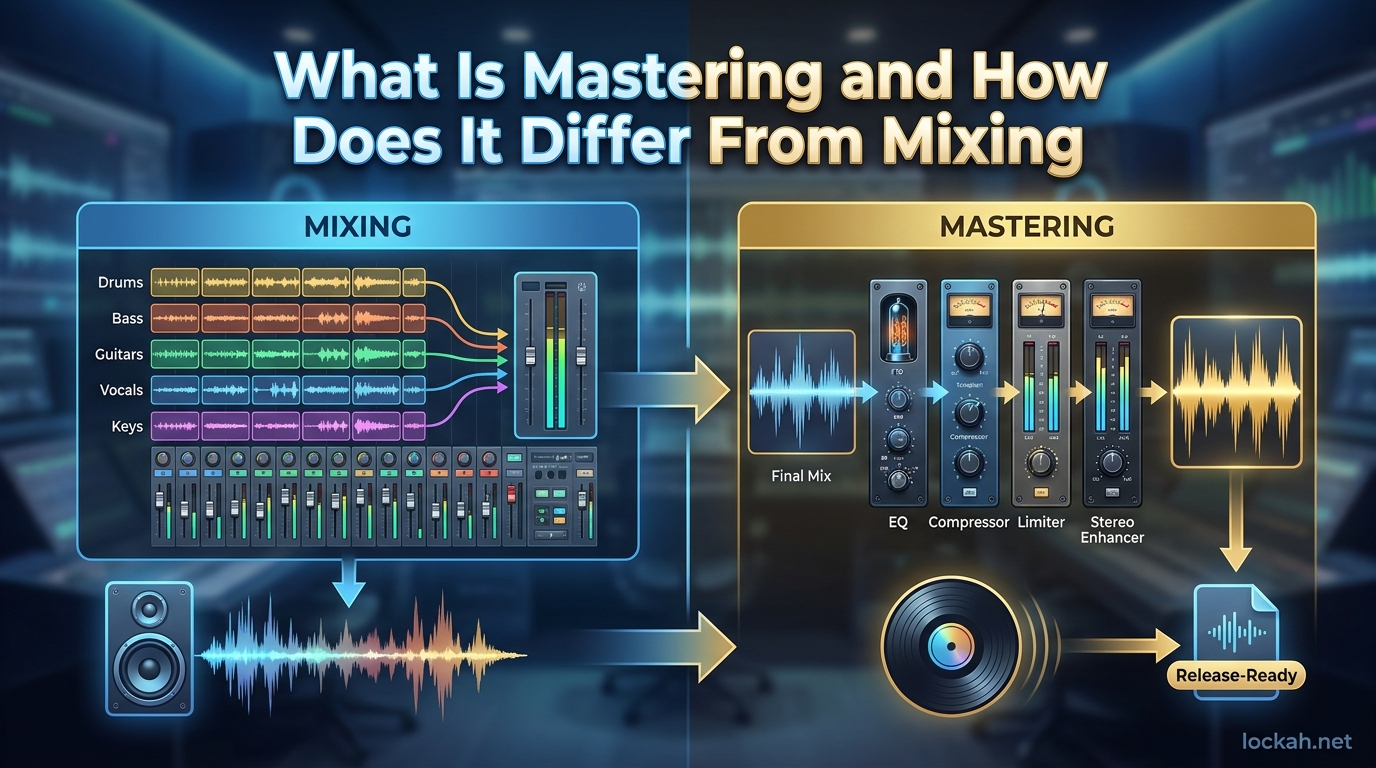
Understanding mastering vs mixing is essential for anyone involved in music production. Mixing involves balancing individual tracks in a session (like vocals, drums, guitars), while mastering finalizes the mixed stereo track for distribution by optimizing loudness, EQ, and consistency. These two stages represent the final creative and technical steps that transform raw recordings into polished, release-ready music.
I remember when I first started producing music, the distinction between these processes confused me for months. I would try to fix mixing problems during mastering, or worse, master my tracks while still adjusting individual instrument levels. This created a frustrating cycle of never feeling like my music sounded “finished.” After working with professional engineers and studying the craft for over five years, I now understand that mixing and mastering serve completely different purposes in the audio production workflow.
In this guide, you will learn exactly what happens during each stage, the key differences that separate them, and practical tips to avoid common mistakes. Whether you are a bedroom producer looking to release your first single or an artist planning to work with professional engineers, this information will help you make informed decisions about your music.
Table of Contents
What Is Audio Mixing?
Audio mixing is the process of combining multiple recorded tracks into a cohesive stereo or surround sound presentation. A mix engineer works with individual elements like lead vocals, background vocals, drums, bass, guitars, synthesizers, and effects to create a balanced, engaging sonic experience.
Think of mixing like being a chef preparing a complex dish. Each ingredient (track) has its own flavor, texture, and intensity. The mix engineer decides how much of each ingredient goes into the final dish, where it sits on the plate (panning), and how all the flavors interact with each other.
What Happens During the Mixing Process?
The mixing process typically begins once all recording and editing is complete. The engineer receives a session file containing dozens or even hundreds of individual tracks that need attention.
First comes organization and cleanup. The engineer groups similar tracks, names them clearly, and removes any unwanted noise, clicks, or pops. This preparation stage makes the actual mixing work much more efficient.
Next, the engineer addresses track balancing through volume faders. Every element needs to sit at the right level relative to everything else. The lead vocal typically sits on top, with supporting instruments arranged around it in a three-dimensional sonic space.
EQ equalization shapes the tonal character of each instrument. The engineer cuts frequencies that create muddiness or conflict and boosts frequencies that add clarity and presence. For example, removing low-end rumble from vocals prevents them from competing with the bass guitar.
Compression controls the dynamic range of individual tracks. A vocal performance might vary significantly in volume between quiet verses and loud choruses. Compression evens out these variations so the vocal sits consistently in the mix.
Spatial effects like reverb and delay create depth and dimension. The engineer places instruments in different virtual spaces, making some feel close and intimate while others sound distant and atmospheric.
Panning positions sounds across the stereo field from left to right. Drums might spread across the stereo image, while bass and lead vocals typically stay centered for focus and power.
Finally, automation allows the engineer to program changes over time. The chorus might need more energy than the verse, so the engineer automates volume increases, effect sends, or EQ changes to build that dynamic progression.
Goals of a Professional Mix
A well-executed mix achieves several specific objectives. Every element should be clearly audible and intelligible. The frequency spectrum should feel balanced, with no ranges feeling too prominent or absent.
The mix should translate well across different playback systems. It needs to sound good on studio monitors, car speakers, earbuds, phone speakers, and club systems.
Emotionally, the mix should serve the song. A ballad requires intimacy and space, while an aggressive rock track needs power and impact. The mix engineer makes creative decisions that enhance the artistic intent.
What Is Audio Mastering?
Audio mastering is the final stage of post-production that prepares a mixed recording for distribution. The mastering engineer receives a single stereo file containing the completed mix and applies subtle but crucial processing to optimize it for release.
Where mixing focuses on the relationship between individual elements, mastering treats the song as a complete, unified entity. The mastering engineer cannot adjust the vocal level separately from the drums because everything exists on one stereo track.
Mastering serves both creative and technical functions. Creatively, it enhances the overall tone, punch, and character of the mix. Technically, it ensures the track meets industry standards for loudness, format compatibility, and quality control.
The Purpose of Mastering
The primary goal of mastering is creating a final mix that sounds polished, professional, and consistent with other commercial releases. This involves several specific tasks.
Quality control comes first. The mastering engineer listens critically for any technical problems that might have been missed during mixing. Clicks, distortion, noise, or balance issues get identified and either fixed or sent back to the mix engineer.
Tonal balance refinement uses linear-phase EQ to make subtle adjustments across the frequency spectrum. Perhaps the mix needs slightly more air in the high frequencies or a touch more warmth in the low mids.
Dynamic range processing through multiband compression adds cohesion and glue to the stereo mix. Different frequency ranges can be compressed independently to address specific issues.
Loudness optimization uses brickwall limiting to increase the overall perceived volume while preventing distortion. Modern streaming platforms target specific LUFS (Loudness Units Full Scale) levels, and the mastering engineer ensures the track meets these targets.
Stereo imaging adjustments widen or narrow the stereo field to create an engaging sense of space while maintaining mono compatibility for club systems and phone speakers.
When mastering an album, the engineer sequences tracks in the desired order, adjusts spacing between songs, and ensures consistent volume and tonal character across the entire project.
Finally, the engineer adds metadata tags including ISRC codes, artist information, and track details, then exports the audio in various formats needed for distribution platforms.
Mastering for Different Formats
A professional mastering session produces multiple versions of each track. The streaming master targets platform-specific loudness standards. Vinyl masters require special processing to accommodate the physical limitations of the format. CD masters include different headroom considerations.
Instrumental versions, TV tracks, and stems might also be prepared during the mastering session for licensing and placement opportunities.
Key Differences Between Mixing and Mastering (2026)
Understanding the fundamental distinctions between these processes helps you approach your music with the right expectations and workflow. Here is a direct comparison of the most important differences.
| Aspect | Mixing | Mastering |
|---|---|---|
| Input Material | Multiple individual tracks | Single stereo file |
| Focus | Balance between instruments | Overall song coherence |
| Timeline Position | After recording, before mastering | Final stage before distribution |
| Track Count | 10 to 100+ tracks | 1 stereo track (2 channels) |
| Adjustments | Individual element control | Broad, global processing only |
| Primary Tools | Channel EQ, compression, faders | Stereo EQ, multiband compression, limiters |
| Creative Scope | High – significant artistic decisions | Moderate – subtle enhancements |
| Technical Role | Build the sonic foundation | Quality control and standardization |
Micro vs Macro Perspective
The most important conceptual difference is the perspective each engineer brings to the project. A mix engineer works from the micro level, adjusting individual elements and their relationships. They might spend twenty minutes getting the snare drum to sit perfectly against the vocal.
A mastering engineer works from the macro level, viewing the entire song as one cohesive unit. They enhance what exists rather than rebuilding from components. This is why a mastering engineer cannot fix a vocal that was mixed too quietly, but they can add overall brightness that might help the vocal cut through slightly better.
Processing Chain Differences
Mixing involves extensive processing on individual tracks. Each instrument might have its own EQ, compressor, saturation, and spatial effects. The mix engineer builds complex routing systems with busses, auxiliary sends, and parallel processing.
Mastering uses minimal processing applied to the full stereo mix. A typical mastering chain might include only 4-6 plugins: an EQ, a compressor, a saturator, an imager, a meter, and a limiter. Each processor makes subtle adjustments that affect the entire frequency spectrum simultaneously.
Session Workflow Differences
A mixing session can last anywhere from a few hours to several days depending on the project complexity. The engineer makes thousands of small decisions and revisions. Mix revisions are common and expected as the artist hears the mix in different environments.
Mastering typically happens in a single session per song, often lasting 30 minutes to a few hours. The process is more deterministic, with less trial and error. Once a master is approved, it should not need revision unless a technical problem is discovered.
Mixing and Mastering Workflow
Understanding the proper sequence of operations helps you work more efficiently and achieve better results. The audio production workflow follows a specific order that has developed over decades of recording industry practice.
The Production Chain
The complete music production workflow typically follows this sequence: songwriting, pre-production, recording (tracking), editing, mixing, mastering, and finally distribution.
You cannot master before you mix. Mastering requires a finished stereo file, which is the output of the mixing process. Attempting to master while still adjusting individual track levels creates a frustrating, inefficient workflow and usually produces inferior results.
Some producers blur the lines by doing rough “mastering” on their mix bus during the mixing stage. While this can help gauge how the mix might translate when mastered professionally, it should not replace a dedicated mastering phase.
Do I Mix or Master First?
You always mix first. The mastering engineer needs a complete, balanced, and approved mix to work with. If you discover problems during mastering that require mix changes, you must return to the mixing stage, make the corrections, export a new stereo file, and then remaster.
This is why professional projects often include a “pre-master check” where the mastering engineer reviews the mix before beginning work. Identifying issues early prevents wasted time and additional costs.
Mixdown and File Preparation
The transition between mixing and mastering involves a crucial step called mixdown or bouncing. The mix engineer exports the finished session as a high-resolution stereo file, typically at 24-bit or 32-bit depth with the original sample rate.
Headroom is critical here. The mix should peak no higher than -6 dBFS to give the mastering engineer adequate space for processing. Exports should not include any mix bus limiting or heavy compression that would restrict the mastering engineer’s options.
Many engineers provide both a limited reference version (for the client to hear approximate final loudness) and an unprocessed master version (for the mastering engineer to work with).
Tools Used for Mixing and Mastering (2026)
While mixing and mastering share many common tool categories, the specific implementations and use cases differ significantly. Understanding these tools helps you choose appropriate software and hardware for your projects.
Digital Audio Workstations (DAW)
Both processes happen within a DAW, though mastering engineers sometimes prefer specialized software. Popular mixing DAWs include Pro Tools, Logic Pro, Ableton Live, FL Studio, and Cubase. These offer extensive track counts, flexible routing, and comprehensive editing features.
Mastering engineers often use Studio One, WaveLab, or specialized mastering DAWs that provide superior metering, album assembly tools, and workflow optimization for stereo processing.
Equalization (EQ)
Mixing relies heavily on parametric EQ on individual tracks. Engineers use surgical cuts to remove problematic frequencies and gentle boosts to enhance desirable characteristics. Highpass and lowpass filters clean up extreme frequency content that clutters the mix.
Mastering uses linear-phase or minimum-phase EQ designed for stereo processing. These preserve stereo imaging better than standard mixing EQs. The adjustments are typically broader and more subtle, affecting ranges like “air” (above 10 kHz) or “sub bass” (below 60 Hz) rather than specific notches.
Compression
Mixing uses single-band compressors on individual instruments to control dynamics. A vocal compressor might have a fast attack and release to tame peaks. A drum bus compressor might have slower settings to glue the kit together.
Mastering often employs multiband compression that processes different frequency ranges independently. This allows the engineer to control low-end dynamics without affecting the high frequencies, or tame harsh midrange while preserving transients.
Limiting and Loudness
Limiters are rarely used on individual tracks during mixing, though they might appear on parallel compression busses or the mix bus for reference purposes.
Limiting is essential in mastering. Brickwall limiters set a maximum output level (typically -1 dBTP for streaming) and increase perceived loudness by reducing peak transients. LUFS meters measure integrated loudness to ensure the track meets platform targets (typically -14 LUFS for Spotify, -16 for Apple Music).
Other Common Tools
Saturation and harmonic exciters add warmth and presence in both stages. During mixing, this might happen on individual instruments. During mastering, it affects the entire mix.
Meters and analyzers are crucial in mastering. Engineers use spectrum analyzers, correlation meters, stereo imaging displays, and loudness histograms to make informed decisions and verify technical compliance.
Reference track comparison tools allow the mastering engineer to quickly compare their work against commercial releases in similar genres.
Common Mixing and Mastering Mistakes
Avoiding errors saves time, money, and frustration. Here are the most frequent mistakes I see from producers learning to finish their own tracks.
Mixing Mistakes That Hurt Mastering
Too much low end creates the most common problem. When the bass and kick drum are mixed too loudly, the mastering engineer cannot fix this without compromising the entire low frequency spectrum. The mix must have balanced low end before mastering begins.
Excessive compression on individual tracks or the mix bus destroys dynamic range. If the mix is already crushed, mastering cannot restore life or punch. Leave dynamic headroom for the mastering stage.
Harshness in the high frequencies becomes painful after mastering adds more air and presence. Address sibilance, cymbal harshness, and digital distortion in the mix rather than hoping mastering will soften it.
Inconsistent levels between sections make it difficult to set appropriate loudness targets. A verse that is significantly quieter than the chorus will either sound too quiet after mastering or cause the chorus to be overly limited.
DIY Mastering Pitfalls
Trying to fix mix problems during mastering wastes time and produces inferior results. If the vocal is too quiet, go back and remix rather than applying aggressive midrange EQ boosts during mastering.
Over-limiting for competitive loudness destroys dynamics and causes distortion. Many streaming platforms now normalize volume anyway, so an extremely loud master gains no advantage while losing sound quality.
Monitoring in untreated rooms leads to poor decisions. If you cannot accurately hear the low end or high frequencies, you will make compensating adjustments that do not translate to other systems.
Using the wrong tools for the job causes problems. Mixing plugins often introduce phase issues or imaging problems when used on stereo busses. Use mastering-specific EQ and compression tools designed for stereo processing.
Can a Mix Be Too Quiet for Mastering?
A mix cannot really be too quiet, though extremely low levels might indicate other problems. As long as the noise floor remains acceptable and the peaks stay below clipping, a quiet mix gives the mastering engineer maximum flexibility.
However, mixes that are too loud with no headroom severely limit what mastering can accomplish. The ideal mix peaks around -6 dBFS with healthy dynamic range and no clipping.
When to Hire a Professional
Knowing when to bring in outside help is a sign of professional maturity. Here are guidelines for making that decision.
Benefits of Professional Mixing
A professional mix engineer brings fresh ears, extensive experience, and specialized monitoring environments. They have heard thousands of mixes across every genre and know how to solve problems quickly.
Professional mixing also provides objectivity. When you have been working on a song for weeks or months, you lose perspective. A mix engineer hears the track for the first time and notices issues you have become deaf to.
The cost of professional mixing varies widely, from $100 per song for emerging engineers to $5,000+ per song for industry legends. Many excellent engineers work in the $300-800 range.
Benefits of Professional Mastering
Mastering is the stage where professional help provides the most dramatic return on investment. A dedicated mastering room features acoustic treatment, monitoring systems, and listening experience that most producers cannot replicate.
Mastering engineers also provide crucial quality control. They catch technical problems that would embarrass you if discovered after release. They ensure your music meets the specific requirements of different distribution formats.
Professional mastering typically costs $50-150 per song for independent engineers and $300-500 per song for top-tier facilities.
Stem Mastering as a Middle Ground
Stem mastering offers a compromise between DIY mastering and full professional service. The mix engineer exports 4-8 grouped stems (drums, bass, instruments, vocals, effects) rather than a single stereo file.
This gives the mastering engineer more control to address balance issues without the cost of a full mix revision. Stem mastering costs slightly more than stereo mastering but less than remixing.
Can the Same Engineer Mix and Master a Track?
Technically yes, but most professionals recommend against it. The same ears that made mixing decisions will carry those biases into mastering. A dedicated mastering engineer provides fresh perspective and quality control.
Many successful producers mix their own work but send it out for mastering. Others mix in their home studio but book time at a commercial facility for the final mastering stage.
Frequently Asked Questions
How is mastering different from mixing?
Mixing works with multiple individual tracks, balancing elements like vocals and instruments to create a cohesive song. Mastering works with a single stereo file, applying subtle processing to optimize the overall sound for distribution. Mixing happens first in the production chain, while mastering is the final step before release.
Do I mix or master first?
You always mix first. Mastering requires a completed, balanced stereo mix as its starting point. The mastering engineer receives the finished mix file and cannot adjust individual instrument levels. If problems are discovered during mastering that require mix changes, you must return to the mixing stage and start the mastering process again.
Can a mix be too quiet for mastering?
A mix cannot be too quiet as long as it has adequate dynamic range and the noise floor is acceptable. However, a mix can be too loud. Mixes that peak above -3 dBFS with heavy compression leave no headroom for mastering engineers to work. The ideal mix peaks around -6 dBFS with healthy dynamic range preserved.
What are common mastering mistakes?
Common mastering mistakes include trying to fix mix problems during mastering, over-limiting for loudness at the expense of dynamics, making decisions in untreated rooms with inaccurate monitoring, and using mixing plugins instead of mastering-specific tools. Another frequent error is exporting masters that are too loud for streaming platforms, which now normalize audio anyway.
What is the difference between mixing and mastering?
Mixing involves combining multiple recorded tracks into a cohesive presentation by adjusting levels, EQ, compression, panning, and effects on individual elements. Mastering takes the completed stereo mix and applies subtle final processing including loudness optimization, quality control, and format preparation for distribution. Mixing focuses on relationships between instruments; mastering treats the song as a complete unit.
What happens during the mixing process?
During mixing, engineers organize tracks, balance levels through faders, apply EQ to shape tonal character, use compression to control dynamics, add spatial effects like reverb and delay, position sounds through panning, and program automation for dynamic changes. The goal is creating a balanced, engaging mix that translates across different playback systems.
What is the purpose of mastering?
Mastering serves creative and technical functions. Creatively, it enhances overall tone, punch, and character. Technically, it ensures the track meets industry loudness standards, performs quality control checks, prepares multiple format versions for distribution, sequences album tracks, and adds metadata. Mastering creates the final polish that makes music sound professional and consistent with commercial releases.
Can the same engineer mix and master a track?
While technically possible, most professionals recommend using separate engineers. The same ears that made mixing decisions carry those biases into mastering. A dedicated mastering engineer provides fresh perspective, specialized monitoring environment, and objective quality control. Many producers mix their own work but send it to a professional for mastering to achieve the best results.
What tools are commonly used for mixing and mastering?
Both processes use DAWs, EQ, compression, and saturation, but implementations differ. Mixing uses parametric EQ and single-band compressors on individual tracks within DAWs like Pro Tools or Logic. Mastering uses linear-phase EQ, multiband compression, brickwall limiters, and specialized metering in dedicated mastering software. Mastering also requires LUFS meters, spectrum analyzers, and reference comparison tools.
Conclusion
Understanding the distinction between mixing and mastering empowers you to make better decisions about your music production workflow. Remember that mixing builds the foundation by balancing individual tracks into a cohesive presentation, while mastering provides the final polish that prepares your music for the world.
Whether you choose to handle these processes yourself or work with professional engineers, knowing what happens at each stage helps you communicate effectively and achieve the results you want. Start with great recordings, create balanced mixes with adequate headroom, and finish with thoughtful mastering that respects both the music and modern distribution standards.
The journey from raw recordings to finished masters takes practice and patience. Apply the principles from this guide, avoid the common mistakes we covered, and your releases will sound more professional with every project you complete.
1 thought on “What Is Mastering and How Does It Differ From Mixing? (October 2026) Expert Guide”