
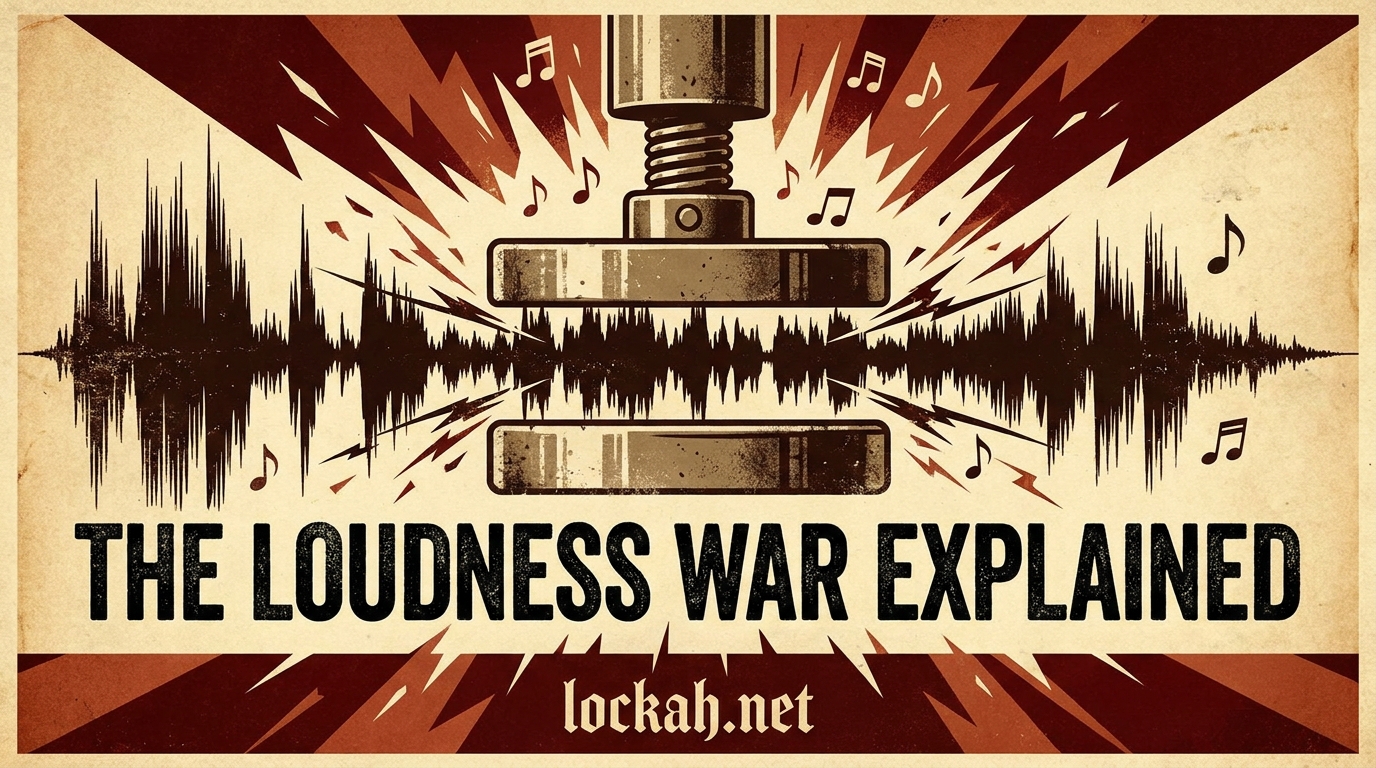
The loudness war is not completely over, but streaming normalization has fundamentally changed the game since 2026. If you are wondering whether cranking your master to maximum volume still gives you an advantage, the answer is more complicated than a simple yes or no. For streaming listeners, the war is effectively finished. Loud tracks get turned down automatically, eliminating the competitive advantage that drove decades of hyper-compression.
But for certain genres and contexts, the battle rages on. Club music, radio play, and specific streaming scenarios still reward loudness in ways that keep mastering engineers reaching for their limiters.
In this guide, I will explain exactly what the loudness war is, how it started, why it mattered, and what streaming normalization means for the future of music quality. Whether you are a casual listener curious why modern music sounds different from classics, or a producer trying to make sense of conflicting loudness advice, you will find answers here.
Table of Contents
What is the Loudness War?
The loudness war refers to the competitive trend of increasing audio levels in recorded music, which reduces audio fidelity and listener enjoyment. Mastering engineers have been gradually pushing recordings louder and louder since the 1980s, sacrificing dynamic range in the process.
Dynamic range is the difference between the quietest and loudest parts of a recording. When you compress that range, you lose the natural ebb and flow that makes music breathe. A kick drum that should punch through the mix gets flattened. Vocals that should soar over the instrumentation get squashed against a ceiling.
The incentive was simple: louder recordings stood out. When listeners compared tracks on radio, CD, or early digital formats, the louder one often sounded more exciting, more immediate, more professional. Radio stations used heavy compression and limiting to ensure consistent levels between songs. Record labels wanted their tracks to hit harder than the competition.
By the 2000s, this competition reached absurd extremes. Albums were being mastered so loud that the audio waveform looked like a solid brick. There was no room left for the music to breathe. Distortion crept in. Transient details that give instruments their character were obliterated.
A Brief History of the Loudness War (2026)
The seeds were planted in the 1980s when the compact disc format arrived with its 16-bit, 44.1kHz digital specification. CDs offered much more headroom than vinyl records. Engineers realized they could push levels higher than ever before without the physical limitations of groove width and stylus tracking.
During the 1990s, multi-band compression became affordable and widespread. This technology allowed engineers to squeeze different frequency ranges independently, making tracks sound louder without obvious distortion. The arms race intensified.
The 2000s brought us the most infamous examples. Metallica’s “Death Magnetic” (2008) became a symbol of everything wrong with the loudness war. The CD version was so crushed that fans petitioned for a remaster. Red Hot Chili Peppers’ “Californication” (1999) suffered similar criticism, with clipping audible throughout the album.
By the early 2010s, backlash emerged. Mastering engineer Ian Shepherd launched Dynamic Range Day in 2011 to raise awareness. Organizations like Turn Me Up! advocated for more dynamic releases. Some artists began releasing less compressed versions of their albums. The tide was slowly turning.
Then streaming exploded. By the late 2010s, Spotify, Apple Music, and other platforms began implementing loudness normalization. This changed everything. Suddenly, your hyper-compressed master did not actually sound louder than your competitor’s dynamic one. The streaming service just turned yours down.
How the Loudness War Works: Compression, Limiting, and Headroom
To understand why the loudness war damaged audio quality, you need to grasp a few technical concepts. Do not worry, I will keep this accessible.
Dynamic Range and Why It Matters
Dynamic range is the span between the softest and loudest sounds in a recording. Think of a symphony orchestra. There are whisper-quiet string passages and thunderous crescendos. That contrast creates emotion, tension, and release.
Popular music naturally has less dynamic range than classical, but it still needs some. A snare hit should be louder than a vocal. The chorus should hit harder than the verse. Without dynamic range, everything sits at the same level and music becomes fatiguing to listen to.
Compression and Limiting Explained
Dynamic range compression is a tool that reduces the volume of loud sounds or amplifies quiet sounds. Used tastefully, it evens out a performance and helps instruments sit together. Used aggressively, it destroys dynamics.
A limiter is essentially a super-fast compressor that sets a ceiling nothing can pass. “Brickwall” limiting slams against that ceiling, allowing engineers to boost the overall level of a track while preventing digital clipping.
Here is the problem: when you push against that brickwall, transients get shaved off. The initial attack of a drum, the pluck of a guitar string, the breath before a vocal phrase, all lose definition. The result sounds loud but flat.
Understanding LUFS and dBFS
Modern loudness measurement uses LUFS (Loudness Units Full Scale), a standard that accounts for human hearing perception. Unlike the older dBFS (decibels relative to full scale) which only measures peak levels, LUFS measures perceived loudness over time.
LUFS uses K-weighting, a frequency curve that matches how we actually hear. We are more sensitive to midrange frequencies than extreme highs and lows. LUFS accounts for this.
Integrated LUFS measures the average loudness of an entire track. This is what streaming services use for normalization. Short-term and momentary LUFS measure loudness over shorter windows, useful for checking consistency.
Loudness range (LRA) measures the variation in loudness throughout a track. Higher LRA means more dynamic contrast. A heavily compressed pop track might have an LRA of 3 LU. A dynamic jazz recording might hit 12 LU or more.
Why Louder Masters Sound Worse
When you push a master louder using limiting, several things happen. First, you reduce crest factor, the difference between peak and average levels. A dynamic recording has high crest factor with big peaks. A crushed recording has low crest factor because peaks are flattened.
Second, distortion increases. Even “transparent” limiters add harmonics when working hard. Pushed too far, you get audible clipping and harshness.
Third, punch and impact disappear. A limited kick drum loses its attack. The result sounds loud on meters but lacks the physical impact that makes you feel the music in your chest.
How Streaming Service Normalization Changed Everything?
Streaming normalization is the single biggest factor in ending the loudness war. Understanding how it works explains why the incentive structure that drove decades of hyper-compression has collapsed.
What is Loudness Normalization?
Loudness normalization adjusts playback volume so all tracks hit a consistent perceived loudness level. Instead of some songs blasting while others whisper, everything plays at roughly the same volume.
This happens automatically. You do not need to adjust your volume knob between tracks. The streaming service measures each track’s integrated LUFS and applies gain adjustment accordingly.
If your track is mastered to -8 LUFS (very loud) and the platform targets -14 LUFS, the service turns your track down by 6 dB. Conversely, a dynamic track at -16 LUFS gets turned up by 2 dB. In the end, both play at the same perceived loudness.
Streaming Platform Target LUFS Levels
Different platforms target slightly different loudness levels. Here is the current landscape in 2026:
| Platform | Target LUFS | Normalization Behavior |
|---|---|---|
| Spotify | -14 LUFS | Normalizes all content; loud tracks turned down |
| Apple Music | -16 LUFS | Sound Check enabled by default on most devices |
| YouTube Music | -14 LUFS | Normalizes streaming content |
| Amazon Music | -14 to -16 LUFS | Normalization varies by device |
| Tidal | -14 LUFS | Loudness normalization enabled by default |
| Deezer | -15 LUFS | Normalizes all tracks to target |
Most platforms aim for approximately -14 to -16 LUFS integrated. This is significantly quieter than the -8 to -6 LUFS that many commercial releases were targeting during the peak of the loudness war.
The New Reality for Mastering Engineers
In the old CD era, mastering to -8 LUFS gave you a real advantage. Your track literally played louder than a -14 LUFS master when someone hit play. On streaming, that advantage vanishes.
Worse, the hyper-compressed -8 LUFS master actually sounds worse after normalization. When both tracks are adjusted to -14 LUFS, the dynamic master had room to breathe. The crushed master is still crushed, but now it is not even louder to compensate. You get all the distortion and none of the perceived volume benefit.
This is why mastering engineers now recommend targeting approximately -14 LUFS integrated for streaming. You avoid the normalization penalty, preserve dynamics, and your music sounds better than over-compressed competition when normalized.
User Control and Platform Variations
Most platforms allow users to disable normalization, though most listeners never do. On Spotify, the “Normalize loudness” setting is on by default. Apple Music’s Sound Check works similarly.
Some platforms handle normalization differently. Spotify offers three loudness settings: Quiet (-23 LUFS), Normal (-14 LUFS), and Loud (-11 LUFS). YouTube Music has faced criticism for aggressive normalization that affects dynamic content.
Even with variations, the fundamental shift is clear: making your master louder than -14 LUFS no longer provides a competitive advantage for streaming listeners.
Is the Loudness War Really Over?
Now for the question that brought you here. Is the loudness war actually over? The honest answer is complicated.
The Case for Yes: The War is Over
For the majority of music consumption, the loudness war has ended. Streaming normalization eliminated the primary incentive that drove the arms race. A loud master no longer sounds louder on Spotify, Apple Music, YouTube, Amazon, or Tidal. It just gets turned down.
Professional mastering engineers have largely adapted. The recommendation to master at -14 LUFS for streaming is now standard advice. Younger producers growing up in the streaming era never experienced the old pressure to compete on raw loudness.
Dynamic range is making a comeback. Compare modern releases to mid-2000s atrocities, and you will generally find more breathing room. The worst excesses of the loudness war have receded.
The Case for No: The War Continues
Despite streaming normalization, loudness competition persists in several contexts. Radio broadcasting still uses heavy compression and limiting. Radio stations want consistent levels between songs and advertisements. A track that is already crushed tends to survive the broadcast chain better than a dynamic one.
Club and DJ culture maintains pressure for loud masters. DJs often play tracks back-to-back without normalization. In a club sound system, a louder track can hit harder and get a better crowd response. Genres like EDM, hip-hop, and pop still push loudness aggressively for this reason.
Downloads and physical media remain relevant. CDs, vinyl, and digital downloads do not have built-in normalization. Someone buying your album on Bandcamp or spinning your vinyl hears exactly what you mastered. If they compare your -14 LUFS master to a competitor’s -8 LUFS banger, yours might sound less immediate.
Some streaming scenarios bypass normalization. When users disable the setting, or when platforms handle it inconsistently, loudness differences reappear. A small competitive advantage still exists at the margins.
The Genre Factor
Different genres approach loudness differently. Classical and jazz largely avoided the loudness war entirely, preserving wide dynamic range. Acoustic and folk music similarly maintained dynamics.
Rock and pop fell deepest into the loudness war trap during the 2000s but have recovered somewhat. Modern rock often targets -12 to -14 LUFS, more reasonable than the -6 LUFS extremes of the past.
EDM, trap, and modern hip-hop still push loudness harder than other genres. These styles often target -9 to -10 LUFS, accepting some dynamic sacrifice for club and car stereo impact.
The Balanced Truth
The loudness war as we knew it, the era where every release tried to be louder than the last regardless of quality, is over. Streaming normalization killed that incentive completely.
But a more nuanced form of loudness competition continues. Context matters. A producer making ambient music for headphone listening can safely embrace -16 LUFS or quieter. A producer making festival trap needs to consider that their track might get played alongside unnormalized bangers at 2 AM in a warehouse.
The smart approach in 2026 is context-aware mastering. Target -14 LUFS for the streaming version. Create a louder alternative for club/radio contexts if needed. Provide dynamic options for audiophile formats. The goal is no longer maximum loudness at all costs, but appropriate loudness for each use case.
Frequently Asked Questions
Are loudness wars over?
The loudness war has largely ended for streaming music due to normalization, but competition for loudness continues in radio, club, and physical media contexts. For most listeners using Spotify, Apple Music, or other streaming services, the war is effectively over because loud tracks simply get turned down to match quieter ones.
What ended the loudness war?
Streaming service loudness normalization ended the loudness war. When platforms like Spotify and Apple Music automatically adjust all tracks to the same perceived loudness level, the competitive advantage of making masters louder disappears. A hyper-compressed master at -8 LUFS gets turned down to match a dynamic master at -14 LUFS, making the crushed version sound worse without any volume benefit.
Is loudness war real?
Yes, the loudness war is a real phenomenon that affected decades of music production. It refers to the competitive trend of increasing audio levels in recorded music through aggressive compression and limiting, which reduces dynamic range and audio fidelity. Evidence is visible in waveform comparisons of albums from the 1980s versus the 2000s, with modern releases often showing brickwall limiting and reduced transient detail.
What LUFS should I master to?
For streaming platforms in 2026, target approximately -14 LUFS integrated with -1 dB true peak. This matches most platform normalization targets and avoids the penalty that hyper-compressed masters receive. For club or radio contexts where normalization does not apply, you may master louder (-9 to -11 LUFS) depending on genre expectations. Classical and jazz can comfortably target -16 LUFS or quieter.
Conclusion: What This Means for You
The loudness war explained and whether it is really over comes down to understanding context. For streaming listeners, the war has ended. Your favorite playlist normalizes everything to consistent levels regardless of how the original was mastered.
For music creators, the landscape has shifted from “louder is always better” to “appropriate loudness for the context.” Master at -14 LUFS for streaming releases. Consider a louder version for club play. Preserve dynamics whenever possible because they translate better across all playback systems.
If you are a listener, you can mostly relax. Your streaming service has your back. If you hear distortion or fatigue in modern music, it is likely from artistic choices rather than mastering mistakes. Seek out dynamic releases when you want to experience music with full emotional range.
The loudness war taught us valuable lessons about audio quality and the dangers of competitive pressure. As we move deeper into the streaming era, those lessons are finally being applied. Music in 2026 sounds better, on average, than it did fifteen years ago. The arms race may not be completely over, but the peace treaty is holding.