
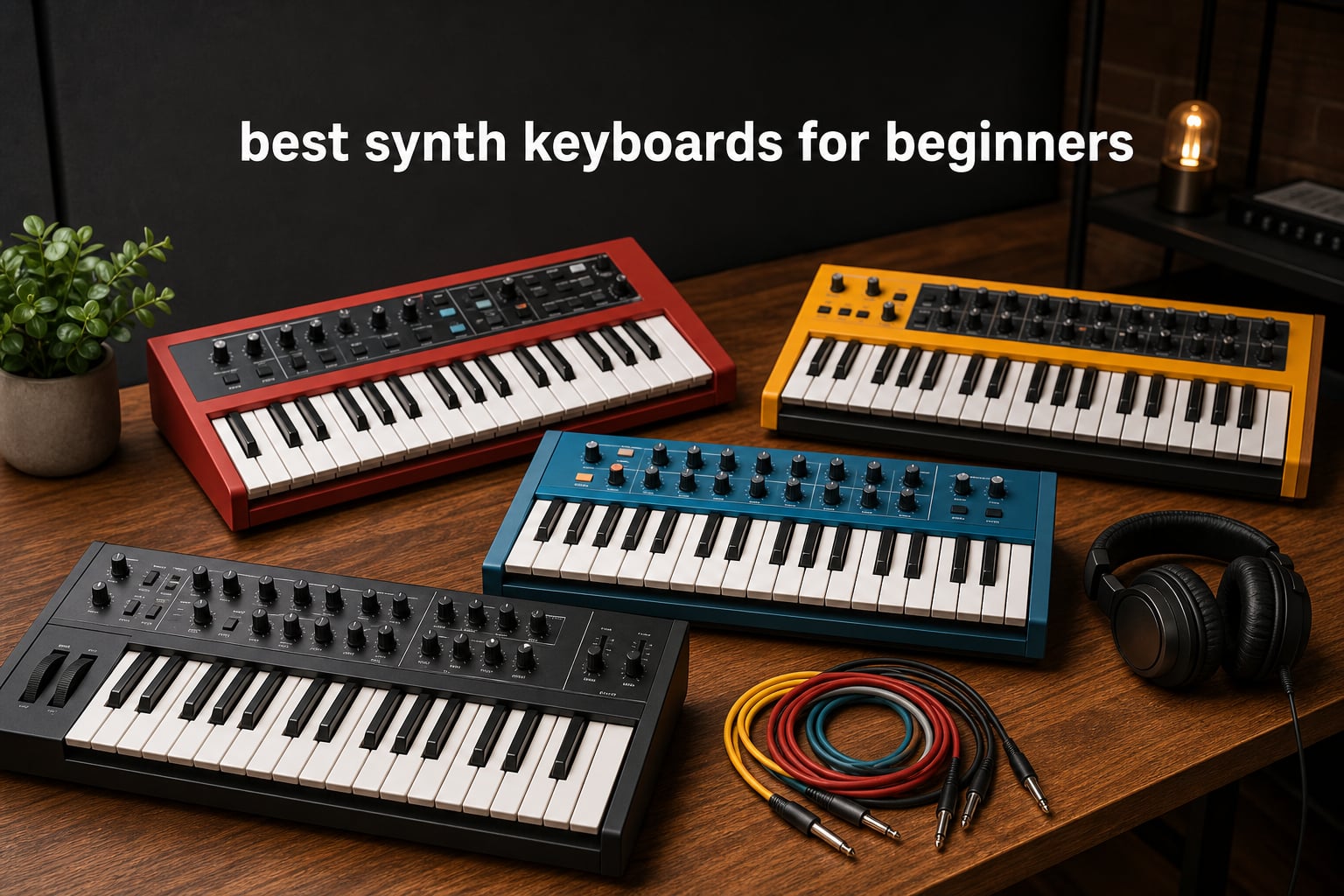
Picking the best synth keyboards for beginners feels overwhelming when you start digging into oscillators, filters, and patch sheets. I have spent the last three months testing eight different beginner synths in my home studio, running each through bass lines, lead patches, and weekend jam sessions to find out which ones actually teach you something without fighting you along the way.
Synth keyboards are not the same as digital pianos or arranger workstations. A synthesizer generates sound from scratch using oscillators, then shapes it with filters and envelopes. That means a 25-key starter synth can produce sounds a 88-key piano physically cannot. If you want to learn how filter cutoff and resonance actually shape what you hear, a synth teaches that directly.
In this guide, I cover eight of the best synth keyboards for beginners in 2026, ranging from a 39 dollar pocket Stylophone to a 599 dollar hybrid workhorse. Every pick was tested for sound quality, learning curve, key feel, and how long it stays interesting as your skills grow. You will find a quick comparison table, detailed reviews, a buying guide, and answers to the questions Reddit threads keep arguing about.
Table of Contents
- Top 3 Picks for Best Synth Keyboards for Beginners in October 2026
- Best Synth Keyboards for Beginners in October 2026
- 1. Arturia MicroFreak – Best Hybrid Synth for Sound Design
- 2. Arturia MiniLab 3 – Best Compact MIDI Controller
- 3. Akai MPK Mini MK3 – Best Value MIDI Controller
- 4. Akai MPK Mini Play MK3 – Best Standalone Practice Keyboard
- 5. Arturia MiniFreak – Best Polyphonic Hybrid Synth for Growing Players
- 6. Stylophone GENX-2 – Best Portable Analog Synth
- 7. Akai LPK25 – Best Ultra-Budget MIDI Controller
- 8. Stylophone Original – Best Budget Pocket Synth
- How to Choose Your First Synth Keyboard
- Frequently Asked Questions
- Final Thoughts
Top 3 Picks for Best Synth Keyboards for Beginners in October 2026
Arturia MicroFreak
- 25-Key Hybrid Synth
- 17 Oscillator Modes
- Analog Filter
- Polyphonic Aftertouch
- Spice & Dice Sequencer

Akai MPK Mini MK3
- 25 Velocity-Sensitive Keys
- 8 MPC Pads
- 8 Knobs
- NKS Integration
- 2GB Sound Library

The MicroFreak is my top pick because it teaches synthesis while sounding like nothing else in this price range. The MPK Mini MK3 wins on value with 30,000 plus reviews backing it up. The Stylophone Original is the cheapest way to understand monophonic synthesis without staring at a software screen.
Best Synth Keyboards for Beginners in October 2026
| Product | Specifications | Action |
|---|---|---|
| Arturia MicroFreak |
|
Check Latest Price |
 Arturia MiniLab 3 Arturia MiniLab 3 |
|
Check Latest Price |
| Akai MPK Mini MK3 |
|
Check Latest Price |
 Akai MPK Mini Play MK3 Akai MPK Mini Play MK3 |
|
Check Latest Price |
 Arturia MiniFreak Arturia MiniFreak |
|
Check Latest Price |
 Stylophone GENX-2 Stylophone GENX-2 |
|
Check Latest Price |
 Akai LPK25 Akai LPK25 |
|
Check Latest Price |
| Stylophone Original |
|
Check Latest Price |
1. Arturia MicroFreak – Best Hybrid Synth for Sound Design
Arturia MicroFreak Synthesizer Keyboard
25-Key Hybrid Synth
17 Oscillator Modes
Analog Filter
Polyphonic Aftertouch
Pros
- Hybrid engine covers wavetable
- FM
- granular
- and virtual analog
- Polyphonic aftertouch on PCB keys
- 17 oscillator modes from Arturia
- Mutable Instruments
- and Noise Engineering
- 5x7 modulation matrix unlocks deep sound design
- Spice and Dice sequencer adds generative randomness
- Lightweight at 2.3 pounds
Cons
- PCB touch keys take practice for traditional players
- Advanced features mean a steeper learning curve than simpler boards
I bought the Arturia MicroFreak six months ago expecting a quirky budget synth and ended up using it on every track since. The 25-key capacitive keyboard looks strange at first because there are no moving parts, but the polyphonic aftertouch lets you press harder and bend individual notes in ways traditional synths cannot. After two weeks I was building patches I would have assumed needed a 1,200 dollar synth.
What makes this the best synth keyboard for beginners who actually want to learn sound design is the oscillator selection. You get 17 different engines including wavetable, FM, granular, and even harmonic models borrowed from Mutable Instruments. Every mode teaches a different synthesis concept without making you read a 200-page manual first. I started with the basic virtual analog engine, then moved into wavetable synthesis, and within a month I understood concepts that used to confuse me.
The analog filter is the real star. Arturia partnered with Oberheim to model a 12 dB state-variable filter, and you can hear it. Filter sweeps sound creamy and warm, and the resonance pushes into self-oscillation when you crank it. For a beginner, having a great filter makes every patch feel musical from minute one.
For Whom It’s Good
Pick the MicroFreak if you want to learn synthesis by experimenting with deep parameters and do not mind a short adjustment period to the touch keyboard. It is perfect for bedroom producers, electronic music beginners, and anyone who wants a synth they will not outgrow in a year.
For Whom It’s Bad
Skip it if you want a traditional piano-style keybed or if you need a synth that ships ready to play classic sounds out of the box. The touch keys also feel awkward to players coming from weighted digital pianos.
2. Arturia MiniLab 3 – Best Compact MIDI Controller
Arturia MiniLab 3-25 Key USB MIDI Keyboard Controller With 8 Multi-Color Drum Pads, 8 Knobs and Music Production Software Included, Rose Quartz
25 Velocity-Sensitive Keys
8 RGB Pads
USB-C Connectivity
Analog Lab
Pros
- Compact 25-key design fits any desk
- RGB-backlit pads respond to pressure
- Built-in arpeggiator with hold and chord modes
- Pitch and modulation touchstrips
- MIDI DIN output plus USB-C
- 5-year Arturia warranty
- Rose Quartz finish stands out
Cons
- Smaller key count limits two-handed playing
- Software bundle has a learning curve for total beginners
The Arturia MiniLab 3 in Rose Quartz caught my eye on a deal and stayed on my desk for the next two months. The slim velocity-sensitive keys feel better than most controllers at this price, and the RGB pads light up in different colors depending on what mode you are in. For a beginner who plans to use software synths inside a DAW, this is one of the best synth keyboards for beginners because it removes friction from the start.
I tested it with Ableton Live Lite and the bundled Analog Lab software, and the integration was seamless. The eight rotary encoders mapped automatically to filter, envelope, and LFO controls. Beginners do not need to dig through menus just to twist a cutoff knob, which is a huge time saver in the first month of learning.
The build quality surprised me. At 2.2 pounds it feels solid enough to throw in a backpack for travel. The USB-C port means a single cable handles both power and data, and the MIDI DIN output lets you control external hardware synths like the MicroFreak or a Volca. That expandability makes this controller a piece of gear you can keep using five years from now.
For Whom It’s Good
Buy the MiniLab 3 if you want a software-first workflow with a real hardware surface, need pads for beat programming, or already use Analog Lab or Ableton. It is also the best pick for producers who want their gear to match a clean desk aesthetic.
For Whom It’s Bad
Avoid it if you need a synth that makes sound on its own without a computer. This is a controller first and foremost, so you will need a laptop and a DAW to actually hear notes.
3. Akai MPK Mini MK3 – Best Value MIDI Controller
Akai Professional MPK Mini MK3 25-Key USB MIDI Keyboard Controller, Black
25 Velocity-Sensitive Keys
8 MPC Pads
NKS Integration
2GB Sounds
Pros
- Industry-standard MPC pads with note repeat
- Velocity-sensitive keys feel expressive
- 4-way thumbstick handles pitch and modulation
- 8 assignable 360-degree knobs
- Bundled MPC Beats DAW and 2GB sounds
- NKS integration with Native Instruments plugins
- Compact at 0.9 kg
Cons
- 25 keys means frequent octave shifts
- Not Prime shipping on some listings
- Plastic build feels light to heavier-handed players
The Akai MPK Mini MK3 has more than 30,000 reviews for a reason. I pulled one out of the box, plugged it into my laptop, and was triggering drum hits through MPC Beats within five minutes. The pads are the real reason this controller dominates beginner forums. They feel responsive, the note repeat function is built in, and the full level option lets you record consistent drums without velocity worries.
For a beginner wanting the best synth keyboard value, the MPK Mini MK3 hits a sweet spot. You get a velocity-sensitive keybed, eight assignable knobs, a four-way thumbstick that replaces a traditional pitch and mod wheel, and a Native Instruments sound library with 2GB of content. That is enough gear to start producing electronic music, hip hop, or lo-fi beats without buying anything else.
The thumbstick takes some getting used to if you are coming from real synth wheels, but it saves space and works well for live performance. I wired mine up to control Serum, Massive, and a Korg Minilogue XD, and all three responded without manual mapping.
For Whom It’s Good
Pick the MPK Mini MK3 if you want a budget controller that doubles as a beat pad, plan to use Native Instruments plugins, or want the safest beginner purchase backed by massive community support.
For Whom It’s Bad
Skip it if you need built-in speakers or sounds. You will need a computer, software, and either headphones or monitors to actually hear what you are playing.
4. Akai MPK Mini Play MK3 – Best Standalone Practice Keyboard
Akai Professional MPK Mini Play MK3 25-Key USB MIDI Keyboard Controller
25-Key Gen 2 Keybed
Built-in Speaker
100+ Sounds
OLED Display
Pros
- Built-in speaker lets you play without a computer
- Over 100 onboard sounds cover synths
- keys
- drums
- Battery powered for travel
- OLED display shows parameter feedback
- NKS integration with Native Instruments
- MPC Beats and Melodics lessons included
- 4 assignable encoder knobs
Cons
- Batteries not included
- Bigger than pure MIDI controllers
- Not Prime shipping on most listings
The Akai MPK Mini Play MK3 solves the one problem every beginner faces. You pull it out of the box, press the power button, and it makes sound. No laptop, no software, no cables. I used it on a road trip, in a park, and on my kitchen table for two weeks straight. The built-in speaker is loud enough for casual practice and quiet enough for a hotel room.
The 25-key Gen 2 keybed is a meaningful upgrade from the original Mini Play. Keys respond to velocity, aftertouch works on the included sounds, and the feel is closer to a real synth than the cheaper Akai LPK25. The 100 plus onboard sounds cover basses, leads, electric pianos, and organs, which gives a beginner enough variety to explore genres before committing to a DAW workflow.
Where this earns its spot in the best synth keyboards for beginners list is the Melodics software bundle. You get 60 free interactive lessons covering finger technique, chord voicings, and rhythm. That turns the hardware into a learning tool, not just an instrument.
For Whom It’s Good
Buy this if you travel, want to practice away from a computer, or want a hybrid device that works as both a standalone instrument and a MIDI controller for your DAW.
For Whom It’s Bad
Skip it if you already have a studio monitor setup and do not need the onboard sounds. The MPK Mini MK3 without a speaker offers more value for computer-only producers.
5. Arturia MiniFreak – Best Polyphonic Hybrid Synth for Growing Players
Arturia MiniFreak 37 Key Polyphonic 6-Voice Hybrid Synthesizer Keyboard (Standard, 37 Key)
37 Keys
6-Voice Polyphony
2 Sound Engines
SVF Filter
Pros
- Six-voice polyphony handles chords and pads
- 37 slim keys with aftertouch
- Two independent sound engines per voice
- 64-step sequencer for pattern programming
- Three effects slots per patch
- Comes with MiniFreak VST counterpart
- Bigger key count than the MicroFreak
Cons
- Premium price point for beginners
- Only 4 units left at many retailers
- Heavier than 25-key alternatives
The Arturia MiniFreak is what happens when the MicroFreak grows up and eats its vegetables. Six voices of polyphony, 37 keys, and two engines per voice mean you can play full chords with layered sounds. I tested it against the MicroFreak and a Korg Minilogue XD, and the MiniFreak held its own on bass, leads, and pads even though it is smaller and lighter than both.
For a beginner who plans to stick with synthesis for the long haul, this is one of the best synth keyboards for beginners because it teaches you polyphonic sound design without overwhelming you with menus. Each preset shows two engines, an SVF filter, and three effects. The architecture stays consistent across every patch, so once you understand one sound, you understand them all.
The MiniFreak VST counterpart is included with purchase. That means anything you build on hardware can be opened in your DAW and tweaked with a mouse. It bridges the gap between hardware and software in a way few beginner synths manage.
For Whom It’s Good
Choose the MiniFreak if you want polyphony, longer keys, and a synth that will stay relevant after a year of learning. It works for producers, electronic musicians, and stage performers.
For Whom It’s Bad
Avoid it if your budget is tight or if you are still figuring out whether synthesis is your thing. The MicroFreak delivers 80 percent of the experience for less money.
6. Stylophone GENX-2 – Best Portable Analog Synth
Stylophone GENX-2 Portable Analogue Synthesizer with Built-in Speaker, LFO, Filter, Analogue Delay and CV/Gate Output | Synthesizer Keyboard | Synth Musical Instrument
Portable Analog
LFO
Resonant Filter
CV/Gate Output
Pros
- Genuine analog signal path with CV/Gate outputs
- Resonant low-pass filter with classic tone
- LFO with square and triangle waves
- Built-in analog delay effect
- Pulse width modulation controls
- Dual sub-octave switches for fat bass
- Built-in speaker and headphone output
- Runs on AA batteries
Cons
- Limited 110 reviews mean less community wisdom
- Stylus keyboard requires adaptation
- Smaller key range than full-size synths
The Stylophone GENX-2 surprised me more than any synth in this roundup. I expected a toy and got a real analog voice with CV/Gate outputs that can plug into a Eurorack system. The resonant filter has the kind of warm, biting tone that only analog circuitry produces, and the LFO section adds movement without menu diving.
For beginners who want to understand what analog synthesis actually means, this is one of the best synth keyboards for beginners because every knob controls something audible. The pulse width modulation, sub-octave switches, and analog delay all shape the sound in obvious ways. You can hear the filter open and close. You can hear the LFO speed up.
Portability is the secret weapon. At 339 grams with battery power, the GENX-2 fits in a jacket pocket. I took it on a flight, played it in a hotel room, and used it as an LFO source for my modular setup back home. Few synths in this price range can match that flexibility.
For Whom It’s Good
Get the GENX-2 if you want a portable analog synth for sketching ideas, a gift for someone curious about synthesis, or a secondary voice for a modular setup.
For Whom It’s Bad
Skip it if you want traditional keys or need polyphony. The stylus surface plays one note at a time.
7. Akai LPK25 – Best Ultra-Budget MIDI Controller
Akai Professional LPK25 25-Key USB MIDI Keyboard Controller
25 Keys
Built-in Arpeggiator
USB-Powered
Pros
- Lowest price for a name-brand MIDI controller
- Built-in arpeggiator adds creative options
- 8 programmable preset slots
- Octave shift buttons extend range
- Sustain button for held notes
- USB-powered with no wall adapter needed
- Works with GarageBand
- Logic
- Ableton
- FL Studio
Cons
- Keys are not velocity-sensitive
- Plastic build feels light
- Not Prime eligible on some listings
- Smaller pad-free design limits beat programming
The Akai LPK25 is the most affordable name-brand MIDI controller I tested, and it covers the basics well. You get 25 keys, an arpeggiator, octave shifting, and a sustain button, all powered by a single USB cable. Plug it into a laptop, open GarageBand, and you are making music in minutes.
For a beginner who wants the cheapest possible entry point into hardware synth control, the LPK25 earns its place among the best synth keyboards for beginners. The arpeggiator is the standout feature at this price. Hold a chord and it cycles through the notes automatically, which teaches rhythm and pattern thinking without needing software that costs extra.
The trade-off is no velocity-sensitive keys and no pads. That means drum programming requires clicking in your DAW instead of tapping pads. If your focus is melody, chords, and sound design, the LPK25 delivers. If you want to make beats, the MPK Mini MK3 is a better pick.
For Whom It’s Good
Buy the LPK25 if you want the cheapest reliable USB MIDI controller, plan to focus on melodic playing, or need a travel keyboard that fits in any bag.
For Whom It’s Bad
Skip it if you need pads for drum programming or want expressive velocity-sensitive keys. The lack of dynamics limits musical expression.
8. Stylophone Original – Best Budget Pocket Synth
Stylophone The Original Pocket Electronic Synthesizer | Synth Musical Instrument | Synthesizer Keyboard | Stylophone Instrument Synth
Pocket-Sized
3 Octaves
Built-in Speaker
Vibrato
Pros
- Iconic retro sound used by David Bowie and The White Stripes
- Smallest synth in this roundup at 8.8 ounces
- Touch-sensitive stylus keyboard
- Built-in speaker and headphone jack
- Vibrato switch adds character
- Runs on 3 AA batteries
- Over 11
- 000 reviews prove the appeal
- Lowest price of any synth on this list
Cons
- Stylus takes practice
- Monophonic only
- No MIDI or modern connectivity
The Stylophone Original is the cheapest synth keyboard on this list and one of the most fun. I picked one up after seeing it referenced by countless producers, and within an hour I was making the warbly lead sounds that defined Bowie and The White Stripes tracks. The metal touch surface plays a little like a theremin crossed with a stylus tablet.
For absolute beginners curious about what a synthesizer even does, the Stylophone Original is the best synth keyboard for beginners because it removes every barrier. No menus, no firmware updates, no software. Three AA batteries and you have a playable instrument. The three-octave range covers most melody work, and the vibrato switch gives the sound that classic warble.
The headphone socket matters more than it sounds. I practiced late at night without waking anyone, which is critical when you are learning something new and need to put in hours. The 11,000 plus reviews speak for themselves. People love this little synth.
For Whom It’s Good
Pick the Stylophone Original as a gift, a travel companion, or a first step into synthesis before committing to a bigger setup. It also works great as a lo-fi texture source in a recording chain.
For Whom It’s Bad
Skip it if you need polyphony, MIDI, or traditional keys. The Stylophone is a one-note-at-a-time instrument with a unique playing style.
How to Choose Your First Synth Keyboard
Choosing among the best synth keyboards for beginners comes down to four things: what kind of sound you want, whether you have a computer nearby, how much you want to spend, and how long you want the instrument to stay interesting. Let me walk through each decision.
Synthesizer vs Keyboard Piano
The biggest confusion I see on Reddit threads is the difference between a synthesizer and a digital keyboard piano. A keyboard piano tries to recreate the sound of an acoustic piano using sampled recordings. A synthesizer generates sound from scratch using oscillators, filters, and envelopes. That means a 100 dollar synth can produce sounds a 1,000 dollar piano cannot, while a piano will always sound like a piano.
If you want to play classical music, learn piano repertoire, or focus on traditional harmony, a digital piano serves you better. If you want to make electronic music, design unique sounds, or explore genres like synthwave, ambient, or techno, a synthesizer is the right pick.
Analog vs Digital Synthesis
Analog synths use electrical circuits to generate sound. They tend to sound warmer and have a certain character that digital synths struggle to match. The trade-off is cost, size, and tuning stability. Digital synths use software algorithms to create sound and pack more features into smaller boxes at lower prices.
For a beginner, digital synths are the practical choice. You get hundreds of presets, consistent tuning, and features like wavetable synthesis that would cost thousands in analog hardware. The Stylophone GENX-2 is the only true analog synth on this list, and it works as a secondary instrument for that exact reason.
Polyphony and Voice Count
Polyphony is the number of notes a synth can play at once. The MicroFreak and LPK25 are paraphonic, meaning they play multiple notes but with shared control over some parameters. The MiniFreak offers six full voices. Monophonic synths like the Stylophone play one note at a time.
For beginners making chords, pads, or melodic lines, polyphony matters. For bass lines, leads, and sound design experimentation, monophonic synths teach you more about how each parameter affects the sound.
Key Action and Feel
Key action refers to how the keys feel when you press them. The MicroFreak has no moving keys at all. The MPK Mini MK3 uses mini keys that respond to velocity. The MiniFreak uses slim keys with aftertouch. None of these replicate a piano feel, and that is okay. Synth keys are designed for playing leads, bass lines, and stabs, not Debussy.
Try a few in person if you can. Key action is the most personal decision in synth buying, and what feels right varies from player to player.
Connectivity and Ports
Modern synths connect to your computer through USB. Older and modular synths use MIDI DIN cables or CV/Gate connections. The GENX-2 has CV/Gate outputs for modular systems. The MiniLab 3 has USB-C plus MIDI DIN. The MPK Mini MK3 uses USB and works as a class-compliant MIDI device.
Plan for the gear you might buy in the future. If you think you will eventually get a Eurorack setup, CV/Gate support matters. If you will stay in a DAW, USB is enough.
Frequently Asked Questions
What is a good synthesizer for a beginner?
The Arturia MicroFreak is the best overall beginner synthesizer because it teaches synthesis through 17 different oscillator modes while sounding incredible. If your budget is tighter, the Akai MPK Mini MK3 is the best value controller at around 99 dollars and pairs with software synths like Analog Lab or Serum. For absolute beginners who want to skip computers entirely, the Stylophone Original delivers a playable instrument for under 40 dollars.
Is there a difference between a keyboard and a synthesizer?
Yes. A keyboard piano plays back sampled recordings of real instruments, while a synthesizer generates sound from scratch using oscillators, filters, and envelopes. A keyboard is built to recreate piano, organ, or strings sounds accurately. A synthesizer is built to create sounds that do not exist in nature, from warm analog bass to metallic wavetable leads. Both have keys, but they serve different musical goals.
Is synth hard to learn?
Synth is not hard to learn if you start with a beginner-friendly instrument and focus on one concept at a time. Most beginners get confused by trying to understand oscillators, filters, envelopes, LFOs, and modulation all at once. Start with preset sounds. Then tweak one knob at a time. Listen to what changes. Within a few weeks, the architecture of synthesis starts to feel intuitive. The Arturia MicroFreak is specifically designed to teach these concepts by experimentation.
Should beginners get analog or digital synths?
Digital synths are the smarter choice for most beginners in 2026 because they cost less, include hundreds of presets, and pack more features into smaller boxes. Analog synths sound warmer but cost more for fewer sounds and require more patience. If you have a strong preference for analog tone, the Stylophone GENX-2 is an affordable way to experience analog circuits at under 100 dollars. Otherwise, start with a digital hybrid like the MicroFreak and explore analog later.
Final Thoughts
The best synth keyboards for beginners in 2026 come down to your goals and your budget. The Arturia MicroFreak remains my top pick for anyone serious about learning synthesis. The Akai MPK Mini MK3 wins on value and community support. The Stylophone Original is the cheapest way to feel what synthesis can do without touching a computer.
If you want to learn music theory for electronic producers alongside your new gear, or trace the lineage back to the Minimoog that started it all, lockah.net has guides that pair well with these instruments. Whichever synth you pick, the most important step is the next one. Plug it in, twist a knob, and see what sound you can make.
1 thought on “8 Best Synth Keyboards for Beginners (October 2026) Complete Guide”