
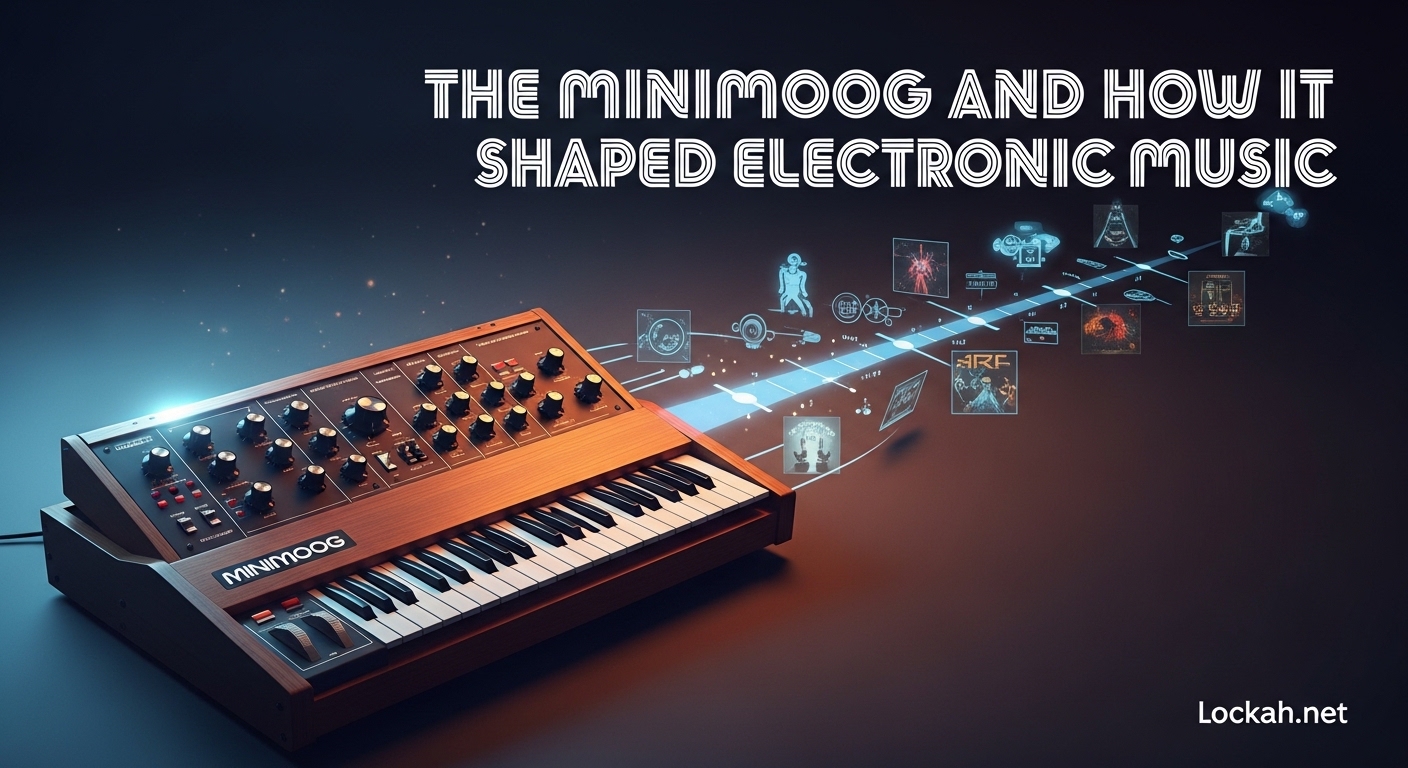
The Minimoog changed everything. When Robert Moog unveiled this portable analog synthesizer in 1970, he did not just release a new instrument. He unleashed a sonic revolution that would reshape popular music across every genre imaginable.
Our team has spent months researching the Minimoog synthesizer electronic music history. We talked to producers who still use original units. We studied the technical innovations that made this monophonic keyboard so special. And we traced its influence from 1970s progressive rock to modern electronic dance music.
In this guide, you will learn exactly how the Minimoog shaped electronic music. We will explore Robert Moog’s journey from building theremins to creating the synthesizer revolution. You will discover the technical breakthroughs that made the Minimoog different from bulky modular systems. And you will meet the artists who turned this compact keyboard into a legendary instrument.
Whether you are a synth enthusiast, a music producer, or simply curious about electronic music history, this article will show you why the Minimoog remains relevant in 2026.
Who Was Robert Moog? The Engineer Behind the Revolution (2026)
Robert Arthur Moog was born in 1934 in New York City. His father was an electrical engineer, and young Bob grew up fascinated by electronics and music. By age 14, he was already building his own electronic instruments.
Moog’s early passion was the theremin. This eerie-sounding electronic instrument, invented by Leon Theremin in 1920, required no physical contact to play. Moog started building and selling theremin kits as a teenager, founding his first company, RA Moog Co., in 1953 while still in high school.
His theremin business funded his education at Queens College and later Columbia University. At Columbia, Moog pursued a PhD in engineering physics. But it was his encounter with experimental composer Herb Deutsch in 1963 that changed his trajectory forever.
Deutsch asked Moog if he could build a device that could generate electronic music automatically. Moog responded by creating voltage-controlled modules. These components became the foundation of the modular synthesizer revolution.
The Columbia Connection
Columbia University played a crucial role in Moog’s development as an inventor. The university’s electronic music studio, established in the late 1950s, gave Moog access to cutting-edge equipment and experimental composers.
Working with academics like Vladimir Ussachevsky, Moog refined his understanding of what musicians actually needed from electronic instruments. This collaboration between engineer and artist would define Moog’s approach throughout his career.
The Electronic Music Landscape Before the Minimoog
To understand why the Minimoog mattered, you need to picture the electronic music scene of the 1960s. Synthesizers existed, but they were massive modular systems that filled entire rooms. These installations cost thousands of dollars and required extensive technical knowledge to operate.
The RCA Mark II Sound Synthesizer at Columbia-Princeton Electronic Music Center filled a wall and weighed tons. Composers like Milton Babbitt created groundbreaking electronic works on these machines. But the process was painstaking. Musicians spent hours connecting patch cables between oscillators, filters, and envelope generators. Every sound required physical rewiring.
Electronic music remained confined to academic studios and avant-garde composition. Popular musicians could not take these instruments on tour. Studio time was expensive. The barrier to entry was impossibly high for most working musicians.
The Need for Portability
By the late 1960s, demand was growing for a more practical solution. Musicians wanted the otherworldly sounds of synthesizers in their live performances. Keyboardists wanted to compete with the expressive power of guitarists.
Robert Moog heard these requests from working musicians. He realized that the modular concept needed to be condensed into something portable, affordable, and playable. The Minimoog would answer this call.
What Made the Minimoog Different: Technical Innovation
The Minimoog Model D, released in 1970, revolutionized electronic music through five key technical innovations. Understanding these features explains why the Minimoog became the template for virtually every synthesizer that followed.
Voltage-Controlled Oscillators (VCOs)
At the heart of the Minimoog are three voltage-controlled oscillators. These generate the raw waveforms that form the basis of every sound. VCO 1 and VCO 2 offer a range of waveforms including triangle, sawtooth, and pulse waves. VCO 3 can function as either an audio source or a low-frequency oscillator for modulation.
The voltage-control system meant that keyboard pitch, envelope generators, and the modulation wheel could all influence oscillator pitch automatically. This created the expressive, sliding tones that became the Minimoog signature.
The Legendary 24dB/Octave Lowpass Filter
The Minimoog’s filter is perhaps its most famous component. The transistor-ladder filter, designed by Moog engineer Jim Scott, creates a distinctive warm, resonant character. The 24dB per octave slope means frequencies above the cutoff point decrease rapidly, creating a smooth, vocal-like timbre.
When pushed into resonance, this filter produces the screaming lead tones heard on countless classic recordings. The filter’s envelope amount control allows keyboard velocity to affect the filter opening, adding expressiveness to every note.
ADSR Envelope Generator
The Minimoog features a dedicated Attack, Decay, Sustain, Release envelope generator. This shapes how sounds evolve over time. A short attack creates percussive plucks. Long attacks produce swelling pads.
The ADSR envelope can modulate both the filter cutoff and the amplifier. This dual routing creates complex, evolving tones from a relatively simple control set.
Pitch and Modulation Wheels
The Minimoog introduced the now-standard pitch bend and modulation wheels to the left of the keyboard. These controllers gave synthesists the expressive tools that guitarists and horn players had always enjoyed.
The pitch wheel allows smooth pitch glides between notes. The modulation wheel adds vibrato or other effects in real-time. Together, they transformed the synthesizer from a studio tool into a performance instrument.
Hardwired Signal Path and Portability
Unlike modular synthesizers that required patch cables, the Minimoog featured a fixed signal path. Oscillators fed into the mixer, then the filter, then the amplifier. This streamlined design made the instrument immediately playable without routing decisions.
The result was a 44-key keyboard synthesizer weighing under 30 pounds. For the first time, musicians could carry a complete synthesizer to gigs. The Minimoog was the first synthesizer sold in retail music stores, priced at $1,495 at launch.
Switched-On Bach: The Album That Introduced America to Synthesizers
No discussion of the Minimoog and how it shaped electronic music is complete without Wendy Carlos. Her 1968 album Switched-On Bach became the breakthrough moment for synthesizers in popular culture.
Carlos worked closely with Robert Moog to refine the modular synthesizer’s capabilities. Using Moog modules, she painstakingly recorded electronic versions of Bach’s compositions. The album took months to complete, with Carlos manually splicing tape to create multi-tracked performances.
Released in 1968, Switched-On Bach sold over a million copies. It won three Grammy Awards and stayed on the Billboard classical charts for years. Suddenly, synthesizers were not just academic curiosities. They were commercially viable instruments capable of beautiful, accessible music.
The album’s success created mainstream demand for Moog instruments. It proved that electronic music could appeal to general audiences, not just avant-garde enthusiasts. When the Minimoog appeared two years later, the market was primed and ready.
Artists Who Defined the Minimoog Sound
The Minimoog’s impact came from the legendary musicians who embraced it. These artists demonstrated the instrument’s versatility across genres and established sonic templates that producers still reference today.
Stevie Wonder: The Funk Pioneer
Stevie Wonder discovered the Minimoog in the early 1970s and never looked back. His 1972 album Talking Book features the Minimoog prominently on tracks like “Superstition.” The squelching bass tones and soaring leads became signatures of his sound.
Wonder used the Minimoog for everything from funky basslines to cosmic textures. His 1974 album Fulfillingness’ First Finale and 1976’s Songs in the Key of Life continued exploring the instrument’s capabilities. He proved that synthesizers could feel soulful and human, not just cold and mechanical.
Rick Wakeman: Progressive Rock’s Keyboard Wizard
Rick Wakeman brought the Minimoog to progressive rock. As a member of Yes and as a solo artist, Wakeman’s virtuosic synthesizer playing defined the genre’s sonic palette. His 1973 solo album The Six Wives of Henry VIII showcases the Minimoog’s capacity for intricate, classical-influenced composition.
Wakeman’s live performances featured multiple keyboards, with the Minimoog providing cutting lead tones that could compete with electric guitars. His work helped establish the keyboardist as a frontline rock performer, not just a background accompanist.
Kraftwerk: Electronic Foundation
The German band Kraftwerk used Moog synthesizers to build the foundation of electronic pop music. Their 1974 album Autobahn and 1977’s Trans-Europe Express demonstrated how synthesizers could create entire sonic worlds.
While Kraftwerk used various Moog modular systems, the Minimoog’s influence on their approach was clear. The band’s minimalist, repetitive aesthetic showed how electronic instruments could create hypnotic, danceable music without traditional rock instrumentation.
Gary Numan: New Wave’s Synthesizer Star
Gary Numan’s 1979 hit “Cars” brought the Minimoog sound to the new wave generation. The song’s detached, electronic aesthetic combined with pop sensibilities created a template for 1980s synth-pop.
Numan’s success proved that synthesizer-based music could dominate the charts. His influence extends directly to artists like Depeche Mode, The Human League, and countless electronic acts that followed.
Parliament-Funkadelic: The Funk Revolution
George Clinton’s Parliament-Funkadelic collective used the Minimoog to create some of funk’s most memorable basslines. Bernie Worrell’s playing on tracks like “Flash Light” established the Minimoog as a funk weapon.
The combination of the Minimoog’s deep bass tones with Clinton’s psychedelic funk created a sound that influenced hip-hop producers for decades. Dr. Dre, Dr. Luke, and countless others have sampled these Minimoog lines.
Jazz Fusion Explorers
Jazz musicians like Herbie Hancock and Chick Corea embraced the Minimoog for its expressive capabilities. Hancock’s 1973 album Head Hunters and Corea’s Return to Forever project demonstrated how synthesizers could work within improvisational contexts.
These artists showed that the Minimoog was not just for rock and pop. It could handle the complexity and spontaneity of jazz while adding new textural possibilities.
The Minimoog Across Genres: From Prog Rock to Disco
The Minimoog’s versatility allowed it to cross genre boundaries effortlessly. Each musical movement found different ways to exploit its unique capabilities.
Progressive Rock Keyboard Solos
In the 1970s, progressive rock bands competed to create the most elaborate keyboard sounds. Emerson, Lake & Palmer’s Keith Emerson was famous for his Moog work on tracks like “Lucky Man.” The Minimoog’s screaming leads became a prog rock staple.
These musicians treated the synthesizer as a lead instrument equal to electric guitar. Extended solos, complex layering, and theatrical performances established the keyboardist as a rock star in their own right.
Disco Basslines
As disco emerged in the mid-1970s, producers discovered the Minimoog’s capacity for punchy, sustained bass tones. The instrument could produce the deep, round bass sounds that defined the genre’s dancefloor appeal.
Giorgio Moroder’s production work with Donna Summer featured the Minimoog prominently. The 1977 track “I Feel Love” used synthesized bass and sequenced patterns to create a purely electronic foundation that still sounds futuristic today.
Funk and R&B Leads
Beyond Parliament-Funkadelic, countless funk and R&B acts used the Minimoog for both bass and lead duties. The Ohio Players, Kool & the Gang, and later Prince all incorporated the Minimoog sound into their hits.
The instrument’s ability to cut through a mix made it perfect for horn-like lead lines. Its bass capabilities provided the foundation for dance grooves.
Jazz Fusion Experimentation
Weather Report, Mahavishnu Orchestra, and other fusion bands used the Minimoog to expand jazz’s sonic vocabulary. The instrument could approximate traditional keyboard sounds while creating entirely new timbres.
These experiments helped establish electronic instruments as legitimate tools for serious musical exploration, not just pop gimmicks.
The Business Struggles and Perseverance of Moog Music
Despite the Minimoog’s cultural impact, Moog Music faced serious financial difficulties throughout the 1970s. Competition from companies like ARP Instruments and later Roland and Yamaha intensified.
Robert Moog was an engineer first and a businessman second. The company struggled with cash flow, distribution challenges, and the rapid pace of technological change. By the late 1970s, Moog had lost control of the company that bore his name.
What stands out is Moog’s persistence. Despite business setbacks, he continued innovating. He left Moog Music in 1977 but remained active in electronic instrument design. His later work included the Moog synthesizer patents that continued generating income and the Big Briar company, which eventually led to the Minimoog’s return.
Moog’s story reminds us that innovation and commercial success do not always align. The Minimoog’s influence far outpaced the company’s profits during those years.
Later Models and the Minimoog Revival
The Minimoog story did not end in the 1970s. The instrument has experienced multiple revivals, each introducing the classic sound to new generations.
Minimoog Voyager (2002)
Robert Moog returned to his namesake instrument with the Voyager in 2002. This modern interpretation retained the classic Minimoog architecture while adding MIDI connectivity, patch memory, and expanded modulation capabilities.
The Voyager brought the Minimoog into the digital age. It remained in production until 2015 and became a staple of modern studios. Artists from Daft Punk to Radiohead used the Voyager to access that unmistakable Moog sound.
Model D Reissue (2016)
In 2016, Moog Music surprised the synthesizer world by announcing a faithful reissue of the original Model D. This limited production run used modern manufacturing techniques while maintaining the original circuit designs.
The reissue included modern conveniences like MIDI and a dedicated LFO. But the core sound remained identical to the 1970 original. The reissue sold out quickly and demonstrated the continuing demand for authentic analog synthesis.
Modern Analog Resurgence in 2026
Today, we are experiencing a renaissance in analog synthesizer manufacturing. Companies like Moog, Sequential, and Arturia produce instruments inspired by the Minimoog’s legacy. Software synthesizers emulate the Model D’s sound with increasing accuracy.
The Minimoog remains relevant for modern producers in 2026. Its sound appears in contemporary hip-hop, electronic dance music, and pop productions. The instrument’s influence extends through every genre that uses synthesizers, which means virtually all modern music.
Software emulations from companies like Arturia and Native Instruments make the Minimoog sound accessible to producers who cannot afford vintage hardware. These digital versions capture the essential character while adding modern workflow improvements.
Frequently Asked Questions About the Minimoog
How did the synthesizer influence music?
Synthesizers transformed music by introducing entirely new sound palettes that no acoustic instrument could produce. They enabled keyboardists to play lead lines like guitarists, brought electronic textures to mainstream pop and rock, and created the foundation for electronic dance music genres. The synthesizer democratized sound creation, allowing musicians to design custom tones rather than being limited to traditional instrument sounds.
What made the Minimoog so special?
The Minimoog combined portability, affordability, and an intuitive interface in a way no previous synthesizer had achieved. Its three voltage-controlled oscillators, legendary 24dB/octave lowpass filter, and integrated pitch/modulation wheels created a distinctive warm, rich sound. Being the first synthesizer sold in retail stores, it made electronic music accessible to working musicians rather than just academic studios.
How did Moog change music?
Robert Moog changed music by inventing the voltage-controlled synthesizer architecture that became the industry standard. His instruments brought electronic sounds to popular music through Wendy Carlos’s Switched-On Bach and countless artists who followed. The Minimoog specifically enabled live performance of synthesizer music, transforming electronic instruments from studio-only tools to stage instruments.
How much did a Minimoog cost in 1970?
The Minimoog Model D launched in 1970 with a retail price of $1,495. This price point, while significant, was far more affordable than modular systems that cost $10,000 or more. It was the first synthesizer priced within reach of working professional musicians.
Is the Minimoog still relevant today?
The Minimoog remains highly relevant in 2026 for producers seeking authentic analog sounds. Modern reissues, software emulations, and the continuing influence of its sound on contemporary genres keep it current. Many producers consider the Minimoog’s filter and oscillator design unmatched for certain bass and lead tones.
What is the famous Moog sound?
The famous Moog sound is characterized by warm, rich analog tones with a distinctive filter resonance when pushed. The transistor-ladder filter creates smooth, vocal-like timbres that can range from mellow bass to screaming leads. This sound appears on thousands of recordings across funk, rock, disco, and electronic music from the 1970s to present day.
Conclusion: The Minimoog’s Enduring Legacy
Our exploration of the Minimoog and how it shaped electronic music reveals an instrument that was more than the sum of its circuits. Robert Moog’s creation bridged the gap between academic experimentation and popular music, between studio technology and live performance.
The Minimoog’s technical innovations set standards that synthesizer designers still follow. Voltage-controlled oscillators, integrated keyboard controllers, and expressive performance features became industry norms because of this instrument. The 24dB/octave filter design remains a benchmark for analog sound quality.
But the Minimoog’s true legacy lives in the music it enabled. From Stevie Wonder’s funk explorations to Kraftwerk’s electronic foundations, from progressive rock solos to disco basslines, the Minimoog gave musicians new voices. Those voices continue echoing through modern hip-hop, EDM, and pop production in 2026.
If you are a producer seeking to understand electronic music history, studying the Minimoog is essential. If you are a musician looking to expand your sonic palette, exploring Minimoog emulations or hardware will reward your curiosity. And if you are simply a music lover, listening for that distinctive Moog sound on classic recordings connects you to a revolutionary moment in musical history.
The Minimoog proved that technology and artistry could merge to create something entirely new. Fifty years after its release, that proof still resonates through every synthesizer that followed.