
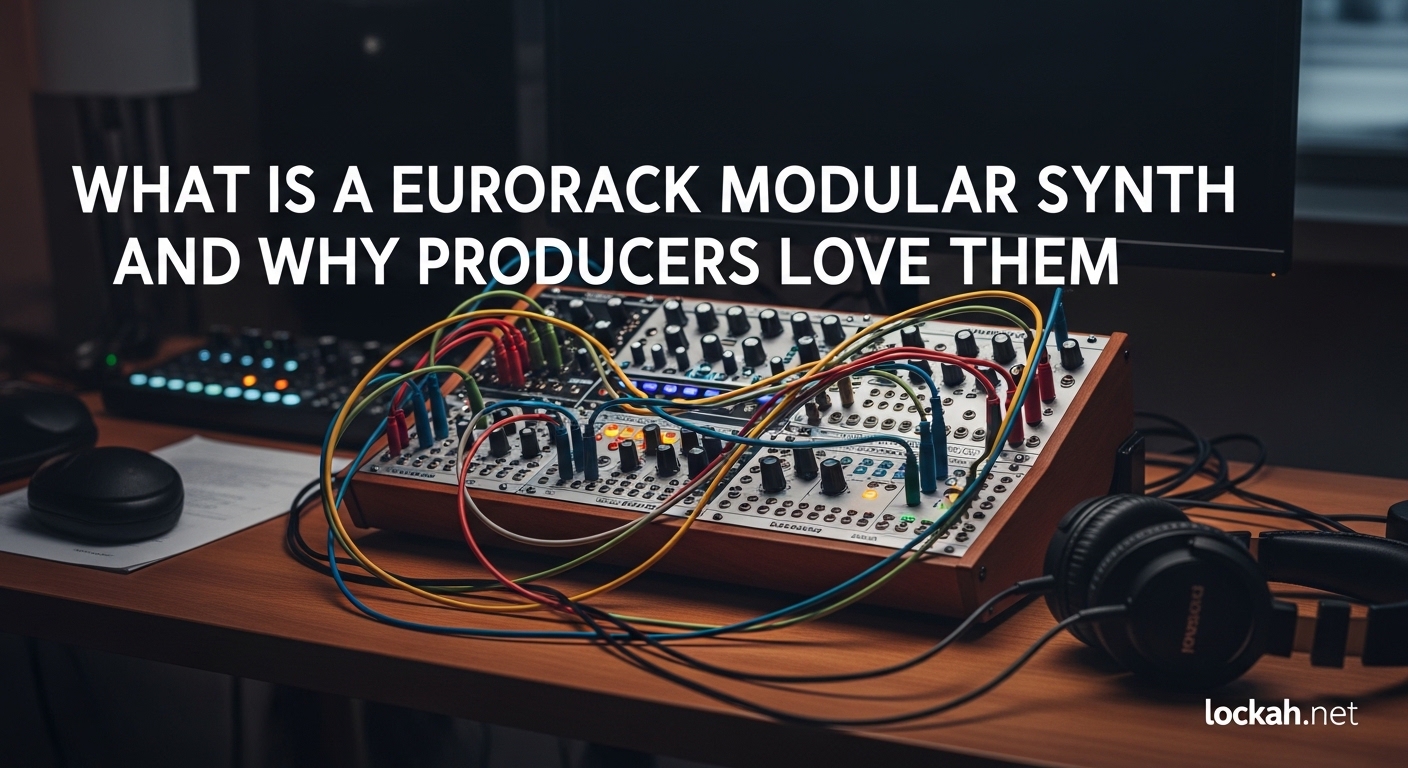
A Eurorack modular synth is a format of modular synthesizer where individual sound-building blocks are housed in separate units that you connect with patch cables to create custom signal flows. Unlike traditional keyboards that come with fixed connections between oscillators, filters, and amplifiers, Eurorack lets you decide how everything connects. Producers love them because they offer infinite flexibility, a deeply hands-on creative process, and sounds that are impossible to achieve with conventional instruments.
In this guide, you will learn exactly what makes Eurorack unique, why so many electronic musicians are building these elaborate systems, and how the core modules work together to create sound. Whether you are completely new to synthesis or looking to understand what the hype is about, this article will give you a clear foundation.
Table of Contents
What is a Eurorack Modular Synth?
Eurorack is a modular synthesizer format originally specified in 1995 by Doepfer Musikelektronik, a German synthesizer company. The format defines the physical dimensions, power specifications, and signal standards that allow modules from different manufacturers to work together seamlessly.
Modules fit into cases that follow the “3U” height standard, which equals 133.4 millimeters or about 5.25 inches. The width of modules is measured in HP, which stands for Horizontal Pitch, where 1 HP equals 5.08 millimeters. Common cases range from 84 HP (portable) to 168 HP or larger for studio installations.
What makes Eurorack truly special is the freedom to design your own instrument. You choose each module based on what you need, arrange them in your case, and then connect them using patch cables. This modularity means your system can be a simple three-module setup or an expansive wall of sound creation that grows over years.
The Difference Between Eurorack and Regular Synthesizers
A traditional synthesizer keyboard has internal wiring that is fixed by the manufacturer. The oscillator always feeds into the filter, which always feeds into the amplifier. You can change settings, but you cannot change the signal path.
Eurorack breaks those connections open. You decide if the oscillator goes into a filter or straight to an effects module. You can route the LFO to modulate pitch, filter cutoff, or even another LFO. This open architecture is what producers mean when they talk about “patching” – physically creating the signal flow with cables.
Control Voltage and Gate Signals
Eurorack modules communicate using two main signal types. Control Voltage, abbreviated as CV, carries continuous information like pitch or modulation amount. A higher voltage might mean a higher pitch or a more open filter. Gate signals are binary on/off messages used to trigger events, like telling an envelope generator to start when a key is pressed.
These analog signals travel through patch cables, typically 3.5 millimeter mono cables, similar to headphone jacks but carrying voltage instead of audio. This standardization across manufacturers is why a module from Make Noise can connect perfectly to one from Mutable Instruments or Intellijel.
Why Producers Love Eurorack?
The popularity of Eurorack has exploded over the past decade. What started as a niche format for synthesizer enthusiasts has become a staple in studios worldwide. Here is why producers keep investing time and money into these systems.
The Physicality of Patching
Modern music production happens largely inside computers. While software is powerful, many producers feel disconnected from their tools. Eurorack brings back the physical interaction. You twist knobs that directly control voltage. You plug cables and hear the result immediately. This tactile experience creates a different kind of focus that many find inspiring.
After years of clicking through software menus, the immediate cause-and-effect of modular synthesis feels refreshing. Turning a knob and hearing the filter sweep in real time connects you to the sound in a way that automation lanes sometimes cannot match.
Infinite Flexibility and Unique Sounds
The patchable nature of Eurorack means there are no presets in the traditional sense. Every patch you create is unique to that moment. This leads to happy accidents and discoveries that would be difficult to stumble upon in fixed-architecture instruments.
You can create complex FM patches by routing audio-rate oscillators into each other. You can build generative systems where LFOs trigger sequencers that modulate filters. With the right modules, you can process external audio, create granular textures, or build complete drum machines. The possibilities are limited only by your modules and imagination.
Creative Workflow and Inspiration
Many producers report that Eurorack helps them break out of creative ruts. The modular approach forces you to think about sound differently. Instead of reaching for a preset bass sound, you build one from scratch. This process slows you down in a good way, encouraging experimentation over default choices.
The forum discussions on communities like Reddit and ModWiggler consistently highlight this creative benefit. Users describe modular systems as instruments that teach you synthesis by forcing you to understand signal flow. You cannot rely on factory presets – you must learn what each module does and how they interact.
The Learning Journey
Eurorack is often described as an educational investment. To use it effectively, you need to understand what oscillators, filters, envelopes, and modulation actually do. This deeper knowledge transfers to every other synthesizer you touch. Many producers find that their time with Eurorack improved their sound design skills in software synths too.
The Community and Culture
There is a vibrant community around Eurorack that extends beyond just making music. Module designers are often small operations or single individuals creating innovative tools. The culture celebrates exploration, weird sounds, and pushing boundaries. For many producers, being part of this community is as rewarding as the music they create.
Core Eurorack Modules Explained
Understanding the basic module types will help you grasp how these systems function. Most Eurorack setups include some combination of these essential building blocks.
VCO – Voltage Controlled Oscillator
The VCO is your sound source. It generates raw waveforms like sine waves, sawtooth waves, square waves, and triangles. The pitch of these waveforms is controlled by voltage – send it 1 volt and you get one pitch, send it 2 volts and you get an octave higher.
Some VCOs are analog circuits that drift and characterfully distort. Others are digital oscillators that offer complex wavetables or multiple outputs. Many producers start with one or two VCOs and expand as they understand their sound preferences.
VCF – Voltage Controlled Filter
After generating raw waveforms, you typically want to shape them. The VCF removes frequencies to sculpt the tone. Low-pass filters are most common, removing high frequencies for warm, mellow sounds. High-pass filters do the opposite, removing lows for thin, airy textures. Band-pass filters isolate specific frequency ranges.
The voltage control aspect means you can sweep the filter cutoff automatically using envelopes or LFOs. This creates the classic synthesizer “wow” sound that defines so much electronic music.
VCA – Voltage Controlled Amplifier
The VCA controls loudness. Even if your oscillator and filter are creating a great tone, you need the VCA to shape how that sound behaves over time. Without a VCA, your sound would just drone constantly at full volume.
VCAs respond to control voltage by opening and closing. Send it a high voltage and the sound passes through. Send it low voltage and the sound is muted. This is essential for creating articulation in your patches.
Envelope Generator
Envelopes shape how a sound evolves from the moment it starts to when it ends. The classic ADSR envelope has four stages: Attack (how quickly it rises), Decay (how quickly it falls to sustain), Sustain (the held level), and Release (how quickly it fades after the note ends).
In Eurorack, envelopes are typically triggered by gate signals from keyboards, sequencers, or other modules. The envelope then outputs a control voltage that you send to your VCA for volume shaping or to your VCF for filter sweeps.
LFO – Low Frequency Oscillator
An LFO is essentially a VCO that oscillates too slowly to be heard as pitch. Instead, you use it as a modulation source. Route an LFO to oscillator pitch for vibrato. Send it to filter cutoff for a rhythmic wobble. Patch it to VCA level for tremolo effects.
Many LFO modules offer multiple waveform shapes and can reach audio rates for more experimental FM applications. Having several LFOs gives your patches movement and life.
Utilities – Mults, Mixers, and Attenuators
Utility modules might not sound glamorous, but they are essential for complex patches. Multiples, or mults, split one signal into several copies so you can route it to multiple destinations. Mixers combine multiple audio or CV signals. Attenuators reduce the strength of control voltages, which is crucial for dialing in the right amount of modulation.
Experienced modular users often say you cannot have too many utilities. They enable routing possibilities that make your system more flexible and musical.
Understanding Signal Flow
The concept of signal flow is fundamental to modular synthesis. In a basic subtractive synthesis patch, the signal moves from oscillator to filter to amplifier, with envelopes and LFOs adding modulation along the way.
But Eurorack breaks this linear path open. You can feedback audio outputs into control inputs. You can mult a modulation source to affect five different parameters simultaneously. You can process external audio through your modular filters and effects. Understanding this freedom is key to moving beyond basic patches.
Audio signals and control voltage signals use the same cables in Eurorack, which means you can often interchange them in creative ways. Send audio into a module expecting CV and you might get unexpected but interesting results. This is part of the experimental nature that attracts many producers.
Getting Started with Eurorack
Entering the world of Eurorack can feel overwhelming. The cost, the learning curve, and the sheer number of module choices create real barriers. Here is a practical approach that many forum users recommend.
Start with Software: VCV Rack
Before spending any money on hardware, download VCV Rack. It is a free software modular synthesizer that accurately emulates Eurorack modules and signal flow. You can patch virtual cables, experiment with different module combinations, and learn how everything connects.
VCV Rack includes emulations of real hardware modules from companies like Mutable Instruments and Befaco. Many producers use it to test concepts before buying physical equivalents. Some even use VCV Rack alongside their hardware setups to expand their patching possibilities.
Minimum Viable System
To make actual sound, you need at minimum: a case with power, an oscillator, a filter or VCA for shaping, an envelope generator, and a way to trigger notes like a keyboard or sequencer. This is often called a “voice” in modular terminology.
Many beginners start with a small case of 84 or 104 HP. This forces you to choose modules carefully and really learn each one deeply. Starting small also helps avoid the collecting compulsion that forum users joke about as “Eurorocrack.”
Budget-Friendly Entry Points
Semi-modular synthesizers offer another smart entry path. Instruments like the Moog Mother-32, Make Noise 0-Coast, or Arturia MiniBrute 2 come as complete synths but include patch points for Eurorack connectivity. You get a working instrument immediately while preserving the option to expand into full modular later.
Used modules are also common in the Eurorack community. The resale market is active, and modules tend to hold their value well. This means you can try something, sell it if it does not fit your workflow, and try something else without losing much money.
Avoiding Common Pitfalls
Forum discussions consistently warn about a few beginner mistakes. Do not buy modules faster than you can learn them. A small system you understand will make better music than a large system you patch randomly. Plan your cases with room to grow, but resist filling every HP immediately.
Another common trap is buying modules that do too much. Complex digital modules with menu diving can actually work against the immediate, hands-on workflow that makes Eurorack special. Start simple and add complexity gradually as you understand what you need.
Frequently Asked Questions
What is an Eurorack modular synthesizer?
A Eurorack modular synthesizer is a format of modular synth where individual modules fit into standardized 3U height cases and connect via patch cables. The format was created by Doepfer in 1995 and has become the most popular modular standard. Each module performs a specific function like oscillation, filtering, or amplification, and you create sound by routing signals between them with cables.
What are modular synths good for?
Modular synths excel at creating unique sounds, experimental textures, ambient music, techno, and sound design. They are particularly good for producers who want hands-on control, infinite routing flexibility, and sounds that cannot be replicated with preset-based instruments. Modular systems also teach deep synthesis knowledge that transfers to any electronic music production.
Why are modular synths so expensive?
Modular synths cost more than mass-produced keyboards because they are typically manufactured in small batches by boutique companies or individual designers. Many modules are hand-built with high-quality components. The small production quantities and specialized nature of the market mean higher per-unit costs compared to factory-produced instruments.
What does an Eurorack do?
A Eurorack system generates and shapes electronic sound through interconnected modules. You patch cables between oscillators, filters, amplifiers, and modulators to create custom signal paths. Unlike fixed synthesizers, Eurorack lets you design your instrument’s architecture, enabling unique sounds and routing possibilities limited only by your modules and imagination.
Conclusion
A Eurorack modular synth is more than a musical instrument. It is a personal system for sound exploration that grows and evolves with your skills. The format offers producers something increasingly rare in modern music production: a completely hands-on, non-prescriptive approach to creating sound.
The investment in time and money is real, but so are the rewards. Whether you are drawn to the unique sounds, the creative workflow, or the deep learning journey, Eurorack offers an experience that software alone cannot replicate. Start with VCV Rack to learn the basics, begin small when you move to hardware, and let your system grow organically as your understanding deepens.