
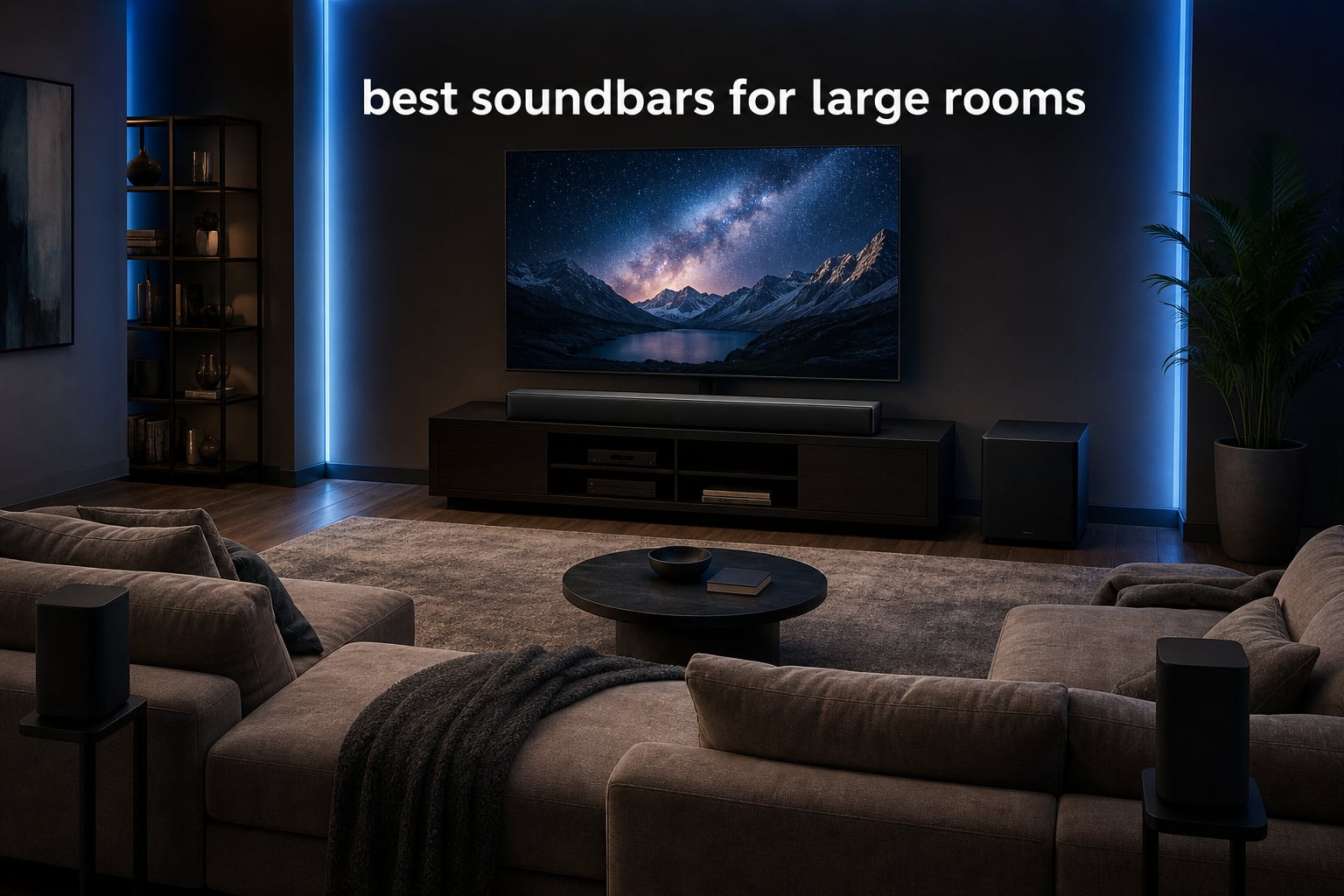
A large room can make a modest TV speaker or basic bar sound thin long before the volume becomes satisfying. The best soundbars for large rooms pair enough channels and output with a dedicated subwoofer, while a proper surround package adds the side and rear cues that get lost in an open living area.
I treated 400 square feet and above as the starting point for this guide, following the room-size definition surfaced in the research. For a long room, an open floor plan, or a ceiling that rises above the listening area, I would put channel layout, bass capability, rear-speaker placement, HDMI eARC, and calibration ahead of a long feature list.
Our six picks run from a 5.1 package to complete 11.1.4 systems. I compared the published channel counts, listed power and subwoofer details, connectivity, included surrounds, and customer-rating data, then matched each system to the room shape where its hardware makes the most sense.
Our top 3 picks cover the biggest large-room needs in September 2026
For a traditional home-theater layout, the Samsung HW-Q990F is the strongest all-in-one recommendation because it includes an 11.1.4-channel soundbar, wireless subwoofer, and rear speakers. The JBL Bar 1300XMK2 is the pick I would make when running power to rear speakers is the deal-breaker, while the JBL Bar 500MK2 suits a large room that needs strong bass and clear dialogue without adding separate rear units.
Samsung HW-Q990F: Best for a complete 11.1.4 surround package with four up-firing channels, voice emphasis, and Samsung Q-Symphony support.
JBL Bar 1300XMK2: Best for flexible seating layouts because its detachable surround speakers remove the usual rear-speaker cable problem.
JBL Bar 500MK2: Best for large living rooms that need a substantial 10 inch wireless subwoofer, 750W output, and straightforward calibration.

These six soundbars fit large rooms in September 2026
The comparison below makes the dividing lines clear: the Samsung and JBL 1300XMK2 bring physical rear channels and four height channels, the Sonos and Sennheiser favor a single-bar approach, and the JBL 500MK2 and ULTIMEA keep the package simpler. A listed channel count does not settle every sound-quality question, but it is a useful first filter when a room needs more than front-facing sound.
| Product | Specifications | Action |
|---|---|---|
 JBL Bar 500MK2 JBL Bar 500MK2 |
|
Check Latest Price |
 Sonos Arc Ultra Sonos Arc Ultra |
|
Check Latest Price |
| JBL Bar 1300XMK2 |
|
Check Latest Price |
| Samsung HW-Q990F |
|
Check Latest Price |
 ULTIMEA Skywave F40 ULTIMEA Skywave F40 |
|
Check Latest Price |
 Sennheiser AMBEO Soundbar Plus Sennheiser AMBEO Soundbar Plus |
|
Check Latest Price |
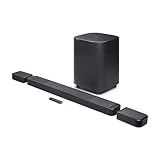
1. JBL Bar 500MK2 is the strong 5.1 choice for a big living room
JBL Bar 500MK2-5.1 Channel soundbar System with Dolby Atmos, MultiBeam 3.0 & PureVoice 2.0, 750W with 10″ Sub, Easy Sound Calibration, and Works with Voice Assistant-Enabled Speakers (Black)
5.1 channels
750W output
10 inch wireless sub
Dolby Atmos
Pros
- 750W listed output
- 10 inch wireless subwoofer
- PureVoice 2.0 dialogue
- Easy app calibration
Cons
- No included rear speakers
- 5.1 layout has fewer surround channels
The JBL Bar 500MK2 makes sense when the room needs weight and scale but the seating arrangement does not make rear speakers practical. Its published 750W maximum output and 10 inch wireless subwoofer are the two specifications I would focus on first for a large TV area, since they address the weak bass and underpowered presentation that owners regularly describe in larger spaces.
This is a 5.1-channel system with Dolby Atmos and MultiBeam 3.0 rather than a full physical rear-surround package. That trade-off suits a couch against a rear wall or a room where walking paths would put separate speakers in the way.
JBL lists PureVoice 2.0 and SmartDetails processing, so dialogue support is a central part of the design instead of an afterthought. Its 4.7 out of 5 rating from 224 reviews is the highest rating in this set, although the sample is smaller than the ULTIMEA and Sonos listings.
I also like that the JBL ONE app offers sound calibration, which is useful when one side of the room opens into a kitchen or hallway. HDMI eARC, Bluetooth, optical, USB, and Wi-Fi give it practical connection options, while 4K Dolby Vision passthrough can simplify a TV setup.
The JBL Bar 500MK2 is best when bass and dialogue matter more than rear effects
Choose this system for movie nights in a wide living room where a dedicated subwoofer can sit near a front corner and the TV wall is the main listening direction. The 20 Hz listed frequency response and larger 10 inch woofer point to more low-end reach than a compact bar can normally offer.
It is also a sensible choice for mixed TV and music use because it supports AirPlay, Google Cast, Spotify Connect, Tidal Connect, and Roon Ready. I would still keep expectations aligned with the 5.1 layout: the bar can widen its presentation, but it cannot place discrete rear speakers behind the couch.
The JBL Bar 500MK2 needs a clear front-wall layout and a realistic Atmos expectation
The 37 inch-wide bar is easier to place under many televisions than the longest models here, but confirm that it does not block the TV’s infrared receiver. Wall mounting is listed as an option, which can free the cabinet surface if the television sits high enough.
Atmos effects depend on reflective surfaces above the seat, so a very tall or sharply vaulted ceiling can soften the height illusion. In that room type, I would favor physical rear and height-capable packages if immersion ranks above simplicity.
2. Sonos Arc Ultra is the polished single-bar 9.1.4 option
Sonos Arc Ultra Soundbar with Dolby Atmos – Black
9.1.4 spatial audio
Sound Motion
Trueplay tuning
Wi-Fi and Bluetooth
Pros
- 9.1.4 Dolby Atmos
- AI Speech Enhancement
- Trueplay room tuning
- Expandable Sonos system
Cons
- No separate subwoofer included
- No rear speakers included
The Sonos Arc Ultra is the most compelling pick here for someone who wants a high-channel-count Dolby Atmos soundbar without beginning with a box of separate speakers. It is specified as 9.1.4, uses Sonos Sound Motion technology, and measures 46.18 inches wide, so it has a substantial physical presence below a large screen.
Its single HDMI eARC connection is intentionally simple, and controls extend to the TV remote, app, touch interface, Sonos Voice Control, and Alexa. I would choose that control flexibility for a shared living room where different people use the system in different ways.
Trueplay room tuning is the reason this bar deserves consideration in an irregular large room. It can account for a TV wall beside a doorway or an asymmetrical furniture layout, though it cannot change the fact that bass and rear effects will be handled virtually until you add compatible pieces.
The listing shows a 4.6 out of 5 rating across 655 reviews, the largest review base among the premium models here. It supports Wi-Fi, Bluetooth, AirPlay 2, and Spotify Connect, making it easy to move from television audio to music streaming without changing systems.
The Sonos Arc Ultra is best when a clean room and future expansion are priorities
I would start with the Arc Ultra in a design-conscious room where extra cabinets and speaker stands are not welcome at first. Sonos states that it can expand with a Sonos Sub and Era 300 rear speakers, allowing the system to grow if the room later demands more bass or stronger wraparound effects.
AI-powered Speech Enhancement is particularly useful for listeners who turn subtitles on because dialogue gets buried in a busy mix. The feature does not replace good placement, but it gives a large family room an easy way to favor voices during casual TV viewing.
The Sonos Arc Ultra works best with a plan for bass and rear coverage
The bar alone is a streamlined home theater soundbar, not a complete physical-surround package. For a room that is open to a dining area or extends well beyond the couch, I would account for the optional subwoofer and rears from the outset rather than assume a single bar will pressurize the whole space.
Place the 46.18 inch bar where its drivers have a clear path across the front of the room, and leave room around it rather than burying it in a closed media cabinet. Its tabletop mounting specification makes cabinet depth and TV-stand width worth checking before installation.
3. JBL Bar 1300XMK2 is the flexible 11.1.4 system for hard-to-wire rooms
JBL Bar 1300XMK2 Dolby Atmos Soundbar with Detachable Speakers – Black
11.1.4 channels
1570W output
Detachable surrounds
12 inch wireless sub
Pros
- Physical detachable rear speakers
- 1570W listed output
- 12 inch subwoofer
- Dolby Atmos and DTS:X
Cons
- Very wide 55.3 inch bar
- Rear speakers need battery charging
The JBL Bar 1300XMK2 is the answer for a large room that needs a full surround layout but has no convenient way to route cable to the back of the couch. Its detachable wireless surround speakers can be moved into position for a film and returned to the bar afterward, a practical answer to the wire-management issue raised repeatedly in large-room discussions.
On paper, this is one of the most capable packages in the roundup: 11.1.4 channels, six up-firing speakers, 1570W maximum output, and a 12 inch wireless subwoofer. That combination gives it the hardware to serve a long room, a deep seating arrangement, or a home theater where dynamic impact matters.
It supports both Dolby Atmos and DTS:X, which matters if your movie library or game setup uses more than one immersive format. JBL also includes MultiBeam 3.0, PureVoice 2.0, and a night listening mode, so the system has options for both focused movies and lower-level late viewing.
The 4.6 out of 5 rating is based on 85 reviews, so I would read the count as a useful early signal rather than a final verdict. Its listed connectivity includes HDMI, optical, USB, Wi-Fi, Bluetooth, and Ethernet, offering more installation flexibility than a simple eARC-only arrangement.
The JBL Bar 1300XMK2 is best when real rear channels have to stay flexible
Detach the surrounds and place them slightly behind and to either side of the main seats when watching Atmos material. That creates a more direct rear sound field than a bar attempting to reflect every surround cue from the front wall, which is why physical rears remain a strong recommendation for a large room.
The wireless subwoofer should begin near the front wall, then move in small increments if bass sounds boomy at the couch. I would use the calibration process before judging the system, especially in a room with bare floors, lots of glass, or an open side wall.
The JBL Bar 1300XMK2 needs space for its long bar and a charging routine
At 55.3 inches wide, this is the broadest soundbar in the group. It can visually suit a very large television, but measure the furniture surface and leave clearance for both the bar and the television stand before committing to its position.
The detachable surrounds solve power-cable routing, not all maintenance. Their battery-powered design means I would build recharging into the routine after a long viewing session, particularly if the speakers are used often for games and films.
4. Samsung HW-Q990F is the complete 11.1.4 package for large home theaters
Samsung Q990F 11.1.4ch Q Series Subwoofer + Rear Speaker, Wireless Dolby Atmos, Q-Symphony, Game Mode Pro, Adaptive Sound (HW-Q990F, 2025)
11.1.4 channels
Wireless sub and rears
Q-Symphony
Wireless Dolby Atmos
Pros
- Complete rear-speaker package
- Four up-firing channels
- Q-Symphony support
- Adaptive Sound
Cons
- Best integration is with Samsung TVs
- Rear speakers still need power
The Samsung HW-Q990F is my first choice for a big, dedicated television room because the package already includes the pieces a large space usually needs: 11.1.4 channels, a wireless subwoofer, and rear speakers. There is no need to create a surround plan from optional parts before the system can deliver its full layout.
Samsung specifies 11 front and surround channels plus four up-firing channels, along with 756W maximum output and an 8 inch woofer. The separate rear speakers give this setup an advantage over virtual-only alternatives when the listening seats sit well away from the TV wall.
Wireless Dolby Atmos, adaptive sound adjustment, voice emphasis, and embedded-sensor calibration give the Q990F a useful mix of automation and immersion features. I would use voice emphasis for news and dialogue-heavy dramas, then let the wider surround layout take over for action films or games.
The listing has a 4.5 out of 5 rating from 157 reviews, with 81 percent five-star reviews. Forum research also repeatedly points to the Q990 line for large rooms, which fits the underlying specification: it is one of the few choices here that arrives as a full surround system instead of asking the buyer to add core components later.
The Samsung HW-Q990F is best when the couch has usable space behind it
Put the rear speakers behind the main listening position rather than beside the television, keeping them clear of tall furniture that could block their output. They need power even though the connection is wireless, so a nearby outlet or discreet extension-routing plan remains part of the installation.
This is the system I would favor for a long rectangular room with a defined viewing zone. The included subwoofer and rear channels work together to keep low-frequency impact and surround information present as the room gets larger.
The Samsung HW-Q990F is most compelling with a compatible Samsung television
Q-Symphony is designed to let a Samsung TV and the soundbar work together, making this a natural brand-match choice. The soundbar remains useful with other televisions through HDMI, but that particular integration benefit depends on the television in the room.
Game Mode Pro is a welcome fit for a large-room gaming setup, while AirPlay 2, Google Cast, Alexa, and Bluetooth broaden the music options. I would still use HDMI eARC for the main TV connection when available, because it keeps the audio path direct and makes TV-remote volume control easier.
5. ULTIMEA Skywave F40 is the adaptable 5.1.2 system for a modest large-room setup
ULTIMEA 5.1.2ch Sound Bar with Dolby Atmos, Surround Sound System for TV
5.1.2 channels
400W output
Two rear speakers
10-band app EQ
Pros
- Physical rear speakers
- HDMI eARC
- 13-step level controls
- Two-year warranty
Cons
- 5.25 inch subwoofer is compact
- 40 Hz listed low end
The ULTIMEA Skywave F40 is the practical option for someone who wants physical rear speakers and Dolby Atmos without moving straight to an 11.1.4 arrangement. It combines a 5.1.2 layout, 400W listed output, two surround speakers, and up-firing drivers, so it can create a more enveloping field than a basic front-only bar.
Its 5.25 inch subwoofer and 40 Hz listed frequency response set a sensible boundary for the largest rooms. I would view it as a fit for a modest large room with a defined couch area, not as the system to carry a cavernous, open-plan space where bass has to travel far beyond the viewing zone.
The strong point is adjustment: the companion app offers 13-step level control and a 10-band EQ alongside BassMX and VoiceMX processing. That control is meaningful when the rear speakers sound too dominant, dialogue needs a lift, or a room’s hard surfaces make bass thicker than expected.
Its 4.4 out of 5 rating comes from 634 reviews, the deepest review base in this group. HDMI eARC, Bluetooth 5.4, optical, and CEC synchronization cover the connections most TV setups need, and the two-year warranty is longer than the one-year coverage listed for several alternatives.
The ULTIMEA Skywave F40 is best when surround placement matters more than maximum scale
Place the two included surround speakers behind the seating area and use the app’s level adjustments to blend them with the front bar. In a compact open-plan room, those physical rear channels can do more for immersion than a wider front-only bar with no sound behind the listener.
VoiceMX is a useful option when a large room contains soft furnishings that absorb upper-midrange detail or when viewers sit off-center. I would use it sparingly, then return to a more neutral setting for music if voices become too forward.
The ULTIMEA Skywave F40 needs reasonable room boundaries to sound its best
A 5.1.2 system can fill a family room with a clear seating zone, but it has fewer discrete channels and less listed low-end reach than the flagship packages. If the room continues into a second major area with no wall or doorway break, the JBL 1300XMK2 or Samsung Q990F has more hardware for the task.
Mounting is listed for either a tabletop or wall, which helps when the TV furniture is shallow. Keep the bar’s up-firing drivers unobstructed, and do not place it inside a cabinet shelf if Atmos height cues are a priority.
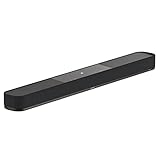
6. Sennheiser AMBEO Soundbar Plus is the virtual 7.1.4 option for a clean front wall
Sennheiser AMBEO Soundbar Plus for TV and Music with Immersive 3D Surround Sound, Virtual 7.1.4 Speaker Setup, Built-in Dual Subwoofers, Advanced Streaming Connectivity, Night Mode, Black
Virtual 7.1.4
Dual built-in subwoofers
AMBEO processing
Dolby Atmos and DTS:X
Pros
- Single-bar 3D approach
- Built-in dual subwoofers
- Wide streaming support
- Voice and night modes
Cons
- No included physical rear speakers
- Lower 3.8 rating in this group
The Sennheiser AMBEO Soundbar Plus is for a large room where adding a subwoofer cabinet and rear speakers is simply not an option. It uses AMBEO virtualization to reproduce a 7.1.4 speaker setup from one bar, supported by seven speakers and dual built-in subwoofers.
That is a different solution from the Samsung or JBL packages. I would expect the AMBEO system to create spacious, processed 3D sound from the front of the room, but I would not treat virtualization as a substitute for actual speakers behind the couch when discrete rear effects are the goal.
Its format support is extensive: Dolby Atmos, DTS:X, MPEG-H, and 360 Reality Audio are all listed. AirPlay 2, Spotify, Tidal Connect, Chromecast, Bluetooth, and Alexa control also make it a capable music bar rather than a television-only upgrade.
This is the caution pick in the roundup because its 3.8 out of 5 rating from 88 reviews trails the other products. The listing’s mixed feedback still praises AMBEO virtualization, so I would consider it for its specific single-bar brief instead of assuming it is the broadest recommendation for every large room.
The Sennheiser AMBEO Soundbar Plus is best when extra speakers are off the table
The 41.38 inch bar is a clean option for a room with a single front wall, no reachable outlets behind seating, and no appetite for speaker stands. Its integrated equalizer, voice enhancement, and night mode provide useful controls without spreading hardware across the room.
It can be a good match for music streaming in a multi-use lounge because the audio system stays contained at the television. I would use its app or web interface to tune the response after rugs, curtains, and furniture are in place.
The Sennheiser AMBEO Soundbar Plus needs reflective room surfaces for its virtual field
Virtual surround has the best chance when side walls and ceiling surfaces give sound something consistent to reflect from. An extremely open plan or very high vaulted ceiling gives the processor fewer predictable boundaries, which is where physical rear speakers become the safer route.
The bar’s integrated subwoofers remove one box from the floor, but they do not offer the placement freedom of a separate wireless subwoofer. If the seating position has a bass null, a system with a movable sub can be easier to tune.
A large-room soundbar needs channels, bass, placement, and the right connections
The quickest answer is to prioritize a dedicated subwoofer and a surround layout that matches the seating area. A large room does not need a particular brand, but it does need enough output and coverage that listeners at the couch do not hear a small, front-loaded soundstage.
An 11.1.4 system is the safer choice for very large or open rooms
The first number is the count of main and surround channels, the second represents the subwoofer channel, and the final number counts height channels. An 11.1.4 soundbar system therefore has many more paths for front, side, rear, and overhead information than a 5.1 or 5.1.2 setup.
For an enclosed room around 400 square feet, a solid 5.1 package can work if the seats are near the TV. For a deeper room, a 500-square-foot-or-larger area, or an open plan that spills into adjacent spaces, I would start with 7.1.4, 9.1.4, or 11.1.4 and favor real rear speakers.
A dedicated subwoofer matters because low bass spreads differently in a large room
Small drivers in a soundbar can make voices and effects louder, but they cannot move the same amount of air as a separate subwoofer. Large-room forum discussions consistently return to this point: without a dedicated subwoofer, a system can sound bright or thin once the listening position moves away from the TV wall.
Begin with the wireless sub near the front wall, about a short distance from a corner, then listen from the couch before making a final call. If bass is bloated, pull it farther from the corner; if it nearly disappears at the main seat, try a different wall position instead of only raising the bass setting.
Physical rear speakers make the biggest surround difference for the main seats
Rear satellite speakers are not mandatory for every television setup, but they are the clearest route to convincing effects behind the listener. They are particularly helpful when the couch is centered in a large room and there is enough walking clearance to place speakers slightly behind it.
Plan the practical part before buying. Wireless usually means the audio signal is wireless, not that the speaker has no power needs; the JBL Bar 1300XMK2 is unusual because its rears detach and use batteries, while the Samsung rear speakers still need nearby electrical power.
A lower, reflective ceiling makes Atmos effects easier to hear
Up-firing drivers direct sound toward the ceiling so it can return from above the listening position. A flat, reflective ceiling gives that sound a more predictable route, while a very high ceiling, a sharply angled vault, exposed beams, or heavy acoustic treatment can make overhead effects less distinct.
Do not reject Atmos because your ceiling is imperfect, but set expectations honestly. In a high-ceiling room, extra main and rear channels often deliver a more dependable improvement than relying only on reflected height effects.
HDMI eARC is the connection to look for on a modern large-room TV setup
HDMI eARC sends television audio back to the soundbar through one cable and is the preferred connection for high-quality formats when both devices support it. It also usually lets the television remote control volume and reduces the chance that one streaming app behaves differently from another.
Optical remains useful for older televisions, but it has fewer audio-format capabilities. Check the TV’s ports before buying, then reserve eARC for the soundbar and connect game consoles or media players according to the soundbar’s passthrough options.
A soundbar does not have to match a 65 inch TV width exactly
There is no fixed soundbar width for a 65 inch television. The practical checks are whether the bar fits the furniture, leaves the TV’s sensor unobstructed, and looks proportionate from the couch; a narrower bar such as the 37 inch JBL can still work, while a 55.3 inch JBL naturally suits a broader setup.
Height matters as much as width when a bar sits in front of a television. If the screen’s lower edge is low, wall mounting the TV or soundbar can prevent the bar from covering the picture or interrupting remote signals.
These answers settle the most common large-room soundbar questions
Which sound bar has the best sound quality?
Among these six, the Samsung HW-Q990F is the strongest all-in sound-quality choice for a large home theater because it includes an 11.1.4 layout, wireless subwoofer, and rear speakers. The JBL Bar 1300XMK2 is a close alternative when detachable physical rear speakers and its listed 1570W output better fit the room.
What is the number one rated soundbar?
The JBL Bar 500MK2 has the highest listed customer rating in this comparison: 4.7 out of 5 from 224 reviews. A high rating is one useful signal, but its 5.1 design is a simpler fit than the 11.1.4 systems for a very large room with seating far from the TV.
How big of a soundbar do I need for a 65 inch TV?
A 65 inch TV does not require a soundbar of matching width. Choose a bar that fits the TV furniture, does not cover the screen or infrared receiver, and leaves room for upward-firing drivers if present. The 37 inch JBL Bar 500MK2 and 55.3 inch JBL Bar 1300XMK2 can both work depending on the stand and room proportions.
What is considered a large room for a soundbar?
A room of about 400 square feet or more is a useful large-room starting point for soundbar shopping. Long rooms, open floor plans, and rooms with high ceilings can act larger acoustically, so a dedicated subwoofer, rear speakers, and a 7.1.4 or 11.1.4 layout become more valuable.
The Samsung HW-Q990F is the safest full-system choice for 2026
For the best soundbars for large rooms, I would choose the Samsung HW-Q990F when a complete physical surround package fits the room, or the JBL Bar 1300XMK2 when detachable rear speakers solve a real installation problem. The JBL Bar 500MK2 is the simpler bass-forward alternative, while the Sonos Arc Ultra and Sennheiser AMBEO Soundbar Plus keep the front wall cleaner.
Measure the TV stand, find power for a subwoofer and any rear speakers, and map the main couch before selecting a model. That brief preparation will tell you whether a compact 5.1 setup is enough or whether the room calls for the wider coverage of an 11.1.4 home theater soundbar.