
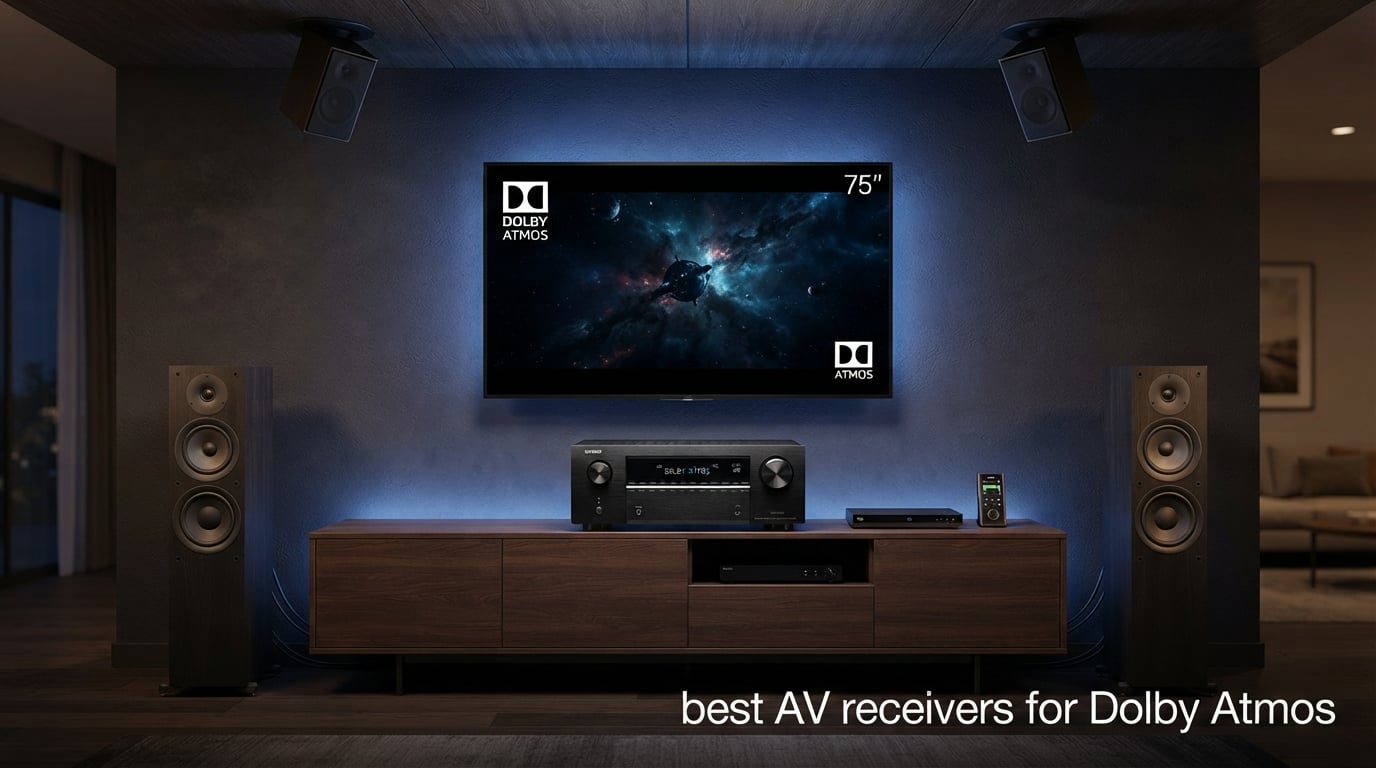
Finding the best AV receivers for Dolby Atmos is less about buying the receiver with the biggest number on its faceplate and more about matching its channels, video connections, and calibration to the speakers you will actually install. A Dolby Atmos AV receiver decodes object-based sound and directs those effects to surround and height speakers, which is how rain, aircraft, and music cues can appear above rather than only around the couch.
I start with the speaker plan because it removes most of the confusion. A modest room can be excellent with five bed-layer speakers, a subwoofer, and two height speakers; a dedicated theater can make real use of nine or eleven amplified channels, additional subwoofer outputs, and more advanced correction.
The seven receivers below all support Atmos, but they are not interchangeable. I compared the published channel counts, power figures, HDMI connections, calibration systems, format support, streaming options, and customer-rating context from the supplied product data, then separated the picks by the kind of system each one can reasonably anchor.
One honest note before the list: an AVR is the control center, not a cure for poor speaker placement. The home-theater discussions behind this guide repeatedly point to setup difficulty, calibration, HDMI handshake problems, and long-term support as real ownership issues, so the buying guide explains where each specification matters and where it does not.
Table of Contents
These three receivers answer the most common Atmos needs
1. Denon AVR-X3800H — best all-round choice. Its nine amplified channels, 9.4 configuration, extensive HDMI 2.1 connection list, HEOS streaming, phono input, and four RCA plus XLR subwoofer outputs make it the broadest fit for someone planning beyond a basic 5.1.2 system.
2. Onkyo TX-RZ30 — best value for room correction. It combines nine channels and 100 watts per channel with full-bandwidth Dirac Live included, IMAX Enhanced support, Sonos compatibility, and an 8-port HDMI count.
3. Yamaha RX300A — best compact entry point. The 5.2-channel model offers Dolby Atmos, DTS Virtual:X, 4K120/8K60 HDMI, eARC, setup-mic auto calibration, Bluetooth Multipoint, and Scene presets without asking a small-room buyer to build a large speaker array.
For a larger theater, the Onkyo TX-RZ70 and Denon AVR-X6800H move to 11-channel amplification and 140-watt ratings. The Sony STR-AZ1000ES is the more specialized 7.2-channel option for people drawn to Sony calibration and 360 Spatial Sound Mapping, while Denon’s AVR-X1800H is a sensible 7.2-channel choice for an Atmos system that also needs HEOS and clear rear-panel labeling.


These seven Dolby Atmos receivers cover compact to large theaters in 2026
The quick overview includes every receiver reviewed here. Channel notation is worth reading carefully: the first digit is the number of regular speaker channels, the second is the number of subwoofer outputs or channels described by the manufacturer, and the final height count appears when a layout such as 5.1.2 or 7.1.4 is configured.
Power figures are manufacturer specifications rather than a promise of identical loudness in every room. Speaker sensitivity, seating distance, impedance, bass management, and calibration all influence the result, so use the table to narrow the field rather than treat one specification as a winner by itself.
| Product | Specifications | Action |
|---|---|---|
| Denon AVR-X3800H |
|
Check Latest Price |
| Onkyo TX-RZ30 |
|
Check Latest Price |
 Yamaha RX300A Yamaha RX300A |
|
Check Latest Price |
 Onkyo TX-RZ70 Onkyo TX-RZ70 |
|
Check Latest Price |
 Denon AVR-X6800H Denon AVR-X6800H |
|
Check Latest Price |
 Sony STR-AZ1000ES Sony STR-AZ1000ES |
|
Check Latest Price |
 Denon AVR-X1800H Denon AVR-X1800H |
|
Check Latest Price |
1. Denon AVR-X3800H is the most flexible all-round Atmos receiver
Denon AVR-X3800H 9.4-Ch 8K UHD AVR Home Theater Stereo Receiver, 105W X 9
9.4 channels
105 watts x 9
HEOS and 9 HDMI 2.1 ports
Pros
- 9.4-channel layout
- Atmos DTS:X Pro IMAX Auro-3D
- HEOS streaming
- phono input
- 4 RCA plus XLR sub outputs
Cons
- 4.2 rating
- 12 percent one-star review share
- not Prime eligible
The AVR-X3800H is the receiver I would put at the top of a serious but not enormous home-theater shortlist. Its published 9.4-channel configuration and 105-watt-per-channel rating give it room for a 5.1.4 or 7.1.2 Atmos layout, so you can add height speakers without immediately outgrowing the receiver.
It is also unusually complete on formats. Denon lists Dolby Atmos, DTS:X Pro, IMAX Enhanced, and Auro-3D, alongside Dolby Height Virtualization and DTS Virtual:X for cases where physical height speakers are not yet in place.
Video and source flexibility are a major reason it earns the all-round spot. The supplied specifications list nine HDMI 2.1 ports, described as six inputs and three outputs, with 8K and 4K/120 support, HDCP 2.3, eARC, HDR10+, HLG, HDR, and Dolby Vision Dynamic HDR.
I also like that this is not movie-only hardware. HEOS handles multi-room streaming, Bluetooth and Wi-Fi are built in, and the phono input makes it friendlier to a turntable than many surround receivers; the four RCA and XLR subwoofer outputs give bass planning more options than a basic single-sub system.
Its nine amplified channels fit an upgrade-minded speaker plan
A buyer choosing between a 7.2 channel receiver and the X3800H should focus on height-channel ambition. Five surrounds plus four heights, or seven surrounds plus two heights, are practical Atmos pathways here, while the published 9.4 designation also gives installers several subwoofer connection options.
This flexibility does not mean every room needs four height speakers. In a small room, a carefully placed 5.1.2 layout can sound more coherent than a crowded array, but the extra channels keep a later expansion possible without replacing the hub.
Its review volume gives a useful but mixed ownership signal
The supplied listing has 400 reviews, the largest count in this group, with a 4.2 average rating. That amount of feedback is helpful context, yet the same data shows a 12 percent one-star share, so I would leave time to test every HDMI source, speaker output, and network function during the return period.
That caution mirrors forum concerns about AVR reliability and HDMI behavior after setup changes. It is not proof that every unit will have an issue; it is a reason to buy from a seller with a clear support route and to update firmware before judging a console or TV handshake.
2. Onkyo TX-RZ30 is the value-focused 9.2-channel Dirac Live pick
Onkyo TX-RZ30 9.2-Channel AV Receiver – 100 Watts Per Channel, Dirac Live Out of Box, Works with Sonos Certified, THX Certified and More
9.2 channels
100 watts per channel
Dirac Live included
Pros
- Dirac Live full bandwidth
- 9.2 channels
- THX Certified
- IMAX Enhanced
- Works with Sonos
Cons
- 4.2 rating
- 14 percent one-star review share
- limited review count
The TX-RZ30 makes its case with a combination that matters to a real room: nine channels, a 100-watt-per-channel specification, and full-bandwidth Dirac Live Room Correction included. That last point stands out because users regularly ask whether calibration is worth caring about, and it can make a clearer difference at the main seats than chasing another small feature.
Onkyo specifies an RZ ultra-wide-bandwidth amplifier spanning 5 Hz to 100 kHz. It also lists Dolby Atmos, Dolby Vision, IMAX Enhanced, Klipsch Optimize Mode, Sonos compatibility, and built-in streaming apps, giving this receiver a wide home-theater and music feature set.
For best AV receivers for Dolby Atmos under $1000 searches, channel count and room correction are the facts to compare first rather than a marketing label. A nine-channel model opens the door to 5.1.4 or 7.1.2 speaker layouts, which is a meaningful jump from receivers limited to seven channels.
The product data lists eight HDMI ports, but it does not state the version or video-bandwidth capability for each connection. I would confirm the current manual and the exact ports you plan to use before assuming a particular console or 8K source gets the same behavior as another input.
Its included Dirac Live makes it a strong fit for difficult rooms
Dirac Live uses measured responses to help correct the system for the room, and the TX-RZ30 includes the full-bandwidth version according to the supplied specifications. That speaks directly to common complaints about boomy bass, uneven seats, and the intimidating first calibration pass.
Correction cannot fix a subwoofer placed in the worst possible corner or a height speaker aimed far away from listeners. Still, it is a powerful reason to favor this model if you are working around an open-plan room, asymmetrical furniture, or speakers with different distances from the couch.
Its 4.2 rating calls for deliberate setup checks
The available data reports a 4.2 average from 81 reviews and a 14 percent one-star share. I read that as a reminder to make the setup methodical: connect and label sources one by one, run calibration after final speaker placement, and verify eARC before mounting cables out of reach.
THX certification, IMAX Enhanced, and Klipsch Optimize Mode add useful compatibility signals, but they do not replace that basic work. This is the pick for a buyer who wants high channel capacity and Dirac Live, then is willing to spend a focused evening getting every input and speaker assignment right.
3. Yamaha RX300A is the compact starting point for a 5.2 Atmos system
Yamaha RX300A 5.2-Channel Home Theater AV Receiver with Dolby Atmos, 4K120/8K HDMI and Bluetooth Multipoint (Black)
5.2 channels
70 watts
4K120 and 8K60 HDMI
eARC
Pros
- Dolby Atmos support
- 4K120 and 8K60
- auto calibration
- Bluetooth Multipoint
- Scene presets
Cons
- 5.2 channels limits expansion
- only 13 reviews
The Yamaha RX300A is the sensible answer for someone who wants an Atmos-capable home theater receiver but has a compact room and a realistic speaker plan. It is specified as a 5.2-channel receiver with 70 watts of power, Dolby Atmos and DTS Virtual:X support, HDMI eARC/ARC, and five HDMI ports.
With only five amplifier channels, this is not the model for a conventional wired 5.1.2 Atmos layout with two physical height speakers. Its value is in putting modern video support, virtual-height processing, and a straightforward surround foundation into a smaller system, not in pretending to be a nine-channel theater controller.
Yamaha lists 4K120/8K60 HDMI support alongside Dolby Vision and HDR10+, which is relevant for a TV-and-console setup. Bluetooth Multipoint can connect two devices for streaming, and the included setup microphone supports auto calibration.
The small chassis is another real consideration: product dimensions are listed as 12.5 by 17.13 by 6.13 inches and weight as 16.8 pounds. A receiver still needs breathing room in a cabinet, but this is much less physically demanding than the 57.9-pound Onkyo TX-RZ70.
Its five-channel design suits a simple room rather than a ceiling-speaker build
For apartments, bedrooms, and compact media rooms, a properly placed 5.1 arrangement can be satisfying before height speakers enter the picture. The RX300A also offers DTS Virtual:X, which creates a height impression from compatible processing when a full physical array is not practical.
I would not choose it if ceiling speakers or dedicated Atmos modules are already part of the plan. Start with the speaker layout you know you want, because moving from five channels to a physical 5.1.2 system requires more amplification than this unit provides.
Its simple controls support repeatable everyday use
Bluetooth Multipoint and Scene buttons are small features that can matter more than another mode buried in a menu. Scene presets can call up common combinations of source and sound settings, which helps a shared family system avoid constant input switching and mode hunting.
The listing reports a 4.6 average from 13 reviews, the highest rating in this comparison but from a very small sample. Treat that as encouraging rather than conclusive, and judge it by whether its channel limit, HDMI needs, and cabinet space match your room.
4. Onkyo TX-RZ70 is the powerful 11.2-channel choice for a bigger theater
Onkyo TX-RZ70 11.2-Channel AV Receiver – 140 Watts Per Channel, Dirac Live Out of Box, Works with Sonos Certified, THX Certified and More
11.2 channels
140 watts per channel
Dirac Live
THX Certified
Pros
- 11 channels and 140 watts
- Dirac Live included
- THX Certified
- ESS Sabre DACs
- IMAX Enhanced
Cons
- 57.9-pound chassis
- not Prime eligible
- only 88 reviews
The TX-RZ70 is for the buyer who has moved past a basic Atmos system and wants 11 amplified channels with a published 140-watt-per-channel rating. That capacity can support a 7.1.4 layout, bringing four height positions into a dedicated theater rather than asking virtualization to fill the overhead space.
Its audio credentials are unusually direct in the supplied data: ESS Sabre DACs, THX certification, IMAX Enhanced Mode, eARC, and full-bandwidth Dirac Live are all listed. It also carries Klipsch Optimize Mode, Sonos certification, Bluetooth and Wi-Fi connectivity, plus advanced streaming options.
The 10 HDMI ports are useful for a room with a console, disc player, media streamer, cable box, and more than one display path. Sony’s STR-AZ1000ES may be easier to fit into a seven-channel plan, but Onkyo’s 11-channel headroom is the reason to select the RZ70 for a larger speaker installation.
This is physically substantial equipment. The published dimensions are 24 by 23 by 14 inches and the weight is 57.9 pounds, so I would measure both the cabinet opening and its ventilation clearance before treating it like a normal shelf component.
Its eleven channels make physical height effects the priority
Dolby Atmos works best when the receiver has speakers in the locations the soundtrack expects. An 11-channel chassis lets a theater owner put the budget into a seven-speaker bed layer and four height speakers, a layout that gives moving effects more places to travel.
That is an upgrade only when the room allows it. In a narrow space with one listening row, a clean 5.1.4 system can be a wiser use of channels than forcing rear surrounds too close to the seats.
Its power and size ask for a serious installation
More stated power is not a license to ignore speakers, wires, or ventilation. Match speaker impedance to the manufacturer guidance, avoid stuffing the receiver into a sealed cabinet, and keep the calibration microphone positions around the main listening area consistent.
The data shows a 4.4 average from 88 reviews, with 78 percent five-star feedback. That is a positive signal, but it remains a smaller sample than the X3800H, so an owner should still verify all channels, outputs, network behavior, and HDMI sources before a permanent installation.
5. Denon AVR-X6800H is the premium 11.4-channel option for scale
Denon AVR-X6800H 11.4 Channel AV Receiver (140W x 11), Wireless Streaming
11.4 channels
140 watts per channel
up to 13.4 processing
Audyssey XT32
Pros
- 11.4 channels
- up to 13.4 processing
- 140 watts
- Audyssey XT32 and SubEQ HT
- VRR QFT ALLM
Cons
- only 30 reviews
- large-system complexity
The AVR-X6800H is the premium system-builder’s choice because it combines 11.4 channels of amplification with up to 13.4-channel processing. Its 140-watt-per-channel specification, 10 HDMI ports, seven 8K inputs, and two or three outputs listed in the data make it suited to a theater with multiple sources and display requirements.
Denon includes Dolby Atmos, DTS:X, IMAX Enhanced, Auro-3D, and Dolby Atmos Height Virtualization. It also lists Audyssey MultEQ XT32 and SubEQ HT calibration, a significant point for systems with several subwoofers where level and timing integration can decide whether bass sounds controlled or disconnected.
The gaming credentials are unusually complete on paper, with VRR, QFT, and ALLM listed alongside 8K upscaling on all inputs and HDR formats including Dolby Vision, HDR, HLG, HDR10+, and Dynamic HDR. HEOS, Wi-Fi, Bluetooth, Spotify, TIDAL, and Deezer extend the receiver’s role beyond film playback.
This is not an entry-level plug-and-play choice. The 34.4-pound unit can front a very elaborate system, which means cable labeling, amplifier assignments, subwoofer placement, display handshakes, and calibration planning all deserve time before the first movie night.
Its processing capacity supports theaters that will keep expanding
An 11.4-channel receiver already covers large configurations, while the stated ability to process up to 13.4 channels offers a path for even more speakers when paired with suitable external amplification. That makes sense for a dedicated room with clear seating geometry, not for adding speakers simply because the terminals exist.
If you are staying with 5.1.2 or 7.1.2 for the life of the system, this capacity will be unused. The better reason to choose it is a confirmed plan for multiple heights, several subs, more sources, and possible future expansion.
Its Audyssey tools help when multiple subwoofers are part of the design
Audyssey MultEQ XT32 and SubEQ HT are listed as included calibration tools. In a complex room, several subwoofers can improve seat-to-seat bass consistency when placed and calibrated carefully, but they need measurement and patience rather than identical settings copied across each box.
The listing’s 4.1 average comes from 30 reviews, so there is limited customer-feedback volume for a strong reliability conclusion. I would view the three-year warranty, stated in the product details, as relevant comfort, while still checking every core function early and saving the final calibration profile after it is working well.
6. Sony STR-AZ1000ES is the 7.2-channel pick for Sony calibration features
Sony STRAZ1000ES Premium ES 7.2 CH 8K A/V Receiver
7.2 channels
100 watts
360 Spatial Sound Mapping
6 in 2 out HDMI
Pros
- 100 watts and 7.2 channels
- 360 Spatial Sound Mapping
- 8K and 4K120 HDMI
- Works with Sonos
- Chromecast and AirPlay
Cons
- seven-channel limit
- only 95 reviews
- one-year warranty
The Sony STR-AZ1000ES is a focused premium 7.2-channel receiver rather than a channel-count leader. It pairs a 100-watt figure with Dolby Atmos and DTS:X decoding, 8K and 4K/120 HDMI 2.1 support, and Sony’s Digital Cinema Auto Calibration IX with 360 Spatial Sound Mapping.
Its HDMI section is described as six inputs and two outputs, while the product details list eight HDMI ports in total. Dolby Vision, HDR10, Hybrid Log Gamma, and IMAX Enhanced support make it a credible video hub for a current TV and console arrangement.
Music and convenience are covered well: the receiver works with Sonos and offers Bluetooth, Wi-Fi, Chromecast built in, Spotify Connect, Apple AirPlay, and Google Assistant compatibility. I would favor this mix for someone who uses the theater system daily for streaming instead of only on movie nights.
The hard limit is channel count. A 7.2 receiver can run a 5.1.2 physical Atmos configuration or a conventional 7.1 system, but it cannot amplify a 5.1.4 or 7.1.2 configuration without more channels than it has.
Its calibration and mapping features suit a precise seven-channel plan
Digital Cinema Auto Calibration IX is Sony’s setup and measurement system, while 360 Spatial Sound Mapping is listed as a key feature. Those tools are relevant to listeners who want help matching levels and distances across a seven-channel installation without jumping to a much larger receiver.
They should be treated as the finishing step, not the first step. Put front speakers at sensible height and spacing, keep the center aimed at ear level where possible, place the sub after trying the room, and then let calibration refine the result.
Its streaming selection makes it easier to use outside movie sessions
The Sony has more than one wireless path, including Chromecast, AirPlay, Bluetooth, Wi-Fi, Spotify Connect, and Sonos compatibility. That gives different household devices a straightforward way to play music without forcing every listener into the same app.
The listing has a 4.4 average from 95 reviews, and its review notes mention positive sound-quality and setup feedback. Its one-year warranty is shorter than the two- and three-year coverage listed on several other receivers here, so support coverage is worth considering in a long-term purchase decision.
7. Denon AVR-X1800H is the approachable 7.2-channel HEOS option
Denon AVR-X1800H 7.2 Channel AV Stereo Receiver (80W x 7), WiFi, Bluetooth
7.2 channels
80 watts per channel
HEOS
3 dedicated 8K inputs
Pros
- Dolby Atmos and DTS:X
- 3 dedicated 8K inputs
- HEOS streaming
- 4K120 gaming
- colour-coded connections
Cons
- 80-watt rating
- setup complaints in reviews
- 14 percent one-star review share
The AVR-X1800H is a practical option for a first physical Atmos layout because it has seven channels, 80 watts per channel, Dolby Atmos and DTS:X support, and an Audyssey microphone included for calibration. Its 7.2 layout can power five bed-layer speakers plus two heights, which is the familiar 5.1.2 starting point.
Denon specifies an 8K HDMI video section with three dedicated 8K inputs and 4K/120 pass-through for gaming. Dolby Vision, HDR10+, Dynamic HDR, Wi-Fi, Bluetooth, AirPlay 2, HEOS, and Dolby Atmos Height Virtualization cover the essentials for a modern TV, console, streamer, and music setup.
One detail I appreciate for first-time owners is the color-coded speaker connections. It will not make speaker placement automatic, but clear labels reduce the avoidable mistake of swapping a surround or height channel during installation.
The product data also flags setup complexity in some customer feedback. That is believable for any AVR with TV audio return, several sources, and calibration menus, so plan to do initial wiring while every terminal is visible rather than after the unit is pushed deep into cabinetry.
Its seven channels are right for a real 5.1.2 Atmos setup
A 5.1.2 configuration has five main speakers, one subwoofer channel, and two height speakers. This is often the best balance for a normal living room because the front soundstage, surround coverage, and overhead layer all have space to work without crowding rear speakers into the seats.
Choose a nine-channel receiver instead if four height speakers or a 7.1.2 configuration is already planned. There is no benefit in buying seven channels today if the room and installer are ready for nine channels tomorrow.
Its gaming and setup features answer common first-time concerns
Three dedicated 8K inputs and 4K/120 pass-through give console owners a clear starting point, while HEOS offers multi-room playback and AirPlay 2 broadens device support. For the most reliable result, connect the console directly to the intended high-bandwidth input, use a certified cable, and check the TV’s eARC setting after firmware updates.
The listing has a 4.1 average from 294 reviews, with a reported 14 percent one-star share. That is enough customer feedback to take the setup comments seriously, but it is not a reason to rule it out; a patient, labeled installation and early testing of each feature are the sensible response.
The right Dolby Atmos receiver starts with your speaker plan
The receiver should serve the room, speakers, sources, and listening habits rather than dictate them. The cleanest way to choose is to decide how many physical speakers you can place well, then select enough amplified channels, appropriate correction, and the HDMI connections your sources need.
A 5.1.2 layout is the practical starting point for most rooms
The notation 5.1.2 means five main speakers, one subwoofer channel, and two height speakers. That layout needs seven channels of amplification and is why the Sony STR-AZ1000ES and Denon AVR-X1800H are relevant choices for a living-room Atmos installation.
A 7.1.2 layout uses seven bed-layer speakers plus two heights, while 5.1.4 uses five bed-layer speakers and four heights. Both require nine channels, so the Denon AVR-X3800H and Onkyo TX-RZ30 are better fits when that is the firm destination.
Eleven amplified channels are for larger plans such as 7.1.4, where the ceiling layer can cover front and rear positions. The Onkyo TX-RZ70 and Denon AVR-X6800H have the published channel and power capacity for that kind of system, provided the room has proper seating distance and speaker locations.
HDMI 2.1 and eARC matter when consoles and TV apps are part of the system
HDMI 2.1 receiver features commonly include 4K/120 video, 8K capability, VRR, ALLM, and eARC, though individual ports can differ. A console owner should confirm that the particular input used supports the desired video mode, not merely that HDMI 2.1 appears in the product description.
eARC returns audio from a TV’s internal apps back to the receiver through the TV connection. It is useful for a streaming-first setup, but it can be the source of handshake frustration if the TV, receiver, cable, and input settings disagree after an update.
I would test the signal chain in this order: source to receiver, receiver to TV, then TV-app audio back by eARC. Confirm picture format, refresh rate, surround format, and lip sync one stage at a time; doing all changes together makes a simple setting problem far harder to find.
Room correction helps speakers work with the room rather than against it
Room correction measures the response at the listening area and applies settings intended to improve integration. The receivers here offer several approaches: Dirac Live is listed on both Onkyo models, Audyssey is included with the Denon AVR-X1800H, and Audyssey MultEQ XT32 with SubEQ HT is listed on the AVR-X6800H; Sony lists Digital Cinema Auto Calibration IX.
These systems are a reason to use the supplied microphone carefully. Keep the microphone at seated ear height, follow the manufacturer’s placement instructions, quiet the room during the sweeps, and do not move furniture halfway through the measurement sequence.
Correction is most effective after basic placement is already sensible. It cannot turn a center speaker hidden inside a closed cabinet into a clear dialogue speaker, and it cannot fully erase a bass null at one chair; move the subwoofer and seats when the room allows before expecting software to solve everything.
Power ratings matter after speaker sensitivity and seating distance
Published output figures in this list range from 70 watts on the Yamaha RX300A to 140 watts on the Onkyo TX-RZ70 and Denon AVR-X6800H. More power can be helpful with less-sensitive speakers, a larger room, or louder listening, but it is not a substitute for suitable speakers or correct bass management.
Check the receiver manufacturer’s impedance guidance against the speakers you own. If your room is large, your seats are far away, or your speakers are demanding, favor the higher-power options and leave ventilation space around the chassis.
Subwoofers also change the workload. Proper bass management sends deep bass to the powered subwoofer rather than asking the receiver’s main channels to handle everything, which can improve headroom and clarity for the speakers that carry dialogue and effects.
Music features should match the way the system is used between films
For mixed music and movie use, consider the sources you already play. The Denon AVR-X3800H adds a phono input plus HEOS, the Sony supports Chromecast, AirPlay, Spotify Connect, Sonos, Bluetooth, and Wi-Fi, and the Denon models include HEOS streaming.
These choices do not make one brand universally more musical than another. They make daily playback less awkward, which often means the system gets used more often and the listening habits you value actually shape the purchase.
Onkyo’s TX-RZ30 and TX-RZ70 add Sonos compatibility, while the RZ70 lists ESS Sabre DACs. Treat those facts as useful feature distinctions, then listen with your own speakers when possible rather than assuming a single component determines every part of music playback.
Setup discipline and support matter as much as the feature list
Community discussions repeatedly raise reliability after several years, complex calibration, and source-switching failures. No seven-product comparison can predict the life of an individual unit, but warranty length, seller support, firmware updates, good ventilation, and deliberate first-week testing are sensible parts of the decision.
Document speaker wires, HDMI inputs, and your successful calibration settings before making changes. I also recommend testing the same four actions after setup: console video mode, disc playback, TV-app eARC audio, and network music playback; those checks expose many of the problems that otherwise appear during a movie.
These answers cover the Dolby Atmos receiver questions buyers ask most
Do I need a special receiver for Dolby Atmos?
Yes. You need an AV receiver that can decode Dolby Atmos and has enough amplified channels for the physical speakers you intend to use. A 5.1.2 system needs seven channels, while 5.1.4 and 7.1.2 layouts need nine. Some receivers can create virtual height effects, but physical height speakers provide the intended overhead placement.
Which receiver supports Dolby Atmos?
Every receiver in this guide supports Dolby Atmos: the Sony STR-AZ1000ES, Onkyo TX-RZ70, Yamaha RX300A, Denon AVR-X3800H, Onkyo TX-RZ30, Denon AVR-X1800H, and Denon AVR-X6800H. Choose among them by channel count, correction system, HDMI requirements, and the room rather than Atmos support alone.
What is replacing Dolby Atmos?
Nothing is replacing Dolby Atmos as a general home-theater requirement. It remains a widely supported object-based format. DTS:X, IMAX Enhanced, and Auro-3D are alternative or additional formats on some receivers, but they do not make an Atmos-capable receiver obsolete. Format support is useful; speaker layout and setup still determine much of the result.
Which AV receiver has the best sound quality?
For a large, fully built theater, the Onkyo TX-RZ70 and Denon AVR-X6800H have the highest listed channel count and 140-watt ratings in this group. For broad flexibility, the Denon AVR-X3800H combines nine channels, multiple formats, extensive HDMI connections, and flexible subwoofer outputs. The best sound quality in a specific room still depends on speakers, placement, calibration, and bass management.
The Denon AVR-X3800H is the strongest all-round choice for Dolby Atmos
The Denon AVR-X3800H is my broad recommendation because nine channels, flexible subwoofer outputs, current video connections, multiple surround formats, HEOS, and a phono input leave room for a system to change. Pick the Onkyo TX-RZ30 when included Dirac Live and a 9.2 layout matter most, or the Yamaha RX300A when a compact five-channel system is the honest match for the room.
For the best AV receivers for Dolby Atmos in 2026, the simple rule is to buy channels for the speaker layout you will build, not the layout you might vaguely want someday. Place speakers well, calibrate carefully, confirm every HDMI path early, and the receiver will have a far better chance to deliver the immersive result that made Atmos appealing in the first place.