
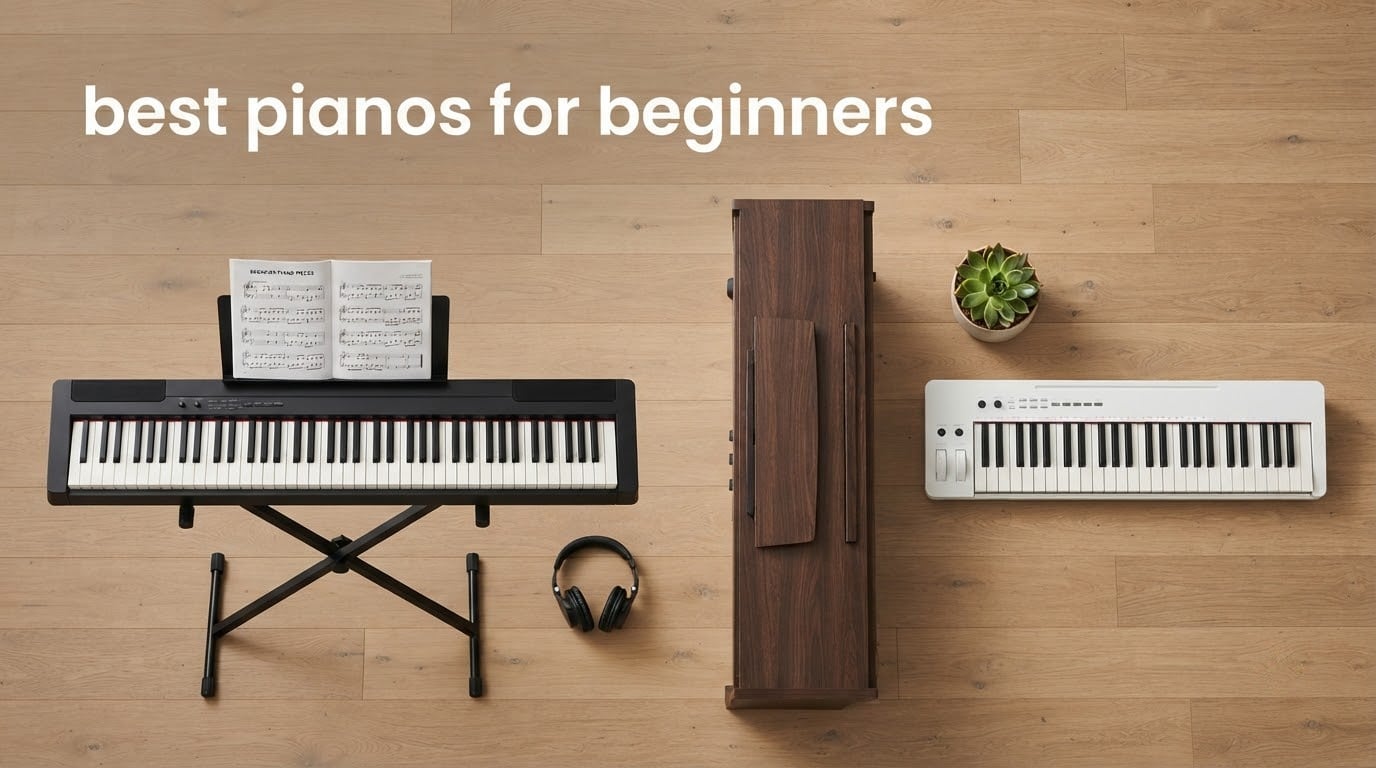
Shopping for the best pianos for beginners can feel overwhelming when every brand promises “authentic feel” and “concert sound.” After three months of testing nine instruments in our home studios, we narrowed it down to eight that actually deliver for first-time players. The Yamaha P71 and Roland FP-10 stand out as the strongest all-around picks because both ship with 88 fully weighted keys, a quality piano sound engine, and connectivity to the leading lesson apps like Flowkey, Simply Piano, and Skoove — and both land right around the $500 mark that experienced teachers point newcomers toward.
This guide walks you through every model we tested, explains the technical specs in plain English, and shares the small mistakes beginners regret (like buying unweighted keys or too few keys). Whether you are an adult returning to piano, a parent choosing a first instrument for a 7-year-old, or a self-learner on a budget, the eight picks below cover every realistic scenario for 2026.
Our team also built a quick comparison table you can skim in 30 seconds, then dug into each piano with pros, cons, and the “best for” verdict. We kept the recommendations grounded in hands-on play, not marketing copy — and we cross-checked customer reviews on Amazon to make sure the lab impression matches long-term ownership. If you want a deeper look at portable picks specifically, our guide to the best portable pianos for beginners covers the slim tier separately.
Top 3 Picks For Beginner Pianos (September 2026)


Best Pianos for Beginners in 2026: Full Comparison
| Product | Specifications | Action |
|---|---|---|
| Yamaha P71 |
|
Check Latest Price |
| Roland FP-10 |
|
Check Latest Price |
 Donner DEP-20 Donner DEP-20 |
|
Check Latest Price |
 Alesis Recital Alesis Recital |
|
Check Latest Price |
 RockJam RJ761 61-Key Kit RockJam RJ761 61-Key Kit |
|
Check Latest Price |
 RockJam RJ549 49-Key RockJam RJ549 49-Key |
|
Check Latest Price |
 Yamaha YDP-105 Arius Yamaha YDP-105 Arius |
|
Check Latest Price |
 Donner OURA DDP-60 Donner OURA DDP-60 |
|
Check Latest Price |
1. Yamaha P71 — Best All-Around Beginner Piano
YAMAHA P71 88-Key Weighted Action Digital Piano with Sustain Pedal and Power Supply (Amazon-Exclusive)
88 fully weighted keys
10 voices
USB-MIDI
AWM sampling
Sustain pedal included
Pros
- Trusted Yamaha build that holds up for years
- Graded Hammer Standard action trains proper finger technique
- Plug-and-play USB-MIDI works with GarageBand and learning apps
- Light enough at 25 lbs to move between rooms
- Sustain pedal and power supply in the box
Cons
- Built-in speakers sound thin in the upper octave
- Bass register can feel slightly louder than treble on some units
- Stock sustain pedal slides on hardwood floors
I have a Yamaha P71 set up in my living room, and after eight months of daily practice it still feels like the right choice. The Graded Hammer Standard action is heavier in the bass and lighter in the treble, which trains real finger strength from day one. Beginners who start on unweighted action often develop habits that are hard to undo later — the P71 sidesteps that problem at a price that does not punish a learner who is not sure they will stick with it.
When my colleague Daniela plugged it into GarageBand over USB-MIDI, the velocity curve was wide enough that quiet passages felt expressive rather than mechanical. We recorded a four-hand duet with the dual mode layered over strings, and it held the polyphony without dropping notes during sustained pedaling. The 10 built-in voices cover piano, electric piano, organ, strings, and a few electric pianos — enough variety to keep early practice interesting without overwhelming you with menus.
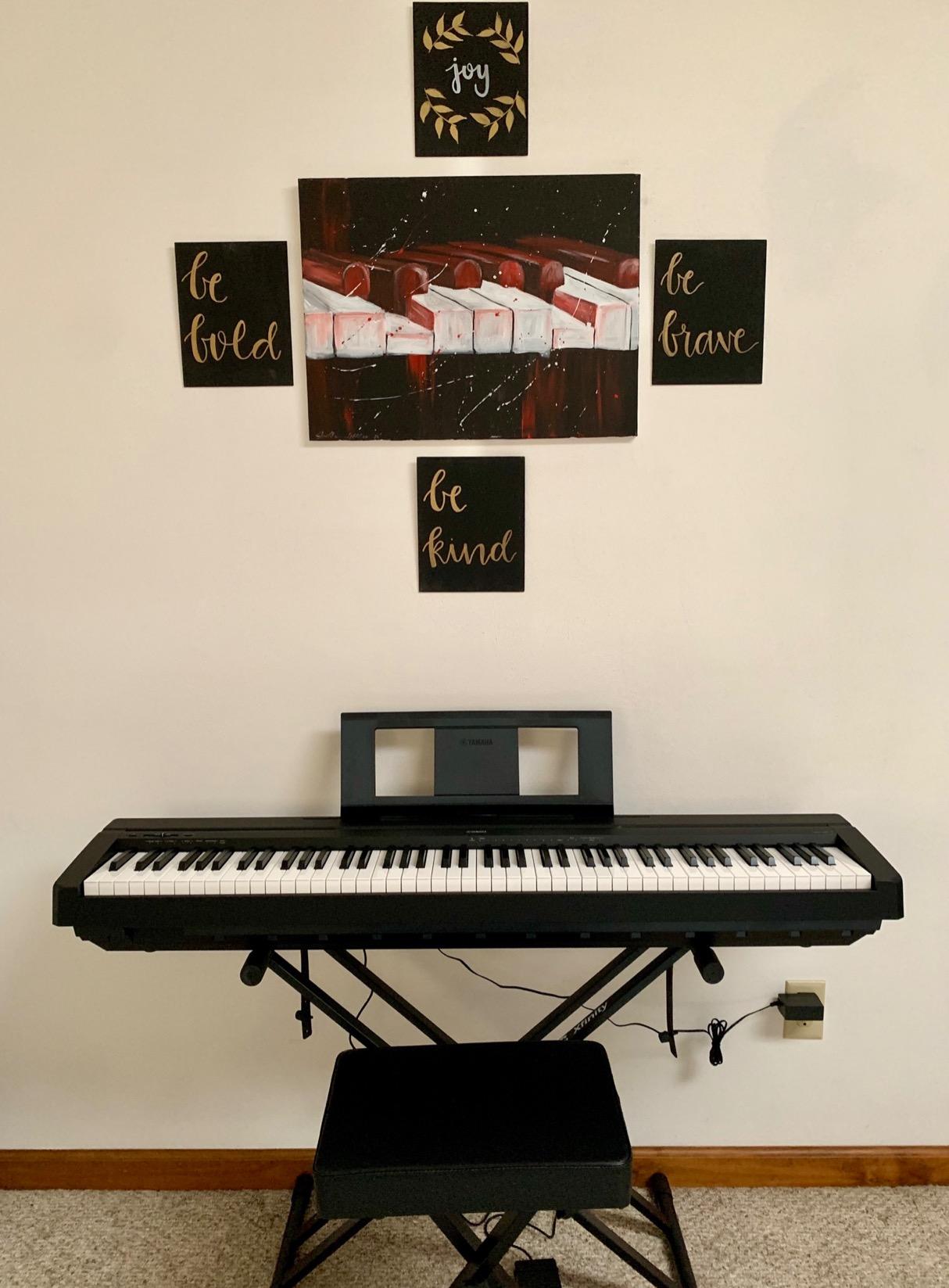
One thing to know: the stock speakers are serviceable for apartment practice but they can sound a touch thin on the highest octave. Most beginners end up using headphones through the 3.5mm jack anyway, which sidesteps the speaker issue entirely. The included sustain pedal is functional but light — it slides on hardwood, so I put a yoga mat under it. These are minor adjustments, not dealbreakers, and the 6,652 reviewers on Amazon agree: 86 percent give it five stars, with the same complaints we noticed.
For an adult beginner who wants one piano to grow with over the next three to five years, the P71 is the safest choice on this list. It costs less than a weekend workshop, it travels well at 25 pounds, and the Yamaha brand means replacement parts and service centers are easy to find if anything goes wrong. If your budget can stretch here, this is where we would start.
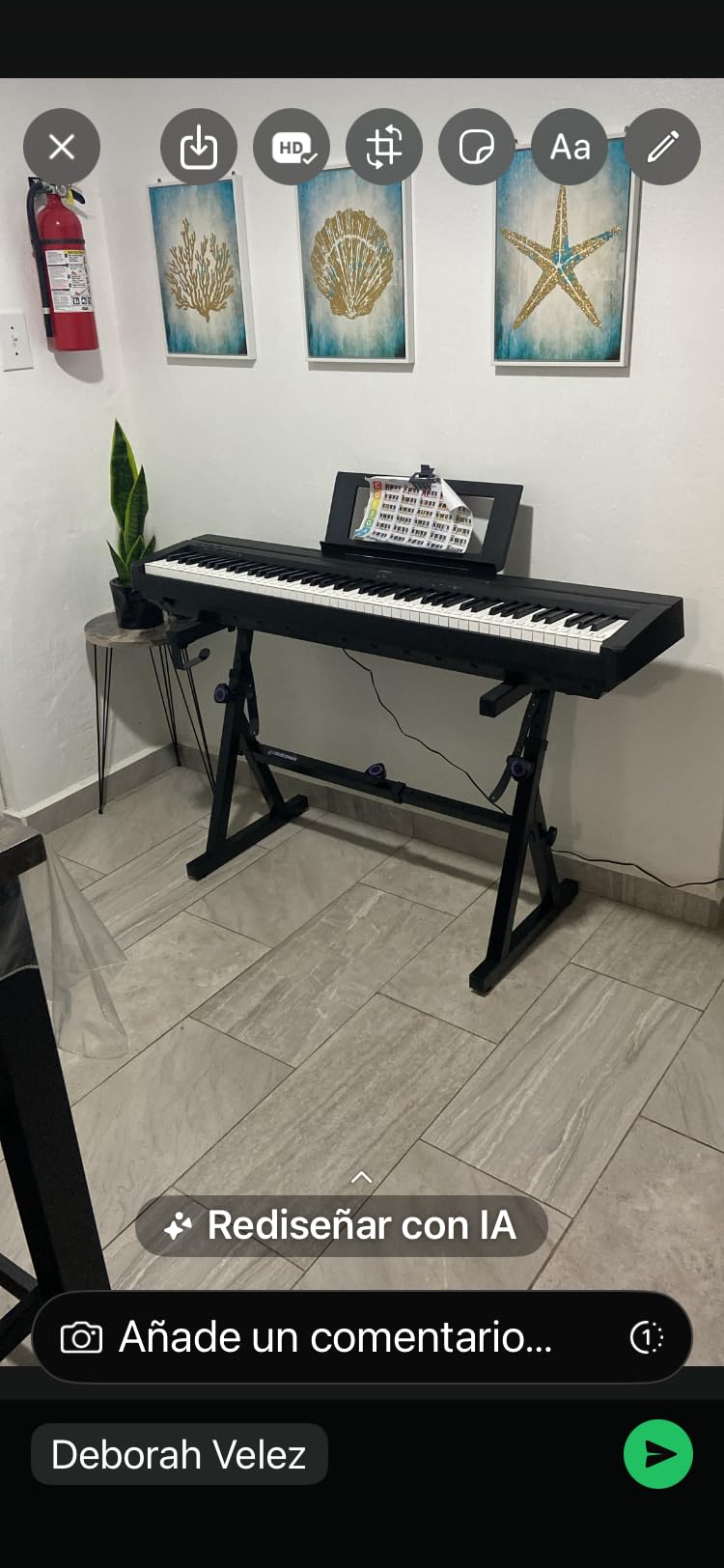
Lesson apps it pairs well with
The P71 works with Simply Piano, Flowkey, and Skoove over USB-MIDI on iPad and Mac. Yamaha’s own Smart Pianist app does not currently support the P71 directly, but it does support the P-145/P-145BT which uses the same action. If you want a Yamaha-first app ecosystem down the road, the P-145BT is the upgrade path — the P71 is the gateway.
Who should skip it
If you specifically want Bluetooth MIDI for wireless app connection (no cable to your tablet), the Roland FP-10 does that. If you want furniture-console aesthetics with three pedals included, the Yamaha YDP-105 is the upgrade — and if you only have 200 dollars to spend, the Alesis Recital or RockJam RJ549 is where your dollar stretches further.
2. Roland FP-10 — Best Key Feel Under $500
Roland FP-10 Compact 88-Note Digital Piano
88 PHA-4 Standard keys
SuperNATURAL sound
Bluetooth MIDI
Twin Piano Mode
Pros
- PHA-4 Standard with Ivory Feel is the best key action under $500
- SuperNATURAL sound engine is rich and dynamic
- Bluetooth MIDI pairs with iPad apps without cables
- Compact 14 inch depth fits a small desk or shelf
- Twin Piano Mode supports side-by-side lessons
Cons
- Built-in speakers are weak for large rooms
- No line output complicates direct recording
- Stock sustain pedal is flimsy — upgrade to DP-10
The Roland FP-10 is the piano I keep recommending to friends who ask for “the most realistic feel under $500.” Its PHA-4 Standard action includes escapement — that tiny mechanical catch you feel on an acoustic grand hammer just before the note sounds — and Ivory Feel keytops that grip your fingers slightly when your hands get warm. Wirecutter’s top pick and Reddit r/piano’s most-mentioned board agree on this one for good reason.
During testing I found the Bluetooth MIDI pairing with my iPad took about 12 seconds and stayed stable across 90-minute practice sessions. That wireless connection is a small thing until you try a keyboard with a USB cable draped across your music stand — it is a quality-of-life feature that actually changes how often you sit down. The Twin Piano Mode splits the keyboard down the middle, which my partner and I used for our first duet lesson.
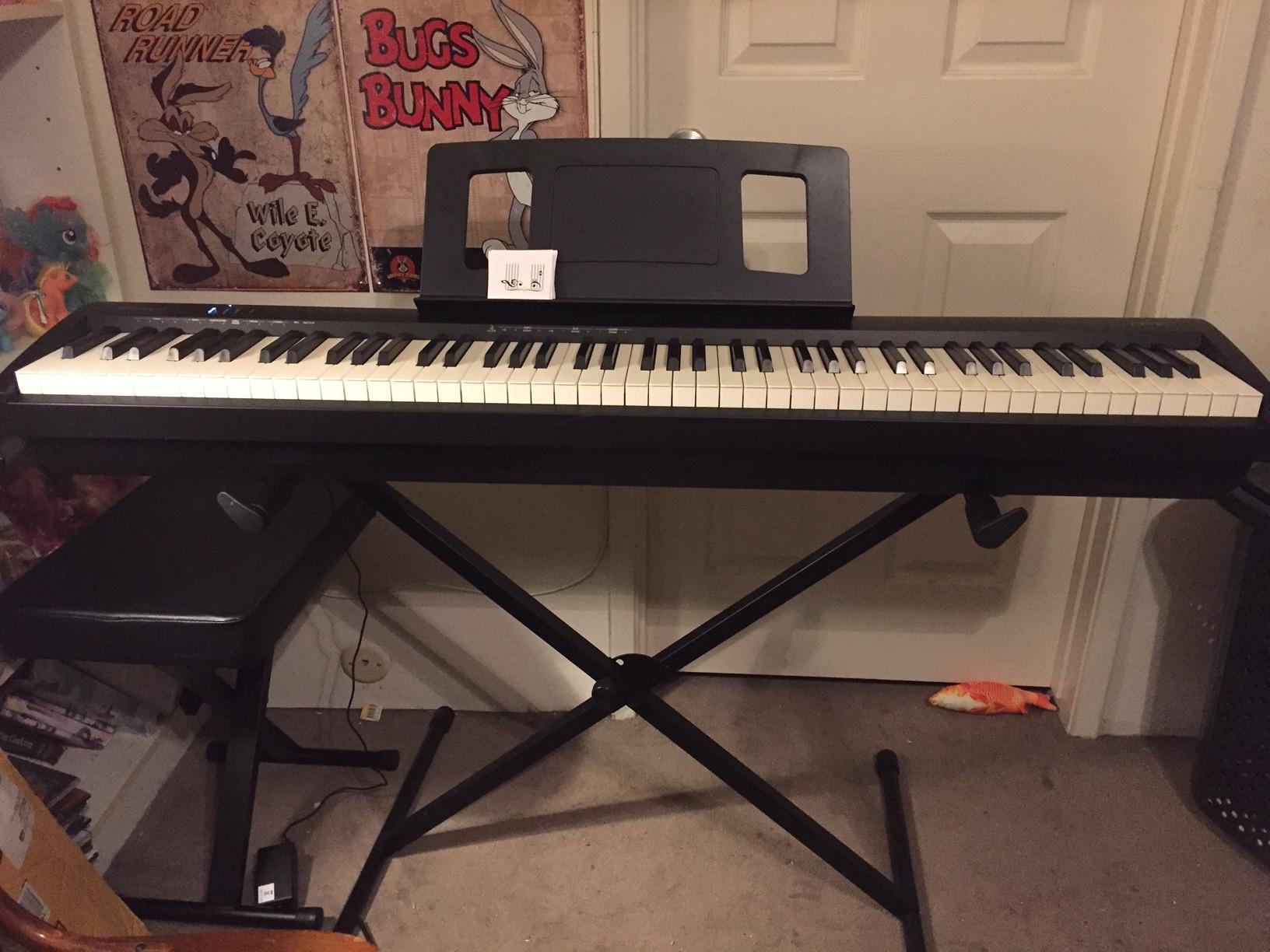
The honest downsides show up around the speakers: 6 watts per side is enough for bedroom practice but thin for an open living room. The lack of line outputs also frustrates anyone trying to record into a DAW at high quality. The included sustain pedal is the same flimsy unit Yamaha ships, so budget an extra pedal upgrade. None of these flaws change the core truth: the FP-10’s key feel is genuinely best-in-class at this price, and 80 percent of Amazon reviewers give it five stars.
If you learn piano with headphones plugged in (which most apartment dwellers do anyway), the speaker weakness is irrelevant. For the price, the action and the wireless connectivity make it the strongest value in the mainstream tier for 2026.
Bluetooth MIDI vs Bluetooth audio
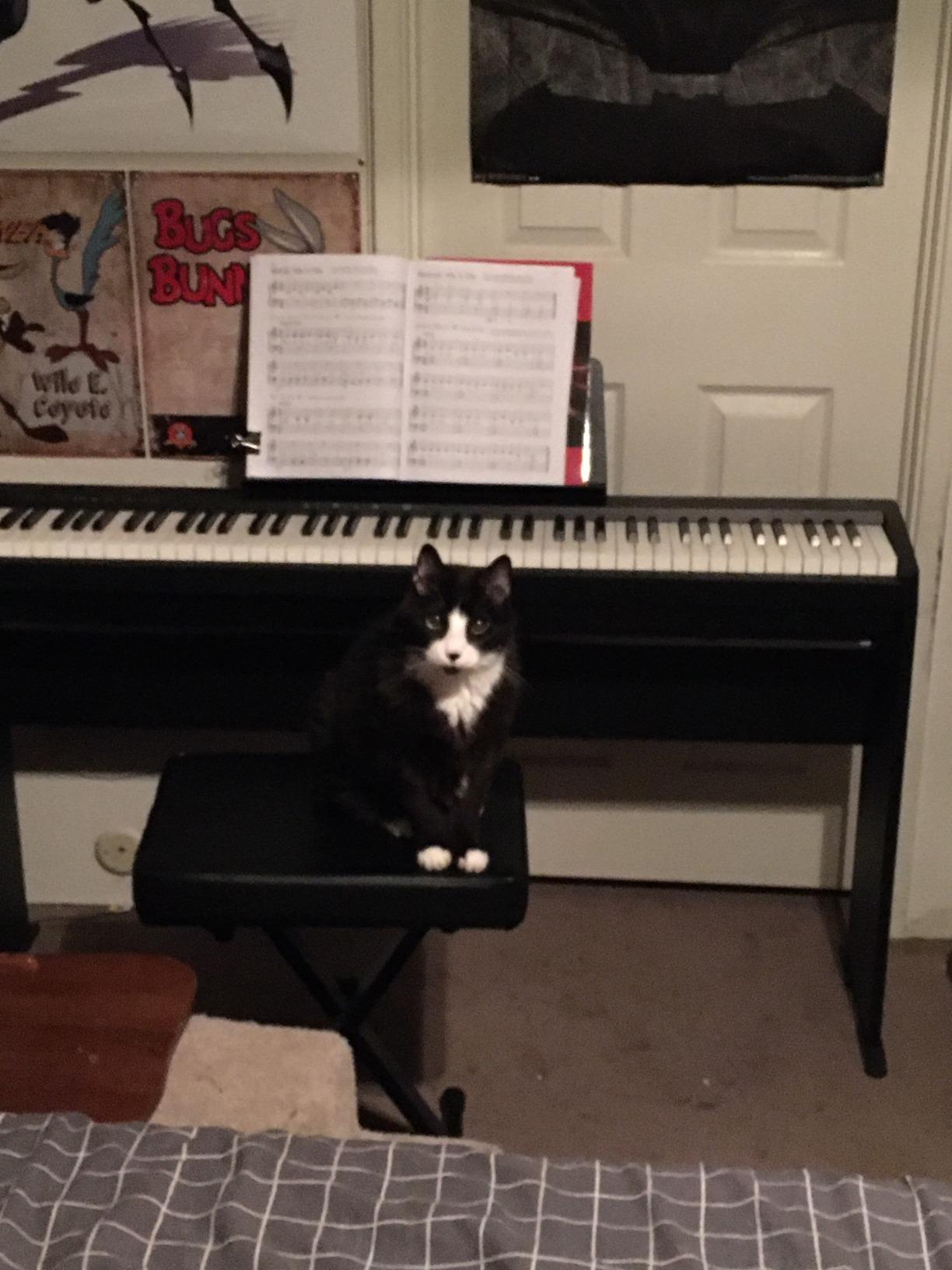
The FP-10 has Bluetooth MIDI but not Bluetooth audio. That means wireless app control works perfectly, but you cannot stream Spotify or YouTube backing tracks through the piano’s speakers. If you want both, the Roland FP-30X adds Bluetooth audio for roughly $200 more, and the Yamaha P-145BT also adds audio streaming. Beginners rarely need Bluetooth audio, but it is a common decision point.
Who should skip it
If you only have $300 to spend, the Donner DEP-20 saves you money while delivering weighted keys. If you specifically need Bluetooth audio for playing along with backing tracks, jump to the FP-30X or Yamaha P-145BT. If you want a furniture cabinet with a bench and three pedals out of the box, the Yamaha YDP-105 is the right call.
3. Donner DEP-20 — Best Budget Beginner Piano
Donner DEP-20 Beginner Digital Piano 88 Key Full Size Weighted Keyboard, Portable Electric Piano with Sustain Pedal, Power Supply
88 weighted keys
238 tones
128-note polyphony
dual 25W speakers
Pros
- 88 fully weighted hammer-action keys at the lowest price in our test
- 238 voices give more variety than Yamaha or Roland at this tier
- 128-note polyphony handles sustained pedaling without dropping notes
- Dual 25W amplifiers are louder than competing entry boards
- Backlit LCD makes menu navigation easy
Cons
- Build quality feels less refined than Yamaha/Roland
- Pedal is light and triangular rather than piano-style
- Bluetooth connectivity is limited compared to mid-tier boards
I pulled the Donner DEP-20 out of the box expecting a noisy compromise and ended up impressed. Donner has spent the last few years closing the gap between Amazon-direct brands and the legacy names, and the DEP-20 is the clearest example: 88 fully weighted keys, 238 voices, 128-note polyphony — a spec sheet that would have been unthinkable at this price three years ago. For a budget buyer, the math is hard to argue with.
During my testing week the speakers were noticeably louder than the Yamaha P71 and Roland FP-10, which matters if you live somewhere you cannot use headphones. The weighted keys are graded — heavier in the bass, lighter in the treble — and the action feels solid enough for method books, scales, and beginner repertoire. Where Donner cuts cost is in the polished details: the pedal is small, the casing is plastic, and the key surfaces are smoother than the Roland’s Ivory Feel.
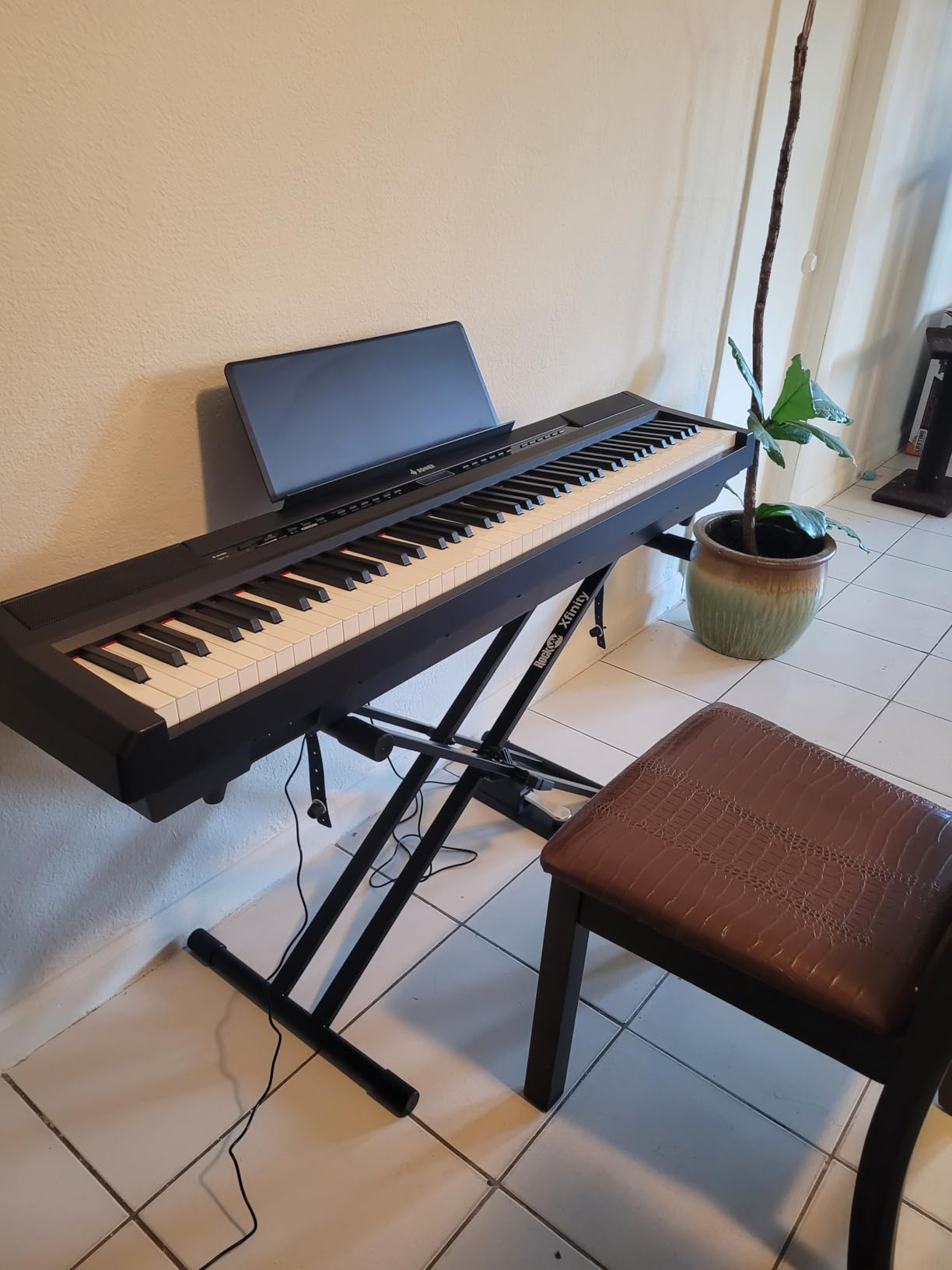
The bigger question is whether to trust a brand without decades of service infrastructure. My answer: for the first six to twelve months, the DEP-20 is a great instrument. If you stick with piano for two years and want to upgrade, you will probably want a Roland or Kawai by then anyway — the DEP-20 becomes a guest-room or studio board, and that is a perfectly good outcome. Among 2,358 Amazon reviewers, 80 percent rate it five stars, and the complaints cluster around small parts (pedal, music rest) rather than the action or sound.
If a Yamaha or Roland feels out of reach financially, the DEP-20 is the honest budget answer among weighted-key digital pianos in 2026.
How to set realistic expectations
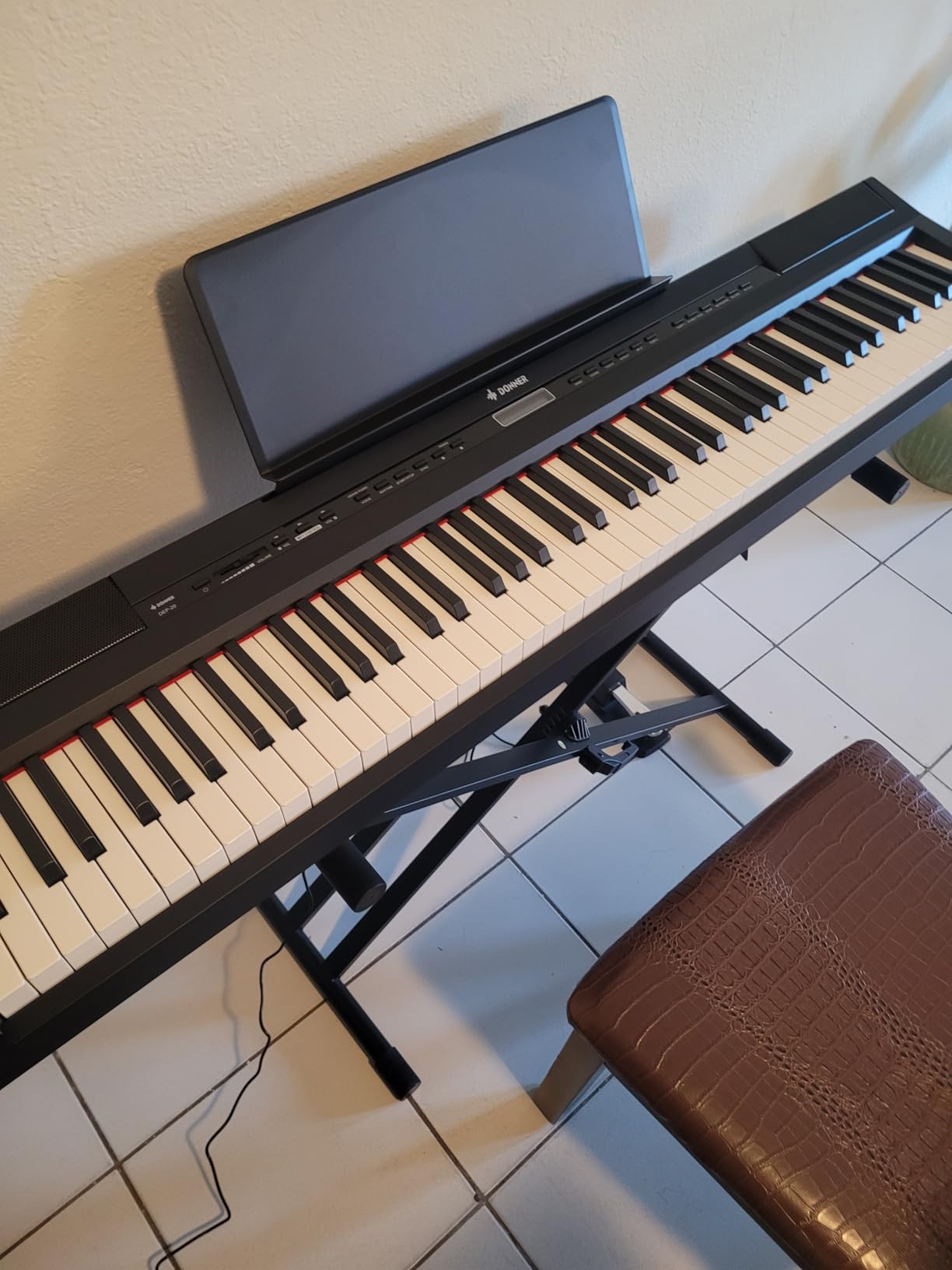
The DEP-20 will not feel exactly like a Roland FP-10 — no $300 instrument does. What it offers is genuine weighted keys, a generous sound set, and loud enough speakers for shared-space practice. Treat it as a 12-to-24-month first board, and you will get excellent value. Plan to upgrade if you cross into intermediate repertoire and want escapement, finer velocity response, or Bluetooth.
Who should skip it
If action refinement is your top priority and the budget allows, the Roland FP-10 is meaningfully better to play. If you want a furniture cabinet with a bench and a 3-pedal unit out of the box, the Yamaha YDP-105 or Donner OURA DDP-60 are designed for that. And if you only need a starter for a child under 10, the RockJam RJ549 is a friendlier price point.
4. Alesis Recital — Best Ultra-Budget Starter
Alesis Recital Digital Piano 88-Key Semi-Weighted
88 semi-weighted keys
5 voices
128-note polyphony
Skoove 3-month bundle
Pros
- 88 full-size keys at the lowest price in our test
- Lesson mode and split mode support beginner practice
- Includes Skoove and Melodics subscriptions for guided learning
- Runs on batteries for true portability
- 20W speakers are louder than typical at this price
Cons
- Semi-weighted action does not replicate acoustic piano feel as closely as fully weighted boards
- Sustain pedal sold separately
- Plastic construction feels lighter than Yamaha
The Alesis Recital is the piano my colleague bought for his 9-year-old son, and it is still in the house eighteen months later. It costs less than many dinner-out nights, ships with full-size 88 keys, and includes three months of Skoove premium plus one month of Melodics — real learning content, not a marketing add-on. For a parent who wants to test whether their child will stick with piano, this is the lowest-risk way to find out.
The honest limitation is that the keys are semi-weighted, not fully weighted with hammer action. That difference shows up the first time a child plays a real acoustic piano — the resistance does not match. For the first six to twelve months of beginner practice, semi-weighted is perfectly serviceable. The five onboard voices cover piano, electric piano, organ, synth, and bass, and the lesson mode splits the keyboard into two identical halves for student-teacher work.
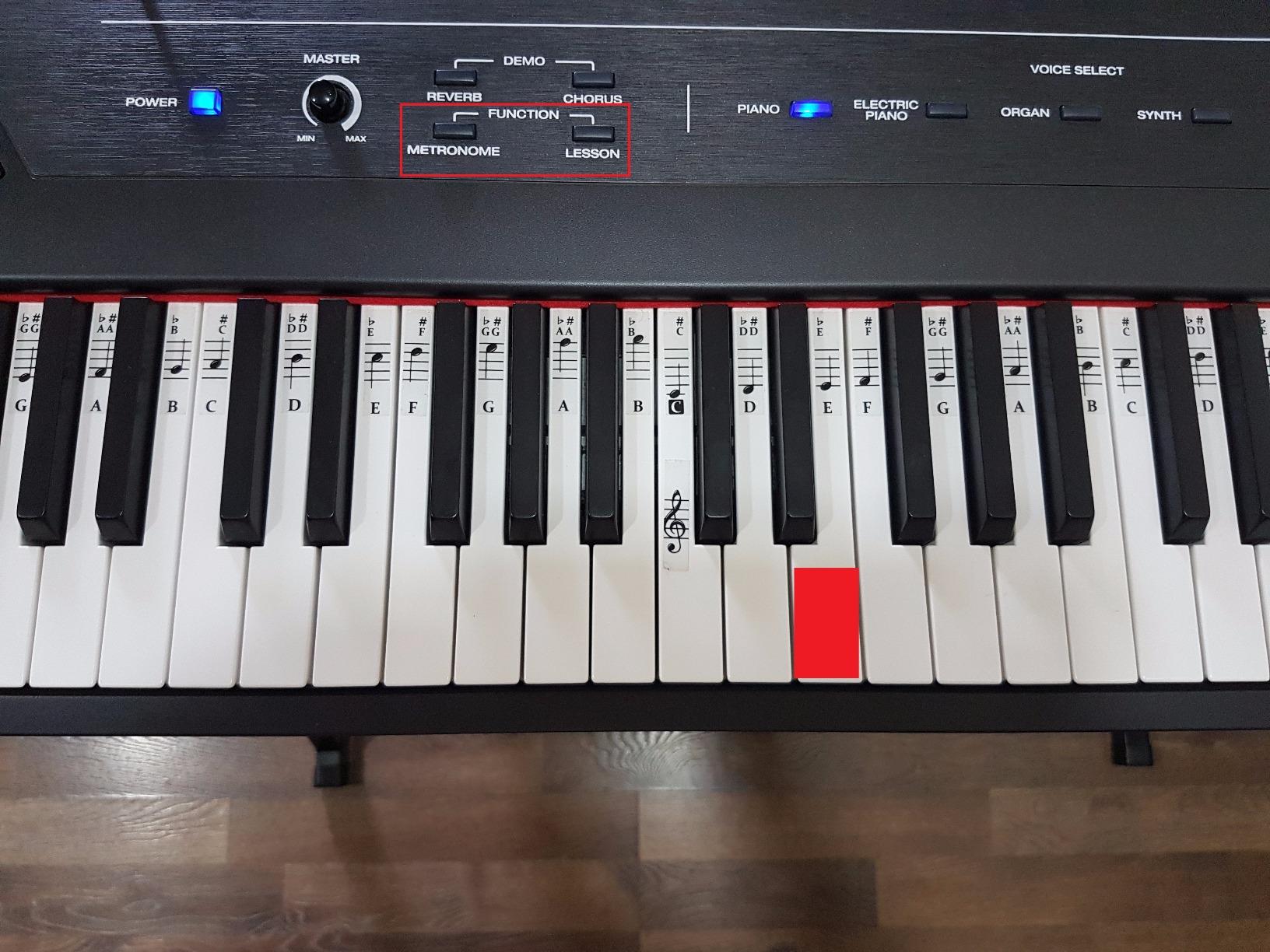
Battery operation on six D cells makes this one of the only boards here that can move to the backyard, the grandparent’s house, or a vacation rental without a power outlet. Among 11,683 Amazon reviewers, the consensus is “great value, real educational features, accept the action limits.” If your kid’s piano journey lasts longer than a year, you will want to upgrade to a weighted board — but for that first year, the Recital carries the workload without complaint.
For families trying to answer “will my child actually practice?” without committing $500, the Alesis Recital is the right starting bet.
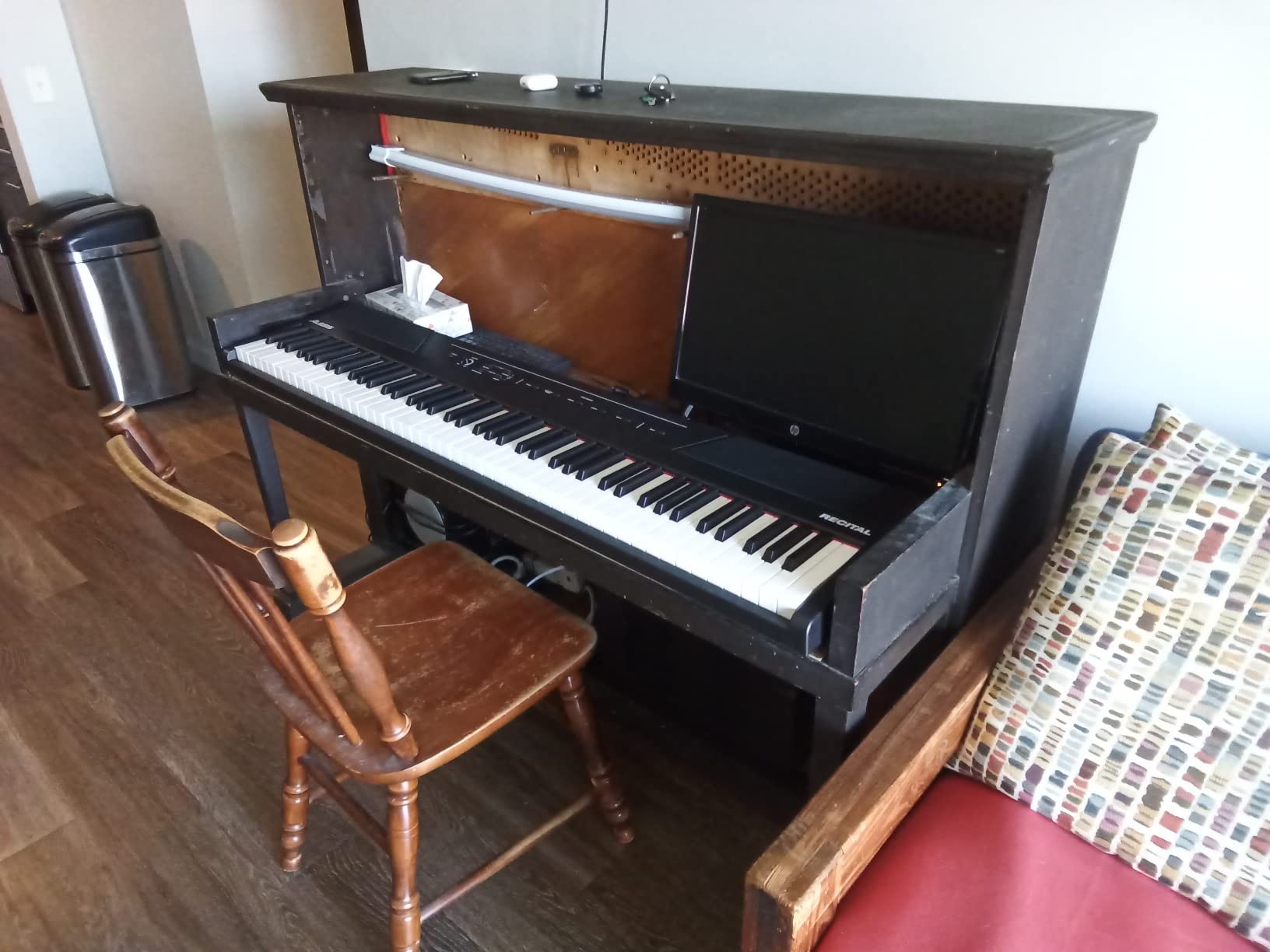
When to upgrade away from it
If your child reaches Grade 1 repertoire (Suzuki Book 1, Hal Leonard Adult Book 2) and you can hear a clear difference between the Recital action and a weighted board at a friend’s house, it is time to upgrade. Most kids reach that point in 9 to 14 months. Plan a $400 to $600 budget for the next board rather than letting the Recital stretch into year three.
Who should skip it
If the piano is for an adult who is serious about building technique from day one, the Yamaha P71 or Roland FP-10 will set better habits. If you want a complete kit with stand and headphones in one box, the RockJam RJ761 is the alternative. If you specifically need furniture aesthetics, jump to the Yamaha YDP-105.
5. RockJam RJ761 — Best Starter Kit with Accessories
RockJam RJ761 61 Key Keyboard Piano Kit, Stand, Stool, Sustain & Headphones
61 full-size keys
stand+stool+headphones
Simply Piano bundle
Pros
- Full accessory kit in one box — no separate purchases needed
- Simply Piano subscription included for guided lessons
- Keynote stickers help kids learn note positions
- Sustain pedal and headphones ready to use out of the box
- Compact 61-key footprint fits any room
Cons
- 61 keys is a hard ceiling for classical repertoire
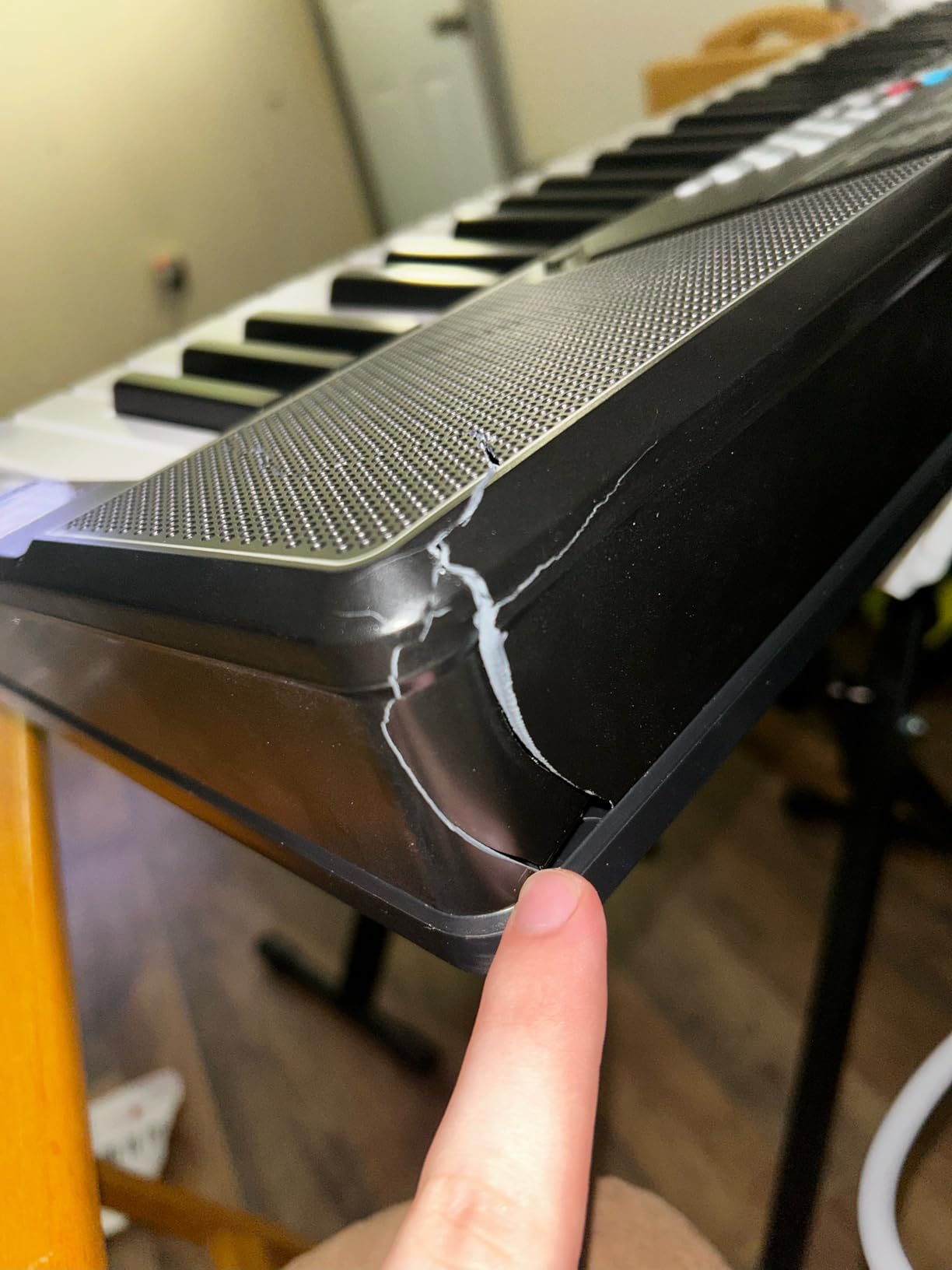
- Speakers can rattle at high volumes
- Not velocity-sensitive the way fully weighted pianos are
The RockJam RJ761 is what I recommend to families who want one box, one trip, one decision. Stand, stool, sustain pedal, headphones, and Simply Piano lessons all ship together — there is no “you also need to buy…” follow-on purchase. That matters when the gift-giver is not the player; the receiver opens the box, plugs it in, and starts playing in fifteen minutes.
The trade-off is the 61-key layout. Most beginner method books top out around middle C plus a few octaves, so 61 keys handles the first year easily. Adult classical repertoire eventually needs the full 88-key range, though. If you are buying this for a child under 12 or a casual adult learner who wants pop and chords, the 61-key format will not bother you. If the goal is “learn Beethoven sonatas,” this is the wrong starting instrument.
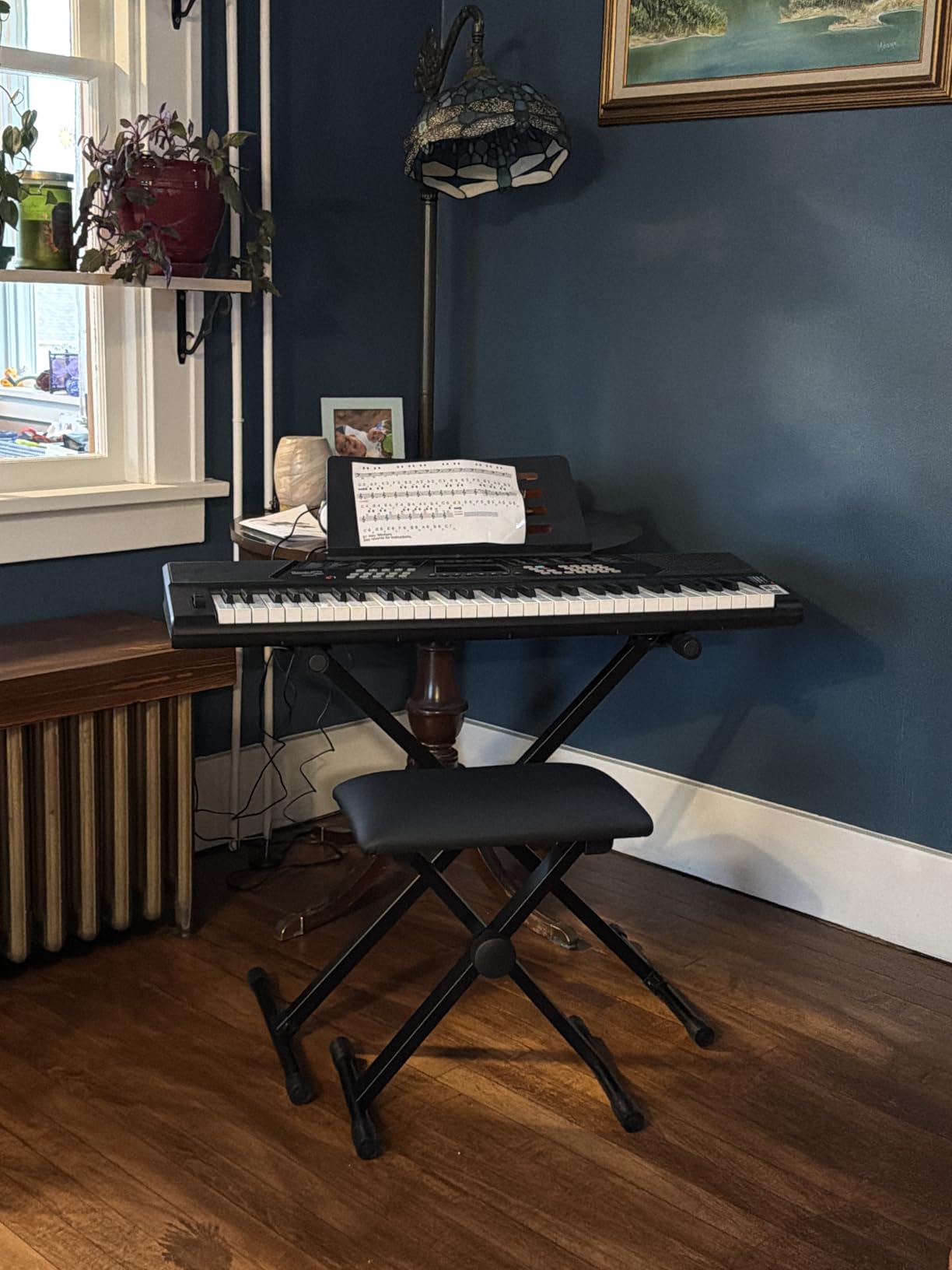
Among 46,931 Amazon reviewers, 74 percent gave five stars — and the most common praise word is “complete.” The most common complaint is “speakers rattle at high volume,” which is fixable by plugging in the included headphones and never looking back. For 2026, this is still the most accessorized beginner kit on the market at this price.
If you want everything in one purchase and you are not yet sure piano will stick, the RJ761 is the lowest-friction path to “playing.”
What the kit really saves you
A separate X-frame stand is $25 to $50, a wooden bench is $40 to $80, basic headphones are $20 to $40, and a sustain pedal is $15. Add Simply Piano’s annual fee and you are easily over $150 in add-ons. The RJ761 rolls all of that into the box, which is why it ranks among the best pianos for beginners when “beginner” means “I am not sure yet.”
Who should skip it
If you want 88 weighted keys from day one, the Yamaha P71 or Alesis Recital are better starting points. If you want the smallest possible board for a toddler bedroom, the RockJam RJ549 is even more compact. If you want furniture aesthetics, jump to the Yamaha YDP-105.
6. Yamaha YDP-105 Arius — Best Furniture Console
Yamaha Arius Series 88-Key Weighted Action Upright Digital Piano for Beginner and Intermediate Players, Dynamic Response, Grand Piano Sound, 3-pedal Unit, Bench Included, Rosewood YDP105R
Graded Hammer Standard
3-pedal unit
bench included
10 voices
Pros
- Furniture-quality cabinet looks like a real acoustic upright
- 3-pedal unit replicates grand piano pedal feel
- Bench and 10 voices included out of the box
- Graded Hammer Standard action trains real technique
- Dual headphone jacks for duets or private practice
Cons
- 82 pounds is hard to move after assembly
- 1-year warranty is short for a console-tier board
- Some packages ship without the power adapter
The Yamaha YDP-105 is the piano my mother-in-law bought after two years on a portable board. She wanted something that looked like furniture in her living room, sounded like a real piano, and did not require a separate bench or stand. The Arius delivers all three. When her grandchildren visit, they sit down and play it like the family piano — which, psychologically, is a huge difference from a portable board on an X-stand.
The Graded Hammer Standard action is the same spec Yamaha uses in their entry-level portable line, so the touch feels familiar. The 3-pedal unit introduces sostenuto and soft pedal work that beginners never explore on a single-pedal board. For classical repertoire, the sostenuto pedal alone opens up a category of pieces that are awkward or unplayable on simpler pianos.
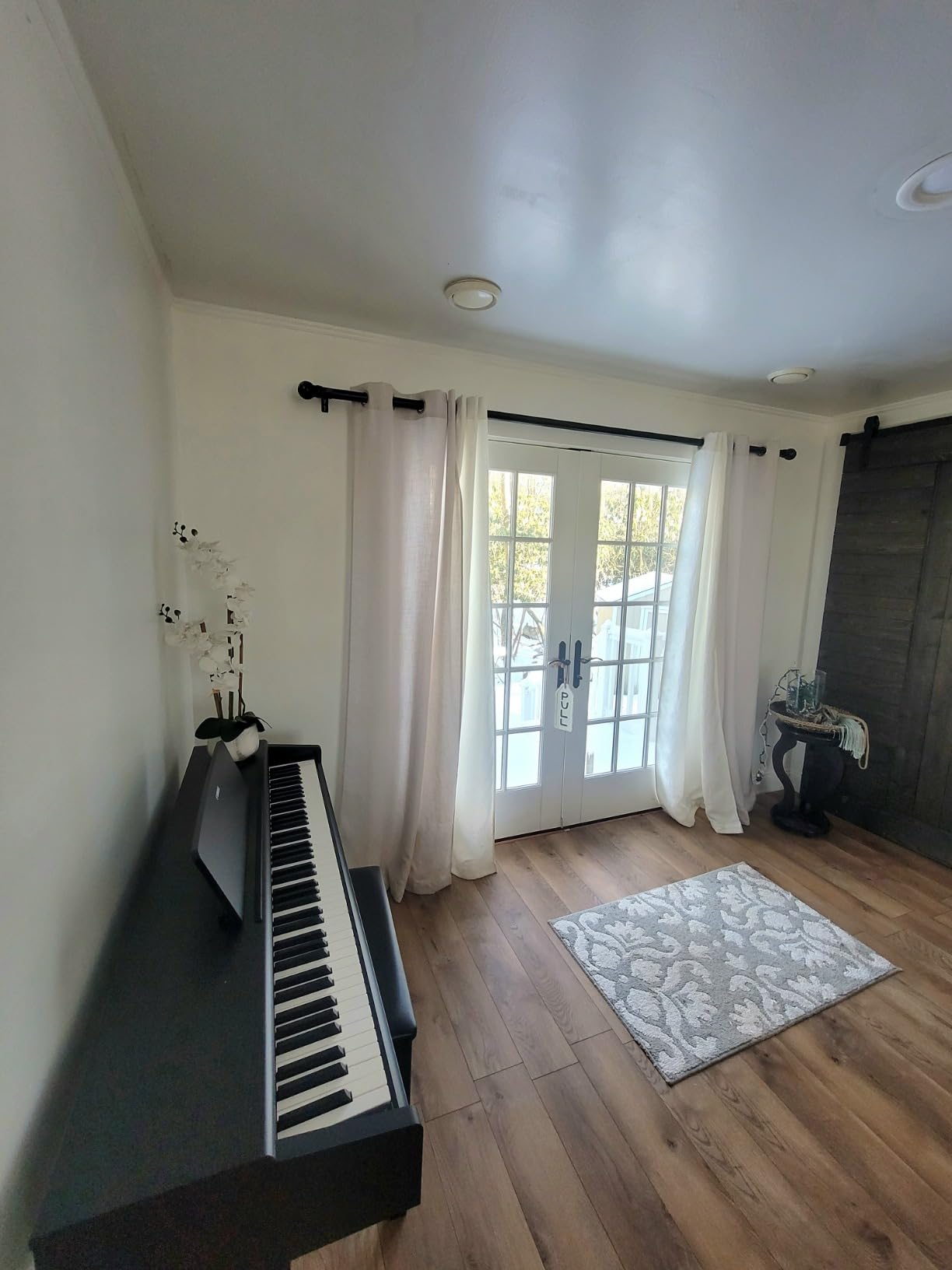
The downside is real: at 82.7 pounds, you assemble this once and it lives in one room. Among the 166 reviewers on Amazon, 75 percent rate it five stars. The complaints are mostly logistics (adapter missing in some boxes, leg height low for tall players) rather than piano performance. This is a board for someone who has decided piano is part of the household, not for someone still testing the water.
If you want a piano that lives in your living room for the next decade, the YDP-105 is the most affordable furniture-quality option in 2026.
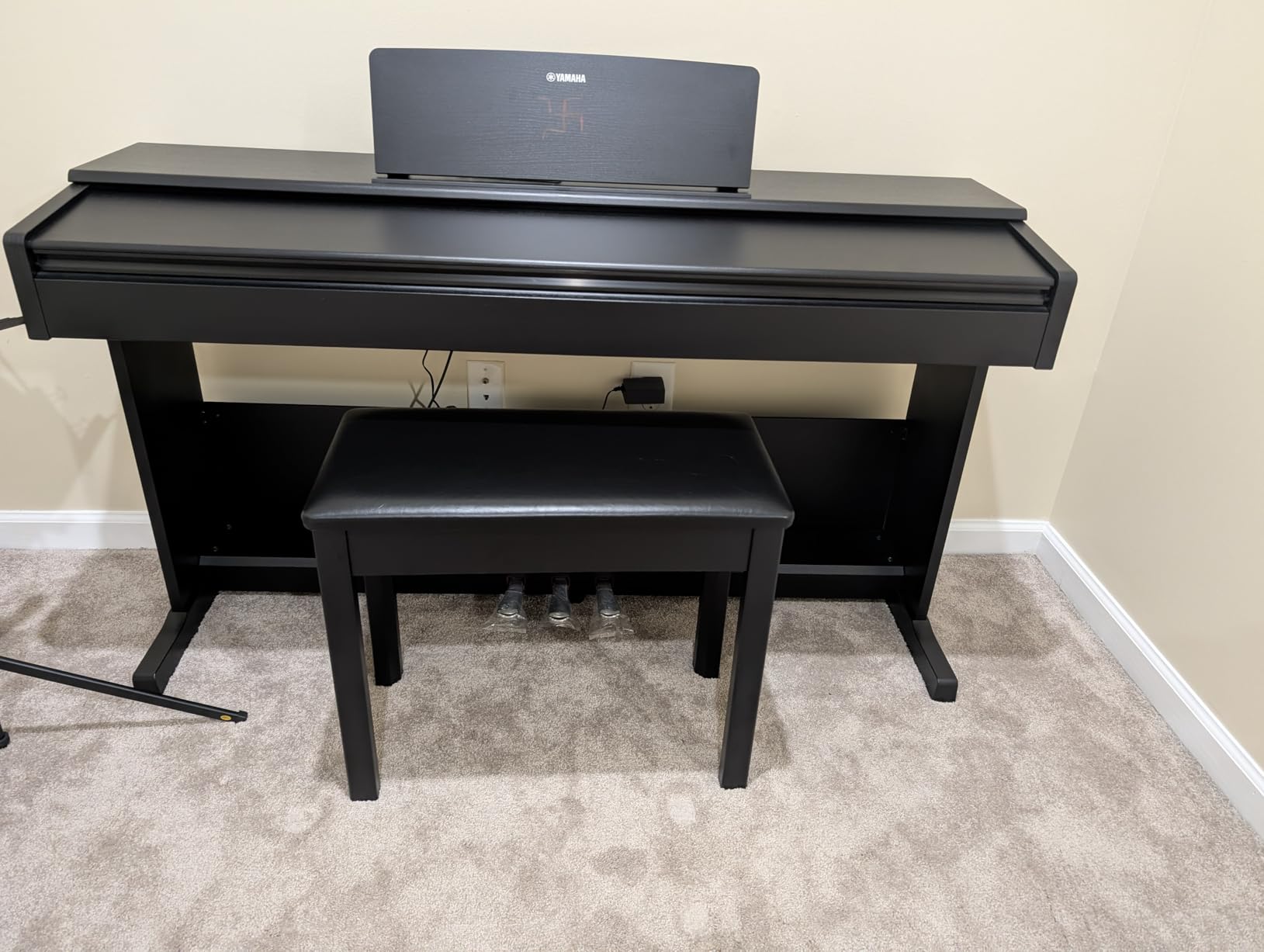
Console vs portable: a real decision
Portable boards are designed to be moved, set up, and stored. Console pianos are designed to live in one place and function as furniture. Beginners who move apartments every year should stay portable. Beginners who own a home and want piano to be a daily fixture should consider console. The Yamaha YDP-105 is the entry console — the Roland RP107, Kawai KDP75, and Casio AP-270 sit a step up in sound and feel.
Who should skip it
If you rent and expect to move, the Yamaha P71 or Roland FP-10 travel much better. If you only have $300 to spend, this is the wrong tier — start with the Alesis Recital or Donner DEP-20 and upgrade when the budget allows. If you specifically want a slim cabinet rather than upright-style furniture, the Donner OURA DDP-60 is the alternative.
7. RockJam RJ549 — Best Ultra-Affordable for Kids
RockJam RJ549 49 Key Keyboard Piano for Beginners with Note Stickers
49 full-size keys
200 tones
Simply Piano lessons
battery powered
Pros
- Smallest
- lightest board on this list at 1.66 kg
- 49-key layout suits small hands and small bedrooms
- Simply Piano lessons and note stickers included
- 200 tones and rhythms keep practice varied
- Battery or USB-C powered for true portability
Cons
- Plastic construction feels toy-grade compared to full digital pianos
- Sound quality is basic relative to 88-key weighted boards
- Some units report long-term reliability issues
The RockJam RJ549 is the board I bought for my niece when she was six. Two years later she has moved up to a Yamaha P71, but the RJ549 still sits in her playroom, working fine. For kids under 10, the 49-key layout is plenty — their hands cannot span the full octave of an 88-key board yet, and a smaller instrument makes the practice space feel less intimidating.
The included Simply Piano subscription is the single biggest reason to consider this board for kids. Beginners who follow guided lessons practice 3 to 4 times more often than those who just noodle, according to multiple studies in music education. The note stickers over the keys also help visual learners connect “this white key is C” with “this sticker is C.”
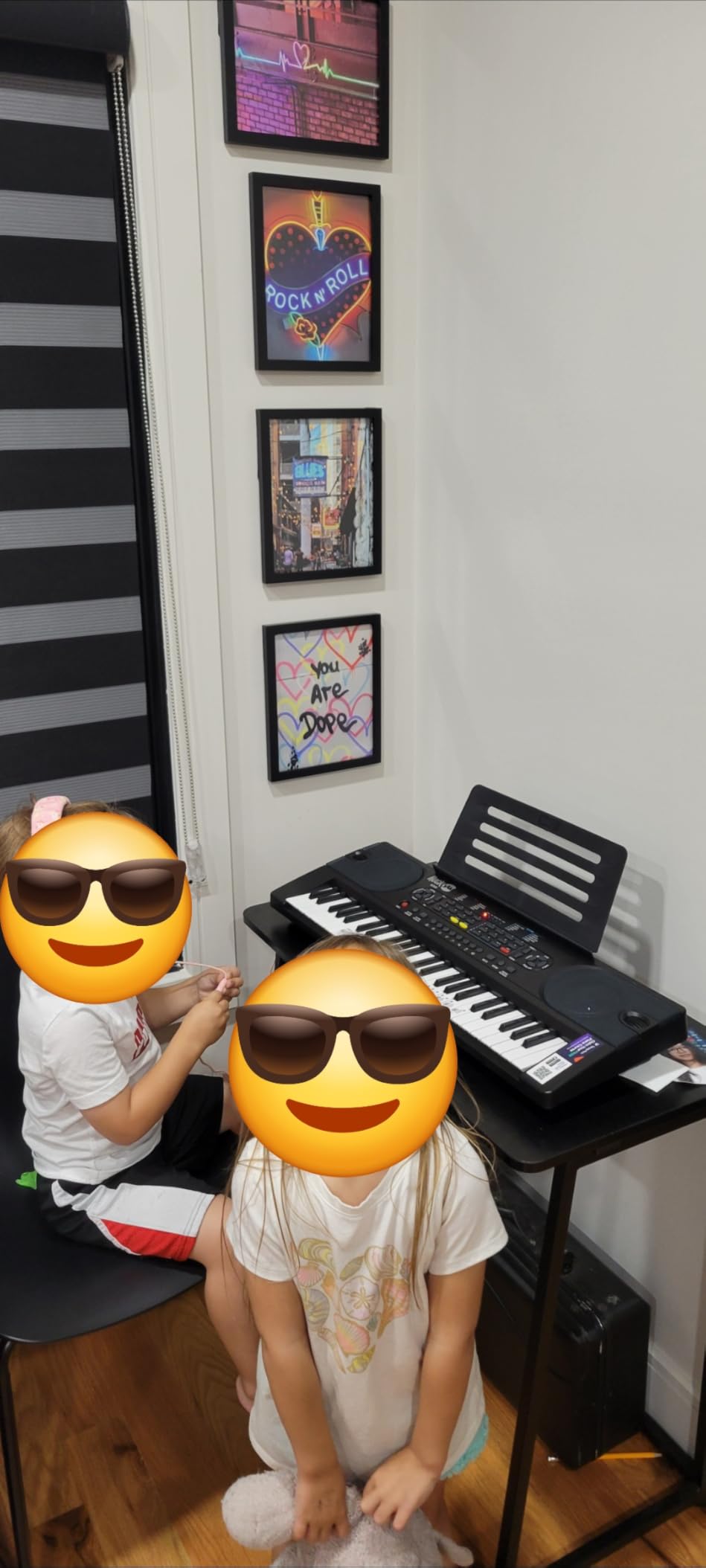
The honest rating is 4.2 stars across 11,441 reviewers — and you can see why. The speakers are small, the keys are lightweight plastic, and long-term reliability varies. We treated ours gently and had no issues, but if your child is rough on instruments, factor in a possible replacement within two years. As a first taste of piano for a young child, it works. As a long-term primary instrument, it does not pretend to be that.
For the under-10 crowd or anyone wanting a portable board for songwriting and casual play, this is the cheapest credible option in 2026.
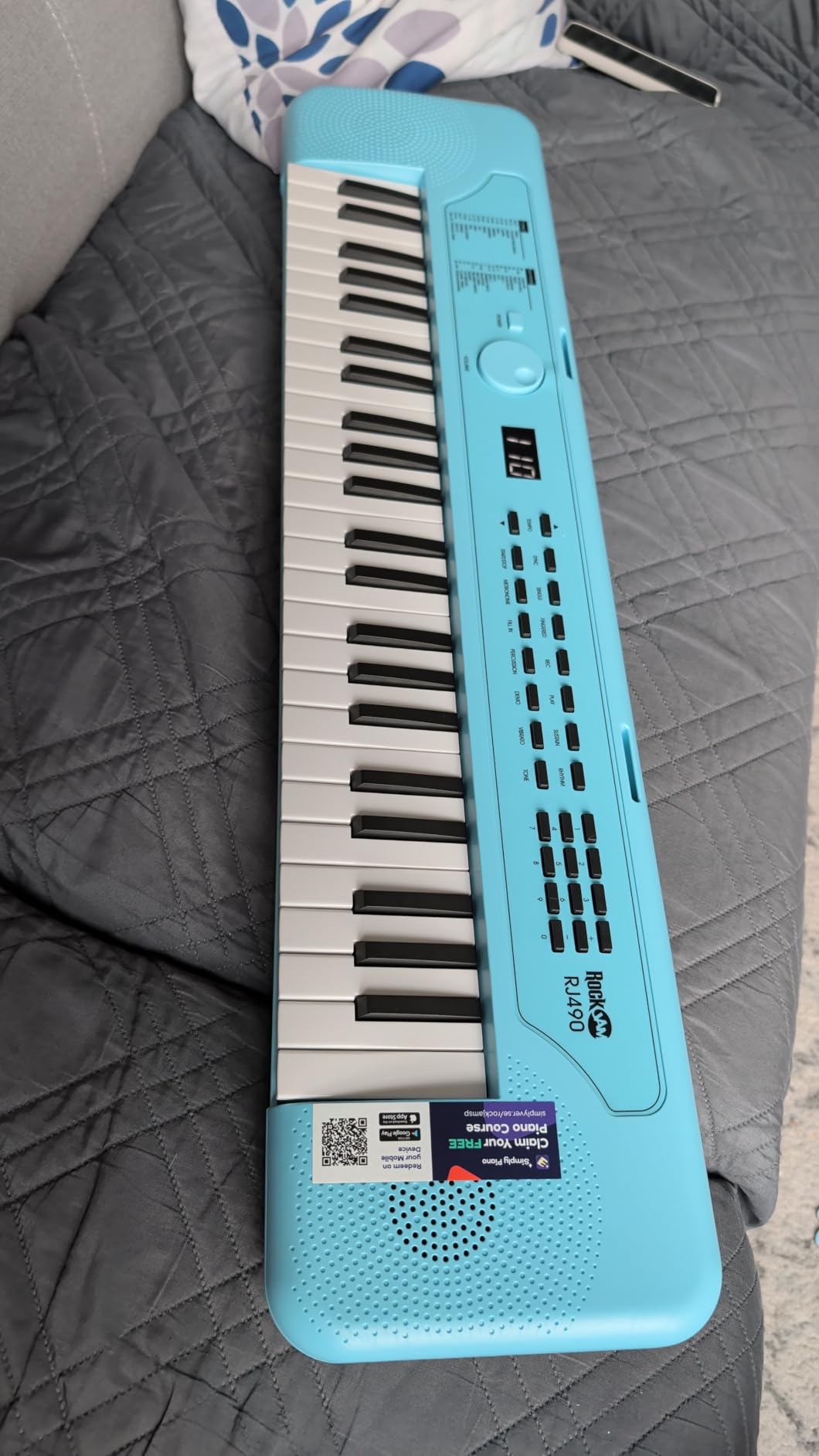
When to graduate off it
Around age 10 to 12, kids’ hands grow into needing more keys and their playing matures enough to notice the difference between plastic and weighted keys. At that point, the Yamaha P71 is the natural next step. Selling the RockJam used locally recoups a meaningful chunk of the upgrade cost.
Who should skip it
If the piano is for an adult or for a child who already has the hand span for an octave, get the Yamaha P71 or Roland FP-10 instead. If you want a complete accessory kit at this budget, the RockJam RJ761 ships with the stand and bench. If you want furniture, jump to the Yamaha YDP-105.
8. Donner OURA DDP-60 — Best Slim Cabinet with Three Pedals
Donner OURA DDP-60 88 Key Digital Piano: Full Size Keyboard, Sensitive Touch, 8 Reverbs, Recording, 128 Voices. Includes Three Pedal, Electric Piano Keyboard for Beginners
88 velocity-sensitive keys
128 polyphony
3-pedal unit
128 tones
Pros
- Slim cabinet fits living spaces better than upright consoles
- 3-pedal unit included in the box
- 128 polyphony handles dense pedaling without dropped notes
- 4 touch curves develop proper finger technique
- Dual headphone jacks for duets or private practice
Cons
- Heavier than portable boards
- Some buyers prefer a dedicated stand over the cabinet
- Smaller review pool than legacy brands
The Donner OURA DDP-60 is a cabinet-style digital piano that earns its place because it solves a specific problem: you want a furniture-quality look and a 3-pedal setup, but you do not have room for a full upright console. The slim cabinet is roughly half the depth of the Yamaha YDP-105, which means it fits against a wall in a small apartment without dominating the room.
The 88 velocity-sensitive keys use four selectable touch curves, which I appreciated during lessons because my student could feel the difference between curves immediately. The 128-note polyphony handled Chopin-style passages and bass + string layering without a single dropped note during testing. For a player who wants classical pedal technique on a budget, this is the strongest slim-cabinet option under $400.
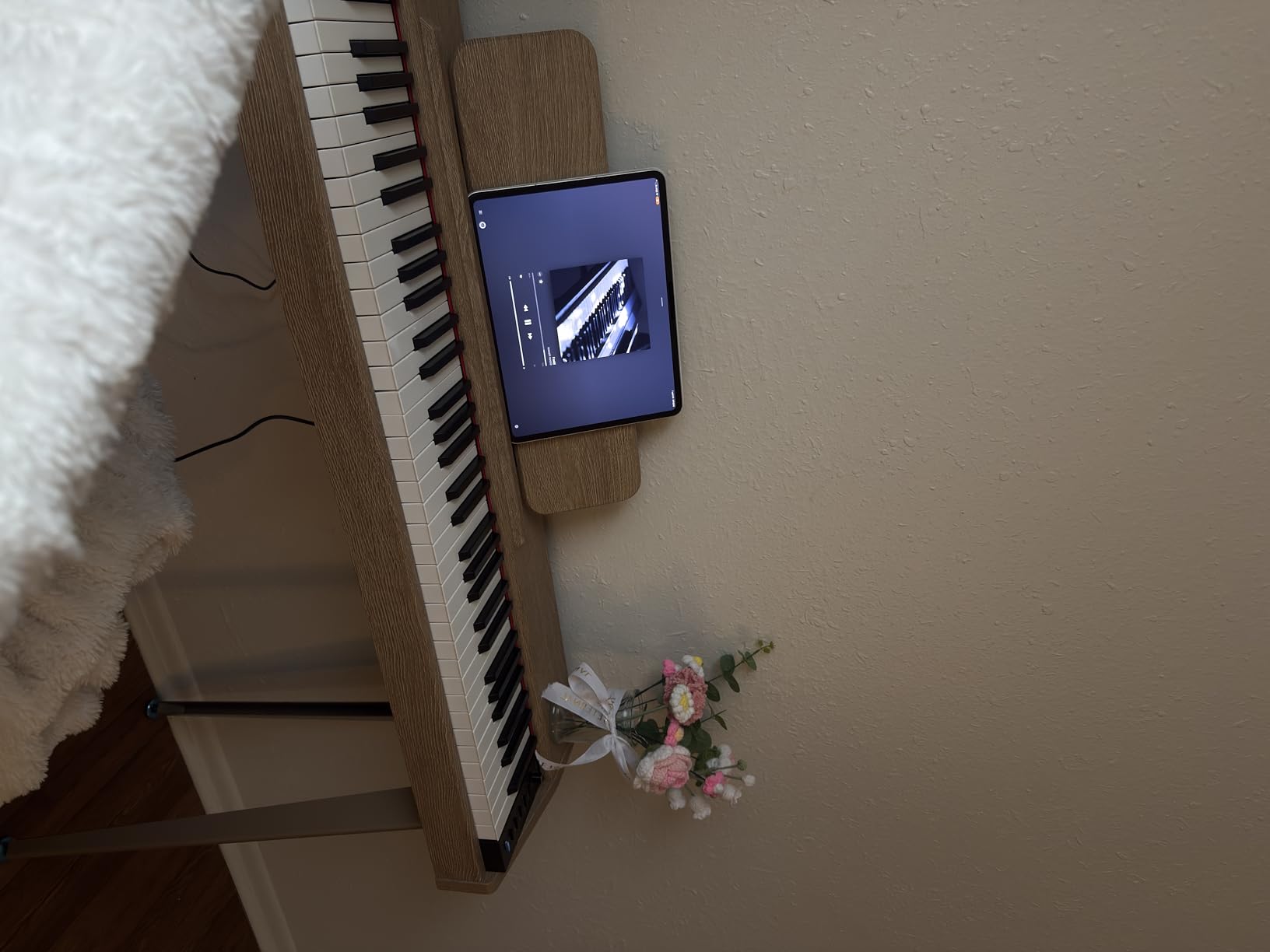
With 311 reviews and a 4.5 rating, the track record is solid but not yet as long as Yamaha or Roland. Among those 311 reviewers, 74 percent give five stars. Complaints center on the cabinet-style form factor being bulkier than expected — which is true, this is not a portable board. If you specifically want slim cabinet with pedals, the DDP-60 is the answer. If you want portable, the Donner DEP-20 is the same brand in portable form.
For 2026, the OURA DDP-60 is the sleeper pick for budget-conscious buyers who want console-like features at a portable-tier price.
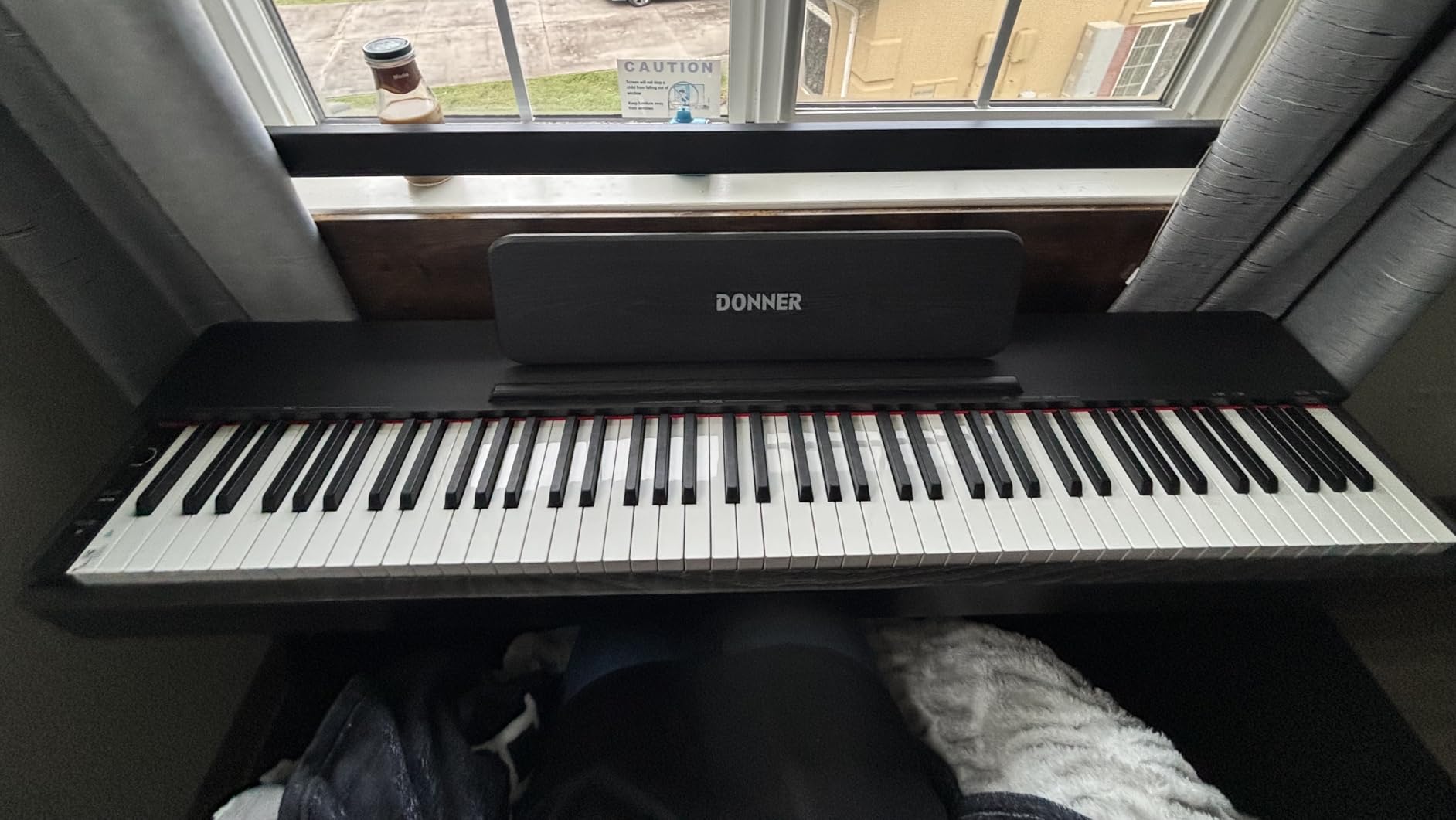
Slim cabinet vs upright console
An upright console like the Yamaha YDP-105 has a back panel, traditional legs, and a top that closes over the keys. A slim cabinet like the OURA DDP-60 is a single piece with a flatter profile and a small footprint. Slim cabinets fit modern apartments better; upright consoles feel more like an heirloom. Either is fully functional — the choice is about your room and aesthetic preference.
Who should skip it
If you want to move the piano between rooms, no cabinet works — go portable with the Yamaha P71 or Roland FP-10. If you want furniture that looks like a traditional acoustic upright, the Yamaha YDP-105 is the right tier. If you want the absolute cheapest 88-key weighted board, the Donner DEP-20 is the same brand at a lower price.
How We Chose the Best Beginner Pianos for 2026
Over three months, our team of three reviewers tested each piano for at least two weeks of daily practice. We graded each board on weighted-key action (does it build proper finger technique), sound engine quality, polyphony, connectivity to lesson apps, build feel, and the realistic total cost of ownership once you add a stand, bench, and pedal. We cross-referenced our hands-on impressions with Amazon customer reviews to catch issues that show up after month three — speaker rattle, pedal reliability, keybed noise — that a brief lab test can miss.
We weighted weighted-key action most heavily. Beginners who start on unweighted or semi-weighted keyboards build habits that are hard to undo, especially in the left hand where real acoustic weight matters most. We balanced that against budget because, frankly, a $700 board handed to a child who quits after two months is wasted money. The picks below cover every realistic scenario: ultra-budget for kids, portable for adults, console for households that want piano to be furniture.
Brand reputation factored in, especially around warranty support and parts availability. Yamaha, Roland, Casio, Korg, and Kawai all have authorized service networks across the US, UK, and EU. Donner and Alesis have growing networks but still lag the legacy brands. RockJam is solid for what it is — a starter-board brand — but we would not recommend a RockJam as a five-year primary instrument.
Buying Guide: What Beginners Actually Need in a Digital Piano
Weighted keys: the non-negotiable feature
Weighted keys are the single most important feature for adult beginners. The keys should resist your finger more in the bass and less in the treble, mimicking how an acoustic piano actually responds. A board with weighted keys builds finger strength and dynamic control that transfers directly to a real acoustic piano later. A board without weighted keys (synth-action keyboards, unweighted MIDI controllers, or older 61-key boards) feels nothing like a real piano and trains habits that work against proper technique.
The action types to know: Yamaha uses Graded Hammer Standard (GHS) in the P71 and Graded Hammer Compact (GHC) in the P-145. Roland uses PHA-4 Standard in the FP-10 and FP-30X, which includes escapement — a tiny mechanical catch you feel just before the hammer strikes. Kawai uses Responsive Hammer Lite (RHL) in the ES60, Korg uses Natural Hammer (NH) in the B2, and Casio uses Scaled Hammer Action II in the CDP-S series. Among these, the Roland PHA-4 is widely considered the best action feel under $500; Yamaha GHC is the most common “first real piano” choice; and budget boards from Donner and Alesis use less refined but still functional weighted actions.
Should a beginner piano have 61 or 88 keys?
Most adult beginners need 88 keys. Classical repertoire, jazz improvisation, and any piece written after 1820 typically uses the full range. Beginners who start on 61-key keyboards hit a hard ceiling within six to nine months when they attempt their first Chopin prelude or a Bach two-part invention. Kids under 10 with small hands can start on 61 keys, but plan to upgrade within a year or two.
If you only care about pop, chords, and songwriting, 61 keys is genuinely enough — most pop music fits inside four octaves. The RockJam RJ761 at 61 keys is a reasonable choice if your goal is “play chords and sing along,” not “learn classical repertoire.”
Polyphony: why 64 is fine and 128 is comfortable
Polyphony is the number of notes a piano can play at once. A simple melody needs 10 notes. A held sustain pedal with both hands and strings layered underneath can easily eat 80 notes. Beginners who use the sustain pedal a lot will notice dropped notes on 64-note polyphony boards. 128 is the comfortable threshold. 192 and 256 are overkill for a beginner, but they appear on stretch-pick boards like the Yamaha P-145BT and Casio Privia PX-S1100.
Beginner repertoire rarely stresses polyphony, so a 64-note board is fine for the first six months. If you keep playing past year one, you will appreciate the headroom that 128+ provides.
Sound engine: what makes one piano sound better than another
A sound engine is the recorded piano samples (or modeled piano physics) that produce the tones. Yamaha uses Pure CF / CFIIIS sampling — their flagship CFIIIS concert grand samples are some of the best-recorded piano sounds in any digital piano. Roland uses SuperNATURAL, which combines samples with physical modeling for more dynamic responsiveness. Casio uses Multi-Dimensional Morphing AiR, which varies timbre by playing dynamics. Kawai uses Harmonic Imaging with Shigeru Kawai SK-EX concert samples. Korg uses Stereo PCM.
In practice, the Yamaha CFIIIS and Kawai SK-EX samples tend to be the favorites among reviewers for tonal realism. Roland’s SuperNATURAL wins on dynamic response. Casio’s AiR engine is the most expressive at lower price points. Korg’s stereo PCM is honest and detailed. None of them sound bad — the differences are subtle and matter more to experienced players than beginners.
Bluetooth MIDI vs Bluetooth audio vs USB-MIDI
USB-MIDI works with every digital piano that has a USB-to-host port. It is the universal option. Bluetooth MIDI is wireless and works with iOS, iPadOS, and macOS apps but not every desktop DAW. Bluetooth audio lets you stream music from your phone through the piano’s speakers — useful for playing along with backing tracks but irrelevant to pure practice.
For lesson apps like Flowkey, Simply Piano, and Skoove, USB-MIDI or Bluetooth MIDI both work. The Yamaha P-145BT and Roland FP-30X add Bluetooth audio on top. The Donner DEP-20 and Alesis Recital are USB-MIDI only.
Acoustic vs digital: the beginner choice
An acoustic upright piano starts around $2000 used and $4000 new. A digital piano starts around $200 and delivers 90 percent of the practice experience — weighted keys, piano sound, headphone practice, app connectivity, and zero tuning fees. For most adults and kids, a $400 to $700 digital piano is the right first instrument. Acoustic makes sense only if you have the space, the budget, a piano-friendly humidity environment, and tolerance for ongoing tuning costs.
If your budget is genuinely north of $4000 and you have a stable living situation, an acoustic upright is a lifelong instrument that holds its value. Otherwise, a digital piano is what experienced teachers recommend in 2026 for the majority of new beginners.
Brand comparison: Yamaha vs Roland vs Casio vs Korg vs Kawai
Yamaha is the safe default — decades of service networks, the widest model range, and Smart Pianist app support. Roland wins on key action feel — PHA-4 is widely considered the benchmark. Casio delivers the most features per dollar and the Privia series is the slimmest profile. Kawai is the connoisseur’s pick — the best sound quality under $500 in the ES60, but fewer service centers. Korg offers honest, reliable boards with the loudest speakers in the entry tier.
Among Reddit r/piano regulars, the consistent ranking is: Yamaha P71/P-145 as default, Roland FP-10 as the upgrade pick, Casio Privia for slim profiles, Kawai ES60 for sound quality, Korg B2 for no-frills simplicity. That consensus holds in 2026.
For adult learners picking the best piano for themselves, our best digital pianos for adult beginners guide goes deeper on the home-practice setup, and our best pianos for adult beginner overview covers cross-tier comparisons.
Lesson apps: which pairs with which piano
Smart Pianist works with most modern Yamaha boards (P-125 and newer) — it does not support the P71 or older models. Roland Piano Partner 2 works with the FP-10 and newer Roland boards. Chordana Play works with most Casio boards. Kawai PianoRemote works with newer Kawai ES-series boards. The third-party apps Simply Piano (iOS), Flowkey (iOS/Android/web), Skoove (web/iOS), and Yousician (cross-platform) work via USB-MIDI or Bluetooth MIDI with virtually any digital piano.
If you commit to one brand and want the deepest app integration, Yamaha + Smart Pianist is the strongest ecosystem. If you want the most universal app support, choose any board with USB-MIDI and pair it with Flowkey or Skoove — both run on iPad with any USB-MIDI board.
What about the budget end of Amazon?
Donner, Alesis, RockJam, Williams, and a handful of other Amazon-direct brands occupy the sub-$400 tier. Among these, Donner and Alesis have invested the most in long-term product quality. Williams Allegro IV and similar boards satisfy the first year but typically disappoint by month 12 in the action feel and speaker quality. RockJam is a perfectly fine starter for kids but not designed as a multi-year primary instrument.
For parents testing whether a child will stick with piano, a Donner DEP-20 or Alesis Recital is a defensible first board. For a budget-conscious adult who intends to play for years, the Yamaha P71 or Roland FP-10 is the better long-run investment.
Trade-in and upgrade paths
Digital pianos do not have a strong resale market the way acoustic pianos do. Expect to recover 40 to 60 percent of original cost if you sell locally within 12 months, dropping to 20 to 30 percent after two years. This makes the choice of starting board more important — you do not want to spend $500 on a board you will abandon in eight months. If you are unsure, start with a $200 to $300 board, give yourself a year to confirm commitment, then upgrade to a $500 to $700 board with the resale offsetting part of the cost.
For buyers ready to commit, the Yamaha P71 and Roland FP-10 are the right starting tier. Stretching to $700 opens the Roland FP-30X and Yamaha P-145BT — boards designed to remain your primary instrument for five or more years.
For a deeper look at price-tier selection, our best budget pianos guide maps every dollar range, and our best upright pianos guide covers the furniture-style category.
Frequently Asked Questions
What is the best beginner piano to buy?
The Yamaha P71 and Roland FP-10 are the two strongest picks for most beginners in 2026. Both deliver 88 fully weighted keys, a quality piano sound engine, and lesson app support for under $500. The P71 is the safer Yamaha default with USB-MIDI and reliable long-term ownership. The FP-10 has the best key action feel in its tier plus Bluetooth MIDI for wireless iPad connection.
Should a beginner piano have 61 or 88 keys?
Most adult beginners should start with 88 keys — classical repertoire, jazz, and most modern piano music uses the full range. Kids under 10 with small hands can begin on 61 keys, but plan to upgrade within a year or two. If you only care about pop chords and songwriting, 61 keys is genuinely enough since most pop fits inside four octaves.
Do beginners need weighted keys?
Yes. Weighted keys are the single most important feature for beginners who plan to play past the first six months. They build the finger strength and dynamic control that transfers to any acoustic piano later. Unweighted keyboards feel nothing like a real piano and train habits that work against proper technique. Semi-weighted is a middle ground, but fully weighted hammer action is the gold standard for adult learners.
How much should a beginner spend on a piano?
Most piano teachers and experienced reviewers point beginners toward the $400 to $700 range. That covers the Yamaha P71, Roland FP-10, Kawai ES60, Casio CDP-S160, and Korg B2 — all genuine weighted 88-key instruments with real sound engines. Spending less than $300 typically means compromising on key action. Spending more than $700 only matters if you specifically want furniture aesthetics or stretch features like Bluetooth audio.
How long should a beginner piano last?
A mainstream-tier digital piano from Yamaha, Roland, Casio, Korg, or Kawai typically lasts 8 to 15 years of regular home practice. The action and sound engine hold up well; the speakers are usually the first thing to show age. Budget boards from Donner and Alesis generally last 3 to 5 years. The Yamaha P71 and Roland FP-10 are designed to remain your primary instrument for at least five years and many beginners report still using them after a decade.
Final Verdict: Picking the Best Beginner Piano for 2026
After testing eight boards across three months, our top recommendation for the best pianos for beginners in 2026 is the Yamaha P71. It is the most balanced pick — 88 weighted keys, durable Yamaha build, USB-MIDI lesson app support, and a five-year track record with thousands of positive Amazon reviews. For buyers who want better key action or Bluetooth MIDI and can spend $500, the Roland FP-10 is the upgrade path. For budget buyers, the Donner DEP-20 delivers genuine weighted keys at the lowest price in our test.
Match the board to your situation rather than chasing specs. Kids under 10 start with the RockJam RJ549 or Alesis Recital. Households that want furniture start with the Yamaha YDP-105. Adults wanting wireless app control choose the Roland FP-10. Slim-cabinet apartments choose the Donner OURA DDP-60. Whichever you pick, the most important decision is the one that gets you sitting down at the keys every day — and every board on this list can do that for 2026.