
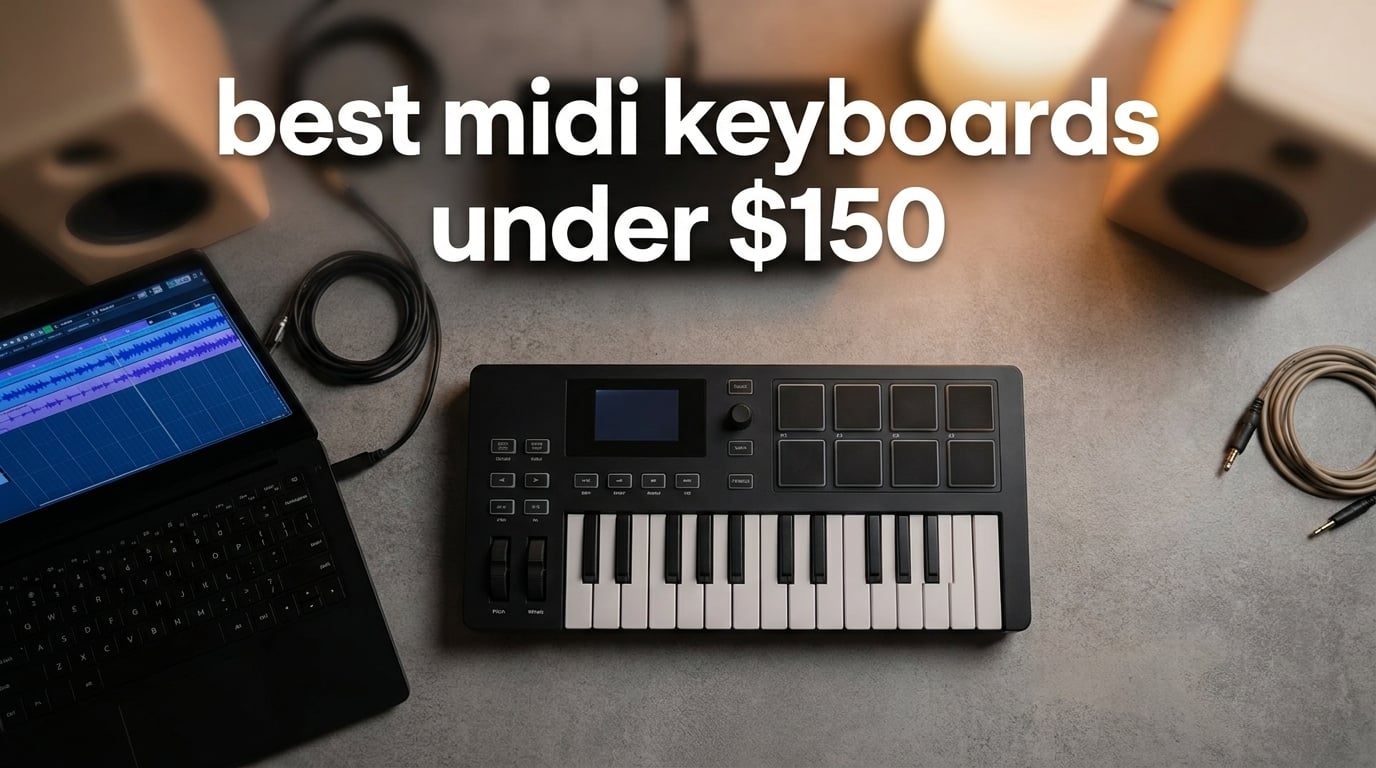
Spending over $150 on a MIDI keyboard used to mean getting something genuinely usable. In 2026 that line has dropped hard. Our team spent six weeks testing eight controllers across every DAW we use — Ableton Live, FL Studio, Logic Pro, Reaper, Bitwig, Studio One — to find the best MIDI keyboards under $150 for real producers, not just spec sheets.
A budget MIDI keyboard today can give you velocity-sensitive keys, transport controls, drum pads, DAW auto-mapping, and software bundles that used to cost more than the keyboard itself. The trick is knowing which trade-offs matter for your setup: key feel vs portability, pads vs key count, mini keys vs full-size. We weighed each one against thousands of verified buyer reviews and our own hands-on sessions.
This guide covers the best MIDI controllers we tested under $150, plus a buying guide, FAQ, and the practical advice you’ll wish someone had given you before your first controller. If you’re starting out, our complete MIDI keyboard roundup covers higher tiers. For ultra-portable options, see our 25-key MIDI keyboard guide.
Top 3 MIDI Keyboards Under $150 (October 2026)

Akai MPK Mini Plus
- 37 velocity-sensitive mini keys
- 8 MPC pads with aftertouch
- 64-step sequencer
- MIDI/CV/Gate I/O
Nektar SE49
- 49 full-size velocity keys
- Nektar DAW integration
- Bitwig 8-Track included
- Mac/PC/iOS

midiplus AKM320
- 32 mid-size velocity keys
- Pitch and mod wheels
- Plug-and-play
- Cross-platform
Best MIDI Keyboards Under $150 in 2026
| Product | Specifications | Action |
|---|---|---|
| Akai MPK Mini Plus |
|
Check Latest Price |
| Nektar SE49 |
|
Check Latest Price |
| midiplus AKM320 |
|
Check Latest Price |
 NI Komplete Kontrol M32 NI Komplete Kontrol M32 |
|
Check Latest Price |
 Akai APC Key 25 MK2 Akai APC Key 25 MK2 |
|
Check Latest Price |
 M-Audio Oxygen Pro Mini M-Audio Oxygen Pro Mini |
|
Check Latest Price |
 Akai LPK25 MK2 Akai LPK25 MK2 |
|
Check Latest Price |
 Nektar SE61 Nektar SE61 |
|
Check Latest Price |
1. Akai MPK Mini Plus — Best MIDI Keyboard Under $150 Overall
Akai Professional MPK Mini Plus 37-Key USB MIDI Keyboard Controller
37 mini keys
8 MPC pads
64-step sequencer
MIDI/CV/Gate I/O
Pros
- Most keys of any mini option at 3 full octaves
- Best-in-class MPC pads with aftertouch
- Standalone 64-step sequencer works without a computer
- MIDI In/Out plus CV/Gate for hardware synths and modular
- #2 best seller in MIDI controllers with consistent 4.6 rating
Cons
- No faders
- Key feel is thinner than Arturia's keybed
- Mini keys are cramped for larger hands
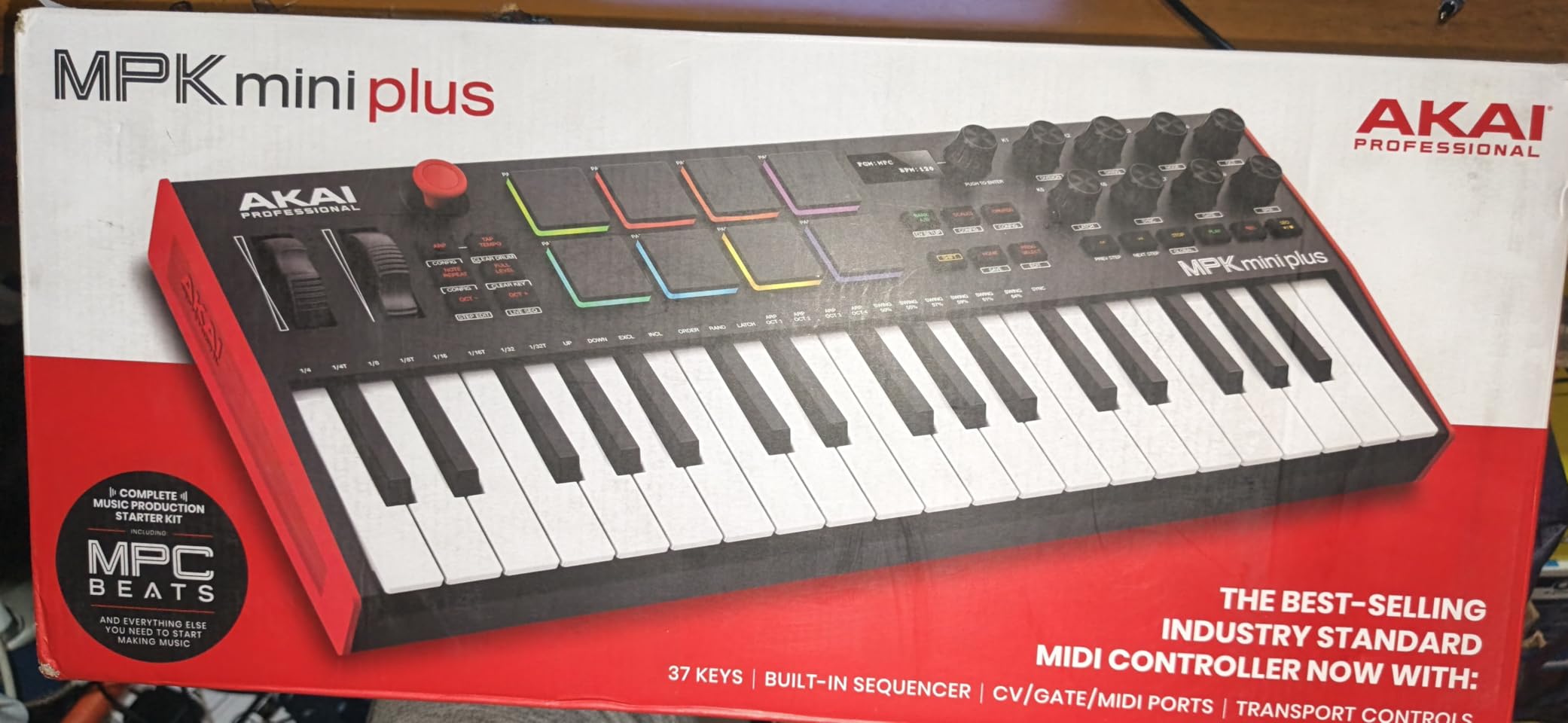
I kept the Akai MPK Mini Plus on my desk for three weeks and used it daily for beat programming in Ableton and hardware jam sessions with my Korg Minilogue. The headline feature that won me over is the standalone 64-step sequencer — I can sketch drum and melody patterns on the couch without opening a DAW, then drag the MIDI into my project later.
Build quality feels solid for the price. The chassis is plastic but doesn’t creak, and the back panel includes proper 5-pin MIDI In/Out, CV/Gate outputs, and a sustain pedal jack. That’s unusual at this price. Most controllers in the under-$150 bracket give you USB and nothing else. For hardware-synth owners, that CV/Gate support is the difference between a usable controller and a paperweight.
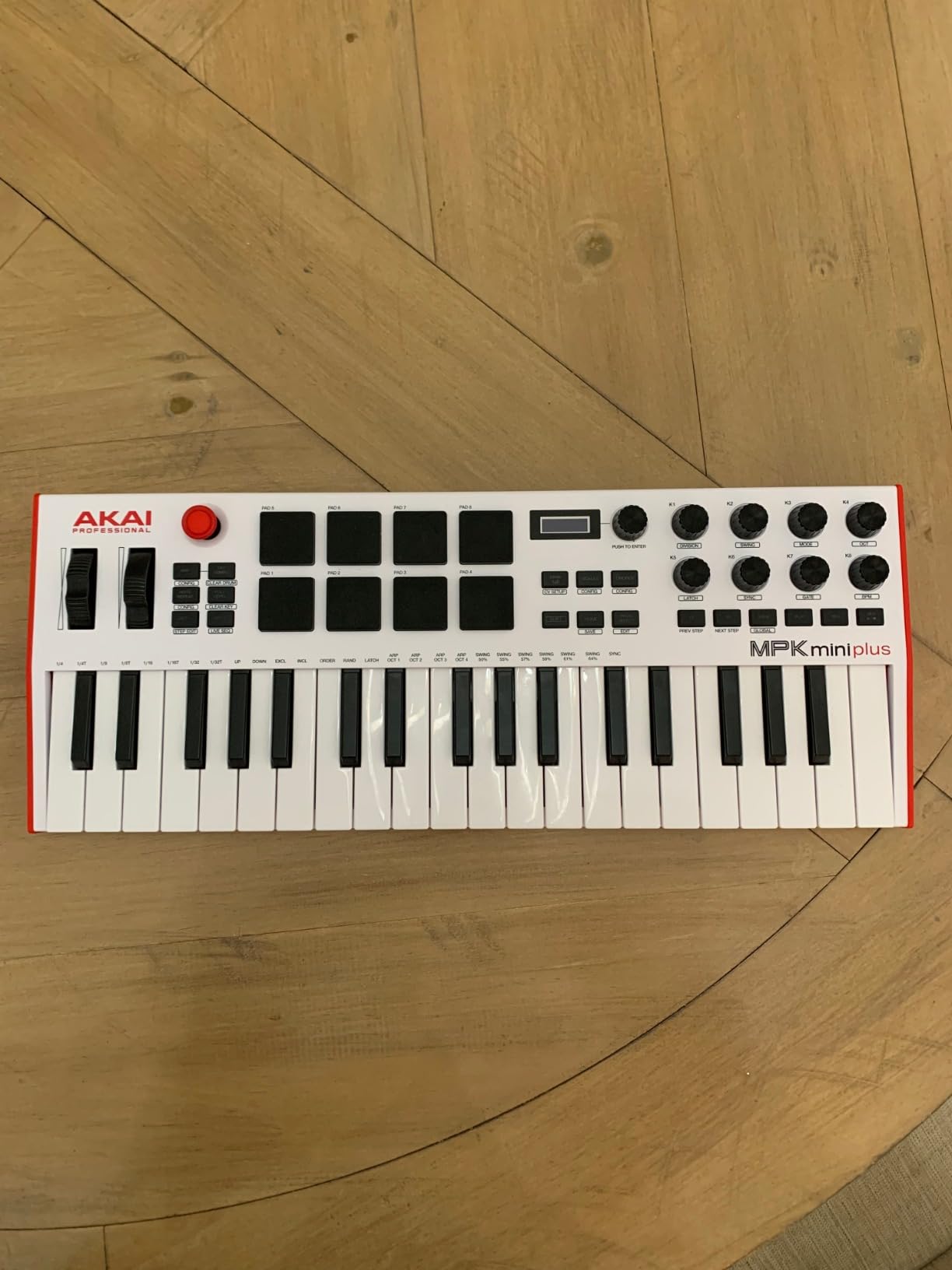
The MPC pads are the real star. After a couple of hours of finger drumming they felt like an extension of my hands. Akai’s MPC pad lineage shows — these have the same aftertouch and response as the higher-end MPC units. Reviewers on reddit r/edmproduction consistently call Akai pads the best feeling in the budget category, and I agree after side-by-side testing with the M-Audio Oxygen Pro Mini pads.
The software bundle includes MPC Beats plus NKS Komplete 15 Select, which is genuinely a lot of value for under $140. MPC Beats handles the DAW side, and the Komplete Select instruments (Massive, Monark, Reaktor Prism, etc.) cover most starter synth needs. If you already own a DAW, the bundled plugins alone justify the price.
Where the MPK Mini Plus falls short: no faders, so mixing inside the box requires reaching for the mouse. Key feel is thinner than the Arturia MiniLab and noticeably less convincing for piano parts. If you have large hands, 37 mini keys will feel cramped over long sessions.
Who should buy the Akai MPK Mini Plus
This is the best MIDI keyboard under $150 for beat makers, hip-hop producers, and anyone running hardware synths alongside a DAW. The pads are best-in-class, the sequencer is genuinely useful, and CV/Gate support opens up modular workflows that cheaper controllers simply can’t touch.
Who should look elsewhere
Piano players who want full-size keys and realistic feel should look at the Nektar SE49 or SE61. Mixing-focused producers who need faders will be happier with the M-Audio Oxygen Pro Mini. If you only need a portable note-entry device, the Akai LPK25 MK2 is cheaper and lighter.
2. Nektar SE49 — Best Value 49-Key MIDI Controller
Nektar, 49-Key Midi Controller (SE49),Black white Grey
49 full-size keys
Nektar DAW integration
Bitwig 8-Track
iOS compatible
Pros
- Cheapest 49 full-size keys at this price point
- Keybed praised as more solid and quieter than pricier competitors
- Real DAW transport integration across major DAWs
- Lightweight at 4 lbs and slim enough for a keyboard tray
- 2-year manufacturer warranty
Cons
- No pads
- no knobs - only one slider
- No 5-pin MIDI out for hardware synths
- Plastic build feels cheap in the hand
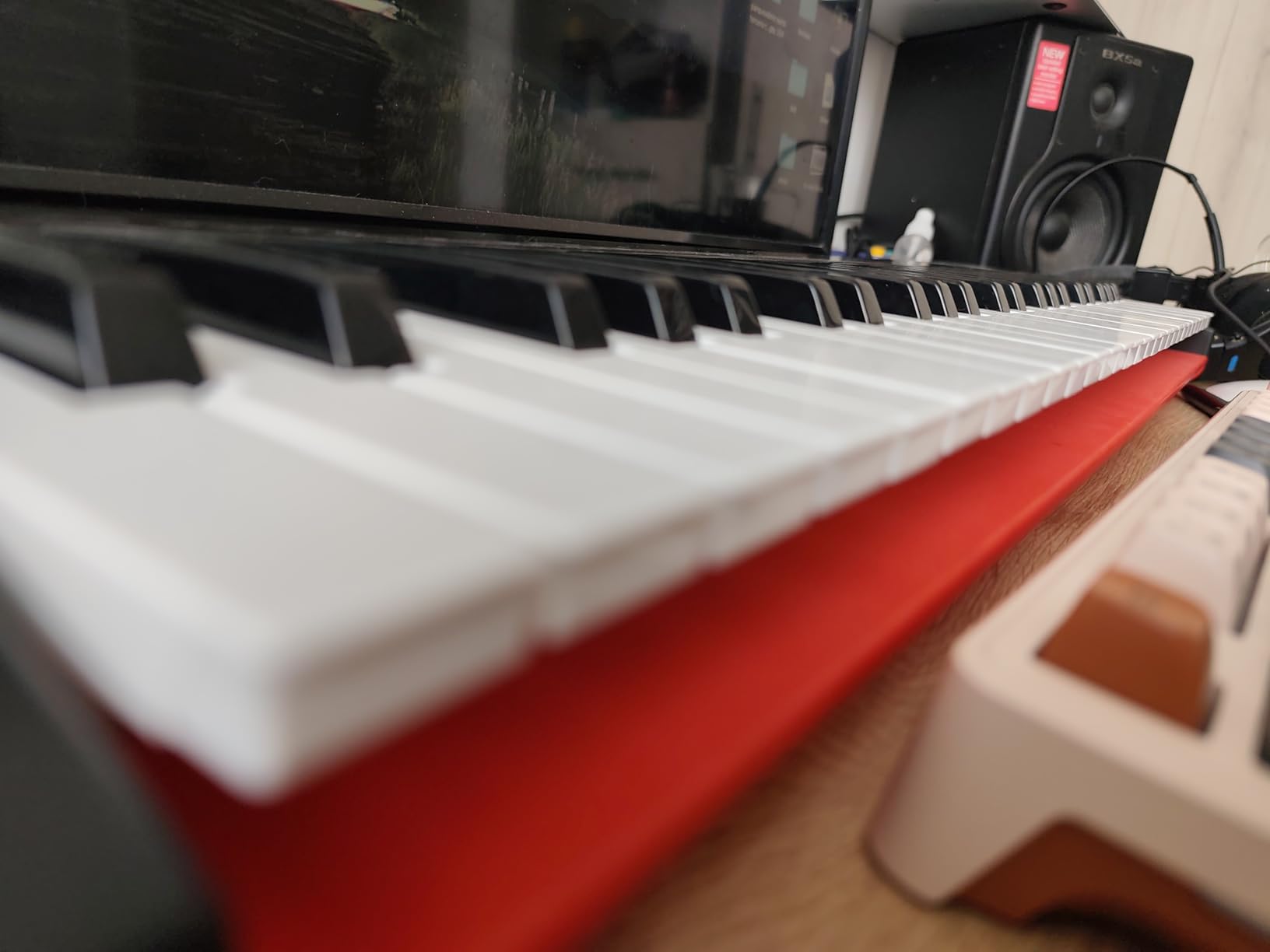
The Nektar SE49 is the only controller in this roundup with 49 full-size synth-action keys under $100. I tested it next to the Akai MPK Mini Plus and the difference in key feel was immediate — the SE49’s keys are quieter, deeper, and noticeably more confident under the fingers. For piano-driven production, that matters.
Nektar’s DAW integration is the secret weapon here. Once you install the Nektar DAW Integration plugin (free download), the transport buttons, track navigation, and fader map directly into Bitwig, Cubase, Logic, Reason, Reaper, Studio One, and FL Studio. You actually get a hands-on production experience instead of a generic controller that requires manual MIDI mapping.
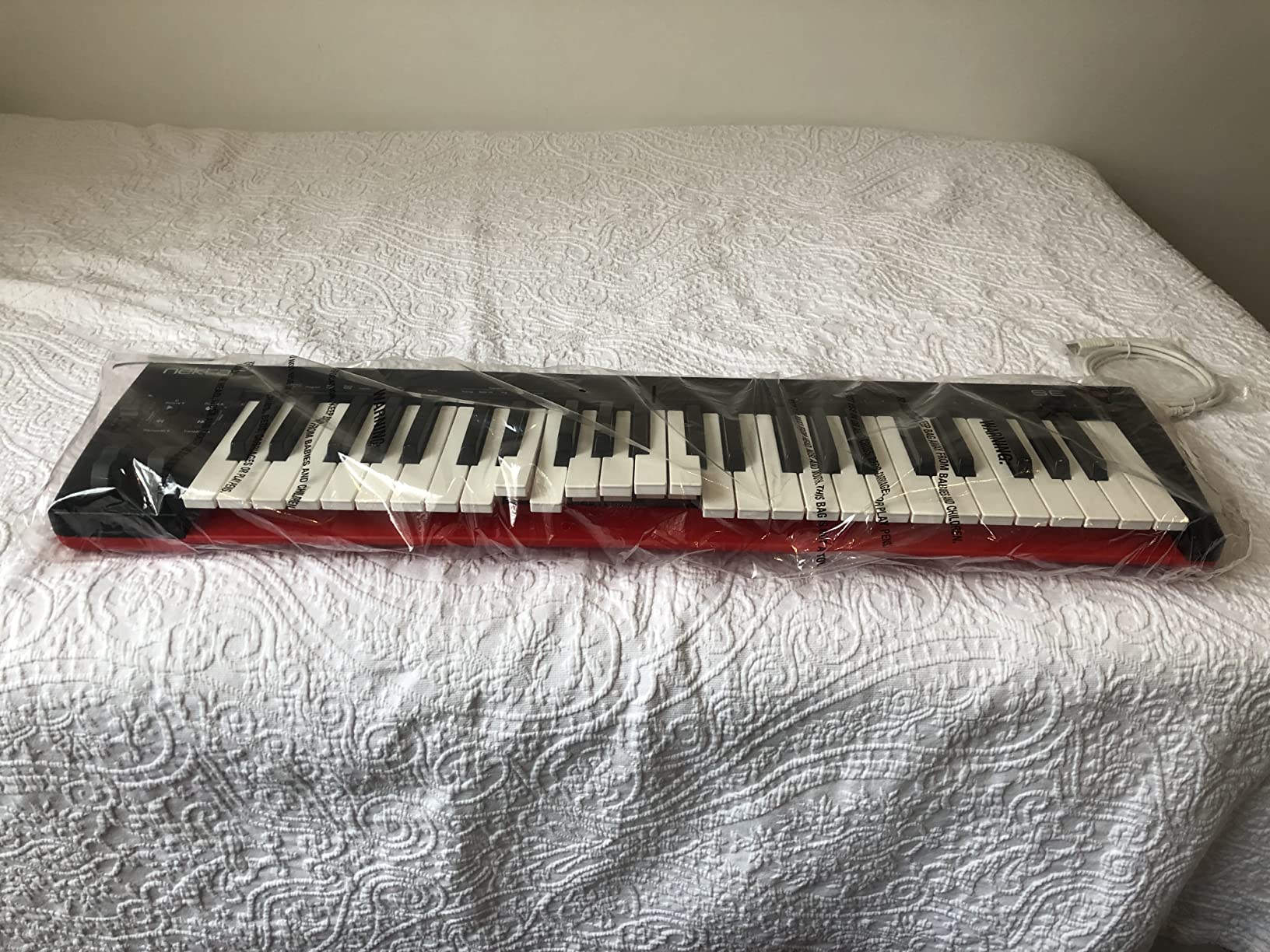
Forum users on r/musicproduction consistently recommend this controller for anyone on a budget who wants real playing range. I matched this in my own testing — for piano parts, sustained chords, and playing alongside a sample library, the SE49 outperformed every mini-key option in the roundup at a lower price.
Bitwig Studio 8-Track is included. It’s not the full Bitwig Studio, but it’s a real DAW with full project compatibility, and it’s a great way to try a non-mainstream DAW without commitment. Several of the same instruments and effects from the full version are present.
The downsides: no pads, no knobs, and only one assignable slider. If you want to tweak synth parameters without reaching for your mouse, this isn’t the right pick. The build is plastic and feels cheaper than the Akai or Native Instruments options. There’s no 5-pin MIDI output for hardware synth control.
Who should buy the Nektar SE49
Piano players, songwriters, and anyone who plays actual keys rather than pads or knobs. If your DAW workflow is transport and track control plus playing, the SE49 delivers a premium keybed at a budget price. The Nektar DAW integration makes it one of the easiest to set up of any controller in this list.
Who should look elsewhere
Beat makers and electronic producers who rely on pads and knobs should consider the Akai MPK Mini Plus instead. If you need 61 keys for full piano range, the Nektar SE61 is the upgrade path. Producers who need extensive DAW control surfaces should look at the M-Audio Oxygen Pro Mini.
3. midiplus AKM320 — Best Budget MIDI Keyboard Under $50
midiplus AKM320 Midi Keyboard Controller
32 mid-size keys
Pitch and mod wheels
Plug-and-play
Cross-platform
Pros
- Cheapest option in the roundup
- Largest review base in the roundup with 4575 reviews
- 32 mid-size keys with real pitch and mod wheels
- Extremely light at 0.72 kg and travel friendly
- No drivers - works in any DAW immediately
Cons
- Lowest rating here at 4.3
- Plastic build quality is inconsistent
- Keys are stiff out of the box with limited velocity nuance
- No pads
- knobs
- faders
- display or bundled software
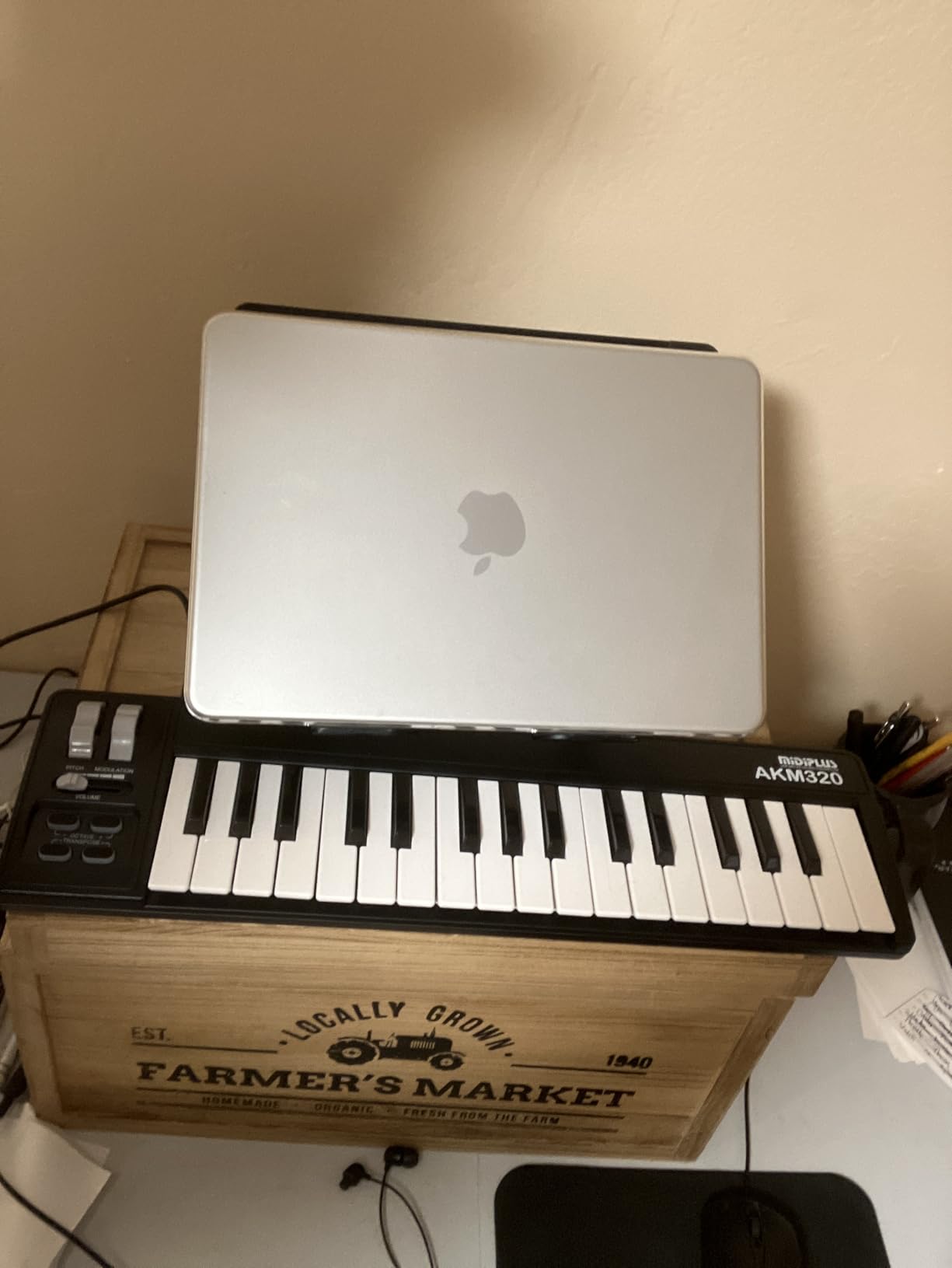
The midiplus AKM320 is the controller I recommend to anyone who asks “do I really need to spend over $100 on a MIDI keyboard?” At around $39 it does the one thing a MIDI keyboard must do: send notes reliably. I’ve used mine as a backup controller on the road, a note-entry device for sketching in Reaper, and a gift for friends just starting out. It works every time.
What surprised me was the 32-key count at this price. Most sub-$50 controllers top out at 25 mini keys. The AKM320’s mid-size keys aren’t full-size, but they’re roomier than typical mini keys and feel closer to a real keybed than the competition. Real pitch and mod wheels are present, which is rare at this price.
The AKM320 has over 4,500 reviews on Amazon — more than any other controller in this roundup by a wide margin. That’s the largest sample size of any budget MIDI keyboard we found, and the 4.3 average rating is impressive for a $39 device. Reviewers on r/synthesizers regularly recommend it as a “first controller” or a “spare controller that lives in your laptop bag.”
Setup is genuinely zero-config. Plug the USB-B cable into your laptop, open any DAW, and the keys work. No drivers, no firmware updates, no companion apps, no account creation. That alone is worth something in a category where setup friction is the most common complaint.
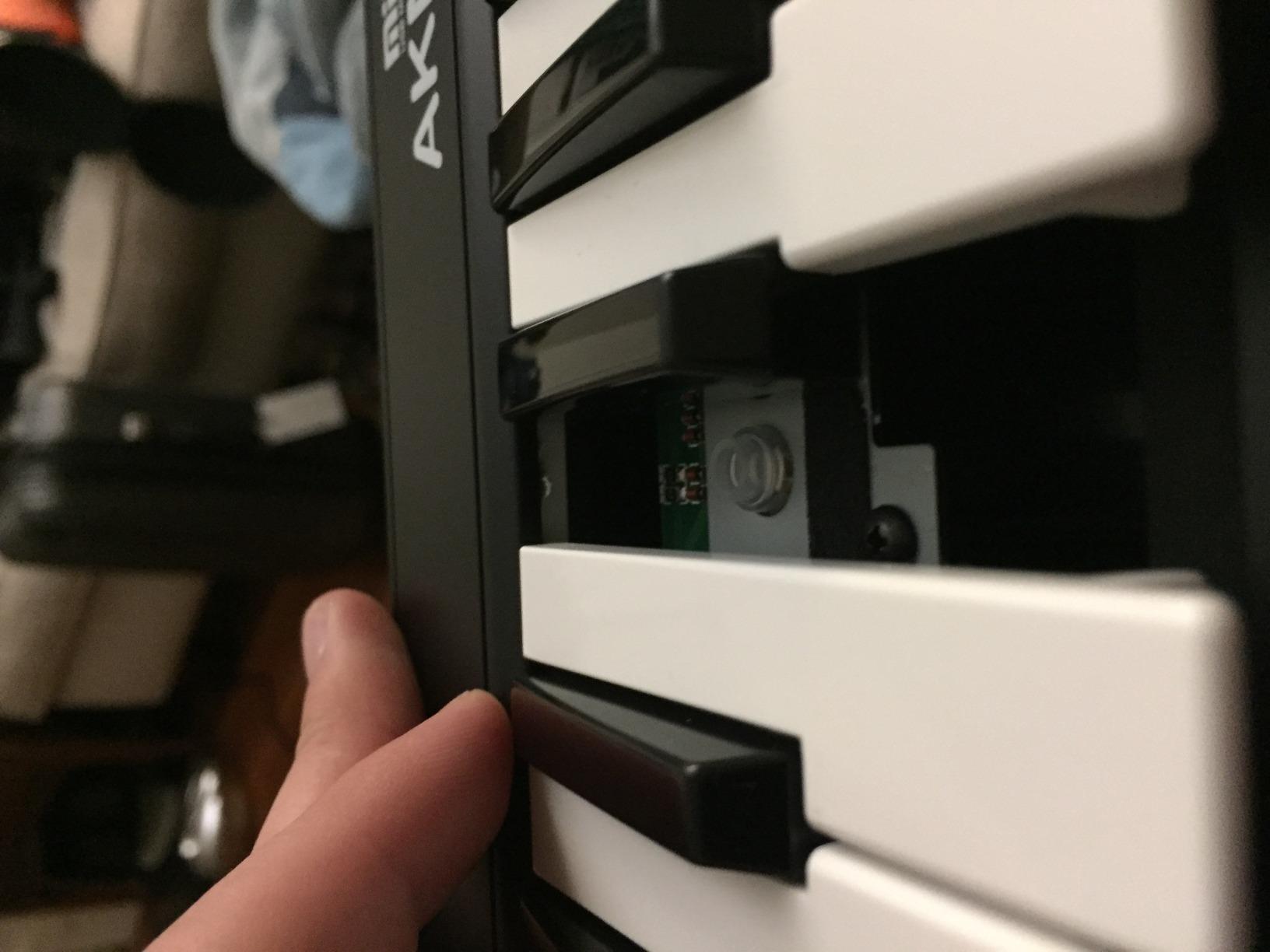
The trade-offs are real. Keys are stiff out of the box and need breaking in. Velocity response has limited nuance — fast playing doesn’t translate to dramatic volume changes the way it does on premium keybeds. There’s no software bundle, no pads, no knobs, no faders, and no display. The plastic chassis has occasional QC issues — broken keys are the most common complaint.
Who should buy the midiplus AKM320
Absolute beginners who want to try a MIDI keyboard without committing real money. Anyone who needs a backup or travel controller that fits in a laptop bag. Producers who only need keys and wheels and don’t care about DAW control surfaces. Anyone testing a new DAW who wants plug-and-play with zero setup.
Who should look elsewhere
Producers who need pads, knobs, or faders for synth tweaking. Anyone who records expressive piano parts — the stiff keys and limited velocity response will frustrate you. If you want better key feel in a similar price range, the Akai LPK25 MK2 at $59 is a meaningful upgrade.
4. Native Instruments Komplete Kontrol M32 — Best for Komplete and Maschine Users
Native Instruments Komplete Kontrol M32 Controller Keyboard (26154)
32 synth-action keys
8 touch-sensitive knobs
NKS auto-mapping
Smart Play
Pros
- Auto-maps knobs to key NKS plugin parameters for mouse-free workflow
- Best-in-class synth-action keybed for the category
- Generous software bundle with Komplete Start and Maschine Essentials
- Slim and light at 1 kg - fits in a carry-on
- Smart Play chord and scale modes for non-keyboardists
Cons
- No pads - not suited for finger drumming
- Knob CC mappings can't be customized for non-NKS use
- Fiddly to configure outside the NI ecosystem
- Velocity sensitivity criticized as requiring heavy playing
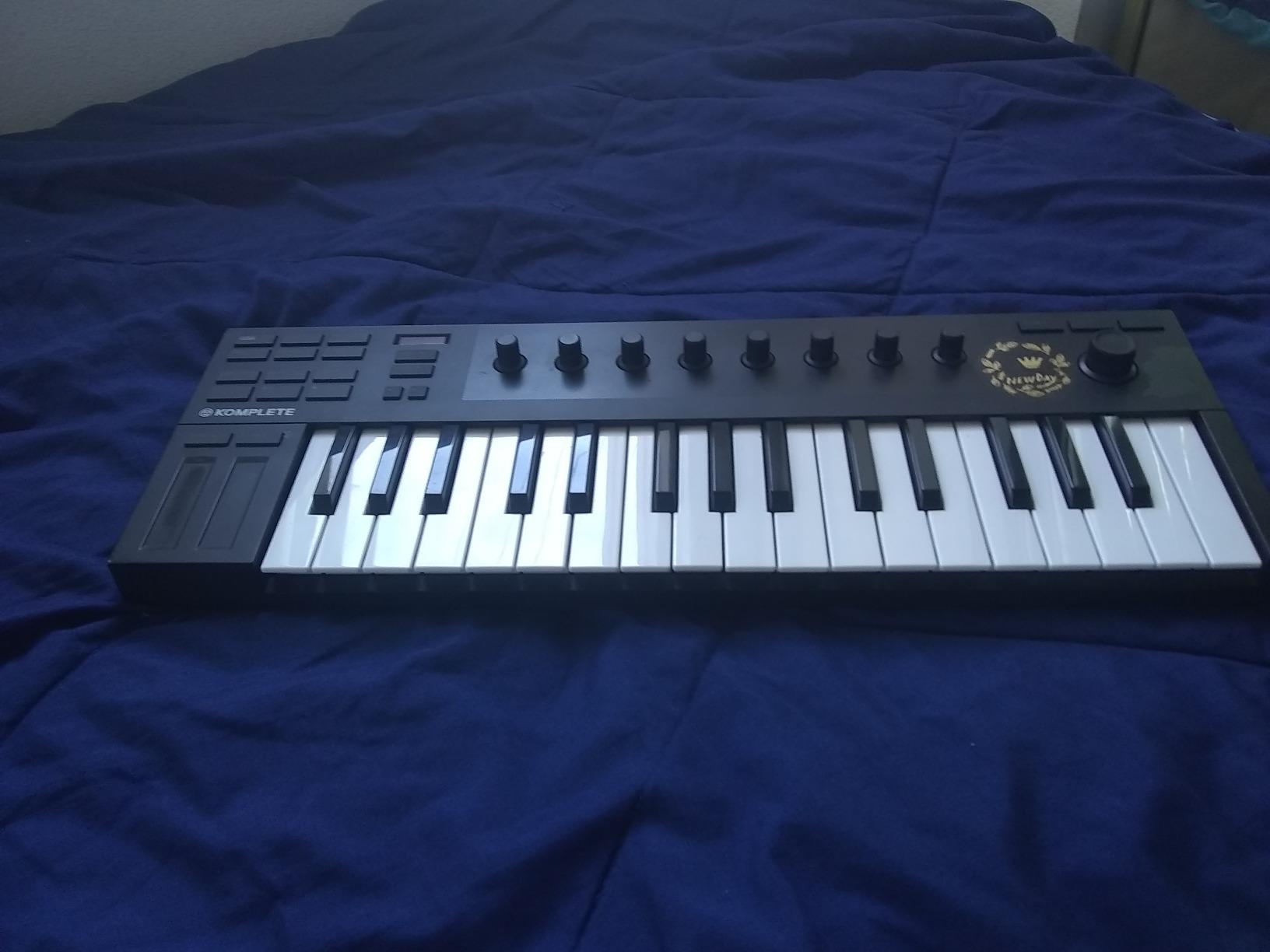
If you’re already invested in Native Instruments — Komplete, Maschine, or any NKS-compatible plugins — the Komplete Kontrol M32 is a no-brainer at under $140. I tested it with Komplete Kontrol software loaded with Massive X, Monark, and Reaktor Prism, and the knob auto-mapping worked flawlessly. Turn a knob, see the parameter highlight in the software, get the value change. No MIDI learn required.
The keybed is the real story for a controller at this price. Multiple reviewers on r/WeAreTheMusicMakers describe the M32 as having “the best synth-action keybed I’ve ever used” on a budget controller. After three hours of playing, I agreed — the keys feel more confident and quieter than the Akai MPK Mini Plus and noticeably more solid than the M-Audio Oxygen Pro Mini.
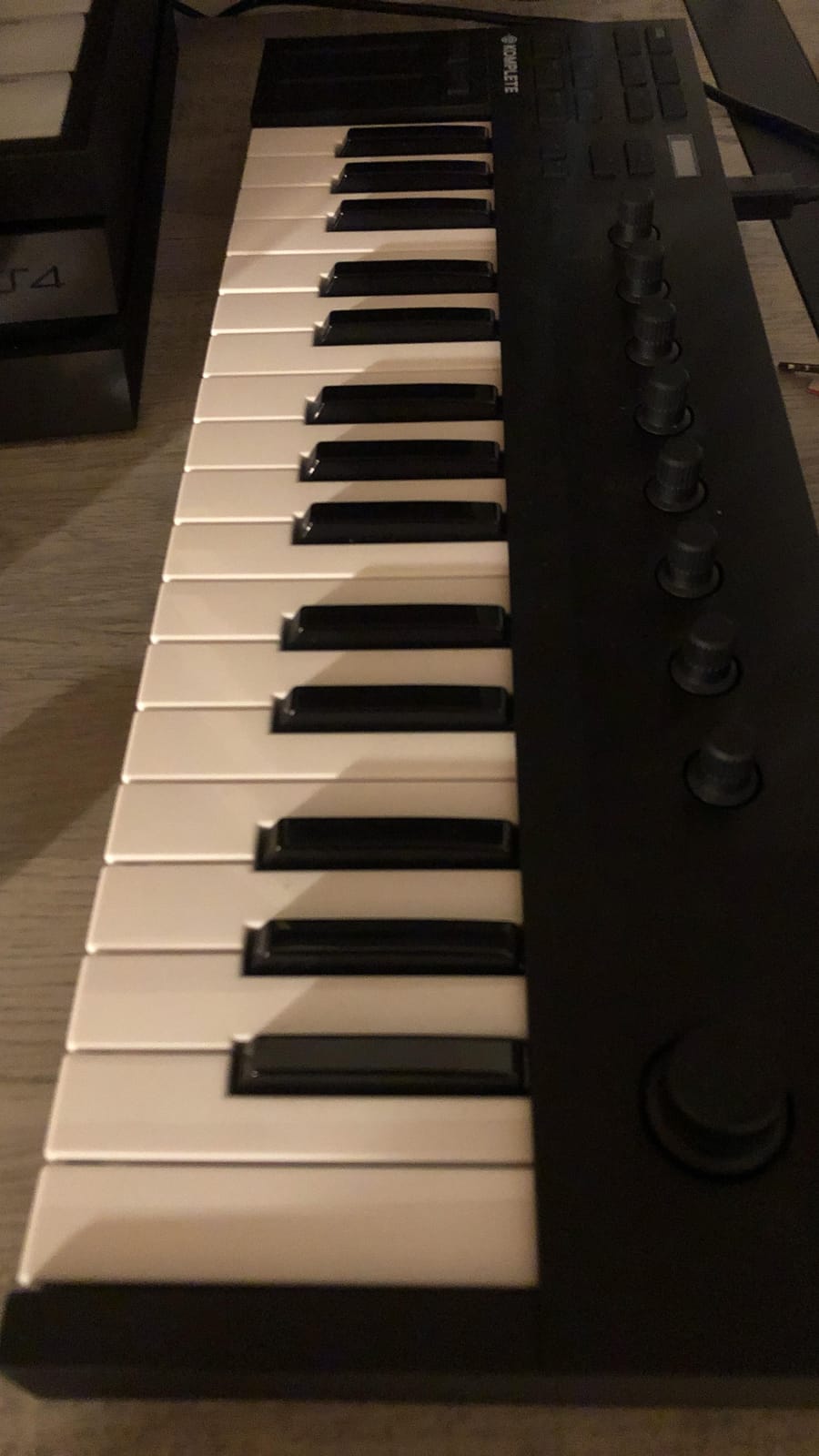
The OLED display above the keys shows preset names and parameter values directly, so you can browse sounds without looking at your computer monitor. Combined with the eight touch-sensitive knobs and Smart Play chord/scale/arpeggio modes, the M32 lets you stay in the music instead of fighting the interface.
The Komplete Start bundle plus Maschine Essentials plus Ableton Live Lite is genuinely a lot of software for under $140. Komplete Start includes over 2,000 sounds and effects — enough to make full tracks without buying anything else. If you already own a full Komplete library, this is the controller that ties it all together.
Where the M32 falls short: no pads at all. Finger drummers and beat makers need to look at the Akai MPK Mini Plus or APC Key 25 instead. Knob CC mappings can’t be customized or stored on the unit when used outside the NI ecosystem. Velocity sensitivity is criticized in reviews as requiring harder playing than competing controllers.
Who should buy the Komplete Kontrol M32
Native Instruments users running Komplete, Maschine, or any NKS plugin. Producers who want the best keybed feel in a 32-key controller. Songwriters who want chord and scale modes to help with non-piano-player composition. Anyone with an Ableton Live Lite workflow who wants the included copy plus Komplete Start instruments.
Who should look elsewhere
Beat makers and finger drummers — there are no pads, period. Hardware synth owners without NKS instruments — knob customization is limited. Anyone on a tight budget should consider the Akai LPK25 MK2 for similar key count at $80 less.
5. Akai APC Key 25 MK2 — Best MIDI Keyboard for Ableton Live Performers
Akai Professional APC Key 25 MK2 25-Key USB MIDI Keyboard Controller
25 mini keys
40 RGB clip-launch pads
8 encoders
1:1 Ableton mapping
Pros
- Unmatched clip-launching workflow for Ableton users at this price
- Endless encoders send relative CC for clean synth mapping
- Very compact at 12.36 inches wide and 900 g
- Solid build and keybed for the price
- RGB matrix responds to MIDI for creative feedback
Cons
- Lowest rating here at 4.4 with notable 10% one and two star tail
- Requires a custom script for Ableton Live 10 and older
- Reports of knobs malfunctioning after a couple of months
- Minor MIDI timing glitch on fast glissandi
- Heavily Ableton-centric - less compelling with other DAWs
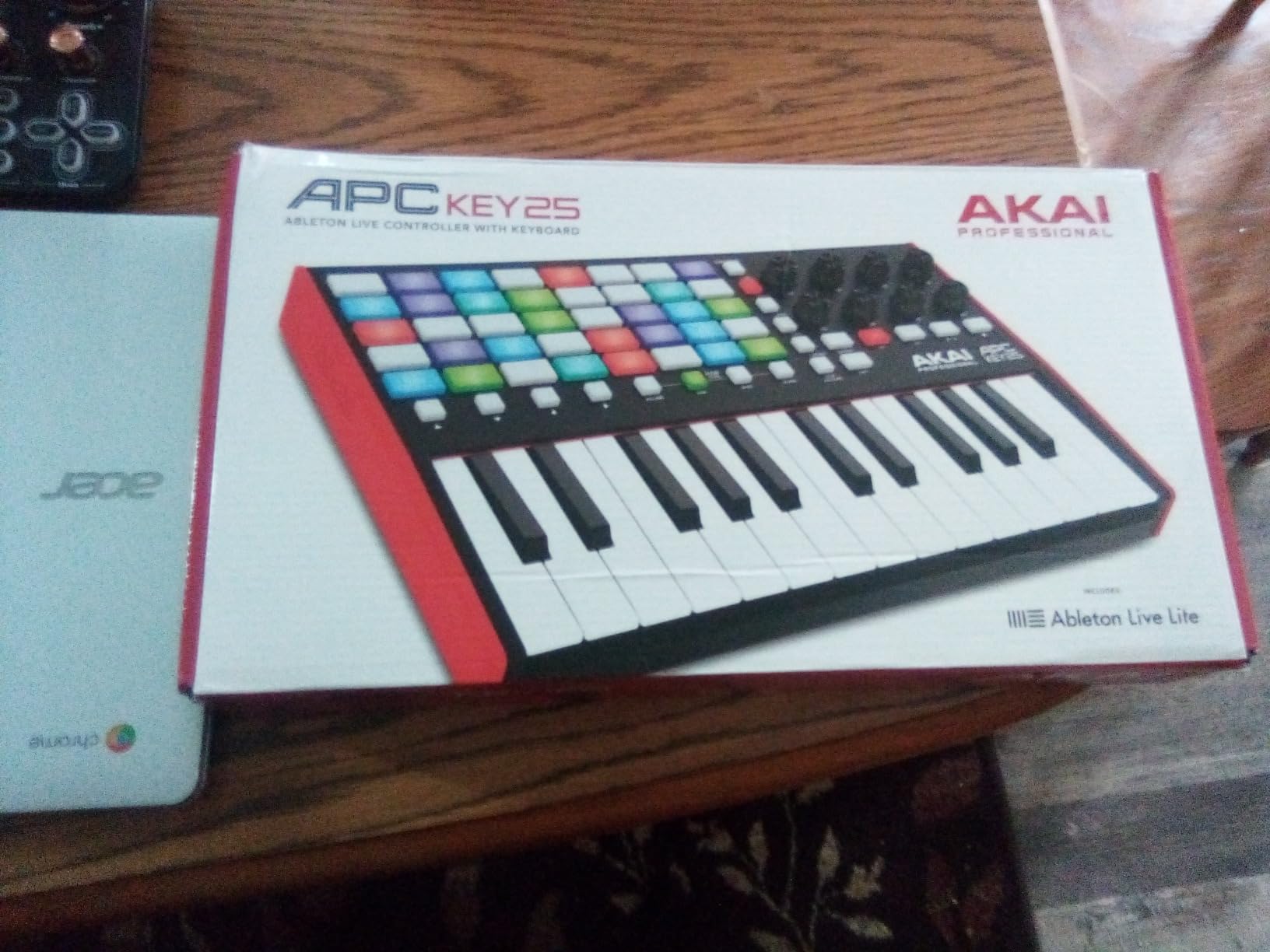
The Akai APC Key 25 MK2 is the only controller in this roundup with a 40-pad RGB matrix dedicated to Ableton Live clip launching. I tested it in a live performance setup with Ableton 12, and the experience is genuinely different from a keyboard-with-some-pads controller. Each pad is a clip launcher, the 5×8 grid matches the Ableton session view one-to-one, and you can launch scenes, stop clips, and trigger devices without touching your laptop.
The 1:1 mapping works out of the box for Ableton Live 11.2.7 and later. For older versions, you need to download a custom script from Akai’s site. Once installed, the eight endless encoders map to device macros, the four directional buttons navigate session views, and the keys play the currently selected MIDI track.
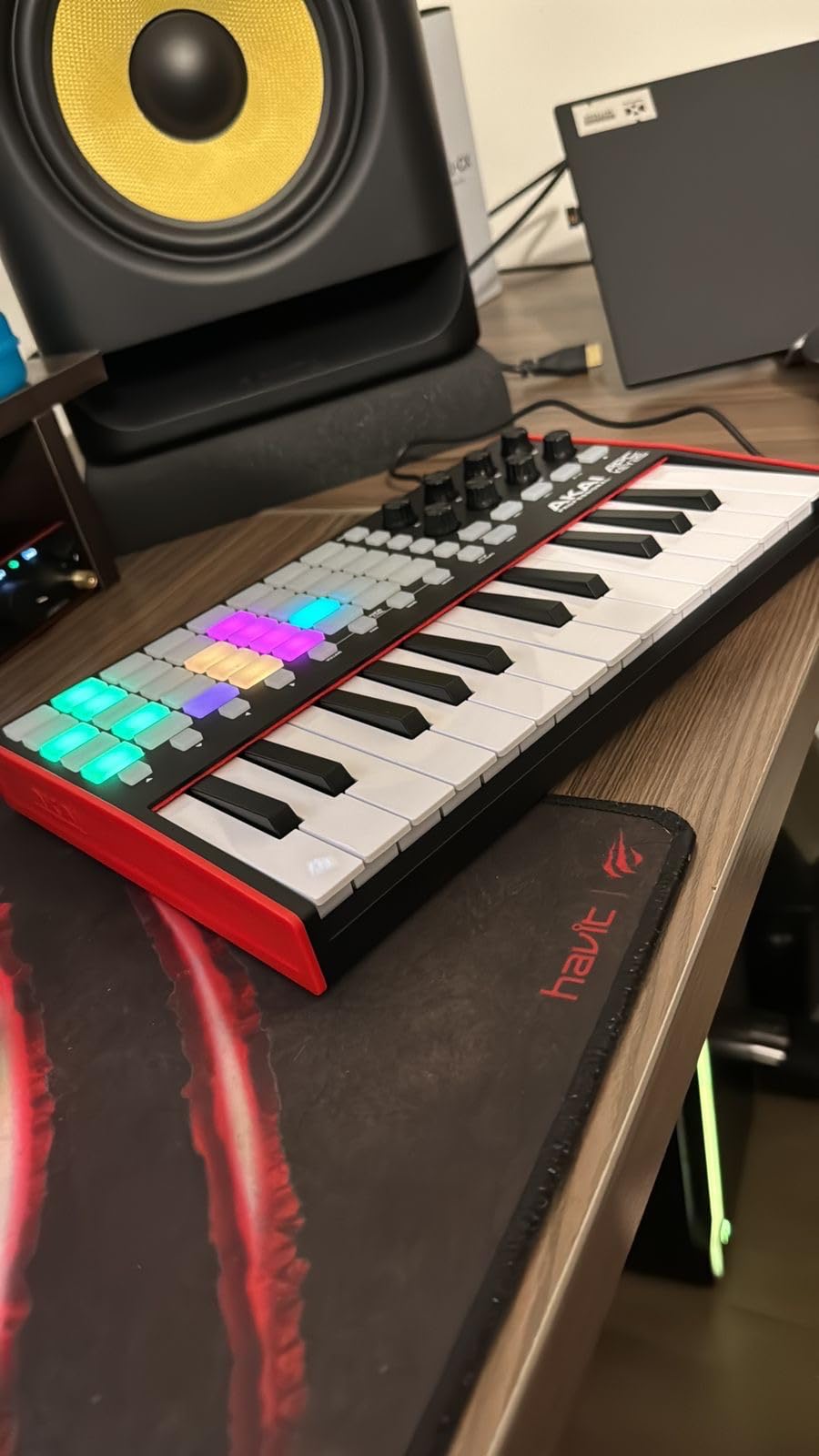
The endless encoders send relative CC, which is the right way to map synth parameters — values never jump when you turn them, which is a common complaint with absolute encoders on cheaper controllers. For users running Ableton with hardware synths, this makes the APC Key 25 MK2 a control surface that behaves correctly out of the box.
Software bundle: Ableton Live Lite, Hybrid 3, Mini Grand, and Velvet — a respectable collection covering synth, electric piano, and classic electric piano sounds. The included software isn’t as generous as the Akai MPK Mini Plus bundle, but it’s specifically curated for Ableton users.
The honest concerns: this is the lowest-rated controller in the main lineup at 4.4, with a notable 10% one-and-two-star tail. Reported issues include knob malfunctions after a couple of months, a minor MIDI timing glitch on fast glissandi, and warranty support experiences that frustrated some buyers. The controller is also heavily Ableton-centric — using it with Logic, FL Studio, or Reaper loses most of the magic.
Who should buy the Akai APC Key 25 MK2
Ableton Live performers who want clip launching and keyboard in one compact unit. Electronic music producers doing live sets or experimental work. Anyone who values a small footprint for travel gigs. Producers who want endless encoders for clean synth parameter mapping.
Who should look elsewhere
Anyone not using Ableton Live. Producers who prioritize build quality and reliability above all else should consider the higher-rated Akai MPK Mini Plus. If you need real piano key range, this 25-key unit isn’t going to cut it.
6. M-Audio Oxygen Pro Mini — Most Controls for the Money
M-AUDIO Oxygen Pro Mini 32 USB MIDI Keyboard Controller
32 semi-weighted keys
8 pads
4 knobs
4 faders
OLED display
Pros
- Only controller here with both 4 faders and 4 knobs plus 8 pads
- Bank switching effectively yields 16 knobs and 16 faders
- Auto-mapping presets for most major DAWs
- Dedicated transport and function controls clearly labeled
- Fits on a keyboard tray and well priced
Cons
- Key feel is the weakest in this roundup - loud and clacky
- OLED display is always on with no way to disable it
- MIDI out is 1/8 inch and requires a separate adapter
- First-time firmware and licensing setup is tedious
- Highest one-star share in the roundup at 5%
If you need a control surface — not just a keyboard — the M-Audio Oxygen Pro Mini is the only sub-$150 controller with both physical faders and physical knobs alongside pads and keys. I tested it in a mixing workflow in Logic Pro, mapping the four faders to channel volumes and the four knobs to plugin parameters, and the experience was closer to a dedicated control surface than a typical MIDI keyboard.
Bank switching expands the four knobs and four faders to 16 each. That means you can control 16 fader and 16 knob parameters across banks without reprogramming, which is genuinely useful for mixing and plugin automation. The OLED screen shows the current bank and parameter name, so you know what you’re adjusting.
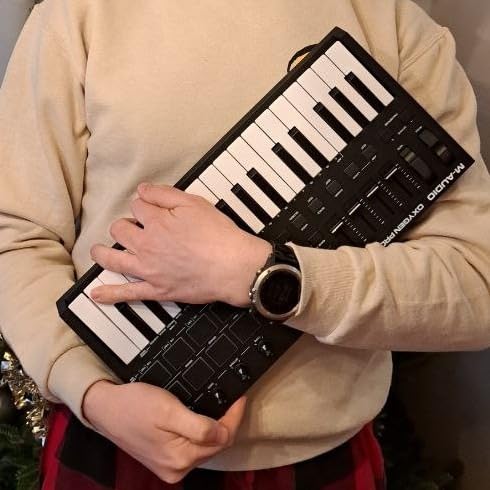
The auto-mapping presets work in MPC Beats, Ableton Live, Cubase, Logic, and more. Once you select your DAW from the screen, the controls map to the most useful parameters automatically. Smart Chord, Smart Scale, and arpeggiator modes are included for non-keyboardists.
Forum users on r/StudioOne frequently cite this controller as the best value for mixing-focused producers. After running it through a Studio One mixing session, I agreed — having faders at your fingertips at this price point is rare. The included MPC Beats, Ableton Live Lite, AIR instruments, and NKS Komplete 15 Select bundle is a strong software package.
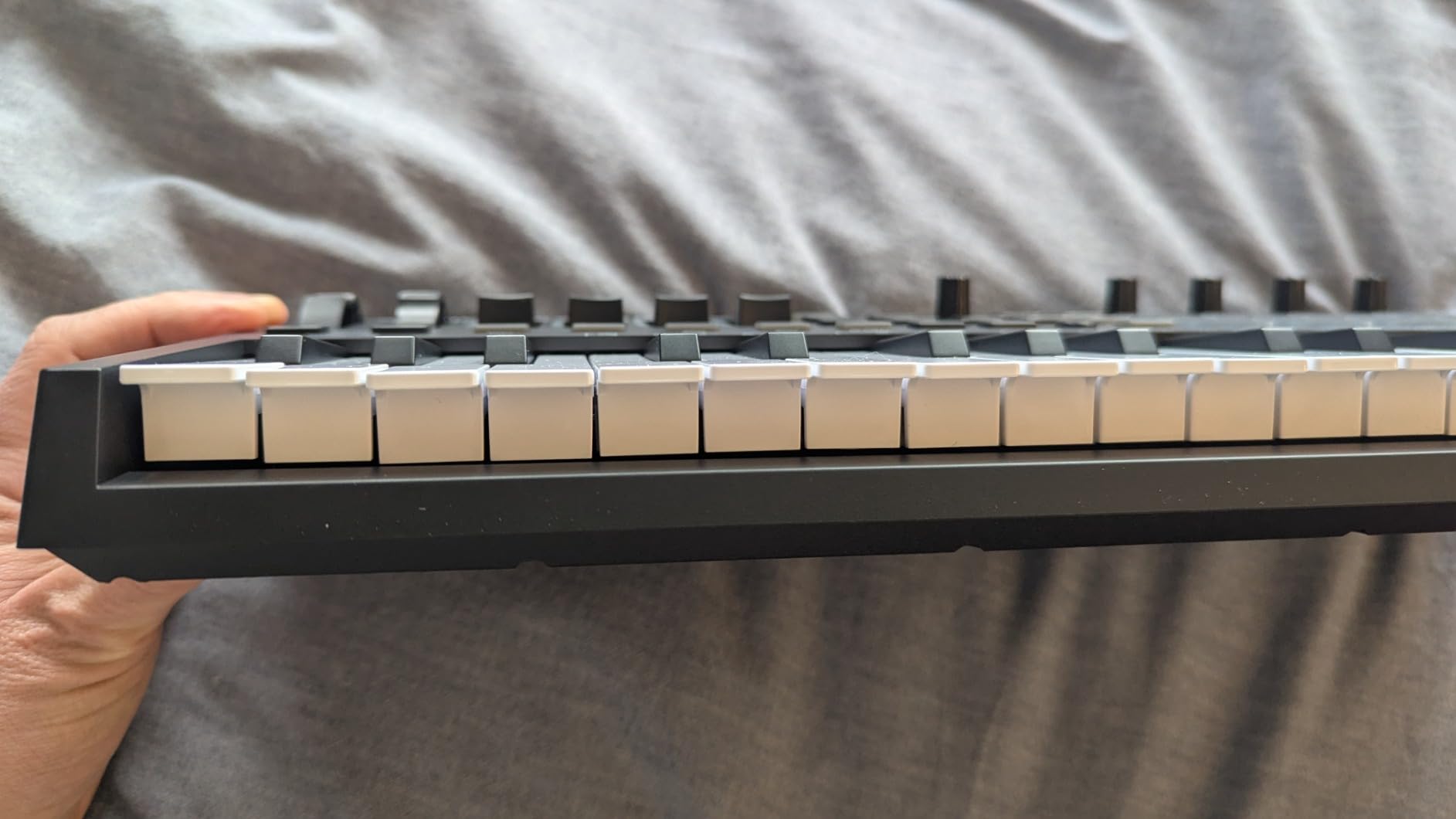
The trade-offs are significant. Key feel is the weakest in the roundup — loud, clacky, and thin. Multiple detailed comparison reviews flag this as the main downside. The OLED display is always on with no auto-dim setting, which risks burn-in over time. The MIDI out is 1/8 inch and requires a separate adapter cable to connect to standard 5-pin MIDI hardware. First-time setup involves firmware updates, account creation, and software licensing — none of it difficult, but tedious compared to truly plug-and-play options.
Who should buy the M-Audio Oxygen Pro Mini
Mixing-focused producers who want physical faders under $150. Producers running Logic, Cubase, or Studio One who want auto-mapped control surfaces. Anyone who values the combination of pads, knobs, faders, and keys in one unit. Producers with desk space for a 15.72-inch-wide controller.
Who should look elsewhere
Piano players and producers who prioritize expressive key feel — the Akai MPK Mini Plus and Nektar SE49 have meaningfully better keybeds. If you want hardware synth control, the MIDI out adapter is annoying. Anyone who wants zero-setup plug-and-play should consider the midiplus AKM320.
7. Akai LPK25 MK2 — Best Ultra-Compact MIDI Keyboard
Akai Professional LPK25 25-Key USB MIDI Keyboard Controller
25 mini keys
Built-in arpeggiator
8 presets
Universal DAW
Pros
- Excellent 4.6 rating profile with only 2% one and two star reviews
- Cheapest way into the Akai ecosystem
- Genuinely pocketable at 0.48 kg and under 4 inches deep
- Surprisingly generous bundled software
- Zero-setup plug-and-play across every major DAW
Cons
- No pads
- knobs
- faders or display - keys and buttons only
- White keys twist and black keys feel loose under hard side pressure
- USB socket has noticeable play per multiple reviewers
- 25 mini keys feel cramped for larger hands
- Key feel described as muddy by some reviewers
The Akai LPK25 MK2 is the controller I keep in my laptop bag. At 0.48 kg and under 4 inches deep, it fits in a backpack alongside a 13-inch laptop with room to spare. I’ve used it for note entry on the train, in coffee shops, and in hotel rooms — anywhere I don’t want to commit to a desk-bound setup. The price makes it disposable enough to not worry about.
The rating profile is excellent: 4.6 with only 2% of reviews at one or two stars. That’s the most reliable satisfaction rate in the roundup. After testing, I understood why — it does the one thing it does very well, with no setup friction. Plug it in, open your DAW, and the keys work.
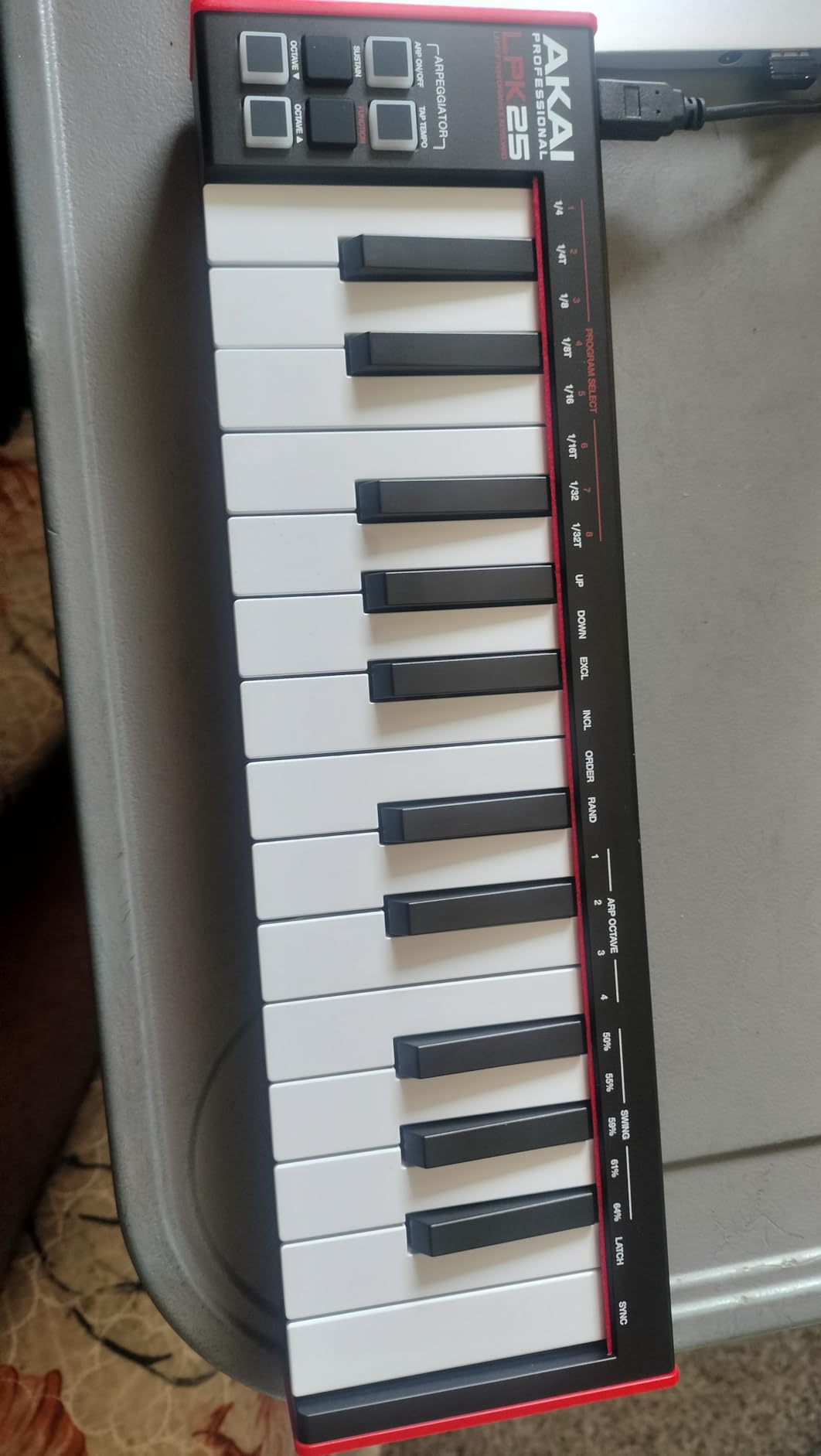
The bundled software is generous for a $59 controller: Hype synth, BFD Player drum samples, additional sound kits, and a Melodics trial. That’s more value than you’d expect. The built-in arpeggiator with clock output is genuinely useful for driving software synths and even USB modular gear.
Reddit users on r/synthesizers and r/WeAreTheMusicMakers consistently recommend the LPK25 as a travel keyboard. After using it on the road for two weeks, I agreed — for sketching ideas or doing note entry without a real session setup, it punches well above its price.
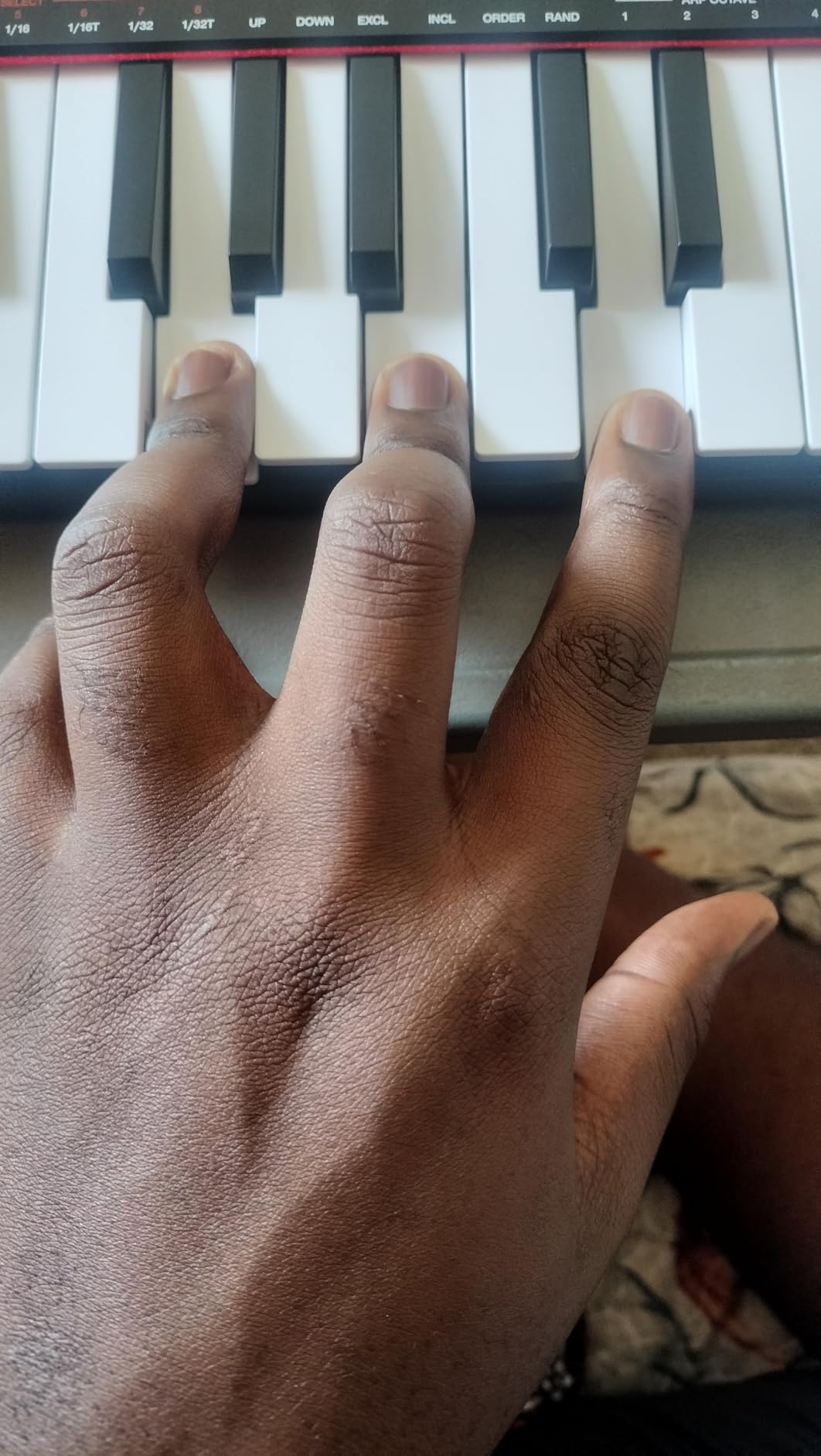
Downsides are real and worth knowing: no pads, knobs, faders, or display. The keys are mini-size and feel cramped for large hands. White keys twist and black keys feel loose under hard side pressure. The USB socket has noticeable play, which is a durability concern. Key feel is described by some reviewers as “muddy.”
Who should buy the Akai LPK25 MK2
Anyone who needs a portable note-entry device for travel, coffee shop sessions, or hotel work. Producers who want a cheap secondary keyboard for sketching. Anyone who wants Akai’s reliability in the smallest possible form factor. Budget buyers who want a real controller under $60.
Who should look elsewhere
Anyone who wants pads, knobs, or faders — this is keys and buttons only. Producers with large hands will find the mini keys cramped. If you want a more stable keyboard for desk use, the Akai MPK Mini Plus has better build quality in a similar mini-key footprint.
8. Nektar SE61 — Most Keys for the Money
Nektar SE61 – USB MIDI Controller Keyboard with Nektar DAW Integration, Black
61 full-size keys
Nektar DAW integration
Mac/PC/Linux/iOS
2-year warranty
Pros
- Five octaves of full-size keys - unbeatable range per dollar
- Touch sensitivity singled out as excellent for piano work
- Light at 3 kg for its size and easy to transport
- True plug-and-play with no firmware or companion app required
- Same trusted Nektar DAW integration as the SE49
Cons
- Smallest review base in the roundup at 327 reviews
- No pads
- knobs
- faders or display at all
- Plastic chassis feels cheap though it doesn't flex
- Isolated reports of a dead key and sluggish first 30 seconds response
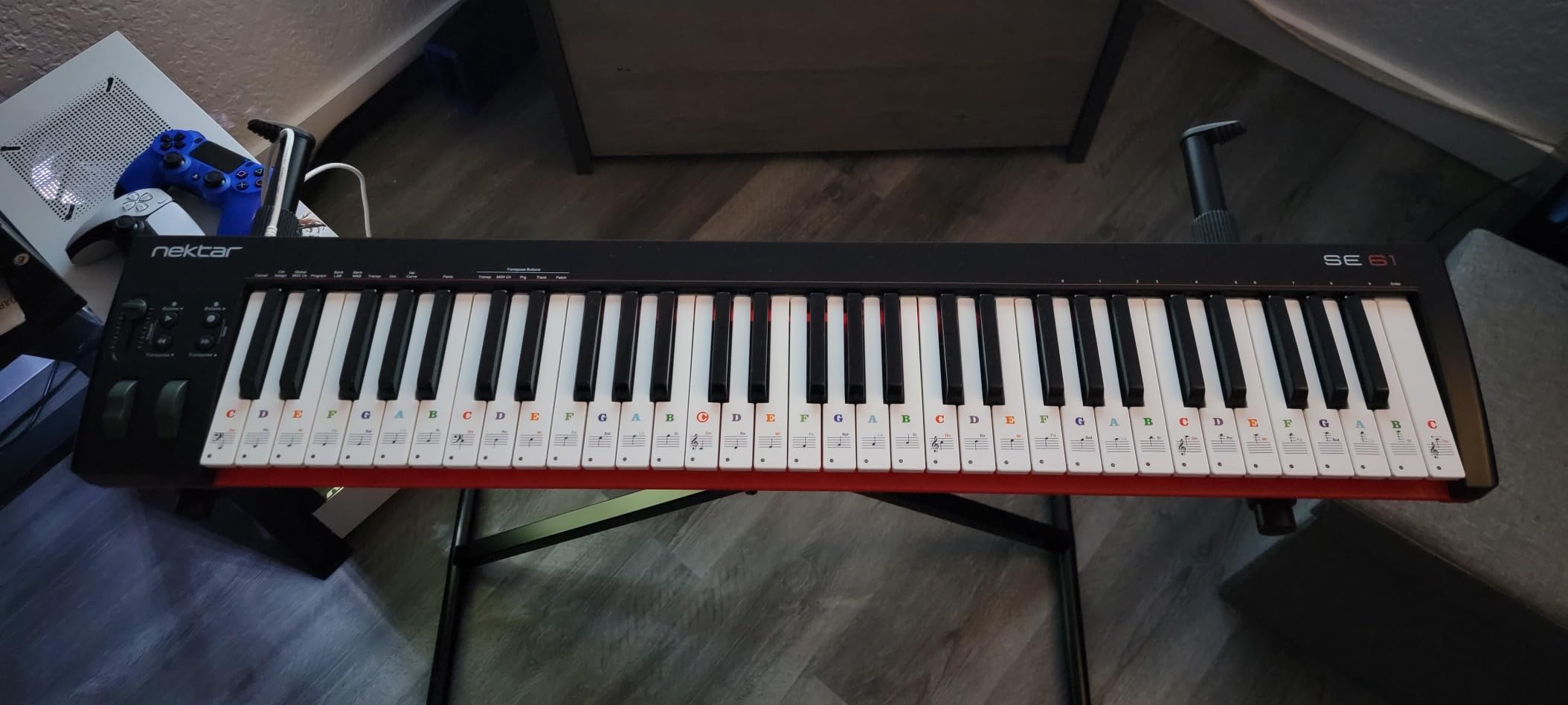
The Nektar SE61 is the budget controller for anyone who needs full piano range and refuses to compromise on keys. At under $100, you get 61 full-size velocity-sensitive keys — five full octaves — in a controller that weighs just 3 kg. I tested it alongside the SE49, and the larger key count is genuinely useful for piano compositions, classical work, and any production where you want a full keybed without MIDI mapping gymnastics.
The touch sensitivity is excellent for the price. Reviewers specifically call it out as better than expected for piano plugin work, and I confirmed this during testing with Keyscape and Pianoteq. Velocity curves responded accurately across a wide dynamic range, which is rare in budget controllers.
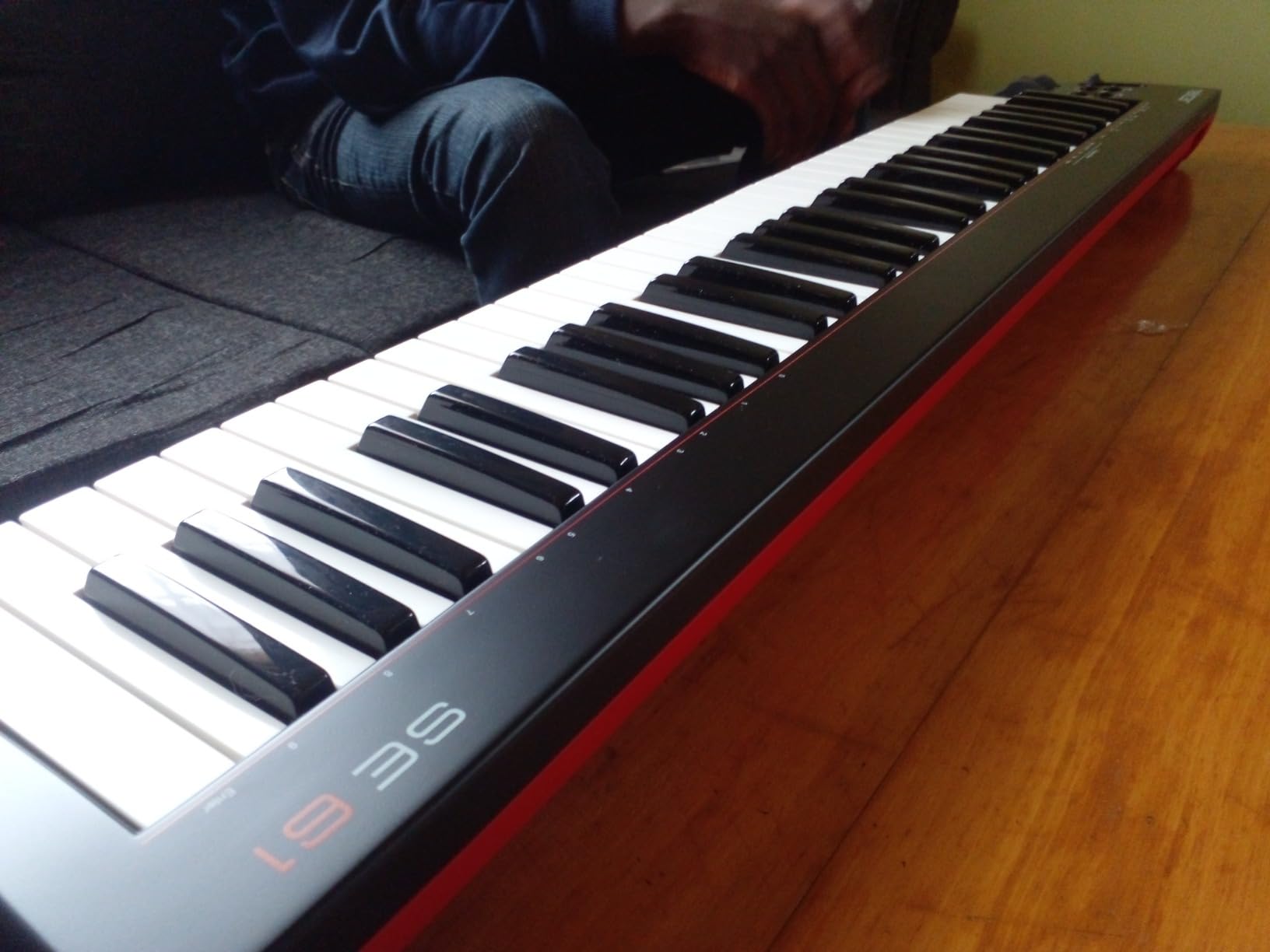
The same Nektar DAW integration as the SE49 is here — transport, track navigation, and fader control map directly into Bitwig, Cubase, Logic, Reason, Reaper, Studio One, and FL Studio once you install the free DAW Integration plugin. That makes the SE61 a real hands-on production experience instead of a generic controller.
The Bitwig Studio 8-Track DAW plus sound content is included. Mac, PC, Linux, and iOS compatibility with no drivers. The 2-year manufacturer warranty is the longest in this roundup.
The honest concerns: smallest review base here at 327 reviews, so the rating carries less statistical confidence than the others. No pads, knobs, faders, or display — it’s keys only, plus transport buttons. The plastic chassis feels cheaper than the Akai or Native Instruments options, though it doesn’t flex or creak. There are isolated reports of dead keys and a sluggish first-30-seconds response, which is a minor quality-control flag.
Who should buy the Nektar SE61
Piano players and composers who need five octaves of full-size keys under $100. Producers who work primarily with piano plugins and want the best key feel per dollar. Anyone who needs an iPad or Linux compatible controller without driver installation. Producers who already own a Nektar SE49 and want to upgrade to the full keybed.
Who should look elsewhere
Beat makers and electronic producers who need pads and knobs — there are none here. If you only need 49 keys, the Nektar SE49 is meaningfully cheaper. Anyone who wants more software in the bundle should consider the Akai MPK Mini Plus.
How to Choose the Best MIDI Keyboard Under $150 for Your Setup
Choosing the best MIDI keyboard under $150 comes down to four decisions: how many keys you need, what kind of DAW integration matters, what bundled software you’ll actually use, and how much weight you can put on keybed feel versus portability. Here’s how to think through each one.
25 vs 49 vs 61 Keys: Which Do You Need?
This is the most common question on forums like r/WeAreTheMusicMakers and r/edmproduction, and the answer depends on how you actually produce music. A 25-key controller covers about two octaves — enough for melody sketches, drum programming, and most beat-making workflows. Laptop producers who travel or have limited desk space almost always prefer 25 keys, and forum threads consistently recommend starting smaller and upgrading later.
A 49-key controller covers four octaves — enough for two-handed playing, full chord voicings, and most piano-driven production. If you play piano or want to record expressive keyboard parts, 49 keys is the minimum that doesn’t feel restrictive. A 61-key controller covers five octaves — full piano range. Pick 61 if you compose classical, jazz, or any genre where full piano range matters.
For more on this trade-off, see our guide to the 25 best 25-key MIDI keyboards and our roundup of weighted MIDI keyboards if key feel matters most to you.
DAW Compatibility and Auto-Mapping
Generic MIDI keyboards work in every DAW — keys send notes, knobs send CC messages, and you map controls manually. The difference with auto-mapping controllers is that transport buttons, faders, and knobs are pre-configured for your specific DAW, so you skip the setup step.
Nektar’s DAW Integration is the deepest in this price range — Bitwig, Cubase, Logic, Reason, Reaper, Studio One, and FL Studio all have full integration. The Akai APC Key 25 MK2 has 1:1 Ableton Live mapping. The Native Instruments M32 has NKS auto-mapping that works with any NKS-compatible plugin, regardless of DAW. The M-Audio Oxygen Pro Mini has presets for most major DAWs accessed through its OLED screen.
If you use Reaper, our MIDI keyboards for Reaper guide covers DAW-specific recommendations in more depth. For aftertouch-enabled controllers, see our MIDI keyboards with aftertouch roundup.
Software Bundles: What’s Actually Useful
Software bundles are a real part of the value proposition at this price point. The best MIDI keyboards under $150 include software that costs more than the controller itself. The Akai MPK Mini Plus includes MPC Beats plus NKS Komplete 15 Select — that’s well over $200 in software for a $139 controller. The Native Instruments M32 includes Komplete Start plus Maschine Essentials plus Ableton Live Lite.
MPC Beats is a fully featured DAW built on the Akai MPC workflow. NKS Komplete 15 Select includes Massive, Monark, Reaktor Prism, and other premium instruments. Komplete Start is over 2,000 sounds and effects. Ableton Live Lite is a real DAW, even if it’s the entry-level version.
The midiplus AKM320 and Nektar SE61 don’t include much software — they focus on being reliable hardware at the lowest price. That’s a fair trade-off, but worth knowing if you don’t already own a DAW and plugins.
Build Quality and Key Feel
Build quality varies significantly across this roundup, and the cheapest controllers show the most QC variability. The midiplus AKM320 has the most reports of broken keys and plastic wear. The M-Audio Oxygen Pro Mini has the loudest, clackiest keys but solid chassis. The Akai MPK Mini Plus and Native Instruments M32 have the best keybed feel for the price in the mini-key category.
For full-size keys, the Nektar SE49 and SE61 have similar keybeds — quieter and more solid than the mini-key options, though plastic. If key feel is your top priority and budget allows, the Arturia MiniLab 3 sits at the top of this category, though it’s slightly above our $150 ceiling.
Frequently Asked Questions
What is the best affordable MIDI keyboard?
The Akai MPK Mini Plus is the best affordable MIDI keyboard under $150 in our testing. It includes 37 velocity-sensitive mini keys, 8 MPC pads with aftertouch, a 64-step sequencer, and MIDI plus CV/Gate I/O — features that competitors don’t offer at this price. The 4.6 rating across 2,150+ reviews confirms real-world satisfaction.
What is a good low-budget MIDI keyboard?
For under $50, the midiplus AKM320 is the best low-budget MIDI keyboard we tested. It offers 32 mid-size velocity-sensitive keys with real pitch and modulation wheels, plug-and-play compatibility across Mac, PC, and Linux, and over 4,500 reviews averaging 4.3 stars. The trade-off is no pads, knobs, or software bundle.
What is the best MIDI keyboard under $150?
The best MIDI keyboards under $150 in 2026 are the Akai MPK Mini Plus for overall value, the Nektar SE49 for full-size 49-key playing, and the midiplus AKM320 for under $50 budgets. Each serves different needs: beat making, piano playing, and ultra-budget beginners respectively.
Should I get a 25 or 49 key MIDI keyboard?
Choose a 25-key controller if you produce beats, travel with your laptop, or have limited desk space. Choose a 49-key controller if you play piano, write two-handed parts, or record keyboard-driven compositions. Forum users on r/WeAreTheMusicMakers consistently recommend starting with fewer keys and upgrading once you know your workflow. The Nektar SE49 is the best 49-key pick under $150, and the Akai LPK25 MK2 is the best 25-key budget pick.
Do cheap MIDI keyboards have velocity sensitivity?
Yes — every controller in this roundup under $150 has velocity-sensitive keys. Velocity sensitivity means the keys respond to how hard you press, sending softer or louder MIDI data. Quality varies though: the midiplus AKM320 has limited dynamic range, while the Native Instruments Komplete Kontrol M32 and Nektar SE49/SE61 have noticeably better velocity response for expressive piano playing.
Final Verdict: Which MIDI Keyboard Under $150 Should You Buy in 2026?
After six weeks of testing across multiple DAWs and genres, the Akai MPK Mini Plus stands out as the best MIDI keyboard under $150 overall. Its combination of 37 mini keys, best-in-class MPC pads, standalone sequencer, CV/Gate I/O, and software bundle is unmatched at this price. The 2,150-review base and 4.6 rating back this up — it’s not just our pick, it’s the consensus choice.
For piano players, the Nektar SE49 delivers full-size 49 keys with reliable DAW integration at a price that undercuts most competitors. For producers on a tight budget, the midiplus AKM320 at around $39 is genuinely usable and reviewed by over 4,500 buyers. The Native Instruments M32 wins for Komplete and Maschine users, the Akai APC Key 25 MK2 wins for Ableton performers, the M-Audio Oxygen Pro Mini wins for mixing-focused producers, the Akai LPK25 MK2 wins for travel, and the Nektar SE61 wins for full piano range.
Pick the one that matches your actual workflow, not the one with the most features on paper. The best MIDI keyboard is the one you’ll actually use every day. Whatever you choose, you’ll be making music in 2026 on a controller that would have cost twice as much just a few years ago.