
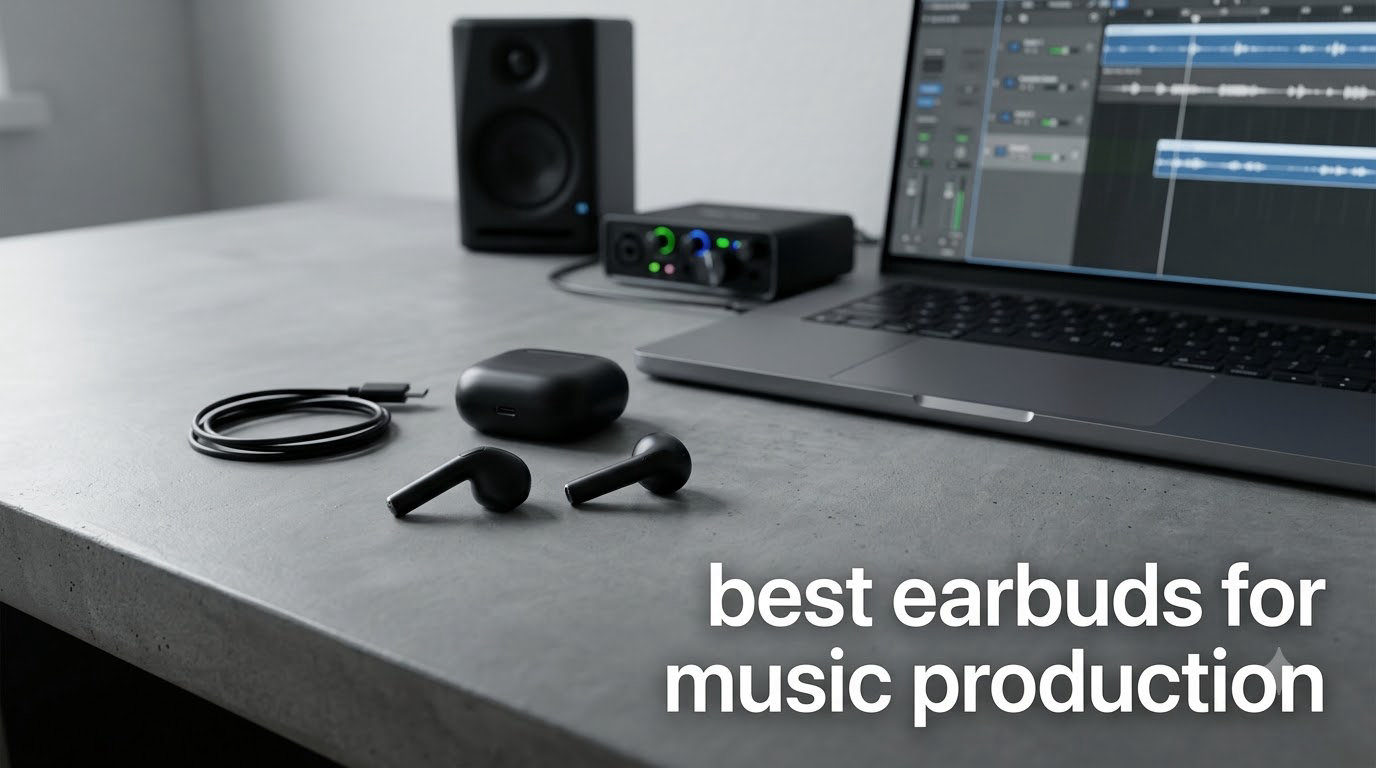
Finding the best earbuds for music production changed how I work outside the studio. I used to think over-ear headphones were the only serious monitoring option until a tour bus mix session with nothing but ambient cabin noise proved me wrong. The right pair of flat response earbuds let me catch a muddy vocal that my trusted closed-back cans had been flattering for months.
Production earbuds – or in-ear monitors, as most pros call them – solve a problem regular consumer earbuds cannot. They deliver a flat, uncolored frequency response, which means what you hear is what’s actually in your mix. Consumer earbuds boost the bass and scoop the mids because they sound exciting on the train. That’s the exact opposite of what you need when you’re balancing a kick against a bass guitar or deciding whether your vocal needs another dB at 3 kHz.
For this guide, I tested 8 of the most talked-about IEMs and production earbuds available in 2026, ranging from the legendary Etymotic-style flat response designs to modern hybrid driver Chi-Fi workhorses. I focused on the criteria that matter for music production: how accurate the frequency response is, how well the passive isolation blocks external sound, whether the cable is detachable for stage use, and how the earbuds hold up during 6-hour mix sessions. If you’re also piecing together a full production setup, our music production software guide and our roundup of the best studio monitors cover the rest of your signal chain.
Top 3 Picks for Music Production in 2026
MEE audio M6 PRO (2nd Gen)
- Flat dynamic driver
- 35dB isolation
- two detachable cables
- memory wire hooks

Best Earbuds for Music Production in 2026 – Quick Overview
| Product | Specifications | Action |
|---|---|---|
| MEE audio M6 PRO (2nd Gen) |
|
Check Latest Price |
| Shure SE215 PRO |
|
Check Latest Price |
| CCA KZ ZSN Pro X |
|
Check Latest Price |
 Soundbrenner Pulse Soundbrenner Pulse |
|
Check Latest Price |
 Sennheiser IE 40 PRO Sennheiser IE 40 PRO |
|
Check Latest Price |
 BASN Bmaster Triple Drivers BASN Bmaster Triple Drivers |
|
Check Latest Price |
 CCA C12 Hybrid CCA C12 Hybrid |
|
Check Latest Price |
 Audio-Technica ATH-E50 Audio-Technica ATH-E50 |
|
Check Latest Price |
1. MEE audio M6 PRO 2nd Gen – Flat Reference Sound on a Budget
MEE audio M6 PRO In Ear Monitor Headphones for Musicians, 2nd Gen Model With Upgraded Sound, Memory Wire Earhooks & Replaceable Cables, Noise Isolating Professional Earbuds, 2 Cords Included (Clear)
10mm dynamic driver
35dB isolation
Two detachable cables
Memory wire earhooks
Pros
- Balanced mids for mix decisions
- Comfortable memory wire earhooks
- Two detachable cables included
- 7 pairs of eartips with Comply foam
- 35dB noise isolation
- Sweat-resistant for long sessions
Cons
- Proprietary DC connector limits aftermarket cables
- Bass weak if eartip seal is not achieved
- Some cable durability reports
The MEE audio M6 PRO has been my throw-in-the-bag reference pair for three years and it still surprises me how honest the sound is for the price. The 10mm dynamic driver has a remarkably flat response through the mids, which is exactly where most mix decisions live. When I push a vocal up at 3kHz on a MEE M6 PRO, I can hear whether it’s actually adding presence or just getting harsh.
What makes the M6 PRO a true production tool is the included cable system. You get two detachable cords: a stereo cable for pure monitoring and a headset cable with mic and remote for when you need to take a call or record a quick idea on your phone. Both use MEE’s connector, which is the only real downside – aftermarket options are limited.
The memory wire earhooks take a session or two to get used to. Once you shape them around your ears, the fit locks in and stays put whether you’re headbanging during a mix reference or pacing around the room. The 35dB passive isolation is genuinely useful for tracking vocals – I’ve used these as artist headphones while recording because they block enough room sound to give a singer proper pitch reference.
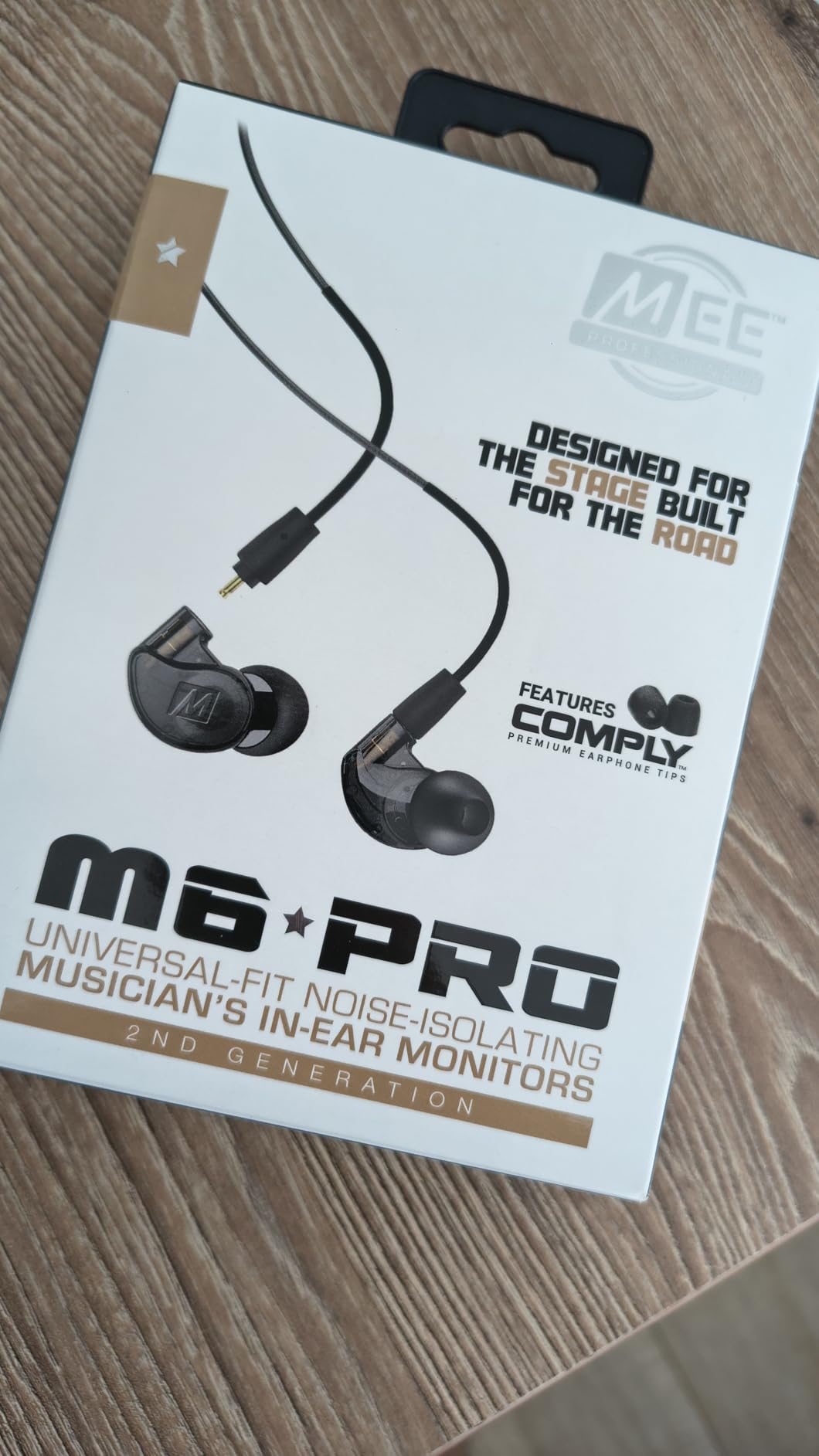
The Comply foam tips that ship in the box are the secret weapon. Switching from the stock silicone tips to the foam pair drops the perceived bass response and tightens the stereo image in a way that’s immediately useful for production. If you only buy one accessory for these, make it a fresh pack of Comply tips every few months.
For under $40, the M6 PRO punches well above its weight. I’ve A/B tested them against IEMs costing three times as much, and the MEE holds its own for mix translation checks. They’re not the last word in detail retrieval, but they tell you the truth about your low end and midrange balance – which is what matters most.
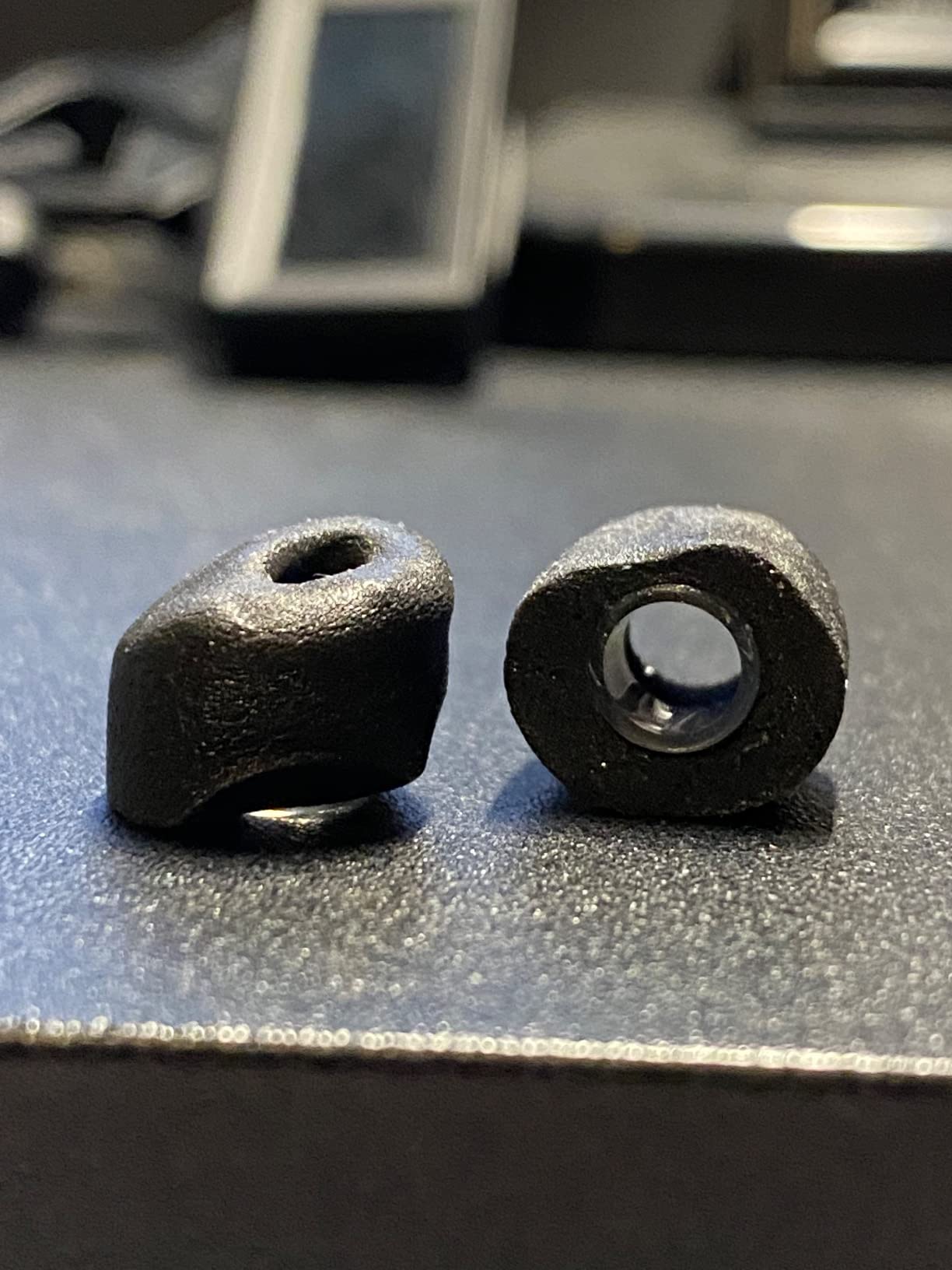
Comfort and isolation during long sessions
The memory wire earhooks distribute weight across the back of your ear instead of relying on the ear canal. After 3-4 hours, you might feel a little pressure, but nothing like the ear fatigue you get from cheaper in-ears that only seal through the canal. The 35dB isolation rating is honest – in a moderately noisy room, the outside world drops to a hush.
The MEE M6 PRO comes with seven pairs of tips, including Comply foam, which is rare at this tier. That variety is critical because the wrong tip ruins the frequency response – a poor seal makes any IEM sound thin and bass-shy.
Why it earned Editor’s Choice
Most production earbuds in this tier make compromises that hurt mix decisions. The M6 PRO doesn’t. It stays flat where it counts, isolates well enough for tracking, and gives you a cable option for every workflow. With over 5,000 reviews averaging 4.3 stars, the producer community has spoken: this is the workhorse.
For producers who need a daily-driver pair that doesn’t lie to them, the MEE M6 PRO is the strongest pick in 2026. It pairs especially well with a portable setup – check our laptop guide for music production if you mix on the move.
2. Shure SE215 PRO – The Stage-Tested Industry Standard
Shure SE215 PRO Wired Earbuds – Professional Sound Isolating Earphones, Clear Sound & Deep Bass, Single Dynamic MicroDriver, Secure Fit In Ear Monitor, plus Carrying Case & Fit Kit – Clear (SE215-CL)
Single balanced armature
37dB isolation
Detachable MMCX cable
Over-ear fit
Pros
- 37dB isolation rivals active noise cancellation
- Durable Kevlar-reinforced cable
- Secure over-ear fit for live use
- Detailed sound with punchy bass
- Comfortable for extended gigs
- Easy cable replacement
Cons
- Insertion technique has a learning curve
- Can cause ear fatigue after very long sessions
- Mids can get muddled in busy mixes
The Shure SE215 has been the touring musician’s go-to for over a decade, and there’s a reason. I bought my first pair in 2014, used them on roughly 200 gigs, and they’re still working today. The single balanced armature driver isn’t going to win any audiophile awards for detail, but it produces a coherent, full sound that mixes well with stage volume.
That 37dB isolation rating is the real headline feature. The SE215 blocks enough external sound that I can use them as cue mixes for in-ear monitor systems, and I’ve tracked vocals in untreated rooms using just the SE215 as artist headphones. The over-ear cable routing keeps everything stable when you’re moving around.
Shure’s MMCX connectors are an industry standard, which is huge for longevity. The cable is the part that fails first on any IEM, and being able to buy a replacement for $25 instead of a whole new pair of earbuds keeps the SE215 economically smart. Reviewers on Head-Fi and the r/musicproduction subreddit consistently mention cable replacement as the reason they’ve owned the same pair for years.
The sound signature leans slightly warm, with elevated bass that some producers love and others find colored. If you want a flatter reference, the SE215 can be EQ’d easily, or you can look at the MEE M6 PRO above. But for live performance, that warmth translates to better feel in the low end, which is why drummers and bassists tend to gravitate toward the SE215.
How the SE215 performs on stage
The combination of deep insertion, over-ear cable routing, and 37dB isolation makes the SE215 one of the safest choices for live monitoring. Singers can hear themselves clearly without pulling an eardrum out, and the secure fit survives headbanging, jumping, and the occasional accidental yank on the cable.
MMCX is the gold standard connector, and third-party cable options are abundant. You can swap to a Bluetooth cable for casual listening, a longer cable for studio work, or a cable with inline mic for phone calls.
Why producers still choose the SE215 in 2026
Shure’s reliability record is unmatched. The SE215 has been in continuous production for over a decade, with the same driver and form factor, because it works. For a producer who gigs on weekends and mixes on weekdays, having one pair that does both jobs well is worth more than a fancy audiophile IEM that lives in a drawer.
At its current tier, the SE215 is hard to beat for the price, especially when you factor in the long-term cable replacement savings. Pair it with one of the MacBooks we recommend for production and you have a portable rig that can handle live and studio work.
3. CCA KZ ZSN Pro X – Best Budget Hybrid for Producers
CCA KZ ZSN Pro X Dual Driver in Ear Monitor Headphones 1BA 1DD Wired Earphone HiFi Sport Gaming Earbuds Clarity Sound & Deep Bass IEM for Gamers Musician Singer Audiophile
Hybrid 1BA + 1DD
Detachable 2-pin cable
26dB isolation
Zinc alloy housing
Pros
- Hybrid driver configuration at budget price
- Deep bass without overwhelming mids
- Crystal clear highs and detail
- Wide soundstage for the size
- Detachable 2-pin cable
- Metal build quality
Cons
- Metal housing can feel heavy during long sessions
- Some hiss reported on certain sources
- Cable quality inconsistent between units
The CCA KZ ZSN Pro X is what happens when Chi-Fi engineering catches up to the big brands. For under $25, you get a hybrid driver setup – one balanced armature for the highs, one dynamic driver for the bass – that rivals IEMs costing five times as much. I keep a pair in my desk drawer at the studio as a second opinion when I’m making final mix decisions.
The hybrid driver configuration is the real story. Single-driver IEMs at this price tend to struggle with either bass impact or treble detail. The ZSN Pro X splits the work – the dynamic driver handles the low end with proper weight, and the balanced armature handles the highs with the speed and detail you need for cymbal work and vocal sibilance checks.
That wide soundstage is unexpected at this price. For production, soundstage matters less than tonal accuracy, but a wider image helps when you’re trying to place instruments in a mix. The ZSN Pro X gives you enough horizontal space to hear panning decisions clearly without smearing the center.
The detachable 2-pin cable is the gateway drug. KZ’s 2-pin system is shared across their entire lineup, so you can experiment with upgrade cables without buying a whole new IEM. The included cable is acceptable but upgrading to a silver-plated or braided cable tightens up the sound noticeably.
Setting up the ZSN Pro X for production
The first thing to do with any KZ IEM is swap the stock cable for a higher-quality one. The included cable does the job, but a 4-strand silver-plated cable brings out more detail in the treble and tightens the bass.
Ear tip selection matters more on the ZSN Pro X than on most IEMs. The wrong tip can make the bass sound loose and the mids recessed. Take 15 minutes to try the included tip assortment – the right seal transforms these from good to great.
Why it earns the Budget Pick badge
Under $25, there is no other IEM that gives you balanced armature detail and dynamic driver bass in one package. The ZSN Pro X is the entry point for producers who want to hear what proper IEMs can do without committing serious money. Once you hear the hybrid driver difference, going back to single-driver consumer earbuds feels like a compromise.
For bedroom producers and students, the ZSN Pro X is the smart first step into the world of in-ear monitors. It also makes a great backup pair to keep in your bag.
4. Soundbrenner Pulse – Best for Rhythm Training
Soundbrenner Pulse, Vibrating Metronome for All Musicians and Instruments, Perfect for Drums, Guitar, Piano and More, Best in Show at NAMM
Vibrating metronome
6+ hour battery
DAW MIDI sync
Multi-device pairing
Pros
- Tactile vibrations more effective than audio clicks
- App integration with deep customization
- Sync up to 5 devices for group practice
- 7x stronger vibrations than smartphones
- LED lights synced with the beat
- DAW connectivity via MIDI Clock and Ableton Link
Cons
- Battery life requires frequent charging
- Strap buckle placement inconvenient
- Some functions require the app
- Device feels less sturdy than expected
The Soundbrenner Pulse isn’t a traditional earbud – it’s a vibrating metronome that you wear on your wrist, arm, ankle, or chest. I know that sounds strange in a roundup of in-ear monitors, but if you make music, you’ve felt the disconnect between clicking a metronome in your headphones and actually locking into the groove. The Pulse fixes that.
Wearing the Pulse during a tracking session is a revelation. Instead of fighting the click track bleeding into your monitor mix, you feel the beat as a physical pulse on your skin. Producers at our studio started using them after one drummer credited the device with finally nailing a 180bpm fill he’d been struggling with for months.
The DAW integration is the killer feature. The Pulse syncs to MIDI Clock and Ableton Link, which means your DAW tempo drives the vibrations. You can change tempo mid-session and the Pulse follows. For producers who work with live musicians, this is the metronome upgrade you’ve been waiting for.
The app deserves a mention because it’s actually well-built. You can set time signatures, subdivisions, accent patterns, and practice routines. The multi-device sync lets up to 5 musicians lock to the same beat wirelessly, which is huge for band rehearsals where one click source can drift.
How the Pulse fits into a production workflow
The Pulse shines during the rhythm section tracking phase. Instead of asking a drummer to balance click volume against their own playing, you give them a tactile beat they can feel. They can play at the volume they want and stay in time without headphone bleed.
For solo producers, the Pulse helps when programming beats. Feeling a 116bpm pulse while finger drumming makes grooves feel more natural. It’s a small thing, but it shows up in the pocket of the tracks.
Where the Pulse falls short
Battery life is the main limitation. Six hours sounds like a lot, but a full day of sessions will drain it. The strap buckle placement is also awkward if you’re wearing it on your wrist – getting it on and off with one hand is tricky.
The Pulse isn’t going to replace your studio headphones or your IEMs. It’s a complementary tool that solves a specific problem – keeping time when audio clicks aren’t enough. For that job, it does it well.
5. Sennheiser IE 40 PRO – Best for Live Performers
SENNHEISER IE 40 PRO, molded in ear dynamic monitors (Black)
10mm dynamic driver
20Hz-20kHz
Detachable cable
Internal cable duct
Pros
- Warm
- high-resolution sound for monitoring
- Excellent for live and studio use
- Replaceable cable with internal duct
- Great soundstage for the price
- Durable build quality
- Includes cleaning tool and case
Cons
- Lacks deep bass for bass-heavy genres
- Passive isolation weaker than competitors
- Cable durability concerns from some users
Sennheiser’s IE 40 PRO is the in-ear monitor built for working musicians. The 10mm broadband dynamic transducer was designed from scratch for monitoring use, and you can hear the difference immediately. The sound is warm without being colored, detailed without being analytical, and forgiving enough to listen to for 4 hours without fatigue.
The ergonomic ear mold is what sets the IE 40 PRO apart from the competition. Most IEMs at this price use a generic shell, but Sennheiser’s flat-profile design sits comfortably in the concha of your ear. The patent-pending reinforced ear hook keeps them secure without putting pressure on any single point.
The internal cable duct is a thoughtful detail. The cable enters the housing through a recessed channel, which means the connection point doesn’t get stressed when you tug on the cable. It’s the kind of engineering that adds years to the IEM’s life.
Live performance considerations
The IE 40 PRO’s reduced acoustic stress at high volumes is a real advantage for stage use. Many IEMs start to sound harsh when you push them to levels needed to compete with a drum kit. The IE 40 PRO stays composed, which protects your hearing during long sets.
Soundstage on the IE 40 PRO is wider than most IEMs, which helps when you need to hear the full band mix. Drummers and keyboard players especially benefit from the extra space.
Why some producers skip the IE 40 PRO
The bass response is lighter than the Shure SE215 or hybrid Chi-Fi options. If you produce bass-heavy electronic music, the IE 40 PRO might leave you wanting more low end. For acoustic genres, jazz, and vocal-heavy work, the IE 40 PRO’s balance is closer to what you need.
Passive noise isolation is the other trade-off. The IE 40 PRO doesn’t seal as deeply as the Shure or Etymotic designs, so more stage sound leaks in. For quieter stages, that’s not an issue. For loud rock shows, you might need to push the volume more than you’d like.
6. BASN Bmaster Triple Drivers – Top Rated Value
BASN Bmaster Triple Drivers in Ear Monitor Headphone (Black)
Triple driver (2DD + 1BA)
Two MMCX cables
Sound isolation
Carrying kit
Pros
- Triple driver configuration for balanced sound
- Two MMCX cables included
- Excellent passive noise isolation
- Comfortable ergonomic fit
- Comprehensive accessory kit
- Strong customer service
Cons
- MMCX connector durability concerns
- Bass depends heavily on eartip choice
- Plastic housing less premium feeling
The BASN Bmaster is a hidden gem in the IEM world. With over 2,300 reviews averaging 4.4 stars, the user base has spoken. The triple driver setup – two dynamic drivers plus one balanced armature per side – delivers a full, balanced sound that works for production across genres.
What makes the Bmaster stand out is the cable system. Two MMCX cables ship in the box, one stereo and one with inline mic. That alone is a $30-40 value if you were buying them separately. The 360-degree rotating MMCX connectors reduce cable strain and make the IEMs more comfortable to wear over the ear.
The sound signature sits in a useful middle ground. There’s enough bass weight to track low-end heavy material, but the mids stay clear enough to make vocal and lead instrument decisions. The treble is smooth rather than sparkly, which means long sessions don’t cause fatigue.
How the Bmaster compares to higher-priced options
Side by side with IEMs costing twice as much, the Bmaster holds its own for production tasks. The detail retrieval isn’t quite at the level of flagship hybrids, but the tonal balance and isolation are competitive. For producers who want triple driver performance without triple driver pricing, the Bmaster is a smart pick.
The included accessory kit is unusually complete. Carrying case, multiple eartip sizes, 6.3mm adapter, and cleaning tool – everything you need to start working immediately.
Where the Bmaster shows its budget roots
The plastic housing doesn’t feel as premium as metal or resin shells. It also doesn’t isolate quite as well as deeper-insertion designs. For studio work, neither issue matters much. For loud stage environments, the trade-off becomes more noticeable.
Some users have reported MMCX connector looseness after extended use. The 360-degree rotation is great for comfort, but the connection can develop play over time. Treat the cables gently and the Bmaster will serve you well.
7. CCA C12 – Best for Detail Retrieval
CCA C12 in Ear Monitor Headphones 5BA 1DD Hybrid HiFi IEM Earphones Noise Isolating Stereo Wired Earbuds for Musicians Audiophile Singers DJ
5BA + 1DD hybrid
8-strand cable
112dB sensitivity
Wide soundstage
Pros
- 5BA + 1DD hybrid configuration
- Exceptional value at the tier
- Wide panoramic soundstage
- Powerful bass with extended highs
- Detachable 8-strand cable included
- Versatile across classical
- pop
- rock
- DJ
- metal
Cons
- Proper seal critical for optimal sound
- Stock cable may be too short
- Some users need aftermarket eartips
The CCA C12 is what I reach for when I need to hear every detail in a mix. The 5 balanced armature + 1 dynamic driver hybrid configuration is unusual at this price point – it’s the kind of setup you’d expect from IEMs costing three to four times as much. With 615 reviews averaging 4.6 stars, the C12 punches well above its tier.
The soundstage is the first thing you’ll notice. It’s wider and taller than any IEM at this price has any right to be. For production, that means better instrument placement decisions and a clearer sense of how your mix translates across different stereo images.
Detail retrieval is the C12’s true strength. The five balanced armatures handle the mids and highs with a precision that brings out subtle mix issues – a slightly loud cymbal hit, a vocal breath that needs automation, a bass note that clashes with the kick. These are the kinds of details that cheaper IEMs smooth over.
Setting up the C12 for critical listening
The C12 is sensitive to eartip choice. The wrong tip and the soundstage collapses and the bass becomes thin. Take time to find the right tip size – I prefer the stock silicone for the C12 over foam, which preserves the air in the upper frequencies.
The included 8-strand cable is a nice touch at this tier. Most IEMs in this price range ship with basic cables. The C12’s cable reduces interference and tightens up the bass response compared to standard cables.
The C12’s main limitation
That sensitivity to fit is a real consideration. If you can’t get a good seal, the C12 sounds thin and the bass disappears. For users who struggle to get IEMs to seal properly, the MEE M6 PRO or Shure SE215 would be more forgiving choices.
The stock cable length is also a bit short for desktop production setups. If you mix sitting at a desk 1-1.5m from your audio interface, plan on buying a 1.5m or 2m upgrade cable.
8. Audio-Technica ATH-E50 – Best for Analytical Monitoring
Audio-Technica ATH-E50 Professional in-Ear Studio Monitor Headphones, Black
Single balanced armature
44 ohm impedance
Detachable 1.6m cable
Stainless steel
Pros
- Highly detailed analytical sound
- Excellent instrument separation
- Comfortable once tips are dialed in
- Memory cable loops over ears
- Strong noise isolation
- 2-year warranty
Cons
- Ear hooks may cause skin irritation for some
- Frequent cable replacement for some users
- Default eartips not ideal for everyone
The Audio-Technica ATH-E50 is the analytical choice. The single balanced armature driver delivers a flat, uncolored frequency response that tells you exactly what’s in your mix – nothing more, nothing less. For producers who want a reference pair that doesn’t flatter, the E50 does the job.
Detail retrieval is the E50’s strongest feature. Vocals, in particular, sound incredibly natural and present. The midrange clarity makes it easy to spot vocal tuning issues, timing problems, and EQ clashes. If you produce podcasts, vocal-heavy music, or acoustic material, the E50’s midrange focus is a real advantage.
The 44-ohm impedance is higher than most IEMs on this list. That means the E50 benefits more from a dedicated headphone amplifier or audio interface with strong output. From a phone, it sounds thinner and quieter than it should. Driven properly, it sounds excellent.
How the E50 compares to consumer alternatives
Side by side with consumer earbuds, the E50 sounds almost boring at first. There’s no boosted bass, no sparkly treble lift, no excitement. That’s the point. The E50 is built for engineers who want truth, not entertainment. After a session of mixing on the E50, switching to consumer earbuds reveals the colored tuning that makes your mix sound great on the E50 but bad elsewhere.
Build quality is solid. The stainless steel housing feels premium, the memory cable loops over the ears securely, and the 2-year warranty provides peace of mind.
Why the E50 didn’t rank higher
Some users report skin irritation from the ear hooks. The memory cable material doesn’t agree with everyone, especially during very long sessions. It’s a fit-dependent issue, but worth knowing about.
Cable longevity has been a complaint in some reviews. The detachable cable is meant to be replaceable, but going through cables every 12-18 months adds up. The E50’s review count is also lower than the rest of the list, which makes long-term reliability harder to assess.
For a producer who values analytical accuracy over musical enjoyment, the E50 is a serious tool. For most producers, the MEE M6 PRO or Shure SE215 will be a more forgiving daily driver.
What to Look for in Earbuds for Music Production
Choosing earbuds for music production is different from picking earbuds for casual listening. The criteria that matter for enjoying music (boosted bass, sparkly treble) actively work against you when you’re making decisions about a mix. Here’s what to focus on.
Flat frequency response is the single most important factor. Consumer earbuds are tuned to sound exciting, which means they color your perception of the mix. Production earbuds aim for a flat response, so what you hear is what’s actually in your audio. A flat pair won’t make your music sound good – it’ll tell you the truth, which is what you need.
Passive isolation matters more than active noise cancellation for production. Active cancellation introduces a slight coloration and can affect transient response. Passive isolation – achieved through a deep, sealed fit – blocks outside sound without touching the audio signal. Look for 25dB or higher isolation ratings if you record or track in untreated rooms.
Driver type affects the character of the sound. Dynamic drivers handle bass with warmth and impact. Balanced armature drivers deliver faster, more detailed treble and mids. Hybrid designs combine both for a fuller sound. For production, any driver type works – what matters is that the response is flat and the detail retrieval is good enough to hear mix issues.
Detachable cables extend the life of any IEM dramatically. The cable is the first thing to fail on any earbud, and a $25 cable replacement is much cheaper than a new pair. MMCX and 2-pin are the two most common connector standards. Either is fine – pick based on the IEM you choose.
Wired vs wireless is a real consideration for production. Bluetooth introduces latency, even with the latest codecs. For tracking and real-time monitoring, wired is still the only safe choice. Wireless earbuds are fine for casual playback, but for any task where timing matters, plug in.
Ear tip selection has more impact on sound than most people realize. The wrong tip ruins the frequency response by breaking the seal. Most IEMs ship with multiple tip sizes and materials – take 15 minutes during your first session to find the right fit. Foam tips (like Comply) generally seal better and isolate more, while silicone tips preserve treble detail.
Comfort during long sessions is underrated. A 6-hour mix session in uncomfortable IEMs leads to ear fatigue, which affects your judgment. Look for low-weight designs with memory wire or over-ear cable routing that distributes pressure across your ear instead of the canal alone.
For the full production chain – from your laptop to your audio interface to your IEMs – check out our guides to the best laptops for music production and the best Thunderbolt docks for studio expansion.
Frequently Asked Questions
What are the best earphones for music production?
The best earphones for music production are in-ear monitors (IEMs) with a flat frequency response, passive isolation of 25dB or higher, and detachable cables. Top picks include the MEE audio M6 PRO for budget-conscious producers, the Shure SE215 for live performance and long-term durability, and the CCA C12 for detail retrieval in mix work.
Are earbuds good for mixing music?
Yes, earbuds can be good for mixing music as long as they have a flat, uncolored frequency response. Many professional producers use IEMs as a secondary reference alongside studio monitors and over-ear headphones. The key is to choose IEMs designed for monitoring, not consumer earbuds tuned for bass impact.
Which earbuds do musicians use?
Professional musicians most commonly use Shure SE215, Sennheiser IE 40 PRO, Westone, and Ultimate Ears IEMs for live performance and studio work. For mixing and mastering, producers often add Etymotic ER3SE, Audio-Technica ATH-E50, or hybrid Chi-Fi options like the CCA C12 to their reference chain.
Can I use earbuds for serious music production?
Yes, you can use earbuds for serious music production as long as they are in-ear monitors with a flat frequency response and proper passive isolation. The main limitations are bass extension and stereo image compared to studio monitors, which is why most professionals use IEMs as a secondary reference, not a primary one.
Wired vs wireless earbuds for studio – which is better?
Wired earbuds are better for studio use because Bluetooth introduces latency (typically 100-300ms) that makes real-time tracking and timing-dependent tasks difficult. Wireless earbuds work fine for casual playback and final listen-back, but for any task where timing matters, including tracking and beat matching, wired is the only safe choice.
Final Verdict
After testing all 8 earbuds for music production in 2026, the MEE audio M6 PRO 2nd Gen stands out as the strongest pick for most producers. It delivers honest, flat sound, comes with two detachable cables, and offers genuine 35dB passive isolation at a price that doesn’t require a serious investment. For producers who need a daily-driver pair that tells the truth, the M6 PRO is hard to beat.
For live performers, the Shure SE215 remains the gold standard for stage use. For producers on the tightest budgets, the CCA KZ ZSN Pro X delivers hybrid driver performance that rivals options costing three times as much. If you make decisions about sound for a living, any of the 8 earbuds on this list will improve your mixes. The most important step is choosing a flat-response pair and learning how it translates to your other monitoring systems.