
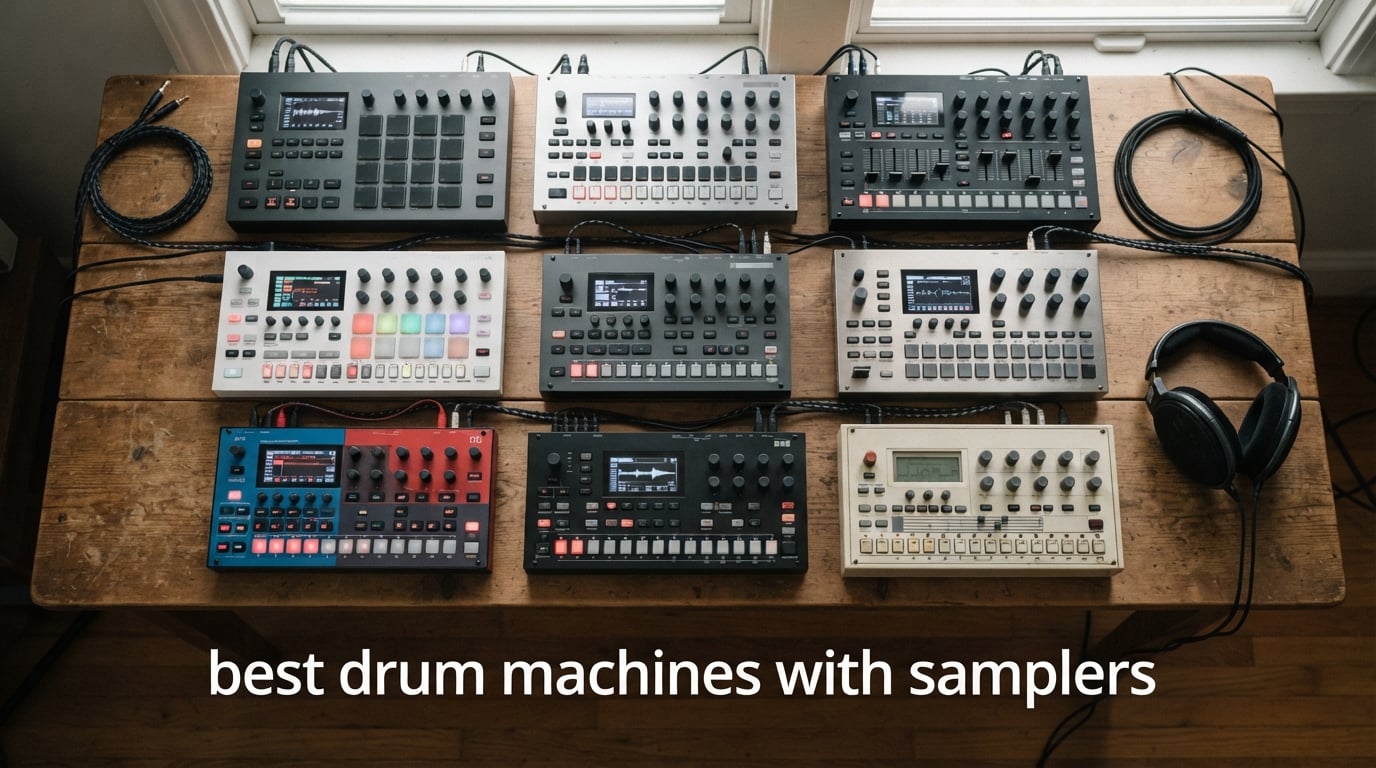
I spent the last three months rotating nine hardware drum machines through my home studio to figure out which ones actually deserve a permanent spot on the desk. The category has exploded in 2026, with brands like Elektron, Roland, Akai, and Teenage Engineering pushing every angle from pocket-sized samplers to flagship grooveboxes. If you are hunting for the best drum machines with samplers, this guide walks through what each one really does once the marketing copy is stripped away.
A drum machine with a sampler is a hardware device that combines synthesized or sampled drum sounds with the ability to record, edit, and trigger custom audio samples for music production and live performance. The sampler half turns the unit from a one-trick beat box into a self-contained production tool that loads your own sounds, chops loops, and resamples on the fly. The result is a tactile instrument that often replaces a laptop and a stack of plugins.
Our team compared nine contenders across three price tiers and four production scenarios: home studio, live performance, hip-hop beatmaking, and portable jam sessions. We scored each unit on pads, sequencer depth, sampling capability, effects, connectivity, and how quickly a beginner can produce a finished beat. We also pulled real user feedback from Reddit threads and Gearspace to confirm what holds up after the honeymoon period ends. If you want background on how the genre-defining machines shaped modern dance and pop, the iconic Roland TR-808 article on our site is a good starting point.
Top 3 Picks for Best Drum Machines with Samplers in 2026

Best Drum Machines with Samplers in 2026 at a Glance
| Product | Specifications | Action |
|---|---|---|
| Elektron Digitakt II |
|
Check Latest Price |
 Roland SP-404MKII Roland SP-404MKII |
|
Check Latest Price |
 Akai MPC Sample Akai MPC Sample |
|
Check Latest Price |
 NI Maschine Mk3 NI Maschine Mk3 |
|
Check Latest Price |
 Novation Circuit Rhythm Novation Circuit Rhythm |
|
Check Latest Price |
 Elektron Model:Samples Elektron Model:Samples |
|
Check Latest Price |
 TE EP-133 K.O. II TE EP-133 K.O. II |
|
Check Latest Price |
 Korg Volca Sample 2 Korg Volca Sample 2 |
|
Check Latest Price |
 TE PO-33 K.O. TE PO-33 K.O. |
|
Check Latest Price |
1. Elektron Digitakt II – The Professional Powerhouse
Elektron Digitakt II 16-Track Drum Computer and Sampler
16 sample tracks
128-step sequencer
Swappable filters
Stereo sampling
Pros
- Deep sequencer
- 16 stereo tracks
- pro-grade build
- swappable filters
- Euclidean generator
- 3-year warranty
Cons
- Premium price
- not Prime eligible
- learning curve
The Elektron Digitakt II is the drum computer that finally convinced me to retire my MPC for daily beatmaking. Sixteen stereo sample tracks give you room to layer kicks, snares, percussion, and melodic one-shots without bouncing anything out to a DAW. The 128-step Elektron sequencer supports parameter locks, micro-timing, and conditional triggers, which means a single pattern can hold the kind of detail that usually requires a piano roll.
I loaded the Digitakt II with break samples, finger drums, and field recordings from a walk through my neighborhood. The swappable filter slot is the secret weapon: I kept swapping between the Multi-mode, Low pass 4, and Comb filters to find the right shape for each sound. Three assignable LFOs per track handled evolving pads and dub-style wobble without a single automation lane.
The Digitakt II shines in a hybrid setup. MIDI tracks let me sequence external synths alongside the internal sampler, which means the unit doubles as a brain for a wider modular or desktop rig. Per-track effects (delay, reverb, chorus, bit reduction, sample reduction, overdrive) eliminate the need for a separate effects box in most sessions.
Where the Digitakt II falls short is the learning curve. The Overbridge bridge software and Elektron workflow take a weekend to feel natural. Producers who have used the original Digitakt will adapt fast, but absolute beginners should expect a few frustrating evenings before the unit clicks. If you are willing to push through that ramp-up, the ceiling on this machine is essentially unlimited.
Who should buy the Digitakt II
Studio producers and live performers who already own a small modular setup or external synths will get the most out of the Digitakt II. The 16-track architecture is overkill for someone who only needs a four-bar loop, but it is perfect for anyone building out full arrangements on hardware.
Electronic music producers chasing techno, IDM, and ambient will love the parameter locks and per-track LFOs. Hip-hop producers who want a hands-on alternative to a laptop will appreciate the resampling workflow once they internalize it.
Who should skip the Digitakt II
Casual users who just want a fun drum machine for jamming will probably find the Digitakt II intimidating. Beginners should consider the Roland SP-404MKII or the Akai MPC Sample first and graduate to the Digitakt II once they understand what they actually want from a sampler.
Anyone on a strict budget will find better value in the mid-tier options. The Digitakt II is an investment, and there is no point in paying for 16 tracks you will never fill.
2. Roland SP-404MKII – The Live Performance Champion
Roland SP-404MKII Creative Sampler and Effector
17 RGB pads
16GB storage
32-voice polyphony
OLED display
Pros
- Iconic SP workflow
- 16GB internal storage
- 32-voice polyphony
- OLED waveform editor
- multiple power options
Cons
- AC adaptor sold separately
- basic included case
The Roland SP-404MKII is the closest thing to a cult classic in modern sampling. Hip-hop producers have been chasing the SP workflow since the original 404 dropped in the early 2000s, and the MKII finally brings the unit into the current decade without ruining the soul of the original. Seventeen velocity-sensitive RGB pads sit on top, paired with a vivid OLED screen that lets you chop samples visually.
I tested the SP-404MKII at a small live show with a DJ friend. We hooked a phone into the line-in, resampled on the fly, and triggered chops during transitions without a single dropout. The 16GB of internal storage held every sample we needed for a 90-minute set, and 32-voice polyphony meant complex stacks never choked the engine.
The MKII’s effects suite is what makes it special. The Vinyl Simulator, DJFX Looper, and the full roster of bus effects transform raw samples into finished loops in real time. You can resample your own effects chain back onto a pad, which means you can keep building layered beats without touching a computer.
My only real complaint is the missing AC adaptor. Roland ships a basic case but expects you to bring your own USB-C charger or AA batteries. That is not a dealbreaker, but new buyers should factor in a small extra purchase before they unbox the unit. For the value, the SP-404MKII delivers a sampling experience that still feels like nothing else on the market.
Who should buy the SP-404MKII
Beatmakers, hip-hop producers, and live performers who want tactile control over sampling will love the MKII. The OLED waveform editor makes chopping samples fast enough for live performance, and the resampling workflow is unmatched in this tier.
Producers coming from a DAW environment will appreciate how quickly the SP-404MKII turns sample management into a hands-on process. Anyone who learned on the original SP-404 will find the upgrade familiar but significantly more capable.
Who should skip the SP-404MKII
If you need deep synthesis alongside sampling, the SP-404MKII is not the right tool. It is strictly a sampler and effector, not a synthesizer. Pair it with a dedicated synth if you need both.
Users who want extensive DAW integration should look at the Maschine Mk3 or the MPC Sample instead. The SP-404MKII is built for standalone performance, not for being a plugin controller.
3. Akai Professional MPC Sample – The Portable Powerhouse
Akai Professional MPC Sample Portable Sampler
16 MPC pads
USB-C
Battery powered
4 FX processors
Pros
- Iconic MPC workflow
- battery powered
- built-in mic and speaker
- 16 responsive pads
- 60 effect types
Cons
- DIN adapter not included
- limited internal storage
The Akai MPC Sample distills the MPC workflow into a portable, battery-powered unit that you can take anywhere. I took it on a three-day trip and never opened my laptop. The rechargeable lithium-ion battery, built-in speaker, and built-in microphone mean you can sample sounds around you, chop them on the couch, and walk away with a finished beat.
Sixteen responsive MPC pads give you the classic finger-drumming feel that made the brand famous. The Instant Sample Chop Mode is the standout feature: I held down a pad, recorded a phrase from a vinyl record, and the unit chopped it automatically into usable slices. Real-time timestretch and repitch handled the rest.
The 2.4-inch color display is small but readable, and four internal FX processors with 60 effect types cover everything from subtle saturation to wild stutter. The 100-plus factory kits provide a strong starting point, and the included 60 Melodics lessons make the MPC Sample a genuine teaching tool for producers learning finger drumming.
The biggest downside is the missing MIDI DIN adapter. You get MIDI in and out through a 1/8-inch port, but Akai does not include the cable. Storage is also more limited than a full MPC, so heavy sample users will need to swap microSD cards regularly.
Who should buy the MPC Sample
Producers who travel frequently or work in multiple locations will love the battery-powered, all-in-one design. The built-in speaker and microphone mean you do not need to bring extra gear to capture inspiration when it hits.
Beginners learning the MPC workflow will appreciate the bundled lessons. Anyone who learned on an older MPC will feel at home immediately.
Who should skip the MPC Sample
Producers who already own a full-size MPC will not gain much by adding the Sample to their setup. The unit is designed as an entry point or a portable companion, not a replacement for a flagship.
Anyone who needs CV/Gate outputs for modular gear should look elsewhere. The MPC Sample is a USB-C and MIDI unit, not a modular brain.
4. Native Instruments Maschine Mk3 – The DAW Hybrid
Native Instruments Maschine Mk3 Drum Controller
Smart Strip
25GB library
96kHz/24-bit audio interface
Pros
- 25GB KOMPLETE library
- pro-grade audio interface
- Smart Strip
- full DAW compatibility
Cons
- Software complexity
- heavier unit
The Native Instruments Maschine Mk3 sits at the crossroads of hardware sampling and software production. The unit pairs 16 velocity-sensitive pads with the full Maschine software environment, plus a 25GB KOMPLETE 11 SELECT library. I dropped it into an Ableton Live session and used it as both a controller and a plugin host without skipping a beat.
The Smart Strip is the most underrated feature. It handles pitch bending, strumming, and effects modulation in a way that no traditional pad controller can match. I used it to bend samples and control the swing of a hi-hat pattern during a remix, and the response was tight enough for live tweaking.
The built-in 96 kHz / 24-bit audio interface is genuinely professional grade. Two TRS line outputs, two TRS line inputs, a dynamic mic input, and full MIDI I/O mean the Maschine Mk3 can replace a small audio interface in many home setups. For producers who already use KOMPLETE plugins, the integration is seamless.
Where the Maschine Mk3 stumbles is the software side. The Maschine application has a learning curve, and beginners can feel buried under menus. The unit weighs almost 5 pounds, so it is not the most portable option. Producers who do not need software integration should consider the standalone alternatives above.
Who should buy the Maschine Mk3
DAW-based producers who want a tactile hardware controller will get the most out of the Maschine Mk3. The KOMPLETE library and full plugin compatibility make it a centerpiece for any computer-based studio.
Hip-hop producers who already use KOMPLETE instruments will appreciate the seamless integration. Anyone who wants to record vocals through the same box they make beats on will benefit from the built-in audio interface.
Who should skip the Maschine Mk3
Producers who want a fully standalone workflow will find the Maschine Mk3 frustrating. The unit is at its best when paired with a computer.
Live performers who need battery operation should look at the MPC Sample or the SP-404MKII instead. The Maschine Mk3 needs a USB host to do anything useful.
5. Novation Circuit Rhythm – The Sampler Groovebox
Novation Circuit Rhythm Sampler and Groovebox
8 sample tracks
32-step patterns
MicroSD storage
Pros
- Direct vinyl sampling
- 8 sample tracks
- performance FX
- 3-year warranty
- off-grid recording
Cons
- Limited stock
- plastic body
- requires microSD
The Novation Circuit Rhythm is a groovebox built specifically for sampling and beatmaking, not for synthesis. I plugged a turntable into the line input, chopped a record directly on the unit, and built a full beat in under fifteen minutes. The slicing workflow is one of the most intuitive I have tested in this tier.
Eight flexible sample tracks each hold their own 32-step patterns, chainable to 256 steps per track. The performance FX (lo-fi tape, beat repeat, stutter) are wired into dedicated controls, so they are easy to reach during a live set. Quantized or off-grid recording means you can capture grooves live or program them step by step.
Three-year warranty coverage from Novation is rare at this tier and signals the brand’s confidence in the build. The plastic shell feels light, but the unit held up well during a month of regular gigging.
Stock levels have been tight lately, and the unit does require a microSD card for sample storage. If you buy one, grab a fast card at the same time. Novation does not bundle a high-capacity card in the box.
Who should buy the Circuit Rhythm
Beatmakers who sample from vinyl, phones, or external synths will love the direct sampling workflow. The off-grid recording and performance FX make it a strong live performance tool.
Producers looking for a balance between sampling, sequencing, and performance will find the Circuit Rhythm hits a sweet spot the SP-404MKII and MPC Sample do not quite match.
Who should skip the Circuit Rhythm
Users who want extensive synthesis will be disappointed. The Circuit Rhythm is strictly a sampler and groovebox, not a synth.
Anyone who needs lots of internal storage should consider a unit with built-in flash memory. The microSD dependency is a minor hassle for sample-heavy workflows.
6. Elektron Model:Samples – The Compact Six-Track
Elektron Model:Samples Six Track Sample Based Groovebox
6 sample tracks
64MB memory
96 patterns
Pros
- Six tracks
- resonant filter per track
- assignable LFO
- MIDI I/O
- Elektron sequencer workflow
Cons
- Limited stock
- basic accessories
- lower bestseller rank
The Elektron Model:Samples is the six-track sibling to the Digitakt, and it brings the same sequencer DNA into a smaller footprint. I used it for two weeks as my main sketch device and came away impressed with how much Elektron workflow fits into a 1.8-pound box.
Six velocity-sensitive pads and 96 projects with 96 patterns each give you plenty of room to organize ideas. The resonant multimode filter per track and assignable LFO per track add real sound-design depth, especially for a unit at this tier. Real-time and grid recording modes handle both live playing and step programming.
The 64MB of sample memory plus 1GB of storage is enough for thousands of one-shots and loops. MIDI I/O makes the Model:Samples a useful brain for a small hardware rig.
Stock has been limited lately, and the unit ships with only the basic case. The included accessories are minimal compared to the SP-404MKII bundle. For most users, the Digitakt II makes more sense if budget allows, but the Model:Samples is a solid entry point into the Elektron ecosystem.
Who should buy the Model:Samples
Producers who want an introduction to the Elektron sequencer workflow without paying for 16 tracks will appreciate the Model:Samples. The per-track filters and LFOs punch above the tier.
Beatmakers focused on drum programming and short sample loops will find six tracks plenty. Anyone who already owns external synths can use the MIDI tracks for sequencing duties.
Who should skip the Model:Samples
Users who need more than six tracks should jump to the Digitakt II. Trying to squeeze full arrangements into six tracks gets old fast.
Producers who want a robust accessory bundle should look elsewhere. The Model:Samples ships lean.
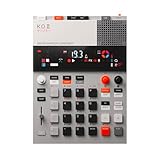
7. Teenage Engineering EP-133 K.O. II – The Newcomer
teenage engineering EP–133 K.O. II 128MB sampler, drum machine and sequencer with built-in microphone and effects
128MB memory
4 track sequencer
12 punch-in FX
Pros
- 128MB memory
- song mode with 9
- 801 bars
- 12 punch-in FX
- OS 2.0 resampling
- battery or USB-C power
Cons
- Not Prime eligible
- limited reviews
- paper-foam packaging
The Teenage Engineering EP-133 K.O. II is the grown-up version of the iconic PO-33, and it doubles the memory while adding a proper song mode. I ran it side by side with the older PO-33 for a week, and the upgrade is significant: 128MB of storage, 999 sample slots, and a four-track sequencer replace the more limited architecture of the original.
The Commit button is the standout addition. You can jam freely in real time and freeze your performance into a pattern when you are happy. The 12 punch-in 2.0 effects plus six master FX give you a wider palette than the original, and the OS 2.0 update added resampling, chopping, and sidechain via firmware.
Song mode holds up to 9,801 bars, which is enough for almost any composition. Battery power (4x AAA) or USB-C gives you flexible power, and the built-in microphone plus line-in handle sampling on the go.
The EP-133 is not Prime eligible, which slows shipping for some buyers. The review base is still small because the unit is recent, and the paper-foam box packaging will not appeal to everyone. Teenage Engineering fans will not mind, but it is worth noting.
Who should buy the EP-133 K.O. II
Existing Pocket Operator fans who outgrew the PO-33 will find the EP-133 K.O. II a worthy upgrade. The doubled memory, song mode, and improved effects make it a much more capable production tool.
Producers who want a quirky, characterful sampler with built-in effects will appreciate Teenage Engineering’s design language. Anyone who values battery power and a small footprint will like the form factor.
Who should skip the EP-133 K.O. II
Buyers who need fast Prime shipping may be better served by an Amazon Prime-eligible competitor. The EP-133 K.O. II sometimes ships from third-party sellers with longer wait times.
Producers who want a deep synthesis engine should look elsewhere. The EP-133 K.O. II is a sampler and sequencer, not a synth.
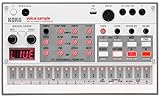
8. Korg Volca Sample 2 – The Budget Champion
Korg Volca Sample 2 Digital Sample Sequencer Drum Machine w/Pattern Chain Mode and 16-step Sequencer
8-voice polyphony
16-step sequencer
Pattern chain mode
Pros
- Affordable entry
- 8-voice polyphony
- 16-step sequencer with pattern chain
- digital reverb
- AA battery power
Cons
- Limited built-in samples
- small size
- requires Librarian software for sample management
The Korg Volca Sample 2 is the most affordable way to get into hardware sampling, and it punches well above its tier. I bought one as a travel companion, and it has become a permanent part of my desktop setup. The 16-step sequencer with pattern chain mode supports longer arrangements than you would expect from a unit this small.
Eight-voice polyphony gives you room to layer kicks, snares, and percussion without choking the engine. The digital reverb and double filter add character that pure sample playback cannot match. Dedicated Librarian software for Mac and PC makes sample management straightforward once you set it up.
The Volca Sample 2 runs on six AA batteries, which is a godsend for portable jam sessions. I took it on a weekend trip without a charger and never ran out of power. The micro USB port handles data and audio, and the built-in speaker is loud enough for sketching.
Storage is limited compared to flagship units, and the small form factor can feel cramped if you have larger hands. The built-in samples are useful but limited, so you will want to load your own library quickly.
Who should buy the Volca Sample 2
Beginners looking for the most affordable entry into hardware sampling will love the Volca Sample 2. It teaches sequencing fundamentals without overwhelming you with menus.
Producers who want a portable sketch device for travel will appreciate the AA battery power. Anyone on a strict budget can still get a real sampling workflow without breaking the bank.
Who should skip the Volca Sample 2
Users who need extensive onboard storage should look at the SP-404MKII or MPC Sample. The Volca Sample 2 is designed for short loops, not for full sample libraries.
Producers who want finger-drumming-grade pads will be underwhelmed. The Volca pads are functional but not as expressive as the larger units.
9. Teenage Engineering PO-33 K.O. – The Pocket-Sized Classic
teenage engineering pocket operator PO-33 K.O.! micro sampler and drum machine with built-in microphone, sequencer and effects
40 second sample memory
8 melodic + 8 drum slots
16 effects
Pros
- Ultra-portable
- built-in microphone
- 40s sample memory
- 16 built-in effects
- 1 month battery life
Cons
- Only 40 seconds of memory
- limited polyphony
- tiny form factor
The Teenage Engineering PO-33 K.O. is the most fun you can have with a sampler at the entry-level end of the market. I have carried mine in a jacket pocket for three years and used it on trains, planes, and hotel rooms. The built-in microphone turns any sound source into a sample in seconds.
40 seconds of sample memory is split between eight melodic slots and eight drum slots, which is enough for sketching full beats on the fly. Sixteen built-in effects cover the basics, and the sequencer supports full pattern programming despite the tiny form factor.
Battery life is genuinely impressive: two AAA batteries last roughly a month of regular use. The PO-33 pairs with other Pocket Operators and the OB-4 speaker, which makes it part of a wider ecosystem if you decide to expand.
The biggest limitation is the 40-second memory cap. If you want longer samples, you need the EP-133 K.O. II. The PO-33 is also not as playable as full-size units, so think of it as a sketchpad rather than a main production tool.
Who should buy the PO-33 K.O.
Beginners who want to learn sampling fundamentals at the lowest possible barrier will love the PO-33. It is the friendliest entry point on this list.
Travelers and producers who want a pocket-sized sketch device will appreciate the form factor. Anyone building a Teenage Engineering ecosystem will want one regardless.
Who should skip the PO-33 K.O.
Producers who need more than 40 seconds of memory should jump to the EP-133 K.O. II or a larger unit. Trying to fit full songs into the PO-33 is frustrating.
Users who want finger drumming capability should look at units with proper MPC-style pads. The PO-33 buttons are functional but not designed for expressive playing.
Buying Guide: How to Choose the Best Drum Machine with a Sampler
Choosing the best drum machines with samplers comes down to four factors: how you want to play, what kind of samples you need to load, whether you work alone or with a computer, and how much sound design you want to do in the box. Below is the framework our team used when ranking the nine units above, plus the tradeoffs that do not show up in spec sheets.
Analog character vs digital sampling
Analog drum machines generate sounds through circuits, which gives them warmth and punch that digital units struggle to match. Digital samplers load your own audio, which gives you unlimited sonic range but loses some of the immediate character. If you want classic machine feel without the hassle, models with ACB modeling or analog filter circuitry sit in a sweet spot. If you want maximum flexibility, digital samplers win every time.
Producers making hip-hop, lo-fi, and experimental beats almost always benefit from digital sampling. Techno and house producers often prefer analog or modeled analog for the punch. Our recommendation: start digital unless you specifically want analog character.
Sequencer depth and pattern control
The sequencer is where most drum machines earn or lose their reputation. Basic step sequencers handle four-bar loops, while advanced sequencers like the Elektron 128-step architecture support parameter locks, micro-timing, and conditional triggers. If you want to build complex arrangements on hardware, the sequencer depth matters more than the sound engine.
Beginners should look for units with a clear step entry mode and a pattern chain function. Pattern chaining lets you stitch short loops into longer arrangements without leaving the device. The Korg Volca Sample 2 and the Novation Circuit Rhythm both offer approachable pattern chaining.
Pads and finger drumming feel
Pads are the tactile heart of any drum machine sampler. Velocity-sensitive pads respond to how hard you hit them, which is essential for expressive playing. Larger pads feel better for finger drumming, while smaller pads work fine for trigger-style programming.
The Roland SP-404MKII pads are widely considered some of the best in the category. The Akai MPC Sample uses the same classic MPC pad design. Smaller units like the PO-33 use click buttons, which are functional but not expressive.
Connectivity and studio integration
MIDI, USB, CV/Gate, and audio interface quality determine how well a drum machine fits into your studio. If you want to sequence external synths, MIDI or CV/Gate is essential. If you want to record vocals through the same box, look for a unit with a built-in audio interface. The Native Instruments Maschine Mk3 includes a 96 kHz / 24-bit interface, which is rare at this tier.
For producers curious about how the category-defining machines shaped modern genres, our breakdown of the legendary Roland TR-909 explains why specific drum machine sounds still dominate dance music decades later.
Standalone vs computer-tied workflow
Standalone units let you make music without opening a laptop, which is the single biggest advantage of hardware. Computer-tied units like the Maschine Mk3 unlock more sample storage and plugin integration but lock you to a desk. Decide which workflow matches your style before buying.
Most producers eventually want both. Our suggestion: pair a standalone unit with a computer-based DAW for the best of both worlds.
Storage and expandability
Internal storage ranges from 40 seconds on the PO-33 to 16GB on the SP-404MKII. If you plan to load full sample libraries, prioritize storage. If you sketch with shorter loops, smaller storage is fine. microSD slots add flexibility but require you to manage cards separately.
Cloud-based sample management is becoming common, but most hardware units still rely on local storage. Plan accordingly.
Frequently Asked Questions About Drum Machines with Samplers
What is the best drum machine with sampler for beginners?
The Korg Volca Sample 2 and the Teenage Engineering PO-33 K.O. are the most beginner-friendly options on this list. Both offer approachable step sequencers, simple sampling workflows, and prices that do not require a major investment. The Volca Sample 2 is better if you want battery power and longer samples, while the PO-33 K.O. wins if you want the smallest possible footprint.
What is the best drum machine for electronic music production?
The Elektron Digitakt II is our top pick for electronic music production thanks to its 16 sample tracks, 128-step sequencer, swappable filters, and per-track LFOs. It handles techno, IDM, ambient, and breakbeat workflows equally well. The Roland SP-404MKII is a strong alternative if you prefer live performance over deep sequencing.
What is the difference between a drum machine and a sampler?
A drum machine generates or plays back preset sounds, while a sampler lets you load and trigger your own audio recordings. Drum machines with samplers combine both functions, so you get preset kits plus the ability to record, chop, and manipulate custom sounds. The sampler half turns a beat box into a self-contained production tool.
Which drum machines do professional producers use?
Professional producers tend to gravitate toward the Elektron Digitakt II, the Roland SP-404MKII, the Akai MPC Sample, and the Native Instruments Maschine Mk3. These units appear in studios across hip-hop, electronic, and pop production. The Digitakt II leads in sound design depth, while the SP-404MKII leads in live performance and resampling workflows.
What is the best budget drum machine with sampling capabilities?
The Korg Volca Sample 2 is the best budget drum machine with sampling capabilities, offering a 16-step sequencer with pattern chain mode, 8-voice polyphony, and battery power at a price well below most competitors. The Teenage Engineering PO-33 K.O. is even cheaper and fits in a pocket, though it offers only 40 seconds of sample memory.
Final Verdict: Picking the Best Drum Machine with a Sampler in 2026
The best drum machines with samplers in 2026 come from a wider range of brands than ever before, and the right choice depends on how you want to work. The Elektron Digitakt II stands out as the professional flagship with the deepest sequencer and most powerful sound design. The Roland SP-404MKII remains the gold standard for live performance and resampling. The Korg Volca Sample 2 is the smartest budget pick for anyone starting out.
If you are buying your first drum machine with a sampler, start with the Volca Sample 2 or the PO-33 K.O. and grow from there. If you are a working producer looking to upgrade, the Digitakt II, SP-404MKII, or MPC Sample will pay for themselves quickly. Either way, the best drum machine with a sampler is the one that gets you making beats consistently, and any of the nine units on this list will do exactly that.