
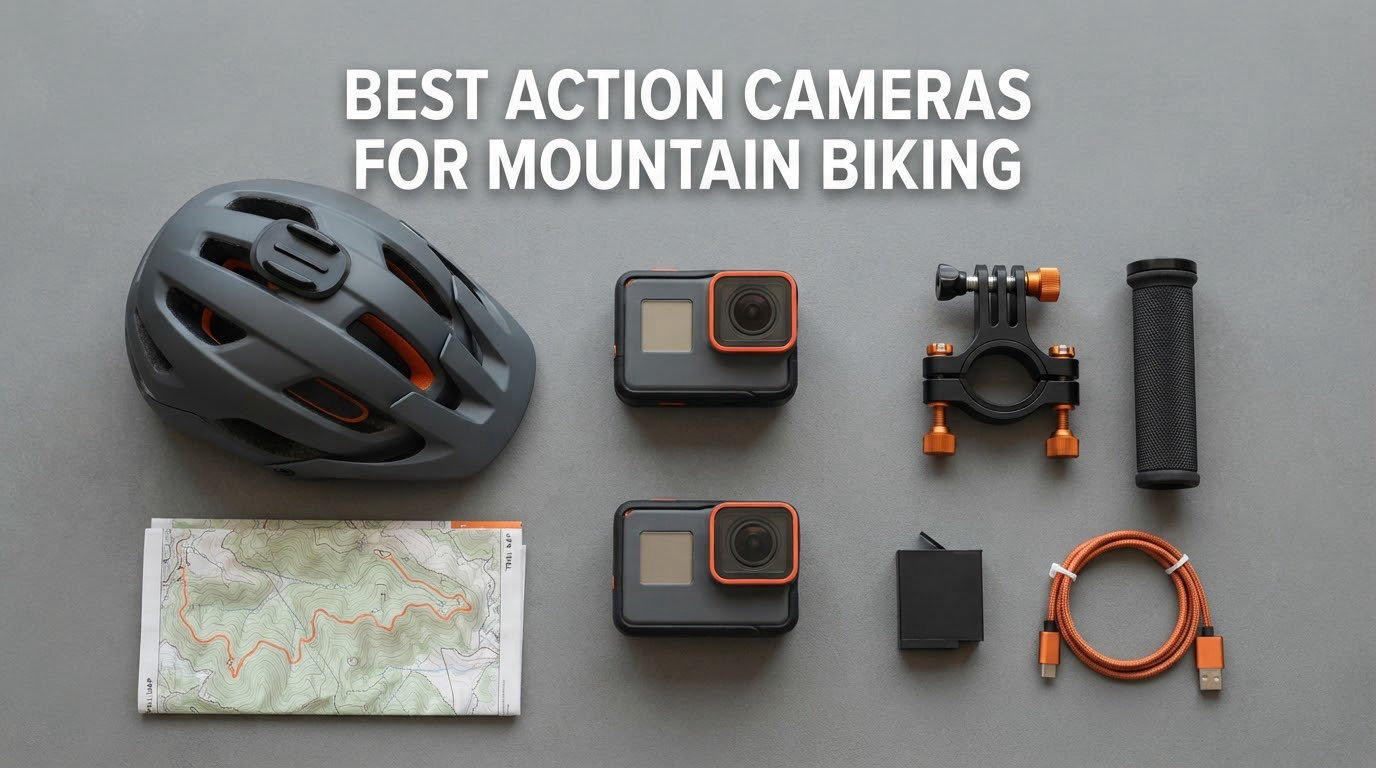
Mountain biking is the hardest test an action camera gets. You get constant high-frequency vibration from the bars and fork, exposure swings that go from bright sky to black timber in half a second, mud and creek spray, helmet contact with the dirt, and ride days that run well past the point where a small internal battery gives up. Cameras that look brilliant in a spec list can produce unusable footage bolted to a full-face helmet over a rock garden.
So the best action cameras for mountain biking in 2026 are not simply the cameras with the highest resolution. The Insta360 X5 takes our top slot because 360 capture with FlowState stabilization and a full 360 Horizon Lock covers every mount position a rider actually uses, while the DJI Osmo Action 6 is the pick when you want a single flat lens and a four-hour rated runtime. One records everything and reframes later. The other records less and gets it right the first time.
We compared eight cameras across four brands, including two budget options for riders who just want to see their own lines. The evaluation weights the things that break on a trail: stabilization that holds a level horizon, sealed bodies that do not need a housing in rain, real battery headroom, mount security, and how much editing the camera demands before you can post a clip. We also looked at what riders report after a season of drops and creek crossings rather than the numbers on the box.
If you also ride other sports, our guides to the best action cameras for skiing and the best action cameras for surfing cover the cold and the salt-spray ends of the same problem. This one is built around gravel, roots and rock.
Disclosure: as an Amazon Associate we earn from qualifying purchases. Every recommendation below is based on published specifications, aggregated rider feedback, and the practical demands of mountain biking. We may earn a commission at no additional cost to you.
Either way, the deciding spec on an MTB camera is not megapixels. It is how well the camera holds a level horizon under repeated vertical impacts, and how much of the frame it gives away to do it. Our picks below are all rated for this, and each one tells you plainly whether it is a crop-based smoother or a true rotational lock.
For context on the general capability tiers, our general action camera buying guide breaks down the technology without the MTB angle.
Table of Contents
- Top 3 Best Action Cameras for Mountain Biking (October 2026)
- Every Camera Compared at a Glance in 2026
- 1. Insta360 X5 – The One Camera That Films Every Mount Position
- 2. DJI Osmo Action 6 – Best All-Rounder With a Variable Aperture
- 3. DJI Osmo Action 5 Pro – The Low-Light and Horizon-Lock Benchmark
- 4. DJI Osmo Action 4 – Best Value Flagship With the Biggest Review Base
- 5. AKASO Brave 7 LE – Best Budget Camera With Two Screens in the Box
- 6. AKASO EK7000 Pro – Best Entry Camera for Daylight Trail Days
- 7. GoPro HERO12 Black – Best GoPro With the Widest Accessory Shelf
- 8. GoPro HERO11 Black – A Previous-Generation GoPro That Still Holds Up
- How to Choose an Action Camera for Mountain Biking
- Stabilization: horizon lock beats plain EIS on technical terrain
- Mount position, weight and surviving the descent
- Battery life, cold weather and long ride days
- Sealed body versus screw-on housing
- GoPro vs DJI vs Insta360 for mountain biking
- Budget versus flagship: where the money actually goes
- Storage math and card speed per ride day
- Audio on the trail and wireless microphone pairing
- Frequently Asked Questions
- Final Verdict: The Best Action Camera for Mountain Biking in 2026
Top 3 Best Action Cameras for Mountain Biking (October 2026)

Insta360 X5
- 8K30 360 video
- dual 1/1.28 inch sensors
- FlowState stabilization with 360 Horizon Lock
- replaceable lenses

DJI Osmo Action 6
- 1/1.1 inch square sensor with 8K30
- variable aperture f/2.0 to f/4.0
- RockSteady 3.0 and HorizonSteady
- up to 4 hours recording

DJI Osmo Action 5 Pro
- 1/1.3 inch sensor with 2.4 micron pixels
- 13.5 stops dynamic range
- 1950mAh battery good to -20C
- waterproof to 20m
Every Camera Compared at a Glance in 2026
| Product | Specifications | Action |
|---|---|---|
| Insta360 X5 |
|
Check Latest Price |
| DJI Osmo Action 6 |
|
Check Latest Price |
| DJI Osmo Action 5 Pro |
|
Check Latest Price |
 DJI Osmo Action 4 DJI Osmo Action 4 |
|
Check Latest Price |
 AKASO Brave 7 LE AKASO Brave 7 LE |
|
Check Latest Price |
 AKASO EK7000 Pro AKASO EK7000 Pro |
|
Check Latest Price |
 GoPro HERO12 Black GoPro HERO12 Black |
|
Check Latest Price |
 GoPro HERO11 Black GoPro HERO11 Black |
|
Check Latest Price |
1. Insta360 X5 – The One Camera That Films Every Mount Position
Insta360 X5 – Waterproof 8K 360° Action Camera, Leading Low Light, Invisible Selfie Stick Effect, Rugged and Replaceable Lens, 3-Hour Battery, Built-in Wind Guard, Stabilization, Triple AI Chip Design
8K30 360 video
Dual 1/1.28 inch sensors
FlowState with 360 Horizon Lock
208 minute battery
Pros
- Invisible selfie stick produces genuine third-person angles
- 8K30 360 capture from two 1/1.28 inch sensors
- 360 Horizon Lock keeps the ground level
- replaceable scratch-resistant lenses
- built-in wind guard on a 4-mic array
Cons
- 8K files eat storage quickly
- reframing 360 footage has a real learning curve
- transfer and editing lean on the Insta360 app
Best for: reframe-later workflows and third-person angles you cannot get from a flat camera. The X5 is the only body in this group that captures everything in front of, behind, above and below the rider, then lets you decide the shot in an app. Run it on the invisible selfie stick on a flow trail and the pole disappears from the frame entirely, which is the whole point of the shot.
Two 1/1.28 inch CMOS sensors shoot 8K at 30 fps across a 360 degree field of view, and a triple AI chip design handles the noise reduction that normally makes 360 footage look mushy. On the trail that matters most in the two situations riders complain about most: shaded forest canopy at midday, and the last twenty minutes of a dusk session. Owners consistently report that the low-light output is the reason they stopped worrying about evening shuttles.
Stabilization is the FlowState system with a full 360 Horizon Lock, which is a genuinely different thing from crop-based electronic stabilization. Because the camera is looking in every direction, the horizon lock can rotate the frame without losing the edges of the image. On a rock garden that means the ground stays flat in the frame instead of rolling with every impact, and the bar-mounted footage reads almost like a handheld gimbal shot.
The other thing that sets the X5 apart for MTB use is durability in the places that actually break. The lenses are fully replaceable and scratch-resistant, so a rock strike that would end a fixed-lens camera is a spare-part swap rather than a write-off. The sealed body is waterproof and the package includes a lens cloth, a protective pouch and a USB-C cable, so the only thing you need to add is a microSD card.
What the X5 does better than a flat camera on a descent
Reframing after the ride means you can pull the best line out of a single take instead of guessing at the right angle while riding. On technical downhill you can pull a follow view from behind a drop, then switch to a low front angle for the next feature, with no extra hardware and no second ride. The InstaFrame mode handles auto-framing for riders who do not want to touch the timeline at all.
It also moves between mount positions with no extra hardware at all. Bar, stem, helmet, backpack strap or pole, you keep the same camera and change the mount. For a rider who films a shuttle run from a follow vehicle and then a bike park session from the bars, that flexibility is worth a lot over a season.
When you should pick something else
Editing workflow is the real tax here. 360 footage has to be reframed in the Insta360 app before it is watchable, and buyers who want to post within an hour of getting home describe that as a genuine drag rather than a minor inconvenience. Large 8K files also fill a card faster than flat capture, and the transfer process pushes you toward the Insta360 app and its cloud storage for anything beyond a short clip.
If you mostly want a single clean forward-facing clip, review your own line, or film slow-motion of a jump, a flat camera will get you there with far less work. Pick the DJI Osmo Action 6 or the Osmo Action 5 Pro instead and you spend your time riding rather than editing.
2. DJI Osmo Action 6 – Best All-Rounder With a Variable Aperture
DJI Osmo Action 6 Enhanced Combo, 8K Waterproof Action Camera
1/1.1 inch square sensor
8K30 variable aperture
RockSteady 3.0 + HorizonSteady
4 hour battery
Pros
- Large square sensor records sharp 8K with vibrant colour
- variable aperture handles dark forest and bright rock
- 360 HorizonSteady holds the horizon
- Enhanced Combo includes two 1950mAh batteries
- sealed body waterproof to 20m
Cons
- Onboard audio is only usable rather than good
- high-bitrate files are large
- some menu options are unreachable inside a third-party housing
Best for: riders who want a clean flat image straight out of the camera with minimal editing. The Osmo Action 6 pairs an all-new 1/1.1 inch square CMOS sensor with 8K at 30 fps, and that sensor size is the headline. Bigger sensors gather more light, which is the difference between a usable dusk shuttle clip and a muddy one.
The variable aperture from f/2.0 to f/4.0 is the feature nobody else in this group offers, and it maps directly onto how MTB light behaves. Wide open for a shaded gully or a dawn patrol, stopped down when you are filming a bright rock face in full sun. Reviewers single out the colour as vibrant and true even in difficult conditions, and the stabilisation as noticeably smooth and level.
RockSteady 3.0 and 360 HorizonSteady run up to 4K at 60 fps, which is where you will spend most of your recording time. HorizonSteady is the rotational mode, so switch it on for technical terrain where the bike is leaning and switch it off for flat-out bar shots where you would rather keep the crop. The dual-screen body means you can frame yourself without a mirror or a phone, which is the difference between usable solo footage and a second attempt.
Battery life is the other headline. The rated runtime is up to four hours with a cold-resistant design, and the Enhanced Combo includes two 1950mAh Extreme Battery Plus cells, a multifunctional battery case, a 1.5 m extension rod, two quick-release adapter mounts and anti-slip pads. That is a full ride day of spare power out of the box rather than a battery you buy separately. At 149 g it is also light enough that helmet mounting does not pull the strap out of shape.
Why the variable aperture matters on a trail ride
Auto exposure is usually good until a camera exits a tunnel into a bright clearing, and then the highlights blow out while the shadows crush. Because the Action 6 can change aperture as well as shutter speed and ISO, you get a second lever to pull with. Riders filming the same trail at dawn and at two in the afternoon report far fewer unusable clips than they did with the fixed-aperture generation.
There is a practical storage benefit too. You are not forced into 8K to get detail. 4K Custom Mode lets you reframe a wider capture into different aspect ratios, and 50 GB of built-in storage means a short ride does not need a card at all. The card slot takes V90 and U3 microSD for longer shoots.
When you should pick something else
Audio is the weak point. The onboard microphones are described as usable rather than good, which is a polite way of saying a fast descent will sound like a jet engine. If sound matters to you, pair it with a wireless transmitter through the direct dual-transmitter connection, and plan on that cost before you commit. Night footage still runs into the physics limits of a small sensor, and high-bitrate files fill a card quickly.
If you are chasing slow-motion for social edits, this camera tops out well below the 4K120 of the Osmo Action 4. And if your whole plan is the invisible selfie stick look, you are paying for a capability this body does not have. Go 360 or go cheaper, not in between.
3. DJI Osmo Action 5 Pro – The Low-Light and Horizon-Lock Benchmark
DJI Osmo Action 5 Pro Essential Combo, Waterproof Action Camera
1/1.3 inch sensor, 2.4 micron pixels
13.5 stop dynamic range
1950mAh battery, 4 hours
IP68 to 20m
Pros
- Large 2.4 micron pixels give strong low-light clarity
- 13.5 stops of dynamic range holds highlight and shadow detail
- 360 HorizonSteady keeps rough terrain level
- dual ultra-bright OLED touchscreens
- colour temperature sensor handles white balance automatically
Cons
- Essential Combo includes only one battery
- subject tracking can recentre framing unexpectedly
- 47GB built-in storage still needs a fast card for long 4K shoots
Best for: forest trails, dusk sessions and any ride where the light changes faster than you can adjust. A 1/1.3 inch sensor with 2.4 micron pixels is the current benchmark for gathering light in this form factor, and paired with 13.5 stops of dynamic range it holds shadow detail under a canopy and highlight detail on an open rock face in the same clip.
That combination is why riders comparing GoPro bodies to DJI bodies keep landing on the same conclusion in the shade: the Osmo holds a usable image where the GoPro body starts to break up. On a tight, treed descent at four in the afternoon, the difference is not a subtle grading choice. One of them is a clip you post and one of them is a clip you delete.
Stabilization is 360 HorizonSteady and RockSteady 3.0, the same family as the Action 6. HorizonSteady is the one that matters on technical terrain because it rotates rather than crops, and the horizon stays level through switchbacks where a bar-mounted camera would otherwise roll. A 4 nm chip handles subject centering in both 16:9 and 9:16, and a colour temperature sensor sets white balance automatically, which removes a whole category of edit-time work on mixed-light trails.
The 1950mAh battery is rated at up to four hours and holds 3.6 hours at minus 20 degrees Celsius, which is a real number for anyone riding a frosty morning before the trail gets sun. IP68 to 20 m without a case means creek crossings and mud need no extra box. At 146 g it sits between a helmet mount and a bar mount without feeling like a brick, and the Essential Combo includes the Extreme Battery Plus, a horizontal-vertical protective frame, a quick-release adapter mount and both glass and rubber lens protectors.
What the 5 Pro does that the Action 6 does not
The gap between the two is narrower than the generation numbers suggest, and the honest summary is that the Action 6 wins on aperture control and battery headroom while the 5 Pro wins on low-light sensitivity and a much larger installed base of footage and accessory knowledge. Both share HorizonSteady and RockSteady 3.0, both are sealed to IP68, and both take DJI Mic 2 and Mic Mini transmitters directly.
Where the 5 Pro still has an edge is the dual ultra-bright OLED touchscreens, which are noticeably easier to read in daylight than a standard LCD when you are checking framing on a bar mount at speed. Riders who also use the camera for solo riding or vlogging on the trail rate the front screen higher because of it. If your existing accessories are already DJI Osmo, this body slots straight into them.
When you should pick something else
Two practical catches. The Essential Combo includes a single battery, so if you ride four-hour days you are buying spares before your first trip, not after. And subject tracking can be over-eager, recentring your framing when a branch crosses the frame and turning a deliberate off-centre composition into a centred one. If you shoot composed shots, turn the active tracking off.
The 47 GB of built-in storage is a convenience for short rides, not a replacement for a V90 card. And if your priority is a 360 shot rather than a flat one, this is the wrong shape of camera entirely.
4. DJI Osmo Action 4 – Best Value Flagship With the Biggest Review Base
DJI Osmo Action 4 Standard Combo, Waterproof Action Camera Vlogging Camera
1/1.3 inch sensor, 2.4 micron pixels
4K120 at 155 degrees
1770mAh battery
Waterproof to 18m
Pros
- 4K120 slow motion at 155 degrees is rare at this price
- 10-bit D-Log M gives real grading headroom
- Pre-Rec buffer captures moments before you press record
- magnetic self-locking quick-release makes angle changes fast
- operates to -20C
Cons
- Still resolution of 10MP is low by current standards
- fixed focus lens limits framing options
- 18m depth rating is shallower than newer Osmo bodies
Best for: slow motion, grading and riders who want a proven body with a deep review history. The Osmo Action 4 carries more than 5,000 reviews averaging 4.6 stars, which is a lot of real-world history for a tool you bolt to a helmet and forget about.
The headline spec is 4K at 120 fps across a 155 degree ultra-wide field of view, and no other flat body in this roundup matches it. A 120 fps clip of a drop or a jump gives you a genuine slow-motion window in the edit rather than an interpolation effect. The wide field of view also means you see more of what is about to hit you, which is not just a footage benefit.
The same 1/1.3 inch sensor with 2.4 micron pixels as the 5 Pro handles low light well, with automatic white balance and three stabilisation modes including HorizonBalancing. The 1770mAh battery is rated to 150 minutes and works down to minus 20 degrees Celsius. At 145 g and with 2.25 inch dual full-colour touchscreens, the body is the lightest Osmo here, which makes it the least intrusive on a helmet mount for long days.
Two features get more use than their reputation suggests. The Pre-Rec buffer in 5, 10, 15, 30 or 60 second chunks captures the seconds before you press record, which is exactly the crash or the loose rear wheel you did not see coming. OsmoAudio gives direct wireless connection to DJI Mic 2 and Mic Mini transmitters without an adapter. The magnetic self-locking quick-release adapter mount makes changing between bar and helmet in about two seconds.
Where the Osmo Action 4 still wins in 2026
Colour science. The 10-bit colour depth with D-Log M is a genuine grading workflow, and for anyone who edits rather than just posting, it still gives more headroom than the fixed-look output of the budget tier. Push the shadows back under a canopy or pull colour out of a muddy creek crossing and you have actual latitude rather than a slider that clips the moment you touch it.
The waterproof rating of 18 m is shallower than the 20 m on the newer Osmo bodies, but for riding rather than diving it makes no practical difference. You would need to hold the camera under two metres of water to reach the limit, and no trail does that. For a rider whose budget stretches to a good single-lens body and stops there, this is the most complete package in the roundup.
When you should pick something else
The 10MP still resolution is genuinely low by current standards. If you want to pull high-resolution frames out of your ride for social posts, look at a body with a 20MP or higher sensor. The fixed focus lens also means no creative reframing tricks, and if you are coming from a camera with interchangeable lenses you will notice the constraint immediately.
If battery headroom is your priority, the 150 minute rating here is the shortest of the three DJI bodies in this roundup, so plan on swapping mid-ride or carry a battery case. Riders who need 360 reframe-later capability should skip straight past this.
5. AKASO Brave 7 LE – Best Budget Camera With Two Screens in the Box
AKASO Brave 7 LE 4K30FPS 20MP WiFi Action Camera with Touch Screen EIS 2.0 Zoom Remote Control 131 Feet Underwater Camera with 2X 1350mAh Batteries Support External Microphone Vlog Camera
4K30 and 20MP photos
Rear plus front screens
Two 1350mAh batteries
IPX7, 131 ft housing
Pros
- Dual screens make solo riding and framing easy
- two 1350mAh batteries and a mounting kit are in the box
- 6-axis EIS 2.0 smooths 4K better than the price suggests
- external microphone support
- remote control for hands-free capture
Cons
- Only 4K30 so no high-frame-rate slow motion
- digital only zoom crops image quality
- the housing blocks the rear display and is not touch capable
Best for: a rider on a budget who wants a complete kit on day one. The package includes a waterproof housing, two rechargeable 1350mAh batteries, a remote control and a mounting kit, so you are not writing a separate accessory list before the first ride. At 107 g it is light enough for a chest mount or a helmet strap.
The dual-screen layout is the feature that separates it from the cheapest tier. A 2 inch rear touchscreen plus a front selfie screen means you can frame a chest or bar shot without a mirror, a phone or a second person, which for solo riders is the difference between usable footage and a guessing game. The 6-axis EIS 2.0 does a reasonable job of smoothing 4K for the money.
Video is 4K at 30 fps with 20MP stills, and the body is IPX7 water resistant. That rating does not mean you can film a creek crossing bare, so the 131 foot waterproof housing is not optional on a wet day. It is a real enclosure with a real gasket, and it also means you should expect muffled audio and no screen control once the camera is sealed inside it.
There is also a remote control, digital zoom, time-lapse, burst and fast-motion modes, Wi-Fi transfer and external microphone support. That last one matters more than it sounds, because built-in audio on any camera at this level is dominated by wind at speed, and plugging in an external microphone is the cheapest possible upgrade to your edit.
What the Brave 7 LE handles well for the money
Flowy trail riding in good light, which is honestly a lot of what most riders do. Forum consensus treats this tier as fine on smooth, flowing singletrack in daylight and unreliable on technical rock gardens or at dusk. Within that envelope the image is sharp, the colours are neutral and the stabilisation removes enough of the low-frequency wobble to make a clip watchable.
Battery life is rated at around two hours per 1350mAh cell, and because two are supplied you can swap between laps without a wall outlet. For a half-day local ride that is comfortable. The one-year manufacturer warranty and the fact that the whole kit is in one box are what make this a low-risk first camera.
When you should pick something else
If your riding is technical, the 30 fps ceiling at 4K and the digital-only zoom will frustrate you. There is no high-frame-rate mode, so slow-motion edits of jumps and drops are not available. The housing that protects it in water also blocks the rear display and is not touch-capable, so you lose framing ability the moment you need it most, in a creek.
Low light is the other limit. The 20MP sensor and older chipset trail the current premium models, and forest shade or a dusk shuttle will look soft and noisy next to a 1/1.3 inch body. Wi-Fi transfer is also slower and less reliable than pulling files over a cable, which is a real annoyance after a long ride.
6. AKASO EK7000 Pro – Best Entry Camera for Daylight Trail Days
AKASO EK7000 Pro 4K30fps Action Camera with Touch Screen EIS 131ft Waterproof Underwater Camera Remote Control 5X Zoom with Helmet Accessories Kit (Standalone)
4K30 and 1080p60 video
170 degree fisheye view
Two 1350mAh batteries
61g body, 131 ft housing
Pros
- More than 11000 reviews at 4.4 stars give the largest real-world sample here
- 61g is the lightest body in the roundup
- 170 degree field of view captures a very wide scene
- bright 2 inch IPS touchscreen
- large accessory kit with helmet and handlebar mounts
Cons
- Editing app quality is the most cited weakness
- 1/3 inch sensor limits low-light quality
- housing is not touch capable and the yellow underwater preset cannot be changed
Best for: a first action camera, a secondary camera, or a rider who films on flow trails in daylight and wants the widest possible view. With more than 11,000 reviews behind it, the EK7000 Pro is one of the most thoroughly tried bodies at this price, and the verdict is remarkably consistent.
At 61 g it is the lightest body here, and on a full-face helmet you genuinely forget it is there. That matters for long days. The 170 degree fisheye field of view is among the widest of the flat cameras in this group, which gives you more sky, more trail ahead and more of the landing zone in every frame.
Video is 4K at 30 fps and 1080 at 60 fps with 20MP photos, and the built-in electronic image stabilisation delivers steady footage for the class. Two 1350mAh batteries are rated at up to 140 minutes each, the 2 inch IPS touchscreen is bright enough to read in sunlight, and there is 5x digital zoom plus Wi-Fi transfer and Micro HDMI output.
The accessory kit is unusually generous for the tier, with helmet mounts, handlebar mounts and a carry case in the box. The waterproof case is rated to 131 feet, so rain, mud and shallow water are covered once it is sealed. The body carries a one-year manufacturer warranty.
What you get for a first camera
More than you would expect at the entry point, and the reason this has become the default recommendation for a first MTB camera. A 2 inch IPS touchscreen, a wide 170 degree view, two long batteries, a remote control and a helmet mount kit. A rider who buys this, mounts it on the helmet, records 4K30 on a bright flowy loop and pulls the files over a cable will be genuinely happy.
That is the honest ceiling. Riders use it as a backup body, a pole camera, or a camera they do not mind dropping into a creek, and for those jobs the low weight and low cost are the features that matter most. A second body in the pack is also a genuine safety argument on a technical day.
When you should pick something else
The companion editing app is the most cited weakness, and on a body this cheap it is the thing most likely to frustrate you after the ride. If you are the kind of rider who edits on a phone within an hour of getting home, read recent app feedback before committing.
Low light is where the 1/3 inch sensor runs out. Dusk, deep canopy and night work will be soft and noisy, and there is no optical zoom to recover detail. The housing is not touch capable and the screen is hard to read through it, and the underwater snorkel preset can cast a strong yellow tint that you cannot change once the housing is sealed.
7. GoPro HERO12 Black – Best GoPro With the Widest Accessory Shelf
GoPro HERO12 Black – Waterproof Action Camera with 5.3K60 Ultra HD Video, 27MP Photos, HDR, 1/1.9″ Image Sensor, Live Streaming, Webcam, Stabilization
5.3K60 video and 27MP photos
1/1.9 inch GP2 sensor
HDR video and stills
HyperSmooth 6.0 AutoBoost
Pros
- 5.3K60 video and 27MP photos deliver flagship detail
- HDR holds shadow and highlight in mixed light
- HyperSmooth 6.0 with AutoBoost smooths shake with minimal cropping
- waterproof to 33 feet with a water-repelling lens cover
- folding-finger mounts that the rest of the industry also builds around
Cons
- Runs noticeably warm during extended 5.3K recording
- battery life is short for the class
- rear touchscreen is small and fiddly with gloves and no microSD card is included
Best for: riders who already own GoPro mounts and want to keep using them. The folding-finger form factor is the reason the GoPro ecosystem is still the deepest in the category. Chest harnesses, helmet straps, bar mounts, tripod adapters, the bunny mount, mouth mounts, third-party cages made in Shenzhen and mounts from brands you have never heard of all fit the HERO12 out of the box.
Image quality is genuinely strong. 5.3K at 60 fps with 27MP photos sits 91 percent above 4K in resolution, and HDR applies to both video and stills, which is what keeps a bright sky and a dark forest floor in the same usable frame. HyperSmooth 6.0 with AutoBoost handles the shake, and 24.7MP frame grabs can be pulled from the 5.3K video when you want a still without a separate shutter press.
Waterproofing to 33 feet with a water-repelling lens cover, a 2.27 inch rear touchscreen, and live streaming and webcam modes round out a body with the deepest accessory support in the category. The Enduro Battery and a curved adhesive mount are included, so a new rider can mount it day one.
Stabilization is crop-based rather than a full rotational lock, which is the trade-off. On flowing trail it is excellent. On hard technical rock where the bike is leaning hard through a switchback, a body with a true horizon lock will hold the ground flatter, and that difference is visible in the edit.
What the GoPro ecosystem still does better than anything
Accessory breadth, without question. Every other brand in this roundup borrows the GoPro mounting standard, which means you are choosing from their thinner catalogue rather than the whole shelf. If you already have a chest harness, a bar mount and a helmet strap from a previous GoPro, they still fit.
Resolution and stills are also strong points. The 1/1.9 inch sensor is smaller than the 1/1.3 inch sensors the DJI bodies use, and that shows in low light, but in daylight the 27MP stills and 5.3K60 video give you excellent flat detail, plus 10-bit colour through the GoPro Log curve for anyone who grades.
When you should pick something else
Heat and runtime are the two complaints that come up most. Owners report the body running noticeably warm during extended 5.3K recording, and battery life is short relative to the DJI bodies at a similar tier. On a long shuttle-run day in summer, that combination is how you lose a recording window.
The 1/1.9 inch sensor also loses ground in forest shade, the 2.27 inch rear touchscreen is awkward with gloves on, and no microSD card is bundled, so you need a fast card before the first ride. Riders whose priority is low-light clarity or a single-clip-per-ride workflow should look at a DJI Osmo body instead.
8. GoPro HERO11 Black – A Previous-Generation GoPro That Still Holds Up
GoPro HERO11 Black – E-Commerce Packaging – Waterproof Action Camera with 5.3K60 Ultra HD Video, 27MP Photos, 1/1.9″ Image Sensor, Live Streaming, Webcam, Stabilization
5.3K60 video and 27MP photos
1/1.9 inch sensor
2.7K240 slow motion
HyperSmooth 5.0 Horizon Lock
Pros
- Expansive field of view puts more sky and trail in every frame
- 2.7K240 slow motion captures motion detail invisible at normal speed
- HyperSmooth 5.0 with Horizon Lock levels 4:3 footage
- water-repelling lens cover reduces flare
- front and rear screens for solo filming
Cons
- Battery life is short especially with wireless enabled
- can overheat during sustained high-resolution recording
- digital-only zoom on an older sensor
Best for: riders who want 5.3K60 and 2.7K240 slow motion from a GoPro body at a step down from current pricing. The HERO11 Black still records 5.3K at 60 fps with 27MP photos from a 1/1.9 inch sensor, and it adds 2.7K at 240 fps playback for 8x slow motion, a frame rate that most of the flat cameras in this roundup cannot reach.
For slow-motion edits of jumps, drops and whipper snap, that 240 fps mode is the reason to consider this body at all. The 24.7MP stills can also be grabbed from the 5.3K video, which saves you fumbling for a shutter button while wearing gloves at the top of a drop.
Stabilization is HyperSmooth 5.0 with Horizon Lock for 4:3 footage and AutoBoost, which makes this the more capable of the two GoPro bodies here on technical terrain. The horizon lock applies to the taller 4:3 frame, which is the format most riders actually shoot on a bike, and that is a meaningful difference when you are pointed at a canted horizon on a switchback.
The water-repelling lens cover reduces flare and shooting artifacts, which is a small detail that matters when you are filming into a low sun on a west-facing trail. Front and rear LCD screens make solo filming straightforward, and Bluetooth and wireless connectivity handle remote control and app transfer.
Riders who move up from this body usually do it for one of three reasons: heat, battery endurance, or a desire for higher-resolution stills. All three are real, and all three are fixable with a different camera rather than a firmware update.
When a previous generation is the right call
When your riding is daylight, your edits are straight cuts rather than colour work, and you already own a wall of GoPro mounts. The 5.3K60 sensor here matches the HERO12 for stills capability, and the Horizon Lock on 4:3 is the more useful stabilisation mode for a bike. Nothing about the core image pipeline has gone stale.
It is also a sensible second body. A backup camera in the pack on a technical day, or a pole or bar camera while your main body rides on the helmet, is where the 1/1.9 inch sensor matters less and the shared mount standard matters a lot.
When you should pick something else
Battery life is the recurring complaint, and it gets worse with wireless connectivity enabled, which is exactly what most riders turn on to pull files. Owners also report overheating during sustained high-resolution recording, and the older 1/1.9 inch sensor with digital-only zoom is a real limit in forest shade.
For cold-weather riding the shorter endurance is a problem, because low temperatures shrink an already small runtime. If you ride in winter, buy a couple of batteries with it. And if slow motion is not part of your edit, the current HERO12 or a DJI Osmo will serve you better for the effort.
How to Choose an Action Camera for Mountain Biking
Stabilization: horizon lock beats plain EIS on technical terrain
Start here because it eliminates the most options fastest. Horizon leveling modes, which appear as HorizonSteady, HorizonBalancing, Horizon Lock or 360 Horizon Lock depending on the brand, rotate the frame to keep the ground flat. Crop-based modes like RockSteady and HyperSmooth smooth the picture inside a fixed frame and give up some of your field of view to do it.
On flowing trail the difference barely registers. On a rock garden, a steep switchback or a technical drop, the rotating modes keep the trail edge in a predictable place and the footage stays watchable. If you shoot 4:3 or 9:16, check that the horizon lock actually applies to those aspect ratios, because some bodies limit it to certain modes.
Now the counter-argument. A large group of riders shoot with in-camera stabilisation disabled, record a wider field of view, and smooth the footage afterwards in Gyroflow or HyperSmooth Pro. The result is frequently smoother because the software uses frame area the camera gave up. Budget an extra twenty minutes per edit, and make sure your computer can handle it.
Mount position, weight and surviving the descent
Where the camera sits changes the footage more than any setting you will find in a menu. Handlebar mounts put the camera right at the bars, so every brake input and rock impact arrives directly with almost no soft tissue in between, and you will see the bars flexing in frame. Chest mounts put the camera against your body, and your mass absorbs high-frequency chatter while the low-frequency pitch of the bike still comes through. Helmet and chin mounts isolate the camera from your body entirely and give the smoothest, most distant-looking result, because the camera is not moving relative to the horizon at all.
Chin mounts on a full-face helmet give a distinctive close-in perspective that reads as very fast. Top-of-helmet mounts show the most sky and the least of your arms. On a half-shell, a strap mount moves more than most riders expect, and on a full-face with a visor you need to check the camera is not fouling the visor or your goggles.
Weight matters more than it looks. Bar and chest mounted bodies here start at 61 g, and the heavier premium bodies add enough mass to pull a helmet strap out of position on a long day. Whatever you mount, use a safety tether on a helmet or chin mount. Experienced riders treat it as non-negotiable, and a camera that flies off into a gully on a blind corner costs you far more than the mount saved you.
Battery life, cold weather and long ride days
The rated runtime on the box is measured in controlled conditions. In practice, budget on roughly two-thirds of the figure before the first swap, and less in cold air. The gap comes from stabilisation processing, screen use, high frame rates and low temperatures all drawing on the same cell.
Against the rated figures in this roundup, the two DJI bodies with 1950mAh cells lead at up to four hours, with the Osmo Action 5 Pro holding 3.6 hours at minus 20 degrees Celsius and the Osmo Action 4 rated to 150 minutes with the same cold tolerance. The Insta360 X5 is listed at 208 minutes, the AKASO Brave 7 LE at around two hours per cell, and the EK7000 Pro at 140 minutes per cell. Both AKASO bodies ship with two batteries, which is worth more than a single large cell.
A multifunctional battery case that charges cells on the way to the trail solves the cold problem too, because you can keep a battery warm in a pocket and swap it in when the camera complains. If you ride four hours or longer, that spare power matters more than a single larger cell.
Sealed body versus screw-on housing
Read the waterproof rating carefully, because two different designs are being described by the same word. A sealed body is rated on its own, and the DJI Osmo bodies here carry waterproof ratings of 18 m or 20 m without any case. A housing-dependent camera is only waterproof once you fit an enclosure, and the AKASO Brave 7 LE and EK7000 Pro both rely on a 131 foot housing for that protection.
The difference shows up in the places you actually ride. A sealed body means creek crossings, mud spray and rain with nothing to fit, unfog and dry afterwards, and it means the microphones stay clear. A housing adds bulk, muffles audio, blocks the screen and adds a failure point. Forum consensus treats a housing that must be fitted for basic rain protection as a deal breaker for wet-season riding.
The flip side is repairability. A fixed-lens sealed body takes more damage from a rock strike, because the lens is part of the camera. That is exactly why the Insta360 X5, with fully replaceable scratch-resistant lenses, appeals to riders who ride sharp, rocky terrain year round.
GoPro vs DJI vs Insta360 for mountain biking
GoPro wins the accessory argument and the daylight resolution argument. If you already own GoPro mounts, or you want high-resolution stills and 5.3K60 capture with the widest mount support, the folding-finger format is hard to argue with. You give up a little low-light performance, and you will manage batteries more carefully.
DJI wins the low-light and battery argument. The 1/1.3 inch and 1/1.1 inch sensors in the Osmo family gather more light, the stabilisation modes include true horizon leveling, and the 1950mAh cells deliver a four-hour rated runtime. For a rider who films dusk shuttles and shaded forest, this is the straightforward answer.
Insta360 wins the workflow argument in a different direction. A 360 body captures every angle at once, so you never have to choose the right mount in advance or re-shoot a line from a different position. You pay for that in editing time and in file size, and the 360 lens glass takes scratches on rocky trails more readily than a flat lens. Riders who film in the field of view of others, or who want third-person angles with no visible rig, tend to land here.
Budget versus flagship: where the money actually goes
Budget cameras in this roundup are not bad cameras. They are cameras with a different ceiling. The AKASO pair give you 4K30, a touchscreen, two screens or a wide fisheye, two batteries and a full mount kit, which covers a rider’s first season completely. What you give up is specific and predictable: no high-frame-rate slow motion, digital-only zoom, noisier low light, a housing for wet weather and a companion app that is the most likely thing to annoy you.
Moving up to a mid-range body buys you a larger sensor, 4K60, a real horizon lock, sealed waterproofing and a magnetic quick-release that does not make you re-tighten a thumb screw on a moving bike. Moving up again buys you variable aperture, 10-bit colour, built-in storage, cold-rated batteries and dual wireless microphone pairing. Each step is a real improvement, but the first step delivers most of the visible difference in daylight.
Forum consensus is consistent about the budget tier: fine on flow trails in daylight, not the tool for technical descents or dusk. Buy accordingly, and you will not feel short-changed. Our guide to action cameras under 200 covers the mid-range step in more detail.
Storage math and card speed per ride day
File size is the thing riders underestimate. High-bitrate 4K60 capture is measured in gigabytes per hour, so a four-hour ride day can fill a single card before you add photos. 8K capture on the DJI Osmo Action 6 and 360 capture on the Insta360 X5 both multiply that again, which is why 8K files are one of the most repeated complaints against both.
Plan on at least two high-speed cards for a full riding day at high resolutions, and format them in the camera before every trip. Check the recording time remaining in the settings menu before you leave, because a card that fills mid-descent ends the footage you actually wanted. The Osmo Action 6 and the Osmo Action 5 Pro also carry 50 GB and 47 GB of built-in storage respectively, which is enough for a short local spin without a card at all.
Audio on the trail and wireless microphone pairing
Audio is the most under-served part of this category and the most commonly complained about. Every body here has a microphone, and every body here sounds like a jet engine at 40 km/h. Wind noise dominates, and no amount of post-processing fully recovers a voice that was never recorded cleanly.
There are two practical answers. The first is a windscreen or a furry cover, which helps but does not solve it. The second is a wireless transmitter, and here the DJI bodies have a real advantage: the Osmo Action 6 connects directly to two DJI microphone transmitters for dual-person audio, and the Osmo Action 5 Pro and Osmo Action 4 pair directly with DJI Mic 2 and Mic Mini. The AKASO Brave 7 LE supports external microphones, though through a more conventional route.
Our best action cameras for vlogging guide covers the audio side in more depth, including the multi-mic setups that work best when you are talking while riding.
Frequently Asked Questions
What is the best action camera for bike riding?
The Insta360 X5 is the best all-round action camera for bike riding because 360 capture with a full 360 Horizon Lock records every mount position at once and you reframe in the app afterwards. If you want a single flat clip per ride with minimal editing, the DJI Osmo Action 6 is the alternative, with a 1/1.1 inch square sensor, 8K30 capture and a four-hour rated runtime. Riders on a tight budget get on well with the AKASO EK7000 Pro in daylight.
Which GoPro is best for mountain biking?
Among current GoPro bodies the HERO12 Black is the stronger choice for mountain biking, with 5.3K60 video, 27MP photos, HDR on video and stills, HyperSmooth 6.0 with AutoBoost and waterproofing to 33 feet with a water-repelling lens cover. The HERO11 Black still records the same 5.3K60 and adds 2.7K240 slow motion, plus Horizon Lock on 4:3 footage, at a step down in cost. If your priority is low light or all-day battery, a DJI Osmo body beats both.
Which camera is better for mountain biking, Insta360 or GoPro?
It depends on whether you want one good clip or as many angles as possible. A GoPro HERO12 gives you the sharpest daylight flat image at 5.3K60 and the widest accessory ecosystem, but it runs warm and its battery is short. An Insta360 X5 captures 8K30 across 360 degrees with FlowState stabilization and a 360 Horizon Lock, so you can pull a follow view or a low front angle from one take, but you have to reframe it in the app and the files are large.
Can I use a GoPro for mountain biking?
Yes. Every GoPro body here is sealed and waterproof without a housing, records 5.3K at 60 fps and 27MP stills, and mounts on the widest range of helmets, bars, chest harnesses and cages available. The practical notes are that the bodies run warm during extended 5.3K recording, battery life is shorter than a DJI Osmo at a similar tier, and HyperSmooth smooths within a fixed frame rather than rotating the horizon on technical terrain.
Which action camera has the longest battery life?
The two DJI Osmo bodies with 1950mAh batteries lead here. The Osmo Action 6 and the Osmo Action 5 Pro are both rated to record for up to four hours, and the 5 Pro holds 3.6 hours at minus 20 degrees Celsius. The Insta360 X5 is listed at 208 minutes, the AKASO Brave 7 LE at about two hours per cell and the EK7000 Pro at 140 minutes per cell. In practice, budget on roughly two-thirds of the rated figure before your first swap.
What is the best budget action camera for cycling?
The AKASO EK7000 Pro is the strongest budget action camera for cycling. It records 4K30 and 1080p60 with a 170 degree field of view, weighs 61 g, comes with two 1350mAh batteries rated to 140 minutes each, and includes helmet and handlebar mounts. The AKASO Brave 7 LE is the better budget pick if you want two screens and external microphone support. Forum consensus treats both as good on flowy daylight trails and unreliable on technical descents or at dusk.
Final Verdict: The Best Action Camera for Mountain Biking in 2026
The best action cameras for mountain biking in 2026 come down to one decision. If you want to stop choosing angles mid-ride and reframe afterwards, the Insta360 X5 wins with 8K30 360 capture, FlowState stabilization with a full 360 Horizon Lock, replaceable lenses and a pole shot where the rig is edited out of frame. If you want a single clean forward clip with almost no editing, take the DJI Osmo Action 6 for its 1/1.1 inch sensor, variable aperture and four-hour rated runtime, or the Osmo Action 5 Pro if your riding happens in the shade.
For riders on a budget, the AKASO EK7000 Pro covers a first season of daylight trail riding completely, and the Brave 7 LE adds a second screen if you film solo. Whichever you pick, mount it, tether it, and ride a few hours on one battery before you trust the runtime.