
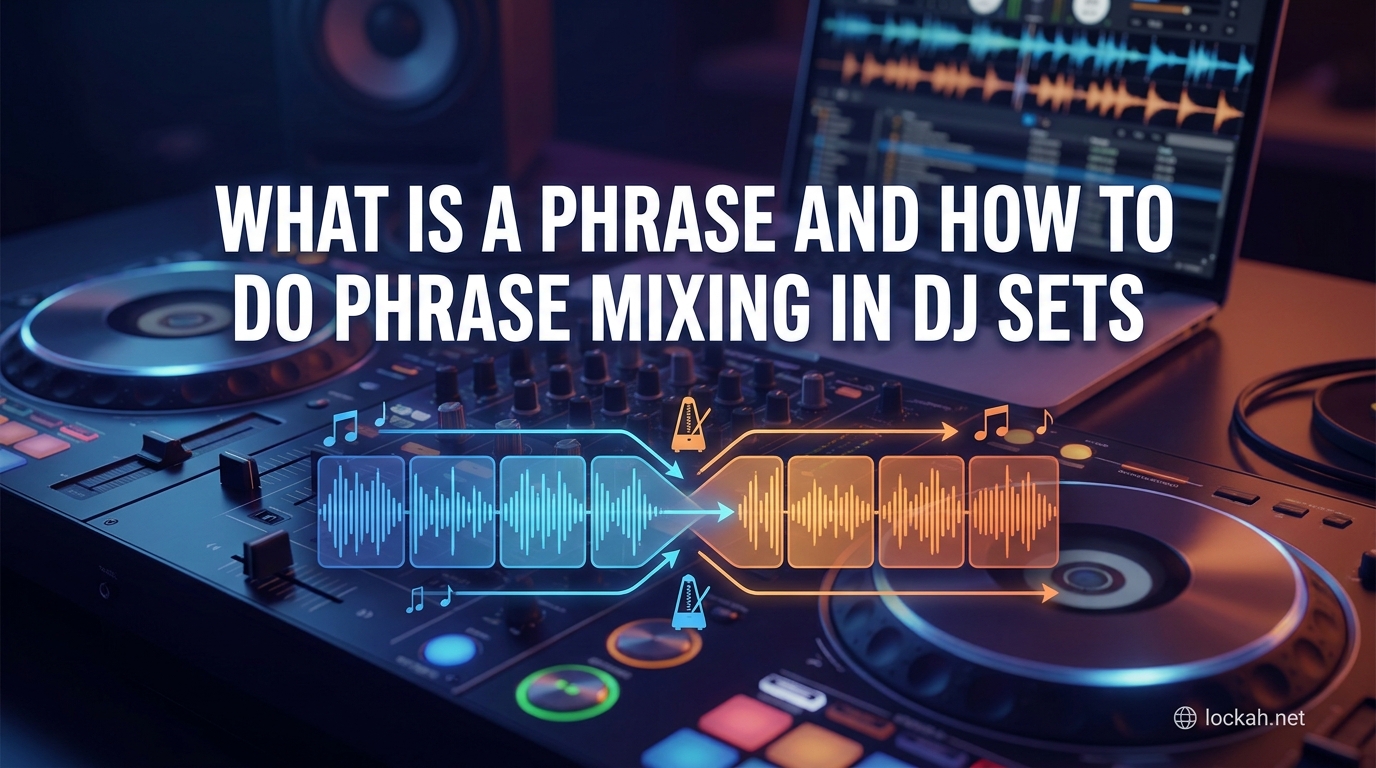
Phrase mixing is the skill that transforms amateur transitions into professional-sounding blends that keep dance floors moving. If you have ever wondered why some DJ sets feel seamless while others sound choppy or disjointed, the answer usually comes down to understanding musical phrases and how to mix between them.
In this guide, you will learn exactly what a phrase is in DJing, how song structure works, and the step-by-step techniques for executing smooth phrase mixes. Whether you are just starting out or looking to tighten up your transitions, these concepts will become the foundation of your mixing style.
I have spent years teaching DJs at every skill level, and I can tell you that phrase mixing is not magic. It is a learnable skill that becomes intuitive with practice. By the end of this article, you will know how to count phrases, identify transition points, and create mixes that sound polished and professional.
Table of Contents
What Is a Phrase in DJing?
A phrase in DJing is a musical section, typically 8 to 16 bars long, that represents a complete part of a song’s structure. Phrases are the building blocks of music. They are the segments you hear repeating and evolving as a track progresses from intro through verse, chorus, breakdown, and outro.
Think of a phrase as a complete musical sentence. Just like sentences have a beginning, middle, and end, phrases have natural start and end points where the energy and musical elements align. When you learn to recognize these boundaries, you gain the ability to predict exactly when a song will change direction.
Beats, Bars, and Phrases: The Foundation
To understand phrases, you need to understand the hierarchy of musical time. A beat is the basic pulse you feel when you tap your foot. Most dance music uses a 4/4 time signature, meaning there are four beats per bar. A bar (or measure) groups those four beats together.
A phrase combines multiple bars into a complete musical idea. Most electronic dance music organizes phrases into 8-bar or 16-bar lengths, though some genres use 4-bar or 32-bar phrases. Here is how the math breaks down:
- 4 beats = 1 bar
- 8 bars = 32 beats (common phrase length)
- 16 bars = 64 beats (extended phrase)
- 32 bars = 128 beats (full song section)
The rule of 32 in DJing refers to counting 32 beats, which typically marks the end of one phrase and the beginning of another. When you hear a change in the music, a new element entering, or a section transition, you are likely hearing a phrase boundary.
Common Phrase Lengths by Genre
Different genres tend to favor different phrase structures. House and techno typically use 8-bar phrases, creating that steady, hypnotic groove these genres are known for. Trance and progressive house often extend to 16-bar phrases, allowing for longer build-ups and more dramatic energy shifts.
Hip-hop and pop music can be trickier, with phrase lengths varying more frequently. Some tracks might have 4-bar phrases in verses that expand to 8 bars in choruses. Understanding these genre differences helps you adapt your mixing approach to whatever style you are playing.
Understanding Song Structure (2026)
Song structure is the roadmap that guides how phrases are arranged throughout a track. Most dance music follows a predictable pattern that makes phrase mixing possible. Once you learn to recognize these sections, you can anticipate exactly where the best transition points will occur.
The Standard Song Sections
Electronic dance music typically follows this progression:
Intro: The opening section with minimal elements, designed for DJs to mix in. Intros are usually 16 to 32 bars and contain just drums and maybe some atmospheric elements.
Verse: The section where the main musical theme or vocals develop. Verses build energy gradually and typically last 16 bars.
Build-up: The section that creates tension before the drop. Elements layer up, the energy rises, and the crowd anticipates the release. Build-ups are usually 8 to 16 bars.
Drop/Chorus: The peak energy section with the full musical elements. This is where the crowd reacts most strongly. Drops typically run 16 to 32 bars.
Breakdown: A section where energy pulls back, often with reduced drums or stripped-back elements. Breakdowns create dynamic contrast and last 16 to 32 bars.
Outro: The closing section, similar to the intro, designed for mixing out. Outros strip away elements and provide a clean exit point.
How Phrases Create Flow
Each section contains multiple phrases that work together to create the overall arc of the song. A typical 16-bar verse contains two 8-bar phrases. The first phrase might introduce a vocal line, while the second phrase repeats it with added instrumentation.
Understanding this structure helps you see the music in blocks. When you look at a track’s waveform, you can start to visually identify where phrases begin and end based on the patterns of density and energy.
What Is Phrase Mixing?
Phrase mixing is the technique of aligning the phrases of two tracks so that their musical sections match up during transitions. Instead of just matching beats, you are matching the structural elements of both songs to create seamless blends.
When you phrase mix correctly, the outgoing track reaches a natural conclusion at the same moment the incoming track begins its next phrase. The result sounds intentional and smooth, as if the two songs were designed to work together.
Phrase Mixing vs Beatmatching
Beatmatching ensures two tracks play at the same tempo and that their beats align. Phrase mixing takes this further by ensuring the musical sections align as well. You can beatmatch two tracks perfectly and still create an awkward transition if you do not consider phrasing.
Imagine mixing the high-energy drop of one track over the breakdown of another. Even if the beats line up, the energy clash will sound jarring to the audience. Phrase mixing prevents these mismatches by ensuring you transition between compatible sections.
Why Phrase Mixing Matters
Phrase mixing is what separates beginner DJs from professionals. It creates several key benefits:
Energy management: You control the flow of energy on the dance floor, building and releasing tension at the right moments.
Professional sound: Your mixes sound polished and intentional rather than accidental.
Dance floor engagement: When phrases align, dancers experience continuous momentum without jarring interruptions.
Creative possibilities: Understanding phrases opens up advanced techniques like looping, layering, and harmonic mixing.
How to Do Phrase Mixing in DJ Sets?
Learning phrase mixing requires developing your ear for musical structure and practicing the timing of your transitions. Here is the step-by-step process that will get you mixing in phrase consistently.
Step 1: Learn to Count Phrases
Before you can mix in phrase, you need to feel where phrases begin and end. Start by listening to tracks you know well and counting in groups of 32 beats. Most dance music has a kick drum on every beat, making counting straightforward.
Count like this: 1, 2, 3, 4, 2, 2, 3, 4, 3, 2, 3, 4, 4, 2, 3, 4, 5, 2, 3, 4, 6, 2, 3, 4, 7, 2, 3, 4, 8, 2, 3, 4. When you reach 8, 2, 3, 4, you have completed 32 beats, which is typically one phrase.
Listen for changes in the music at these boundaries. You might hear a new hi-hat pattern, a vocal phrase starting, or a change in the bassline. These cues confirm you are counting correctly.
Step 2: Set Cue Points at Phrase Boundaries
Once you can identify phrases by ear, set cue points at the start of major sections. Mark the first beat of the intro, the start of the first verse, the beginning of the build-up, the drop, and the outro.
Most modern DJ software allows multiple cue points per track. I recommend setting at least four: the first mix-in point (usually the start of the track or intro), the first major phrase change, the main energy section, and the mix-out point (start of the outro).
Step 3: Plan Your Transition Points
Before you start the mix, decide which sections of both tracks you want to align. The most common phrase mix aligns the outgoing track’s outro with the incoming track’s intro or first verse.
Look for compatible energy levels. Mixing an outro into an intro works well because both sections are lower energy. Mixing an outro into a verse can create a nice energy boost. Avoid mixing high-energy sections over low-energy sections unless you are intentionally creating contrast.
Step 4: Start the Incoming Track on the Correct Beat
Timing is everything in phrase mixing. You need to start your incoming track so that its first beat aligns with the first beat of a new phrase in the outgoing track.
If the outgoing track is at the start of a new phrase (beat 1 of 32), that is your cue to start the incoming track from its cue point. Both tracks will now progress through their phrases simultaneously, reaching their next sections at the same time.
Step 5: Execute the Blend
Once both tracks are playing in sync and in phrase, use your mixer to blend between them. Bring in the incoming track gradually using the volume faders or EQ. Many DJs start with just the high frequencies, then add mids, then bring in the bass as the outgoing track’s bass drops out.
The transition should feel natural because both tracks are progressing through their structures together. When the outgoing track reaches the end of its phrase, the incoming track will be ready to take over with its next section.
Step 6: Complete the Transition Cleanly
As the outgoing track approaches its final phrase boundary, gradually reduce its volume while bringing the incoming track to full level. The goal is for the outgoing track to reach its natural conclusion while the incoming track fully takes over.
Pay attention to the bass frequencies. Having two basslines playing simultaneously often creates a muddy sound. Many DJs swap the basslines at a phrase boundary, cutting the outgoing bass as the incoming bass begins its new phrase.
Benefits of Mastering Phrase Mixing (2026)
Phrase mixing is not just a technical skill. It is a creative tool that transforms how you approach DJing. Here is what you gain when you develop this ability.
Seamless Transitions
The most immediate benefit is that your mixes sound professional. When phrases align, listeners experience continuous flow rather than jarring changes. The music tells a coherent story from one track to the next.
I have heard countless beginner mixes where the DJ beatmatched perfectly but mixed the chorus of one song over the verse of another. The result sounds like two radios playing at once. Phrase mixing eliminates this problem.
Energy Control
Understanding phrases gives you precise control over the dance floor’s energy. You can choose to maintain steady energy by mixing similar sections, build tension by layering build-ups, or create release by transitioning into breakdowns.
This control separates DJs who simply play songs from DJs who craft experiences. The audience feels the intentionality in your set construction.
Extended Creative Possibilities
Once you master basic phrase mixing, you can explore advanced techniques. Looping specific phrases, layering acapellas over instrumentals, and creating mashups all depend on understanding phrase structure.
Phrase mixing also enables harmonic mixing, where you transition between tracks that share musical keys. When both phrase and key align, the blend sounds exceptionally smooth.
Common Mistakes and How to Avoid Phrase Wrecks?
Even experienced DJs occasionally create what the community calls a phrase wreck. This happens when phrases do not align, creating an awkward transition that disrupts the flow. Here is how to recognize and prevent these mistakes.
Misidentifying Phrase Boundaries
The most common beginner mistake is starting the incoming track at the wrong point. If you are off by even 8 beats, your phrases will clash rather than align. The outgoing track might reach its drop while the incoming track is still in its intro.
Solution: Practice counting phrases with your eyes closed until you can feel the boundaries without thinking. Use visual waveforms as a backup, but develop your ear as the primary tool.
Genre Confusion
Mixing between genres with different phrase structures can trip up even experienced DJs. A 16-bar house phrase will not align with an irregular hip-hop phrase structure.
Solution: When mixing between genres, choose transition points carefully. Look for tracks with compatible structures, or use breakdowns and build-ups where timing is more forgiving.
Recovering from a Phrase Wreck
If you realize mid-mix that your phrases are not aligned, you have options. You can quickly fade out the incoming track and try again at the next phrase boundary. Alternatively, you can use EQ to minimize the clash, cutting frequencies where the conflict is most obvious.
Some DJs intentionally create phrase wrecks for creative effect, but this requires knowing the rules before breaking them. Master clean phrase mixing first, then explore intentional chaos.
Practice Tips and Exercises
Phrase mixing takes time to master. Most DJs report that it takes 6 to 12 months of regular practice before it feels natural. Here are specific exercises to accelerate your learning.
Exercise 1: Counting Practice
Choose 10 tracks you know well and practice counting phrases through the entire song. Do this without looking at the waveform. Write down where each major section begins in terms of phrase count.
For example: Intro (2 phrases), Verse 1 (4 phrases), Build-up (2 phrases), Drop (4 phrases). This builds your structural awareness.
Exercise 2: Cue Point Drill
Set cue points at the start of every phrase in a track. Practice jumping between these cue points until you can navigate the track’s structure instinctively. This drill improves your ability to find the right entry point quickly.
Exercise 3: Simple Blend Practice
Start with two tracks that have clear, steady 8-bar phrases. Practice mixing the outro of track A into the intro of track B. Focus entirely on phrase alignment, not fancy EQ work or effects. Repeat until you can execute it perfectly 10 times in a row.
Exercise 4: Genre Exploration
Practice phrase mixing within different genres. Notice how house music’s steady 4/4 structure differs from breaks or drum and bass. Each genre teaches you something new about phrase structure.
Recommended Practice Tracks
Start with straightforward house and techno tracks that have clear structure. Avoid complex progressive tracks or songs with irregular arrangements until you have mastered the basics. Classic house tracks from the 1990s and early 2000s often have the most predictable phrase structures.
Frequently Asked Questions
What are DJ phrases?
DJ phrases are musical sections typically 8 to 16 bars long that form the building blocks of a song’s structure. Each phrase represents a complete musical idea with a clear beginning and end. In dance music, phrases align with song sections like intros, verses, choruses, and outros. Understanding phrases allows DJs to create smooth transitions by aligning the structural elements of two tracks.
What is the rule of 32 in DJing?
The rule of 32 refers to counting 32 beats, which typically equals one phrase in electronic dance music. Since most dance music has 4 beats per bar, 32 beats equals 8 bars. When you count 1 through 32, you usually reach the end of one phrase and the beginning of another. This rule helps DJs identify phrase boundaries and time their transitions correctly.
What is mixing in phrase?
Mixing in phrase means aligning the phrases of two tracks so their musical sections match during transitions. Instead of just matching beats, phrase mixing ensures that song sections like verses, choruses, or intros align between tracks. This creates seamless blends where the outgoing track ends a phrase as the incoming track begins its next phrase, maintaining continuous flow and energy.
What is a phase in DJing?
In DJing, phase refers to the alignment of waveforms between two tracks, specifically whether their beats are synchronized. When two tracks are in phase, their kick drums hit at exactly the same time. This is different from a phrase, which refers to musical sections. Phase is about timing individual beats, while phrases are about musical structure. Both are important for clean mixing.
How long does it take to master phrase mixing?
Most DJs report that phrase mixing takes 6 to 12 months of regular practice to feel natural. Beginners typically start by counting phrases consciously, then gradually develop an intuitive feel for phrase boundaries. The learning curve varies by individual and how frequently you practice. Daily practice accelerates progress significantly compared to occasional sessions.
Can you phrase mix without beatmatching first?
Technically yes, but it is extremely difficult and rarely sounds good. Beatmatching aligns the tempos and beats of two tracks, which is the foundation for any clean mix. Phrase mixing builds on beatmatching by adding structural alignment. Without beatmatching, your phrases might align initially but will drift apart as the tracks play at different speeds. Always beatmatch first, then phrase mix.
Conclusion
Phrase mixing is the bridge between technical DJ skills and artistic expression. When you understand what a phrase is and how to align the phrases of two tracks, you gain the ability to create seamless, professional-sounding transitions that keep dance floors engaged.
Start by mastering the fundamentals: counting beats and bars, identifying phrase boundaries, and understanding song structure. Set your cue points thoughtfully, practice your timing, and be patient with yourself as you develop this skill.
Remember that even the best DJs started by consciously counting phrases before it became second nature. With consistent practice over the next several months, you will find that phrase mixing transforms from a technical exercise into an intuitive part of your creative process. The result will be DJ sets that flow naturally and sound undeniably professional.