
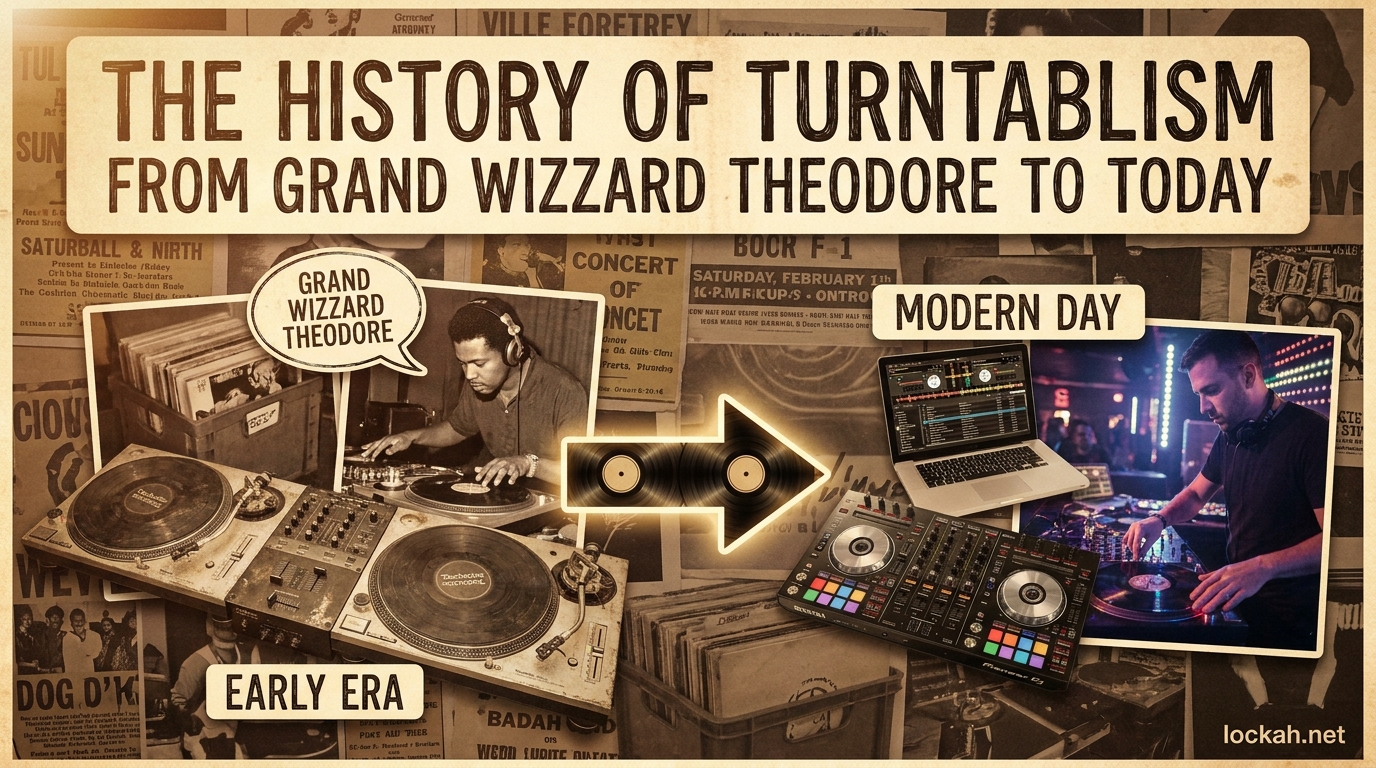
What if the instrument that changed modern music was discovered by accident? Turntablism stands as one of the most influential artistic innovations of the 20th century. This art form transformed the humble record player from a playback device into a creative instrument capable of generating entirely new sounds.
The history of turntablism from Grand Wizzard Theodore to today spans over five decades of innovation, cultural shifts, and technical mastery. What began in Jamaican sound systems evolved into a global phenomenon that influenced hip-hop, electronic music, and modern DJ culture. Our team has researched this journey extensively, examining how a simple manipulation of vinyl records sparked an entire musical revolution.
In this guide, you will learn where turntablism originated, who invented scratching, how the pioneers developed their techniques, and where the art form stands in 2026. Whether you are a DJ seeking historical context or a music enthusiast curious about this unique art form, this comprehensive history covers everything you need to know.
Table of Contents
What Is Turntablism?
Turntablism is the art of manipulating sounds and creating music using phonograph turntables and a DJ mixer. Unlike traditional DJs who simply play records, turntablists use the equipment as musical instruments. They create new compositions through techniques like scratching, beat juggling, and needle drops.
The term itself emerged in 1995, though the practice had existed for over two decades prior. Before that, practitioners were simply called DJs or scratch DJs. The distinction matters because turntablism requires a specific mindset. You approach the turntable as a musician approaches a guitar or piano, coaxing expressive sounds from the equipment rather than merely playing back recorded material.
Where Did Turntablism Originate?
The roots of turntablism trace back to Kingston, Jamaica in the late 1960s and early 1970s. Sound system culture dominated the island’s musical landscape. Mobile DJs called “selectors” played records at outdoor parties, while “toasters” spoke rhythmically over the instrumental portions of reggae records.
This practice of toasting laid the groundwork for what would become rapping in hip-hop. The selectors developed techniques to extend the most danceable parts of records. They would play two copies of the same vinyl, switching between them to prolong the instrumental breaks. This technique directly influenced the breakbeat manipulation that defines turntablism.
When Jamaican immigrants brought sound system culture to the Bronx, New York in the early 1970s, they planted the seeds for what would become turntablism. The neighborhoods needed a creative outlet. Economic hardship and social tensions created conditions where young people sought new forms of expression. The turntable became their instrument.
DJ Kool Herc and the Birth of the Breakbeat
Clive Campbell, known as DJ Kool Herc, threw a back-to-school party on August 11, 1973 at 1520 Sedgwick Avenue in the Bronx. This date marks the widely recognized birth of hip-hop culture. Herc brought his Jamaican sound system experience to this party, and the techniques he demonstrated that night would change music forever.
Herc developed what he called the “Merry-Go-Round” technique. He noticed that dancers responded most enthusiastically to the instrumental breaks in funk records. These sections, typically 10-30 seconds long, featured isolated drums and percussion. Herc realized he could extend these breaks indefinitely by using two turntables.
He would play the break on one turntable, then cue the same record on the second deck to the start of the break. When the first break ended, he would quickly switch to the second turntable. By repeating this process, he created extended rhythmic passages that kept dancers moving. This breakbeat isolation became the foundation of hip-hop music and the starting point for turntablist innovation.
Kool Herc also pioneered the use of massive sound systems with powerful bass, bringing Jamaican sound system aesthetics to New York block parties. His influence extended beyond technique to culture. He established the DJ as the central figure of the musical experience, a role that would eventually evolve into the turntablist as musician.
Grandmaster Flash: The Scientist of the Turntables (2026)
Joseph Saddler, known as Grandmaster Flash, approached DJing with the mindset of an engineer. He studied electronics and applied scientific principles to turntable manipulation. While Kool Herc established the breakbeat foundation, Flash refined the techniques and added innovations that expanded what was possible.
Flash developed the “quick-mix theory” in the mid-1970s. This technique involved using headphones to cue records precisely while one played to the audience. He could match beats and switch between records with surgical precision. The quick-mix theory transformed DJing from a matter of timing into a technical craft requiring exactitude.
He also pioneered the backspin technique. By manually spinning a record backward while the turntable played forward, he could repeat specific phrases or beats. This created stuttering effects and rhythmic patterns impossible to achieve through normal playback. The backspin opened new creative possibilities for turntable manipulation.
Flash’s most practical innovation was the slip mat. He realized that standard rubber mats on turntables created too much friction for the quick manipulations he wanted to perform. He experimented with various materials before discovering that felt-like slip mats allowed records to spin freely while the platter continued moving. This simple modification made modern turntablism possible. Every scratch DJ today owes their craft partly to this invention.
He also developed “clock theory,” a method of marking records to identify where specific breaks and beats began. By placing stickers or tape at key points, he could visually cue sections without relying solely on headphones. These systematic approaches elevated DJing toward musicianship and laid groundwork for the complex techniques turntablists would develop.
Grand Wizzard Theodore and the Accidental Invention of Scratching
Grand Wizzard Theodore was Grandmaster Flash’s younger brother and apprentice. In 1975, at age twelve, he made a discovery that would define turntablism more than any other technique. The story of how scratching was invented demonstrates how accidents often drive artistic innovation.
Theodore was practicing in his bedroom, working on his mixing skills. His mother called him to dinner from downstairs, and he put his hand on the record to pause it while he responded. As he moved the record back and forth under the needle, he noticed the rhythmic sound it created. Instead of dismissing it as a mistake, he recognized musical potential.
He spent the next weeks developing and refining this technique. By moving the record back and forth while the needle stayed in the groove, he could create rhythmic patterns from the recorded sound. He added the crossfader to the technique, using it to cut the sound in and out for sharper rhythmic definition. The scratch was born.
Theodore first showcased scratching publicly at a party, and the crowd response was immediate. What started as an accident became the signature sound of hip-hop. He continued developing the technique, adding variations and refinements. He also pioneered the “needle drop,” a technique of precisely placing the needle on specific parts of records without cuing through headphones first.
Theodore’s story matters because it illustrates how turntablism emerged from experimentation rather than formal training. No music school taught these techniques. They developed through countless hours of bedroom practice, discovery through accident, and sharing knowledge among peers. This DIY origin story remains central to turntablism culture today.
The 1980s: From Underground to Mainstream Recognition
The 1980s brought turntablism from block parties to international attention. Several key events established scratching as a legitimate musical technique and brought the art form before mainstream audiences. This decade transformed turntablism from a Bronx curiosity into a global phenomenon.
In 1983, Herbie Hancock released “Rockit,” a single that featured Grand Mixer DXT performing scratches as a central melodic element. The song became a massive hit, reaching audiences who had never encountered hip-hop. DXT’s scratching wasn’t just a background effect, it functioned as the primary instrumental hook. This demonstrated that turntablism could work in any musical context, not just rap.
The 1984 Grammy performance of “Rockit” marked a watershed moment. Millions of viewers watched Grand Mixer DXT scratch on national television during the awards ceremony. For many Americans, this was their first exposure to turntablism. The performance legitimized the art form in ways that years of underground parties could not.
The Disco Mix Club, or DMC, launched the World DJ Championships in 1985. What began as a mixing competition quickly evolved to emphasize scratching and turntablism. These battles created a competitive structure that pushed innovation. DJs competed to develop more complex techniques, creating a rapid evolution of the art form. The championship became the premier showcase for turntablist skill.
During this decade, the techniques developed in the Bronx spread globally. Japanese, European, and Australian DJs began developing their own turntablism scenes. The art form transcended its origins while maintaining connections to hip-hop culture. Equipment manufacturers took notice, with Technics SL-1200 turntables becoming the standard tool for serious practitioners.
The 1990s: The Golden Age of Turntablism
The 1990s represent what many consider the golden age of turntablism. This decade saw the coining of the term itself, the formal organization of the turntablist community, and an explosion of technical innovation. The art form matured while maintaining its underground credibility.
In 1995, DJ Babu of the Beat Junkies coined the term “turntablism” during an interview. He wanted to distinguish between DJs who simply played records and those who used turntables as instruments. The term caught on immediately. It gave the community a name that reflected their artistic aspirations rather than their functional role.
The International Turntablist Federation formed in 1996, creating organized competition structures beyond the DMC championships. The ITF introduced new battle formats including organized battles, showcase sets, and team competitions. These structures helped standardize judging criteria and push technical development.
Beat juggling emerged as a defining technique of this era. While Kool Herc had used two turntables to extend breaks, 1990s turntablists developed complex rhythmic patterns by manipulating two copies of the same record. They would alternate between decks, creating entirely new beats from existing recordings. This technique required extraordinary timing and transformed the turntable from a melodic instrument into a percussive one.
Crew culture flourished during this decade. The Invisibl Skratch Piklz, formed from former competitors who decided to collaborate rather than compete, became legendary for their technical mastery. Members including DJ Qbert, Mix Master Mike, and DJ Disk pushed scratching to unprecedented levels of complexity. The Beat Junkies on the West Coast developed distinct styles emphasizing musicality and funk. These crews created communities of practice that accelerated innovation.
The DMC World Championships reached their competitive peak in the 1990s. Champions like DJ Qbert (1992-1994) and A-Trak (1997-2000, youngest champion ever) became celebrities within the turntablism community. Their routines combined technical difficulty with showmanship, establishing standards that competitors still reference today.
The Language of Turntablism: Key Techniques
Turntablism developed its own vocabulary to describe the techniques practitioners use. Understanding these terms helps appreciate the complexity involved in what might look like simple record manipulation. Each technique requires specific hand positioning, timing, and crossfader control.
The transformer scratch, developed by Jazzy Jeff and named after the sound effects in the Transformers cartoon, uses the crossfader to cut the sound into rhythmic segments. While moving the record back and forth, the DJ opens and closes the crossfader rapidly, creating a stuttering effect. This technique adds rhythmic complexity to basic scratching.
The flare, developed by DJ Flare (also known as DJ Flare of the Beat Junkies), involves quickly clicking the crossfader while performing a scratch motion. This creates multiple sound bursts from a single record movement. Variations including the 2-click, 3-click, and orbit patterns allow for increasingly complex rhythmic figures.
The crab scratch uses multiple fingers on the crossfader to create rapid-fire sounds. DJs typically use their thumb as a spring while their fingers tap the crossfader knob, producing machine-gun-like rhythms. This technique allows for extremely fast note patterns impossible to achieve with single-fader clicks.
The chirp scratch creates a distinctive bird-like sound through specific crossfader and record movements. The orbit combines multiple techniques into continuous circular patterns. Beat juggling requires switching between two records to create new rhythmic combinations, essentially drumming with two turntables.
Mastering even one of these techniques requires hundreds of hours of practice. Professional turntablists combine multiple techniques fluidly, creating performances that rival any instrumental virtuoso. The physical demands are significant, repetitive strain injuries are common among serious practitioners.
Women in Turntablism: Pioneers and Innovators
The history of turntablism often focuses on male pioneers, but women have played crucial roles throughout the art form’s development. Their contributions deserve recognition, though they faced additional barriers in a male-dominated field. Understanding their stories provides a more complete picture of turntablism culture.
Pam the Funkstress served as Prince’s DJ and earned recognition as one of the most skilled turntablists regardless of gender. She developed distinctive scratching styles that influenced countless DJs. Her position with Prince, one of music’s most demanding artists, demonstrated that women could reach the highest levels of turntablism.
DJ Shortee established herself as a technical innovator and educator. She became the first female member of the Beat Junkies crew, a significant achievement given that crew’s reputation for rigorous standards. Beyond her performances, she created instructional materials that helped many beginners learn fundamentals. Her teaching made turntablism more accessible to newcomers who might otherwise have struggled to enter the community.
Kuttin Kandi gained recognition for her battle skills and became one of the most respected female turntablists in the competition scene. She competed successfully against male DJs at a time when female participation in battles was rare. Her success helped demonstrate that technical mastery had no gender component.
Despite these successes, women in turntablism faced significant challenges. The battle scene’s competitive atmosphere sometimes created hostile environments. Equipment costs and access to mentorship proved more difficult for women to obtain. The culture has evolved, and contemporary scenes include more women than ever before, though gender balance remains uneven. Recognizing these pioneers helps address historical oversights and encourages future participation.
The Digital Revolution: DVS and Modern Turntablism
The late 1990s and 2000s brought technological changes that transformed turntablism. Digital Vinyl Systems (DVS) allowed DJs to control digital audio files using traditional turntables. This technology preserved the tactile feel of vinyl while eliminating many practical limitations.
Serato Scratch Live, introduced in 2004, became the dominant DVS platform. It used special vinyl records containing control tones rather than audio. The computer interpreted these tones to manipulate digital files. DJs could now carry thousands of tracks on a laptop while still performing with their hands on turntables.
Traktor Scratch from Native Instruments offered similar functionality with different interface approaches. Both systems allowed turntablists to scratch digital audio with the same techniques they used on vinyl. The sound quality debates that followed were intense. Some purists insisted that vinyl provided superior audio quality and that digital systems lacked authenticity.
Forum discussions among DJs reveal ongoing tensions about digital versus analog approaches. Many practitioners acknowledge that digital systems make turntablism more accessible. Equipment costs drop significantly when you don’t need to purchase rare vinyl records. Travel becomes easier without carrying heavy crates of records. However, many feel that something intangible is lost, the connection to physical media, the hunt for rare records, the specific feel of vinyl under the needle.
DVS technology also enabled new possibilities. DJs could create custom control records with different sensitivity settings. Looping and cue point management became more flexible. Some performers began combining DVS with controller elements, creating hybrid setups that would have been impossible with pure vinyl. The art form adapted to these tools while maintaining its core techniques.
Turntablism in 2026: The Art Form Today
Turntablism continues evolving in 2026, though its place in popular culture has shifted. The art form no longer dominates mainstream hip-hop as it did in the 1990s, but dedicated practitioners worldwide keep the culture alive and advancing. Understanding current developments requires looking at competition formats, educational resources, and cultural integration.
Red Bull 3Style, launched in 2007, represents the most significant modern competition format. Unlike traditional battles focused purely on scratching, 3Style emphasizes open-format DJing. Competitors must demonstrate skills across multiple genres while maintaining turntablist techniques. This reflects how modern DJs work in clubs, where genre-hopping has become standard. The competition has become one of the most prestigious events in the DJ world.
The DMC World Championships continue, though with reduced mainstream visibility compared to their 1990s peak. Online championships, established during the 2020 pandemic, have expanded participation by eliminating travel requirements. DJs from countries without strong local scenes can now compete internationally. This democratization has revealed talent from regions previously underrepresented in turntablism.
Educational resources have proliferated. Online tutorials, structured courses, and community forums make learning turntablism more accessible than ever. This addresses one pain point frequently mentioned in forum discussions, the difficulty beginners faced finding mentorship in previous decades. Today’s aspiring turntablist can access world-class instruction from their bedroom.
Turntablism has found new homes in electronic music genres. Artists in drum and bass, dubstep, and experimental electronic incorporate scratching and beat juggling into their performances. The techniques developed in hip-hop have proven adaptable to entirely different musical contexts. This cross-genre pollination keeps the techniques relevant even as pure hip-hop turntablism occupies a more niche position.
The vinyl resurgence of recent years has benefited turntablism. Record sales have increased, pressing plants have reopened, and a new generation has discovered the appeal of physical media. While DVS remains dominant for practical performance, many turntablists maintain vinyl collections for practice and certain performance contexts. The art form’s future likely involves continued coexistence of analog and digital approaches.
FAQs
What is turntablism?
Turntablism is the art of manipulating sounds and creating music using phonograph turntables and a DJ mixer. Unlike traditional DJs who simply play records, turntablists use the equipment as musical instruments to create new compositions through techniques like scratching, beat juggling, and needle drops. The term was coined in 1995 by DJ Babu of the Beat Junkies.
Where did turntablism originate?
Turntablism originated in Kingston, Jamaica during the late 1960s and early 1970s within sound system culture. Mobile DJs called selectors played records at outdoor parties while toasters spoke rhythmically over instrumental breaks. When Jamaican immigrants brought this culture to the Bronx, New York in the early 1970s, it evolved into the foundation of hip-hop and turntablism.
Who was the first DJ to invent scratching?
Grand Wizzard Theodore invented scratching in 1975 at age twelve. The discovery happened accidentally when he paused a record by hand to respond to his mother calling him to dinner. As he moved the record back and forth under the needle, he noticed the rhythmic sound it created and spent weeks developing it into a formal technique.
Who was the first Jamaican rapper?
While many toasters in Jamaica contributed to the development of rhythmic speech over music, U-Roy (Ewart Beckford) is widely recognized as one of the earliest and most influential figures who developed toasting into an art form during the late 1960s. His style directly influenced the development of American rapping when sound system culture migrated to New York.
When did turntablism become popular?
Turntablism gained mainstream recognition in the 1980s through Herbie Hancock’s 1983 single Rockit featuring Grand Mixer DXT, which brought scratching to international audiences. The 1990s are considered the golden age, with the term turntablism coined in 1995 and the DMC World Championships reaching peak visibility.
Is turntablism still relevant today?
Yes, turntablism remains relevant in 2026 through competitions like Red Bull 3Style, continued DMC championships, integration with electronic music genres, and educational resources that make learning more accessible than ever. While less commercially dominant than in the 1990s, the art form maintains a dedicated global community of practitioners.
Conclusion: The History of Turntablism from Grand Wizzard Theodore to Today
The history of turntablism from Grand Wizzard Theodore to today demonstrates how accidents, innovation, and community can create entirely new art forms. From Kool Herc’s breakbeats to Theodore’s scratching discovery, from Grandmaster Flash’s technical refinements to today’s digital hybrid setups, turntablism has continuously evolved while maintaining its core identity.
The art form transformed the DJ from a selector of records into a musician creating original compositions. It established the turntable as a legitimate instrument capable of expressing the full range of human musical ideas. The techniques developed in Bronx bedrooms spread globally, influencing countless musical genres and inspiring generations of practitioners.
In 2026, turntablism faces challenges including commercial viability, equipment costs, and competition from simpler DJ technologies. However, the dedication of its practitioners, the richness of its history, and the continued evolution of its techniques suggest a resilient future. Whether you are considering learning turntablism yourself or simply appreciating its cultural significance, understanding this history provides essential context for one of music’s most unique artistic developments.