
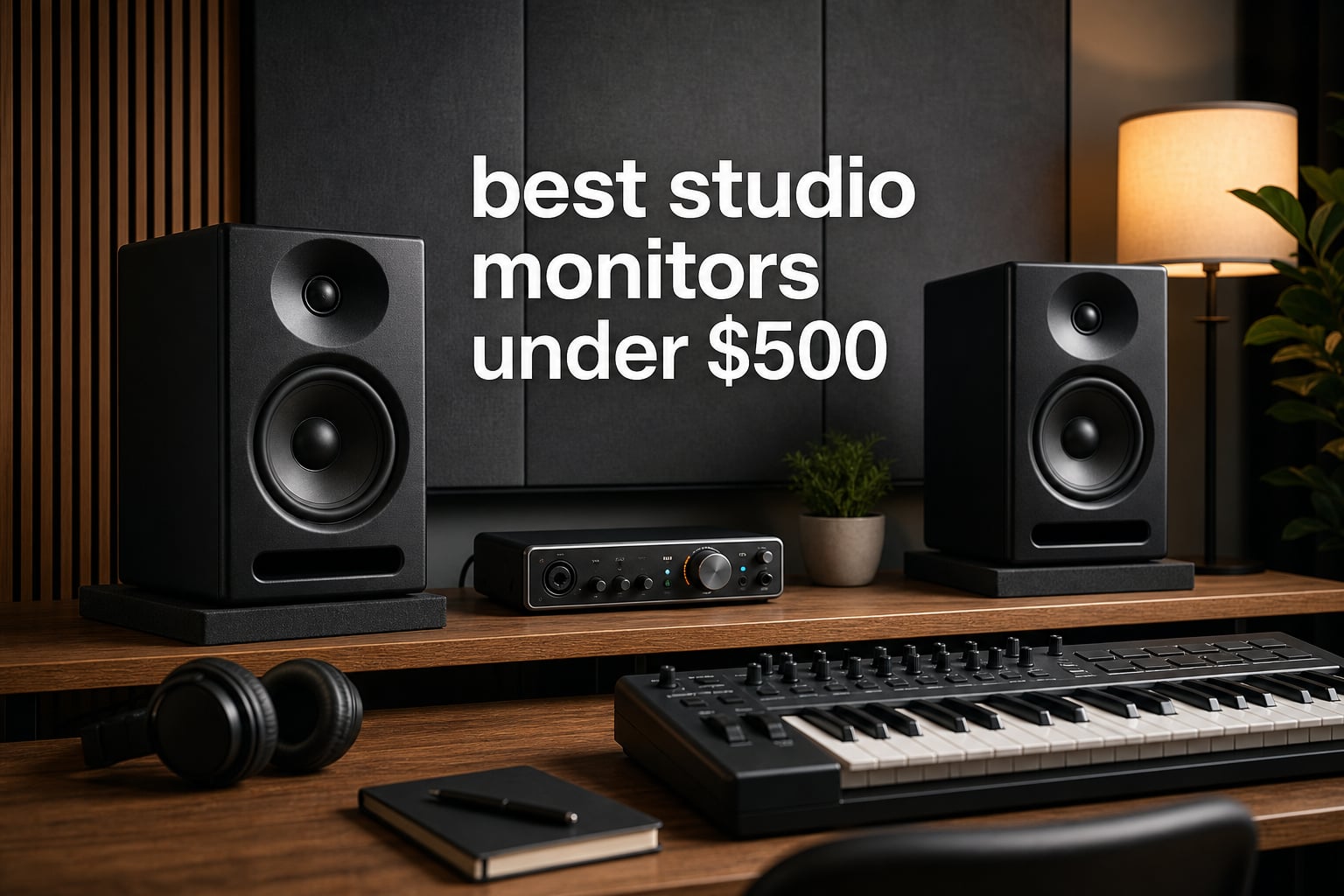
The best studio monitors under $500 are the pair that let you make repeatable decisions in your actual room, not the pair that creates the biggest first impression. For most home producers, that means active nearfield monitors with balanced inputs, sensible placement options, and enough detail to expose a crowded vocal, harsh hi-hat, or overgrown low end.
I approached this list as a working buying decision rather than a race for the largest woofer. The ten powered studio monitors below cover compact desktops, interface-based mixing, Bluetooth convenience, DJ practice, and room-adjustable 5-inch systems, so there is a sensible match whether you work a foot from the speakers or across a small room.
One reality check comes first: speakers and a room act as one system. Community discussions repeatedly point out that untreated bedrooms can make bass hard to judge and make mixes translate poorly, so put some budget and attention into speaker position, basic absorption, and checking work on headphones or another playback system.
Our selection framework favors documented inputs, driver layout, tuning controls, physical scale, and a clear job for each product. A specification does not predict every listening result, but it does show whether a monitor can connect cleanly to your setup and whether its design suits close desktop work or a more conventional nearfield position.
Table of Contents
The Top 3 Picks Are the KRK RP5G5, Kali LP-UNF, and Edifier MR5
For a direct answer, choose the KRK RP5G5 when DSP room tuning and a conventional 5-inch monitor format matter most. Pick the Kali LP-UNF for close desktop monitoring with boundary EQ and several source options, or the Edifier MR5 when a three-way active layout, physical room controls, and XLR connectivity fit your desk.
- KRK RP5G5: Best all-round pick for its 5-inch Kevlar driver, Class D amplification, DSP-driven room tuning, and included foam isolation wedges.
- Kali Audio LP-UNF: Best ultra-nearfield pick for a 4.5-inch woofer, 3D Imaging Waveguide, boundary EQ, USB, TRS, RCA, and Bluetooth.
- Edifier MR5: Best feature-rich pick for its three-way active design, 5-inch woofer, room compensation, and XLR, TRS, RCA, AUX, and Bluetooth inputs.

These Studio Monitors Under 500 Cover Every Desk and Home Studio Role in 2026
The overview below is deliberately broad: a compact 3.5-inch desktop pair and a 5-inch mixing pair are not substitutes, even if both are active speakers. Start with the format that fits your listening distance and room, then use the individual sections to check the details that affect your workflow.
| Product | Specifications | Action |
|---|---|---|
 Edifier MR3 Edifier MR3 |
|
Check Latest Price |
| KRK RP5G5 ROKIT 5 |
|
Check Latest Price |
 KRK Kreate 3 KRK Kreate 3 |
|
Check Latest Price |
 ADAM Audio D3V ADAM Audio D3V |
|
Check Latest Price |
 Mackie CR3.5 Mackie CR3.5 |
|
Check Latest Price |
 Kali Audio LP-UNF Kali Audio LP-UNF |
|
Check Latest Price |
 PreSonus Eris 3.5 PreSonus Eris 3.5 |
|
Check Latest Price |
 Edifier MR5 Edifier MR5 |
|
Check Latest Price |
 Pioneer DJ DM-50D-BT Pioneer DJ DM-50D-BT |
|
Check Latest Price |
 M-Audio BX5BT M-Audio BX5BT |
|
Check Latest Price |
1. Edifier MR3 Is a Flexible Compact Monitor for Mixed Desktop Use
Edifier MR3 Powered Studio Monitor, Speaker Hi-Res Active Bluetooth Speaker
3.5 inch drivers
52Hz-40kHz
TRS RCA AUX Bluetooth
Pros
- Hi-Res certified
- Balanced TRS and Bluetooth
- Monitor and Custom modes
- Headphone output
Cons
- No listed subwoofer output
- Compact 3.5 inch format
The Edifier MR3 is the compact all-purpose choice for a producer who also wants a desk speaker that can take a phone or laptop signal without extra adapters. Its 3.5-inch mid-low drivers and 1-inch tweeters keep the cabinet small, while the listed 52Hz-40kHz response makes clear that it is aimed at near listening rather than room-filling low bass.
I would place this pair at arm’s length, on pads or short stands, and use the balanced TRS input from an audio interface when mixing. Bluetooth 5.4 with multipoint connection is handy for reference tracks, but I would keep the critical signal path wired to avoid changing variables while judging a mix.
The Monitor, Music, and Custom modes give this model more day-to-day flexibility than a bare-bones desktop pair. The ConneX app also supports EQ adjustment, which can help tame a desk setup, though it cannot repair a strong room resonance or a speaker pushed into a corner.
The 18W-per-channel RMS rating and 92.5 dB peak SPL are suitable for close work. It makes more sense as a compact pair for editing, arranging, and learning balances than as the only low-end reference for bass-forward production in a larger space.
It Works Best at a Close Desktop Listening Distance
The MR3 fits a laptop-and-interface workstation where the speakers need balanced TRS, RCA, AUX, and wireless playback in one pair. Its front headphone output is also practical when switching from speakers to private checking without changing the whole desk wiring.
Keep the tweeters close to ear height and angle each cabinet toward the listening position. This nearfield triangle reduces how much of the room reaches your ears compared with placing compact speakers far apart across a room.
It Requires Realistic Bass Expectations
A 3.5-inch driver cannot move the same amount of air as a 5-inch monitor. Check kick and sub-bass relationships on headphones or a second system before committing a mix, especially when working with hip-hop, techno, or other bass-led material.
The MDF cabinet is intended to reduce distortion, but placement remains more important than a mode switch. Leave breathing room around the pair instead of pressing the rear of a compact monitor directly against a wall.
2. KRK RP5G5 Is the Most Adaptable 5-Inch Mixing Pick
KRK RP5G5 ROKIT 5 Generation Five 5″ Powered Studio Monitor Pair
5 inch Kevlar
82W Class D
DSP room tuning
Pros
- DSP-driven tuning
- Kevlar drivers
- Silk dome tweeter
- Isolation wedges included
Cons
- 15.4 pounds per unit
- Only XLR and combo input
The KRK RP5G5 earns the editor’s choice spot because it is the clearest bridge between a traditional 5-inch reference monitor and a room-conscious home-studio tool. It combines an 82W Class D amplifier, a 5-inch Kevlar woofer, a 1-inch silk dome tweeter, and DSP-driven room tuning in a format that suits most small nearfield setups.
I would select it when an interface with XLR or 1/4-inch TRS outputs is already part of the system. The combo analog input is direct and familiar, while the included acoustic foam wedges make it easier to begin with some cabinet isolation instead of placing the monitors flat on a resonant desk.
The low-diffraction baffle design and Brick Wall Limiter are meaningful on paper because they address two common practical concerns: unwanted cabinet-edge effects and pushing the monitor beyond comfortable limits. Neither feature replaces level discipline, but both support a repeatable daily monitoring setup.
Its listing reports a frequency response beginning at 30Hz without a published upper endpoint, so treat that lower number as one part of the picture rather than proof of full subwoofer replacement. Listen at moderate levels and cross-check bass choices, since a small room can overstate or cancel the very frequencies you are trying to judge.
It Fits Producers Who Need Room-Tuning Flexibility
DSP room tuning is the reason to put the RP5G5 ahead of simpler 5-inch alternatives for a changing bedroom or project room. Adjustments can help adapt the monitor to placement, yet they should follow basic positioning rather than substitute for it.
Set the pair and your head as an equilateral triangle, then start with the tuning neutral before making small changes. Work with familiar commercial tracks to hear what the setup is doing before changing a mix because of a single setting.
It Benefits From a Dedicated Interface and Stands
This monitor is a better fit for a focused music workstation than for a casual Bluetooth desk. The listed connection is XLR and 1/4-inch TRS combo, so an interface or controller with appropriate outputs is the tidy route.
At 15.4 pounds per unit, the cabinets deserve stable stands or a substantial desk. The supplied foam wedges are a useful start, but a stand that gets the tweeter to ear height gives more reliable imaging.
3. KRK Kreate 3 Is a Straightforward Small-Space Creative Pair
KRK Kreate 3 Powered Studio Monitors Pair
3.5 inch woofer
Textile tweeter
Bluetooth inputs
Pros
- Woven glass fiber woofer
- Textile dome tweeter
- Bluetooth
- Multiple inputs
Cons
- Limited review history
- No response range listed
The KRK Kreate 3 is for the producer who needs a small powered pair with modern convenience rather than a large nearfield monitor. It uses a 3.5-inch woven glass fiber composite woofer and a 1-inch textile dome tweeter, pairing close-range scale with Bluetooth and multiple audio inputs.
I see it as a sensible first monitor pair for composition, editing, gaming, and reference playback at a desk. The product data describes clear midrange and tight bass, but it does not provide a frequency-response range, so I would avoid making decisions based on assumed deep extension.
This is also a relatively new product with 52 recorded reviews in the provided data, even though its 4.7 rating is encouraging. A smaller review sample is not a reason to reject it; it is a reason to focus more closely on the feature set and return to your own workflow requirements.
Bluetooth can make the Kreate 3 especially convenient for comparing a rough export against reference tracks. For a final mix, use a wired source when possible and keep listening level consistent so that louder playback does not seem better by default.
It Suits Compact Content-Creation Desks
The 3.5-inch driver size makes the Kreate 3 appropriate where larger cabinets would crowd the keyboard, display, and interface. It is a practical option for someone who produces and consumes media at the same workstation.
Place it symmetrically around the screen rather than letting one speaker sit deeper on the desk than the other. Small asymmetries can pull the center image toward one side and make panning decisions less dependable.
It Needs a Second Reference for Deep Low End
Compact nearfield speakers can clarify midrange arrangement without giving a full account of sub-bass. I would check low notes on closed-back or open-back studio headphones and on another familiar system before finalizing a bass line.
That habit is not a failure of the monitor; it is a normal part of working in a small room. It also helps separate a true mix problem from an issue caused by the desk, wall distance, or room mode.
4. ADAM Audio D3V Is the Best Desktop-First Precision Option
ADAM Audio D3V Active Desktop Studio Monitor Speakers – Black
USB-C
1.5 inch ribbon
45Hz bass
DSP switches
Pros
- USB-C plug and play
- Ribbon tweeter
- DSP room switches
- Angled stands included
Cons
- Desktop-sized drivers
- No Bluetooth listed
The ADAM Audio D3V is designed around the desktop rather than treating it as an afterthought. USB-C plug-and-play, balanced 1/4-inch TRS, RCA, a front headphone socket, detachable 15-degree stands, and microphone-stand mounting give it unusually direct fit for a computer-based production setup.
I would recommend it to a bedroom producer who works very close to the speakers and wants a simple digital connection without sacrificing a balanced analog input. The 1.5-inch D-ART ribbon tweeter is the standout component, while the 3.5-inch aluminum woofers and dual-sided passive radiators are listed to reach 45Hz.
The D3V’s four amplifier circuits and 80W total amplifier power suggest a purpose-built active system rather than a repurposed consumer speaker. DSP-powered room tuning switches are useful when the desk or wall arrangement is not ideal, but start with the supplied stand angle and speaker symmetry before changing them.
Automatic sleep after 20 minutes is configurable, which is a small but welcome workday detail. The pair is compact enough to stay near the screen, so it is one of the strongest answers for a genuine ultra-nearfield position rather than a wide, room-spanning layout.
It Connects Directly to a Modern Computer Setup
USB-C makes the D3V unusually simple for a laptop producer, while TRS and RCA preserve options for an interface, controller, or other source. Choose one main connection for monitoring and avoid routing several sources at once when you are chasing a noise issue.
The front headphone socket supports quick private checks. Keep in mind that headphone and speaker balances are different, so use headphones as a second opinion instead of trying to match their sound exactly.
It Prefers an Ultra-Nearfield Placement
The included 15-degree stands aim the drivers upward on a desk, which helps bring the tweeters toward ear level. If the desk is unusually low or high, microphone stands can provide a more controlled height and distance.
Dual-sided passive radiators help the compact enclosure produce low end, but no desktop speaker escapes room interaction. Keep the speakers clear of immediate corners and test a few distances from the wall before trusting kick-bass balance.
5. Mackie CR3.5 Is a Beginner-Friendly Desk Speaker With Useful Controls
Mackie CR3.5 Studio Monitors (Pair), 3.5″ Woofers, Tone Knob, Black
3.5 inch woofer
50W
Tone knob
Location switch
Pros
- Tone control
- Desktop or bookshelf switch
- TRS RCA and 3.5mm
- Isolation pads included
Cons
- No subwoofer included
- Not a full-range monitor
The Mackie CR3.5 gives a new producer physical controls that acknowledge a common reality: a desk and a bookshelf do not sound the same. Its location switch selects desktop or bookshelf mode, and the tone knob can add bass or high-end sparkle for everyday listening.
I would use the location switch as the first adjustment when moving the pair, then keep the tone control restrained while working on a mix. A deliberately colored setting can be enjoyable for playback, but a stable, familiar setting is more useful for making decisions that carry over to earbuds and cars.
The hardware is easy to integrate: TRS, RCA, and 3.5mm inputs cover an interface, computer, and portable device, and the built-in headphone output offers a fast quiet alternative. The package also includes foam isolation pads and the needed speaker-to-speaker wire, reducing basic desk setup friction.
With a 3.5-inch woven woofer, 1-inch silk dome tweeter, and 50W maximum output, this is a compact creative-reference monitor. It can serve music production, gaming, and general listening, but it should not be expected to replace a bigger nearfield pair for judging very low frequencies.
It Helps Beginners Learn Placement Changes
The location switch makes the CR3.5 a useful learning tool because you can hear how one system adapts to two common placements. Still, it is better to move the speakers away from boundaries first than to rely on a switch after placing them in a corner.
Use the included pads, keep both cabinets level, and do not stack one speaker on books while the other sits on the desk. Matching left and right support surfaces aids stereo focus.
It Is Better for Creation Than Deep-Bass Judging
For editing dialogue, arranging songs, and building a first home studio, compact monitors can reveal more than generic computer speakers. For sub-heavy styles, add a trustworthy headphone check and audition exports away from the desk.
An optional CR8SBT subwoofer is available in the product ecosystem, but it is not included with this pair. A subwoofer also adds another placement and crossover problem, so solve the main monitor setup first.
6. Kali Audio LP-UNF Is the Best Ultra-Nearfield Choice for Small Rooms
KALI AUDIO LP-UNF Ultra Nearfield Monitor System – Black
4.5 inch woofer
39Hz response
Boundary EQ
USB Bluetooth
Pros
- Boundary EQ
- 3D Imaging Waveguide
- USB and Bluetooth
- 4.5 inch woofer
Cons
- Touch slider takes adjustment
- Needs careful desk placement
The Kali Audio LP-UNF is the most purpose-specific choice here for close desktop work, which is why it is my best-value recommendation. Its 4.5-inch woofer, 1-inch tweeter, 3D Imaging Waveguide, and boundary EQ directly address the needs of a listener sitting close to a desk in a small room.
The listed 39Hz frequency response and 160W maximum output make it more ambitious on low-end extension than the 3.5-inch desktop pairs. I would still treat that capability as a reason to check bass carefully, not as permission to put it against a wall and assume the response remains unchanged.
Connection coverage is excellent: 1/4-inch TRS, RCA, USB, and Bluetooth all appear in the product details. That means a producer can use USB at a computer desk, balanced analog from an interface, and Bluetooth for reference listening without changing monitors.
The touch-sensitive volume slider is modern and compact, though it may need an adjustment period compared with a conventional knob. Once a consistent level is found, leave it there during a session so that changes in loudness do not influence mix calls.
It Handles Close Listening and Boundary Control Well
Boundary EQ is a valuable feature for an ultra-nearfield system because desks and nearby walls strongly shape bass and low midrange. Use it after positioning, not before: make an equilateral triangle, angle the speakers inward, and keep both side walls as similar as possible.
The 3D Imaging Waveguide is designed to support stereo imaging. Give it a proper center listening position rather than judging it while standing or leaning far to one side of the desk.
It Gives Small-Setup Producers Many Connection Paths
USB simplifies a computer-only rig, while TRS is the cleaner choice from a balanced interface. RCA and Bluetooth broaden convenience, though wired inputs should be the default for critical work.
This combination makes the LP-UNF a strong home studio speaker for producers who need one compact pair to handle composing, mixing practice, and casual reference playback. Its controls reward a little setup time rather than a plug-it-anywhere approach.
7. PreSonus Eris 3.5 Is a Proven Entry Point With Acoustic Tuning
PreSonus Eris 3.5 Powered Studio Monitors, Pair — 3.5” Active Near
3.5 inch woofer
80Hz-20kHz
TRS RCA aux
Acoustic tuning
Pros
- High and low tuning controls
- Front headphone jack
- Balanced TRS input
- Strong review volume
Cons
- 80Hz low-end limit
- No USB connection
The PreSonus Eris 3.5 is a familiar entry-level active monitor pair with an unusually large review base in the supplied product data: 1,583 reviews at a 4.5 rating. It brings 3.5-inch woven-composite woofers, 1-inch silk-dome tweeters, 50W maximum output, and high- and low-frequency acoustic tuning controls to a compact desktop format.
Its listed 80Hz-20kHz frequency response makes the trade-off unusually clear. These are suitable for vocals, guitars, arrangement work, editing, and ordinary close-range music production, but the deepest octave of modern electronic music needs a separate check.
I would choose the Eris 3.5 for a first interface-based desk because it has balanced 1/4-inch TRS, RCA, and a front auxiliary input. The front-panel headphone jack is practical too, especially in a shared home where speaker time is limited.
Acoustic tuning controls are a useful advantage over a fixed-response multimedia pair. Use small adjustments only after correct placement, because large EQ changes can hide a problem rather than help you learn what your room is doing.
It Makes an Accessible First Monitoring Setup
These powered studio monitors do not need an external speaker amplifier. Connect the interface outputs to the monitor inputs, start with monitor and interface levels low, then raise them gradually to a comfortable working level.
Balanced TRS cables are preferable when your interface supports them because they are built for balanced line-level connections. RCA and aux remain useful for simpler sources, but avoid running multiple live sources together.
It Demands Bass Cross-Checks for Electronic Music
The 80Hz lower specification is an honest cue to use a second reference for sub-bass. Headphones, a car, or another known system can tell you whether a bass note that seems controlled at the desk is actually excessive elsewhere.
This limitation is predictable from the compact driver size and does not prevent useful mixing practice. It simply makes disciplined referencing part of the purchase rather than an optional extra.
8. Edifier MR5 Is a Feature-Dense Three-Way Monitor for Detailed Work
Edifier MR5 2.0 Studio Monitor Bookshelf Speakers, 110W RMS, Black
Three-way active
5 inch woofer
46Hz-40kHz
XLR TRS RCA
Pros
- Three-way crossover
- Room compensation
- XLR and TRS inputs
- 110W RMS
Cons
- Large desktop footprint
- Tuning needs setup time
The Edifier MR5 stands out because it is the only listed three-way active design in this group. A 5-inch long-throw woofer, 3.75-inch mid driver, and 1-inch silk dome tweeter divide the range across three drivers, while the published response is 46Hz-40kHz and the system provides 110W RMS.
I would look at it when midrange separation matters and the desk can accommodate a larger cabinet. A dedicated mid driver may help organize the work of the woofer and tweeter, but the benefit depends on placement and room behavior as much as the driver count.
Its inputs are unusually complete for a monitor pair: XLR, TRS, RCA, AUX, and Bluetooth 6.0 with multipoint connection. That supports a balanced interface connection for production alongside simple playback from other devices, without turning the monitor into a cable-management project.
Room compensation is available through rear knobs or the Edifier ConneX app, and a front-panel volume knob plus headphone output improve daily use. The listed 101 dB peak SPL suggests adequate headroom for a modest studio, but work at moderate levels when evaluating tonal balance.
It Separates Production Sources Without Adapter Clutter
XLR and TRS are the sensible interface choices, while RCA and AUX accommodate consumer devices. Bluetooth with LDAC support is useful for references, though a wired line from the interface remains my choice when the mix itself is under review.
The front headphone output can speed up comparisons, but it does not make headphones and speakers interchangeable. Make notes about a vocal or bass issue, then listen through both systems before editing.
It Needs Space and Symmetrical Placement
The MR5 measures 11 inches deep, 6.3 inches wide, and 10.4 inches high per the product details, so measure the desk before ordering. It needs room for the cabinets, connections, and some distance from nearby boundaries.
A three-way layout does not remove the need to align tweeters with ear height. Stands or substantial isolation pads can raise the pair above a desktop surface and reduce direct reflections from the desk.
9. Pioneer DJ DM-50D-BT Is the Best Pick for DJ Practice and Producing Modes
Pioneer DJ DM-50D-BT 5-inch Active Monitor Speakers, Bluetooth, Pair
5 inch woofer
DJ and Produce modes
Bluetooth
96kHz DSP
Pros
- Switchable DJ and Produce modes
- DECO diffusers
- Time alignment
- Bluetooth
Cons
- Paper-based enclosure
- Not focused only on neutral mixing
The Pioneer DJ DM-50D-BT is the obvious selection when a single pair must serve DJ practice and production rather than only flat-reference work. Its two-way sound mode switches DSP settings for DJing or producing, while the 5-inch woofer, 0.75-inch tweeter, Class D amplification, and 96kHz DSP define a very specific use case.
I would use Produce mode as the starting point for creating tracks and reserve DJ mode for performance practice or casual playback. Switching modes can be useful, but do not move between them while making fine EQ or balance decisions inside the same mix.
The system also includes Bluetooth, RCA, mini-jack connectivity, and a front-panel headphone socket. That makes it easy to connect a controller, computer, or phone, but an interface or controller output should be set carefully to prevent an accidental level jump.
DECO convex diffusers are intended to produce a broader stereo sound, and time alignment addresses coordination between woofer and tweeter. Those features support an engaging desktop experience, although the product is less narrowly focused on the neutral-monitor role than the KRK or Kali selections above.
It Supports a Combined DJ and Production Desk
The DM-50D-BT saves space for someone who alternates between mix practice and DJ sessions. Put the mode switch into the role you are doing, then listen to familiar references before trusting a new tonal impression.
Use an interface or DJ controller as the central volume point and leave the speakers at a known setting. That makes it easier to return to a dependable loudness from one session to the next.
It Rewards Consistent Mode Discipline
Two sound modes are useful only when their purpose remains clear. If you use DJ mode to enjoy a set, do not carry that expectation into a production session where you need a stable reference.
The listed 30Hz-20kHz response is broad, but any response figure changes in effect with placement. Keep the 5-inch cabinets off a crowded desk edge and check low end at the actual listening position.
10. M-Audio BX5BT Is a Powerful App-Controlled 5-Inch Option
M-AUDIO BX5BT 5″ Desktop Studio Monitors Pair
240W bi-amplified
5 inch Kevlar
5-band EQ
Bluetooth 5.0
Pros
- 240W bi-amplified power
- FLAT HYPE and CUSTOM modes
- 5-band app EQ
- 100 foot Bluetooth
Cons
- App setup required
- Rating points to variable experiences
The M-Audio BX5BT is for a producer who wants substantial stated power and hands-on DSP options from a 5-inch desktop monitor pair. Its 240W bi-amplified system, Kevlar woofer, 1-inch silk dome tweeter with waveguide, and listed 49Hz-20kHz response put it in the more capable end of the physical-size range.
I would begin in FLAT mode for any serious project, then use HYPE only for entertainment or a deliberate alternate reference. CUSTOM mode and the Studio Control app offer 5-band EQ and saved presets, but an EQ curve should be a small correction to a measured problem, not an attempt to redesign the room.
Bluetooth 5.0 has a stated 100-foot range, which is generous for streaming away from the workstation. For production, the analog TRS input is still the direct connection to use from an audio interface, with Bluetooth reserved for quickly hearing a commercial reference.
The product has the largest supplied review count after the PreSonus pair at 1,471 reviews, with a 4.4 average rating. That is solid but lower than several products here, so I would take the flexibility seriously while recognizing that setup and individual expectations may affect ownership experience.
It Gives You Several Reference Voicings
FLAT, HYPE, and CUSTOM modes can support different tasks if you avoid confusing them with a single objective truth. Mix from the stable FLAT baseline, then hear a known song in another mode as a secondary check rather than remaking the mix around it.
The app-controlled five-band EQ can save a repeatable adjustment after you have tested it with familiar material. Document the setting and do not change it every session, or your ears will have no stable reference point.
It Calls for Sensible Gain Management
Higher amplifier power does not mean that monitoring should be loud all day. Set a comfortable working level where conversation is still possible, then use brief louder checks only when you need to spot a problem.
Start with the interface output and monitor volume low, bring one up at a time, and stop before distortion or fatigue enters the picture. Long, moderate sessions usually reveal more useful mix information than short, very loud ones.
The Right Monitor Choice Starts With Your Room, Distance, and Connections
Buying active studio monitors is simpler when you make three decisions in order: where they will sit, how far away you will listen, and what output will feed them. That process prevents a common mistake in forum discussions, where a buyer chooses the largest woofer first and discovers that the room cannot support its bass reliably.
A 3.5-Inch Pair Fits a Very Small Desk, While 5 Inches Fits a Proper Nearfield Setup
Choose 3.5-inch monitors when the speakers must sit close to a display on a shallow desk and you work at short range. Edifier MR3, KRK Kreate 3, ADAM D3V, Mackie CR3.5, and PreSonus Eris 3.5 all belong to this compact category, although the D3V and LP-UNF add more desktop-specific monitoring features.
Choose a 5-inch system when you can give the monitors more physical room, use stands or a deeper desk, and sit a little farther back. KRK RP5G5, Edifier MR5, Pioneer DJ DM-50D-BT, and M-Audio BX5BT are better matched to that conventional nearfield role.
Active Monitors Include the Amplifiers, So You Need Sources and Cables Instead
All ten choices in this guide are active or powered studio monitors, meaning their amplifiers are built into the system. You do not buy a separate power amplifier; you connect a line-level source, set gains carefully, and let each speaker’s onboard amplification drive its woofer and tweeter.
Balanced XLR or TRS connections from an audio interface are generally the cleanest path when available. USB-C on the ADAM D3V and USB on the Kali LP-UNF can simplify a computer rig, while RCA, AUX, and Bluetooth make reference playback convenient.
The Correct Placement Is an Equilateral Triangle at Ear Height
Place the left monitor, right monitor, and your head at the three points of an equilateral triangle. Aim each speaker inward so that the tweeters point near your ears, then begin with both speakers the same distance from the front wall and side walls.
Keep the monitors off the very edge of the desk, use isolation pads or stands, and avoid corners. A small move can change perceived bass more than an expensive cable, so test several positions before changing monitor EQ.
Acoustic Treatment Helps You Trust What You Hear
Yes, basic treatment is worth considering because bare walls and parallel surfaces create reflections that blur imaging and make low frequencies uneven. Start with the first reflection points and practical absorption, then improve placement and listening habits before assuming a new monitor is the cure.
Treatment does not have to mean a full commercial build. Even a thoughtful setup, stable speaker locations, and checks on headphones and familiar consumer systems can improve the translatability of home-studio mixes.
A Reference Routine Matters More Than Constant EQ Changes
Use two or three familiar tracks with arrangements you know well, listen at the same moderate level, and notice how vocal level, kick weight, and stereo width behave on your monitors. This gives you a personal baseline and makes the speaker’s character easier to account for over time.
Community feedback often favors Kali and KRK-style value because real-world translation matters more than an impressive spec sheet. No monitor eliminates the need to learn your room, but a repeatable routine turns any good pair into a more useful reference.
The Answers Below Cover the Most Common Studio Monitor Questions
What are the best studio monitors under $500?
The strongest choices depend on the desk and room. KRK RP5G5 suits a conventional 5-inch nearfield setup with DSP room tuning, Kali Audio LP-UNF suits close desktop work with boundary EQ and USB, and Edifier MR5 suits users who want a three-way active layout with XLR and TRS inputs.
What size studio monitors do I need for my home studio?
Choose 3.5-inch monitors for a shallow desk and close listening, then use headphones or another system to check deep bass. Choose 5-inch monitors when you have a little more desk or stand space and can sit farther back in a symmetrical nearfield triangle.
How do I connect studio monitors to my computer or interface?
Connect an audio interface to balanced TRS or XLR inputs when both devices support them, then set output and monitor levels low before raising them gradually. USB-C or USB can connect some desktop models directly to a computer, while RCA and AUX work for simpler sources.
What is the difference between active and passive studio monitors?
Active monitors have amplifiers built in and connect directly to a line-level source such as an audio interface. Passive monitors need a separate power amplifier, so active designs are usually the simpler choice for a small home studio.
Do I need acoustic treatment for my studio monitors?
Basic acoustic treatment and correct placement help you judge stereo imaging and bass more reliably, especially in a bedroom. Start with symmetrical placement, isolation, first-reflection absorption where practical, and checks on headphones or another familiar playback system.
The Best Choice Is the Monitor You Can Place and Learn Consistently
For most people shopping for the best studio monitors under $500, the KRK RP5G5 is the broadest 5-inch choice, the Kali LP-UNF is the desktop-first pick, and the Edifier MR5 is the feature-rich three-way alternative. In 2026, choose the pair that fits your listening distance and connections, set it up carefully, and spend time learning it with familiar music before judging your own mixes.
1 thought on “10 Best Studio Monitors Under 500 (October 2026) Top Picks”