
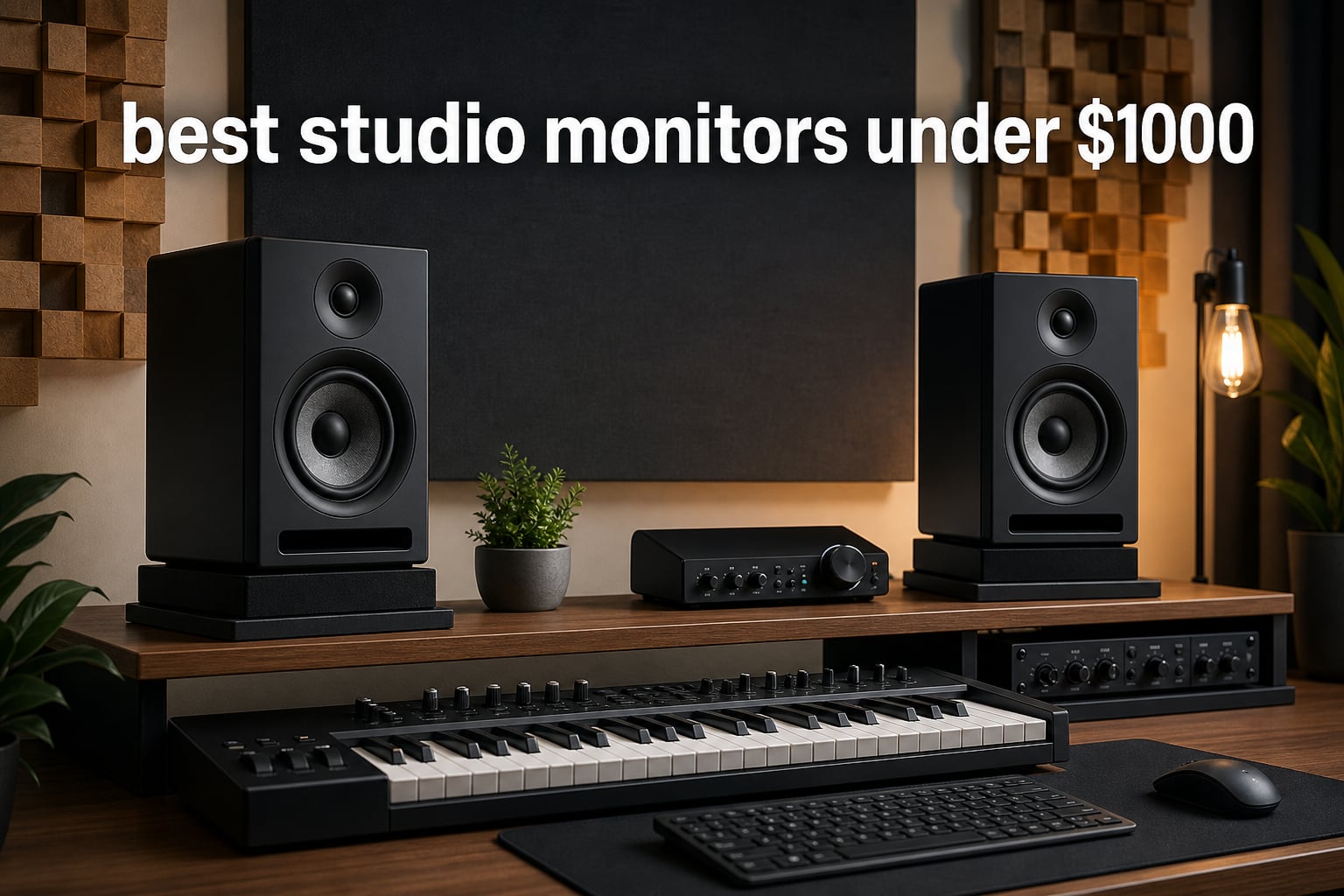
The best studio monitors under $1000 are the ones that let you hear balance problems before the mix leaves your room. A useful monitor is not supposed to make every track exciting; it should make vocal level, low-end buildup, harshness, and panning decisions easier to judge.
For this guide, I compared all 12 supplied powered studio monitors by driver size, published frequency response, amplification, connections, room-adjustment features, and whether the listing is for one monitor or a stereo pair. My main picks are the ADAM Audio A7V for a full-featured nearfield, the Kali Audio LP-6 V2 for a front-ported 6.5-inch option, and the PreSonus Eris 3.5 for a compact entry setup.
There is no monitor that can repair a bare, square room. Forum discussions from mixers keep returning to the same practical point: mix translation matters more than a flattering first listen, so speaker placement, level matching, and basic absorption deserve attention alongside the monitors.
All picks below are active studio monitors or powered monitor systems, meaning amplification is built in. That keeps a home studio setup simpler, but it also means each monitor needs power and its own signal connection where applicable.
Table of Contents
Top 3 Picks Answer the Main Question
My short answer is the ADAM Audio A7V for producers who need a 7-inch nearfield with DSP-based tuning, the Kali Audio LP-6 V2 for people who need a front port and flexible analog inputs, and the PreSonus Eris 3.5 for close desktop work. Choose by room and listening distance first, then by features.
- ADAM Audio A7V: Best for detailed nearfield mixing with a 7-inch low-frequency driver, rotatable X-ART high-frequency driver, and DSP tuning.
- Kali Audio LP-6 V2: Best value for a medium-size workstation needing a 6.5-inch woofer, front port, boundary EQ, and XLR, TRS, and RCA inputs.
- PreSonus Eris 3.5: Best compact pick for a desk, with a pair format, high and low acoustic tuning, and a front headphone output.
Best Studio Monitors Under $1000 in 2026 at a Glance
This overview covers every product in the supplied data, including listings sold as pairs and listings sold individually. Confirm the listing format before ordering a stereo setup, especially for the T5V, A7V, and LP-6 V2.
| Product | Specifications | Action |
|---|---|---|
 Yamaha HS5 Pair Yamaha HS5 Pair |
|
Check Latest Price |
 KRK Classic 5 Pair KRK Classic 5 Pair |
|
Check Latest Price |
 Yamaha HS3 Pair Yamaha HS3 Pair |
|
Check Latest Price |
 JBL 305P MkII Pair JBL 305P MkII Pair |
|
Check Latest Price |
 Edifier MR3 Pair Edifier MR3 Pair |
|
Check Latest Price |
 ADAM Audio T5V ADAM Audio T5V |
|
Check Latest Price |
 KRK ROKIT 8 G5 Pair KRK ROKIT 8 G5 Pair |
|
Check Latest Price |
 ADAM Audio D3V Pair ADAM Audio D3V Pair |
|
Check Latest Price |
 PreSonus Eris 3.5 Pair PreSonus Eris 3.5 Pair |
|
Check Latest Price |
 iLoud MTM MKII Pair iLoud MTM MKII Pair |
|
Check Latest Price |
 ADAM Audio A7V ADAM Audio A7V |
|
Check Latest Price |
 Kali Audio LP-6 V2 Kali Audio LP-6 V2 |
|
Check Latest Price |
1. Yamaha HS5 Is Best for Straightforward Small-Room Reference
YAMAHA Hs5 Powered Studio Monitor, Pair
5 inch woofer
54 Hz to 30 kHz
70 watt bi-amp
Pros
- Pair included
- XLR and TRS inputs
- 54 Hz to 30 kHz response
- 70 watt bi-amp
Cons
- Limited deepest bass
- Heavy pair
The Yamaha HS5 pair is a clear fit for a close nearfield position where a 5-inch cone is more sensible than a large woofer. Its published 54 Hz to 30 kHz response and 45-watt low-frequency plus 25-watt high-frequency bi-amplification make it a focused option for production and studio monitoring.
I like that the listing includes both monitors and accepts balanced or unbalanced signals through XLR and TRS phone inputs. That makes connection to an interface direct, without adding adapters for a basic balanced setup.
The best placement is close and symmetrical
Put the HS5s at ear height in an equal-sided triangle with your listening position. Their 5-inch drivers suit a desk or small studio better than an attempt to fill a large untreated room.
The main limitation is very low bass
A 54 Hz stated low end is useful context, not a promise to hear sub-bass decisions perfectly. Check bass-heavy work on headphones or a second system, and consider a subwoofer only after placement and treatment are working.
2. KRK Classic 5 Is Best for Adjustable Nearfield Voicing
KRK Classic 5 Near-Field 2-Way Studio Monitor, Black (Pair)
5 inch woofer
Class A/B bi-amp
HF and LF controls
Pros
- Pair included
- High and low controls
- Class A/B amplification
- Waveguide tweeter
Cons
- Plastic enclosure
- 5 inch bass limits
The KRK Classic 5 pair puts adjustment front and center. High- and low-frequency controls, a flat low-frequency setting, and an optional plus-2 dB bass boost give a producer ways to adapt the speaker response rather than treating one setting as correct for every desk.
Its custom bi-amped Class A/B amplifier and soft-dome tweeter with optimized waveguide are the useful technical story here. The supplied data also describes a glass-aramid composite woofer aimed at clear midrange and tight bass.
The best use is learning one repeatable setting
Start with the flat low-frequency adjustment and neutral high-frequency position, then work with familiar reference tracks. Change one control at a time and live with it before deciding whether the room or the monitor is causing a problem.
The connection plan should stay balanced
The listing data does not make input details as complete as several rivals, so verify your cables before committing. When your interface offers balanced outputs, keep the monitor chain balanced where the monitor supports it.
3. Yamaha HS3 Is Best for a Very Small Desktop Setup
Yamaha HS3 Powered Studio Monitor in Black, Pair (HS3 B)
3.5 inch woofer
70 Hz to 22 kHz
XLR TRS RCA mini
Pros
- Pair included
- Room and high trim controls
- Many input types
- Cables included
Cons
- 70 Hz low end
- 26 watt output
The Yamaha HS3 pair is made for the producer whose speakers must live close to a screen and close to the ears. It uses a 3.5-inch cone woofer, 0.75-inch dome tweeter, and a stated 70 Hz to 22 kHz response, so it is better treated as a compact reference than a bass-monitoring solution.
Room Control and High Trim are practical on a desk, where walls and desktop reflections often shape what you hear. XLR/TRS combo, RCA, and stereo mini inputs also make it unusually easy to move between an audio interface and everyday sources.
The best desk setup uses the included isolation pads
Use the included anti-slip pads, angle the speakers toward your ears, and avoid placing them flat on the desk. A little separation from the wall and a sensible listening level will tell you more than simply turning small speakers louder.
The bass check belongs on another system
The HS3’s stated response reaches 70 Hz at minus 10 dB, which is a fair reminder to verify kick and sub content elsewhere. It remains useful for editing, arrangement, podcast production, and level decisions at close range.
4. JBL 305P MkII Is Best for a Wide Listening Window
(2) JBL 305P MkII 5″ 2-Way Active Powered Studio Reference Monitors Speakers
5 inch woofer
Dual 41 watt Class D
Image Control Waveguide
Pros
- Pair included
- Wide sweet spot
- Boundary EQ
- 5 year warranty
Cons
- 5 inch woofer
- Room still matters
The JBL 305P MkII pair is a strong candidate when you cannot keep your head perfectly still while working. Its Image Control Waveguide is specifically designed to give a wide sweet spot, while the 5-inch woofer and Slip Stream port handle the low-frequency portion of this two-way active design.
Dual 41-watt Class-D amplifiers drive the pair, and Boundary EQ plus HF Trim offer basic room adaptation. XLR and quarter-inch TRS inputs make this an easy match for typical interface outputs.
The best benefit is stable stereo imaging
Set the monitors equidistant from your ears and toe them in until center vocals lock into place. The waveguide can help retain a usable image as you move, but accurate left-right placement still comes from symmetry.
The room controls should correct placement effects
Use Boundary EQ only after you have tried to pull the monitors away from a wall. EQ is helpful for a real constraint, but it is not a substitute for moving the desk or adding absorption at first reflection points.
5. Edifier MR3 Is Best for Computer-Friendly Connectivity
Edifier MR3 Powered Studio Monitor, Speaker Hi-Res Active Bluetooth Speaker
52 Hz to 40 kHz
Balanced TRS
Bluetooth 5.4
Pros
- Pair included
- Balanced TRS and RCA
- Headphone output
- App EQ
Cons
- 92.5 dB peak SPL
- Plastic listed enclosure
The Edifier MR3 pair bridges desktop convenience and monitoring-oriented features. It has a stated flat response from 52 Hz to 40 kHz, balanced TRS, RCA, and AUX inputs, plus a headphone output for a small computer-based workstation.
Bluetooth 5.4 with multi-point connection is convenient for casual playback, while Music, Monitor, and Custom modes plus app EQ give the system more flexibility than a basic powered speaker. For serious mixing, I would still feed it from a wired interface through the balanced TRS input.
The best workflow separates reference work from convenience
Use Monitor mode and a wired source for decisions you intend to translate. Bluetooth can stay useful for checking a track as a listener might hear it, but wireless playback is not the reference path.
The output level suits close listening
The MR3 is listed at 18 watts RMS per channel and a 92.5 dB peak SPL. That points toward a desk or compact room rather than a loud, distant monitoring position.
6. ADAM Audio T5V Is Best for Ribbon-Tweeter Detail on a Desk
ADAM Audio T5V Studio Monitor
Single monitor
U-ART tweeter
45 Hz to 25 kHz
Pros
- Detailed U-ART tweeter
- DSP shelf filters
- XLR TRS RCA
- T10S compatible
Cons
- Sold singly
- Rear port needs clearance
The ADAM Audio T5V is sold as a single monitor, so a stereo system requires two units. Its 5-inch polypropylene woofer, U-ART 1.9-inch tweeter, HPS waveguide, and published 45 Hz to 25 kHz response make it a serious nearfield option for a producer who prioritizes high-frequency detail.
The monitor offers 70 watts RMS, DSP-based high- and low-shelf filters, and XLR, quarter-inch TRS, and RCA connectivity. It also has a rear bass-reflex port, which matters when the desk is near a wall.
The best setup leaves breathing room behind the cabinet
Give the rear port room instead of pushing the T5V tight against a wall. If that placement cannot change, use the shelf filters carefully and cross-check low-end decisions on familiar material.
The subwoofer path is already defined
The T5V is compatible with the ADAM T10S subwoofer. Add a sub only when your room and monitoring habits support calibrating it; uncontrolled sub-bass can make translation worse, not better.
7. KRK ROKIT 8 Generation Five Is Best for Larger Nearfield Space
KRK RP8G5 ROKIT 8 Generation Five 8″ Powered Studio Monitor Pair, 8 Inches
8 inch Kevlar woofer
25 EQ combinations
Pair with isolation pads
Pros
- Pair included
- 8 inch Kevlar woofer
- 25 EQ combinations
- Foam pads included
Cons
- Large and heavy
- Needs room to work
The KRK ROKIT 8 Generation Five pair is the big-driver option in this list. Each monitor uses an 8-inch woven Kevlar aramid-fiber woofer, and the system provides 25 boundary and tuning EQ combinations for producers who need to adapt to a real room rather than an ideal control room.
The low-diffraction baffle design is intended to support stereo imaging, while the included acoustic foam wedge isolation pads make a sensible starting point for desk placement. XLR and quarter-inch TRS combo inputs suit standard interface connections.
The best room is not the smallest room
An 8-inch woofer can excite room modes more strongly than a small monitor, especially near walls and corners. Choose this pair when you can sit farther back, place speakers thoughtfully, and address bass buildup rather than expecting the EQ choices to solve everything.
The best starting EQ is still the neutral one
Begin with the flattest appropriate setting and reference tracks you know well. The 25 combinations are useful when placement creates a repeatable issue, but frequent switching makes it harder to learn your monitoring reference.
8. ADAM Audio D3V Is Best for USB-C Desktop Production
ADAM Audio D3V Active Desktop Studio Monitor Speakers – Black
USB-C pair
D-ART ribbon tweeter
DSP room switches
Pros
- USB-C plug and play
- Ribbon tweeter
- Angled stands
- Passive radiators
Cons
- Small 3.5 inch woofers
- Desktop scale
The ADAM Audio D3V pair is designed around a computer-first workflow. USB-C plug-and-play connection, balanced quarter-inch TRS inputs, a 1.5-inch D-ART ribbon tweeter, and DSP-powered room correction switches make it a purposeful compact monitoring system rather than just a pair of computer speakers.
Each speaker has a 3.5-inch aluminum woofer, dual-sided passive radiators, and 80 watts of amplifier power. The included detachable 15-degree angled stands and microphone-stand thread also help when desk height is not ideal.
The best connection is direct USB-C for a simple workstation
USB-C can reduce desktop clutter when your computer is the only source. Use balanced TRS when you need to route through an interface, add hardware, or maintain a more conventional studio signal path.
The best expectation is close-range accuracy
Passive radiators can support the small cabinet, but driver size still sets physical limits. Keep the D3V close, aim the ribbon tweeters at ear level, and check low-frequency balance on a second reference.
9. PreSonus Eris 3.5 Is Best for an Entry-Level Stereo Desk
PreSonus Eris 3.5 Powered Studio Monitors, Pair — 3.5” Active Near
Stereo pair
3.5 inch woofer
50 watt Class AB
Pros
- Pair included
- TRS RCA and aux
- Acoustic tuning
- Headphone amplifier
Cons
- 80 Hz low end
- Compact output
The PreSonus Eris 3.5 pair is the compact starting point for beginners who need proper left-right monitoring rather than a single consumer speaker. It combines 3.5-inch woven-composite woofers, 1-inch silk-dome tweeters, 50 watts total Class AB amplification, and a published 80 Hz to 20 kHz response.
Balanced TRS, RCA, and a front-panel auxiliary input cover common sources, while high- and low-frequency acoustic tuning and the integrated headphone amplifier support a practical desk workflow. The limited low-frequency extension simply means it should not be your only source for checking deep bass.
The best use is learning mix fundamentals
Use the Eris 3.5 to build habits around vocal balance, arrangement, editing, and panning at moderate volume. Compare regularly with familiar headphones and a consumer playback device to understand what the small monitors reveal.
The best placement keeps the front panel accessible
The front aux input and headphone output are useful when the speakers sit within reach. Put each monitor on a stand or isolation pad if possible, and make their spacing at least as deliberate as their connections.
10. iLoud MTM MKII Is Best for Built-In Room Calibration
IK Multimedia iLoud MTM MKII (Pair Plus ARC mic) Compact Studio Monitor with Built-in ARC Room Correction, Speaker Emulation, 200W Power
Pair plus ARC mic
36 Hz to 32 kHz
200 watts
Pros
- ARC calibration included
- Linear phase
- Speaker emulation
- USB XLR aux
Cons
- Compact drivers
- Fewer reviews
The IK Multimedia iLoud MTM MKII pair stands apart because it includes an ARC microphone and built-in ARC room correction. Its MTM layout uses 3-inch midwoofers around a 1-inch tweeter, with linear-phase time alignment and a listed 36 Hz to 32 kHz ultra-flat response.
It also brings 200 watts of total power, ARC X speaker-emulation software, USB, XLR, and auxiliary inputs. Desktop stands and mic-stand mounting points mean it can fit a small production desk without forcing a conventional large-monitor layout.
The best reason to choose it is a constrained room
Room calibration is particularly useful when your desk must stay where it is. Run the supplied calibration carefully, then still use basic treatment and sensible placement because software cannot remove every reflection or bass null.
The best workflow uses emulation as a second opinion
Speaker emulation can help you compare a mix perspective, not replace genuine checks on other systems. Keep your main calibrated response as the decision-making reference and use alternate voicings sparingly.
11. ADAM Audio A7V Is Best for Detailed 7-Inch Nearfield Mixing
ADAM Audio A7V 7-inch Powered Studio Monitor
Single 7 inch monitor
X-ART tweeter
DSP based tuning
Pros
- 7 inch low-frequency driver
- Rotatable waveguide
- DSP tuning
- 24-bit conversion
Cons
- Sold singly
- Small review sample
The ADAM Audio A7V is my editor’s choice for a producer who wants a 7-inch powered nearfield and is ready to build a stereo pair from two individual monitors. The supplied specifications list DSP-based tuning, a rotatable HPS waveguide, a rotatable X-ART high-frequency driver, 24-bit A/D conversion, and a 96 kHz sampling rate.
The 7-inch low-frequency driver provides more physical scale than the 5-inch options, while the rotatable waveguide gives flexibility for vertical or horizontal positioning. That does not mean any orientation will work at any desk; mirror the two speakers and preserve tweeter-to-ear alignment.
The best fit is critical detail with room adjustment
Choose the A7V if ribbon-tweeter detail, a larger woofer, and DSP tuning match your working priorities. It is especially sensible for nearfield music production where you can provide a stable stand position and an intentional listening triangle.
The purchase decision requires pair planning
The listing is for one monitor, not a pair. Account for two matching units, appropriate cables, and stands or isolation before comparing this option to pair listings.
12. Kali Audio LP-6 V2 Is Best for Front-Ported 6.5-Inch Monitoring
KALI AUDIO LP-6 V2 6.5″ Project Lone Pine Powered Studio Monitor – Low-Noise Bi-Amped Professional Studio Speaker for Music Production – 80W, 115dB Max SPL – TRS, RCA, XLR Inputs – Single, Black
Single monitor
6.5 inch woofer
80 watt front port
Pros
- Front port
- Boundary EQ
- XLR TRS RCA
- 115 dB max SPL
Cons
- Sold singly
- 15.5 pound cabinet
The Kali Audio LP-6 V2 is a compelling 6.5-inch powered studio monitor for a producer who needs a front-ported cabinet. It is sold individually, uses an 80-watt bi-amped design with a 1-inch tweeter, states a 47 Hz to 21 kHz response, and is rated to 115 dB maximum SPL.
Updated boundary EQ provides room-placement choices, while XLR, TRS, and RCA inputs cover interfaces and uncomplicated desktop sources. Kali also reports a low-noise design with 12 dB noise reduction, an important practical feature when your ears sit close to the monitors.
The best placement favors the front port
A front port can be helpful when rear-wall clearance is limited, though it does not make corner placement harmless. Leave space where you can, use the boundary EQ as a measured correction, and test familiar kick and bass material.
The best buyer wants medium-size nearfields
The LP-6 V2 sits between compact 5-inch options and 8-inch monitors in physical scale. Buy two for stereo, then use the 6.5-inch drivers at an appropriate listening distance rather than trying to fill a large room from a desk.
The Best Buying Guide Starts with Your Room
Choose woofer size by listening distance and room behavior, not by the idea that bigger always sounds more professional. A 3.5-inch model works close to you on a desk, 5- to 7-inch nearfield studio monitors cover many home studios, and an 8-inch model needs enough space and bass control to avoid exaggerating room modes.
The correct first setup forms an equal triangle
Place the tweeters at ear height and make the distance between the monitors roughly equal to the distance from either monitor to your head. Toe them in toward you, keep the left and right sides as symmetrical as possible, and avoid putting one monitor beside an open space while the other is against a wall.
Use isolation pads or stands to reduce desk vibration. Keep a few inches of clearance where the cabinet design needs it, especially with rear-ported models such as the ADAM T5V.
The right inputs are balanced when your interface supports them
XLR and quarter-inch TRS connections are the usual balanced choices for an audio interface. RCA, AUX, USB-C, and Bluetooth add convenience, but use the most direct stable wired path for mixing monitors when accuracy is the goal.
Turn monitors on only after your interface volume is low, then bring the level up gradually. This simple routine avoids surprises and makes it easier to keep a consistent monitoring level from session to session.
DSP helps placement but does not replace treatment
DSP room correction, boundary EQ, HF trim, and shelf filters can reduce predictable placement effects. The iLoud MTM MKII provides ARC calibration, while the ADAM and KRK models here offer DSP or EQ-based adjustment options.
Those tools cannot fully fix early reflections, a deep bass null at your chair, or an unevenly shaped room. Start with speaker placement and basic absorption at side-wall reflection points; then make small, repeatable monitor adjustments while checking reference tracks.
Two-way monitors are the straightforward choice for nearfields
A two-way monitor divides the signal between a woofer and a tweeter. Every product in this roundup uses a two-way approach or an MTM variation, so the design is familiar, compact, and sensible for a close listening position.
A three-way monitor adds a dedicated midrange driver, which can reduce the range each driver covers. It can be useful in the right room, but it is not automatically better for a small desk; placement, crossover design, and room acoustics remain more important than driver count alone.
A subwoofer is useful only when it can be integrated
Add a subwoofer when you need to hear the lowest octave and can place, calibrate, and cross-check it. The ADAM T5V’s stated T10S compatibility is one example of a defined upgrade path.
Do not add a sub merely because a smaller monitor does not feel exciting. A poorly integrated sub can disguise kick-bass relationships, while a well-placed nearfield pair plus good references often delivers more dependable mix decisions.
The final choice should prioritize translation
Read the specifications, but spend your first weeks with familiar tracks and your own past mixes. Producers in forum discussions repeatedly describe translation as the target: if your decisions hold up on headphones, cars, and ordinary speakers, the reference is doing its job.
Keep notes about what each monitor reveals and compare at moderate volume. Over time, that learned reference is more useful than chasing a monitor that sounds impressive in the first five minutes.
The FAQ Answers Common Studio-Monitor Questions
What are the best studio monitors under $1000?
The strongest choices depend on room and workflow. The ADAM Audio A7V suits detailed 7-inch nearfield mixing, the Kali Audio LP-6 V2 combines a front port with boundary EQ, and the PreSonus Eris 3.5 suits compact desktop work. Choose a pair or two single monitors based on the product listing.
Which studio monitors are best for mixing under 1000 dollars?
For mixing, prioritize stable placement, balanced inputs, known reference tracks, and room adjustment over exaggerated bass. The ADAM A7V offers DSP tuning and a rotatable X-ART driver, while the Kali LP-6 V2 offers a 6.5-inch woofer, front port, and boundary EQ. Both single-monitor listings require two units for stereo.
What is the best budget studio monitor for professional mixing?
The Kali Audio LP-6 V2 is a strong value-focused option because it provides 80-watt bi-amplification, a 6.5-inch woofer, front port, boundary EQ, and XLR, TRS, and RCA inputs. The PreSonus Eris 3.5 is a more compact pair for close desktop work, but its stated 80 Hz low end requires extra bass checking.
How do you choose studio monitors for a home studio?
Match driver size to your room and listening distance, then check whether the monitor is sold as a pair or singly. Set monitors in an equal triangle at ear height, use balanced connections from an interface when available, and treat room correction as a finishing adjustment after placement and basic acoustic treatment.
What is the difference between 2-way and 3-way studio monitors?
A 2-way monitor uses a woofer and tweeter, splitting bass and mids from high frequencies. A 3-way monitor adds a dedicated midrange driver, which can divide the workload more narrowly. Three-way designs are not automatically better in a small room; placement, crossover implementation, room acoustics, and learned reference matter more.
The Best Final Choice Is the Monitor You Can Learn
The best studio monitors under $1000 in 2026 are not one-size-fits-all. Pick the A7V for a detailed 7-inch DSP-capable nearfield, the LP-6 V2 for a front-ported 6.5-inch design with flexible inputs, or a compact pair such as the Eris 3.5 or HS3 when your work happens close to a desk.
Set them up carefully, use familiar music, and verify important low-end choices on another reference. That repeatable process gives your music production speakers the best chance of helping mixes translate.