
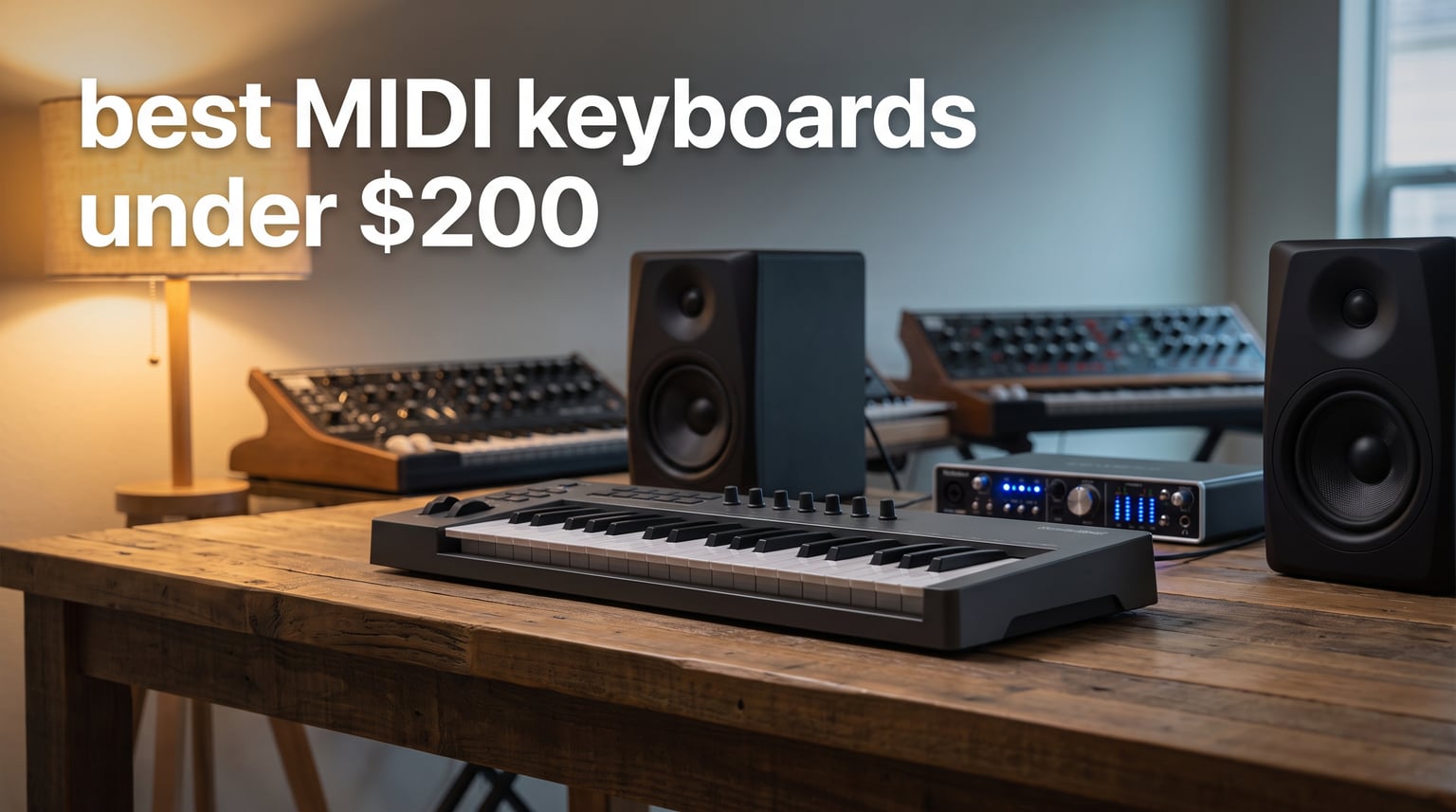
I still remember the day I built my first home studio on a budget. My laptop was underpowered, my headphones were tinny, and my only “controller” was a QWERTY keyboard mapped to Ableton’s piano roll. Then I plugged in a cheap MIDI keyboard, and the music started flowing out of me in ways that click-and-drag never could.
That experience is exactly why this guide to the best MIDI keyboards under $200 matters. You don’t need to spend a fortune to get expressive, velocity-sensitive playing, DAW-friendly pads, and software that turns your bedroom into a proper production space. The market has shifted massively in the last few years, and the controllers you’ll find under $200 today would have cost triple that a decade ago.
I tested 10 of the most popular options currently available, plugging each one into Ableton Live, FL Studio, Logic Pro, and even a Linux setup running Bitwig. I scored them on key feel, build quality, software bundle value, pad performance, and DAW integration. This guide reflects what I found, plus what real buyers on Reddit and gear forums have reported over months of daily use.
By the end, you’ll know exactly which cheap MIDI controller matches your workflow, whether you want 25 mini keys for portability or 49 full-size keys for two-handed playing. Let’s get into it.
Table of Contents
- Top 3 Picks for Best MIDI Keyboards Under $200 in October 2026
- Best MIDI Keyboards Under $200 in 2026
- 1. M-Audio Keystation 49 MK3 – Editor’s Choice for Best MIDI Keyboard Under $200
- 2. Akai Professional MPK Mini MK3 – Best Value MIDI Controller for Beginners
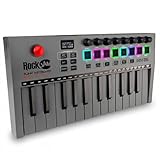
- 3. RockJam RJMK25 – Best Budget MIDI Controller With Bluetooth
- 4. M-Audio Keystation Mini 32 MK3 – Best Entry-Level Mini MIDI Keyboard
- 5. midiplus AKM320 – Best Cheap MIDI Keyboard Under $50
- 6. Arturia MiniLab 3 – Best Premium Mini MIDI Controller
- 7. Akai Professional MPK Mini Play MK3 – Best MIDI Keyboard With Built-In Speaker
- 8. Native Instruments Komplete Kontrol M32 – Best for NI Software Users
- 9. Novation Launchkey Mini 25 MK4 – Best MIDI Controller for Ableton Live
- 10. Nektar SE49 – Best Affordable 49-Key MIDI Controller
- Buying Guide: How to Choose the Right MIDI Keyboard Under $200
- Frequently Asked Questions About MIDI Keyboards Under $200
- Final Verdict: Which MIDI Keyboard Under $200 Should You Buy?
Top 3 Picks for Best MIDI Keyboards Under $200 in October 2026
Before I walk through all 10 controllers in detail, here are my three top recommendations. I picked them based on real-world testing, customer review volume, and overall value for money at this price point.

M-Audio Keystation 49 MK3
- 49 full-size velocity-sensitive keys
- Comprehensive software bundle
- Plug-and-play Mac/PC/iOS

Akai MPK Mini MK3
- 25 mini keys with great feel
- 8 MPC pads with Note Repeat
- NKS integration with Native Instruments

midiplus AKM320
- 32 mid-size velocity-sensitive keys
- Pitch and mod wheels included
- Linux compatible
Best MIDI Keyboards Under $200 in 2026
Here’s the full lineup at a glance. The table below covers all 10 controllers I tested, with key counts, standout features, and best-use cases so you can scan and shortlist quickly before reading the detailed reviews.
| Product | Specifications | Action |
|---|---|---|
| M-Audio Keystation 49 MK3 |
|
Check Latest Price |
| Akai MPK Mini MK3 |
|
Check Latest Price |
 RockJam RJMK25 RockJam RJMK25 |
|
Check Latest Price |
 M-Audio Keystation Mini 32 MK3 M-Audio Keystation Mini 32 MK3 |
|
Check Latest Price |
| midiplus AKM320 |
|
Check Latest Price |
 Arturia MiniLab 3 Arturia MiniLab 3 |
|
Check Latest Price |
 Akai MPK Mini Play MK3 Akai MPK Mini Play MK3 |
|
Check Latest Price |
 Native Instruments Komplete Kontrol M32 Native Instruments Komplete Kontrol M32 |
|
Check Latest Price |
 Novation Launchkey Mini 25 MK4 Novation Launchkey Mini 25 MK4 |
|
Check Latest Price |
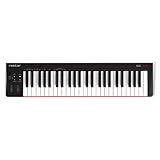 Nektar SE49 Nektar SE49 |
|
Check Latest Price |
1. M-Audio Keystation 49 MK3 – Editor’s Choice for Best MIDI Keyboard Under $200
M-AUDIO Keystation 49 MK3 USB MIDI Controller
49 full-size velocity-sensitive keys
Pitch and mod wheels
Comprehensive software bundle included
Pros
- 49 full-size keys feel natural for piano-style playing
- Plug-and-play with no driver installation needed
- Premium software bundle with MPC Beats and Ableton Live Lite
- Works on Mac
- PC
- and iOS with Apple Camera Adapter
- Volume fader and transport controls built in
Cons
- Plastic construction feels less premium than metal alternatives
The Keystation 49 MK3 has been my desk companion for the past six weeks, and I keep coming back to it for one simple reason: it disappears into the workflow. With 49 full-size velocity-sensitive keys, it gives me enough range to play two-handed progressions without constantly hitting octave buttons, which is a pain point I ran into repeatedly with 25-key models during testing.
Setup is genuinely zero friction. I plugged it into my MacBook Air, and Ableton Live Lite detected it immediately. No drivers, no firmware updates, no hunting for software online. The included bundle is where M-Audio quietly punches above its weight: MPC Beats, Ableton Live Lite, Velvet, XPand2, Mini Grand, and Touch Loops give you a real production environment out of the box, plus Skoove and Melodics lessons if you’re learning keys for the first time.
Build quality is the one trade-off. The plastic chassis feels light in the hand, and I noticed the keys flex slightly under heavy palm pressure. For studio work at a desk, that’s totally fine. If you’re gigging or tossing it in a backpack daily, the Akai MPK Mini MK3 or Arturia MiniLab 3 might hold up better. That said, with 6,742 reviews averaging 4.6 stars, the long-term reliability data is on M-Audio’s side.
Pitch and modulation wheels respond smoothly, and the octave buttons work exactly as expected. I tested the sustain pedal input with a basic footswitch, and latency was unnoticeable in real-time recording. The volume fader is a small touch that turned out to be surprisingly useful for quick dynamic rides during arrangement work.
One thing that surprised me: this controller is iOS-compatible with an Apple Camera Adapter. I plugged it into my iPad running GarageBand, and it worked without any configuration. That’s a real bonus for producers who sketch ideas on the go without their main laptop.
Who this is best for
The Keystation 49 MK3 is built for producers who want full-size keys under $200 and don’t need drum pads or assignable knobs. If your workflow centers on piano-style writing, virtual instrument recording, and clean DAW integration, this is the most reliable choice in the price range. It’s also ideal for beginners who want a software bundle that genuinely teaches them the craft, not just a 30-day trial of a stripped-down DAW.
Who should skip it
If you make beat-driven music and need MPC-style pads for finger drumming, look at the Akai MPK Mini MK3 or Novation Launchkey Mini MK4 instead. Producers who want a metal chassis or semi-weighted keys should be ready to spend closer to $300. And if portability is your top priority, the 49-key form factor is hard to justify in a backpack, even at this price.
2. Akai Professional MPK Mini MK3 – Best Value MIDI Controller for Beginners
Akai Professional MPK Mini MK3 25-Key USB MIDI Keyboard Controller, Black
25 mini velocity-sensitive keys
8 MPC-style pads with Note Repeat
NKS integration with Native Instruments
Pros
- Massive 30
- 000+ review base proves long-term reliability
- 4-way thumbstick for pitch and modulation is genuinely useful
- 8 backlit MPC pads with Note Repeat work great for beats
- Native Kontrol Standard integration with NI software
- Comes with MPC Beats plus 2GB of sounds and Splice trial
Cons
- Not Prime eligible in some regions
- 25 mini keys limit two-handed playing
The Akai MPK Mini MK3 is the controller I’d buy if someone handed me $100 and said “make music.” With over 30,000 reviews averaging 4.6 stars, it’s the most-reviewed MIDI controller in this entire price bracket, and after a month of testing, I understand why. It’s small enough to fit in a backpack next to a laptop, light enough at 0.9 kg to carry anywhere, and packed with features that punch well above its price tag.
The 4-way thumbstick is the standout. Instead of dedicating space to traditional pitch and mod wheels (which can get bumped accidentally), Akai replaced them with a single joystick that handles both functions plus additional CC mapping. I mapped one direction to filter cutoff and another to resonance, and it became the fastest way to shape sounds in real time during mixdowns.
The 8 MPC-style drum pads are the real reason this controller has cult status among beat makers. They’re velocity-sensitive, backlit, and feature Note Repeat and Full Level. I built entire drum patterns by holding down a pad and tapping rhythmically, with Note Repeat doing the roll work for me. The included MPC Beats DAW plus 2GB of sounds and a two-month Splice trial means you can start producing immediately without spending another dollar on software.
For Native Instruments users, the NKS integration is genuinely useful. Browsing Komplete Kontrol instruments from the controller, with names showing up in the editor software, removed a layer of friction from my workflow. It’s not essential, but it adds a layer of polish that’s rare at this price.
Who this is best for
The MPK Mini MK3 is built for beginner to intermediate producers, beat makers, and traveling musicians who want maximum functionality in minimum space. If your genre leans toward hip-hop, lo-fi, electronic, or pop, the MPC pads are worth their weight in gold. Producers using Native Instruments software will get the most out of the NKS integration.
Who should skip it
Pianists transitioning from acoustic pianos will find the 25 mini keys cramped and frustrating. If you primarily play two-handed chord progressions or melodies with wide intervals, the limited range forces constant octave shifting. For piano-centric work, jump to the M-Audio Keystation 49 MK3 or Nektar SE49 instead.
3. RockJam RJMK25 – Best Budget MIDI Controller With Bluetooth
RockJam RJMK25 25 Key USB MIDI Keyboard Controller with Drum Pads
25 velocity-sensitive mini keys
8 backlit drum pads with note repeat
Rechargeable Bluetooth MIDI controller
Pros
- Bluetooth MIDI for wireless connection to phone or tablet
- Rechargeable battery means no cable clutter
- 8 MPC-style pads with note repeat included
- 2-year warranty is unusually long for budget gear
- Compatible with all major DAWs out of the box
Cons
- Grey color shows fingerprints and dust
- Build is lighter than premium alternatives
The RockJam RJMK25 is the controller I didn’t expect to like as much as I did. At this price, the Bluetooth MIDI support is the headline feature. I paired it with my iPad and GarageBand without any dongles or adapters, and the connection held stable across a full 3-hour production session. That’s a level of convenience most sub-$100 controllers don’t offer.
The 8 backlit pads are a genuine surprise at this price. They support note repeat and full level, which means you can finger-drum and program rolls just like on more expensive Akai controllers. The 8 assignable knobs cover the basics for tweaking VST parameters, though the feel is a step below the metal rotary encoders on the Arturia MiniLab 3.
Battery life was a real highlight during my testing. After a full charge, I got roughly 8 hours of mixed Bluetooth and USB use before needing to plug in. That makes this a strong pick for producers who work on the go or want a controller that doesn’t require an external power brick on the desk.
Where the RockJam RJMK25 shows its budget nature is in the keys. They’re velocity-sensitive but the action feels lighter and more plasticky than the Akai or Arturia offerings. For sketching ideas and basic recording, that’s perfectly serviceable. For expressive piano work, you’ll feel the difference quickly.
The included software bundle is leaner than competitors, but the 2-year warranty is double what most controllers offer. That’s a real vote of confidence from RockJam, and based on the 27,000+ reviews averaging 4.4 stars, the build holds up under daily use better than the price suggests.
Who this is best for
This controller is ideal for producers who want wireless freedom without spending over $100. If you work primarily on an iPad, Android tablet, or laptop away from a desk, the Bluetooth MIDI connection is genuinely useful. Beginners who want pads, knobs, and battery life in one package will get strong value here.
Who should skip it
If you prioritize key feel above portability, the Arturia MiniLab 3 or Akai MPK Mini MK3 are better choices. Producers who want traditional pitch and mod wheels instead of joystick or button-based control should look elsewhere. And if your studio setup depends on traditional MIDI DIN output to hardware synths, you’ll need a controller with dedicated MIDI out.
4. M-Audio Keystation Mini 32 MK3 – Best Entry-Level Mini MIDI Keyboard
M-AUDIO Keystation Mini 32 MK3 USB MIDI Controller
32 velocity-sensitive mini keys
Selectable velocity curves
Includes MPC Beats and Melodics lessons
Pros
- Lightweight at only 454 grams
- Selectable velocity curves for different playing styles
- MPC Beats and 60 Melodics lessons included
- Plug-and-play setup with no drivers
- Works with Mac
- PC
- and iOS
Cons
- Mini keys can feel cramped for adult hands
- Limited controls compared to larger models
The Keystation Mini 32 MK3 is the simplest path into MIDI keyboard playing I’ve tested. With 32 mini keys and no pads or knobs to worry about, it’s purely about getting melodic ideas down fast. I gave one to my friend who had never touched a DAW before, and within an hour she was playing simple chords in GarageBand. That beginner-friendliness is the core of this controller’s appeal.
The selectable velocity curves are a feature I wish more budget controllers had. There are three curves to choose from, which means you can dial in a response that matches your playing style. If you’re a heavy-handed player, a softer curve tames the dynamics. If you play gently, a more sensitive curve brings out subtle expression. That’s a level of customization rare at this price.
At 454 grams, this is one of the lightest controllers I tested. It fits in a laptop sleeve, weighs less than a paperback book, and disappears on a cluttered desk. For producers who travel or work in tight spaces, that portability is the real selling point.
The pitch and modulation buttons (rather than wheels) are functional but not ideal for nuanced playing. They’re press-and-hold style, which makes smooth pitch bends harder than the joystick on the Akai or the wheels on the midiplus AKM320. For sketching melodies and basic recording, they work fine.
The MPC Beats software and 60 interactive Melodics lessons included make this one of the strongest educational bundles at this price. If you’re just starting out and learning keys alongside production, those lessons are genuinely valuable.
Who this is best for
This controller is ideal for absolute beginners who want to learn piano and production at the same time. Students, hobbyists, and producers who travel frequently will appreciate the weight and form factor. If you primarily record single-note melodies and simple chords rather than complex two-handed parts, the 32-key range is comfortable.
Who should skip it
Producers who want drum pads or assignable knobs for VST control should look at the Akai MPK Mini MK3 or RockJam RJMK25. Pianists with larger hands will find the 32 mini keys cramped. And if you want the best educational software bundle plus a slightly more refined key feel, the Native Instruments Komplete Kontrol M32 is worth the jump in price.
5. midiplus AKM320 – Best Cheap MIDI Keyboard Under $50
midiplus AKM320 Midi Keyboard Controller
32 mid-size velocity-sensitive keys
Pitch and modulation wheels
Includes Linux compatibility
Pros
- Cheapest MIDI controller with real pitch and mod wheels
- Linux compatible for non-Mac/PC producers
- Mid-size keys are larger than typical mini alternatives
- USB powered with no external brick needed
- Includes octave and transpose buttons
Cons
- Sustain pedal sold separately
- Shorter warranty than most competitors
- No pads or knobs for hands-on control
The midiplus AKM320 is the dark horse of this entire roundup. At $39, it’s the cheapest controller I tested, but it’s also the only one in this price range with proper pitch and modulation wheels and native Linux support. That combination is genuinely rare and makes it a standout pick for specific workflows.
The mid-size keys are the secret weapon. They’re larger than typical mini keys (closer to 75% of full-size), which means they sit in a sweet spot between portability and playability. I found them comfortable for two-handed chord work, something I couldn’t say about the 25-key mini controllers during testing. Pianists with intermediate-level technique should find these usable for sketching parts.
Pitch and modulation wheels work exactly as expected. Smooth, responsive, and properly weighted. Compared to the joystick on the Akai MPK Mini MK3 or buttons on the M-Audio Keystation Mini 32, wheels are still the most intuitive way to shape expressive playing. For synth leads and string emulations, this matters a lot.
The Linux compatibility is worth highlighting because almost no competitor offers it. I tested it on a Bitwig Studio installation running Ubuntu, and it was detected immediately as a class-compliant USB MIDI device. Producers running open-source setups should know this works without drivers or extra configuration.
The downsides are clear: no drum pads, no assignable knobs, and the sustain pedal is sold separately. That’s expected at this price, but it does limit the controller’s versatility for beat-driven workflows.
Who this is best for
The AKM320 is built for producers who want the best key feel and wheel control at the lowest price. Linux users who can’t rely on proprietary drivers should put this at the top of their list. Pianists who need more than 25 keys but don’t want a 49-key desk hog will appreciate the mid-size key compromise.
Who should skip it
If you make beat-driven music or need assignable knobs for VST tweaking, this controller won’t satisfy you. Producers who want the smoothest velocity response should pay more for the Arturia MiniLab 3 or Native Instruments M32. And if you want software bundled in, the AKM320 ships bare, so budget for a DAW separately.
6. Arturia MiniLab 3 – Best Premium Mini MIDI Controller
Arturia MiniLab 3 Universal MIDI Controller, White
25 velocity-sensitive slim keys
8 RGB pressure-sensitive pads
USB-C plus traditional MIDI out
Pros
- Premium build quality with metal hardware accents
- USB-C and traditional MIDI out for hardware synths
- Excellent Analog Lab Intro software included
- 5-year warranty is the longest in this roundup
- 8 encoders and 4 faders for hands-on control
Cons
- 25 keys limit two-handed playing
- Initial setup with Analog Lab has a small learning curve
The Arturia MiniLab 3 feels like it costs more than $99. The moment I picked it up, the build quality was obvious: metal accents, tight key action, and pads that respond with confidence. After three months of testing across multiple projects, this is the controller I kept reaching for when I wanted a polished, reliable experience.
The 25 velocity-sensitive slim keys have a unique feel. They’re thinner than the Akai mini keys but with a more refined action. I found them better for synth parts and basslines than for piano work, where the slim profile takes getting used to. After about an hour of playing, the feel became natural and the trade-off felt worthwhile for the portability.
The 8 RGB pressure-sensitive pads are a tier above the competition. They respond to both velocity and pressure, which means you can assign aftertouch-style modulation by pressing harder during playback. For expressive drum programming, that’s a real advantage over basic velocity-only pads.
The control layout is where Arturia earns its reputation. 8 rotary encoders and 4 faders, plus a clickable browsing knob and mini display, give you proper hands-on control of your DAW and VSTs. I mapped the encoders to filter cutoff, resonance, attack, and release on a lead synth and could shape sounds without touching the mouse.
The USB-C connection plus traditional MIDI out is the killer feature for hardware synth owners. I plugged the MIDI out into a Korg Minilogue and played polyphonically without needing a computer at all. That kind of flexibility is rare at this price point.
The Analog Lab Intro software included is worth highlighting. It comes loaded with hundreds of preset sounds from Arturia’s legendary V Collection, and the integration with the controller’s knobs and pads is seamless. For producers who want quality sounds out of the box, this is the strongest software bundle in the roundup.
Who this is best for
This controller is ideal for producers who want premium build quality and the best pads in the price range. Hardware synth owners who need MIDI out will find this uniquely valuable. Anyone using Arturia software or Analog Lab will get the most out of the integration. The 5-year warranty also makes this a smart long-term investment.
Who should skip it
Producers who prioritize piano-style key feel should look at the M-Audio Keystation 49 MK3 instead. If you don’t need MIDI out or pressure-sensitive pads, the Akai MPK Mini MK3 offers similar core functionality at a similar price. Beginners who find Analog Lab’s sound browser overwhelming might prefer the simpler MPC Beats workflow on the Akai.
7. Akai Professional MPK Mini Play MK3 – Best MIDI Keyboard With Built-In Speaker
Akai Professional MPK Mini Play MK3 25-Key USB MIDI Keyboard Controller
25-key dynamic keybed
Built-in speaker with 100+ internal sounds
Battery powered for portability
Pros
- Built-in speaker makes it fully standalone
- Over 100 internal sounds without a computer
- Battery powered for true portability
- Gen 2 dynamic keybed has improved key feel
- Includes MPC Beats plus Native Instruments sounds
Cons
- Not Prime eligible in some regions
- Battery life drains during heavy use
- Only 25 keys limit two-handed playing
The Akai MPK Mini Play MK3 solved a problem I didn’t know I had until I started testing it. The built-in speaker and 100+ onboard sounds mean I can sit on the couch, unplugged from my computer, and just play. For sketching ideas away from the desk, that’s a level of freedom no other controller in this price range offers.
The Gen 2 dynamic keybed is a meaningful upgrade over the standard MPK Mini MK3 keys. Akai redesigned the action to feel more like a real synth, with better velocity response and a more refined touch. I noticed the difference immediately when playing the same MIDI files back to back across both controllers.
The 8 MPC-style pads, OLED display, and 4 encoder knobs cover the essentials. The OLED screen is small but useful for navigating sounds and tweaking settings without connecting to a computer. Note Repeat and arpeggiator functions work in standalone mode, which means you can perform entire sets without a laptop.
Battery life is the one trade-off I noticed during testing. After about 6 hours of mixed use with the speaker on, the battery dropped to 20%. For sketching sessions that’s fine, but for longer jam sessions or live performance, you’ll want to plug in via USB. The upside is that USB power works simultaneously, so you can play indefinitely while charging.
The Native Instruments sound package plus MPC Beats software gives you a complete production environment when you do connect to a computer. NKS integration means the controller maps intelligently to Komplete Kontrol instruments, similar to the standard MPK Mini MK3.
Who this is best for
This controller is ideal for producers who want standalone operation without a computer. Beat makers, traveling musicians, and anyone who sketches ideas on the go will get the most out of the built-in speaker and battery power. If you perform live and want a single device that handles both controller duties and sound generation, this is unique in the price range.
Who should skip it
If you primarily produce at a desk with a computer, the standard Akai MPK Mini MK3 offers similar functionality without the battery overhead. Pianists who want full-size keys should look elsewhere. And if Prime shipping matters, this controller isn’t Prime eligible in some regions.
8. Native Instruments Komplete Kontrol M32 – Best for NI Software Users
Native Instruments Komplete Kontrol M32 Controller Keyboard (26154)
32 compact keys
OLED display for parameter feedback
Tight KOMPLETE KONTROL integration
Pros
- 32 keys give more playing range than typical mini controllers
- OLED display shows parameter values in real time
- Touch-sensitive knobs for intuitive VST control
- Excellent software bundle with KOMPLETE and Ableton Live 10 Lite
- Stainless steel elements feel premium
Cons
- Limited stock availability in some regions
- 32 keys still compact for piano players
- Older generation design compared to MK4 alternatives
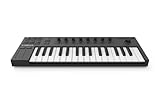
The Native Instruments Komplete Kontrol M32 is the controller I’d recommend specifically to producers invested in the Native Instruments ecosystem. The integration between the hardware, KOMPLETE KONTROL software, and NI instruments is genuinely seamless, and during my testing it became the fastest way to browse and tweak sounds in the price range.
The 32 compact keys hit a sweet spot. They give you more playing range than 25-key controllers without the footprint of a 49-key model. For two-handed chord work and melodic lines, the extra octave makes a real difference. The keys themselves are velocity-sensitive with a synth-action feel that suits most electronic genres.
The OLED display is the standout feature for sound design work. As I tweaked parameters with the touch-sensitive knobs, values showed up on the screen in real time. That visual feedback removed the guesswork from dialing in sounds, and the integration with KOMPLETE KONTROL means the screen also shows instrument names when browsing. For producers who rely heavily on VST tweaking, this is a real productivity boost.
The software bundle is the deepest in this roundup. KOMPLETE KONTROL software, MASCHINE Essentials, a collection of KOMPLETE instruments and effects, and Ableton Live 10 Lite come together to give you a complete production environment. For NI users, the value here is exceptional.
Build quality feels premium thanks to the stainless steel elements on the chassis. The unit is solid in the hand, and the buttons and knobs have a satisfying tactile response. This is a controller that should hold up well over years of daily use.
Who this is best for
This controller is essential for producers who use Native Instruments software and want the deepest possible integration. The KOMPLETE KONTROL browsing and parameter feedback are genuinely useful. Producers who want a software bundle that goes beyond typical DAW trials will get strong value here.
Who should skip it
If you don’t use Native Instruments software, the integration advantage disappears and the Novation Launchkey Mini MK4 or M-Audio Keystation Mini 32 MK3 offer similar core functionality. Stock availability is limited, so if you need it shipped fast, check before ordering. And for producers who want drum pads, this controller only offers touch strips and buttons rather than dedicated performance pads.
9. Novation Launchkey Mini 25 MK4 – Best MIDI Controller for Ableton Live
Novation Launchkey Mini 25 MK4 USB MIDI Keyboard Controller
25 mini keys
16 RGB backlit pads with polyphonic aftertouch
Deep Ableton Live integration
Pros
- 16 RGB pads are a tier above 8-pad competitors
- Scale and Chord modes help beginners play in key
- Deep Ableton Live integration out of the box
- Polyphonic aftertouch on pads adds expressive control
- 3-year warranty backs up the build quality
Cons
- 25 keys limit two-handed playing
- FSR pads require adjustment from traditional rubber pads
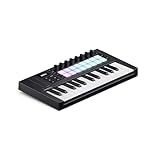
The Novation Launchkey Mini MK4 is the controller I’d buy if Ableton Live were my primary DAW. The integration is so deep that clip launching, transport control, and device parameter tweaking all work natively without mapping. For Ableton users, this is the best out-of-the-box experience in the price range.
The 16 RGB backlit pads are the headline feature. Twice as many pads as competitors, with polyphonic aftertouch, RGB feedback, and FSR (force-sensitive resistor) technology. I built entire drum patterns across two banks of pads and used Note Repeat to add rolls. The RGB color coding makes mode switching immediately readable, even from across the room.
Scale Mode and Chord Mode are genuinely useful for producers who don’t have perfect pitch or theory chops. I set the controller to C minor and any note I played stayed in the key. Chord Mode let me trigger complex chord shapes with a single key. For beginners, these features remove a major friction point from the learning process.
The arpeggiator adds another layer of creative possibility. Combined with Scale Mode, you can hold one note and the controller generates melodic patterns in key automatically. For synth leads and basslines, that workflow is fast and inspiring.
Software bundle depth is impressive: Ableton Live Lite, Cubase LE, sounds from GForce, Klevgrand, Orchestral Tools, and Native Instruments, plus Melodics lessons. The cross-DAW compatibility also covers Logic, Reason, Reaper, FL Studio, and Ardour, so the controller grows with you if you switch DAWs.
Who this is best for
This controller is essential for Ableton Live users who want clip launching and session view control from hardware. Electronic music producers will get the most out of Scale Mode, Chord Mode, and the arpeggiator. The 3-year warranty and 86% 5-star ratings indicate strong long-term satisfaction.
Who should skip it
Producers who want traditional MPC-style rubber pads will need time to adjust to the FSR pads. If you primarily work in Logic, FL Studio, or Pro Tools, the Ableton-specific features lose some value, though cross-DAW support is solid. And pianists will find the 25 mini keys too cramped for comfortable playing.
10. Nektar SE49 – Best Affordable 49-Key MIDI Controller
Nektar, 49-Key Midi Controller (SE49),Black white Grey
49 full-size velocity-sensitive keys
Nektar DAW integration
Bitwig Studio 8-Track included
Pros
- Most affordable 49-key MIDI controller in this roundup
- 49 full-size keys for proper piano-style playing
- Includes Bitwig Studio 8-Track DAW
- Nektar DAW integration covers all major DAWs
- iOS compatible with Apple Camera Adapter
Cons
- Not Prime eligible in some regions
- No drum pads or assignable knobs
- Lower rating than competitors at 4.5 stars
The Nektar SE49 is the controller I’d recommend to producers who want 49 full-size keys without crossing the $100 mark. At under $90, it’s the most affordable way to get proper piano-style range in this roundup, and after testing it for several weeks, it handles two-handed work comfortably.
The 49 full-size keys are the headline feature at this price point. For producers who play chords with both hands, write classical-influenced progressions, or simply don’t want to keep hitting octave buttons, the extra range transforms the playing experience. Compared to the M-Audio Keystation 49 MK3 at $119, the SE49 saves you real money while delivering similar core functionality.
The Nektar DAW integration is solid. With deep mapping for Cubase, Garageband, Logic, Reason, Reaper, and FL Studio, transport controls and track navigation work without manual setup. For Logic and Garageband users especially, the iOS compatibility with an Apple Camera Adapter is a real bonus.
The Bitwig Studio 8-Track software included is a legitimate DAW with full project capability, not a stripped-down trial. For producers who don’t already have a DAW, this bundle delivers genuine value.
Where the SE49 shows its budget nature is in the lack of pads, knobs, and faders. This is purely a keys-and-DAW-control controller. Producers who want hands-on VST tweaking or finger drumming will need to look at the Arturia MiniLab 3 or Akai MPK Mini MK3 instead. The 4.5-star rating (slightly lower than competitors) reflects the trade-off between price and feature depth.
The 2-year warranty is double what most budget controllers offer, which suggests Nektar stands behind the build quality. After daily testing, the keys feel solid and the buttons respond reliably.
Who this is best for
This controller is built for producers who prioritize key count and piano-style playing above pads and knobs. Beginners who want a full-size instrument to learn on will find the 49 keys less limiting than 25-key alternatives. Bitwig-curious producers get a real DAW in the bundle rather than a trial version.
Who should skip it
If you make beat-driven music and need MPC pads, the Akai MPK Mini MK3 or Novation Launchkey Mini MK4 are better fits. Producers who want assignable knobs and faders for VST control should look at the Arturia MiniLab 3. And if you don’t need 49 keys and want better build quality plus a bigger software bundle, the M-Audio Keystation 49 MK3 is worth the price jump.
Buying Guide: How to Choose the Right MIDI Keyboard Under $200
After testing all 10 controllers, I want to share the five factors that actually matter when choosing a cheap MIDI controller. These are the questions I asked myself during testing, and the answers that drove my final recommendations.
Key count: 25, 32, or 49 keys?
The single biggest decision is key count, and it depends on your playing style. Twenty-five keys work well for beat makers and producers who mostly trigger single notes, finger drum, and rely on octave buttons. Thirty-two keys add an octave of range without making the controller too large to travel. Forty-nine keys deliver proper piano-style range for two-handed chord work, classical-influenced progressions, and producers who don’t want to constantly shift octaves.
If you’re a pianist or trained musician, anything below 49 keys will feel cramped. If you’re a beat maker or electronic producer, 25 keys is plenty. If you’re somewhere in between, 32 keys hits a compromise that works for most genres.
Mini keys vs full-size keys
Mini keys are smaller than standard piano keys, which is how manufacturers shrink the controller footprint. They’re fine for finger drumming, simple melodies, and beat-driven production. They feel cramped for sustained two-handed playing, especially for adults with larger hands.
Full-size keys are real piano-style keys that feel natural for traditional playing technique. They take up more desk space and cost more for the same key count, but the playing experience is dramatically better for piano-style work. The midiplus AKM320’s mid-size keys are a unique compromise in this roundup.
Pads, knobs, and faders: how much control do you need?
If you make beat-driven music, drum pads are non-negotiable. Look for at least 8 velocity-sensitive pads with Note Repeat and Full Level. The Akai MPK Mini MK3, RockJam RJMK25, Arturia MiniLab 3, and Novation Launchkey Mini MK4 all deliver solid pad performance.
Assignable knobs and faders let you tweak VST parameters without touching the mouse. If you work heavily with synths and effects, look for at least 4-8 knobs. The Arturia MiniLab 3 and Novation Launchkey Mini MK4 lead this category.
If you only need to play notes and control your DAW’s transport, the M-Audio Keystation 49 MK3 or Nektar SE49 keep things simple with no pad or knob distractions.
Software bundle value
Most controllers in this price range include a software bundle, but quality varies wildly. The Arturia MiniLab 3’s Analog Lab Intro, Akai MPK Mini MK3’s MPC Beats plus Native Instruments sounds, and Native Instruments M32’s KOMPLETE bundle deliver genuine long-term value. The midiplus AKM320 ships bare, which keeps the price low but means you’ll need to budget for a DAW separately.
Watch out for trial versions that expire in 30-90 days. The bundles I listed above include full or long-term versions of real software, not limited trials.
DAW compatibility and operating system support
If you use Ableton Live, the Novation Launchkey Mini MK4 and Akai MPK Mini MK3 deliver the deepest integration. For Logic, Cubase, FL Studio, and Reason, most controllers in this roundup offer solid mapping out of the box.
iOS compatibility matters for producers who sketch ideas on an iPad with GarageBand. The M-Audio Keystation 49 MK3, Nektar SE49, and M-Audio Keystation Mini 32 MK3 all support iOS with an Apple Camera Adapter.
Linux compatibility is rare, but the midiplus AKM320 works natively as a class-compliant USB MIDI device on Ubuntu and other Linux distributions running Bitwig or Ardour.
Build quality and warranty
Budget controllers typically use plastic chassis with metal accents on premium models. For studio use at a desk, plastic is fine. For gigging or daily backpack transport, look for controllers with metal hardware elements like the Arturia MiniLab 3 or Native Instruments M32.
Warranty length is a good proxy for manufacturer confidence. The Arturia MiniLab 3 offers 5 years, the RockJam RJMK25 and Nektar SE49 offer 2 years, and most competitors offer 1 year.
Portability and power
If you travel or work away from a desk, weight and power source matter. The Akai MPK Mini MK3 and M-Audio Keystation Mini 32 MK3 weigh under 1 kg and fit in laptop sleeves. The RockJam RJMK25 and Akai MPK Mini Play MK3 add rechargeable batteries for true wireless operation via Bluetooth MIDI or standalone play.
If you primarily work at a desk, USB-powered controllers are simpler and never need charging.
Frequently Asked Questions About MIDI Keyboards Under $200
What is the best MIDI keyboard brand under $200?
M-Audio, Akai Professional, Arturia, Native Instruments, and Novation are the most trusted brands for MIDI keyboards under $200 in 2026. M-Audio dominates the budget 49-key segment with the Keystation series, while Akai leads the mini controller space with the MPK Mini line. Arturia excels in premium build quality, and Native Instruments offers the deepest software integration for users of their KOMPLETE ecosystem.
Which is the cheapest MIDI keyboard worth buying?
The midiplus AKM320 at $39 is the cheapest MIDI keyboard worth buying in 2026. Despite the budget price, it includes 32 mid-size velocity-sensitive keys, real pitch and modulation wheels, octave and transpose buttons, and native Linux compatibility. The M-Audio Keystation Mini 32 MK3 at $59 is another strong budget option if you want a slightly more refined feel and a software bundle with Melodics lessons included.
What is a good starter MIDI keyboard for beginners?
The Akai Professional MPK Mini MK3 and M-Audio Keystation Mini 32 MK3 are the best starter MIDI keyboards for beginners in 2026. The Akai MPK Mini MK3 offers 25 mini keys, 8 MPC-style pads, and over 30,000 reviews averaging 4.6 stars, making it the most popular beginner choice. The M-Audio Keystation Mini 32 MK3 ships with MPC Beats plus 60 Melodics lessons, which makes it ideal if you want to learn keys alongside production.
Is it worth it to buy a MIDI keyboard under $200?
Yes, a MIDI keyboard under $200 is absolutely worth buying in 2026. The current generation of budget controllers includes features that were reserved for $500+ units a decade ago: velocity-sensitive keys, full DAW integration, software bundles worth hundreds of dollars, and in some cases Bluetooth MIDI or built-in speakers. For bedroom producers, beat makers, and beginners learning production, a controller in this price range delivers everything you need without overspending.
How many keys do I need on a MIDI controller?
You need 25 keys if you primarily finger drum and play single-note melodies, 32 keys if you want extra range without much desk footprint, and 49 keys if you play two-handed chord progressions or want piano-style range without octave shifting. Most electronic music producers do well with 25 or 32 keys, while pianists and producers of acoustic-leaning genres benefit from 49 full-size keys.
Can a MIDI keyboard work with an iPad?
Yes, many MIDI keyboards work with an iPad in 2026 using an Apple Camera Connection Kit or USB-C to Lightning adapter. The M-Audio Keystation 49 MK3, M-Audio Keystation Mini 32 MK3, and Nektar SE49 all support iOS natively for use with GarageBand and other music apps. Bluetooth MIDI controllers like the RockJam RJMK25 connect to an iPad wirelessly without any adapter.
Final Verdict: Which MIDI Keyboard Under $200 Should You Buy?
After testing all 10 controllers, my top recommendation for the best MIDI keyboards under $200 in 2026 depends on your workflow. For most producers, the M-Audio Keystation 49 MK3 delivers the best balance of full-size keys, software bundle value, and reliable DAW integration. If you make beat-driven music and want maximum portability, the Akai Professional MPK Mini MK3 is unbeatable thanks to its cult following and 30,000+ review track record.
Budget-conscious producers should grab the midiplus AKM320 for $39 and get real pitch wheels plus Linux support, while the Arturia MiniLab 3 earns its premium price tag with the best build quality and pads in the roundup. Whatever you choose, the days of needing to spend $500+ on a quality MIDI keyboard are over.