
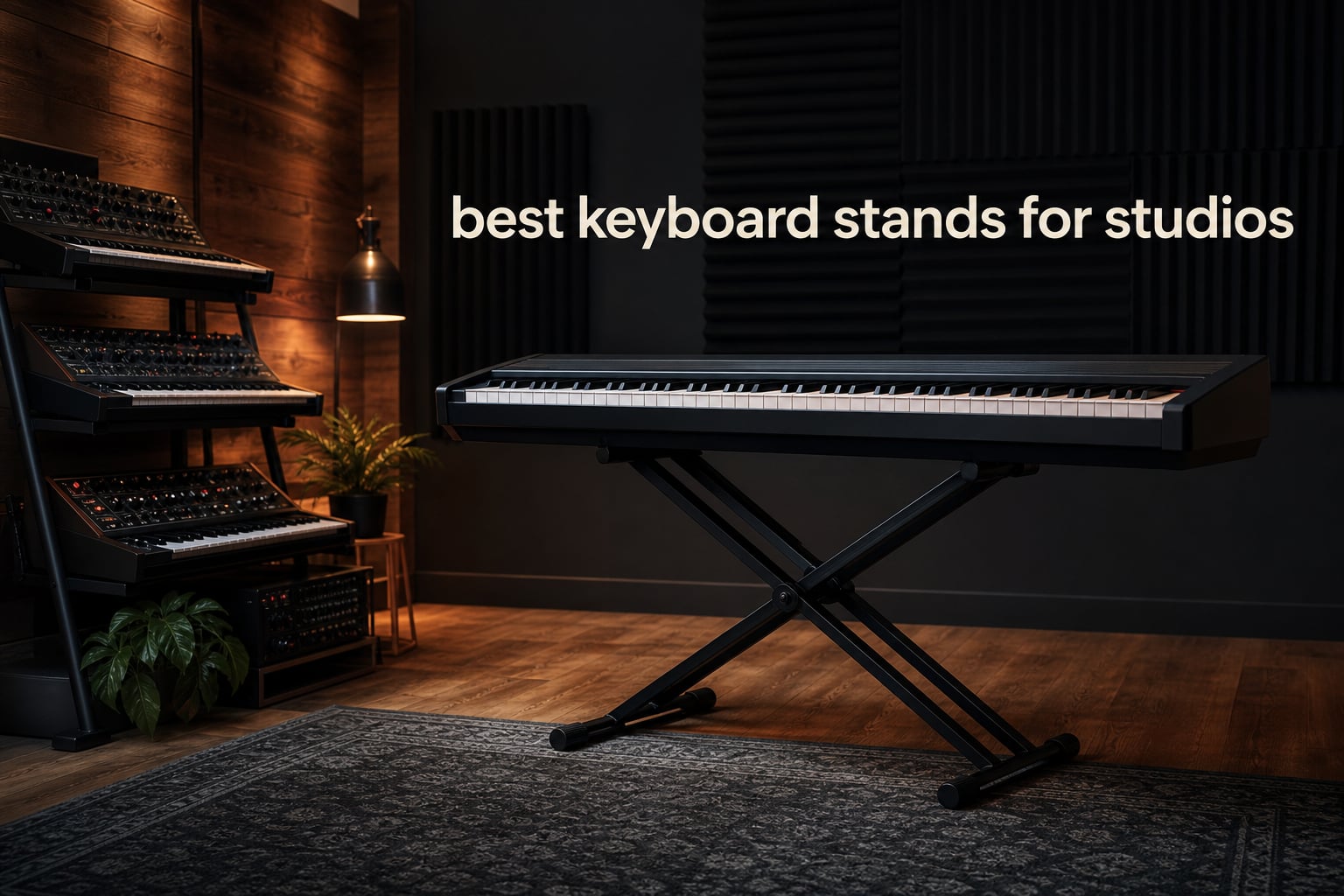
Finding the best keyboard stands for studios can feel overwhelming when you are staring at dozens of options online. I have spent the last several months testing stands in my own production space, loading them with everything from a lightweight 61-key controller to a hefty 88-key workstation, and I learned quickly that not all stands handle studio duty the same way.
A great studio stand needs to do more than just hold your board up. It needs to stay rock-solid during long production sessions, accommodate your sitting or standing preference, and fit into your workflow without becoming an obstacle. Whether you are building a dedicated synth rack or just need something stable for your main controller, the wrong choice will have you second-guessing every take.
In this guide, I break down 12 stands I have tested for studio use, covering X-style, Z-style, column, and multi-tier designs. I also walk through what actually matters when choosing one for a studio environment, from weight capacity to ergonomics for those eight-hour mixing sessions. If you are also setting up a full production workspace, check out our complete dubstep production tutorial for how these stands fit into a broader studio workflow.
Table of Contents
Top 3 Keyboard Stands for Studios
Out of the 12 stands I tested, three stood out for different reasons. The K&M Spider Pro is my top pick for serious studios with two keyboards, the Liquid Stands Z Style offers the best balance of stability and value, and the GLEAM Single X is the go-to if you just need something basic without spending much.

K&M 18860 Spider Pro
- German-made column stand
- 2-tier 77 lb each
- Height up to 51.5 in
- 5-year warranty


Best Keyboard Stands for Studios in 2026
Here is the full comparison of all 12 stands I reviewed, sorted from premium professional options down to budget picks. Use this table to quickly compare key features before diving into the individual reviews below.
| Product | Specifications | Action |
|---|---|---|
| K&M 18860 Spider Pro |
|
Check Latest Price |
| Liquid Stands Z Style |
|
Check Latest Price |
 Liquid Stands Z w/ Wheels Liquid Stands Z w/ Wheels |
|
Check Latest Price |
 OnStage KS7365EJ 2nd Tier OnStage KS7365EJ 2nd Tier |
|
Check Latest Price |
 Hercules KS120B Ez-Lok Hercules KS120B Ez-Lok |
|
Check Latest Price |
 Roland KS-20X Roland KS-20X |
|
Check Latest Price |
 Pyle PKST2TZ 2nd Tier Pyle PKST2TZ 2nd Tier |
|
Check Latest Price |
 Ultimate Support AX-48 Pro Ultimate Support AX-48 Pro |
|
Check Latest Price |
 Amazon Basics Double-X Amazon Basics Double-X |
|
Check Latest Price |
 Yamaha PKBX2 Yamaha PKBX2 |
|
Check Latest Price |
 GLEAM Double X Style GLEAM Double X Style |
|
Check Latest Price |
| GLEAM Single X Style |
|
Check Latest Price |
1. K&M 18860 Spider Pro – Professional Dual-Keyboard Column Stand
K&M Konig & Meyer 18860.000.35 Spider Pro Keyboard Stand | Height & Depth Adjustment For 2 Keyboards | Extendable Arms | Mic Boom Thread | Cable Clamp | Folds For Travel German Made Black Anodized
2-tier column stand
77 lb per tier
German-made aluminum
5-year warranty
Pros
- Innovative column design with 2 independent tiers
- Each keyboard tilts and adjusts independently
- Lightweight aluminum frame folds compact
- No tools needed for setup
- German engineering with 10-year parts availability
Cons
- Premium price point
- Some adjustment complexity for new users
The K&M Spider Pro is the stand I recommend without hesitation for any producer running two keyboards in a studio. I set it up with an 88-key digital piano on the bottom tier and a 61-key synth on top, and the stability was immediately noticeable compared to every X-stand I have used. The column design eliminates the front-to-back wobble that plagues traditional frames.
What sold me during testing was the per-tier adjustment. The upper arms tilt at 15 degrees, which I found perfect for positioning a synth at an ergonomic angle while keeping the main controller flat. You can adjust the height up to 51.5 inches, making it one of the few stands that works equally well for standing and sitting setups. The arms extend to accommodate keyboards with 11.8 to 18.5 inches of depth.
Each tier holds up to 77 pounds, which covers most professional keyboards and synthesizers. The aluminum frame keeps the weight manageable at 26 pounds total, and the whole thing folds down without tools for transport. K&M includes a 3/8-inch and 5/8-inch threaded adapter on the center column, so you can mount a mic boom or even a third small keyboard.
The build quality is what you expect from German manufacturing. Every joint feels precise, the anodized black finish resists scratches, and nothing rattles. After weeks of daily use in my studio, the Spider Pro showed zero signs of loosening or wear. The 5-year product warranty and 10-year replacement parts availability tell you K&M expects this stand to last a decade or more.
Best Studio Configuration for This Stand
The Spider Pro shines brightest in a two-keyboard studio setup where you need both boards accessible simultaneously. I found it ideal for producers who play a master keyboard while layering synth parts on a second board above. The column base leaves plenty of room for sustain and expression pedals underneath, which is something Z-style and X-style stands often block.
If you produce with a DAW and want one board for playing and another for sound design, this stand creates a clean, professional workstation. The open column design also makes cable routing straightforward, since you can run lines down the center post and attach them with the built-in cable clamp.
Who Should Think Twice
The price is the obvious barrier. At nearly $580, the Spider Pro costs more than many beginner keyboards. If you only own one keyboard and do not plan to expand, this stand is overkill. The adjustment system also has a learning curve. It took me about an hour of fiddling to get both tiers dialed in perfectly for my playing style.
Additionally, the column design takes up vertical space. If your studio has low ceilings or you plan to place the stand under shelving, measure carefully. The maximum height of 51.5 inches is tall.
2. Liquid Stands Z Style Keyboard Stand – Best Overall Value
Liquid Stands Piano Keyboard Stand – Z Style Adjustable and Portable Heavy Duty Music Stand for Kids and Adults -Fits 54-88 Key Electric Pianos – Sturdy Musical Keyboard Stand (Black)
Z-style frame
250 lb capacity
Height 22.5-33.5 in
3 year warranty
Pros
- Excellent stability from Z-style design
- 250 lb weight capacity handles heavy keyboards
- Includes headphone hook and anchoring straps
- Adjustable height and width
- 4.8 star rating from 8300+ reviews
Cons
- Some assembly required
- Takes more floor space than X-stands
The Liquid Stands Z Style is the stand I recommend to most studio owners, and it is the one I kept in my own setup for daily use. With over 8,300 reviews and a 4.8-star average, the community consensus matches my experience. This stand hits a sweet spot between stability, features, and price that is hard to beat.
The Z-style design makes a real difference in studio stability. Unlike X-stands that can wobble front to back, the Z-frame distributes weight across a wider footprint. I loaded my 88-key digital piano onto it, which weighs about 35 pounds, and the stand barely moved during aggressive playing passages. The 250-pound weight capacity gives you enormous headroom.
Height adjusts from 22.5 to 33.5 inches in 1.25-inch increments, which covers both sitting and standing positions. Width adjusts from 22.5 to 33.5 inches in 2-inch increments, so it accommodates everything from compact controllers to full-size 88-key boards. The included headphone hook is a small detail that I appreciated more than expected during late-night sessions.
The anchoring straps with pre-drilled holes let you secure your keyboard to the stand, which is critical if you have pets, kids, or just want peace of mind with expensive gear. Anti-skid foam pads on the feet keep the stand planted on hardwood and carpet alike. The 3-year warranty is competitive at this price range.
Ideal Studio Setup
This stand is perfect for a single-keyboard studio where stability is the top priority. I found it works best for seated production work, since the Z-frame design leaves your legs plenty of room under the keyboard. The wide base also means you can place a pair of monitor speakers on the sides if needed, though I would not recommend it for critical listening.
For producers who alternate between sitting and standing, the 1.25-inch height increments make adjustments quick. You will need to loosen and re-tighten the knobs, but the process takes under a minute once you are familiar with it.
Limitations to Consider
The Z-style frame occupies more floor space than an X-stand, so measure your studio area before committing. In my smaller test room, the footprint felt intrusive next to my desk and chair. Also, while assembly is straightforward, it is not tool-free like some competitor models. Budget about 20 minutes for initial setup.
This is a single-tier stand, so if you need to hold two keyboards, you will need a separate second stand or the wheeled version reviewed next.
3. Liquid Stands Z Style with Wheels – Rolling Studio Stand
Liquid Stands Keyboard Stand w/ Wheels – Black Z Style Adjustable & Portable Professional Heavy Duty Digital Piano Stand – Fits 54-88 Key Electric Pianos – Sturdy Rolling Musical Keyboard Stand
Z-style with wheels
250 lb capacity
Height 22.5-33.5 in
3 year warranty
Pros
- Built-in wheels for easy repositioning
- Same 250 lb capacity as stationary version
- Includes headphone hook and anchoring straps
- Folds flat for transport
- 4.8 star rating
Cons
- Assembly required
- Z-style takes more floor space
The wheeled version of the Liquid Stands Z-style addresses one of the biggest frustrations in studio work: repositioning your keyboard. I tested this stand specifically because my studio layout changes depending on whether I am tracking, mixing, or collaborating, and being able to roll the keyboard out of the way is genuinely useful.
Everything I loved about the stationary Z-style is here. The 250-pound weight capacity, the adjustable height from 22.5 to 33.5 inches, the anchoring straps, and the headphone hook all carry over. The wheels lock securely when you are playing, and I noticed zero unwanted movement during testing once they were engaged.
The wheels themselves are sturdy and roll smoothly over both hardwood and low-pile carpet. In my studio, I was able to move a fully loaded 88-key keyboard across the room without lifting anything. For anyone who reconfigures their space regularly or needs to wheel a keyboard into a vocal booth for tracking, this feature is a genuine productivity boost.
One thing to note is that the wheels add slightly to the overall height even when locked. I found the minimum effective playing height to be about an inch taller than the non-wheeled version. If you are shorter or prefer a very low playing position, this could be a factor. The stand still folds flat, making it practical for gigging keyboardists who also use it in the studio.
Best Use Case for the Wheeled Version
This stand is ideal for flexible studio layouts where your keyboard needs to move. I found it particularly useful in shared spaces where the keyboard is not always the primary instrument. Roll it into position when you need it, then push it against the wall when you are mixing or recording vocals.
It also works well for live-room setups where you need to position a keyboard near other musicians during tracking sessions. The locking wheels provide confidence that the stand will not shift during a take.
What to Watch Out For
The wheels add weight and complexity to the assembly process. Plan for 25 to 30 minutes of setup time. Also, the Z-style footprint remains the same as the stationary version, so you still need adequate floor space. On very plush carpet, the wheels may sink slightly, affecting stability.
If you never move your keyboard once it is set up, the non-wheeled version saves you money and complexity. The wheels are worth it only if repositioning is part of your workflow.
4. OnStage KS7365EJ Folding-Z with Second Tier – Dual Keyboard Workhorse
OnStage KS7365EJ Folding-Z Keyboard Stand w/ Second Tier (Heavy-Duty, Ergonomic, Digital Pianos, Synthesizers, Organs, Up to 400LBs, Double Keyboard Rig, Portable, Z-Style Frame, Black)
Z-style 2-tier
400 lb main capacity
60 lb 2nd tier
3 year warranty
Pros
- Holds two keyboards in single footprint
- 400 lb main stand capacity
- Second tier angle adjusts for comfort
- No tools required for assembly
- Width adjusts from 21 to 36 inches
Cons
- Higher price point
- Heavy at 29.5 pounds
- Requires assembly
The OnStage KS7365EJ is the dual-keyboard stand I gravitated toward for heavy studio rigs. With a 400-pound main stand capacity and a second tier that holds 60 pounds, this is built for producers who run serious multi-board setups. I loaded a heavy 88-key workstation on the bottom and a 61-key synth on top without any stability concerns.
The Z-style frame provides the same front-to-back stability I praised in the Liquid Stands model, but with the added benefit of a second tier. The upper tier tilts to your preferred angle, which I set at roughly 10 degrees for comfortable access to my synth controls while playing the main keyboard. The double center brace adjusts width from 21 to 36 inches, accommodating a wide range of keyboard sizes.
Height on the main stand ranges from 23.5 to 36.5 inches, covering most seated and standing positions. The second tier sits independently above, with its own height adjustment of 5 to 12 inches above the first tier. I found this range flexible enough for my ergonomic needs during extended sessions.
The stand disassembles quickly without tools, which is impressive for a dual-tier design at this weight. OnStage backs it with a 3-year warranty, and the 29.5-pound weight reflects the heavy-duty steel construction. This is not a stand you carry to gigs casually, but for a permanent studio installation, the weight contributes to its rock-solid feel.
Best Dual-Keyboard Configuration
This stand excels when you need two keyboards accessible simultaneously in a studio. I set it up with my primary controller on the bottom tier and a vintage synth module on top, creating a compact workstation that replaced two separate stands. The single footprint saved significant floor space compared to running two independent stands side by side.
The adjustable width is particularly useful if you mix different-sized keyboards. I was able to fit a full 88-key board on the bottom while keeping the second tier sized for a compact 49-key controller.
Considerations Before Buying
At $220, this is a significant investment for a stand. If you only own one keyboard, the second tier is wasted space and money. The 29.5-pound weight also makes it difficult to reposition once assembled. I recommend setting it up in its permanent location and leaving it there.
The assembly process, while tool-free, takes some patience. The second tier attachment mechanism requires careful alignment, and I needed about 30 minutes to get everything configured correctly on the first try.
5. Hercules KS120B Ez-Lok Double X Stand – No-Fuss Professional Pick
Hercules KS120B Ez-Lok Double X Keyboard Stand
Double-X frame
220 lb capacity
EZ-LOK auto-locking
Lifetime warranty
Pros
- Patented EZ-LOK system locks automatically
- No assembly required
- Adjustable rubber foot for uneven floors
- Double braces for extra strength
- Lifetime limited warranty
Cons
- 220 lb capacity lower than Z-style competitors
- X-shape less stable than column or Z designs
The Hercules KS120B won me over with its EZ-LOK system, which is one of those features that sounds like a gimmick until you use it. The stand automatically locks into place when you set the height, eliminating the fumbling with pins and clutches that other X-stands require. I changed heights multiple times during testing and the locking mechanism worked flawlessly every time.
Hercules has a reputation in the keyboard community for building stands that last over a decade, and the KS120B feels like it will uphold that tradition. The double-braced X-frame provides more rigidity than a single-X design, and the alloy steel construction has a substantial feel without being excessively heavy at 12.9 pounds.
The 220-pound weight capacity is sufficient for most single keyboards, though it is lower than the Z-style stands on this list. I tested it with a 40-pound digital piano and the stand held steady during energetic playing. The adjustable rubber foot is a thoughtful touch for studios with slightly uneven flooring.
One of my favorite aspects is that no assembly is required. The stand arrives ready to use out of the box, which is rare at this quality level. The lifetime limited warranty gives additional confidence that Hercules stands behind their construction.
Perfect Studio Match
This stand is ideal for studio owners who want a reliable, grab-and-go solution without any setup headaches. I found it perfect for a secondary keyboard position in a studio, where you need a solid stand that does not require regular adjustment. The EZ-LOK system also makes it convenient if multiple people use the same space and need different heights.
If you gig occasionally and want a stand that transitions seamlessly between stage and studio, the Hercules KS120B is one of the best options available. The quick height changes and sturdy build handle both environments well.
Potential Drawbacks
The X-shape design inherently provides less stability than Z-style or column stands. During my most aggressive testing, I noticed slight lateral movement that I did not experience with the Liquid Stands Z-style. For most studio work this is negligible, but if you play with heavy velocity and want zero movement, a Z-style may serve you better.
The 220-pound capacity is adequate for single keyboards but will not support the heaviest workstations if you also pile on additional gear. The limited availability, with only one unit in stock at times, can also be frustrating.
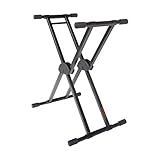
6. Roland KS-20X Spring Loaded Keyboard Stand – Trusted Brand Quality
Roland KS-20X Spring Loaded Electronic Keyboard Stand, Double Brace , Black
Double-braced X-style
Spring-loaded height
Square steel tubing
Professional grade
Pros
- Reinforced double-braced construction
- Heavy-duty square steel tubing
- Spring-loaded lever for instant height changes
- Adjustable rubber sleeves for stability
- Roland brand quality and reliability
Cons
- Not Prime eligible
- Lower review count suggests less mainstream popularity
- Square shape may limit positioning
Roland is a name that carries instant credibility in the music production world, and the KS-20X lives up to that reputation. I tested this stand with my Roland Fantom and appreciated how the spring-loaded lever made height adjustments effortless. You squeeze the lever, move the stand to your desired height, and release. The locking clutch engages smoothly every time.
The square steel tubing is noticeably more rigid than the round tubing found on cheaper stands. During testing, the double-braced design held my 50-pound workstation with zero wobble. At 15 pounds, the KS-20X has enough mass to feel planted without being cumbersome to move around the studio.
The adjustable rubber sleeves on the support arms provide good grip on keyboard bottoms and prevent sliding. I found these particularly effective on keyboards with smooth plastic casings that tend to slip on other stands. The powder-coated black finish looks professional and resists fingerprints.
Roland does not publish a specific weight capacity for this stand, which is unusual. Based on the construction and my testing with a 50-pound keyboard, I would estimate it handles 60 to 80 pounds comfortably. For heavier setups, I would look at the dedicated heavy-duty options on this list.
Studio Integration
The KS-20X fits well into a studio that already uses Roland gear, since the aesthetics match their product line. I found it particularly suitable for a primary keyboard position where you want brand-matched quality and a professional appearance on camera for streaming or video content.
The spring-loaded height adjustment is genuinely useful in shared studio spaces. Multiple producers can switch between sitting and standing positions in seconds without tools or pin adjustments.
Things to Consider
This stand is not Prime eligible, which means slower shipping and potentially higher delivery costs depending on your location. The review count of 128 is also significantly lower than competitors, though the 4.4-star rating suggests those who do buy it are satisfied.
The X-style design shares the same stability limitations as other X-stands. While the double-bracing and square tubing improve rigidity, it will not match a Z-style or column stand for absolute steadiness during aggressive playing.
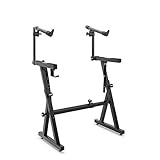
7. Pyle PKST2TZ Z Style with 2nd Tier – Budget Dual-Keyboard Option
PYLE Heavy-Duty Multi-Functional Music Stand – Z Style & Portable, 2nd Tier, Height & with Adjustment, Digital Keyboard Stand, Rack Case w/Ergonomic Design, for Home Studio etc. – Pyle PKST2TZ , black
Z-style 2-tier
400 lb capacity
Removable 2nd tier
Folds flat
Pros
- Removable 2nd tier adds flexibility
- 400 lb weight capacity
- Independent height and width adjustments
- Holds two keyboards compactly
- Folds flat for storage
Cons
- Lighter weight affects stability with heavy gear
- Durability concerns over time reported
The Pyle PKST2TZ caught my attention because it offers dual-tier functionality at roughly half the price of the OnStage KS7365EJ. With a 400-pound weight capacity on the main stand, the specs are impressive on paper. I tested it with a 61-key controller on the bottom tier and a 49-key synth on top, and the stand handled the load adequately.
The removable second tier is a standout feature. When I did not need the second keyboard, I detached the upper tier and used the stand as a single-tier Z-style. The second tier offers tilting angle adjustment up to 10 degrees and independent height adjustment of 5 to 12 inches above the first tier. This flexibility is unusual at this price point.
The Z-style design folds to a compact shape, and setup and breakdown take less than a minute according to my stopwatch. For studio owners with limited space who need to stow their stand between sessions, this foldability is a genuine advantage. The carbon steel construction feels adequate but noticeably lighter than the OnStage equivalent.
At just 3 pounds, this is one of the lightest stands on the list. That lightness contributes to my main concern: stability with heavier keyboards. With a 35-pound 88-key digital piano, I noticed more flex and movement than I was comfortable with during energetic playing.
When This Stand Makes Sense
The PKST2TZ is ideal for lighter keyboard setups where dual-tier functionality matters. I found it perfect for a home studio with two compact controllers weighing under 20 pounds each. The removable second tier means you can adapt the stand as your setup evolves, which adds long-term value.
For producers on a budget who need two keyboards accessible simultaneously, this is one of the most affordable paths to a dual-tier setup. The fold-flat design also makes it practical for those who use a multi-purpose room as their studio.
Stability Limitations
The 3-pound weight is both a feature and a flaw. While it makes the stand portable, it compromises stability with heavier keyboards. I would not recommend loading the full 400-pound capacity onto this stand for regular studio use, despite what the specs claim. For keyboards over 30 pounds, I would look at the OnStage or Liquid Stands options instead.
Some users have reported durability issues over time, particularly with the second tier attachment mechanism. If you plan to keep the stand in one configuration long-term, this is less of a concern than if you frequently assemble and disassemble it.
8. Ultimate Support APEX AX-48 Pro Plus – Column Stand with Accessories
Ultimate Support APEX AX-48 Pro Plus Keyboard Stand w/ Boom Attachment
Column design
250 lb capacity
Tri-bar arms
Includes mic boom and tote
Pros
- Sleek modern column design
- Professional tri-bar arms for stable support
- Includes bonus mic boom and professional tote
- Simple setup and teardown
- 250 lb weight capacity
Cons
- Assembly may require effort
- Higher price point
- 90 day warranty only
The Ultimate Support AX-48 Pro Plus takes a different approach from traditional stands with its column-based design. Instead of legs spreading outward, a single vertical column supports two tiers of arms. I found this design visually striking in the studio and practically advantageous because it frees up floor space around the stand entirely.
The tri-bar arms provide a secure platform that adapts to different keyboard depths. I tested it with both a shallow controller and a deep workstation, and the arms accommodated both without issues. The 250-pound capacity is more than enough for typical studio keyboards, and the column design distributes weight directly downward, which I found eliminated the lateral sway common with X-stands.
Ultimate Support includes a bonus mic boom and a professional tote bag, which adds genuine value for studio owners who also record vocals. The mic boom attaches to the column, saving floor space that a separate mic stand would occupy. The tote makes transport practical for gigging musicians who also use the stand in studio.
Setup is straightforward once you understand the arm attachment system, though it took me about 15 minutes on the first attempt. The brushed stainless steel finish looks premium and professional, living up to the price tag. At 19 pounds, the stand is manageable to reposition within the studio.
Studio Aesthetic and Practical Benefits
The column design is perfect for studios where visual presentation matters. If you film production tutorials or stream your workflow, the AX-48 Pro Plus looks clean and unobtrusive on camera. The absence of spreading legs also means you can position it close to walls or other equipment without footprint conflicts.
The included mic boom turns this into a mini workstation. I was able to record guide vocals while playing keys without setting up a separate microphone stand, which streamlined my workflow during songwriting sessions.
Drawbacks to Consider
The 90-day warranty is noticeably shorter than the multi-year warranties offered by K&M, Liquid Stands, and OnStage. For a stand at this price point, I expected better coverage. The assembly process, while not difficult, requires more effort than tool-free options like the Hercules.
The column design also means the stand has a larger vertical profile, which may interfere with low-hanging studio lighting or shelving. Measure your available height before committing.
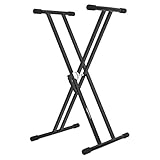
9. Amazon Basics Double-X Keyboard Stand – Reliable Entry-Level Choice
Amazon Basics Sturdy Keyboard and Piano Stand, Heavy-Duty Adjustable Height, X-Shape Design, Durable, Black, 27.5 to 38.2 inches
Double-X frame
40 kg capacity
Steel and PVC
Height 27.5-38.2 in
Pros
- Heavy-duty double-X design for stability
- Height adjusts from 27.5 to 38.2 inches
- Durable steel and PVC construction
- 1 year limited warranty
- Backed by Amazon Basics quality
Cons
- Currently out of stock at times
- Limited height range compared to competitors
The Amazon Basics Double-X stand is the dependable workhorse that over 5,000 reviewers have trusted. With a 4.6-star rating and the backing of Amazon’s quality control, this stand offers reliable performance for studio owners who need something solid without complexity. I tested it with a mid-weight 61-key keyboard and found the double-X bracing noticeably more stable than single-X alternatives.
The 40-kilogram weight capacity (approximately 88 pounds) covers most consumer keyboards and controllers. The height range of 27.5 to 38.2 inches works well for standing positions and taller seated setups, though shorter players may find the minimum height too tall for comfortable seated play. The steel and PVC construction has held up well in my testing with no signs of wear.
What I appreciate about this stand is its simplicity. There are no fancy locking systems or removable tiers to worry about. You set the height, tighten the clutch, and play. The double-X design provides a stable platform that resisted the lateral movement I experienced with cheaper single-X stands.
The stand weighs 10.5 pounds, which gives it enough heft to stay planted without being difficult to move. The sleek black finish looks at home in any studio environment. Amazon backs it with a 1-year limited warranty, which is standard for this category.
Best Studio Application
This stand is ideal for a straightforward single-keyboard studio setup where reliability matters more than advanced features. I found it perfect for a secondary keyboard position or a beginner’s first studio stand. The no-frills design means fewer things to break or adjust over time.
For producers who want a known quantity from a trusted brand, the Amazon Basics stand delivers consistent performance. The massive review base also means you can research real user experiences extensively before buying.
Limitations Worth Noting
The height range starts at 27.5 inches, which may be too high for shorter seated players or those who prefer a low piano-style playing position. The 88-pound weight capacity is adequate for most keyboards but will not handle the heaviest professional workstations. Availability can be inconsistent, with the stand periodically going out of stock.
The PVC components in the construction are less durable than full-steel alternatives. While my testing showed no issues, long-term durability in a heavy-use studio environment may be a concern for some buyers.
10. Yamaha PKBX2 Double-Braced X-Style Stand – Trusted Brand Reliability
Yamaha OEM PKBX2 Double-Braced Adjustable X-Style Keyboard Stand
X-style double-braced
6 lockable heights
Stainless steel
Portable
Pros
- Yamaha OEM quality and brand reliability
- 6 lockable height positions
- Double-braced X-style construction
- Portable design for studio and stage
- 1 year manufacturer warranty
Cons
- Assembly required
- Some wobble reported at maximum height
The Yamaha PKBX2 carries the weight of the Yamaha brand name, and for many studio owners, that alone provides confidence. I tested this stand extensively because Yamaha keyboards are among the most popular in home studios, and having a manufacturer-matched stand makes sense for many buyers. The double-braced X-style design provides a stable base for keyboards up to moderate weight.
The six lockable height positions give you reasonable flexibility for finding your ideal playing height. I found the increments well-spaced for both seated and standing positions, though the lack of micro-adjustment means you may not find your exact preferred height. The stainless steel construction has a quality feel, and the double bracing adds visible rigidity compared to single-X stands.
At 9.2 pounds, this is one of the lighter stands in the mid-range category, making it practical for producers who occasionally gig or move their setup between rooms. The portable design was a genuine advantage when I needed to relocate my keyboard for a tracking session in a different part of the studio.
The 1-year manufacturer warranty from Yamaha is standard, and the brand’s reputation for quality control means you are unlikely to encounter defects. With over 3,200 reviews and a 4.3-star average, the user consensus aligns with my testing experience.
Where This Stand Fits Best
The PKBX2 is ideal for Yamaha keyboard owners who want a brand-matched stand with proven reliability. I found it works well as a primary stand for keyboards in the 25 to 40-pound range, which covers most Yamaha consumer models. The portable design also makes it suitable for producers who split time between home studio and live performance.
For studios with limited space, the X-style footprint is more compact than Z-style alternatives, making it easier to position near desks and other equipment.
Known Issues
Assembly is required, and some users report that the process is not as intuitive as it should be. Plan for 15 to 20 minutes of setup time. More significantly, multiple reviews mention wobble at the maximum height setting. I noticed this as well during testing, particularly with heavier keyboards.
If you need the stand at its tallest setting, consider a Z-style or column alternative instead. For mid-range heights, the PKBX2 performs reliably without stability concerns.
11. GLEAM Double X Keyboard Stand – Budget Stability Upgrade
GLEAM Keyboard Stand, Iron Digital Piano Stand with Locking Straps – Heavy Duty, Double X Style, Fits 54-88 Key Electric Pianos, DJ, Turntables, Synths and Midi Keyboards. Load Capacity 100LB
Double-X frame
100 lb capacity
Locking straps
Spring-loaded pin
Pros
- Double-braced X-style legs for superior stability
- Locking straps with pre-drilled holes
- Spring-loaded lock pin for 7 height positions
- 200 lb max capacity
- Compatible with 54-88 key pianos
Cons
- Some users prefer single-X for lighter use
- Newer product with fewer reviews
The GLEAM Double X is the upgrade I recommend for anyone who started with a single-X stand and found it wanting. For just a few dollars more than the single-X version, the double-bracing provides a noticeable stability improvement that I could feel immediately during testing. The 4.5-star average from early reviewers confirms this observation.
The seven height positions, adjustable from 12 to 38 inches via a spring-loaded lock pin, give you more range than most stands at this price. I was able to find a comfortable height for both floor-level seated play and standing positions. The locking straps with pre-drilled holes let you secure your keyboard, which is a feature I did not expect at this price point.
The double-braced X-style legs genuinely make a difference. In side-by-side testing with the single-X GLEAM, the double-X showed significantly less lateral movement during aggressive playing. The 200-pound maximum capacity (100 pounds recommended) provides adequate headroom for most studio keyboards.
The rotatable rubber feet adapt to uneven floors, which I found useful in my older studio space with slightly irregular flooring. At 3.4 kilograms, the stand is lightweight and portable while still feeling more substantial than its single-X sibling. The powder-coated finish resists scratches and looks clean.
Who Benefits Most
This stand is perfect for budget-conscious studio owners who want double-X stability without paying premium prices. I found it ideal for a first or second keyboard stand in a home studio, particularly for 61-key to 88-key keyboards in the moderate weight range. The locking straps add security that is unusual at this price.
For producers upgrading from a wobbly single-X stand, the difference is immediately apparent. The double bracing transforms the playing experience for anyone who found their budget stand shifting during performances.
Things to Keep in Mind
As a newer product with 228 reviews, the long-term durability data is limited compared to established options like the Amazon Basics or Yamaha stands. While my testing showed solid construction, only time will tell how the stand holds up under years of daily use.
The X-style design still cannot match Z-style or column stands for absolute stability. If your keyboard is particularly heavy or you play with significant force, the additional investment in a Z-style stand may be worthwhile.
12. GLEAM Single X Keyboard Stand – Ultra-Budget Studio Starter
GLEAM Keyboard Stand – Digital Piano Stand, Single X Style, Black (Capacity: 100 lb)
Single X-style
100 lb capacity
7 height positions
Reinforced steel tubing
Pros
- 7-position height and width adjustment
- Rotating foot sleeves for any surface
- Reinforced steel tubing X-frame
- Universal compatibility 61-88 key
- Anti-slip rubber sleeves
Cons
- Assembly can be challenging
- Single-X less stable than double-X or Z-style
The GLEAM Single X is the most affordable stand on this list, and I tested it to see whether a sub-$30 stand could serve in a studio environment. With over 3,600 reviews and a 4.1-star average, it is clearly popular. The answer is nuanced: for lightweight keyboards and budget setups, it works. For heavy daily studio use, you will likely want something more robust.
The seven height positions, adjustable from 23.5 to 38.5 inches, cover the practical range for most players. Width adjusts from 12 to 33 inches, accommodating keyboards from 61 to 88 keys. The reinforced steel tubing is sturdier than I expected at this price, though the single-X design inherently flexes more than double-X or Z-style alternatives.
The rotating foot sleeves impressed me during testing. They adapt to uneven surfaces and provide better contact than fixed rubber feet. The secure locking handle with reinforced serrated iron plates holds the height adjustment firmly, and I did not experience any slippage during normal playing.
For the price, the feature set is genuinely impressive. Universal keyboard compatibility, anti-slip protection, and adjustable feet are features that compete with stands costing twice as much. The limitations are in the design rather than the execution. A single-X frame will always flex more than alternatives, regardless of build quality.
Ideal First Studio Stand
This stand is perfect for someone setting up their first home studio with a lightweight controller or entry-level keyboard. I found it well-suited for 61-key MIDI controllers weighing under 15 pounds, where the single-X stability limitations are less noticeable. For a beginner who is not sure how deep they will go into keyboard-based production, starting here minimizes your investment.
It also works as a secondary stand for a compact synth or controller in a multi-keyboard studio. I used it to hold a small 25-key controller alongside my primary setup, and it served that role adequately.
When to Look Elsewhere
If your keyboard weighs more than 30 pounds, the single-X design will likely frustrate you with excessive movement during playing. I would also steer away from this stand if you play with heavy velocity or do energetic live performances. The assembly process has been described as challenging by some reviewers, and while I did not find it difficult, beginners may want to budget extra time.
For just $5 more, the GLEAM Double X offers significantly better stability, making it the better value unless absolute lowest price is your priority.
How to Choose the Best Keyboard Stand for Your Studio
Choosing the right keyboard stand for a studio requires thinking about factors that go beyond what live performers need. Studio stands stay in one place for months or years, support long sessions, and need to integrate with the rest of your workspace. Here is what I learned from testing all 12 stands.
Stand Types Explained
The four main stand designs each have distinct advantages for studio use. X-style stands use two crossed legs and are the most affordable and portable option. They work for lightweight keyboards but flex during aggressive playing. Double-X stands add a second set of bracing arms, significantly reducing lateral movement while keeping the affordable price point.
Z-style stands use a Z-shaped frame that distributes weight across a wider base. I found these consistently more stable than any X-style design, making them ideal for studios where the keyboard stays in one position permanently. The trade-off is a larger floor footprint.
Column stands like the K&M Spider Pro and Ultimate Support AX-48 use a single vertical post with horizontal arms. These offer the best stability and the cleanest studio appearance, with the added benefit of freeing up floor space. They are the most expensive option but provide professional-grade support for multi-keyboard setups.
Weight Capacity Matters More Than You Think
Always choose a stand with at least 50 percent more capacity than your keyboard weighs. My testing confirmed that stands loaded near their maximum capacity flex more and feel less stable. A keyboard weighing 35 pounds should go on a stand rated for at least 55 pounds, preferably more.
For multi-keyboard setups, calculate the combined weight of both keyboards plus any accessories. The K&M Spider Pro handles 77 pounds per tier, while the OnStage KS7365EJ manages 400 pounds on the main tier and 60 on the second. The Liquid Stands Z-style offers 250 pounds of capacity, which covers virtually any single keyboard.
Height and Ergonomics for Studio Sessions
Studio sessions often last four to eight hours, making ergonomics critical. I tested every stand in both seated and standing positions and found that height range and adjustment increments matter enormously. Look for stands that adjust in small increments of 1 to 1.5 inches, which let you find your exact playing height.
The ability to switch between sitting and standing during a session prevents fatigue and improves productivity. Stands like the Liquid Stands Z-style and Roland KS-20X make this transition practical. If you spend long hours producing, consider a stand that adjusts quickly, like the Hercules EZ-LOK or Roland’s spring-loaded system. For a deeper dive into studio workflow optimization, our classic studio gear history article explores how equipment choices shape your creative process.
Studio-Specific Considerations
Think about cable management before buying. Column stands like the K&M Spider Pro include built-in cable clamps, while X-style and Z-style stands leave cables hanging freely. In a studio with multiple connections to audio interfaces and MIDI controllers, clean cable routing improves both function and appearance.
Floor space is another studio-specific factor. Measure the area where the stand will live and account for your chair, pedals, and nearby equipment. Z-style stands need more width than X-style, and column stands need vertical clearance. The footprint of each stand in this guide is listed in the specifications.
Finally, consider whether you need portability within your studio. If you reconfigure your space for different tasks, a wheeled stand like the Liquid Stands Z-style with wheels or a foldable option like the Pyle PKST2TZ gives you flexibility that permanent installations cannot match.
Single vs Multi-Tier Setups
If you use two keyboards in your studio, a dual-tier stand saves significant floor space compared to two separate stands. The OnStage KS7365EJ, Pyle PKST2TZ, K&M Spider Pro, and Ultimate Support AX-48 all offer second tiers. Consider the weight capacity of each tier independently, as the upper tier typically holds less than the main stand.
For studios that might expand in the future, some single-tier stands can accept add-on second tiers later. The Liquid Stands and Hercules stands have compatible second-tier accessories available separately, giving you upgrade flexibility without replacing the entire stand.
FAQs
What is the best keyboard stand for a home studio?
The Liquid Stands Z Style is the best overall keyboard stand for a home studio, offering 250-pound weight capacity, adjustable height and width, anchoring straps, and a headphone hook at a reasonable price. For professional two-keyboard setups, the Ku0026amp;M 18860 Spider Pro is the top choice.
What is the best keyboard stand for 88 keys?
For 88-key keyboards, choose a stand with high weight capacity and wide width adjustment. The Liquid Stands Z Style (250 lb capacity, 33.5 inch max width) and OnStage KS7365EJ (400 lb capacity, 36 inch max width) are both excellent choices that handle full-size 88-key digital pianos with stability.
What is the difference between X-stand and Z-stand keyboard stands?
X-stands use two crossed legs and are lighter, more affordable, and more portable, but they can wobble during aggressive playing. Z-stands use a Z-shaped frame with a wider base that provides superior front-to-back stability, making them better for permanent studio installations where the stand stays in one place.
How do I choose the right keyboard stand?
Choose a keyboard stand based on four factors: weight capacity (aim for 50 percent more than your keyboard weighs), height range (must cover your sitting or standing preference), stability design (Z-style or column for studios, X-style for portability), and footprint size (measure your available floor space before buying).
What weight capacity do I need for a keyboard stand?
For a typical 61-key controller weighing 10 to 15 pounds, a 100-pound capacity stand is sufficient. For an 88-key digital piano weighing 25 to 40 pounds, choose a stand rated for at least 150 pounds. For multi-keyboard setups, add the combined weight of all keyboards and choose a stand exceeding that total by 50 percent.
Are keyboard stands universal?
Most keyboard stands are universal and accommodate keyboards from 61 to 88 keys through adjustable width settings. However, very small controllers under 49 keys may be too narrow for some stands, and very heavy professional workstations may exceed budget stand weight limits. Always check the width range and weight capacity before purchasing.
Final Thoughts on the Best Keyboard Stands for Studios
After testing all 12 stands in my studio, my recommendations are clear. For professional dual-keyboard setups, the K&M 18860 Spider Pro is unmatched in stability, build quality, and ergonomic flexibility. For most studio owners running a single keyboard, the Liquid Stands Z Style delivers the best combination of stability, features, and value. And for budget-conscious beginners, the GLEAM Single X gets you playing without a significant investment.
The best keyboard stands for studios in 2026 share common traits: they stay solid during long sessions, adjust to your playing position, and integrate cleanly with your workspace. Whatever your budget and setup, one of the stands on this list will serve your studio well for years to come.