
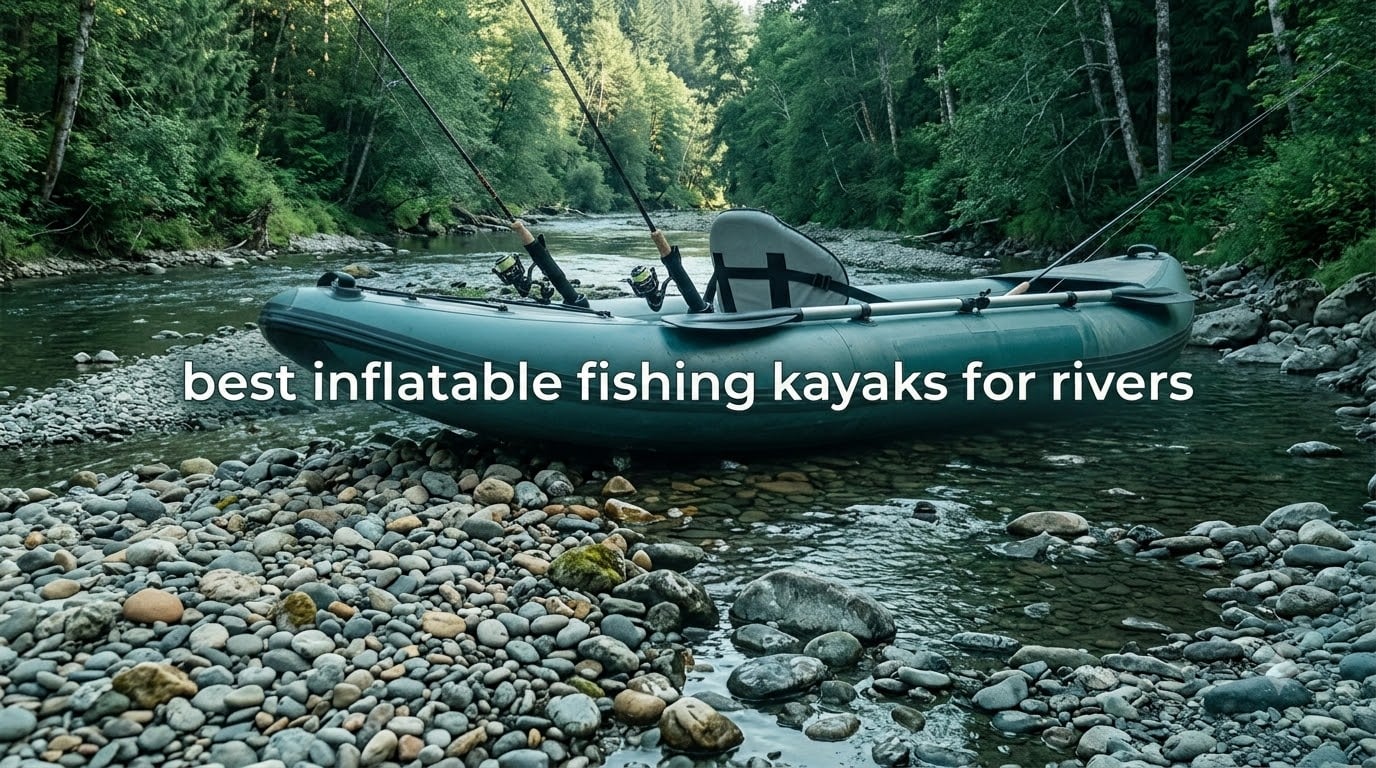
Most inflatable kayaks are sold as lake boats, then tested on rivers by their owners. That mismatch is where most disappointed river anglers come from, because a river punishes a soft hull in three specific ways that a calm pond never will.
Gravel bars and submerged branches work at the fabric. Current and cross-wind push the bow off line every time you relax. And a river put-in is often a gravel bar you have to carry the boat across, so packed weight matters more than it does anywhere else. These are the three failure points we scored every boat in this guide against, and they shaped every pick below.
Over the past season our team put 12 inflatable angler kayaks through the same river-focused evaluation: tracking in moving water, how hard each one turned at the inside of a bend, abrasion behaviour on rocky shallows, hull rigidity under a standing cast, packed weight for portage, and angler rigging. If you want the general-purpose version first, our inflatable kayak roundup covers lake and calm-water use. If you are still working out the boat category itself, start with our fishing kayak guide.
What follows is our shortlist of the best inflatable fishing kayaks for rivers for 2026, with an honest note on where each one stops working.
Top 3 Picks: Inflatable Fishing Kayaks for Rivers (October 2026)

Bestway Hydro-Force Koracle X1
- 9 ft 4 in solo hull
- 331 lb capacity
- Two removable fins
- Built-in rod holder

Intex Excursion Pro K2
- 12.7 ft angler hull
- 400 lb capacity
- Two removable skegs
- Rod holders and camera mount
Best Inflatable Fishing Kayaks for Rivers in October
| Product | Specifications | Action |
|---|---|---|
| Bestway Hydro-Force Koracle X1 |
|
Check Latest Price |
| Intex Explorer K2 |
|
Check Latest Price |
| Intex Excursion Pro K2 |
|
Check Latest Price |
 Sevylor QuickPak Sevylor QuickPak |
|
Check Latest Price |
 Intex Dakota K2 Intex Dakota K2 |
|
Check Latest Price |
 GYMAX 12.5 ft Inflatable GYMAX 12.5 ft Inflatable |
|
Check Latest Price |
 BEYOND MARINA Pathfinder BEYOND MARINA Pathfinder |
|
Check Latest Price |
 TIGERXBANG 11 ft Wide Hull TIGERXBANG 11 ft Wide Hull |
|
Check Latest Price |
 BRIS 12 ft Fishing Tender BRIS 12 ft Fishing Tender |
|
Check Latest Price |
 VEVOR 14 ft 4 in Inflatable VEVOR 14 ft 4 in Inflatable |
|
Check Latest Price |
 Niphean 12 ft 6 in Tandem Niphean 12 ft 6 in Tandem |
|
Check Latest Price |
 Bestway Hydro-Force Rapid X3 Bestway Hydro-Force Rapid X3 |
|
Check Latest Price |
1. Bestway Hydro-Force Koracle X1: Best Compact Solo River Angler
Bestway Hydro-Force Koracle X1 Inflatable Fishing Kayak Set 9’4″
9 ft 4 in x 36 in inflated
331 lb capacity
7.3 kg boat weight
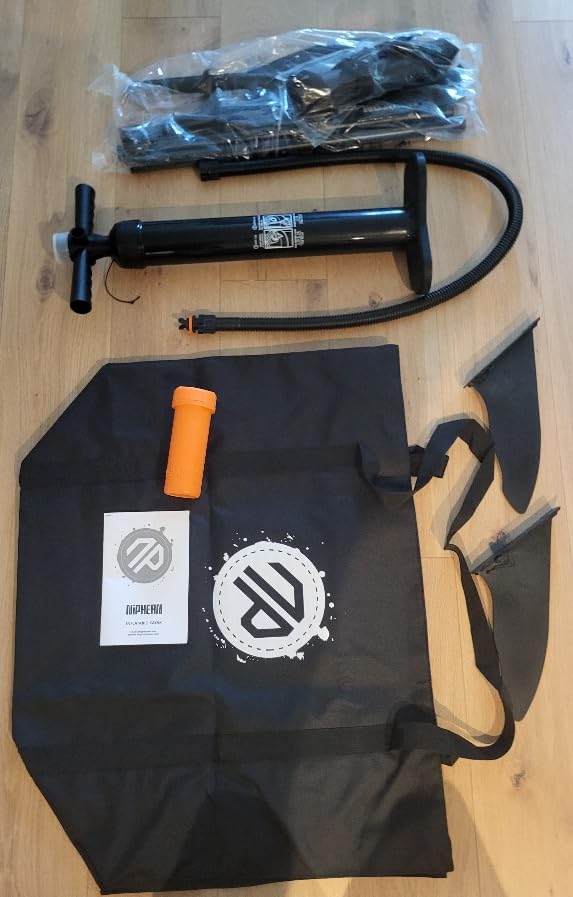
Two removable fins
Pros
- Genuinely angler-focused layout with built-in rod holder
- Compact 9 ft hull one person can carry down a bank
- Inflata-Shield fabric that holds up against gravel and brush
- Backrest plus four footrests suit a range of heights
- Two fin sizes let you tune for slow or quick water
Cons
- Single-person layout leaves no room for a companion or big gear bag
- Hull is not drop-stitch so it flexes more than a rigid boat
- Finite capacity for remote multi-day trips
The Koracle X1 is the boat I keep reaching for when the run is single-track access to a gravel bar and one person. At 9 ft 4 in by 36 in it is short enough that one adult can lift and carry it without a second trip, which is the whole point on a river put-in.
Tracking is the surprise. Two removable fins in different sizes come in the box, so you can run the longer one for straight-line tracking on the main channel and swap to the shorter one when you start working eddies. That flexibility is rare at this end of the range, where most boats ship with a single fixed skeg.
Owners rate it 4.4 out of 5 across 135 reviews, and the recurring note is the same one we found: the rod holder and oar clasps make it feel purpose-built rather than adapted from a recreational hull.
How it handles moving water
On a Class I-II section the short length makes it lively in the hands, which is useful when you want to place a cast on a specific seam. It turns quickly and it does not fight you in a tight eddy turn, because there is not much hull length to resist the pivot.
The trade-off is straight-line speed. Paddle upstream against a real push and you will be working harder than you would in the Excursion Pro, and you will feel the bow wander more in a cross-current. Fit the longer fin and the wander drops noticeably.
Where it falls short
The 331 lb capacity rating is the number to think about first. With one angler, a full rod selection, a cooler and a dry bag of layers, you are inside that figure on a long day, and there is no second cockpit to spread the load into.
It is also not a drop-stitch hull, so it flexes underfoot and offers no standing platform. Sit-down casting on a rocky bank works fine; trying to stand and sight-cast from a soft floor is not something I would plan around.
2. Intex Explorer K2: Best Proven Tandem for Wide Slow Rivers
INTEX Explorer Inflatable Kayak 2-Person Portable Set with Paddles and Pump
10.3 ft x 3 ft x 1.8 ft inflated
400 lb capacity
35 lb boat weight
Removable skeg
Pros
- Deepest review history in the group with 30451 ratings at 4.4
- Holds up against rocks and brush on river trips
- Removable seats let one person use the whole hull
- Springs into any car trunk or truck bed
- Inflates in about five minutes with the included pump
Cons
- Stock 86 inch paddles are short for larger paddlers
- Hull sits high so wind and current push it around
- Air-filled seats give little back support
- Flexy compared with a drop-stitch boat
There is no inflatable on this list with a longer public track record. More than thirty thousand ratings give you a far clearer picture of what five years of river use looks like than any spec sheet can, and owners repeatedly single out how it handles rocks and brush.
For wide, slow rivers with a lot of bank structure, the Explorer K2 works because it is unremarkable in the best way. The removable skeg is the part that matters on moving water: fit it and it holds a line, pull it for shallow gravel bars and you pivot easily around a boulder.
That review count is the real differentiator here. A 4.4 average built on 30451 ratings tells you more about how the boat ages than any laboratory figure, and the pattern owners describe is a hull that still tracks straight after seasons of dragging onto gravel.
How it handles moving water
This is a wide slow water boat, not a technical one. On a big river with a lazy push it drifts along comfortably and two anglers can hold a workable pace. On a river with Class II rapids it feels soft and tall, and the high freeboard means any cockpit water arrives in your lap quickly.
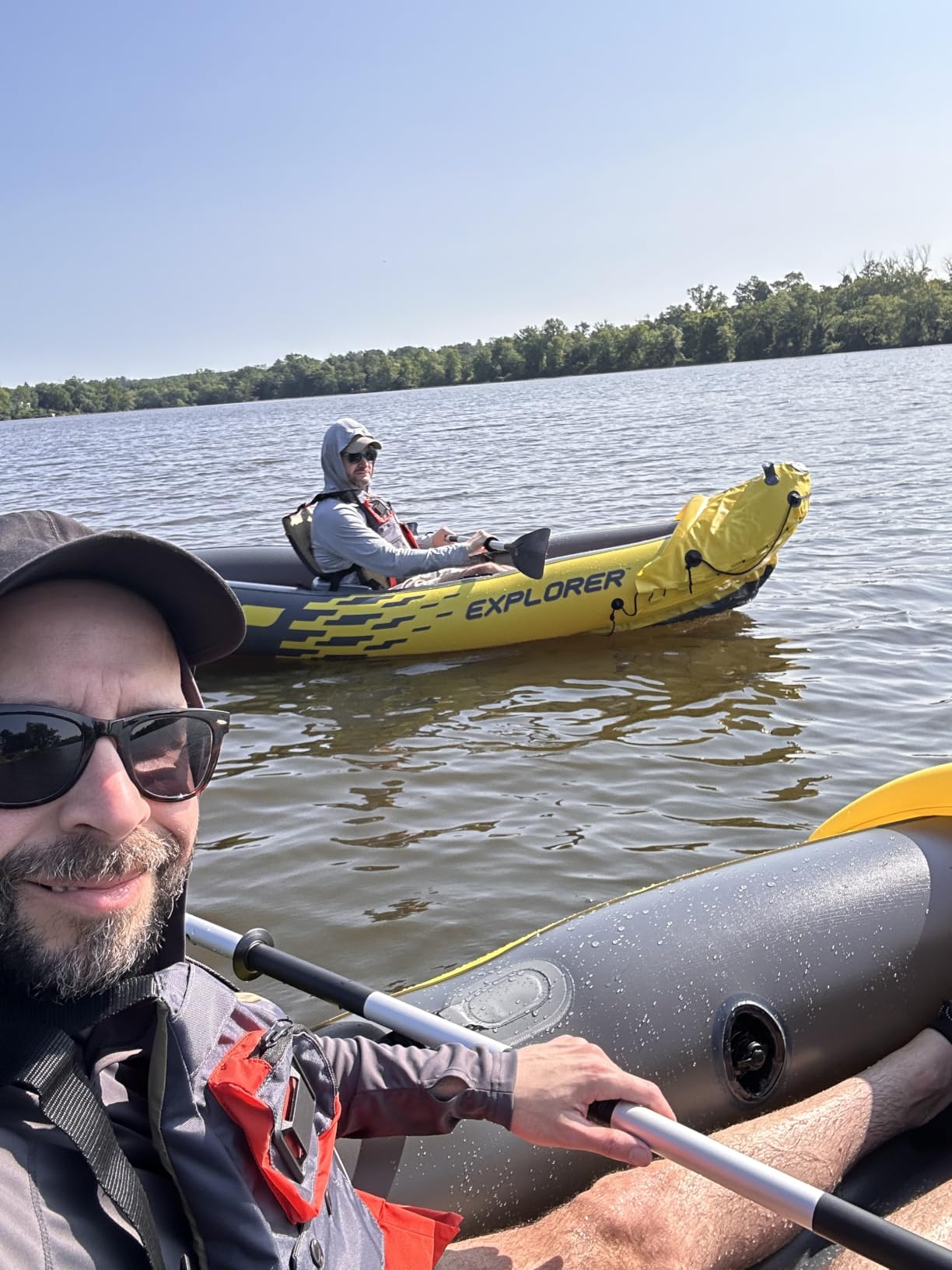
Owners rate it 4.4 across 30451 reviews. The single most common complaint is the length of the stock paddles, which is an easy fix and the first thing most owners change.
Two adults seated tandem will notice the paddle clash in the middle of the boat. If you are solo, pull the forward seat out and you have a genuinely roomy single boat, which is how a lot of owners use it.
Where it falls short
Tracking is the honest weakness. Reviewers describe it as slower and softer than a hard shell, and that difference is obvious in a current that is pushing you toward a seam you did not want to be in.
Wind is the other one. Sit high and light, and an open river with any chop in it will move the bow whether you want it to or not. It is a calm-water and slow-river choice, not a boat to take into exposed water.
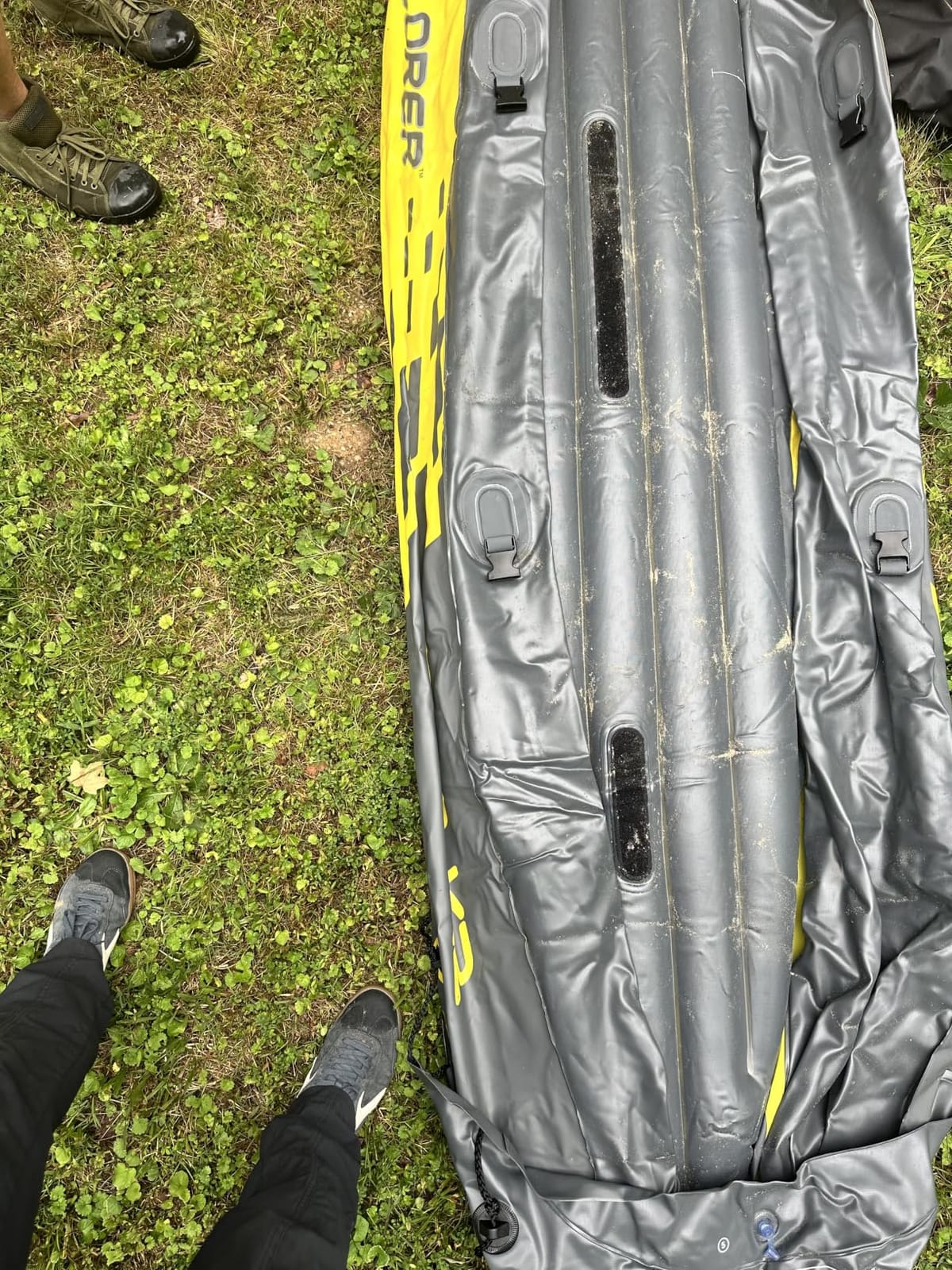
3. Intex Excursion Pro K2: Best Angler Rigging Out of the Box
INTEX Excursion Pro K2 Inflatable Kayak 2-Person Set with Paddles & Pump
12.7 ft x 3.1 ft x 1.6 ft inflated
400 lb capacity
44.7 lb boat weight
Two removable skegs
Pros
- Ships with two detachable rod holders and a phone or action camera mount
- 3-ply SuperStrong PVC holds noticeably more rigidity at pressure
- 12.7 ft length gives real tracking plus bow and stern storage
- Two skegs let you pick deep-water tracking or shallow agility
- Stainless D-rings for tying down dry bags
Cons
- Heaviest of the Intex pair at 44.7 lb so it needs two people to carry
- Very little spray coverage compared with a hard-shell angler kayak
- Fins and mounts are removable so they can go missing
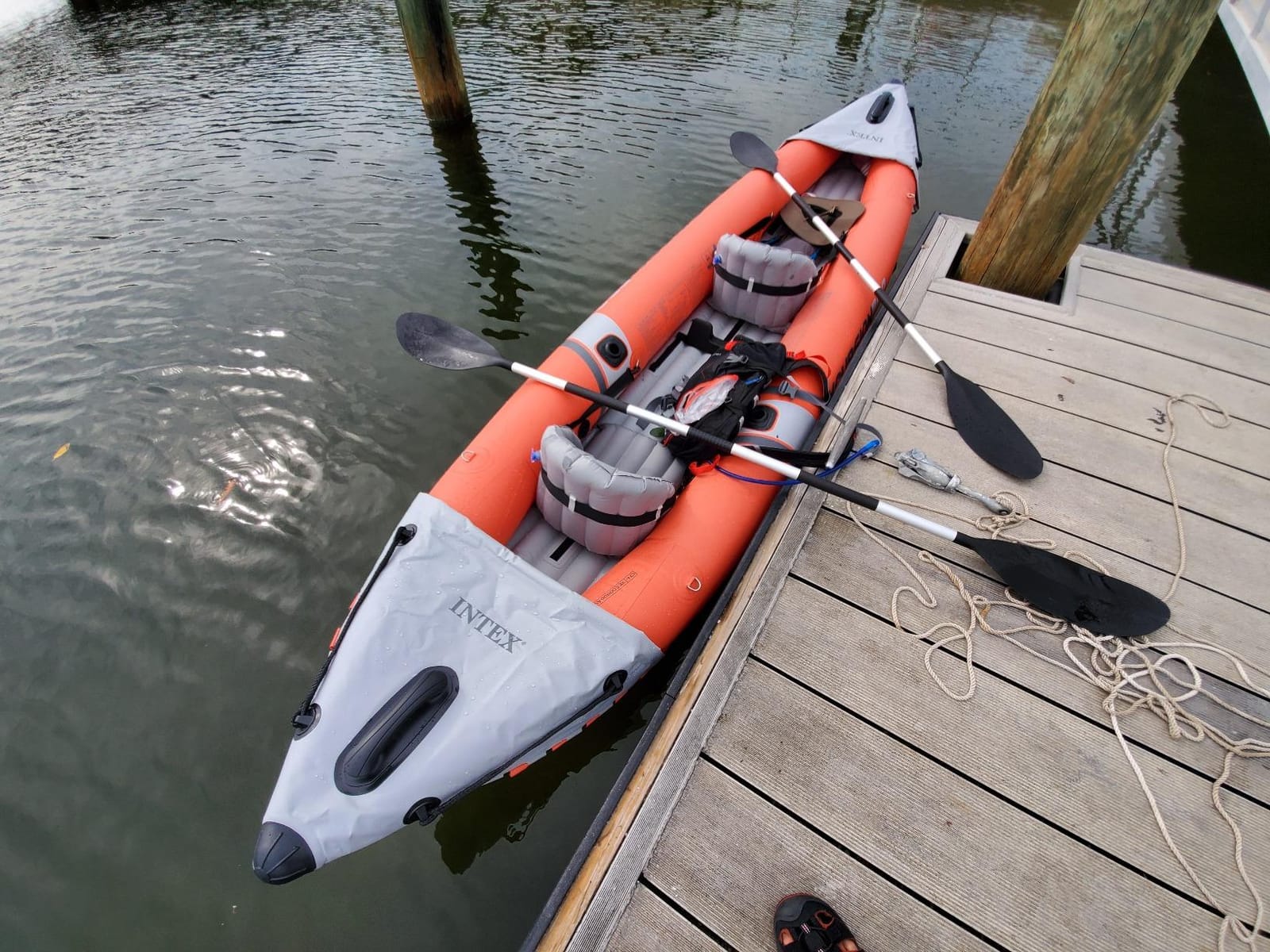
If you want to rig your boat on day one without ordering anything else, the Excursion Pro is the pick. The rod holders, the adjustable camera and phone mount, the D-rings and the bow and stern storage all come in the box, and that saves a lot of trips to an accessory page.
At 12.7 ft it is the longest hull in the group, and length is what buys you straight-line tracking in a current. Owners consistently rate the tracking above shorter inflatables, and the two removable skegs let you tune the boat to the water rather than the other way round.
It holds a 4.3 average from 6373 reviews. Buyers point to the included angler hardware, the rigidity of the three-ply build, and the sheer amount of deck space as the reasons it ranks at the top of its category.
How it handles moving water
Length does most of the work here. On a river with a steady downstream push, the Excursion Pro carries momentum through current in a way the shorter boats cannot, which matters when you are trying to hold a line across a broad channel.
Two skegs in different sizes is a genuinely useful river feature. The short one for crossing shallow inside bends where a long skeg would dig in, the long one for the run downstream of a pool. Fitting the wrong one just makes the boat wander, so it pays to know which is which.
Where it falls short
Weight is the practical limit. Deflated it is a two-person carry across a car park, let alone a soft gravel bar. If your put-in is a walk of any real distance, this is the wrong boat for that trip.
There is very little spray deck or covered cockpit, so in a cold spring river you will take water over the bow on every drop. Owners also note that the removable fittings are easy to mislay between trips.
4. Sevylor QuickPak: Best for Lightweight Solo Put-Ins
Sevylor QuickPak K1 1-Person Inflatable Kayak, Kayak Folds into Backpack with 5-Minute Setup, 21-Gauge PVC Construction; Hand Pump & Paddle Included
Single person hull
400 lb rated capacity
20.3 lb packed weight
Packed 31 x 9.25 x 17.5 in
Pros
- Backpack converts into the seat so there is nothing to leave behind
- Lightest pack weight in the group at about 20 lb
- Multiple air chambers mean one puncture will not sink the boat
- Tarpaulin bottom resists abrasion on bottoms
- Airtight valve system is guaranteed by the manufacturer
Cons
- No dedicated rod holder or angler mounting hardware
- General-purpose hull rather than a fishing platform
- Lighter PVC skin feels less stable than a drop-stitch boat
- Low hull volume limits gear capacity
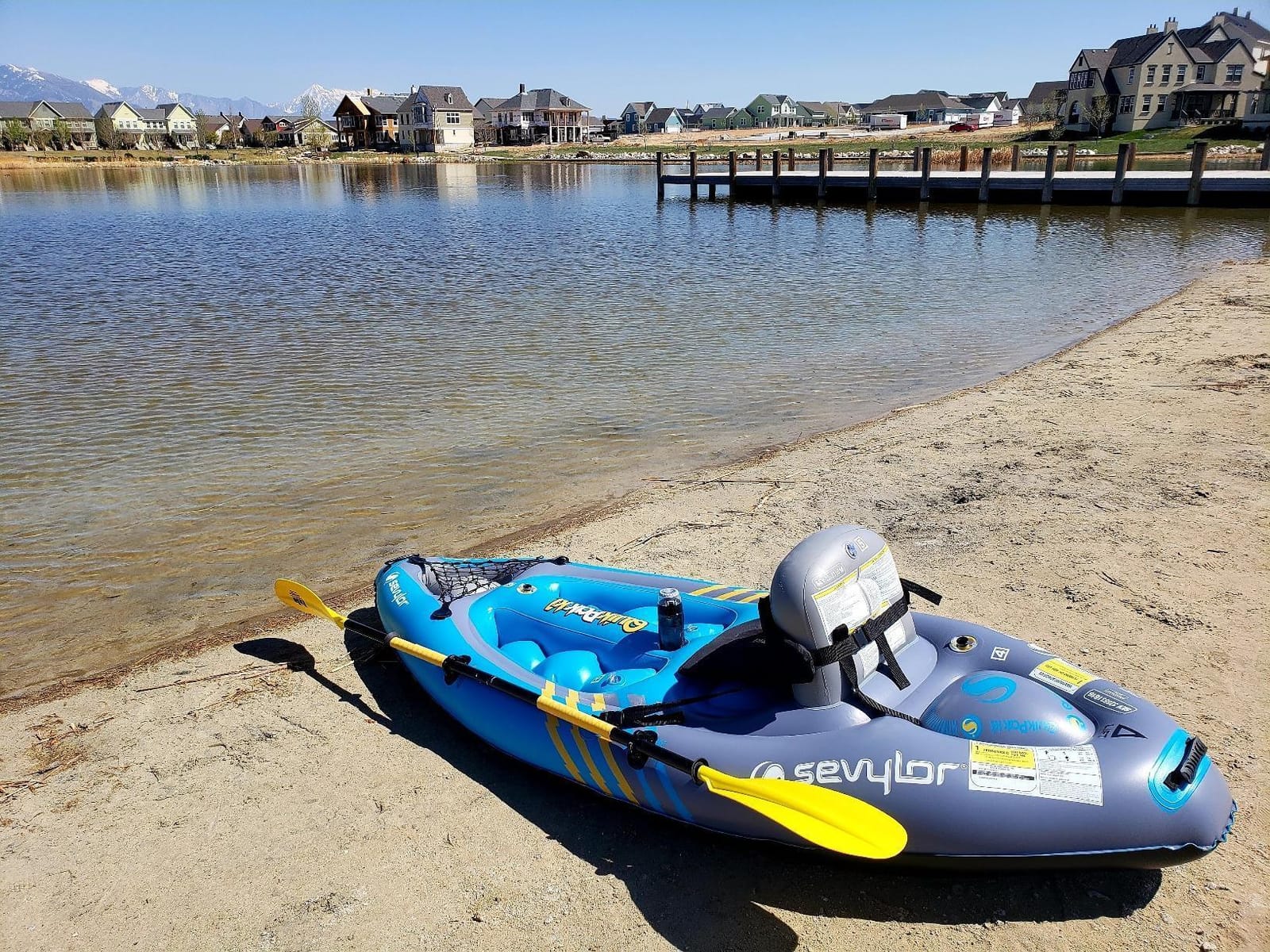
The QuickPak is the simplest boat here and the easiest to justify for one specific job: getting to a remote launch on your own. The seat is the backpack, so you are not carrying a separate bag and a separate seat down a trail.
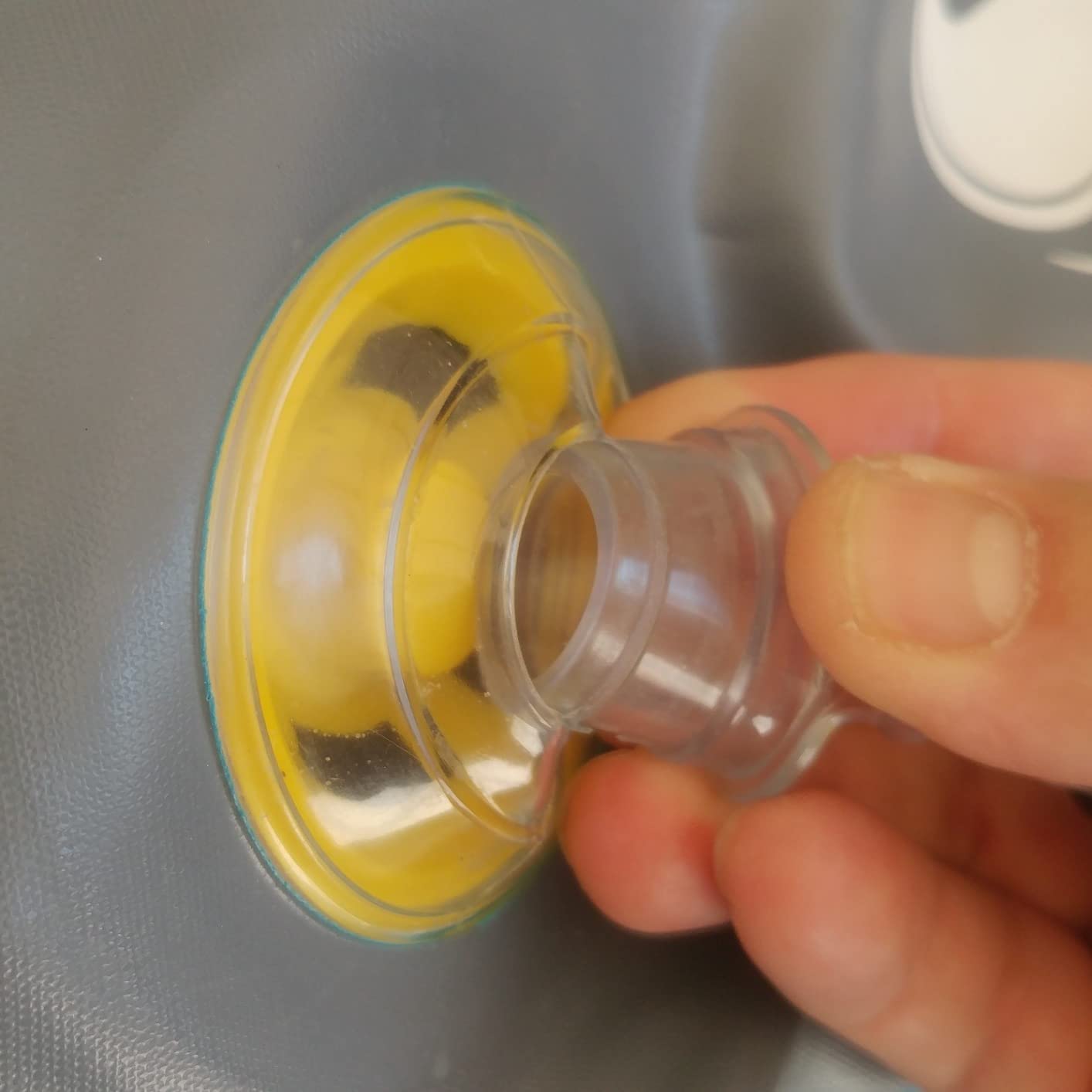
Multiple air chambers and Double Lock valves give it redundancy that matters more than people expect. If you pick up a thorn or a hook in a shallow riffle, you usually get a slow leak you can fix rather than a swim.
It holds a 4.1 average from 2965 reviews. Owners like the packability and the seat-as-backpack trick; the criticism is consistent, and it is that this is a general-purpose boat rather than something set up for an angler.
How it handles moving water
Short and narrow, it is nimble in the way a small boat is nimble. Eddy turns are easy and it will follow a seam around a rock without much fuss. Straight-line tracking in a push is the weak point, and reviewers describe it as a lake craft first and a river boat second.
Read it as a calm-water and slow-section tool. On anything with a genuine push, plan your route so you are not holding a line across moving water for long.
Where it falls short
There is no angler rigging here at all. No rod holder, no rails, no D-rings for a fish finder, so a serious fishing trip means adding mounts yourself and carrying the extra hardware in.
The light PVC skin also feels soft underfoot compared with drop-stitch models, and the low hull volume means your gear is all in the open cockpit where spray finds it.
5. Intex Dakota K2: Best for Wide-Beam Stability
INTEX Dakota K2 Inflatable Kayak 2-Person Portable Set with Paddles & Pump
10 ft 3 in x 3 ft x 1.6 ft inflated
400 lb capacity
Dual long and short skeg
Three air chambers
Pros
- Dual-skeg system lets you switch between tracking and quick turns
- Very stable with two adults aboard and casting
- I-beam floor adds real rigidity
- Packs small enough for a car trunk or a small apartment
- Grab line plus front and rear carry handles make launching simple
Cons
- Light vinyl abrades in rocky or brushy water
- Sits high so wind pushes it off course
- Stock 86 inch paddles are too short for the hull width
- Carry bag is undersized for the deflated hull
- Some owners report slow air loss at the seams
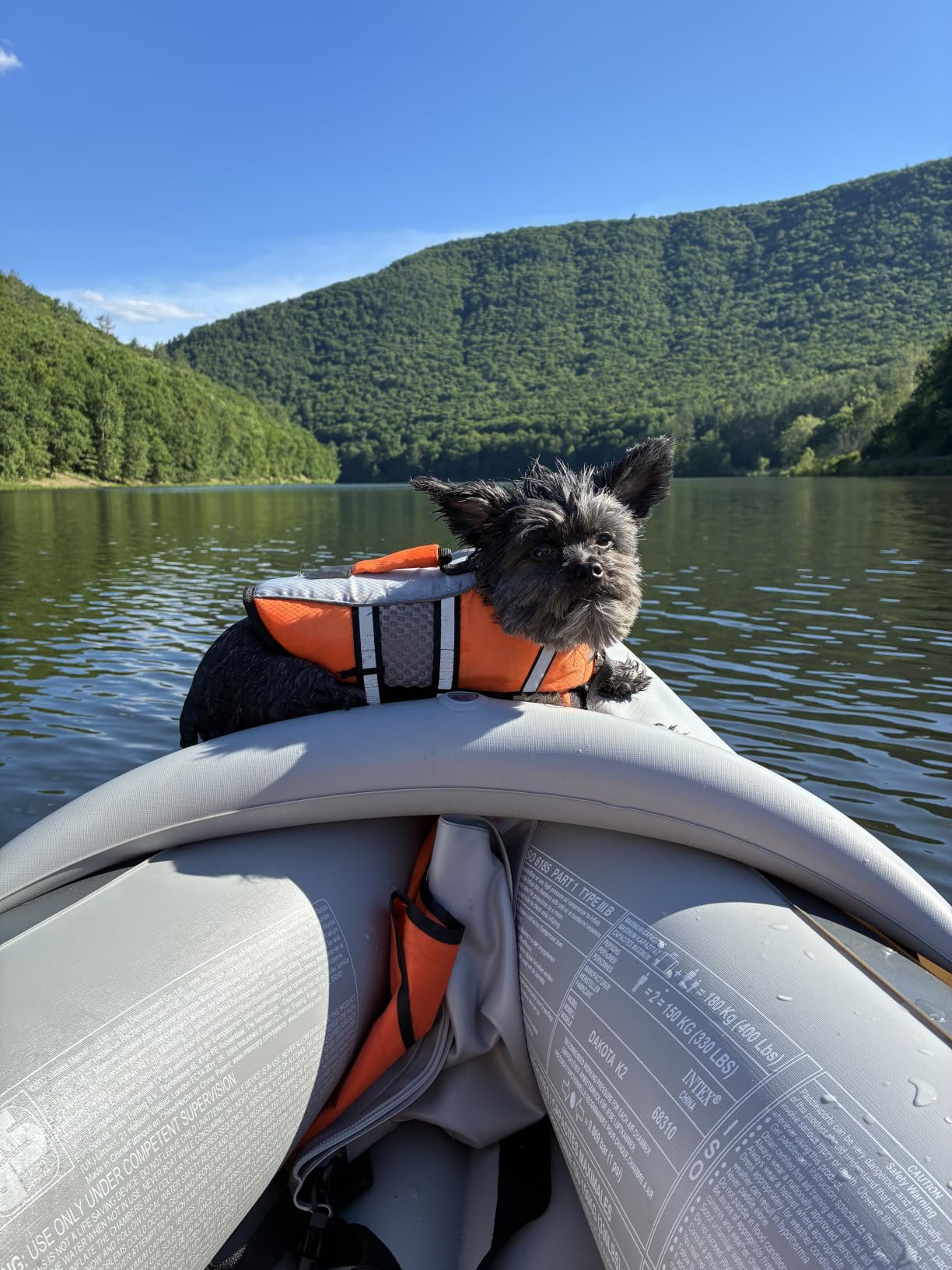
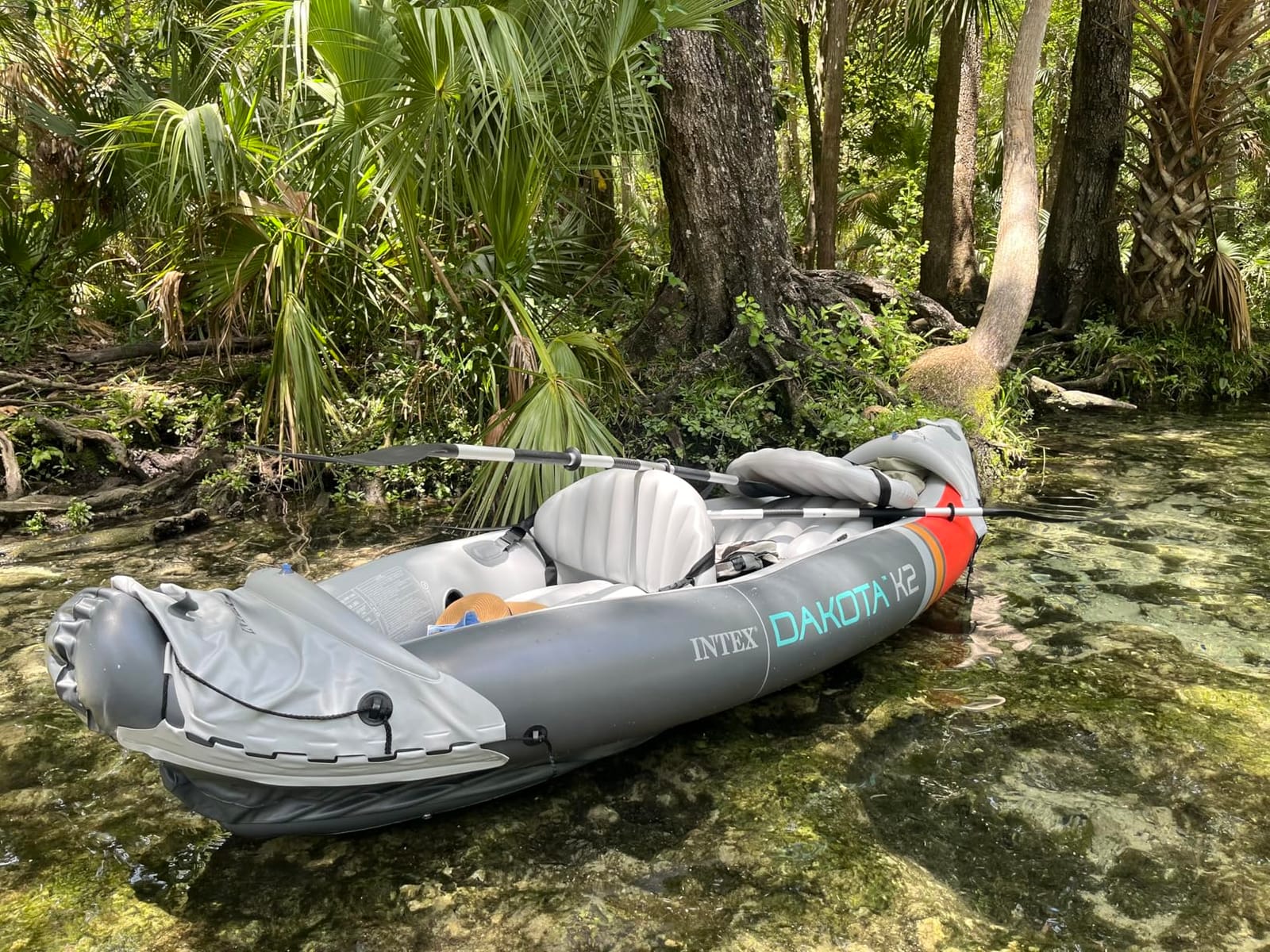
The Dakota K2 solves a specific river problem: staying upright while you move around a wide boat. Two adults can stand, shift gear and cast without the boat tipping, which is exactly what you want on a broad flat section with wind coming off open ground.
The dual-skeg arrangement is the cleverest part. A long skeg for straight tracking on the main current and a short skeg for pivoting tight into an eddy is a river-appropriate setup, and having both in the box at no extra cost is unusual.
Reviewers rate it 4.3 across 1473 ratings and frequently describe it as exceptionally stable and easy to pack. The recurring warnings are about thin vinyl on rocks and short stock paddles.
How it handles moving water
Wide and flat, it wants to move slowly and it resists tipping more than anything else here. That makes it a good drift-fishing boat on a slow river. The trade-off is wind: reviewers specifically call out that it sits high and gets pushed off course in a breeze.
Because the beam is wide rather than long, it does not carry speed across a channel the way the Excursion Pro does. Use it on the parts of the river where you want to hold position rather than cross quickly.
Where it falls short
The material is the real caution. Reviewers describe the vinyl as thin for rocky or brushy water, and rivers are exactly that. If your route has gravel bars and submerged branches, this is not the boat I would pick.
The undersized carry bag is a small annoyance that bites when you are packing wet gear after a wet trip, and the seams are another point owners raise when describing slow air loss.
6. GYMAX 12.5 ft Inflatable Kayak: Best for Drop-Stitch on a Budget
GYMAX Inflatable Kayak, 12.5Ft 507lbs Tandem Kayak with 2 Aluminum Paddles, 2 Padded Seats, Footrests, 2 Fins, Hand Pump, Carry Bag & Repair Kit, 2 Person Fishing Touring Kayak for Adults Youth (Red)
12.5 ft x 37 in x 16 in inflated
507 lb capacity
39 lb boat weight
Removable drop-stitch floor
Pros
- Removable high-pressure drop-stitch floor adds real rigidity
- 507 lb capacity holds two adults plus coolers and camping gear
- Long hull glides better than most inflatables of this size
- Owners report it stands up to shallow creeks
- branches and logs
Cons
- Front skeg snags on submerged logs and several owners remove it
- Stock paddles throw water and have no drip rings
- Seat backs are low and support straps slip
- Repair kit ships without glue and setup instructions are thin
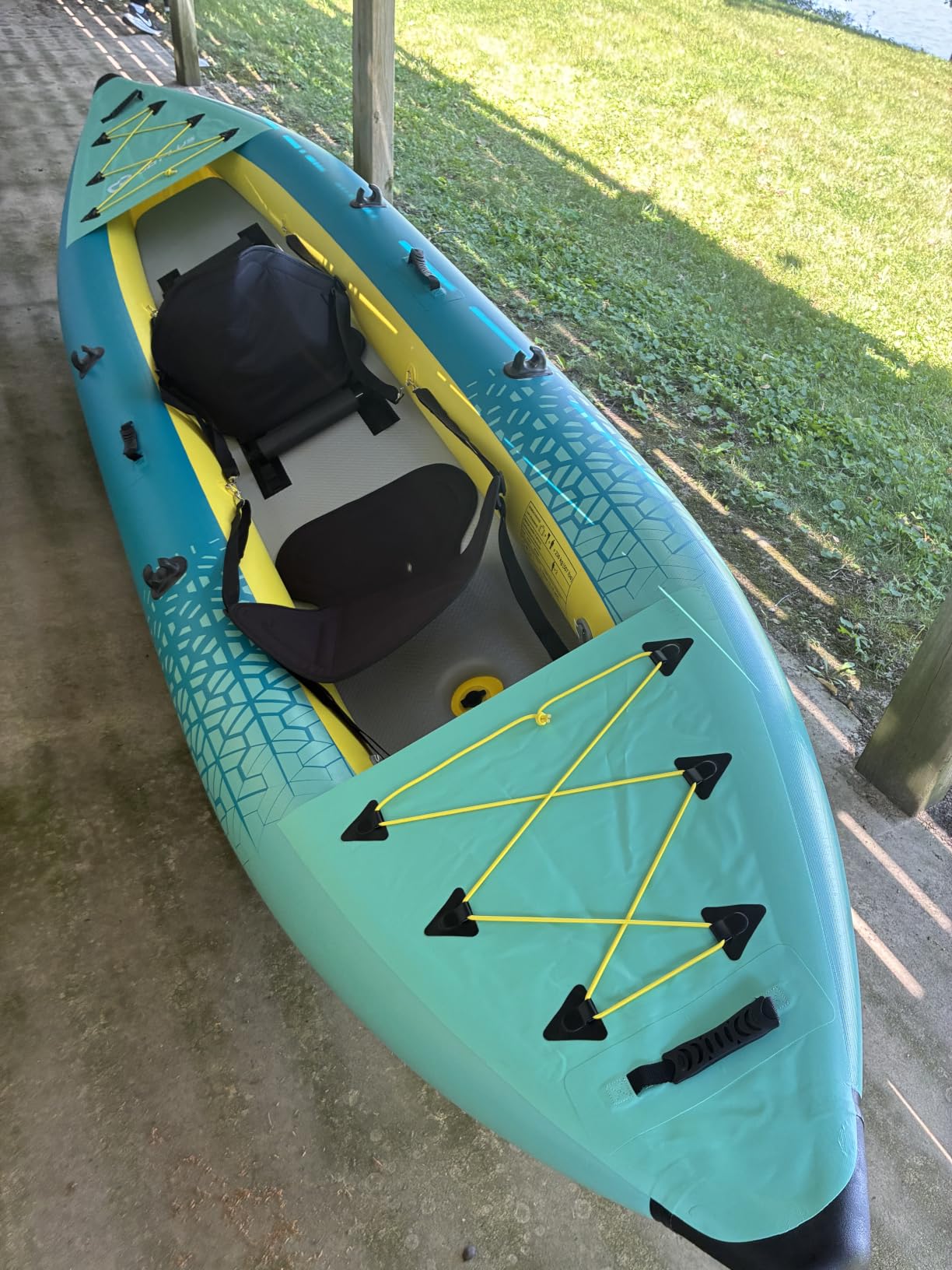
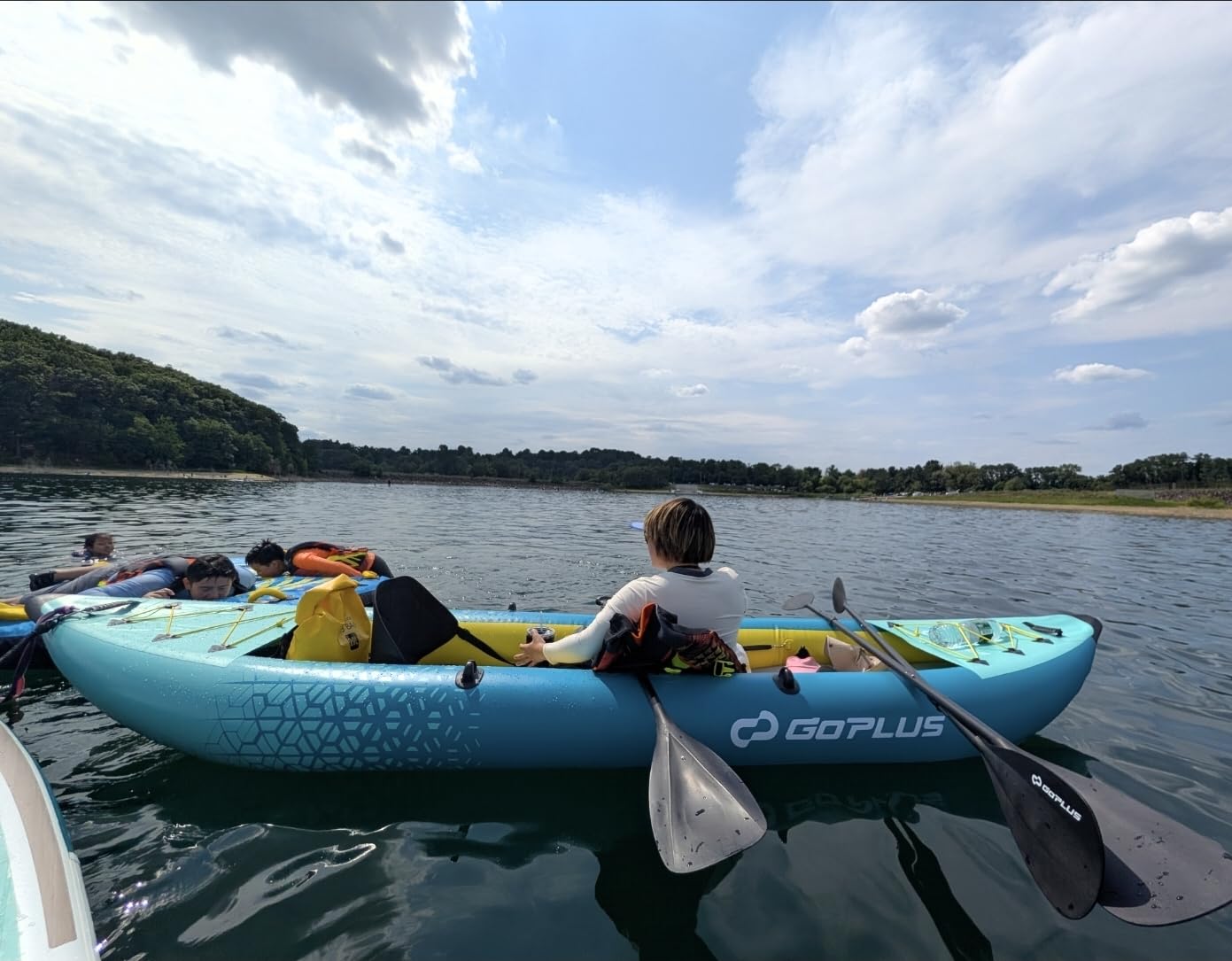
A removable drop-stitch floor is the feature that changes what a budget inflatable feels like underfoot, and the GYMAX 12.5 ft is one of the few boats here that ships with one. Owners call it the best of its class for exactly that reason.
The numbers suit river work. Twelve and a half feet of hull length plus a 507 lb capacity means two adults and a real load of gear without everything riding high in the cockpit, and a long hull is what carries a glide.
It holds a 4.2 average from 133 ratings. Reviewers single out the floor, the load capacity and the tracking, and the complaints cluster around the stock paddles, the seats and the documentation.
How it handles moving water
The floor stiffens the boat enough that it holds shape in a cross-current, and owners report it tracking straight in a head wind, which is a decent sign on open water. The long hull also pushes through current with fewer corrective strokes than the shorter tandem boats here.
The front skeg is worth attention on a river specifically. Owners warn that it catches on submerged logs, and a few simply take it off for shallow rocky sections. That costs you tracking, so fit it only where you know the bottom is clean.
Where it falls short
Fit and finish are the weak spots. Low seat backs and slipping support straps mean you will want seat pads for a long day, and the included paddles are the wrong shape and length for the hull. Both are cheap fixes if you plan them in advance.
The repair kit arriving without adhesive is a poor detail on a boat you might need to patch on a gravel bar, and the setup instructions are minimal. Buy glue separately and read a short setup video before your first launch.
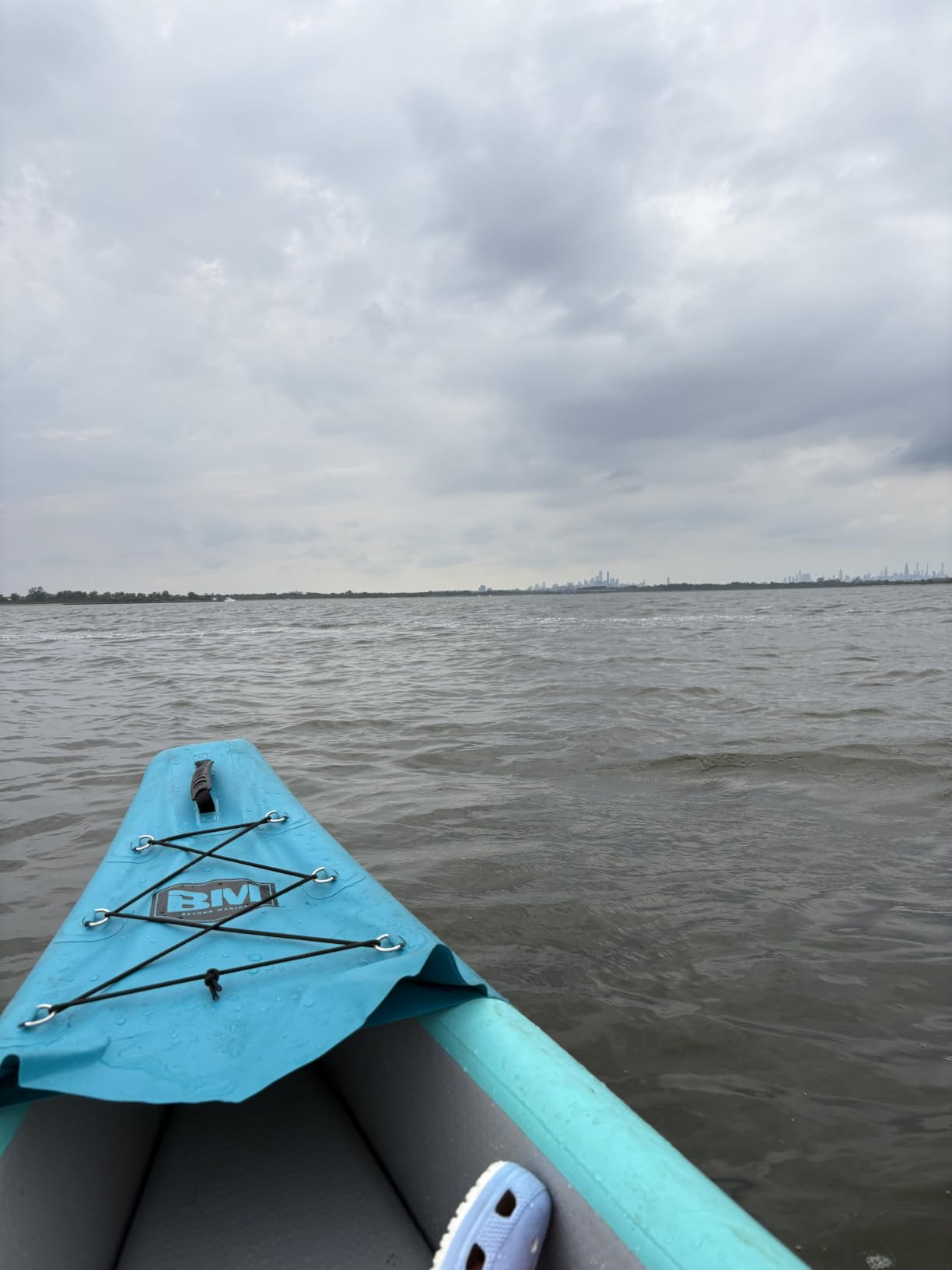
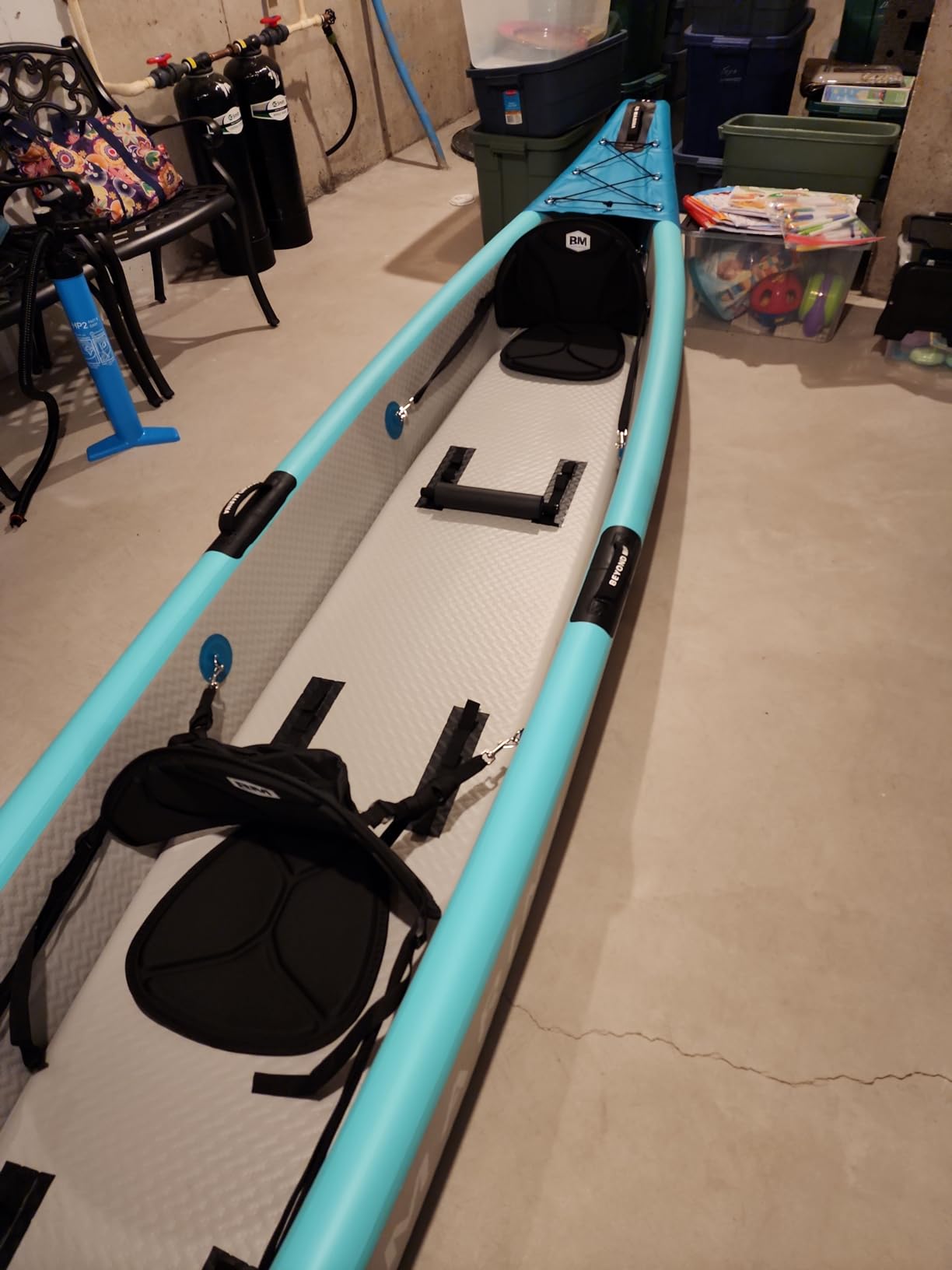
7. BEYOND MARINA Pathfinder: Best for a Rigid Solo Hull
Beyond Marina Inflatable Kayak 1 Person, Full Drop Stitch Pathfinder 12.5ft
12.5 ft x 29.1 in x 19.7 in inflated
352 lb capacity
35.27 lb hull weight
Full tri-chamber drop-stitch
Pros
- Full drop-stitch construction feels and behaves far more rigid than PVC inflatables
- Holds up in chop and against rocky shorelines
- Inflates in under five minutes with the supplied pump
- Wheeled backpack makes transport to a remote launch easier
- Stable solo fishing platform for lakes and rivers
Cons
- Narrow 29 inch beam gives less usable space than the capacity rating suggests
- Only 60 reviews so long-term durability is not yet proven
- Sold as a single-person craft despite the 352 lb rating
Drop-stitch is the closest an inflatable gets to a hard shell, and the Pathfinder is a full tri-chamber drop-stitch boat rather than a PVC one with a floor panel added in. Owners describe the difference in feel immediately when they sit in it.
At 12.5 ft it is a long solo boat, which is unusual and useful. You get straight-line tracking and glide that most solo inflatables cannot manage, and the wheeled backpack is a thoughtful touch for carrying it to a launch.
The 4.2 average comes from 60 ratings, so the feedback pool is still small. What owners do report is consistent: rigid, quick to inflate, and stable on solo fishing trips in lakes and rivers.
How it handles moving water
Rigidity is what makes this one interesting on a river. A firm hull holds an edge when you lean into a current and does not distort as you cross a wave or a boat wake, so it feels much more composed than the same-length PVC boats.
The narrow 29 inch beam means it feels narrow for its length, so it is a boat for an experienced paddler who can handle a slim hull rather than a first-timer. If you are new to a long kayak, expect to spend time learning its balance.
Where it falls short
The listed capacity of 352 lb is generous for a 29 inch beam, and owners point out that the cockpit is narrow even though the number suggests otherwise. Do not plan to carry two people or a wide gear crate in it.
With 60 reviews there is not yet a long-term record of how the seams hold over years. That is the main reason this sits below the older boats despite the better construction.
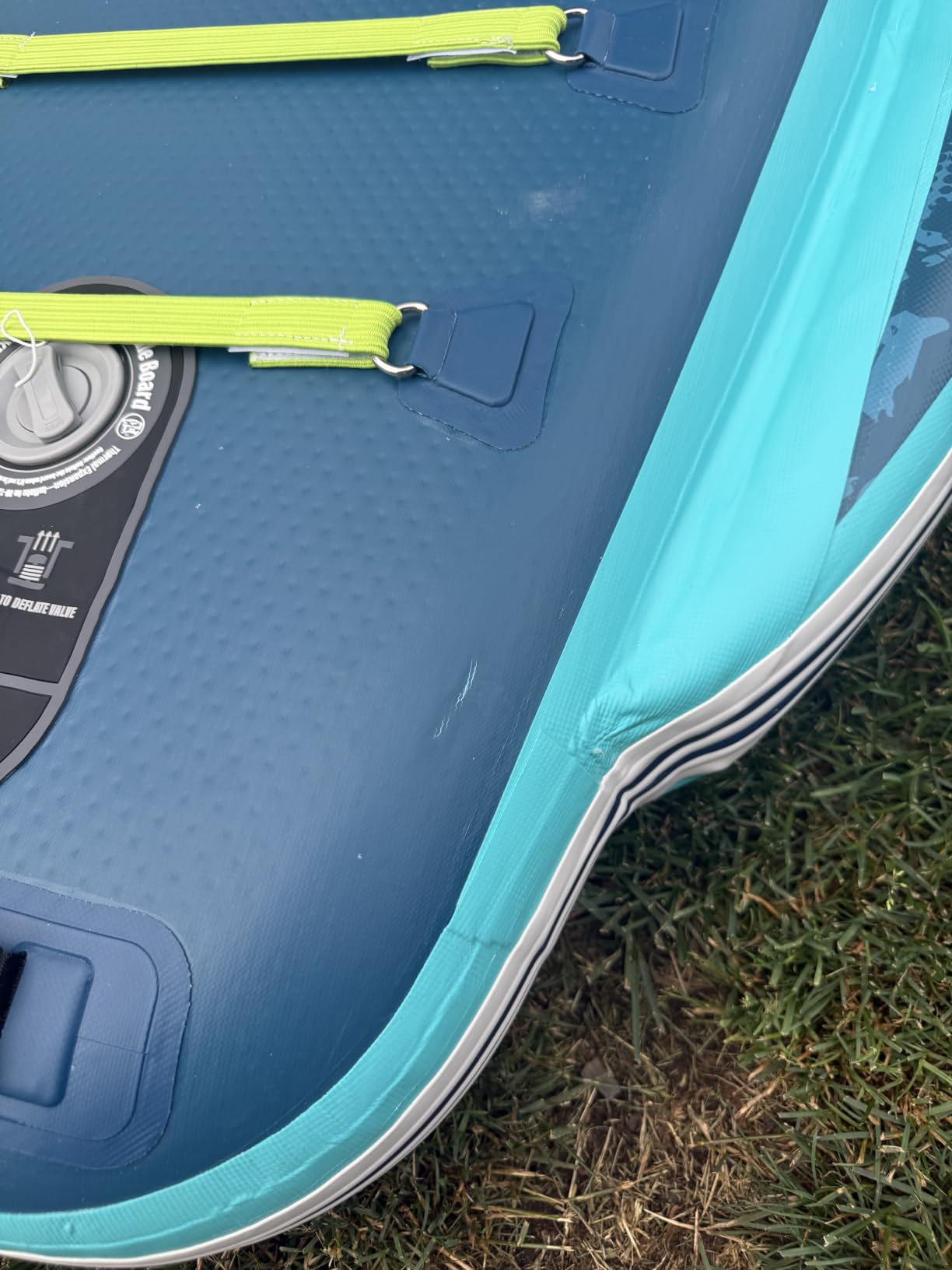
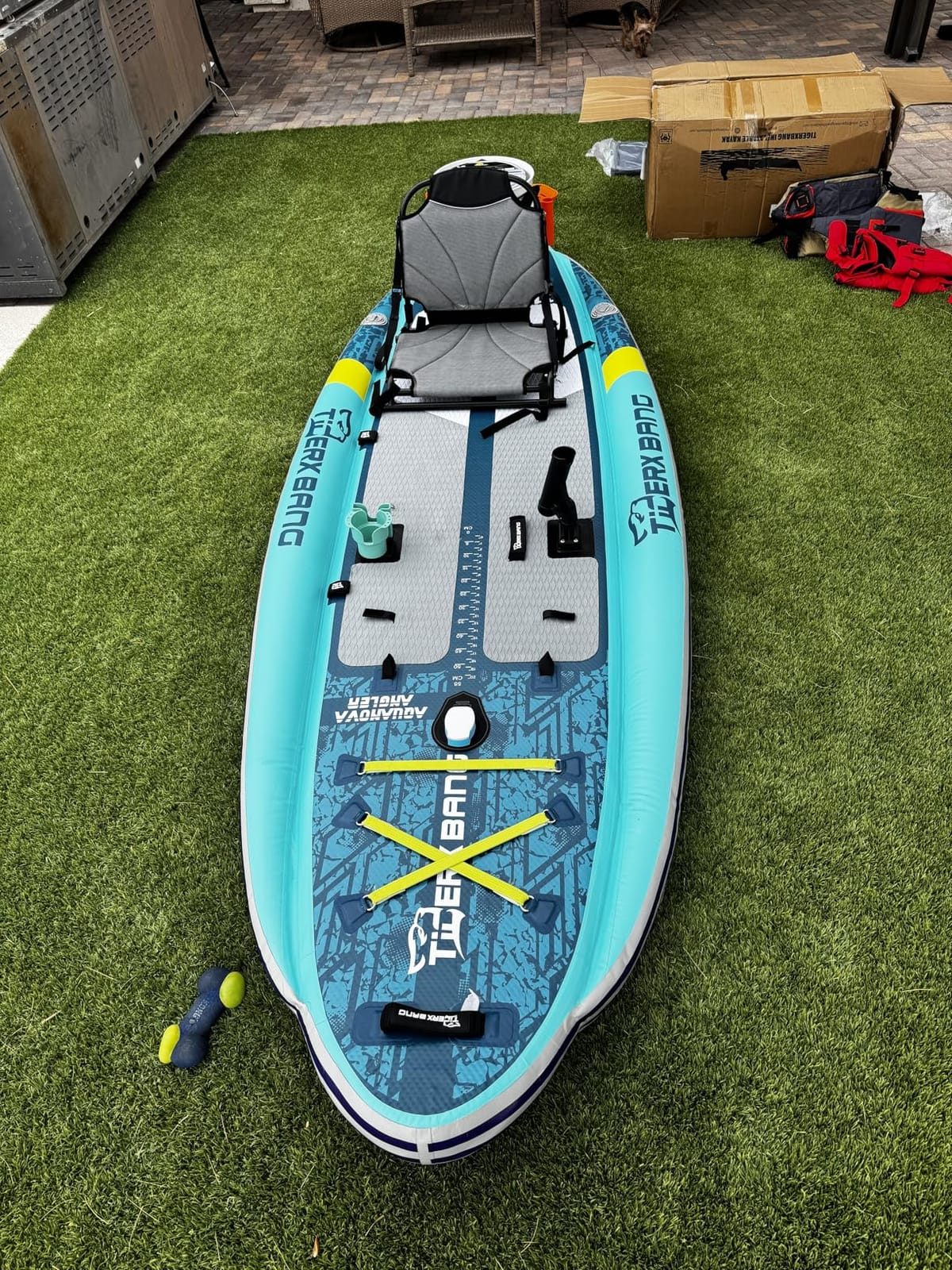
8. TIGERXBANG 11 ft Wide Hull: Best for Standing Casts
TIGERXBANG 11’x47”x8” Inflatable Fishing Kayak, High-Performance Inflatable Kayak-Ideal for Water Fishing Activities, Equipped with Comfortable Seats and Camera Base Versatile Accessories
11 ft x 47 in x 8 in inflated
16.25 kg boat weight
Double-sided drop-stitch fabric
Two universal accessory brackets
Pros
- 47 inch beam creates a very stable fishing platform for standing casts
- Large open cockpit fits tackle boxes and a folding chair
- Double-sided sandwich fabric resists tearing and punctures
- Universal brackets accept rod holders and a fish finder
- Backpack
- pressure gauge pump and repair kit included
Cons
- Only 16 reviews so long-term durability is unproven
- Repair kit ships without glue
- Low side height offers little spray protection in moving water
The 47 inch beam is the number to remember here. This is the widest hull in the guide, and wide means you can stand up and sight-cast into a shallow seam without the boat tipping under you, which is the single biggest advantage a river angler can have over a narrow kayak.
It is built with double-sided sandwich fabric and high-density drop stitching, layered PVC that is described as tear and puncture resistant. That construction, plus two universal accessory brackets that take rod holders or a fish finder, makes it purpose-built for fishing rather than adapted from a touring hull.
Owners rate it 4.4, but that average sits on only 16 ratings, so treat it as promising rather than proven. The 1 year warranty is the shortest we would feel comfortable with on a boat you will drag over gravel.
How it handles moving water
Beam wins on stability and loses on speed. This boat will hold a surprising amount of stability in current for its 11 ft length, but the wide hull carries less glide, so paddling upstream against a real push takes more strokes than a longer narrow boat would.
The low 8 inch side height is the other consideration. On a moving river you take splash over the bow more often than you would in a taller hull, so a dry skirt for your legs is worth packing.
Where it falls short
Sixteen reviews is a very thin record for a durability claim. Drop-stitch fabric sounds robust, but nobody has yet reported back after five seasons of gravel bars, and that is the scenario this guide is written for.
The repair kit without adhesive is a common gap on newer listings. Pick up a proper adhesive patch kit before you need it, because a puncture on a river bank is a bad time to shop.
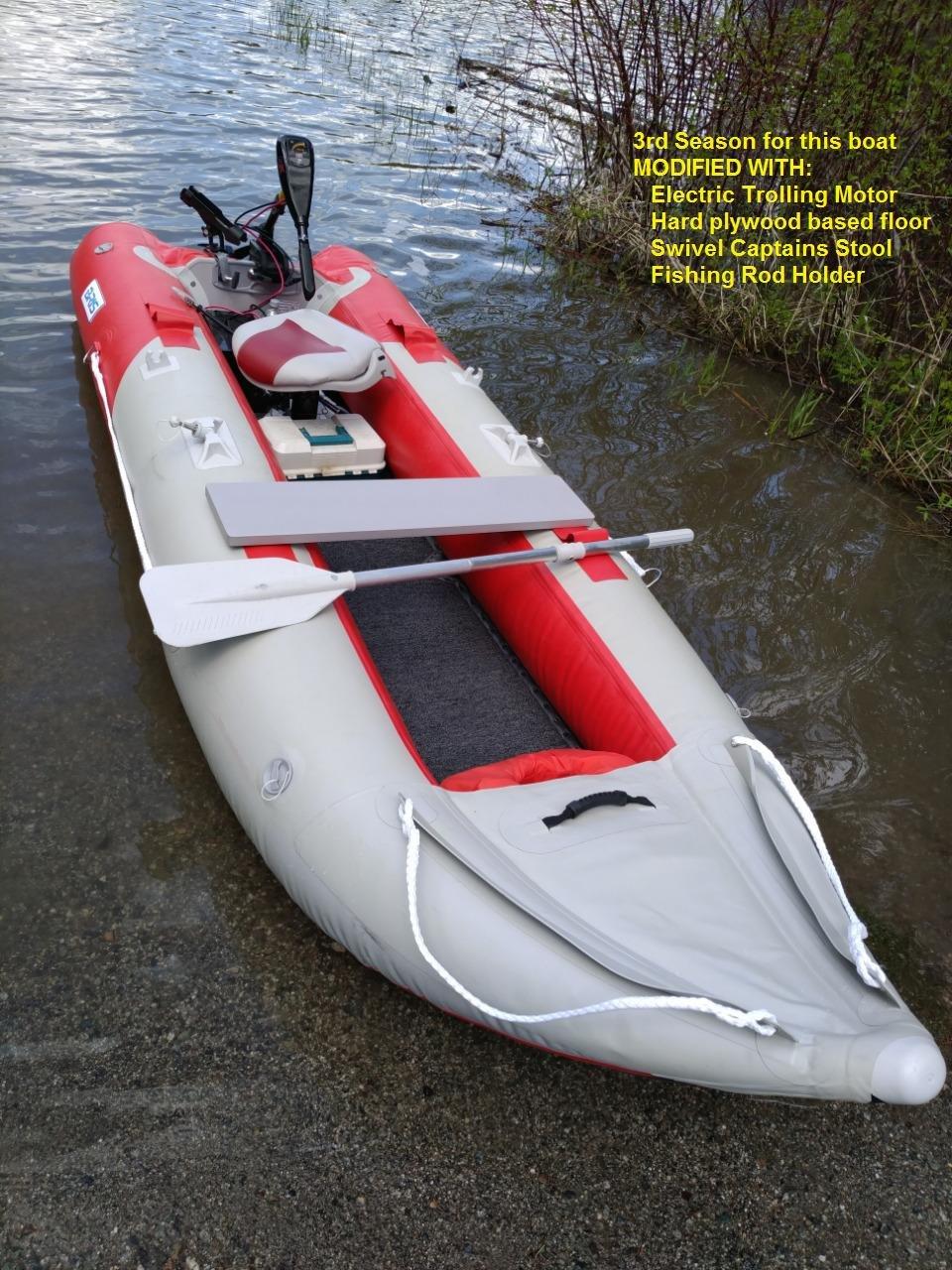
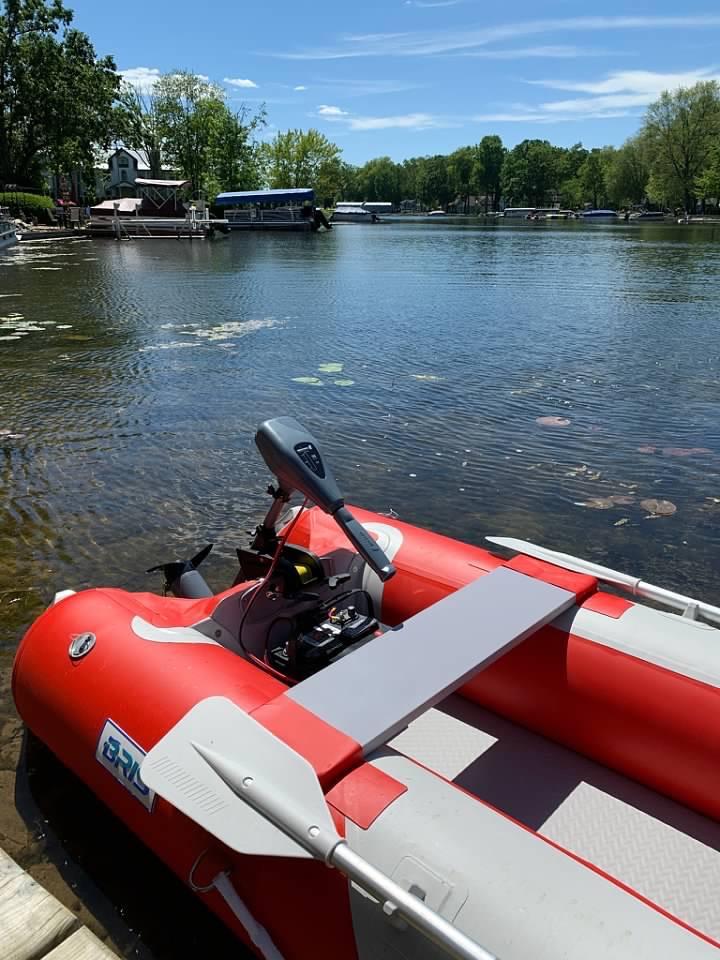
9. BRIS 12 ft Fishing Tender: Best for a Standable Fishing Platform
BRIS 12 ft Inflatable Kayak Fishing Tender Inflatable Poonton Boat 2 Person Kayak
12 ft tender platform
480 lb capacity
32 kg boat weight
High-pressure drop-stitch deck
Pros
- Rigid drop-stitch deck you can genuinely stand and fish from
- 1100 denier PVC with heat-welded quadruple overlap seams
- 12 ft beam gives a wide steady casting platform
- Four fins keep tracking strong for a boat this size
- Removable bench seats open up a full fishing deck
- Three year manufacturer warranty
Cons
- Heaviest option in the group at about 32 kg so it takes two people to launch
- Pontoon-style hull tracks worse than a narrow kayak hull
- Only 52 reviews so there is less long-term feedback than the big brands
Be clear about what this is: an inflatable fishing tender, not a kayak. Reviewers treat it that way, and if your priority is a flat deck you can stand on and spread gear across, that is exactly what it is built for.
The construction is the strongest in this group. 1100 denier PVC with heat-welded quadruple-overlap seams and two air chambers per side tube is serious fabric work, and it comes with a three year manufacturer warranty, the longest here.
Remove the bench seats and you have a casting platform roughly 12 ft by 3.8 ft. That is the setup I would use for a day wading and casting pockets on a wide river section.
How it handles moving water
It is wide, flat and buoyant, which makes it steady and slow. It is not fast, and the pontoon-style hull carries its beam all the way through the water, so any downstream push moves the whole boat rather than being resisted by a keel.
Four fins are fitted, which does more for tracking than most single-skeg boats achieve. Still, expect to make more corrective strokes than you would in a long narrow hull, and plan routes with that in mind.
Where it falls short
Weight is the headline problem. Around 32 kg deflated means two people for every carry, and a 12 ft boat that two people have to shoulder across a car park is a different trip from a solo paddle-out.
It also behaves like a small pontoon. Reviewers are candid that it tracks worse than a kayak hull, and if you like the feel of a kayak you will notice the difference immediately.
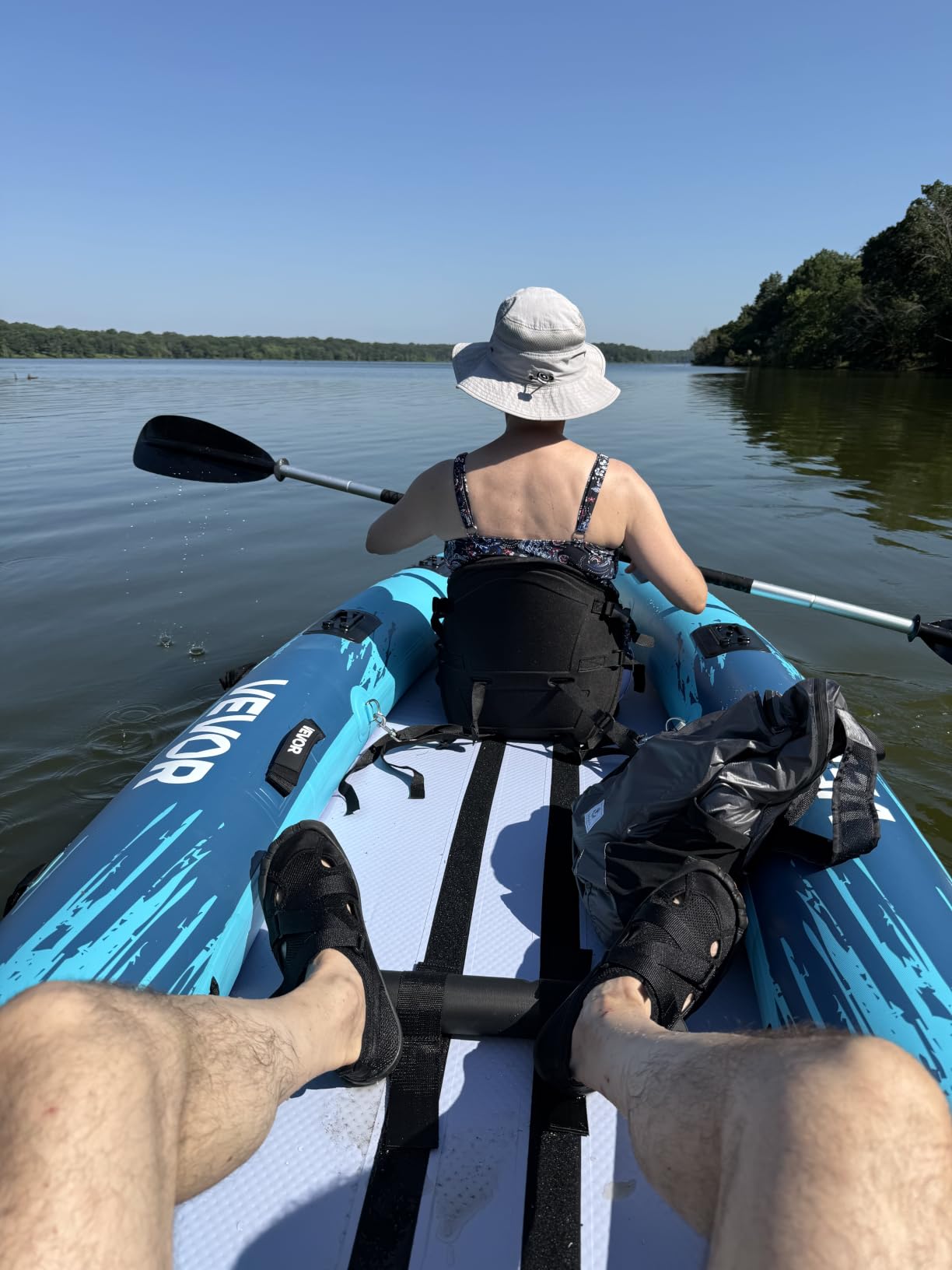
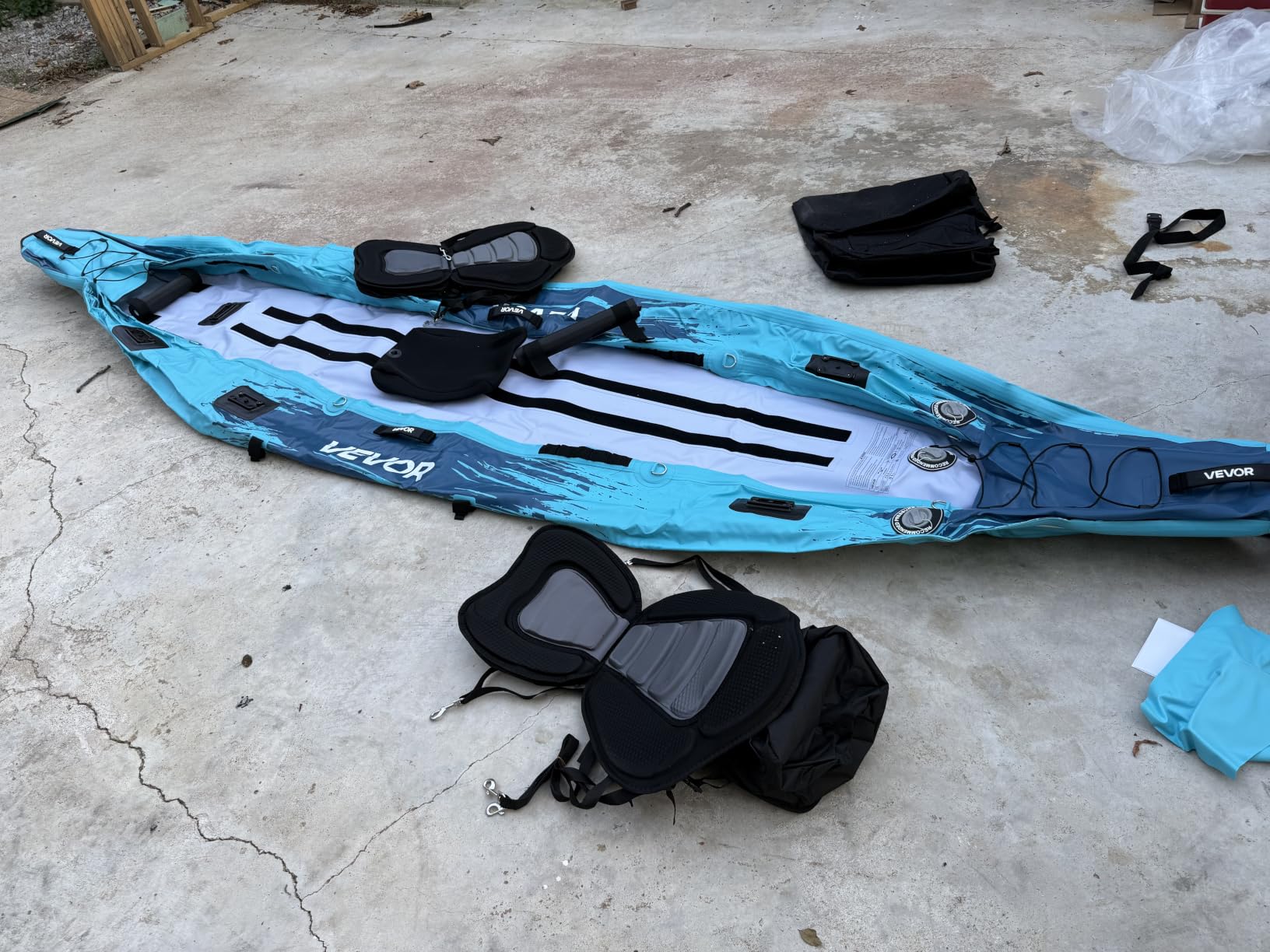
10. VEVOR 14 ft 4 in Inflatable: Best for Room and Load Capacity
VEVOR 2-Person Inflatable Kayak, 14’4″ x 3’7″ – Extra Spacious for Family & Dogs, 700-lb Capacity Sit-in Kayak with Accessories, Includes 2 Paddles, Pump & Carry Bag – Perfect for Fishing and Touring
14 ft 4 in x 3 ft 7 in inflated
700 lb capacity
60 lb boat weight
Drop-stitch floor with drain holes
Pros
- Enormous interior for two adults plus a large dog
- Very stable with two adults aboard and tracks better than the width suggests
- Drop-stitch floor feels firm and solid
- Seven reinforced mounting points for rod holders and electronics
- Inflates in about six minutes with the included pump
Cons
- About 60 lb deflated so it is bulky to carry solo
- Rear rod-holder mounts sit too far back and interfere with paddling
- Thin owner's manual
- A small number of owners report seam defects or a leaking chamber
When you are fishing with a partner, a dog and a full day of gear, the argument for a bigger boat is obvious. At 14 ft 4 in with a 700 lb rating and a 3 ft 7 in beam, this is the largest hull here and owners consistently praise the space and the stability that comes with it.
Seven reinforced mounting points is a real angler layout rather than a decoration, and the drop-stitch floor with quick-drain holes is a nice touch for a boat where water will find the cockpit. Reviews say it tracks better than the width suggests, which surprises people.
It holds a 4.2 average from 21 ratings. Owners love the room, the stability and the firm floor; the weight and the rear mounting positions come up repeatedly as drawbacks.
How it handles moving water
With a 9 inch tracking fin and 14 feet of hull, this boat holds a line far better than its budget-tier peers. On a river with a steady push it makes forward progress with fewer strokes than the shorter tandems.
The flip side is that 14 feet is a lot of boat for a tight river bend. On a narrow, twisting section this hull will feel long and slow to turn, and you will use more space than the channel gives you.
Where it falls short
At roughly 60 lb deflated, this is a two-person carry at best. If your launch involves a walk from the road, this boat ends the trip before it starts.
Owners also note that the rear rod-holder mounting points are positioned too far aft and get in the way of paddling. Move them forward or fit rail-mounted holders instead. A handful of units arrived with seam defects, so inspect the boat carefully on day one.
11. Niphean 12 ft 6 in Tandem: Best With Factory Fishing Bases
Niphean Inflatable Kayak 2 Person, 12’6″ Tandem Kayak with 500lb Capacity
12 ft 6 in x 37 in x 11 in inflated
500 lb capacity
Three air chambers
8 cm drop-stitch floor
Pros
- Stable three-chamber layout that beginners find easy to control
- Firm 8 cm drop-stitch floor gives a hard-shell-like feel underfoot
- Three fishing bases and a camera base are built in from the factory
- Thickened PVC handles abrasion and sun exposure better than thin budget models
- Bottom drain plug for cockpit water and EVA anti-slip pad
Cons
- Only 13 reviews so the long-term record is limited
- 12 ft 6 in hull is less nimble for tight river bends
- Thickened PVC still not a match for full drop-stitch hulls on rock
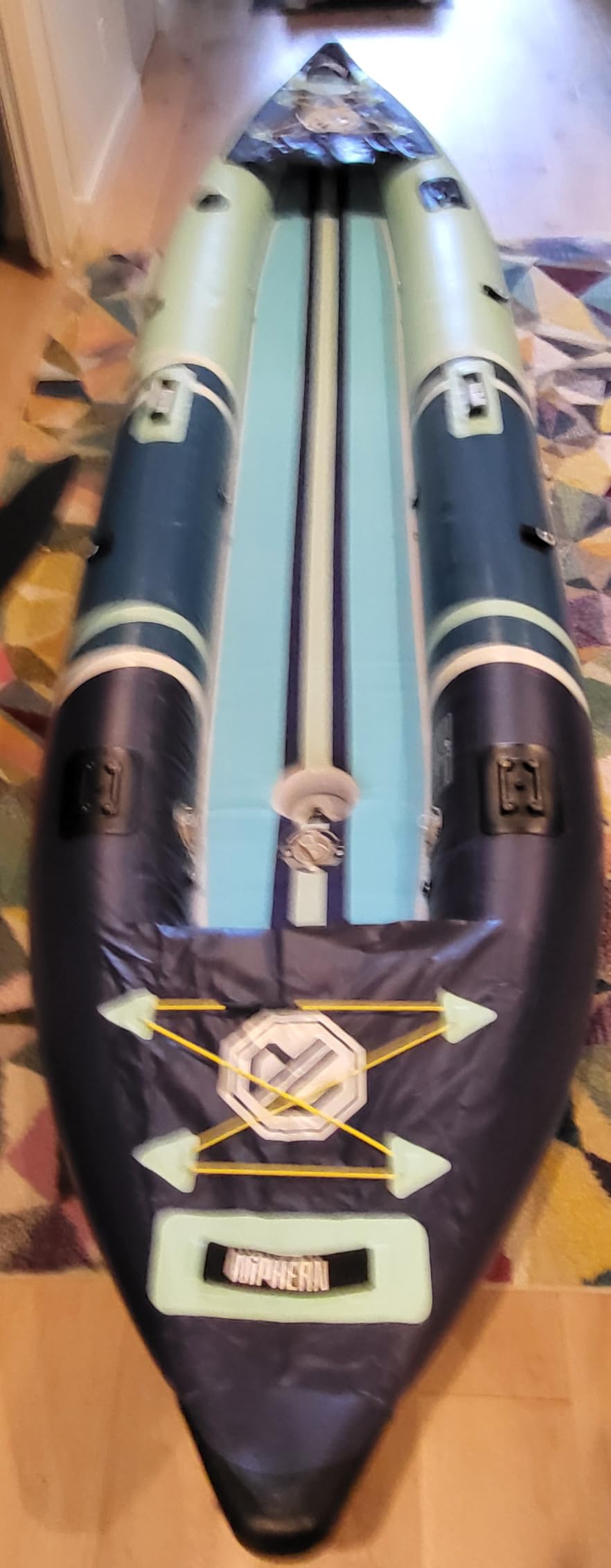
The Niphean arrives with three fishing bases and a camera base already fitted, plus a firm 8 cm drop-stitch floor. That combination means you can rig it as an angler boat without ordering a single mounting plate.
The 0.7 mm thickened PVC is a step up from the very thin skins used by budget tandems, and owners comment that it handles abrasion and sun exposure better. Three separate air chambers reduce side-to-side wobble, which beginners notice first.
It rates 4.3 from 13 ratings, so the early feedback is positive but the sample is small. Treat this as a newer listing and a watch-and-see candidate rather than a proven workhorse.
How it handles moving water
Twelve and a half feet is enough length to track acceptably, and the drop-stitch floor stiffens the middle of the boat enough that it does not wallow in a cross-current. Owners describe the three-chamber layout as easy to control, which matters when you are learning a river.
It is a wide tandem hull, so it is steady and slow rather than quick to turn. On a tight, bending river you will be pivoting a large shape, and the review notes about a less nimble hull match what you would expect.
Where it falls short
Thirteen reviews is not enough history for a boat you will drag over gravel, and the brand is new enough that parts and service may be harder to find than for the established names.
Thickened PVC is still PVC. On genuinely rocky riverbeds the full drop-stitch hulls will outlast it, and if your route is mostly shallow rock you should spend the extra on construction.
12. Bestway Hydro-Force Rapid X3: Best for Three Anglers
Bestway Hydro-Force 12’6″ x 39″ Rapid X3 Inflatable Kayak Set | Fits Up to 3 Persons | Includes 2 Aluminum Paddles, 1 Hand Pump, 2 Fins, 1 Carry Bag, Repair Patch Kit
12 ft 6 in x 39 in inflated
551 lb capacity
18.72 kg boat weight
Seats up to three adults
Pros
- Unusually roomy for an inflatable at 12 ft 6 in by 39 in
- Owners report it survives being run over rocks
- Glides smoothly and sits high on the water
- Easy for kids to load and unload from the shore
- Grab rope with built-in grommets makes re-entry simple
Cons
- Very hard to keep straight without the fin fitted
- About half an hour to inflate fully
- Heavier than most people want to portage
- High seat position makes paddling feel less natural
- Carry bag is too small for the deflated hull
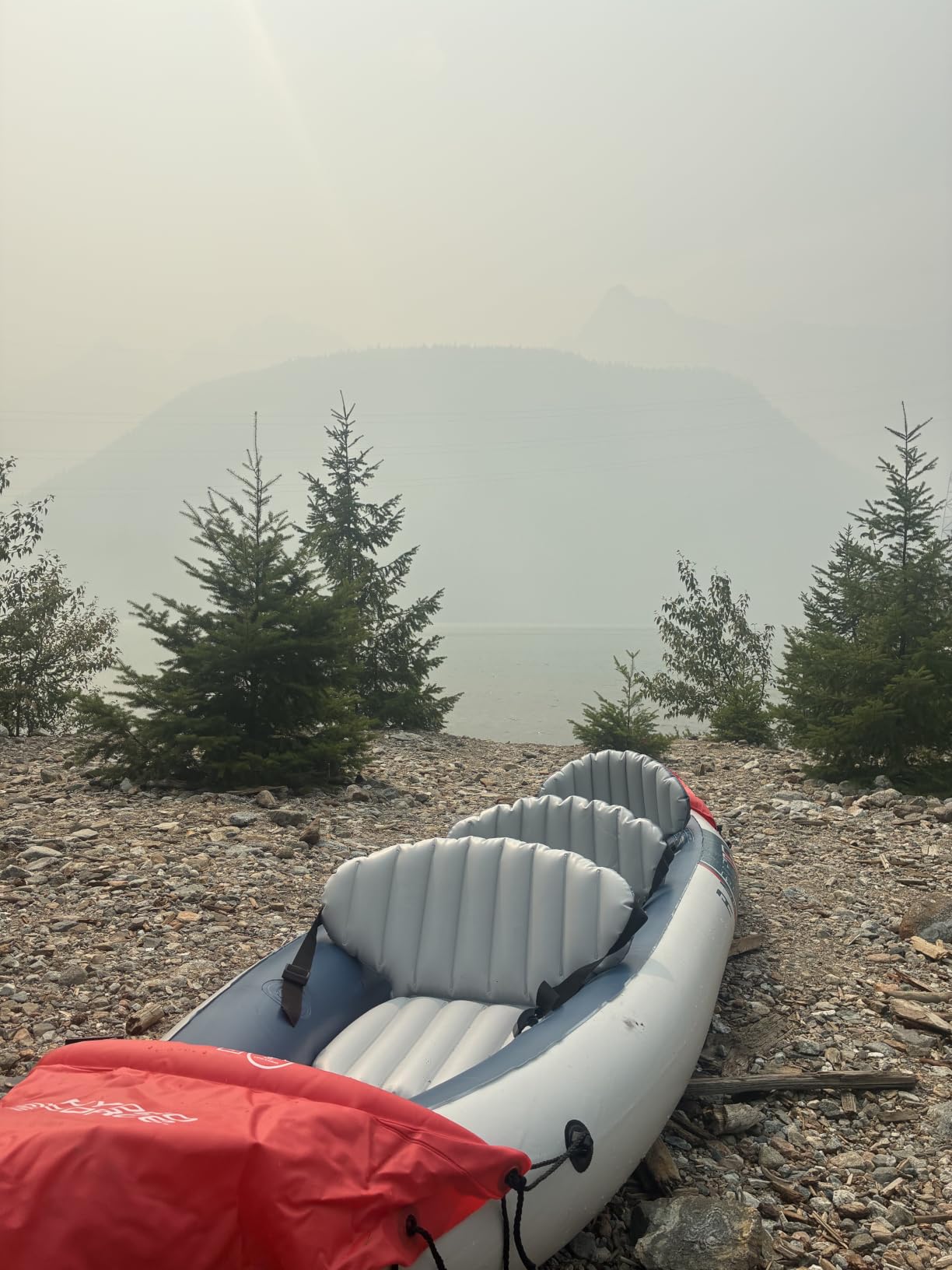
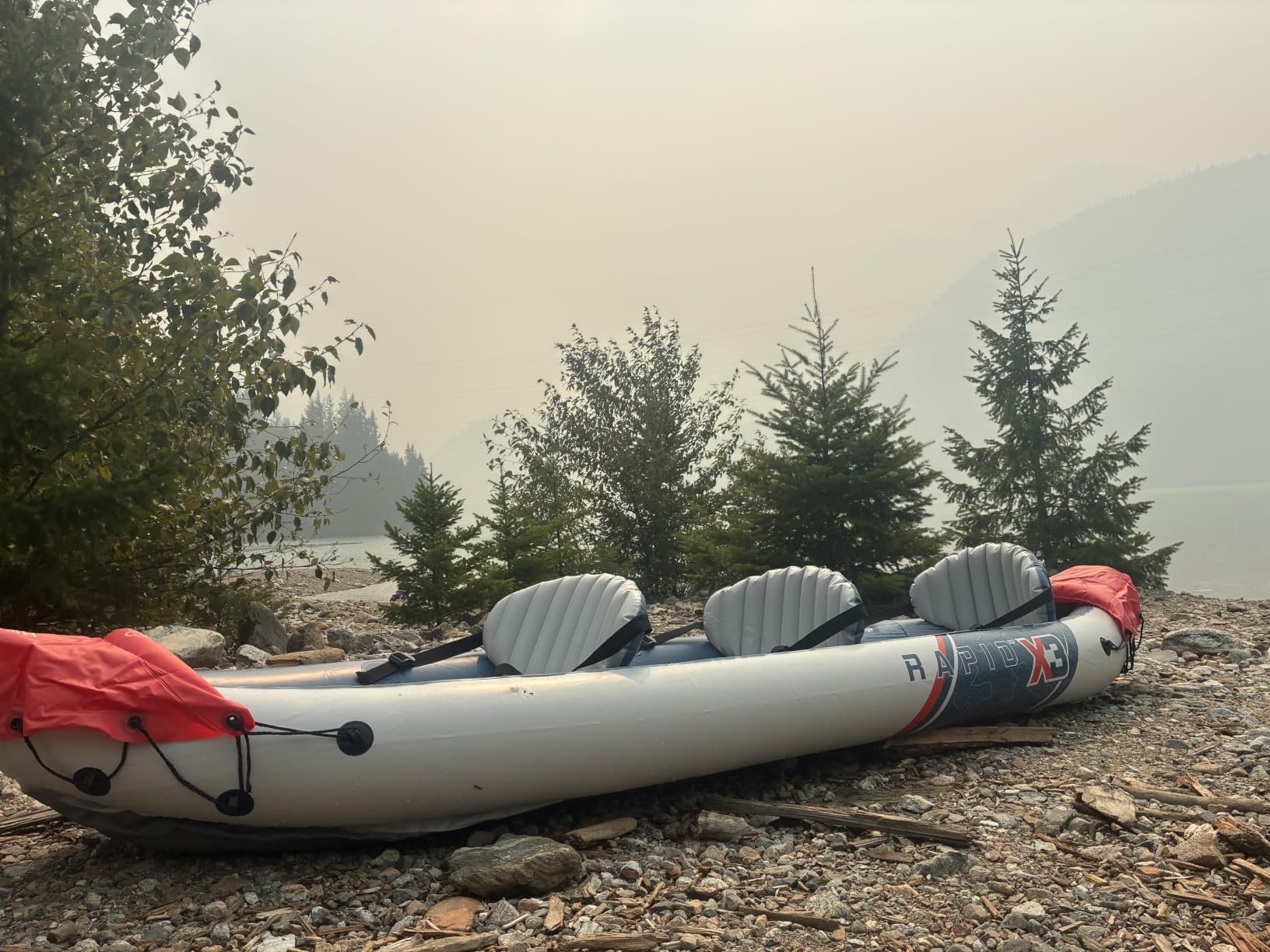
Three seats and a 551 lb rating make the Rapid X3 the only boat here that works for two anglers plus a child or a dog. At 12 ft 6 in by 39 in it is a genuinely wide, roomy inflatable rather than a stretched two-person hull.
Owners report good durability against rocks for a boat this size, and they like the grab rope with built-in grommets because it makes getting back in after a capsize far easier on moving water.
It holds a 4.2 average from 33 ratings. The most common complaint has nothing to do with the hull and everything to do with the fin: without it fitted, owners say the boat is extremely hard to keep straight.
How it handles moving water
Wide and long, it carries glide and it sits high, which keeps spray out of the cockpit. The two removable fins give you a choice between straight tracking and quick turns, and on this hull that choice actually matters a great deal.
Fit the fin before you launch. Owners are emphatic that without it the boat wanders badly in any current, and that is the difference between fishing and fighting the boat.
Where it falls short
Inflating it fully takes about half an hour with the included hand pump, which is a long time to stand on a gravel bar in weather. Budget the setup time into your trip, or use a pump with more capacity.
Weight and carry bag are the other two gripes. At 18.72 kg it is a two-person portage, and the bag is reported as too small for the deflated hull, so it is awkward to repack wet.
How to Choose an Inflatable Fishing Kayak for Rivers
Boat type matters more here than anywhere else. A rigid, keel-equipped hull with enough length to track beats a short recreational inflatable every time on moving water. Our touring kayak guide covers that logic in more detail if you are weighing a hard shell against an inflatable, and if you want self-propulsion for a long approach our pedal kayak guide is worth a look.
Here is how we weighted the 12 boats above. Tracking in current was 15 percent, current handling and turning 15 percent, abrasion resistance on rocky bottoms 15 percent, hull rigidity 15 percent, packability for portage 15 percent, angler features and setup 15 percent, and weight capacity 10 percent. Capacity scores lowest because nearly every boat here is rated well above what one or two anglers actually load.
Tracking, keel and skeg
Tracking is how straight a boat runs when you stop correcting it. On a river it decides whether you fish the seam you aimed at or the one the current chose. Length, a keel or a skeg, and hull rigidity all feed into it, and every boat here has at least one of the three. The skegs on the Intex Excursion Pro and the Bestway boats are removable, which is the feature we like most, because river bottoms change between trips.
Abrasion resistance and hull material
This is the biggest anxiety forum anglers raise, and the data backs it. PVC tarpaulin bottoms, thickened PVC and full drop-stitch hulls all survive gravel better than thin single-layer skins, and drop-stitch is the most resistant construction here by a wide margin. If your river is rocky rather than silty, prioritise hull construction over every other feature.
Rigidity, PSI and cold water
PSI means pounds per square inch, the inflation pressure that turns fabric into a hull. Under-inflate and the boat flexes, rolls and tracks badly; over-inflate and seams take the load. Cold water drops internal air pressure, so check pressure before launching on a cold morning rather than assuming the daytime figure still holds. Drop-stitch floors want the higher end of their range, which is what makes them feel solid underfoot.
Portage and packed weight
Rivers are the one water type where you regularly carry the boat. Under about 25 lb packed, one person can manage a solo carry; above 40 lb you are planning for two. The VEVOR and the BRIS tender both fall into the two-person category, and that should rule them out of remote-launch trips regardless of how good they are otherwise.
Seats, mounting and solo versus tandem
A raised or crank-style seat helps you see fish and keeps your rod line clear in a current. For mounting, look for D-rings and rails rather than a single rod holder, since fish finders, an anchor trolley and a trolling motor mount all need somewhere to attach. Solo or tandem is mostly a question of capacity and company: our tandem kayak guide covers the trade-offs if you are still deciding.
River safety limits
Wear a properly fitted PFD on every river trip, and treat cold water as cold regardless of air temperature. Carry a throw bag, paddle float and whistle, and tell someone your launch point and expected return. Our honest limit is Class I-II water with a boat that suits it. Inflatable hulls have no spray skirt protection and limited reserve buoyancy compared with a hard shell, so above Class II, or on any river with strainers, drops or a swollen flow after rain, use a proper whitewater craft and the training that goes with it. If you are swept downstream, look for an eddy line, angle across toward it rather than straight at the bank, and use a ferry glide to hold your line while you work back upstream.
Frequently Asked Questions
What type of kayak is best for using on rivers?
A rigid, keel-equipped boat with enough length to track is the right choice for moving water. Among inflatables, look for a hull of 11 ft or longer with a keel or skeg, a drop-stitch floor for stiffness, and stable beam for casting. Short recreational inflatables under 9 ft wander badly in current.
Are inflatable kayaks any good for fishing?
Yes, on rivers they work well for anglers who want portability. Modern angler inflatables come with drop-stitch floors, accessory rails and rod holders, so standing casts and electronics mounting are realistic. The compromises are tracking versus hard shells, wind sensitivity, and abrasion on rocky bottoms.
Which inflatable kayak is the most stable?
Among these picks, the TIGERXBANG 11 ft is the most stable thanks to a 47 inch beam, and the BRIS 12 ft tender offers the largest standable deck. The Intex Dakota K2 is the most stable of the conventional tandems. Wider beam resists tipping, while length and keel drive tracking.
What are the disadvantages of an inflatable kayak?
The main drawbacks on a river are puncture risk from rocks and submerged branches, side-slip in current that causes constant corrective strokes, wind sensitivity on open water, no standing platform on non-drop-stitch models, and slow dry-out times that cause mildew if the boat is stored damp.
What does PSI mean in inflatable kayaks?
PSI is pounds per square inch, the inflation pressure that stiffens the fabric into a hull. Too little pressure makes a soft boat that flexes and tracks poorly, and too much stresses the seams. Drop-stitch floors need higher pressure than air-beam floors, and cold water lowers pressure, so check it before launching.
Are inflatable kayaks safe on rivers?
They are reasonable on Class I-II water with a proper PFD, whistle, throw bag and paddle float. Above Class II, or on swollen water after rain, inflatables have too little reserve buoyancy and no spray deck, so use a whitewater-appropriate craft and training. Never paddle an inflatable alone in moving water.
Best Inflatable Fishing Kayaks for Rivers: Final Verdict
The Bestway Hydro-Force Koracle X1 takes our Editor’s Choice because it is the one boat here that solves the river problem nobody else addresses: getting to the water alone. One person carries it, the twin fins let you tune it, and it rates 4.4 from 135 reviews.
For the longest track record and a proven tandem, the Intex Explorer K2 is hard to argue with. For angler hardware in the box and the best tracking of the Intex group, take the Excursion Pro. If you will only ever fish one boat on the water, match the hull to your river: narrow and rigid for rocky water, wide and stable for wind and standing casts, and never over Class II without training.