
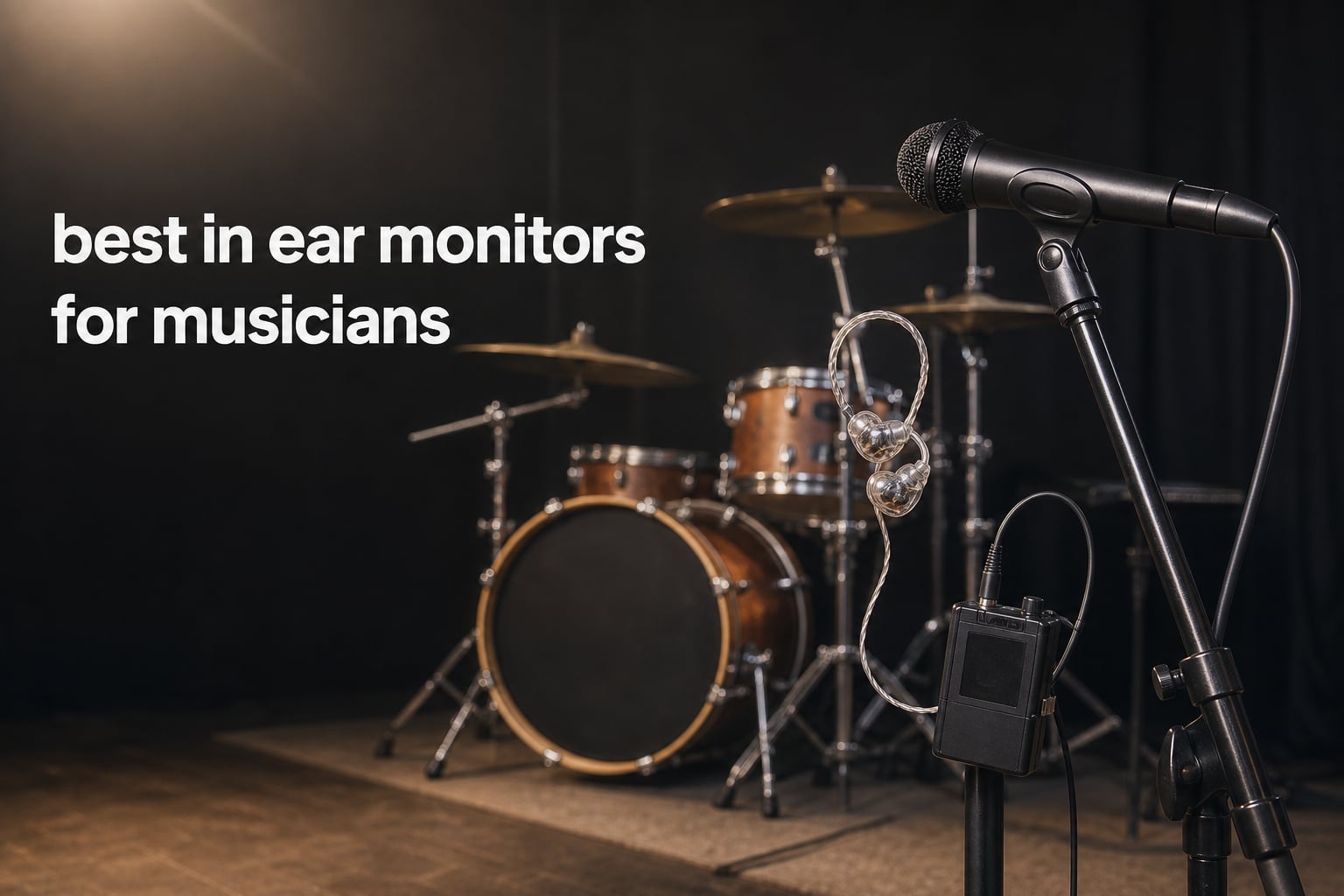
The best in ear monitors for musicians do two jobs at once: they put a clear monitor mix close to your ears and reduce the stage noise competing with it. That combination can make pitch, timing, and cue changes easier to hear at rehearsal, in a worship set, or on a loud club stage.
In-ear monitors, often called IEMs, are compact wired earphones that seal in the ear canal. Connected to a mixer, headphone output, or a wireless receiver, they deliver your personal mix directly while passive isolation lowers the outside sound reaching your ears.
Professional musicians do use in-ear monitors because a controlled mix and less stage volume help them perform consistently. The right pair is not only about driver count: a stable fit, workable cable, reliable seal, and tuning that lets you locate your own instrument matter just as much.
I compared the 10 analyzed models by their published driver layout, impedance, cable design, isolation claims, included accessories, and customer feedback. I have kept the recommendations grounded in those product details, rather than claiming listening tests that were not provided.
For 2026, my short list starts with the KZ ZAR for its dense hybrid driver layout and stated 30 dB isolation, the BASN Bmaster for its complete monitoring kit, and the Moondrop CHU II for a simple dynamic-driver route with replaceable acoustic parts. Read the fit notes carefully: a correctly fitted single-driver IEM can be more useful on stage than a loose multi-driver model.
Table of Contents
The top 3 in-ear monitors for musicians are the KZ ZAR, BASN Bmaster, and Moondrop CHU II
The KZ ZAR is the feature-heavy choice for players who want isolation and a large driver complement in a lightweight shell. The BASN Bmaster makes the most sense for a musician who wants MMCX replaceable cables, several tip options, a case, a cable clip, a cleaning tool, and a 6.3 mm adapter in one package.
The Moondrop CHU II is the uncomplicated pick for players who prefer a single 10 mm dynamic driver and care about low stated distortion and replaceable nozzles. Its supplied details make it a sensible rehearsal or first-IEM candidate, provided its universal fit seals well in your ears.
These 10 in-ear monitors for musicians cover rehearsal, stage, and studio work in 2026
| Product | Specifications | Action |
|---|---|---|
 YINYOO KZ ZST PRO X YINYOO KZ ZST PRO X |
|
Check Latest Price |
 Righteous Roots RR-EV1 Righteous Roots RR-EV1 |
|
Check Latest Price |
 BASN Bmaster BASN Bmaster |
|
Check Latest Price |
 KZ ZAR KZ ZAR |
|
Check Latest Price |
 keephifi KZ DQS keephifi KZ DQS |
|
Check Latest Price |
 TRUTHEAR x Crinacle Zero TRUTHEAR x Crinacle Zero |
|
Check Latest Price |
 KZ ZS10 PRO 2 KZ ZS10 PRO 2 |
|
Check Latest Price |
 Moondrop CHU II Moondrop CHU II |
|
Check Latest Price |
 Moondrop Variations Moondrop Variations |
|
Check Latest Price |
 UE 150 Universal UE 150 Universal |
|
Check Latest Price |
This quick overview separates closed, sound-isolating designs from the semi-open DQS. For loud stage monitoring, the seal and stated isolation of a closed design deserve priority; a semi-open housing can be more appropriate when some natural room sense is wanted.
1. KZ ZST PRO X is a straightforward hybrid starter for wired stage monitoring
Pros
- Hybrid driver layout
- Detachable cable
- Over-ear fit
- Wide frequency range
Cons
- No microphone
- No wireless function
The YINYOO KZ ZST PRO X pairs one 30019 balanced armature with a super-linear dynamic driver. That hybrid format is intended to give vocal and upper-range detail from the armature while the dynamic driver supplies fuller low-end body.
Its published 40-ohm impedance is higher than several models here, so I would verify that your mixer headphone output, wired pack, or receiver can drive it comfortably before a show. The listed 20 Hz to 40 kHz range describes capability, not a guarantee that every instrument will sound prominent in a specific monitor mix.
The over-ear form, detachable 3.5 mm cable, and tangle-free cord address practical rehearsal problems. Customer feedback highlights precise imaging and bass response, though this specific black-and-gold version has no microphone and is wired only.
For a singer or guitarist, the appeal is a simple hybrid IEM that can plug into standard 3.5 mm monitoring hardware. For drummers, a firm seal and a conservative monitor level matter more than pushing bass volume.
A stable over-ear route makes the ZST PRO X easier to keep in place
The cable routes over the ear, which can reduce the chance that the earpieces pull downward when you turn your head. Start with the included tip that seals without pressure, then check the fit while singing or moving through a full song.
A hybrid layout gives this model a clear role in a basic monitor mix
The armature-and-dynamic combination may help players separate vocal cues from kick and bass fundamentals. Keep expectations practical: it is a wired earphone, so it needs a wired feed or a separate wireless receiver to become part of a wireless personal monitor system.
2. Righteous Roots RR-EV1 is a stage-focused dual-driver option for worship teams
Righteous Roots RR-EV1 Professional Dual Driver in-Ear Monitors (IEM) with Carrying Case – Stage Earphones for Musicians, Worship Teams & Audio Engineers – High Fidelity Sound Isolation (1 Pair)
Dual driver
32 ohms
Memory wire
Carry case
Pros
- Stage isolation
- Memory wire
- Detachable braided cable
- 6.3 mm adapter
Cons
- Small review sample
- Not water resistant
The Righteous Roots RR-EV1 is explicitly positioned for musicians, worship teams, and audio engineers. Its dual-driver arrangement, 32-ohm impedance, over-ear memory wire, and sound-isolating design make it one of the more purpose-built stage monitor earphones in this group.
A reinforced, braided detachable cable is a meaningful detail for performers who repeatedly coil, pack, and uncoil their IEMs. The package also includes an EVA carrying case and a 1/8-to-1/4 TRS adapter, which is handy when a rehearsal-room headphone output uses the larger connector.
The rating is strong, but it is based on only 16 reviews, far fewer than many competing models. I would treat the feedback as encouraging rather than a long track record, especially if you play frequent shows and need proof of durability over time.
For a worship team that needs clear vocal cues and a secure physical fit, the RR-EV1 is a sensible candidate. The isolation should support lower stage-volume habits, but one ear should not be removed to hear the room because that can lead to turning the remaining earpiece up too far.
A supplied case and adapter make the RR-EV1 ready for varied rehearsal rooms
The included 6.3 mm adapter gives this pair a direct route to many console and interface headphone jacks. Store the detachable cable separately in the case when possible, since connector strain is a common weak point in daily gig gear.
A dual-driver presentation suits players who need vocal and instrument separation
Dual drivers do not automatically mean a better mix, but the design is aimed at clarity across the range. Ask the monitor engineer for a modest vocal-forward mix first, then add only the drum, click, or instrument information you actually need.
3. BASN Bmaster is a complete triple-driver monitoring kit with MMCX cables
BASN Bmaster Triple Drivers in Ear Monitor Headphone (Black)
Triple drivers
34 ohms
MMCX cables
30 dB isolation
Pros
- Two cables included
- MMCX rotation
- 30 dB isolation
- Full accessory kit
Cons
- No water resistance
- May need break-in
The BASN Bmaster uses triple balanced armature drivers and lists a 34-ohm impedance with 97 dB sensitivity. Its product details describe balanced bass, a clear midrange, and treble, a combination that suits musicians who need a balanced starting point rather than an exaggerated low end.
This is the most complete accessory package in the roundup: two detachable cables, a carrying case, several eartips, a 6.3 mm adapter, cable clip, and cleaning tool are included. The MMCX connectors rotate 360 degrees, which can make cable routing more forgiving around the ear.
BASN claims 30 dB of noise isolation, so the Bmaster has a strong paper case for loud stages when the tips seal properly. Reviews praise comfort and sound quality, while the product listing notes that a break-in period may be wanted for the sound to settle.
Among the best in ear monitors for musicians who want one package for rehearsal and performance, this is the most practical all-rounder. It is particularly appealing for vocalists and keyboard players who want the accessory basics without having to source them separately.
MMCX connectors make the Bmaster a sensible choice for cable-conscious musicians
A detachable cable can extend the useful life of an IEM when the cable becomes noisy, bent, or damaged. MMCX has a rotating connection, but remove each side by gripping the connector itself rather than pulling the wire.
Thirty-decibel isolation gives the Bmaster a strong stage-monitoring advantage
Isolation is only as good as the seal, so test each supplied tip while speaking or playing a backing track. If outside cymbals or wedges still dominate, refit the tips before increasing the monitor level.
4. KZ ZAR is the high-driver-count choice for detailed stage cues
KZ ZAR in-Ear Monitor 7BA+1DD Wired Earbud Headphones IEM
7BA plus 1DD
16 ohms
30 dB isolation
3-year warranty
Pros
- Eight-driver hybrid
- 30 dB isolation
- Aluminum shell
- Serviceable parts
Cons
- May need an amp
- Not wireless
The KZ ZAR combines seven balanced armature drivers with one 10 mm dynamic driver, for eight drivers in total. Its published 10 Hz to 40 kHz range, 16-ohm impedance, and 109 dB sensitivity point to a highly sensitive hybrid design intended to cover a broad spectrum.
For stage use, the most relevant stated feature is 30 dB noise isolation with detachable ear tips. The aluminum billet shells and serviceable-parts design also distinguish it from entry-level plastic models, while the three-year warranty is unusually reassuring within this list.
The listing says it may need a power amp for the best performance, so do a full signal-chain check before relying on it at a gig. A low-impedance IEM can also reveal background noise from a weak headphone output, which is another reason to test your actual pack or receiver.
I would point guitarists toward the ZAR when they want to hear layered guitar parts, vocal cues, and spatial placement without giving up bass information. Its strong isolation can also help drummers work with click tracks, provided the monitor mix has safe headroom.
An eight-driver hybrid gives the ZAR room for complex live arrangements
Balanced armatures are commonly chosen for small-driver detail, while a dynamic driver handles air movement in lower frequencies. That division may be useful in dense arrangements, but the monitor engineer’s EQ and your eartip seal remain the larger variables.
A serviceable design makes the ZAR easier to consider for regular gigging
Replaceable parts and a detachable cable can reduce downtime when a cable fails. Put a spare cable and extra tips in your gig bag, and inspect both connectors before every run of shows.
5. keephifi KZ DQS is the semi-open dynamic option for players who want more room sound
KZ DQS Wired Earbuds Dynamic Driver in Ear Monitor Headphone Semi-Open HiFi Bass Earphone 2pin 3.5mm Gaming Earbuds for Singers Musicians
Dynamic driver
Semi-open cover
2-pin interface
Aluminum cavity
Pros
- Semi-open bass design
- Ergonomic cavity
- 2-pin interface
- Aluminum construction
Cons
- Sound can leak
- Less isolation
The keephifi KZ DQS differs from the closed, isolating models because it uses a semi-open cover design. Its dynamic driver, four-layer voice coil, aluminum cavity, and high-purity copper cable are framed around bass response and signal transmission.
That semi-open construction can make the DQS feel less shut off from the room, which some musicians prefer at quiet practice or for casual listening. The same trait makes it less suited to a loud stage where passive isolation is needed to keep the monitoring feed controlled.
The DQS has a stated 15-ohm impedance and a 20 Hz to 40 kHz frequency range. Its ergonomic cavity is based on cochlea data, but the physical seal remains individual; try the tips while moving your jaw, not only while sitting still.
For acoustic rehearsal, a practice room, or a player who wants some ambient awareness, this model fills a distinct role. I would not make it the first pick for a drummer beside acoustic cymbals or a singer standing near loud wedges.
A semi-open housing makes the DQS better for lower-volume work than loud stages
The design may leak sound and gives up isolation compared with a sealed shell. In a loud environment, that can tempt a musician to turn up the feed, which works against the hearing-protection benefit that IEMs can offer.
A 2-pin interface gives the DQS a practical cable replacement path
The improved 2-pin connection can be useful if the cable wears out. Confirm the connector orientation and the replacement cable’s compatibility before ordering, because 2-pin designs can vary in fit and polarity.
6. TRUTHEAR x Crinacle Zero is a dual-dynamic choice for natural-toned monitoring
Fanmusic TRUTHEAR x Crinacle Zero Earphone Dual Dynamic Drivers in-Ear Earphone with 0.78 2Pin Cable Earbuds (Zero)
Dual dynamic drivers
10 ohms
0.78 2-pin cable
Natural timbre
Pros
- Dual dynamic design
- Natural timbre
- Lightweight build
- Wide frequency range
Cons
- Wired only
- No stated isolation rating
The TRUTHEAR x Crinacle Zero uses dual dynamic drivers and a 0.78 2-pin cable. Its specifications state a 10-ohm impedance, 20 Hz to 39.5 kHz frequency range, and an approach designed around HRTF characteristics with proper low-frequency gain and high-frequency response.
The manufacturer description emphasizes natural, full timbre rather than a cold or rigid monitor presentation. That can be attractive for singers and guitarists who want their vocal or instrument tone to feel familiar while still keeping a clear feed from the board.
Unlike the BASN and KZ ZAR, the analyzed data does not publish an isolation rating here. Use that absence as a prompt to judge its seal in your own setting, rather than assuming it will block the same amount of drums, crowd noise, or stage bleed.
Customer feedback is positive for sound quality and natural presentation. For musicians who find aggressively analytical tuning fatiguing across a long rehearsal, its tonal approach is worth considering, though comfort will decide whether that benefit carries into performance.
A natural timbre makes the Zero useful for vocal and guitar reference
Natural tone can help a vocalist notice pitch and a guitarist hear the character of a clean or lightly driven signal. Start with a dry vocal and your own instrument in the mix, then bring in band elements one at a time.
A 0.78 2-pin cable gives the Zero a replaceable connection
Detachable cables are especially helpful when a cable begins transmitting rub or handling noise. Route it over the ear and secure excess length so it does not catch on a strap, keyboard stand, or clothing.
7. KZ ZS10 PRO 2 is the adjustable hybrid pick for musicians who want tuning control
Linsoul KZ ZS10 PRO 2 1DD+4BA Hybrid in Ear Monitor IEM HiFi Wired Earbuds
1DD plus 4BA
25 ohms
Four tuning levels
3-way crossover
Pros
- Four-level tuning
- Five-driver hybrid
- 3-way crossover
- Detachable cable
Cons
- Wired only
- Durability concerns in feedback
The Linsoul KZ ZS10 PRO 2 brings one 10 mm dynamic driver and four balanced armature drivers together through a three-way crossover circuit. Its 25-ohm impedance, 108 dB sensitivity, detachable silver-plated cable, and four-level tuning switch make it unusually configurable among the analyzed models.
The tuning switches are the defining feature. They let the wearer alter the sound signature, which may help a musician adapt the IEM to a vocal-forward rehearsal, a bass-heavy rhythm section, or personal preferences outside the stage.
That flexibility needs discipline: do not use switches as a substitute for a good monitor mix. Start from a neutral-feeling setting, change one control at a time, and make notes during soundcheck so you can return to the same configuration later.
This is a strong candidate for multi-instrumentalists who work in changing contexts and want to experiment with driver balance. User feedback praises the tuning choices and soundstage, but also raises some durability concern, so the cable and shells deserve regular inspection.
A four-level tuning switch lets the ZS10 PRO 2 adapt to different musical roles
A singer may prefer one balance while a bassist prefers another, even through the same console feed. Make adjustments before the performance, not mid-song, and ask the engineer to keep the source mix consistent as you compare settings.
A three-way crossover gives the hybrid drivers assigned frequency jobs
A crossover divides signal bands between drivers rather than sending every frequency to every driver. The result still depends on implementation, but the published layout explains why this model is aimed at detailed, expansive sound.
8. Moondrop CHU II is a low-distortion dynamic IEM with replaceable acoustic parts
Moondrop CHU II High Performance Dynamic Driver IEMs Interchangeable Cable in-Ear Headphone
10mm dynamic driver
18 ohms
Replaceable nozzle
Below 0.05% distortion
Pros
- Low stated distortion
- Replaceable nozzle
- Brass acoustic nozzle
- Alloy cavity
Cons
- Plastic enclosure
- Wired only
The Moondrop CHU II keeps the design simple with a 10 mm dynamic driver, 18-ohm impedance, and 119 dB sensitivity. Its aluminum-magnesium alloy dome composite diaphragm, alloy casting cavity, brass CNC acoustic nozzle, and stated below-0.05% nonlinear distortion are unusually specific technical details for this kind of basic wired IEM.
The replaceable acoustic nozzle is the most musician-friendly feature. Moisture and earwax can affect a small nozzle over time, so being able to replace the acoustic component gives you a practical maintenance path instead of treating the entire earphone as disposable.
Its listed housing material is plastic, so I would use the included carry case or another protective pouch when packing it with adapters and cables. The product has a large review base, and feedback frequently mentions sound quality, replaceable nozzles, and the low-distortion claim.
This is the easiest recommendation for a player building a first wired monitoring setup or keeping a backup pair in a gig bag. A singer, acoustic guitarist, or keyboard player can begin with the CHU II, then learn what changes they want in fit and tuning before moving to a more complex model.
A replaceable nozzle makes the CHU II easier to maintain between rehearsals
Clean ear tips and nozzles gently according to the maker’s care instructions, and let moisture dry before storage. Maintaining the sound path helps preserve channel balance and can prevent a false impression that the monitor mix has changed.
A single dynamic driver makes the CHU II easy to understand and drive
One dynamic driver has no multi-driver crossover to manage inside the shell. That does not make it inherently better or worse than a hybrid; it makes this IEM a clear baseline for deciding whether you need more isolation, detail, or adjustability later.
9. Moondrop Variations is the tribrid option for detailed critical monitoring
Moondrop Variations Earphone 1DD+2BA+2EST Tribrid Technology in-Ear Monitor with Interchangeable Cable
1DD plus 2BA plus 2EST
15.2 ohms
0.78 connector
Tribrid drivers
Pros
- Tribrid driver array
- Low stated distortion
- 3D printed filter
- Detachable cable
Cons
- Wired only
- Mixed value feedback
The Moondrop Variations uses a tribrid array: one 10 mm liquid-crystal-polymer dynamic driver, two customized midrange balanced armatures, and two electrostatic drivers. Its specification also lists a 15.2-ohm impedance, a 0.78 mm universal detachable connection, a 3D-printed physical filter structure, and distortion below 1%.
On paper, that division assigns bass to the dynamic driver, midrange to the balanced armatures, and upper frequencies to electrostatic drivers. It is a sophisticated architecture for musicians who want to hear layered arrangements and make detailed monitoring decisions in a controlled setting.
The product weighs 0.45 kilograms according to the supplied listing, which is worth checking against your own expectations for a compact IEM package. Customer feedback praises the advanced driver layout and response, but is mixed about value, and the review base is small compared with the mass-market models above.
I would reserve the Variations for a player or engineer who already knows they prefer highly detailed in-ear monitoring. It has the best fit with studio reference work, careful soundcheck listening, or a demanding personal mix, rather than as a casual first step into IEMs.
A tribrid driver array makes the Variations appropriate for dense arrangement detail
Different transducer types can target different parts of the spectrum, giving a designer more tools for complex tuning. That detail is helpful only if the tips seal securely and the source output is clean enough to reveal it.
A 0.78 mm universal connector gives the Variations a familiar replacement-cable format
The detachable interface can help if a cable is damaged during travel or routine use. Carry the IEMs in their case and avoid sharply bending the cable at the earhook or connector exit.
10. UE 150 Universal is the neutral single-driver pick for vocalists and engineers
Ultimate Ears Pro UE 150 Universal IEMs Single Driver – 1 Pair
Single dynamic driver
Neutral response
Perform Fit
Passive isolation
Pros
- Neutral sound
- Secure Perform Fit
- Tactile right marker
- Touring construction
Cons
- Single-driver bass limits
- Wireless status is unclear
The Ultimate Ears Professional UE 150 Universal uses a single dynamic driver tuned for a neutral frequency response. Its acrylic shell, passive noise cancellation, Perform Fit design, and professional-grade touring construction keep the focus on consistent stage use rather than a large driver count.
Neutral sound is especially useful when a vocalist, guitarist, or audio engineer wants to hear source balance without obvious artificial boosting. The tactile red dot marking on the right earpiece is a small but genuinely useful stage detail when you are fitting monitors in poor light.
Ultimate Ears describes the brand as trusted by musicians since 1995, and the UE 150 is made around that performance context. The supplied data shows 82 reviews and notes that players seeking enhanced bass may want more than a single-driver design offers.
This is the direct pick for a singer who needs pitch reference or an engineer who wants a clean baseline when checking a musician’s mix. It is wired, so any freedom of movement comes from pairing it with an external wireless receiver rather than from the earpieces themselves.
A neutral frequency response makes the UE 150 useful for vocal pitch and balance
Neutral tuning can expose whether a vocal is actually buried or whether the issue is an uneven source mix. Start with the vocal, a little instrument reference, and only enough ambience or crowd mic to stay oriented.
A tactile right-side marker makes the UE 150 easier to place on a dark stage
Correct left-right placement matters for stereo cues and for keeping the cable routing predictable. Build the habit of checking the red marker before soundcheck, especially when you are changing quickly between sets.
The right in-ear monitor depends on fit, isolation, driver needs, and your monitor system
Start with fit before driver counts. A universal-fit IEM uses supplied silicone or foam tips, while a custom-molded IEM is made from an ear impression; universal models are easier to share, replace, and try, whereas custom shells are built for one person’s ears and are commonly chosen for extended touring comfort.
A good universal seal should reduce outside noise before music starts. Insert the earpiece, route the cable over the ear, and speak or gently rub your fingers near each ear; if the outside sound barely changes, try another tip size or material before judging bass or isolation.
Closed IEMs with a strong seal are the better starting point for loud drums, amplified guitars, and dense stages. The BASN Bmaster and KZ ZAR publish 30 dB isolation, while the semi-open KZ DQS deliberately trades some isolation for more environmental sound.
Balanced armature, dynamic, and tribrid drivers answer different design goals
Dynamic drivers move a diaphragm and are often used for low-frequency weight; the Moondrop CHU II, UE 150, and KZ DQS show the single-dynamic approach. Balanced armatures are small drivers commonly used for focused detail, while hybrid models such as the KZ ZST PRO X, KZ ZAR, and ZS10 PRO 2 combine driver types.
A tribrid design adds another driver category, as in the Moondrop Variations with dynamic, balanced armature, and electrostatic drivers. None of these labels can replace a proper fit and a clear feed, so choose them as a description of design rather than a ranking system.
A detachable cable is a practical feature for musicians who play often
Forum discussion repeatedly points to tangling, cable noise, and durability as real frustrations. Detachable systems such as MMCX on the BASN Bmaster and 0.78 2-pin connections on the TRUTHEAR Zero and Moondrop Variations can turn a damaged cable into a service job instead of a full replacement.
Use the cable over the ear, leave a small loop of slack at the connector, and store it in loose coils. A cable clip can also limit rubbing noise when you move, sing, or wear the wire under clothing.
A wired IEM can work inside a wireless personal monitor system
Every model in this list is wired at the earpiece. For a wireless stage setup, the IEM cable plugs into a bodypack receiver, and that receiver gets audio from a compatible transmitter connected to the mixer.
This distinction matters because a wireless receiver does not repair a poor ear seal or an unbalanced mix. Check receiver output level at soundcheck, secure the bodypack cable, and bring a short backup cable if the connector type permits it.
A safe monitor level begins with isolation and a calm soundcheck
In-ear monitoring can reduce stage volume and help protect hearing, but only when you resist turning the feed up to overpower noise. Build the mix from the most important references first: your own vocal or instrument, click if used, then timing cues from the rhythm section.
Ask for small changes and give your ears a minute to adjust before making another. If the mix seems dull or thin, reseat the tips and check both channels before adding more level or EQ.
A musician-specific choice starts with the instrument you need to hear
Singers often benefit from neutral or natural midrange reference, making the UE 150 or TRUTHEAR Zero sensible places to begin. Guitarists who need layered cues may prefer the KZ ZAR, while drummers should place sealed fit and controlled click-track volume above a semi-open design.
Worship teams and changing lineups often benefit from durable cables, cases, and adapters, which makes the RR-EV1 and BASN Bmaster especially practical. For a basic backup or first pair, the Moondrop CHU II offers a simpler route with replaceable acoustic parts.
These common questions have direct answers for musicians choosing IEMs
Do professional musicians use in-ear monitors?
Yes. Professional musicians use in-ear monitors to hear a personal mix, reduce stage volume, and maintain more consistent monitoring during rehearsals and live performances. The benefit depends on a secure ear-tip seal, an appropriate monitor level, and a well-built mix.
What IEMs do pro guitarists use?
Pro guitarists use both universal and custom IEMs, usually choosing models with a secure fit, sound isolation, and enough detail for guitar layers, vocal cues, and rhythm references. In this roundup, the KZ ZAR is a feature-rich universal hybrid option, while the UE 150 is the neutral single-driver option.
What in-ear monitors do artists use?
Artists use stage-focused IEMs from brands such as Ultimate Ears, Shure, Sennheiser, and 64 Audio, alongside universal models selected for fit and tuning. Touring artists often use custom molds for individual comfort, while many musicians begin with universal IEMs and interchangeable tips.
What earbuds do professional musicians use?
Professional musicians generally use wired, sound-isolating IEMs rather than ordinary consumer earbuds. They connect the IEMs to a mixer output, wired headphone pack, or wireless receiver so each player can hear a controlled monitor mix.
The best choice is the one that stays sealed and keeps your mix clear
For the best in ear monitors for musicians in 2026, choose the KZ ZAR for a high-driver-count hybrid with stated 30 dB isolation, the BASN Bmaster for its accessory-rich monitoring package, or the Moondrop CHU II for a maintainable single-dynamic starting point. The UE 150 is the cleanest neutral alternative for vocal and engineering reference.
Before your next rehearsal, fit each tip carefully, build a restrained personal mix, and move through a full song with the cable routed as you would wear it onstage. That real-world check will tell you more than a driver specification alone.
1 thought on “10 Best In-Ear Monitors for Musicians (September 2026) Experts Guide”