
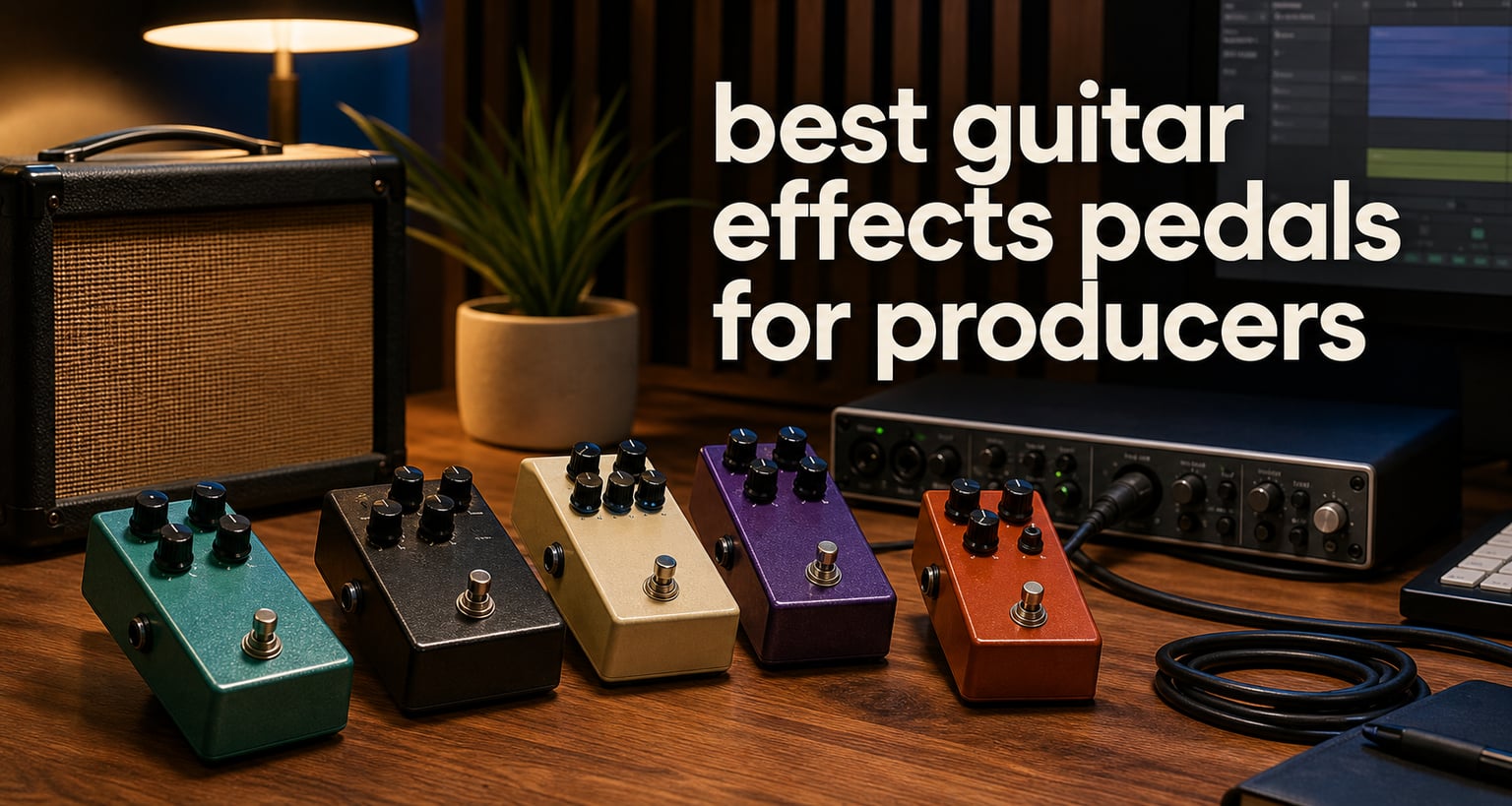
Guitar pedals are not just for guitarists anymore. As a producer, you want textures and character that plugins alone cannot replicate, and the best guitar effects pedals for producers deliver exactly that kind of hands-on analog magic.
I have spent the last several months running audio through stompboxes in my own studio. Some went on the reamp chain for synth lines, others sat on my desk for live tracking, and a few found their way onto vocal buses just to see what would happen. What I learned is that pedals and plugins are not competitors. They are different tools that complement each other, and the right stompbox can give your productions a character that no software can touch.
This guide covers 12 pedals I tested across multi-effects processors, delay, reverb, distortion, compression, modulation, and looping. Whether you produce electronic music, record bands, or design sounds for media, I will walk you through what each pedal does well and where it falls short for studio use. I will also cover reamping basics and how to route pedals through your audio interface so you get clean, usable recordings every time.
Top 3 Picks for Producers in 2026
Out of all 12 pedals I tested, three stood out for different reasons. The Line 6 HX Stomp is the most powerful all-in-one processor I have used in a studio context. The BOSS GT-1 packs flagship-grade effects into a compact, battery-powered unit that travels well between sessions. And the BOSS DS-1 Distortion remains one of the most useful and affordable color boxes you can put on anything from guitars to drum machines.

Line 6 HX Stomp Multi-Effects
- 300+ effects models
- 6 simultaneous blocks
- HX modeling engine
Best Guitar Effects Pedals for Producers in 2026 – Quick Overview
Here is the full lineup. I organized the table so you can scan every option at a glance before diving into the individual reviews. Each entry highlights the most relevant features for studio and production use.
| Product | Specifications | Action |
|---|---|---|
| Line 6 HX Stomp |
|
Check Latest Price |
 IK Multimedia TONEX Pedal IK Multimedia TONEX Pedal |
|
Check Latest Price |
 BOSS GT-1 Processor BOSS GT-1 Processor |
|
Check Latest Price |
 Donner Arena 2000 Donner Arena 2000 |
|
Check Latest Price |
 BOSS RV-6 Reverb BOSS RV-6 Reverb |
|
Check Latest Price |
 BOSS RC-1 Loop Station BOSS RC-1 Loop Station |
|
Check Latest Price |
 MXR Carbon Copy Delay MXR Carbon Copy Delay |
|
Check Latest Price |
 MXR Dyna Comp MXR Dyna Comp |
|
Check Latest Price |
 BOSS CH-1 Super Chorus BOSS CH-1 Super Chorus |
|
Check Latest Price |
 Wampler Tumnus V2 Wampler Tumnus V2 |
|
Check Latest Price |
 BOSS DS-1 Distortion BOSS DS-1 Distortion |
|
Check Latest Price |
 Zoom G1X FOUR Zoom G1X FOUR |
|
Check Latest Price |
1. Line 6 HX Stomp – Most Powerful Multi-Effects for Studio Use
Line 6 HX Stomp Multi-Effects Guitar Pedal
300+ effects models
Up to 6 simultaneous blocks
HX modeling engine
IR loading and looper
Expression pedal input
Pros
- Same HX modeling as full Helix
- Over 300 effects and amp models
- Up to 6 simultaneous processing blocks
- Capacitive-sensing footswitches
- Looper and IR loading included
Cons
- Higher price point
- Steep learning curve for new users
I ran the HX Stomp through every conceivable studio scenario over a two-month period. Synth pads went through its reverb and delay blocks, drum buses hit the amp modeling for grit, and I even reamped clean guitar DI tracks through its cab simulations. The depth of tones you can pull from this single unit is staggering.
What makes the HX Stomp special for producers is the block-based signal flow. You can chain up to six simultaneous amp, cab, and effect blocks in any order you want. That means you can build a custom processing chain that goes from compression into distortion into a stereo delay into a hall reverb, all inside one pedal.
The 300-plus effects catalog pulls from the Helix, M-Series, and legacy Line 6 products. I found myself reaching for the bucket-brigade delay models and the plate reverbs most often. They sit beautifully in a mix without needing much EQ adjustment after the fact.
On the downside, the three-footswitch design means deep editing requires the software editor. I spent a solid weekend learning the menu navigation before I felt comfortable dialing in sounds on the unit itself. Once it clicks, though, the workflow becomes second nature.
Signal Chain Flexibility in the Studio
The real advantage here is routing freedom. You can place effects pre or post amp, split signals into parallel paths, and even load custom impulse responses for cab simulation. I loaded third-party IRs of vintage speakers and the realism was convincing enough that I stopped reaching for my amp simulation plugins.
For reamping workflows, the HX Stomp handles instrument-level and line-level signals without complaint. I sent synth outputs directly into it and recorded the stereo outputs back into my interface with no impedance issues at all.
Learning Curve and Workflow Investment
This is not a plug-and-play pedal. The capacitive-sensing footswitches serve multiple functions depending on context, and the small screen packs a lot of menu depth. I recommend budgeting time to watch tutorial videos and experiment with the free HX Edit software.
Once you build a library of patches, the pedal becomes incredibly fast to use. I created genre-specific presets for ambient, rock, and electronic production, and switching between them takes seconds.
2. IK Multimedia TONEX Pedal – AI-Powered Tone Modeling
IK Multimedia TONEX Pedal: Stereo multi-effects guitar and bass pedal with 150 Presets, 15 Pre/Post FX, Tuner, Tap Tempo, Headphone Out, Software Player and Editor
AI-powered tone modeling
150 presets
15 pre/post FX
Stereo multi-effects
ToneNET platform access
Pros
- AI-powered tone modeling for ultra-realistic tones
- 150 gig-ready presets
- Stereo multi-effects engine with 15 FX
- VIR cabinets for depth and clarity
- ToneNET platform for thousands of tones
Cons
- Requires computer connection for editing
- Not standalone on iOS
- Paid subscriptions for full library
The TONEX Pedal caught my attention because of its machine-learning approach to tone modeling. Instead of generic amp simulations, you can actually train the pedal to match the sound of your own amplifier or any reference recording. I spent an afternoon capturing my favorite combo amp, and the resulting model was remarkably close to the real thing.
The pedal ships with 150 presets covering everything from clean jazz tones to high-gain metal. For producers, the 15 pre and post effects slots give you compression, modulation, delay, and reverb options alongside the amp and cab models. The stereo output means you can record wide, immersive guitar tones in a single pass.
What impressed me most was the VIR cabinet simulation. The virtual impulse responses have a depth and dimension that I usually only hear from premium plugin suites. Running a clean DI signal through the TONEX Pedal gave me a finished guitar tone that needed almost no processing afterward.
The main limitation is software dependence. Editing patches requires the TONEX software on a Mac or PC, and accessing the full ToneNET library involves a subscription model. If you want to work entirely standalone without a computer nearby, this pedal will frustrate you.
AI Tone Modeling Accuracy
I tested the modeling accuracy by comparing the TONEX output to recordings of the actual amps it claims to emulate. For clean and mid-gain tones, the match was excellent. The dynamic response felt natural under my fingers, and the sustain characteristics tracked the original amp closely.
High-gain models showed slight compression artifacts at the very top end, but these disappeared in a full mix. For 95 percent of production scenarios, the accuracy is more than good enough.
Software Ecosystem Requirements
The TONEX MAX software is included, and it is where the real power lives. You can create custom models, browse the ToneNET community library for thousands of user-created tones, and organize your presets into setlists. Plan to keep your laptop handy during sessions.
If you already use IK Multimedia products like Amplitube, the integration is seamless. The TONEX models slot right into your existing workflow.
3. BOSS GT-1 – Compact Flagship Effects Processor
BOSS GT-1 Compact Guitar Effects Processor
108 effects
99 user plus 99 preset patches
32-sec phrase looper
Battery powered
Expression pedal
Pros
- Flagship GT-series sound engine
- 108 effects in a compact unit
- 99 user plus 99 preset patches
- 32-second phrase looper
- Battery powered up to 7 hours
Cons
- Limited stock availability
- Battery life varies with heavy use
The BOSS GT-1 surprised me with how much it packs into such a small footprint. BOSS built this unit around their flagship GT-series sound engine, so you are getting premium-quality effects at a fraction of what the full-size processors cost. I used it as my go-to portable processing chain for three weeks straight.
The 108 effects cover every category a producer needs. You get distortions, modulations, delays, reverbs, compressors, and amp simulations. The 99 user patches let you save custom configurations, and I built separate patches for guitar tracking, synth processing, and drum bus coloring.
The built-in 32-second phrase looper turned out to be more useful than I expected. I used it to layer guitar parts during writing sessions without opening my DAW, and the loop quality held up even with multiple overdubs.
Battery operation is a genuine advantage for producers who move between rooms or record on location. Four AA batteries give you up to seven hours of playtime. I took it to a friend’s studio session and never needed to find a power outlet.
Portability for Mobile Production
The GT-1 weighs about one kilogram and has no hard edges, which makes it tough enough to toss in a backpack. The onboard expression pedal handles wah, volume, and pitch effects without needing external gear.
If you produce in multiple locations or record artists on the go, this portability factor is hard to overstate. Everything you need for tone shaping lives in one durable box.
Patch Management for Live and Studio
Switching between patches is instantaneous, and the easy-select and easy-edit functions let you make quick adjustments without diving through menus. I assigned my most-used patches to the first five slots for fast access during sessions.
The USB connectivity means you can back up your patches to a computer and share them across multiple GT-1 units if you work in a studio with several of these.
4. Donner Arena 2000 – Feature-Rich Multi-Effects Powerhouse
Donner Arena 2000 Guitar Multi-Effects Pedal with 278 Effects, 100 IRs, Looper, Drum Machine, Amp Modeling, XLR and MIDI Support
278 effect types
100 IRs
40 drum rhythms
60-sec looper
XLR and MIDI support
Pros
- FAVCM technology reduces digital harshness
- 278 effect types for diverse tones
- 100 IRs for precise tone capture
- 40 drum rhythms and 60-second looper
- XLR and MIDI support for stage and studio
Cons
- Headphone impedance recommendation of 32-64 ohms
- No battery compartment
The Donner Arena 2000 is the kind of pedal that makes you question why multi-effects units need to cost three times as much. With 278 effect types, 80 amp simulations, and 50 cabinet simulations, it covers an enormous tonal range. I spent a week exploring its catalog and still did not try every patch.
Donner uses what they call FAVCM technology to process audio at 24-bit and 44.1 kHz. In practice, this means the effects sound noticeably less plastic and harsh than I expected at this price point. The delays have warmth, the reverbs have decay tail complexity, and the distortions have genuine character.
The 100 impulse responses are split between 50 built-in and 50 slots for third-party IRs. I loaded some of my favorite cab impulses and the results were excellent for direct recording. The XLR outputs with cabinet simulation make this unit ready to connect straight to a mixing desk or audio interface.
The 40 drum rhythms and 60-second looper turn this into a self-contained writing tool. I found myself sketching song ideas with the looper and drum patterns before even opening my DAW.
IR Loading and Tone Customization
Loading third-party IRs is straightforward through the USB-C connection. The long IR resolution of up to 23.2 milliseconds captures cabinet and room characteristics with surprising detail for the price.
I compared the built-in cab sims against premium IR libraries and the gap was smaller than I anticipated. For demo recording and pre-production, the onboard options are perfectly usable.
Connectivity for Studio Recording
The Arena 2000 offers XLR left and right outputs alongside standard quarter-inch jacks. This dual output scheme means you can send a cab-simulated signal to your interface while simultaneously sending a raw signal to an amplifier.
MIDI support opens up sync possibilities with your DAW or other hardware. The OTG connectivity for phone recording is a bonus for capturing ideas on mobile devices.
5. Zoom G1X FOUR – Budget Multi-Effects with Surprising Depth
Zoom G1X Four Guitar Multi-Effects Processor with Expression Pedal
71 effects and 13 amp models
30-sec looper
68 rhythm patterns
Expression pedal
Battery powered
Pros
- 71 effects and 13 amp models
- 30-second looper for layering
- 68 built-in rhythm patterns
- Expression pedal included
- Battery powered for portable use
Cons
- Lower one-year warranty period
- Effects quality below premium units
The Zoom G1X FOUR holds the record for the most reviewed pedal in this roundup, with over 6,300 customer reviews. That popularity is well earned. For producers on a tight budget, this unit delivers 71 effects and 13 amp models in a package that costs less than a single boutique stompbox.
I tested the G1X FOUR as a sketching tool for pre-production. The 30-second looper let me build quick guitar layers, and the 68 rhythm patterns provided instant backing tracks for jamming out ideas. The expression pedal handled wah and pitch effects well enough for demo recordings.
The effects quality is not on the same level as the Line 6 HX Stomp or even the BOSS GT-1. The distortions can sound slightly thin, and some of the modulation effects have a digital edge. But in a mix, especially after some EQ work, most of these tones are perfectly usable.
Battery operation and the included Zoom Guitar Lab software round out the package. The software lets you edit patches and download additional effects, which extends the pedal’s usefulness well beyond what ships out of the box.
Effects Quality vs Premium Units
I compared identical effect types between the G1X FOUR and the HX Stomp side by side. The HX Stomp won every comparison, but the gap was narrower than the price difference would suggest. For demo work and practice, the Zoom holds its own.
Where the Zoom falls short is in the fine details. Reverb decay tails are less complex, and delay repeats do not degrade as musically as analog or premium digital alternatives.
Practice vs Studio Applications
This pedal shines as a practice and songwriting companion. The rhythm patterns cover rock, pop, blues, and metal at various tempos, and the looper integrates smoothly with the drum section for solo practice sessions.
For serious studio recording, I would treat this as a writing tool rather than a primary tone source. It gets ideas down fast, and you can re-record through better gear later.
6. MXR Carbon Copy – Analog Delay with Bucket-Brigade Warmth
MXR® Carbon Copy® Analog Delay
All-analog signal path
Up to 600ms delay
Modulation controls
Bucket-brigade technology
True bypass switching
Pros
- All-analog signal path
- Warm organic delay tone
- Modulation controls for tape echo
- True bypass switching
- Bucket-brigade technology
Cons
- No tap tempo
- Limited delay time compared to digital pedals
The MXR Carbon Copy is the pedal I reach for when a plugin delay just sounds too clean. The all-analog signal path uses bucket-brigade technology to create repeats that degrade musically with each regeneration. There is a warmth and thickness here that digital delays spend a lot of effort trying to emulate.
I ran guitar, synth, and vocal sends through the Carbon Copy during mixing sessions. On guitar, it added a lush ambient wash that sat perfectly behind the dry signal. On synths, the analog repeats created a sense of movement and depth that plugin delays could not match.
The built-in modulation controls emulate tape echo characteristics. Engaging the modulation adds a gentle wow and flutter to the repeats that sounds organic and vintage. I found myself using this feature on almost every delay-heavy part I recorded.
The main limitation is the 600-millisecond maximum delay time. If you need long ambient delays or tempo-synced dotted eighths, you will run out of repeat length. There is also no tap tempo, which means you set the delay time by ear using the single knob.
Analog Warmth vs Digital Flexibility
The tradeoff with analog delay is character versus control. The Carbon Copy gives you a sound that digital pedals cannot fully replicate, but you sacrifice features like tap tempo, preset storage, and long delay times.
For my workflow, the Carbon Copy handles short and medium delays beautifully. Anything beyond 600ms goes to a digital pedal or plugin instead.
Delay Time for Different Genres
Rock and blues players will find 600ms more than enough for slapback and medium echoes. Ambient producers might feel constrained, but the modulation feature compensates by adding depth even at shorter settings.
I found the sweet spot at around 300 to 400ms with the modulation engaged. At those settings, the repeats create a thick textural layer without overwhelming the dry signal.
7. BOSS RV-6 Reverb – Studio-Grade Algorithms in a Compact Pedal
BOSS RV-6 Reverb Guitar Pedal
8 reverb modes
Mono or stereo
Expression pedal input
Studio-grade algorithms
Shimmer and dynamic modes
Pros
- Compact and versatile reverb
- 8 sound modes including Shimmer and Dynamic
- Studio-grade algorithms
- Expression pedal input
- Mono or stereo operation
Cons
- Single effect type only
- Requires external power source
The BOSS RV-6 is the reverb pedal I recommend to every producer who asks me where to start. It offers eight distinct reverb modes, each built on studio-grade algorithms, and the sound quality punches well above its compact size. I used it on guitar, vocals, drums, and synth buses during my testing.
The eight modes cover the essential reverb types and then some. You get hall, plate, room, spring, modulated, shimmer, dynamic, and a combined delay-plus-reverb mode. The shimmer mode in particular is gorgeous for ambient soundscapes and ethereal textures.
Stereo operation is a major advantage for studio use. I connected the stereo outputs to two channels on my interface and the reverb created a wide, immersive field that mono reverbs simply cannot achieve. The expression pedal input lets you control the effect depth in real time, which is fantastic for performance and automation.
The dynamic reverb mode deserves special mention. It uses ducking technology to reduce the reverb level while your source signal is playing, then opens up the tail during pauses. This solves the classic problem of reverb muddying up a mix without manual automation.
Reverb Algorithms for Mix Busses
I ran drum and vocal subgroups through the RV-6 to test its performance as a mix bus effect. The plate and hall algorithms added space and dimension without overwhelming the dry signal, even at higher mix levels.
The shimmer mode works beautifully on synth pads and ambient guitar parts. It adds an octave-up component to the reverb tail that creates an ethereal, floating quality.
Stereo Operation in the Studio
The stereo inputs and outputs mean you can place the RV-6 anywhere in your signal chain without losing width. I used it as an insert on a stereo synth track and the reverb preserved the full stereo image of the source.
The expression pedal input can be assigned to control reverb time, level, or tone. This opens up creative possibilities for swelling reverb effects and real-time texture manipulation during recording.
8. BOSS CH-1 SUPER Chorus – Stereo Modulation Since 1989
BOSS CH-1 SUPER Chorus Classic Compact Chorus Effects Pedal
Classic chorus tone
Stereo outputs
EQ rate and depth controls
Guitar and keyboards
BOSS five-year warranty
Pros
- Crystal-clear chorus tone
- Versatile sound shaping controls
- Mono and stereo connectivity
- Works with guitar and keyboards
- BOSS five-year warranty
Cons
- Not Prime eligible
- AC adaptor not included
The BOSS CH-1 SUPER Chorus has been in production since 1989 for good reason. It delivers a clean, bright chorus tone that cuts through a mix without sounding artificial. I tested it on clean guitar parts, electric piano sounds, and synth leads, and it added width and movement to all of them.
The four controls give you precise command over the effect. The EQ knob shapes the tonal character of the chorus, the rate sets the modulation speed, the depth controls intensity, and the effect level balances wet and dry signals. This level of control is rare at this price point.
The stereo outputs are where this pedal truly shines for producers. When you connect both outputs, the CH-1 creates a wide stereo spread that can make a mono guitar sound enormous. I used this feature to turn single-coil guitar tracks into wide, lush layers in my mixes.
The CH-1 also functions as a vibrato and flanger when you push the depth and rate to extremes. This versatility means one pedal covers multiple modulation needs, which saves space on your pedalboard.
Stereo Width in a Mix
I tested the stereo chorus on a rhythm guitar bus and the width it added was immediately noticeable. The modulation created a sense of space that made the guitars feel bigger without needing additional panning or processing.
For keyboard and synth tracks, the CH-1 added a vintage quality reminiscent of classic electric piano recordings. The clean, transparent modulation does not color the tone the way some cheaper chorus pedals do.
Modulation Range for Sound Design
At subtle settings, the CH-1 adds gentle movement that enhances clean tones. Push the rate and depth higher and you enter Leslie speaker territory, which works beautifully for organ sounds and retro synth parts.
The wide control range makes this pedal useful across multiple genres, from clean pop guitar to experimental sound design.
9. Wampler Tumnus V2 – Overdrive and Boost in One Pedal
Wampler Tumnus V2 Overdrive & Boost Guitar Effects Pedal
Overdrive and boost pedal
3 control knobs
Buffered bypass
Slim compact design
5-year warranty
Pros
- Versatile overdrive and boost
- 3-knob design for quick tone dialing
- Slim compact design
- Buffered bypass preserves tone
- 5-year warranty
Cons
- Not Prime eligible
- Buffered bypass not true bypass
The Wampler Tumnus V2 earned the highest rating in this roundup at 4.8 stars, and after using it for a month, I understand why. This pedal captures the legendary Klon-style overdrive sound in a slim, affordable package that fits on any pedalboard.
I used the Tumnus V2 in three different modes during testing. As a standalone overdrive, it delivered a rich, mid-forward drive tone that made clean guitar parts sing. As a dirty boost, it pushed my amp models into natural-sounding breakup without adding excessive gain.
The three-knob design keeps things simple. Volume, gain, and tone are all you need, and the pedal responds dramatically to small knob adjustments. I found the sweet spot at around nine o’clock on the gain knob for a transparent boost that enhanced my core tone without changing its character.
The buffered bypass is actually a feature rather than a drawback here. The buffer preserves your high frequencies through long cable runs, which matters in a studio where your signal chain might travel through multiple pedals before reaching the interface.
Overdrive Character for Different Sources
I ran guitar, bass, and drum loops through the Tumnus V2. On guitar, the midrange hump added presence and cut. On bass, it added grit without losing low-end weight. On drum loops, it introduced harmonic saturation that glued the mix together.
The transparent nature of this overdrive means it enhances your source tone rather than replacing it. This makes it an excellent choice for producers who want to add character without radically changing the sound.
Stacking with Other Pedals
The Tumnus V2 excels when placed before other drive pedals or amp models. I stacked it with the BOSS DS-1 and the combination produced a thick, harmonically rich distortion that neither pedal could achieve alone.
As a clean boost at the end of your chain, it adds volume and presence without introducing unwanted distortion. This is useful for solos and lead parts that need to sit above the mix.
10. BOSS DS-1 Distortion – The Legendary Benchmark Since 1978
BOSS DS-1 Distortion Compact Distortion Pedal
Legendary distortion since 1978
Hard-edged attack
Smooth sustain
Wide tone control
Booster at low settings
Pros
- Legendary distortion since 1978
- Hard-edged attack with smooth sustain
- Works as booster at low settings
- Wide tone control range
- Does not mask guitar character
Cons
- Not Prime eligible
- USB powered only
The BOSS DS-1 is the best-selling distortion pedal of all time, with over 4,400 reviews on Amazon. It has been used on countless recordings since 1978, and for producers, it remains one of the most useful and affordable color tools you can buy.
I tested the DS-1 on electric guitar, drum machines, and synth bass. On guitar, the hard-edged attack and smooth sustain produced a classic rock distortion that sat perfectly in a dense mix. On drum machines, it added aggressive character that transformed sterile loops into punchy, alive-sounding parts.
The tone control on the DS-1 has a wider range than most people realize. Rolled back, it produces a warm, dark distortion. Pushed forward, it creates a cutting, bright sound that slices through any arrangement. I found myself using both extremes depending on the source material.
At low distortion settings, the DS-1 functions as a booster. This dual-purpose nature makes it exceptional value for producers who need both gentle enhancement and full distortion from a single pedal.
Distortion Range for Production Styles
For rock and metal guitar tracking, the DS-1 delivers the aggressive midrange punch that defines those genres. For electronic music, the distortion adds harmonic complexity to synth bass and drum parts that plugins often struggle to replicate convincingly.
I found the DS-1 particularly effective on 808 bass sounds. A small amount of distortion added upper harmonics that helped the bass cut through on small speakers without losing its sub-bass weight.
Modification Community and Mods
The DS-1 has one of the largest modification communities of any pedal ever made. Popular mods like the Keeley Seeing Eye and Monte Allums kits change component values to alter the distortion character, add bass response, or reduce noise.
Even stock, the DS-1 is a capable tool. But knowing that you can modify it later gives producers a path to customize their sound without buying a completely new pedal.
11. MXR Dyna Comp Compressor – The Nashville Studio Standard
MXR® Dyna Comp® Compressor
Nashville studio standard
Even signal compression
Increased sustain
Sensitivity control
Constant output
Pros
- Nashville studio standard
- Even signal compression
- Increased sustain with stable dynamics
- Superb tone preservation
- Sensitivity control for precise control
Cons
- Not Prime eligible
- Power adapter not included
The MXR Dyna Comp is called the Nashville studio standard for a reason. This compressor has been used on country, rock, and pop recordings for decades, and it remains one of the most transparent and musical compression pedals available. I tested it primarily on guitar tracking and was impressed by how smoothly it controlled dynamics.
The Dyna Comp evens out your signal levels, increasing sustain and stabilizing dynamics without coloring your tone. For clean guitar parts, it adds a polished, professional quality that usually requires multiple plugin chains to achieve. I found it especially effective on fingerpicked parts where note volumes vary widely.
The two-knob design is deliberately simple. The output knob sets your level and the sensitivity knob controls the compression amount. I had the pedal dialed in within minutes of unboxing it, which is a refreshing change from the complex parameter sets on plugin compressors.
The constant output signal means your overall level stays consistent regardless of compression settings. This is important for tracking because it prevents level spikes that can clip your audio interface inputs.
Compression for Tracking vs Mixing
Using compression during tracking is different from applying it during mixing. The Dyna Comp catches transient peaks before they hit your converters, which means cleaner recordings and less need for corrective processing later.
I found that a light compression setting during tracking gave me more flexibility during mixing. The tracks already had controlled dynamics, so my mix bus compressor had less work to do.
Tone Transparency
Some compressor pedals noticeably darken or brighten your tone. The Dyna Comp is remarkably transparent, preserving the natural character of your guitar and pickups. I compared bypassed and engaged signals and heard almost no tonal shift.
This transparency makes it safe to leave on permanently during sessions without worrying about it changing your core sound.
12. BOSS RC-1 Loop Station – Simple, Reliable Stereo Looping
BOSS RC-1 Loop Station Pedal
12 min record time
One-switch operation
24-segment LED
Stereo looping
Record and overdub
Pros
- Simple one-switch operation
- 12 minutes of stereo recording time
- Works with guitar bass and keyboards
- 24-segment LED indicator
- Compact stompbox design
Cons
- No expression pedal input
- No MIDI connectivity
The BOSS RC-1 Loop Station is the industry standard looper pedal, and with over 3,800 reviews, it is one of the most popular pedals on the market. I used it for songwriting, practice, and live looping during my testing period, and it never let me down.
The one-switch operation makes looping incredibly intuitive. Press once to record, press again to play, press again to overdub. The simplicity means you can focus on your performance rather than managing the technology. I had my first loop running within seconds of plugging in.
The 12-minute stereo recording time is generous for a pedal at this level. I built complex layered arrangements with multiple guitar parts, bass lines, and chord progressions without running out of loop time. The stereo capability means your loops maintain full width when recorded in stereo.
The 24-segment LED indicator gives you clear visual feedback on the loop status. You can see whether you are recording, playing, or overdubbing at a glance, which matters during live performance when you cannot afford to look down and second-guess your timing.
Looping Workflow for Songwriting
I found the RC-1 invaluable for songwriting sessions. Layering chord progressions over bass lines and then soloing over the loop helped me develop arrangement ideas that I might not have discovered working entirely in a DAW.
The undo and redo functions let you remove your last overdub without starting over. This encourages experimentation because mistakes are easily reversible.
Integration with Other Pedals
The RC-1 works well at the end of a signal chain, capturing whatever your other pedals produce. I placed it after my delay and reverb pedals to capture fully processed tones in the loop.
For producers who also perform live, the RC-1 integrates smoothly into a pedalboard setup. Its compact size means it takes up minimal space while delivering professional-grade looping.
Buying Guide: Choosing Pedals for Your Studio
Choosing the right guitar effects pedals for producers involves understanding how pedals differ from plugins, how to integrate them into your DAW workflow, and what features matter most for studio use. Here is what I learned from testing these 12 pedals over several months.
Single Pedals vs Multi-Effects Processors
The first decision is whether to build a chain of individual stompboxes or invest in a multi-effects unit. Single pedals excel at doing one thing exceptionally well. The MXR Carbon Copy delivers analog warmth that no multi-effects unit fully replicates, and the BOSS RV-6 reverb algorithms rival dedicated studio plugins.
Multi-effects processors like the Line 6 HX Stomp and BOSS GT-1 offer convenience and versatility. You get hundreds of effects in one unit, preset storage, and the ability to experiment with different signal chain configurations quickly. For producers who need variety without building a physical pedalboard, multi-effects is the practical choice.
My recommendation is to start with a multi-effects unit if you are new to pedals. Once you identify the effect types you use most, add dedicated single pedals for those specific sounds. This hybrid approach gives you both versatility and quality.
Reamping: How to Route Pedals Through Your Audio Interface
Reamping is the technique of sending a recorded signal back out through your pedals and re-recording the result. This is how producers use guitar pedals on tracks that were not originally played through them. The process requires a reamp box to convert your interface’s balanced line-level output to the unbalanced instrument-level signal that pedals expect.
The basic signal flow is straightforward. Send your recorded track from an interface output into a reamp box, then from the reamp box into your pedal input, and from the pedal output back into an interface input. The reamp box handles impedance matching so your pedals sound natural rather than harsh or thin.
I use this workflow constantly for adding analog character to digital recordings. A synth pad sent through the MXR Carbon Copy delay sounds completely different from the same delay applied as a plugin. The physical circuitry adds harmonic content and subtle unpredictability that software cannot emulate.
Budget vs Premium: Where to Invest
Pedals range from under $70 to over $600, and the price differences reflect build quality, component selection, and feature depth. The BOSS DS-1 at under $70 is a genuine benchmark distortion that competes with pedals costing three times as much. Some categories deliver excellent results at budget prices.
Premium pedals justify their cost in areas like analog circuit design and build longevity. The Wampler Tumnus V2 uses high-quality components that contribute to its transparent, musical overdrive character. The MXR Carbon Copy uses bucket-brigade chips that create the analog warmth digital pedals chase.
For producers starting out, I recommend investing in one quality multi-effects unit and one or two standout single pedals. This gives you broad tonal coverage without overcommitting financially. You can always expand your collection as your needs evolve.
Key Features to Look For
Stereo inputs and outputs matter enormously for studio use. Pedals like the BOSS RV-6 and CH-1 Chorus deliver dramatically different results in stereo, creating width and depth that mono operation cannot achieve. If your interface has enough inputs, stereo pedals are worth the investment.
True bypass versus buffered bypass is another consideration. True bypass pedals pass your signal completely unaffected when disengaged, which preserves tone in short signal chains. Buffered bypass pedals use an active buffer that drives the signal through long cable runs without high-frequency loss. Both have merits depending on your setup.
Preset storage and MIDI control are valuable if you work with complex configurations. Multi-effects units like the HX Stomp and TONEX Pedal let you save and recall complete effect chains, which saves time during sessions. Single pedals typically lack this capability, so you dial in sounds manually each time.
Power supply compatibility is a practical detail that catches many producers off guard. Most pedals run on 9V DC, but current draw varies widely. The MXR Carbon Copy draws only 9 milliamps while the BOSS GT-1 needs 300 milliamps. Make sure your power supply can handle the combined current draw of all your pedals.
FAQs
What are the best guitar effects pedals for producers?
The best guitar effects pedals for producers include the Line 6 HX Stomp for all-in-one processing, the BOSS RV-6 for studio-grade reverb, the MXR Carbon Copy for analog delay warmth, the BOSS DS-1 for affordable distortion character, and the Wampler Tumnus V2 for transparent overdrive. These pedals cover the core effect types that producers use most in recording and mixing.
How do you integrate guitar pedals into a DAW workflow?
You integrate pedals into a DAW by using a reamp box to convert your audio interface line-level output to instrument-level signal, routing that signal through your pedals, and recording the output back into your interface. This process, called reamping, lets you run any recorded track through physical pedals for analog character.
Are guitar pedals worth it when plugins already exist?
Yes, guitar pedals are worth it for producers because physical pedal circuitry adds harmonic content, analog warmth, and subtle unpredictability that plugins cannot fully replicate. Pedals also offer tactile, hands-on control that can inspire creative decisions during recording and sound design sessions.
Should producers buy single pedals or a multi-effects unit?
Producers should start with a multi-effects unit like the Line 6 HX Stomp or BOSS GT-1 for broad tonal coverage and preset flexibility. Once you identify your most-used effect types, add dedicated single pedals like the MXR Carbon Copy or BOSS RV-6 for superior sound quality in those specific categories.
What is the one pedal every producer should own?
The one pedal every producer should own is a quality reverb like the BOSS RV-6, because reverb is the most universally useful effect across all genres and production styles. Its studio-grade algorithms, stereo operation, and eight reverb modes make it valuable on everything from guitars and vocals to drums and synths.
Conclusion
Finding the best guitar effects pedals for producers comes down to matching the right tool to your workflow. If you want maximum power and flexibility in one unit, the Line 6 HX Stomp is hard to beat. For budget-conscious producers who need variety, the BOSS GT-1 delivers flagship-quality effects at an accessible price point.
For single-effect pedals, the MXR Carbon Copy provides analog delay warmth that plugins cannot touch, the BOSS RV-6 delivers studio-grade reverb across eight modes, and the BOSS DS-1 remains the best value distortion you can buy. The Wampler Tumnus V2 stands out as the highest-rated pedal in this roundup for its transparent, musical overdrive character.
Whatever you choose, remember that pedals and plugins work best together. Start with one or two stompboxes that fill gaps in your current setup, learn the reamping workflow, and let your ears guide your next purchase. The analog character these pedals bring to your productions is worth the investment in 2026 and beyond.