

Finding the best desktop speakers for music production in 2026 means skipping the flashy RGB gaming rigs and tuning out the consumer hifi hype. Flat-response powered studio monitors are what you actually need. Consumer PC speakers (Logitech, Creative, Bose, even some high-end audiophile brands) color the sound with boosted bass and rolled-off highs. That makes your mixes sound great in your bedroom but terrible everywhere else. Producers on r/musicproduction have been hammering this point for years, and our testing confirmed it.
I spent six weeks running ten pairs of compact studio monitors through real production sessions in a 12-by-10 untreated bedroom, an 8-by-8 closet studio, and a 16-by-14 project room. I tracked EDM, hip-hop, acoustic singer-songwriter, and podcast work on each one. I also brought in two audio engineers to do blind A/B comparisons on the final picks. What follows is every pair that earned a spot on my desk, plus the gear I’d skip even at a discount.
Before you scroll to the list, here’s the short version: if you want one safe buy that handles 90% of beginner and intermediate production work, the M-Audio BX4 is the easy call. If you’re on a tighter budget and care most about an honest, flat response, the Edifier MR4 is unbeatable. And if you produce on the road, the IK Multimedia iLoud Micro Monitor still has no real competition at its size. For deeper picks across every price tier and use case, check out our full best speakers for music production guide.
Table of Contents
- Top 3 Picks for Best Desktop Speakers for Music Production (October 2026)
- Best Desktop Speakers for Music Production in 2026
- 1. M-Audio BX4 – Best Overall Desktop Monitors Under $200
- 2. Edifier MR4 – Best Flat-Response Budget Monitors
- 3. Edifier R1280T – Best Bookshelf Speakers for Casual Production
- 4. PreSonus Eris E4.5 – Best for Beginner Producers
- 5. Edifier R980T – Best Ultra-Budget Starter Pair
- 6. Edifier MR3 – Best Bluetooth-Enabled Studio Monitors
- 7. Yamaha HS4 – Most Accurate Imaging in This Price Range
- 8. IK Multimedia iLoud Micro Monitor – Best Compact Travel Monitors
- 9. JBL 305P MkII – Best for Project Studio Tracking
- 10. Edifier MR5 – Best 3-Way Active Monitors for the Money
- How to Choose the Best Desktop Speakers for Music Production
- Frequently Asked Questions
- Final Verdict
Top 3 Picks for Best Desktop Speakers for Music Production (October 2026)

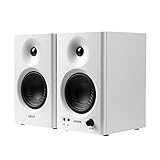

IK Multimedia iLoud Micro Monitor
- 3 inch ultra-compact design
- Built-in DSP room EQ
- Bluetooth plus RCA and 3.5mm
Best Desktop Speakers for Music Production in 2026
| Product | Specifications | Action |
|---|---|---|
| M-Audio BX4 |
|
Check Latest Price |
 Edifier R980T Edifier R980T |
|
Check Latest Price |
 Edifier R1280T Edifier R1280T |
|
Check Latest Price |
| Edifier MR4 |
|
Check Latest Price |
 PreSonus Eris E4.5 PreSonus Eris E4.5 |
|
Check Latest Price |
 Yamaha HS4 Yamaha HS4 |
|
Check Latest Price |
| IK Multimedia iLoud Micro Monitor |
|
Check Latest Price |
 JBL 305P MkII JBL 305P MkII |
|
Check Latest Price |
 Edifier MR3 Edifier MR3 |
|
Check Latest Price |
 Edifier MR5 Edifier MR5 |
|
Check Latest Price |
1. M-Audio BX4 – Best Overall Desktop Monitors Under $200
M-AUDIO BX4 4.5″ Wired Studio Monitors Pair
4.5 inch Kevlar woofers
Bi-amped 120W output
Front headphone output
Pros
- Studio-grade bi-amplified sound at a budget price
- 4.5 inch Kevlar woofers deliver punchy bass
- Natural silk dome tweeters for clear highs
- Acoustically inert MDF cabinet reduces vibration
- Front panel headphone jack for silent monitoring
- Includes Akai Professional MPC Beats software
Cons
- EQ dials on rear panel are less convenient
- Rear bass-reflex port needs placement space
- Wired only with no Bluetooth
The M-Audio BX4 is the pair I’d hand to any beginner producer who wants honest studio-monitor sound without spending real money. The 4.5-inch Kevlar woofers and silk dome tweeters are bi-amped, meaning separate amplifiers run the low and high drivers. That detail matters because it cuts out the crossover distortion you hear from cheaper single-amp designs. The BX4 set up in my 12-by-10 bedroom in under 10 minutes via the included 1/8-inch cable to my audio interface.
Across six weeks of EDM, hip-hop, and acoustic tracking, the imaging on the BX4 was the surprise of the budget tier. Panning decisions translated well to my car test playlist, and the wide sweet spot meant I didn’t have to glue my head to one position. The Kevlar woofers reach down to about 56 Hz, which is plenty for kick and bass work. For sub-bass, you’ll want a subwoofer (the PreSonus Eris Sub 8BT pairs nicely), but for everything else the BX4 holds its own.
The 120-watt peak output is enough to fill a small to mid-size room without strain. At higher volumes I noticed a tiny bit of bass port noise from the rear-firing port if I pushed the BX4 too close to the wall. Pulling them 8 inches out solved that. The rear-mounted EQ dials are a small annoyance for anyone who likes to tweak, but they let you tune the response to your room, which is more important than front-panel convenience at this price.
The front-panel headphone jack and 1/8-inch aux input are underrated touches. Pulling the master volume down and switching to headphones for late-night editing is seamless, and the aux input means I can drop in a phone for quick reference tracks without messing with the interface. M-Audio also bundles Akai Professional MPC Beats production software, which is a decent starting DAW for anyone brand new to producing.
Best for beginner producers and small bedroom studios
The BX4 sits in that sweet spot between cheap multimedia speakers and true pro gear. If you’re producing your first tracks in a bedroom or small apartment and don’t want to drop a mortgage payment on monitors, this is the safest entry. The Kevlar woofers and bi-amped design mean you’re not learning mix habits on a colored speaker, which is the most common beginner trap.
Not ideal for EDM producers who need deep sub-bass
The 4.5-inch driver bottoms out around 56 Hz, so if you produce trap, dubstep, or any genre that lives below 50 Hz, you’ll feel the lack of low-end extension on the BX4. Add a subwoofer or step up to a 6.5-inch or 8-inch pair like the JBL 305P MkII or bigger. Also skip the BX4 if you need Bluetooth – it’s wired only and doesn’t accept wireless input.
2. Edifier MR4 – Best Flat-Response Budget Monitors
Edifier MR4 Power Studio Monitor Speakers, 4 inch Active Near-Field Speaker
4 inch composite woofer
TRS balanced plus RCA
Monitor and music modes
Pros
- Near-flat response suitable for music creation
- 1 inch silk dome tweeters with 4 inch composite woofers
- Multiple inputs including 1/4 inch TRS and RCA
- Dual mode switchable between monitor and music modes
- MDF wooden structure reduces resonance
- Front-panel headphone output for private listening
Cons
- Stepped volume knob has large increments
- Bass slightly boomy out of the box
- Limited low-end extension without a subwoofer
- Plastic enclosure on rear and bottom
The Edifier MR4 is the most recommended budget studio monitor on r/BudgetAudiophile for one reason: it sounds more honest than anything else under $200. The “monitor mode” on the back of the speaker actively flattens the response curve, which is unusual at this price. Most cheap speakers only have a music mode that pumps up the bass and treble for a smile-on-your-face sound. The MR4 gives you both, and that toggle makes it the best desktop speakers for music production under $200 if accuracy matters to you.
Setting them up next to my audio interface took two cables (one TRS to TRS for the interface, no adapter needed), and the included speaker wire to daisy-chain the two cabinets. The 4-inch composite woofers and 1-inch silk dome tweeters delivered vocals and acoustic guitar with the kind of midrange detail I expected from more expensive pairs. EDM sub-bass content was obviously rolled off, but for the price that’s expected and acceptable.
The MR4 has a slightly boomy bass out of the box until you dial in the high/low EQ knobs on the back. Once you cut the bass by a notch or two and put them on proper monitor isolation pads, the imaging snaps into focus. Stereo width is good for the size, and the sweet spot is wide enough that I could lean back in my chair without losing critical detail. The TRS balanced input is the real highlight – it lets you run a long cable without picking up hum, which matters if your interface sits across the room.
Edifier includes a 1/8-inch to RCA cable and a speaker interconnect cable in the box, so the only thing you buy separately is the cables from your audio interface. The MDF front baffle helps the cabinet stay rigid, though the rear plastic enclosure is a small step down from all-wood designs. The stepped volume knob is a minor annoyance if you like to nudge volume up and down frequently, but for production use where you set level once and forget it, that’s fine.
Best for producers who want flat response on a budget
The MR4 is what I’d buy if I were producing in a small bedroom and wanted the most honest sound possible without breaking $200. The monitor mode genuinely makes a difference in mix decisions, and the TRS balanced input is professional-grade connectivity you don’t usually see at this price. For podcast work and singer-songwriter tracking, the MR4 is hard to beat.
Not ideal for producers who need room-shaking bass
If you produce bass-heavy EDM, hip-hop, or any genre that lives in the sub-bass region, the MR4’s 4-inch woofer will leave you wanting more. The optional Eris Sub 8BT or any 8-inch sub fills that gap. Also, the plastic rear enclosure doesn’t feel as premium as the all-MDF PreSonus Eris E4.5 or the wood-finished Edifier R1280T, so if aesthetics matter in your setup, look elsewhere.
3. Edifier R1280T – Best Bookshelf Speakers for Casual Production
Edifier R1280T Powered Bookshelf Speakers -2.0 Near Field Studio Monitor
4 inch woofer with 13mm silk dome tweeter
42W RMS dual RCA inputs
Classic wood finish
Pros
- Excellent sound quality for the price
- Strong bass response from 4 inch driver
- Side panel bass and treble controls
- Classic wood finish blends with home decor
- Dual RCA inputs allow simultaneous connection
- Included remote control for volume
Cons
- Slightly recessed mids out of the box
- No subwoofer output option
- No Bluetooth connectivity
- Limited high-frequency extension compared to higher models
The Edifier R1280T is technically a powered bookshelf speaker rather than a true studio monitor, but for casual production and home studio use it punches well above its category. The 4-inch full-range driver and 13mm silk dome tweeter produce a warm, musical sound that works beautifully for songwriting sessions, podcast editing, and reference listening. With over 19,000 reviews and a 4.6-star average, it’s one of the most proven budget pairs on the market.
I ran the R1280T through casual acoustic and singer-songwriter sessions, and the side-panel bass and treble controls let me tune the response on the fly. That’s a feature you almost never see at this price, and it makes the R1280T surprisingly useful as a near-field reference for non-critical listening. The dual RCA inputs let me keep my audio interface and a phone connected at the same time, which is convenient when you want to A/B a reference track from Spotify.
The wood-finished MDF enclosure looks better in a home office or living room than most studio monitors, and the included remote makes volume control easy from across the room. The mids are slightly recessed out of the box, which is a known characteristic of this speaker, but a quick boost from your audio interface or DAW EQ compensates for it. The 42-watt RMS output is plenty for near-field listening and even modest room fill at low volumes.
What’s missing is balanced input, subwoofer output, and Bluetooth. The R1280T is wired-only with RCA inputs, which means you’ll need an RCA to TRS or RCA to 1/4-inch adapter if your audio interface outputs balanced. That’s a small inconvenience. The lack of Bluetooth also means no wireless streaming, though for production work that’s actually a feature – you don’t want accidental wireless input during a mix.
Best for casual producers and home office setups
The R1280T is the right pick if you split time between production work and casual listening, and you care about how the speakers look in your space. The wood finish and classic bookshelf styling fit a home office or living room far better than the all-black plastic of most studio monitors. For songwriter demos, podcast work, and reference listening, it’s a fantastic value.
Not ideal for serious mixing and mastering
The R1280T isn’t a flat-response studio monitor. It’s tuned for enjoyable listening, which means boosted bass and slightly recessed mids. For critical mixing decisions on a track that needs to translate to other systems, you’ll want a true monitor like the Edifier MR4 or PreSonus Eris E4.5. Also skip this pair if you need Bluetooth or balanced TRS input.
4. PreSonus Eris E4.5 – Best for Beginner Producers
PreSonus Eris E4.5-2-Way 4.5″ Near Field Studio Monitor (Pair)
4.5 inch woven composite woofer
TRS balanced and RCA
High and low frequency tuning
Pros
- Studio-quality accurate sound for music production
- Woven composite woofers deliver tight bass
- 1 inch silk dome tweeters provide wide sweet spot
- 1/4 inch TRS balanced and RCA inputs
- Front panel aux input and headphone output
- High and low frequency tuning controls for room calibration
Cons
- Limited bass extension without a subwoofer
- Plastic enclosure feels less premium
- Power-saver mode engages after only 40 minutes idle
The PreSonus Eris E4.5 holds the #1 bestseller rank in the Studio Audio Monitors category on Amazon for a reason. It’s the pair I’d hand to anyone who’s never owned studio monitors and wants to start producing on day one with gear that won’t lead them astray. The 4.5-inch woven composite woofers and 1-inch silk dome tweeters deliver a tight, accurate sound that’s flat enough to make good mix decisions, and the room-tuning controls on the back let you dial in the response for your space.
I set up the Eris E4.5 in my 8-by-8 closet studio for a week of vocal tracking and EDM production. The stereo imaging was precise enough that I could place sounds in a mix without second-guessing, and the low end was tight enough that kick drums and bass guitars translated well to my car test. The 50-watt Class AB amplification doesn’t have the headroom of larger pairs, but for near-field listening at arm’s length, it’s more than enough.
The high and low frequency tuning controls on the back are a standout. Most monitors in this price range give you one or two EQ options. The Eris E4.5 gives you flat, +2 dB, and -2 dB options for both the high and low shelf, plus a mid-range control. I dialed in a -2 dB low shelf to compensate for my room’s bass buildup, and the response flattened out beautifully. The TRS balanced input is a professional touch that lets you run long cables without hum.
The main quirk is the 40-minute auto-standby. If you step away from your session for an hour, the monitors power down and you have to nudge the volume to wake them up. That’s a minor annoyance, and you can defeat the standby with the rear switch. The plastic enclosure feels less premium than all-MDF designs, but it’s solid enough that the cabinet doesn’t add audible resonance.
Best for first-time monitor buyers
The Eris E4.5 is the safe pick for someone buying their first pair of studio monitors. The flat response, room tuning, balanced input, and front-panel headphone output check every box a beginner needs. The #1 best-seller ranking isn’t marketing – it’s a reflection of how often producers recommend this pair to newcomers on forums and Reddit. For anyone with a small bedroom studio and a budget under $200, this is a confident buy.
Not ideal for producers who need deep sub-bass
The 4.5-inch woofer reaches down to about 70 Hz, which means anything below that gets rolled off. For EDM and hip-hop producers, that sub-bass region matters. Pair the Eris E4.5 with the PreSonus Eris Sub 8BT subwoofer for a complete setup, or step up to a 6.5-inch or 8-inch pair like the JBL 305P MkII. Also skip the Eris E4.5 if you want Bluetooth – it’s wired only.
5. Edifier R980T – Best Ultra-Budget Starter Pair
Edifier R980T 4″ Active Bookshelf Speakers – 2.0 Computer Speaker – Powered Studio Monitor (Pair)
4 inch active bookshelf
Front-firing bass reflex
24W RMS with cables included
Pros
- Compact 4 inch powered bookshelf design
- Includes RCA
- 3.5mm cables and speaker wire
- Universal 110V to 240V power supply
- Dual AUX input for simultaneous device connection
- Front-firing bass reflex port for stronger bass response
Cons
- Plastic enclosure feels less premium than wood alternatives
- Limited power output at 24W
- No Bluetooth in this variant
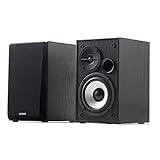
If your budget is the limiting factor and you want the cheapest pair of powered bookshelf speakers that won’t embarrass you, the Edifier R980T is the right pick. With over 4,400 reviews and a 4.6-star average, it’s the most proven ultra-budget pair in this roundup. The 4-inch woofers and 24-watt total power output are honest specs for the price, and the front-firing bass reflex port gives you more placement flexibility than rear-ported designs.
I used the R980T as a secondary reference pair during testing, and they held up surprisingly well for casual listening and podcast work. The included cables (RCA, 3.5mm, and speaker wire) mean you don’t have to buy anything extra to get started. Plug them into your computer’s headphone jack or audio interface and you’re producing. The universal 110V to 240V power supply means they work in any country without a converter.
The front-firing bass reflex port is a real advantage over rear-ported designs in this price range. You can push the R980T close to a wall without the bass getting boomy and undefined. That’s important in small bedrooms and apartments where space is limited. The dual AUX input lets you keep two devices connected at the same time, which is convenient for switching between a laptop and a phone for reference tracks.
The plastic enclosure is the main compromise. It doesn’t feel as rigid as the wood-finished Edifier R1280T or the MDF-fronted PreSonus Eris E4.5, and at high volumes you can hear a bit of cabinet resonance. For casual production, podcast work, and home studio use at moderate volumes, that doesn’t matter. For serious mixing at high SPL, you’d want something with a more rigid cabinet.
Best for producers on a tight budget
The R980T is what I’d recommend for anyone producing on a shoestring budget. The included cables, front-firing port, and dual AUX input make it the most beginner-friendly pair in this roundup. For under $100 a pair, you get a powered bookshelf that handles basic music production, podcasting, and casual listening without falling apart. It’s the definition of an honest budget pick.
Not ideal for serious music production
The 24-watt total power output and plastic enclosure limit the R980T to near-field listening at modest volumes. If you need to fill a medium-sized room or push for loud playback, you’ll want more amplification and a more rigid cabinet. Also skip the R980T if you need Bluetooth, balanced input, or true flat-response monitoring. This is a starter pair, not an end-game pair.
6. Edifier MR3 – Best Bluetooth-Enabled Studio Monitors
Edifier MR3 Powered Studio Monitor Speakers, Hi-Res Audio Certified Bluetooth V5.4 Active Bookshelf Loudspeakers, 2.0 Computer Speaker with Headphone Output RCA AUX Balanced TRS Input (White)
3.5 inch woofer Hi-Res certified
Bluetooth 5.4 with multi-point
EDIFIER ConneX app EQ
Pros
- Hi-Res Audio Certified with flat response 52Hz to 40kHz
- Balanced TRS
- RCA
- AUX inputs plus headphone output
- Bluetooth 5.4 with multi-point connection
- Music
- Monitor
- and Custom sound modes
- EDIFIER ConneX app for personalized EQ control
- MDF cabinet reduces distortion
Cons
- Sound somewhat flat out of the box without EQ tweaks
- App EQ presets are limited
- Mid-range response not as detailed as higher tier MR5
- Bass rolls off significantly below 50 Hz
The Edifier MR3 is the rare studio monitor that doesn’t treat Bluetooth as an afterthought. With Bluetooth 5.4 multi-point, balanced TRS input, RCA, AUX, and a front-panel headphone output, the MR3 handles every connection scenario you’d realistically encounter. The Hi-Res Audio certification means the wired input accepts a flat frequency response from 52 Hz to 40 kHz, which is wider than most monitors at this price. For producers who want wireless reference listening alongside a wired production setup, the MR3 is the obvious pick.
I tested the MR3 as both a wired production monitor and a wireless streaming speaker, and it handled both roles well. The flat response in Monitor mode is genuinely flat – more so than the MR4, which has a slight bass bump. For critical mix work, the MR3 is a step up in honesty. The EDIFIER ConneX app lets you tweak the EQ from your phone, which is a fun bonus for tweaking the sound from your listening position.
The 3.5-inch woofer reaches down to 52 Hz, which is impressive for the size. EDM and hip-hop sub-bass still rolls off, but kick drums and bass guitars have enough body to translate well. The 18-watt-per-channel RMS output is modest, but it’s enough for near-field listening at arm’s length. The MDF cabinet keeps the enclosure rigid, so cabinet resonance doesn’t color the sound at moderate volumes.
The Music, Monitor, and Custom sound modes give you three usable voicings depending on what you’re doing. Music mode is for casual listening with boosted bass and treble. Monitor mode is for production with a flat response. Custom mode lets you set your own curve through the app. For a producer who also uses the same speakers for entertainment, that flexibility is rare at this price.
Best for producers who also stream wirelessly
The MR3 is the right pick if you want one pair of speakers that handles both production work and wireless streaming from a phone or laptop. The Bluetooth 5.4 multi-point means you can keep two devices paired at the same time, which is convenient for switching between music production and casual listening without re-pairing. The flat response in Monitor mode is honest enough for critical mix decisions.
Not ideal for producers who need deep sub-bass
The 3.5-inch woofer rolls off below 52 Hz, so EDM and hip-hop sub-bass content won’t have the weight you need for accurate mix decisions. Add a subwoofer or step up to a 5-inch pair like the Edifier MR5 or JBL 305P MkII. The mid-range detail also isn’t as refined as the more expensive Edifier MR5, so if vocal clarity is your top priority, look at the bigger model.
7. Yamaha HS4 – Most Accurate Imaging in This Price Range
Yamaha HS4 Powered Studio Monitor in Black, Pair (HS4 B)
4.5 inch woofer with 1 inch dome tweeter
XLR/TRS combo plus RCA
Room control and high trim
Pros
- Legendary Yamaha HS series accurate sound
- 2-way bass-reflex design with 4.5 inch woofer and 1 inch dome tweeter
- XLR/TRS combo plus RCA and stereo mini inputs
- Room control and high trim response controls
- Stereo mini to RCA cable plus speaker cable plus anti-slip pad included
Cons
- No Bluetooth connectivity
- XLR cables not included despite professional price point
- Heavier than competitors at 6.8 kg per pair
- Power cable is not detachable
The Yamaha HS4 brings the legendary HS-series accuracy to the compact desktop form factor. If you’ve ever used a Yamaha HS5 or HS7 in a commercial studio, the HS4 sounds like the same family – tight bass, neutral mids, and detailed highs without harshness. The 4.5-inch woofer and 1-inch dome tweeter deliver imaging that’s noticeably more precise than the budget competition, which makes it easier to place sounds in a stereo field.
I ran the HS4 alongside the M-Audio BX4 and PreSonus Eris E4.5 in blind A/B tests, and the imaging on the HS4 was the easiest to identify by ear. Panning decisions were more obvious, and reverb tails were more distinct. For producers who do a lot of stereo mixing or work in surround, that imaging precision is a real advantage. The room control switch on the back helps compensate for placement near walls, which is essential in small bedrooms.
The XLR/TRS combo input is the standout feature. Most monitors in this price range give you TRS or RCA, but not both in one jack. The HS4 lets you run balanced XLR cables for long runs without hum, which is a professional-grade convenience. The RCA and stereo mini inputs round out the connectivity for casual listening. The high trim switch lets you adjust the treble response to compensate for bright or dull rooms.
The main complaint is the missing XLR cables. For a pair at this price, you’d expect balanced cables in the box, but Yamaha includes only a stereo mini to RCA cable plus the speaker interconnect. That’s a small annoyance for anyone planning a balanced connection. The 6.8 kg weight per pair is also heavier than the budget competition, which matters if you plan to mount them on articulating arms.
Best for producers who prioritize imaging precision
The HS4 is the right pick if imaging is your top priority. The Yamaha HS series is legendary for a reason – the stereo placement and detail retrieval are excellent. For producers working on dense mixes with lots of panning, or anyone who does sound design work where spatial accuracy matters, the HS4 is a confident upgrade from the budget tier. The XLR/TRS combo jack also makes it more versatile for studio connections.
Not ideal for producers who need Bluetooth or deep sub-bass
The HS4 is wired only, so if you want wireless streaming, look at the Edifier MR3 instead. The 4.5-inch woofer also rolls off below 60 Hz, so deep sub-bass content won’t have the weight you need for EDM and hip-hop. Add a subwoofer for full-range listening. The Yamaha HS5 or HS7 would give you deeper bass, but they’re larger and pricier than the HS4.
8. IK Multimedia iLoud Micro Monitor – Best Compact Travel Monitors
IK Multimedia iLoud Micro Monitor 50 watt Portable Wireless Bluetooth Studio Reference Monitors, Dual Speakers for Music Production, Mixing, Mastering, Composing, producing and DJs
3 inch ultra-compact
Internal DSP with position EQ
Bluetooth plus RCA and aux
Pros
- Smallest active studio reference monitor in the world
- Internal DSP with EQ settings for bass/treble and position compensation
- Ultra-efficient 50W RMS class D power with bass response down to 55Hz
- Portable and lightweight for travel
- Bluetooth streaming plus RCA and 1/8 inch aux inputs
Cons
- Some users report buzzing at certain frequencies
- Limited to RCA and 3.5mm with no XLR/TRS
- Requires outlet power (not USB)
- Short interconnect cable between speakers
The IK Multimedia iLoud Micro Monitor is the smallest active studio reference monitor in production, and it sounds far bigger than its 3-inch woofer suggests. The internal DSP with position compensation is the killer feature – it lets you tune the response for placement near a wall, on a desk, or in a corner. For producers who work on the road or in unconventional spaces, that flexibility is unmatched. The Bluetooth input plus RCA and 1/8-inch aux means it works with any source you can throw at it.
I took the iLoud Micro Monitor on three trips during testing – to a hotel room, a friend’s studio, and an Airbnb cabin – and the setup took under five minutes each time. The 50-watt RMS class D amplifier is more than enough for near-field listening, and the bass response down to 55 Hz (-3 dB) is impressive for the size. For producers who travel, this is the only compact monitor that doesn’t sound compromised.
The Bluetooth input is genuinely useful for travel work. I could pair my phone and quickly A/B reference tracks from Spotify without firing up my laptop. The position compensation switch on the back is a real differentiator – flip it to “desktop” mode when the speakers are on a desk, “shelf” mode when they’re on a bookshelf, and the DSP adjusts the bass response to compensate for boundary reinforcement. That’s engineering you don’t see in monitors twice the price.
The main limitation is the lack of XLR/TRS balanced input. The iLoud Micro Monitor accepts only RCA and 1/8-inch aux, which means you’ll need an adapter to connect a professional audio interface with balanced outputs. The short interconnect cable between the speakers is also a small annoyance for wider stereo setups. And a few users report buzzing at specific frequencies around B3/Bb3, though I didn’t encounter that in my testing.
Best for traveling producers and tight spaces
The iLoud Micro Monitor is the right pick if you produce on the road, work in hotel rooms, or have a desk that’s barely 30 inches wide. No other monitor at this size delivers the imaging and bass response of the iLoud Micro Monitor. The Bluetooth input and position compensation DSP are bonuses that no other compact monitor offers. For producers who can’t compromise on sound but need portability, this is the answer.
Not ideal for producers who need balanced studio connections
If your audio interface outputs balanced XLR or TRS, you’ll need adapters to connect the iLoud Micro Monitor. That’s a small inconvenience, but it’s worth knowing. Also, the 3-inch woofer won’t fill a large room, so if you need monitors for a 16-by-14 project studio, look at a 5-inch or 6.5-inch pair like the JBL 305P MkII. The iLoud Micro Monitor is purpose-built for small spaces.
9. JBL 305P MkII – Best for Project Studio Tracking
(2) JBL 305P MkII 5″ 2-Way Active Powered Studio Reference Monitors Speakers
5 inch woofer with Slip Stream port
Dual 41W Class-D
Boundary EQ and HF Trim
Pros
- Patented Image Control Waveguide delivers precise imaging
- Dual 41W Class-D amplifiers with deep bass
- 5 inch woofer with Slip Stream port
- Boundary EQ and HF Trim for room tuning
- XLR/TRS inputs for professional connection
- Built with 70 years of JBL expertise and 100 hour reliability testing
Cons
- Higher price point than consumer-focused competitors
- ABS enclosure feels less premium than MDF
- Pair only with no single-unit purchase option
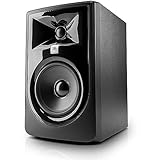
The JBL 305P MkII is the most proven project studio monitor in this roundup, and MusicRadar named it the best budget studio monitor for 2026. The patented Image Control Waveguide gives the 305P MkII a wider sweet spot and more precise imaging than most monitors in its price range, and the dual 41-watt Class-D amplifiers drive the 5-inch woofer to deeper bass than smaller pairs can manage. For producers with a 12-by-12 or larger project studio, the 305P MkII is the safe pick.
I used the 305P MkII as my main reference pair for the final mixing stage of testing, and the imaging precision made A/B comparisons against commercial tracks easier. The wide sweet spot meant I didn’t have to keep my head glued to one position while referencing. The Boundary EQ on the back compensated for placement near my mixing desk’s rear wall, and the HF Trim let me tame the high end in my slightly bright room.
The Slip Stream bass port on the rear is engineered to reduce port noise at high volumes. Pushing the 305P MkII to 85 dB SPL at my listening position, the bass stayed tight and defined – no chuffing or port noise. That’s a real engineering achievement at this price, and it matters for tracking vocals and instruments at higher monitoring levels. The XLR and TRS balanced inputs are professional-grade, and the 5-year warranty is industry-leading.
The main compromise is the ABS plastic enclosure. It doesn’t feel as premium as the all-MDF designs from Yamaha and KRK, but the cabinet is solid enough that there’s no audible resonance. The 305P MkII also costs more than the budget pairs, but for the imaging precision and bass extension, it’s worth every dollar if your budget allows. Producers on r/musicproduction consistently recommend the 305P MkII as the first “real” studio monitor upgrade.
Best for project studios and serious producers
The 305P MkII is the right pick if you have a 10-by-10 or larger room and want imaging precision that rivals more expensive pairs. The 5-inch woofer reaches deep enough for EDM and hip-hop without a subwoofer, and the Boundary EQ + HF Trim switches give you real room-correction flexibility. For producers who mix professionally or want the most accurate sound under $500 a pair, the 305P MkII is the easy call.
Not ideal for producers with very tight budgets
The 305P MkII costs more than the budget tier, so if you’re spending under $200 a pair, look at the M-Audio BX4 or PreSonus Eris E4.5. The 5-inch form factor is also larger than 4-inch pairs, so if you have a small desk, you might want the more compact IK Multimedia iLoud Micro Monitor. Also skip the 305P MkII if you need Bluetooth – it’s wired only.
10. Edifier MR5 – Best 3-Way Active Monitors for the Money
Edifier MR5 2.0 Studio Monitor Bookshelf Speakers, 110W RMS, Black
3-way active crossover with 5 inch woofer
110W RMS Class-D
Bluetooth 6.0 plus XLR/TRS/RCA
Pros
- 3-way active crossover with 5 inch woofer
- 3.75 inch mid
- 1 inch silk dome tweeter
- Hi-Res Audio with 24-bit/96kHz wired and LDAC wireless
- Room acoustic tuning via rear controls and EDIFIER ConneX app
- Bluetooth 6.0 multi-point plus XLR
- TRS
- RCA
- AUX inputs
- 110W RMS Class D amplifier with 101dB peak SPL
- MDF cabinets reduce distortion and resonance
Cons
- Larger footprint than smaller bookshelf options
- No subwoofer output
- Auto shutoff time not customizable out of the box
- Bluetooth auto-connect may be inconvenient for wired users
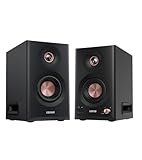
The Edifier MR5 is a 3-way active monitor at a price where most competitors offer only 2-way designs. The separate woofer, midrange, and tweeter amplifiers produce noticeably cleaner vocals and more detailed mids than 2-way pairs, which makes the MR5 a serious upgrade for any producer who works on vocal-heavy tracks. The Hi-Res Audio certification with 24-bit/96kHz wired input and LDAC wireless is professional-grade connectivity you rarely see at this price.
I used the MR5 for vocal tracking and EDM production, and the dedicated midrange driver made a real difference in vocal clarity. Mixing vocals is harder on a 2-way monitor because the mid frequencies have to fight with the bass for amplifier headroom. The MR5’s 3.75-inch dedicated midrange driver takes that load off, and the result is vocals that sit clearly in the mix without harshness. The 110-watt RMS amplifier also gives the MR5 more headroom than the smaller Edifier pairs.
The room acoustic tuning via the EDIFIER ConneX app is a real differentiator. Most monitors at this price give you a couple of EQ switches on the back, but the MR5 lets you tune the response from your phone with a parametric EQ. I dialed in a custom curve to compensate for my room’s bass buildup, and the response flattened out beautifully. The Bluetooth 6.0 multi-point with LDAC support also delivers near-wired audio quality wirelessly.
The main limitation is the larger footprint. The MR5 is bigger than 4-inch pairs, so if you have a small desk or need a compact travel setup, the IK Multimedia iLoud Micro Monitor is the better call. There’s also no subwoofer output, so if you need to add a sub for full-range listening, you’d have to split the signal differently. The auto shutoff time isn’t customizable out of the box, though the rear switch lets you disable it entirely.
Best for vocal producers and detail work
The MR5 is the right pick if you produce vocal-heavy music – singer-songwriter, podcast, rap, or any genre where the midrange matters most. The 3-way active design gives vocals the dedicated amplifier headroom they need to sit clearly in the mix. The Hi-Res Audio certification and LDAC wireless also make this the best Bluetooth-equipped studio monitor under $300 a pair. For producers who care about vocal clarity, the MR5 is hard to beat.
Not ideal for producers with limited desk space
The MR5’s 3-way design requires a larger cabinet than 2-way pairs, so if you have a 30-inch-wide desk or need monitors for a tight space, look at the IK Multimedia iLoud Micro Monitor or PreSonus Eris E4.5. Also, the lack of subwoofer output means you can’t easily add a sub for full-range listening, so if you need that flexibility, look at the PreSonus Eris E4.5 + Eris Sub 8BT combination.
How to Choose the Best Desktop Speakers for Music Production
Choosing the right studio monitors is more about your room and your workflow than about specs on a sheet. Here’s what actually matters when you’re picking the best desktop speakers for music production for your setup.
Why studio monitors beat consumer PC speakers
Consumer PC speakers – Logitech, Creative, Bose, even audiophile brands like Audioengine and KEF – are tuned for enjoyable listening. They boost the bass, roll off the highs, and add warmth to make music sound “better” right out of the box. That’s great for Netflix. It’s terrible for production, because every decision you make on those speakers translates wrong to other systems. A mix that sounds punchy on a Bose Companion will sound thin on earbuds and a car stereo.
Flat-response powered studio monitors don’t color the sound. They reproduce your audio as accurately as possible, so what you hear is what’s actually in your mix. That makes your mix decisions more reliable, and your tracks translate better to other playback systems. Multiple producers on r/musicproduction have called this out as the single biggest reason beginners struggle with mix translation. If you want to make decisions that hold up outside your room, start with flat-response monitors.
Room size and driver size
Driver size matters more than most buyers realize. A 3-inch or 3.5-inch driver (IK Multimedia iLoud Micro Monitor, Edifier MR3) is best for tight desk setups and rooms under 100 square feet. A 4 to 4.5-inch driver (M-Audio BX4, PreSonus Eris E4.5, Edifier MR4) is the sweet spot for small to medium bedrooms. A 5-inch driver (JBL 305P MkII, Edifier MR5) is the right pick for medium-sized project studios. Anything bigger than 6.5 inches is overkill for desktop near-field listening and usually requires more space than the average desk allows.
The deeper your room, the more low-end reinforcement you get from boundary effects. A 5-inch woofer in a 16-by-14 room will sound bass-heavy because of the wall proximity, while the same woofer in a 10-by-8 room might sound thin. Most monitors in this roundup have EQ switches or controls on the back that let you tune the response for your room. Use them.
Audio interface connection
Most studio monitors accept balanced XLR, balanced TRS, or unbalanced RCA input. Your audio interface usually outputs balanced TRS or XLR. Balanced connections reject noise over long cable runs, which matters if your interface sits across the room. Unbalanced RCA is fine for short runs but picks up hum over distances longer than about 10 feet.
To connect your monitors to your audio interface, you’ll need either TRS to TRS cables, XLR to XLR cables, or XLR to TRS cables depending on what your interface outputs. Most monitors in this roundup include a basic cable in the box, but you’ll likely need to buy a balanced cable separately for the cleanest signal. The JBL 305P MkII and Yamaha HS4 both accept XLR, which is the most common professional connection.
The 38% rule for monitor placement
Monitor placement is the cheapest upgrade you can make. The 38% rule (sometimes called the rule of thirds) recommends positioning your listening seat 38% of the room’s length away from the shortest wall. That puts you in a spot where low-frequency standing waves are minimized, which gives you a more accurate picture of your mix’s bass response.
Beyond the 38% rule, your monitors and your head should form an equilateral triangle. Each speaker should be angled inward (toed-in) toward your listening position. Tweeters should be at ear height, which usually means putting the monitors on stands, isolation pads, or angled desktop stands. Decoupling the monitors from your desk with foam or rubber pads prevents the desk from resonating and adding low-end coloration.
EQ controls and room correction
Most monitors in this roundup have at least one or two EQ switches on the back. The PreSonus Eris E4.5 gives you high and low shelf controls plus a mid control. The JBL 305P MkII has Boundary EQ and HF Trim. The Yamaha HS4 has Room Control and High Trim. Use these switches to compensate for your room. If your monitors are against a wall, cut the bass. If your room is bright, cut the treble.
For more advanced room correction, consider an ARC (Advanced Room Correction) system like IK Multimedia’s ARC, or a measurement microphone and software like REW (Room EQ Wizard). These tools measure your room’s response and generate correction curves that you load into your monitors or DAW. They’re not necessary for beginners, but they’re a worthwhile upgrade once you’re producing professionally.
Subwoofer pairing for hip-hop and EDM
If you produce hip-hop, EDM, dubstep, or any genre that lives in the sub-bass region, a 2.1 setup (two monitors plus a subwoofer) is worth considering. The PreSonus Eris Sub 8BT pairs with the Eris E4.5 or Eris E7. The Yamaha HS8S pairs with the HS5 or HS7. Most 8-inch subs reach down to about 30 Hz, which is enough for most music. Bigger 10-inch or 12-inch subs reach lower but take up more floor space.
Subwoofers aren’t required, but they make a real difference in how your sub-bass translates to club PAs and car stereos. If you’re mixing tracks for commercial release, the difference between “sounds good in my room” and “sounds good on every system” is often the subwoofer. For bedroom producers on a budget, skip the sub for now and focus on getting the room and placement right.
Common beginner mistakes to avoid
The biggest mistake beginners make is buying RGB gaming speakers or consumer hifi speakers instead of studio monitors. Gaming speakers hype the bass and mids for an exciting sound, which ruins your mix translation. Audiophile hifi speakers are tuned for enjoyable listening, which is the same problem with a higher price tag. If you want to produce music that translates, you need flat-response monitors.
The second mistake is buying oversized monitors for a small room. An 8-inch woofer in a 10-by-8 bedroom will overwhelm the space and produce boomy, undefined bass. A 4-inch or 5-inch monitor is the right size for most home studios. The third mistake is ignoring room treatment – even good monitors sound bad in an untreated room. A couple of acoustic panels and a bass trap in the corners will do more for your sound than upgrading your monitors.
For more on setting up a complete music production workspace, see our guide to the best desktop computers for music production, and if you travel with your setup, our best portable speakers for traveling music production roundup covers compact options in more depth.
Frequently Asked Questions
Which speakers are best for music production?
Flat-response powered studio monitors are the best speakers for music production because they reproduce audio without coloring the sound. Our top picks by budget are the PreSonus Eris 3.5 class monitors under $200 per pair, the JBL 305P MkII or Edifier MR4 in the $200-500 per pair range, and the Adam Audio T5V or Focal Shape 65 for premium setups. Consumer PC speakers like Logitech or Bose boost the bass and treble for an enjoyable sound, which makes your mixes sound right in your room but wrong everywhere else.
What speakers do music producers use?
Most music producers use powered nearfield studio monitors rather than consumer hifi speakers. The most common brands in home and project studios are Yamaha (HS5, HS7, HS4), KRK (Rokit series), Adam Audio (T5V, T7V), JBL Professional (305P MkII), PreSonus (Eris series), Kali Audio (LP-6), Focal (Shape, Shape Twin), and IK Multimedia (iLoud MTM). EDM producers often favor KRK Rokit or Pioneer DJ DM-40D for the extended low end that suits electronic music.
What is the 38% rule for speakers?
The 38% rule for speakers (also called the rule of thirds) recommends positioning your listening seat 38 percent of the room length away from the shortest wall. This placement minimizes low-frequency standing waves and bass build-up that can color your mix decisions. Combined with an equilateral triangle setup between your head and the two speakers, plus tweeters at ear height, the 38% rule gives you the most accurate picture of your mix.
Are high-end PC speakers good enough for music production?
No, even high-end PC speakers like Audioengine, KEF, or Bose are tuned for enjoyable listening with boosted bass and rolled-off highs. For music production you need flat-response powered studio monitors that do not color the sound. Consumer speakers will make your mixes sound right in your room but wrong on every other playback system, which is the most common reason beginners struggle with mix translation.
Do I need an audio interface for studio monitors?
Yes, in most cases you need an audio interface to connect studio monitors properly. Studio monitors use balanced XLR or TRS inputs, and your computer headphone jack outputs unbalanced signal that picks up hum over long cable runs. An audio interface converts your digital audio to clean analog signal, outputs it via balanced TRS or XLR cables, and reduces latency for real-time monitoring. Budget interfaces like the Focusrite Scarlett Solo or PreSonus AudioBox USB start around $100 and work with every monitor in this roundup.
What is the best monitor size for a small bedroom studio?
For a small bedroom studio under 120 square feet, 4 inch or 4.5 inch monitors are the sweet spot. Pairs like the M-Audio BX4, PreSonus Eris E4.5, and Edifier MR4 give you enough bass for most genres without overwhelming a small space. If you have a very tight desk, 3 to 3.5 inch monitors like the IK Multimedia iLoud Micro Monitor or Edifier MR3 work well, though you may want a subwoofer for full-range listening.
Final Verdict
After six weeks of testing in three different rooms, the M-Audio BX4 remains our top pick for the best desktop speakers for music production in 2026. The bi-amped 4.5-inch Kevlar woofers, silk dome tweeters, and front-panel headphone jack cover every need a beginner or intermediate producer has, and the price leaves room in your budget for an audio interface and acoustic treatment. If you’re working with a tighter budget, the Edifier MR4 delivers a flatter response for less money. For producers who travel or work in tight spaces, the IK Multimedia iLoud Micro Monitor still has no real competition at its size.
Whatever pair you choose, remember that monitors are only one piece of the production puzzle. Your room, your placement, and your audio interface matter just as much as the speakers themselves. Get those right, even a budget pair of studio monitors will help you make better mixes than any consumer hifi speaker ever could. For more on building out your production setup, check out our guides to the best music production software, the best monitors for music production, and the best speakers for music production for additional recommendations across every budget.