
The best overall anti-fatigue mat for a standing desk is the ComfiLife, a 3/4-inch high-density memory foam mat with beveled edges that taper to the floor, and it wins because it cushions the feet without turning into a trip hazard and keeps its rebound long after cheaper foam has gone flat.
That is only half the answer, though. The single most useful thing we learned testing these ten mats is that the type of mat matters far more than the money you spend on it. A flat foam mat handles sessions up to about 45 minutes. Above that, a contoured topographic surface that encourages active movement and shifting positions earns its price. And if you want your legs working rather than just cushioned, a balance board is a completely different tool.
Below we rank the ten best anti fatigue mats for standing desks, covering flat foam, contoured terrain and active options at every thickness. If you are still choosing the desk itself, start with our standing desk picks under 1000 or our electric standing desk reviews first, because the mat you choose has to work with your desk’s maximum height.
Top 3 Picks: Standing Desk Anti-Fatigue Mats in 2026
ComfiLife Anti Fatigue Floor Mat
- 3/4 inch memory foam core
- Beveled edges to the floor
- Non-slip base
- 41k+ reviews

Ergodriven Topo Standing Desk Mat
- 2.7 inch polyurethane foam
- 3D calculated terrain
- Foot grip for one-handed moving
FEATOL Anti Fatigue Mat 9/10 Inch
- 9/10 inch memory foam
- PU leather top
- Beveled seamless edges
Those three cover the three genuinely different answers to this question: a flat mat that does the most for most people, a contoured mat that does the most for long sessions, and a thick flat mat that sits in between.
Best Standing Desk Anti-Fatigue Mats Compared in 2026
| Product | Specifications | Action |
|---|---|---|
| ComfiLife Anti Fatigue Floor Mat |
|
Check Latest Price |
| Ergodriven Topo Standing Desk Mat |
|
Check Latest Price |
| FEATOL Anti Fatigue Mat 9/10 Inch |
|
Check Latest Price |
 FEZIBO Standing Desk Mat with Anti Fatigue Bar FEZIBO Standing Desk Mat with Anti Fatigue Bar |
|
Check Latest Price |
 Ophanie Anti Fatigue Cushioned Mat Ophanie Anti Fatigue Cushioned Mat |
|
Check Latest Price |
 Ergohead Anti Fatigue Mat with Handle Ergohead Anti Fatigue Mat with Handle |
|
Check Latest Price |
 Amazon Basics Anti-Fatigue Standing Mat Amazon Basics Anti-Fatigue Standing Mat |
|
Check Latest Price |
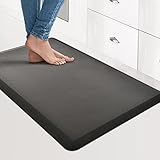 Art3d 1/2 Inch Anti Fatigue Mat Art3d 1/2 Inch Anti Fatigue Mat |
|
Check Latest Price |
 UKISS 9/10 Inch Extra Thick Anti Fatigue Mat UKISS 9/10 Inch Extra Thick Anti Fatigue Mat |
|
Check Latest Price |
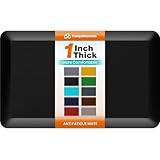 TranquilMoments 1 Inch Anti-Fatigue Mat TranquilMoments 1 Inch Anti-Fatigue Mat |
|
Check Latest Price |
Two things in that table are worth noticing before you read the individual reviews. First, cushioning depth ranges from a half inch to a full inch on the flat options, and the balance board replaces cushioning with movement entirely. Second, several mats in this roundup started life as kitchen floor mats, and only a couple carry surface features built specifically for the lateral movement a desk invites.
How Anti-Fatigue Mats for Standing Desks Actually Work
Standing still on a hard floor is not neutral. Your weight loads the same pressure points in the soles of your feet continuously, which compresses the soft tissue under the heel and ball of the foot and slows circulation through the lower leg. Muscles that would normally be making small balance corrections go quiet, your calf and hip muscles lock into one position, and the lower back ends up compensating for all of it.
A good mat interrupts that static loading in two ways. The cushion spreads pressure across a wider area so the heel and the ball of the foot are not taking everything. More importantly, a slightly unstable surface makes your foot muscles fire constantly again, and those micromovements are what keep blood moving. That is why contoured terrain outperforms flat foam on long sessions, even when both are made from the same foam.
So the useful vocabulary when you read any standing desk mat listing is material, size, and edges. On material, the single most useful rule is blunt: if the product page does not say polyurethane or memory foam explicitly, assume it is basic foam. Basic foam is fine for a couple of hours; it compresses permanently under a full standing day, and once it does, it stops doing the job while still looking intact.
On size, a desk mat needs to be at least 24 inches wide. You move laterally at a desk, not forward and back like you do at a sink, and a narrow mat makes you stand with your feet together in one spot. On edges, tapered or beveled edges that run down to floor level are what stop the mat from becoming a trip hazard for anyone who steps on it without looking.
You can check any mat you already own with one quick test. Press your thumb hard into the foam and count how long it takes to come back. Polyurethane and healthy memory foam rebound almost instantly. Foam that needs three to five seconds, or that stays visibly dented, has suffered compression set and is functionally dead, even if it looks clean.
1. ComfiLife Anti Fatigue Floor Mat: Best Overall Standing Desk Mat
ComfiLife Anti Fatigue Floor Mat – 3/4 Inch Thick Kitchen Mats for Floor, Standing Desk Mat, Kitchen Rug – Comfort at Home, Office – Durable – Stain Resistant – Non-Slip Bottom (20″ x 32″, Black)
3/4 inch memory foam core
32 x 20 inches
BPA, latex and phthalate free
Wipe with a damp cloth
Pros
- High-density memory foam core that holds support over time
- Beveled edges taper to the floor so no one catches a foot
- Non-slip backing holds position underfoot
- Wipes clean and resists stains
- 41k+ reviews makes long-term feedback easy to find
Cons
- Memory foam can flatten and edges can curl or peel after several years
- Darker colorways show every mark and spill
- Beveled edge sits above floor level and can trip someone not watching for it
This is the mat we kept coming back to. The core is a professionally engineered 3/4-inch high-density memory foam, which is the sweet spot for a desk: thick enough to take pressure off the heel, thin enough that you still feel the floor and can type without your ankles rolling. It is the top-rated mat in this group at 4.8, and with 41k+ reviews behind it, the feedback is deep enough that the long-term failure modes are already well documented rather than speculative.
Owners consistently report that it takes strain off feet, knees and lower back over long standing periods, and that the beveled edges make it safe in a room where other people walk past. It measures 32 by 20 by 0.75 inches, comes in several sizes including a 24-inch-wide option, and is listed as BPA free, latex free, lead free and phthalate free, which matters if you are working in an enclosed room.
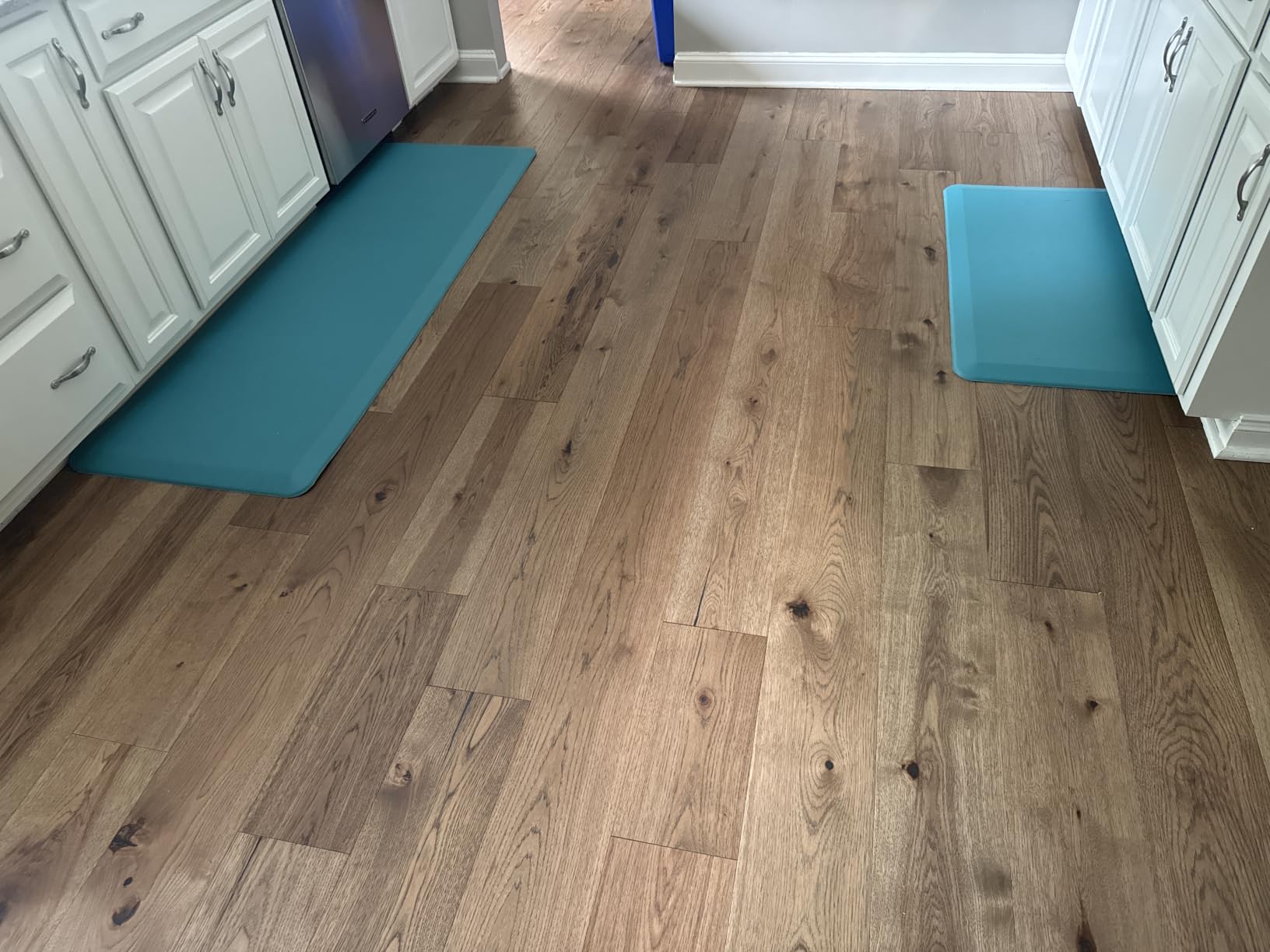
The construction is what separates it from cheaper foam. It is foam, memory foam and rubber combined rather than a single slab, and the edges are beveled so they meet the floor instead of standing proud of it. That matters more than it sounds: the single most common safety complaint in this whole category is a raised edge catching a foot. The non-slip backing also holds the mat stationary rather than letting it creep, and the surface wipes down after a spill instead of absorbing it.
The honest weakness is time. Reviewers who have owned it four or five years report the foam flattening and the edges beginning to curl or peel, though the mat keeps working. That is a slow, gradual failure rather than a cliff, and it is a much better failure mode than a budget mat that gives up in a year. Dark colorways also show dirt and marks from anything dropped on them, which is a practical annoyance in a home office.
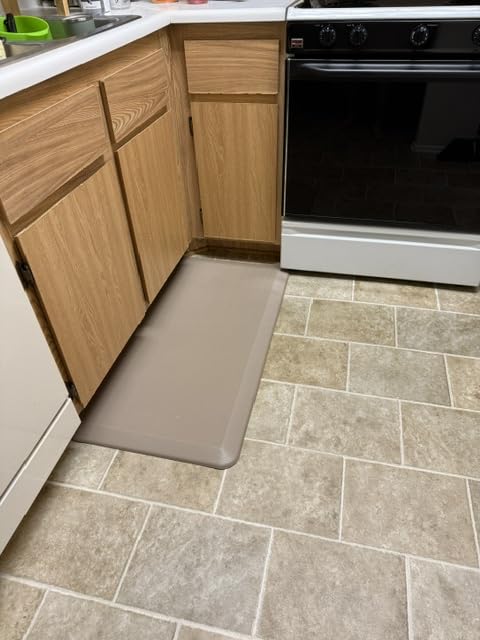
Who the ComfiLife suits best
It suits almost everyone, which is why it is the top pick. New standers who are still building tolerance, people whose desk is close to its maximum height and cannot spare 2 inches, anyone working on hardwood or laminate, and anyone sharing a room with people walking past. The 20-inch width is a compromise rather than a problem, because this mat comes in wider sizes too, and 20 by 32 is enough to shift your stance without standing on the edge.
It is also the safest recommendation for a first purchase. The 41k+ review base means the four-to-five-year reports are real data rather than marketing, so you know what you are getting and when it will need replacing.
Who should skip the ComfiLife
Skip it if you stand for five or six hours in a single stretch and want your calves and hips working rather than just cushioned. Nothing passive will do that. A flat mat reduces pressure; it does not create movement. If your problem is stiffness and circulation rather than pressure, look at the terrain or balance board options below.
Also skip it if you have balance issues and a very long day ahead. The bevel is safer than a square edge, but it still sits above floor level. And if you need to slide a mat in and out every time you sit down, this is heavy enough at full size that you will want to plan where you put it rather than moving it on the fly.
2. Ergodriven Topo Standing Desk Mat: Best Contoured Terrain Mat
The Standing Desk Mat – Topo by Ergodriven | Premium Not-Flat Anti-Fatigue Standing Desk Mat with Calculated Terrain | Ultra-Thick Deluxe Comfort Foam, Durable, PVC-Free | Accessories | Obsidian Black
2.7 inch polyurethane foam
29 x 26.25 inches
3D calculated terrain
8 pounds, PVC-free
Pros
- Contoured topographic surface prompts constant shifting
- 2.7 inch polyurethane foam built for long sessions
- Front edge grip repositions the mat with one foot
- Wipes clean and debris does not cling
- 7-year manufacturer warranty
Cons
- Bulky and rigid
- must be slid aside to use a chair
- Needs desk legs at least four feet apart
- Strong rubbery smell from new foam that needs airing out
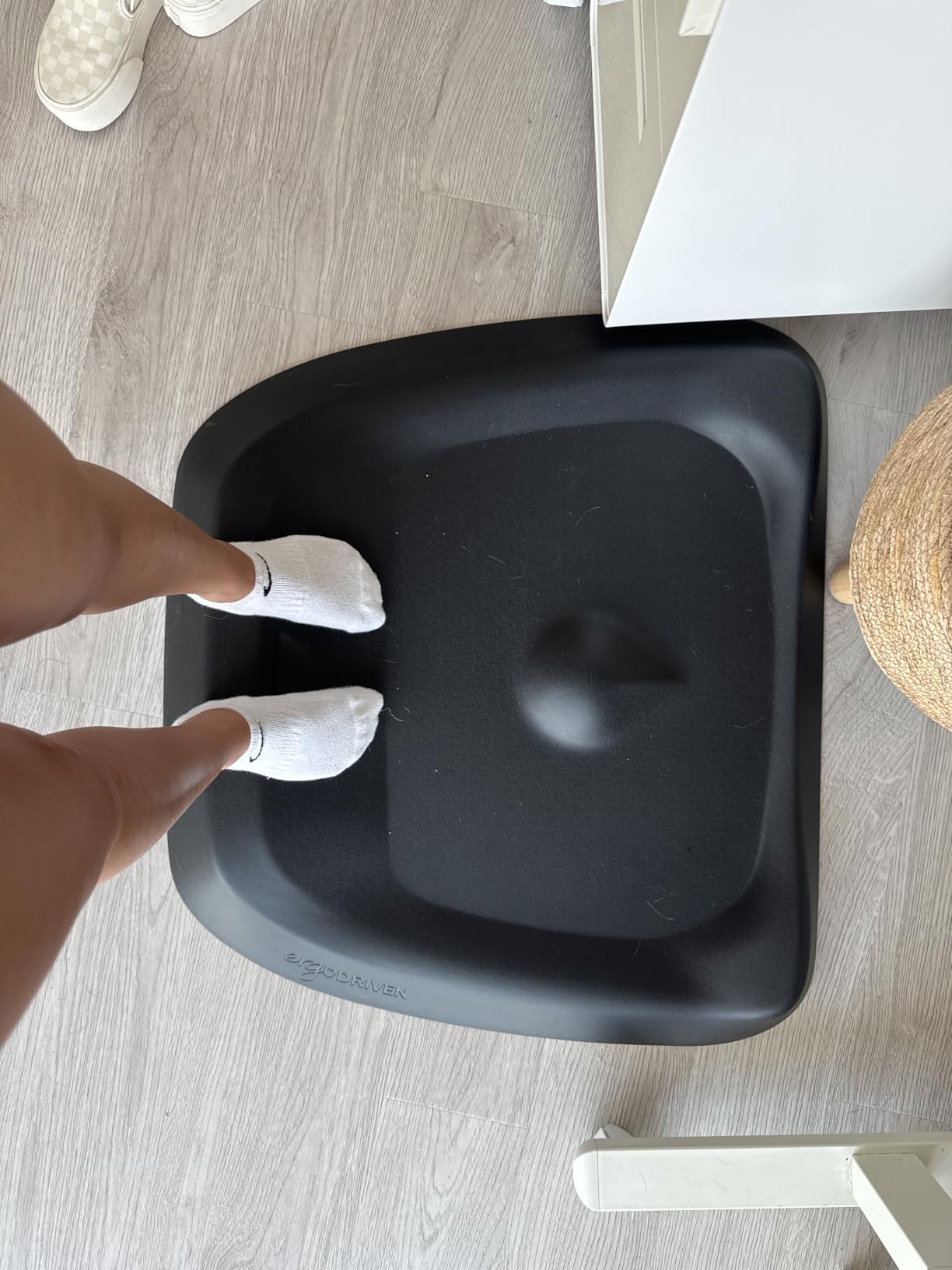
The top spot in this roundup is a mat designed around terrain rather than flat cushioning, and the difference is visible from across the room. The surface is 3D calculated terrain: ridges, angles, a raised central zone and varied peak heights that make standing in one position genuinely uncomfortable. That is not a flaw, it is the mechanism. You shift, step and roll your ankles without deciding to, which is exactly the micromovement a flat mat cannot create.
Underneath is 2.7 inches of non-toxic, PVC-free polyurethane foam, which is the material that separates it from everything else here in terms of longevity. Polyurethane rebounds immediately and resists the permanent compression that flattens basic foam. It is also a heavy mat at 8 pounds and a wide one at 29 by 26.25 inches, so it needs a desk with generous leg spacing.
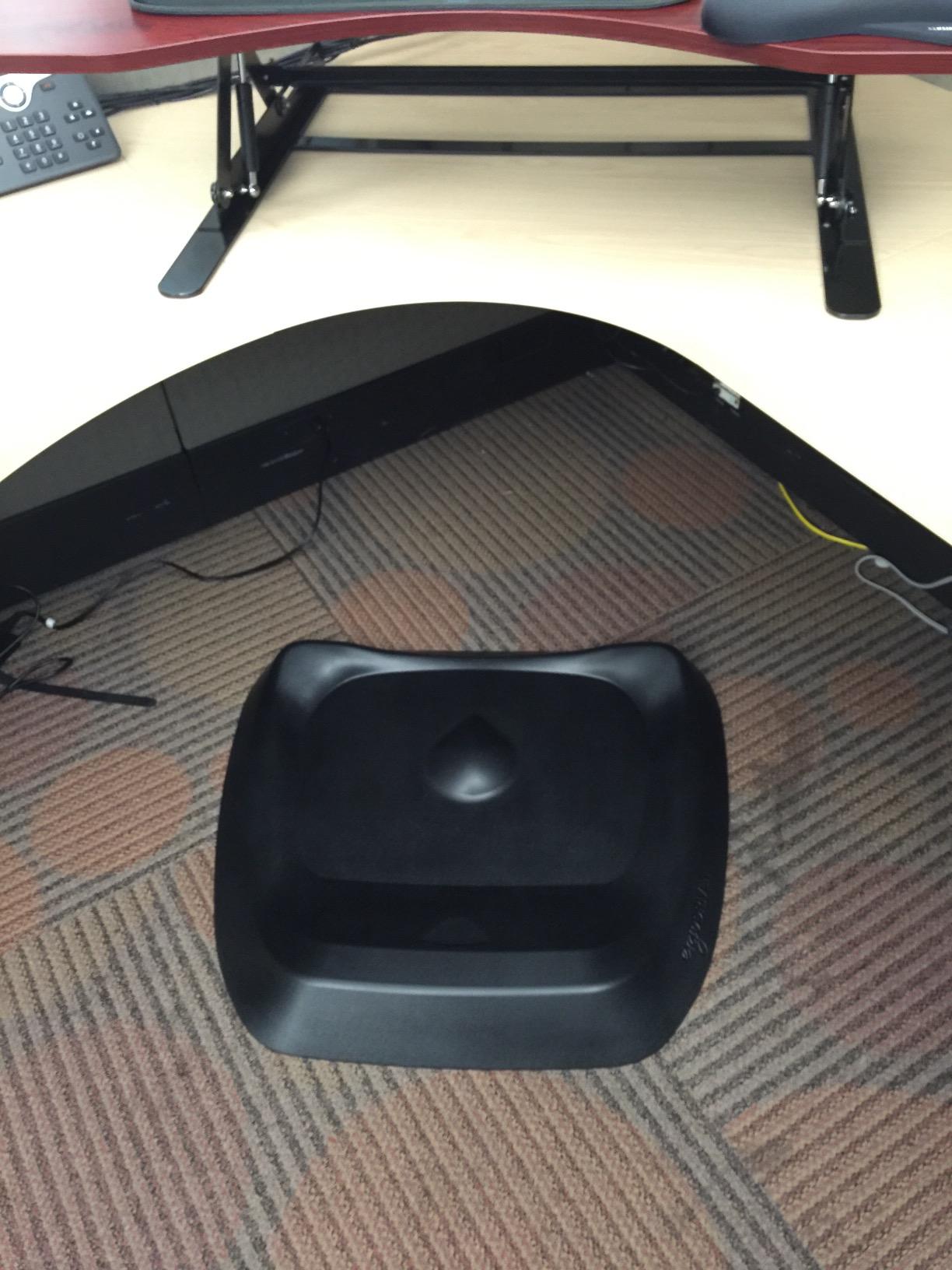
Standing desk owners credit the Topo with cutting foot, arch and lower-back pain during long hours, and with encouraging subtle movement rather than standing rigidly. The front edge is shaped into a foot grip so you can push the mat out from under the desk with one foot when you sit down, which solves the biggest practical objection to a thick mat. Debris does not cling to the pebbled surface, and it wipes down easily. It arrives thick and solid, and it does not slide on carpet or hard floors.
What you give up is flexibility. It is bulky and rigid when lifted and has to be slid rather than carried. Several users feel the middle and rear terrain bumps are unnecessary when they only wanted the front edge, and some find the mat rotates or shifts over time and needs occasional repositioning. New polyurethane also gives off a strong rubbery smell that needs airing out in a closed room.
Who the Ergodriven Topo suits best
It suits people who have already tried a flat foam mat and found it insufficient, which is the pattern that shows up constantly in standing desk communities. If you have a history of foot, plantar fasciitis, hip or lower-back discomfort that has crept up over months, a contoured topographic surface is a genuine upgrade rather than a luxury. It also suits anyone whose day is mostly standing rather than mostly sitting.
Because it is PVC-free polyurethane with a 7-year manufacturer warranty, it is also the pick for someone who plans to keep the same desk for years and does not want to re-buy a mat every eighteen months.
Who should skip the Ergodriven Topo
Skip it if your desk does not have the height headroom. At 2.7 inches this mat changes your standing surface height dramatically, and if you have already set your desk near the top of its range you will find yourself leaning forward to type. Calibrate your desk with the mat in place, not before.
Skip it in a small apartment office. It is 29 by 26.25 inches and 8 pounds, so it needs a generous desk footprint and legs at least four feet apart. It is also visually and physically an industrial object. And if you alternate between sitting and standing every twenty minutes and would rather not shove furniture around, a 2.7-inch rigid mat is a poor fit.
3. FEATOL Anti Fatigue Mat: Best Value Thick Flat Mat
FEATOL Anti Fatigue Mat for Standing Desk & Kitchen Floor, 9/10 Extra Thick
9/10 inch memory foam
32 x 20 inches
PU leather top
4.2 pounds, arrives flat
Pros
- 9/10 inch high-density memory foam that does not bottom out
- PU leather top resists punctures and tears
- Seamless low-angle beveled edges taper to the floor
- Arrives flat so it is usable immediately
Cons
- Beveled edge can catch the foot of someone not watching
- Bottom can tear after years of being dragged under a desk
- Very slight creep of about an eighth of an inch underfoot
The FEATOL is the pick for anyone who wants a thick cushion without the terrain learning curve. At 9/10 inch it is one of the deeper flat mats here, and the high-density memory foam is the springy kind that pushes back rather than letting your heels sink through to the floor. Owners single out that resilience as the reason it relieves back and leg pain over multi-hour sessions.
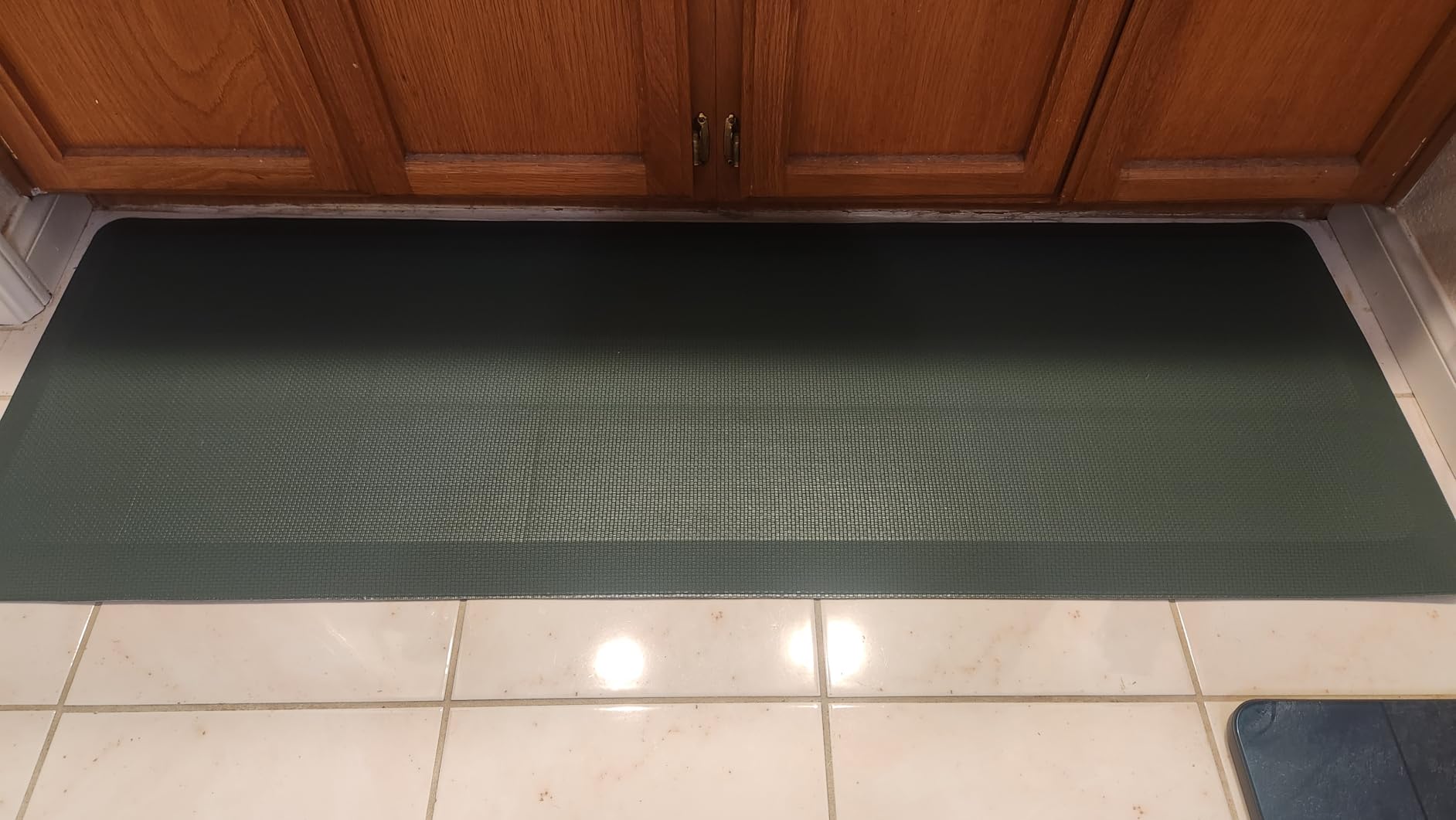
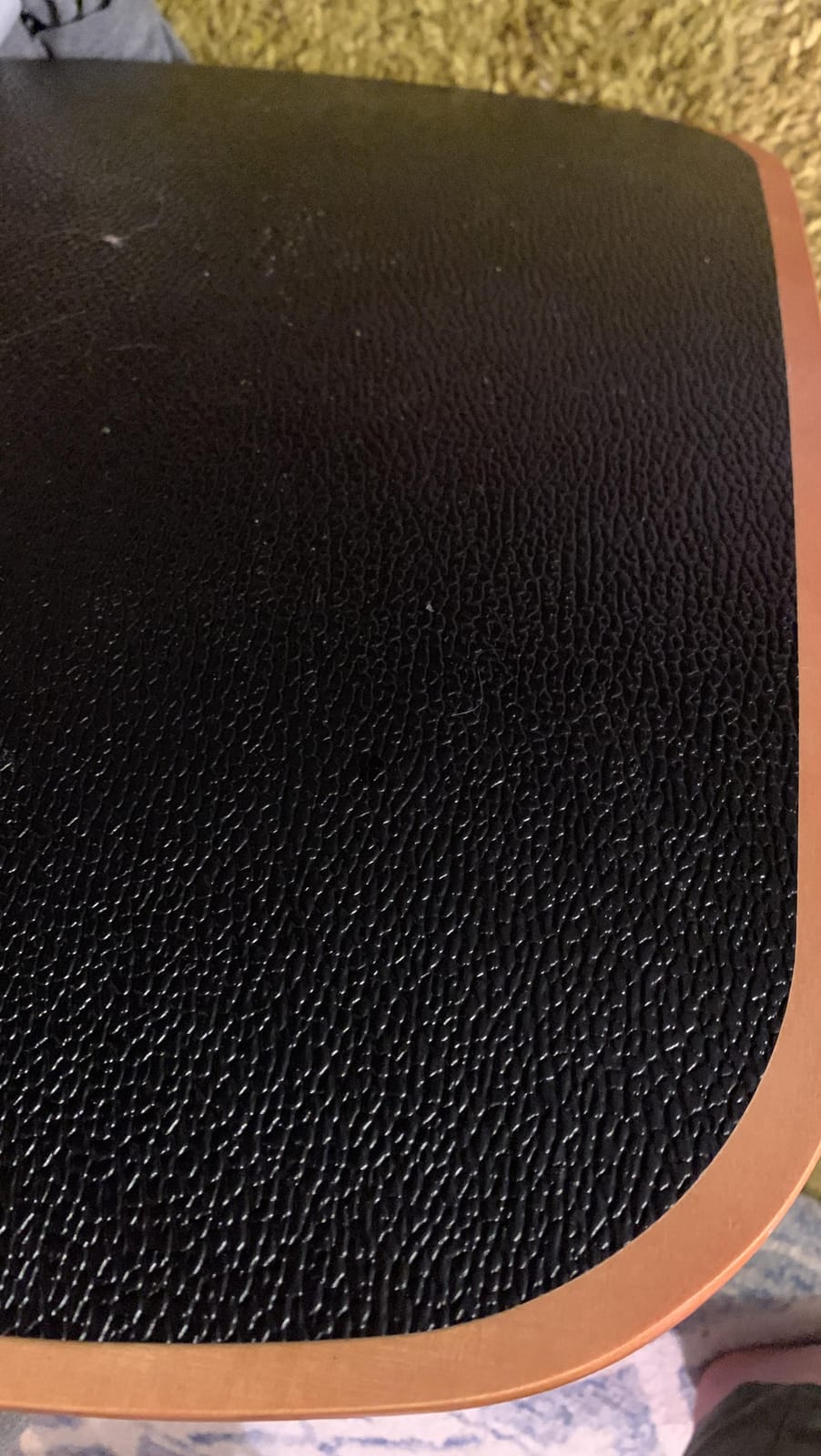
The surface is PU leather, which is a genuinely good choice for a desk mat. It resists punctures, tears and stains, and it wipes clean. It is also minimally textured, and buyers tend to prefer that to heavily patterned surfaces that trap crumbs. It measures 32 by 20 by 0.9 inches, weighs 4.2 pounds, and arrives flat rather than rolled, so you can stand on it immediately instead of spending a day flattening out a curl.
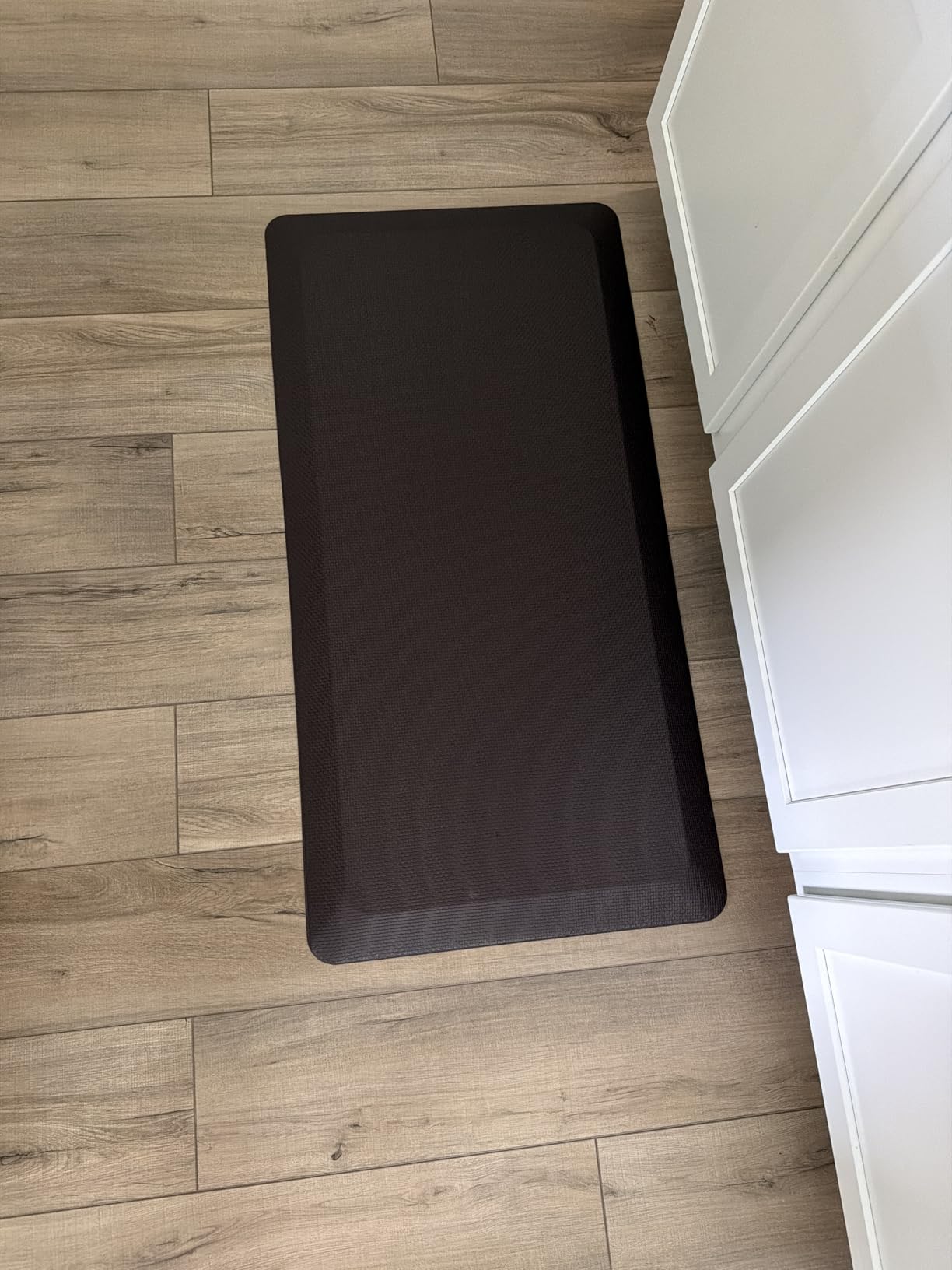
The seamless one-piece beveled edges are the standout feature. Rather than a cut-and-sewed edge that can separate, this mat has a continuous low-angle taper to the floor, which both reduces trip risk and stops the edge from peeling away over years. That single design choice is the main reason it outperforms cheaper foam in this group over time. The non-slip underside keeps it firmly in place underfoot.
Long-term owners report that the cushion and appearance still look near-new after close to a year, which is a good sign for a foam mat. The two complaints that do come up are physical rather than ergonomic: the raised beveled edge can still catch the foot of someone unaware of it, particularly an older person or anyone with balance issues, and the bottom can tear after years of being dragged in and out from under the desk to switch between sitting and standing.
Who the FEATOL suits best
It suits people who stand three to four hours a day on a hard floor, want a deep cushion, and do not want a contoured surface pushing their feet into a position. It is a good first upgrade from a thin kitchen mat, and the smooth PU top is easy to keep clean in a home office where you eat lunch at your desk.
It also suits anyone who is fussy about appearance. A flat, untextured, solid black mat reads as neutral floor covering rather than gym equipment, and 32 by 20 inches fits under most desks without dominating the space.
Who should skip the FEATOL
Skip it if you plan to move the mat every time you sit down. Dragging a 4.2-pound mat in and out from under a desk is what eventually tears the bottom, so this is a mat for a dedicated standing position rather than an alternating one. If your desk is near its maximum standing height, measure first, because 9/10 inch is not a trivial amount of added floor height.
Skip it if you want your legs actively working. This is a comfort mat, not a movement tool, and it will not address circulation problems the way a terrain surface or balance board can.
4. FEZIBO Standing Desk Mat with Anti Fatigue Bar: Best Active Option
FEZIBO Standing Desk Mat Balance Board with Anti Fatigue Bar, Black
Wood balance board
20 x 12 x 2.2 inches
8.5 degree tilt
Supports up to 320 pounds
Pros
- Rocks through 360 degrees to keep legs and core active
- 8.5 degree tilt is stable enough to type on
- Rated for up to 320 pounds
- Compact and light so it is easy to move
- Doubles as a platform for planks and squats
Cons
- Firm wood rather than soft foam padding
- Small 20 by 12 inch footprint limits standing positions
- Not suitable if you need a stable motionless surface
This is the mat for the people who have read every foam comparison and concluded that the problem is not comfort, it is stillness. The FEZIBO is a wooden balance board that rocks through 360 degrees on an 8.5-degree tilt, and the rocking keeps your hips, calves and core firing continuously. Users value that the tilt angle is shallow enough that typing is not affected, which is the objection that kills most wobble boards at a desk.
It comes rated to support up to 320 pounds of body weight, so it covers a wide body weight range. At 20 by 12 by 2.2 inches and available in medium and large sizes, it is compact and light enough to move when you sit down, and it doubles as a platform for push-ups, squats and planks if you want to turn standing time into training time.
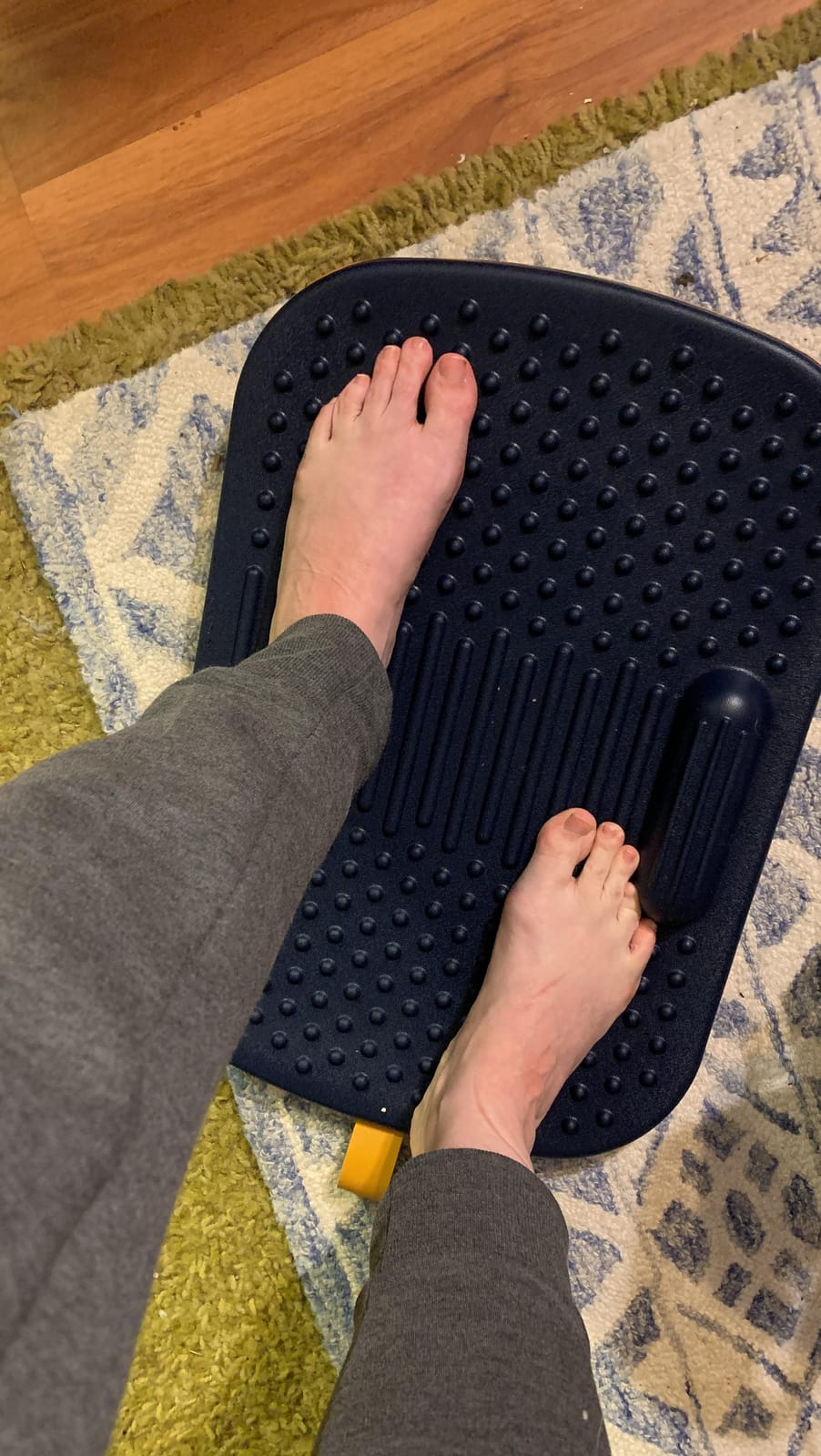
Understand what you are buying. This is a movement tool that happens to relieve foot discomfort, not a cushioning mat. Wood is firm rather than springy, so if your main problem is pressure on the heels after a long shift, this will not solve it the way a 9/10-inch foam mat will. Its mechanism is circulation through movement rather than pressure distribution through cushioning, and the ratings sit a notch below the foam mats here for that reason.
The small footprint is the other limitation. At 20 by 12 inches you can rock your feet, shift your weight and rotate your stance, but you cannot take long lateral steps, so it is a poor substitute for a wide desk mat if you like to pace while you think. It is also the wrong choice for anyone who needs a genuinely motionless surface, for example while doing precise work with their hands.
Who the FEZIBO suits best
It suits people who get restless while standing, who fidget and shift constantly at a desk, and who want their legs working rather than numb. It is a good fit for video-call-heavy days where you want to look alert, and for anyone who finds static standing uncomfortable in a way that foam has not fixed.
Because it is compact and light, it is also among the most portable options here, which makes it practical for small apartments and for anyone who moves between rooms. The 320-pound rating is a genuine advantage if you are a larger user and have been priced out of the foam options by weight.
Who should skip the FEZIBO
Skip it if your problem is foot pain rather than restlessness. There is no soft padding here. Skip it if you do a lot of fine motor work, drawing, typing at speed or anything where a wobbling surface would be a hindrance, and skip it if your desk is already set near its maximum height, since 2.2 inches is a lot of added floor height.
Also skip it if your floor is carpet. A hard, smooth, thin board rocks best on a hard level floor. On soft or uneven flooring the motion becomes inconsistent rather than calming, which defeats the entire purpose.
5. Ophanie Anti Fatigue Cushioned Mat: Best for Hardwood Floors
Ophanie Kitchen Mats for Floor,3/4 inch Thick,20×32 Anti Fatigue Cushioned Mat,Kitchen Rugs,Waterproof,Comfort Ergonomic Standing Mat for Office,Home,Sink with 99+ Pairs of Anti-Slip Bottom Ridges
0.8 inch PU foam core
1.2mm PVC leather top
20 x 32 inches
99+ anti-slip ridges
Pros
- Deep 0.8 inch cushion over a high-density recycled PU core
- Fine textured surface grips the floor without sliding
- Slanted beveled edges avoid tripping
- Arrives flat with no rolling or curling
- CP65 and GRS certified materials
Cons
- Fine texture can hold onto marks that do not scrub out
- One edge arrived slightly curled and took about ten hours to flatten
- Hardwood shows through rather than looking like carpet
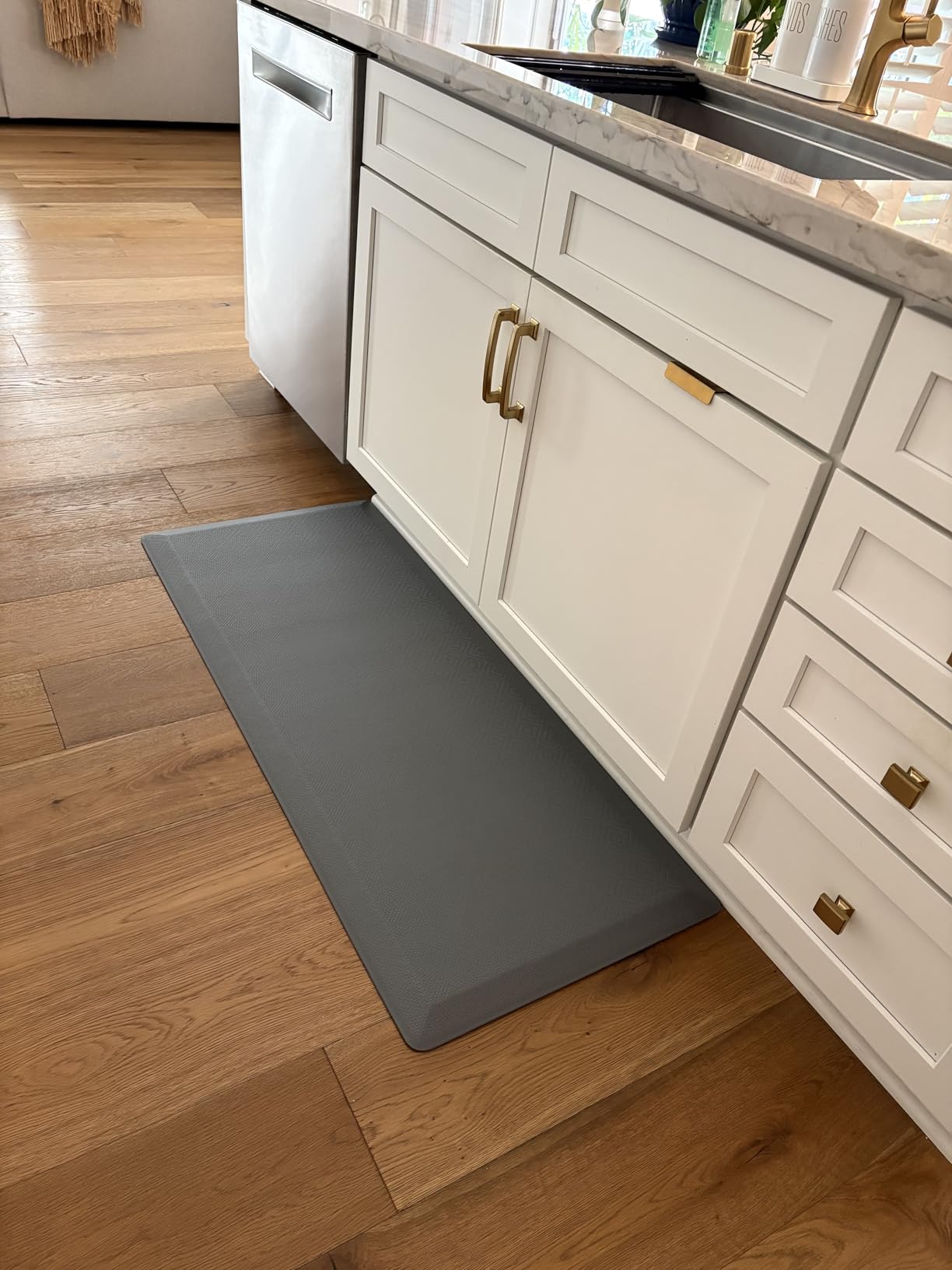
Sliding is the number one durability complaint about anti-fatigue mats across this whole category, and it is almost always a hardwood and laminate problem. The Ophanie is the most aggressively engineered against it here. The base carries 99+ pairs of anti-slip ridges, and the fine-textured PVC leather top grips the floor rather than gliding across it. If your standing desk sits on hardwood, this is the one we would put under it.
Underneath the 1.2mm surface is a high-density recycled PU foam core, 0.8 inch thick, and owners consistently describe it as the most cushioned mat they have used at this level of build quality. It arrives flat rather than rolled, which means no day spent uncurling it. The slanted beveled edges avoid tripping, and the materials are CP65 and GRS certified, which is worth knowing in a home office where air quality matters.
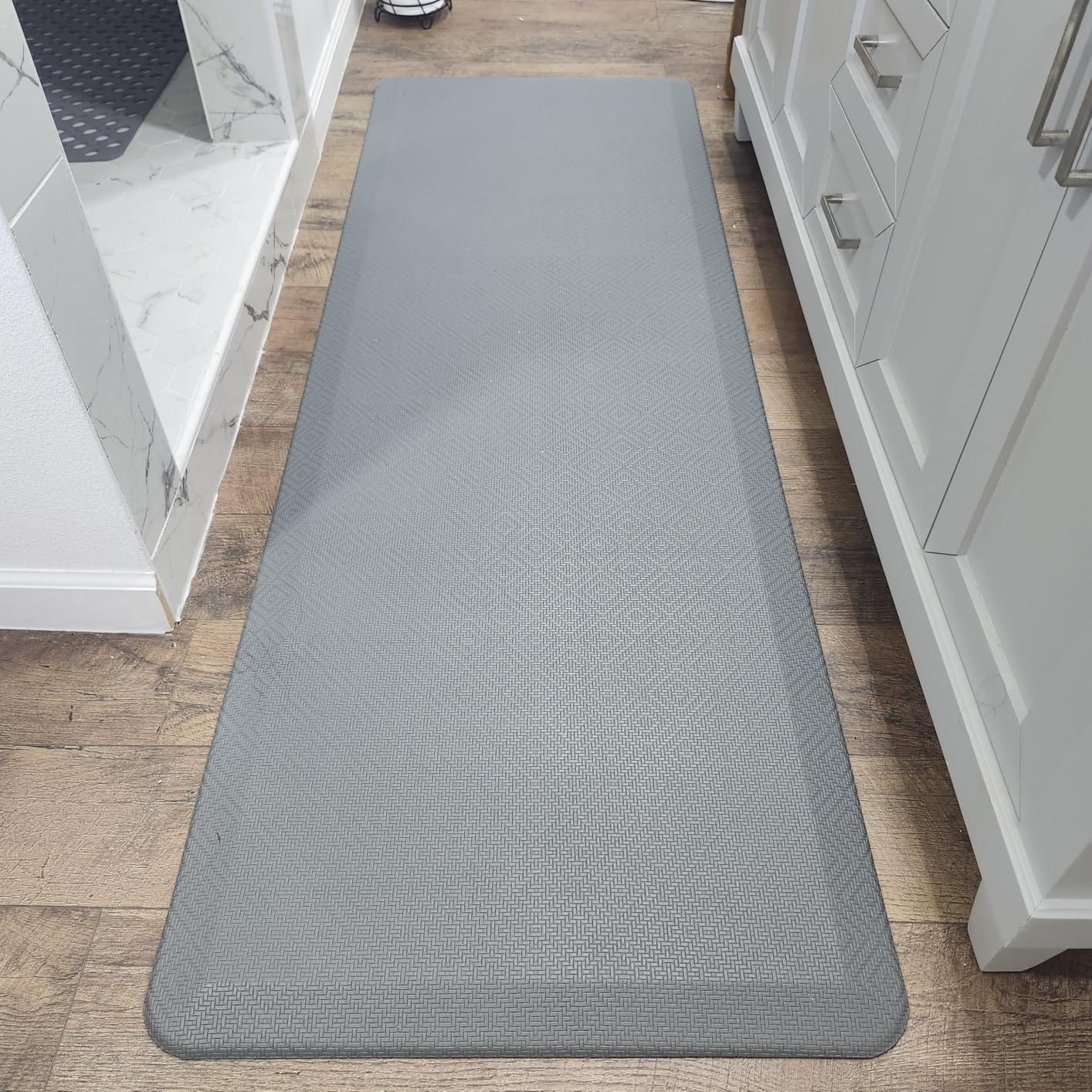
Repeat buyers often move up from a thinner 0.5-inch version of the same mat and report a clear difference in comfort, which is a useful data point if you are deciding between thicknesses. It wipes clean easily, and unlike a fabric-cushioned mat it lets the hardwood floor show through, so it does not look like carpet has been laid in your office. Sizes run from 20 by 32 up to 24 by 70.
The main downside is the fine texture itself. It grips the floor superbly, but it also holds onto marks, and a scuff or white spot that appears on it may not scrub off. One edge also arrived slightly curled and took about ten hours to flatten, so give it most of a day before standing on it. The 20-inch width is on the narrow side for lateral movement, so check the wider sizes if you like to shift your stance.
Who the Ophanie suits best
It suits people on hardwood, laminate or tile who have already had a mat creep away from under them and been unconvinced by a mat that slides. The ridged base is the direct answer to that frustration, and the certified materials make it the pick if you are sensitive to off-gassing in a closed room.
It also suits anyone moving up from a thin mat. If you have been on a 0.5-inch cushion and found it marginal, going to 0.8 inch of higher-density PU foam is a meaningful step without the bulk or rigidity of a terrain mat.
Who should skip the Ophanie
Skip it if appearance matters more than grip. A visibly textured surface that shows scuffs will not blend into a well-kept living space, and there is no contoured or sculpted option here. Skip it if you stand for long stretches and want your legs working, because this is a passive cushion with no terrain features.
Skip it if you are on thick carpet. The ridged base is designed to bite into a hard surface, and on soft flooring it is less effective while the beveled edge becomes less stable over an uneven base.
6. Ergohead Anti Fatigue Mat with Handle: Best for Small Desks and Shared Desks
Ergohead Anti Fatigue Kitchen Floor Mat Comfort Standing Mat, Portable Office Standing Desk Mat, Multi-Purpose Kitchen Rug, Built-in Handle with Massage Points Comfort Floor Mat (Black, 17″ x 22″)
0.75 inch PU memory foam
17 x 22 inches
Built-in carry handle
1.9 pounds
Pros
- Light enough to move one-handed when sitting down
- Integrated handle for hooks and carrying between rooms
- Firm PU cushioning without sinking too far
- Massage points encourage circulation
- Compact footprint suits shared and small desks
Cons
- Thinner feel than full-length mats
- 17 x 22 size limits repositioning
- Handle seam is the first point to split in harsh wet conditions
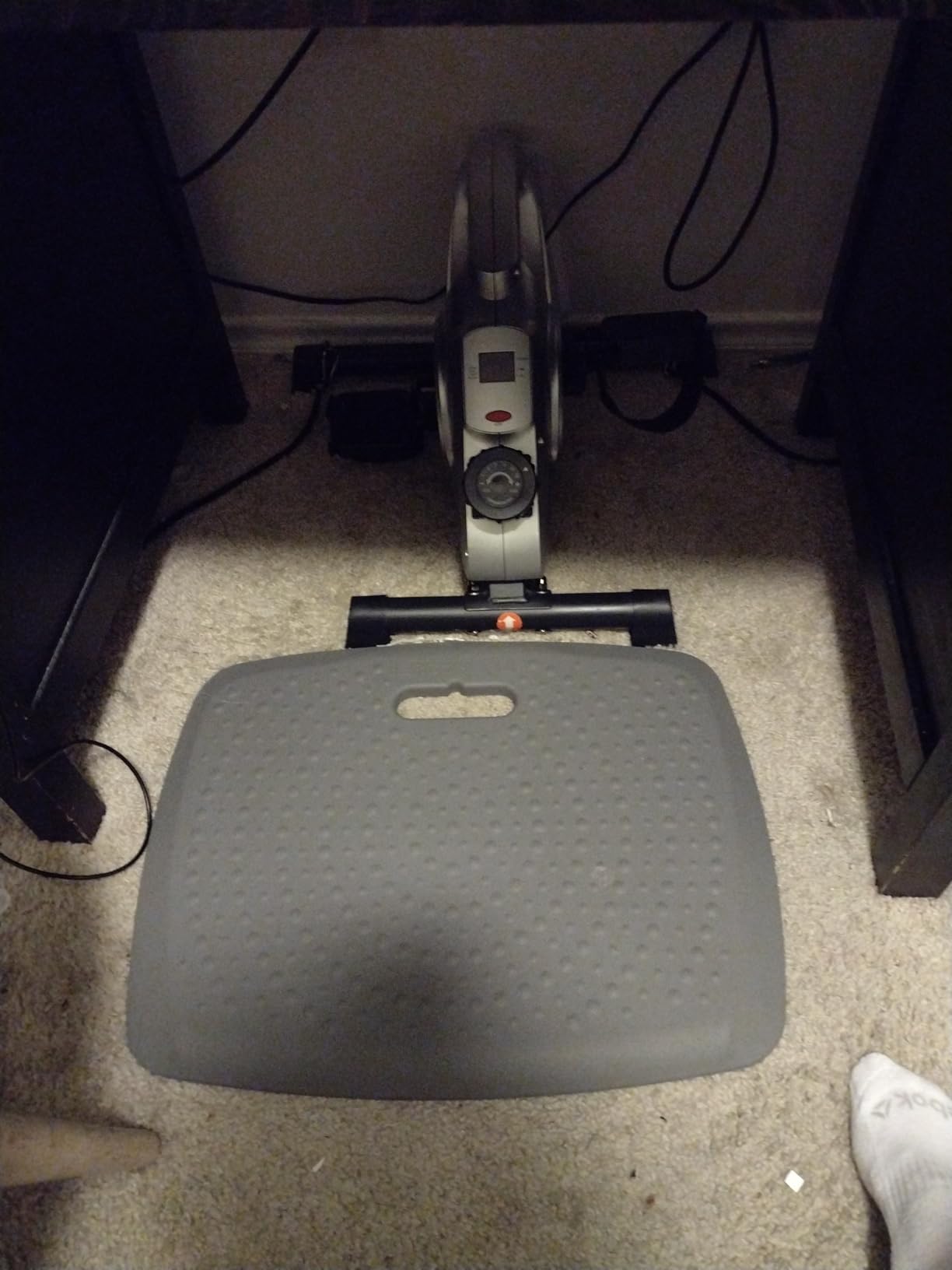
This solves a problem no other mat here addresses properly: shared sit-stand desks. At 1.9 pounds with a built-in carry handle, you can lift it off the floor and hang it on a hook in about two seconds when a colleague sits down, and put it back when you stand up again. People working in shared offices describe exactly that routine, and it is the reason this mat keeps coming up in reviews.
The cushioning is polyurethane memory foam at 0.75 inch, and the important word there is firm. It takes the sting out of concrete and tile without letting your shoes sink in, which is a common failure of thicker memory foam. Raised massage points across the surface promote circulation and small muscle movement, so it is doing something active, just not much.
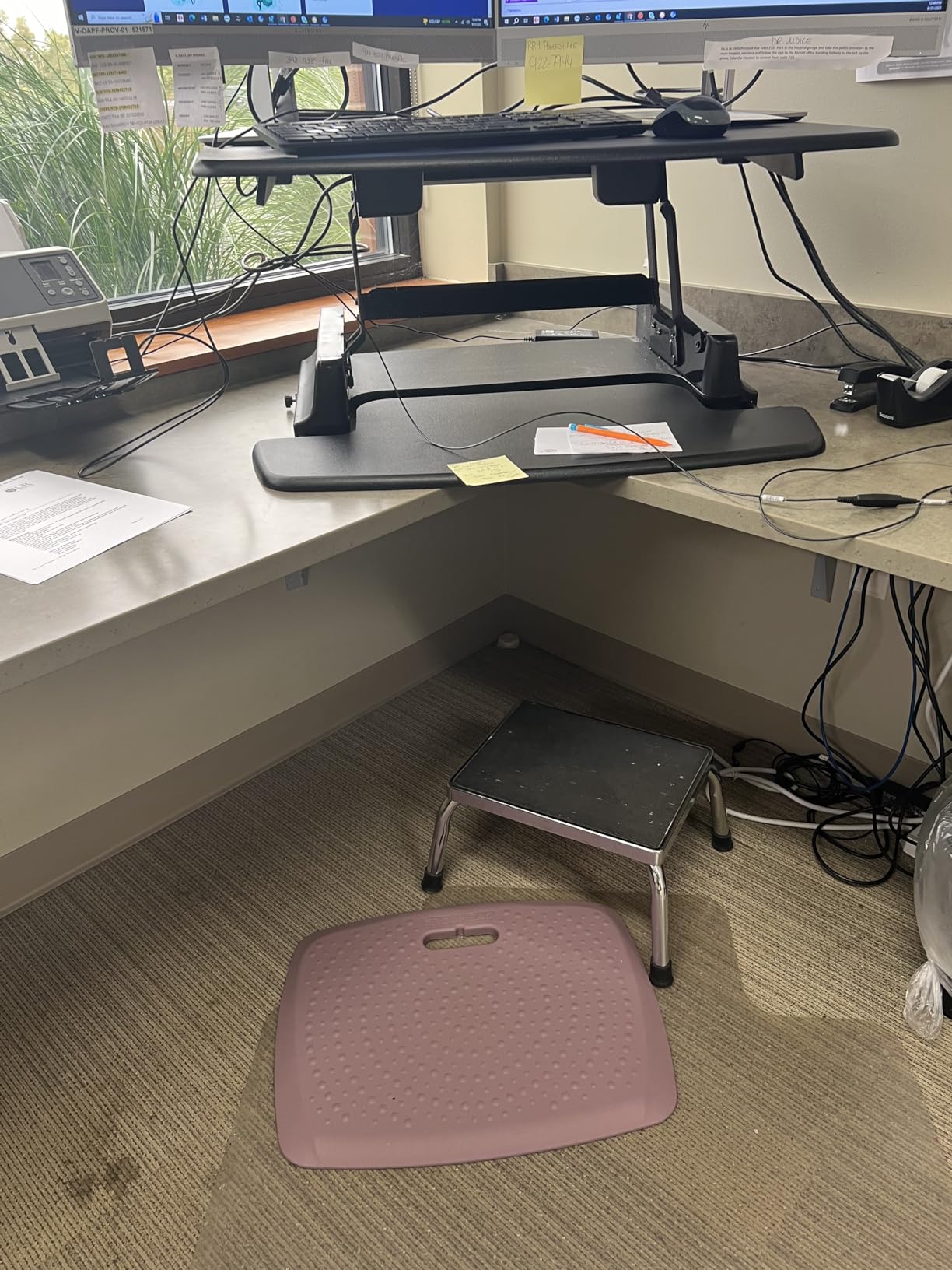
The non-slip bottom holds position, it wipes clean with a damp cloth, and it comes with a 1-year manufacturer warranty, which is worth knowing if you are the type who plans ahead. The 17 by 22 inch footprint is genuinely compact, and that cuts both ways as the trade-off for being so portable.
A few users note the padding is on the light side for ten-hour days and that the floor can be felt through it during very long stands. The handle seam is also the weak point: it is the first place to split when the mat is used outdoors in mud and water, so treat it as an indoor mat. It can also pick up dirt and stains from outdoor concrete.
Who the Ergohead suits best
It suits shared and co-working desks, small apartment offices, and anyone who alternates between sitting and standing frequently enough that a heavy mat would be an obstacle. The handle is a small design decision that changes the whole experience of a shared desk, and no other mat here has it.
It also suits anyone whose floor is hard and unforgiving, like bare concrete or tile, where the priority is taking the edge off rather than deep cushioning. If you want massage-style stimulation as part of your standing time, the raised points give you some.
Who should skip the Ergohead
Skip it if you stand for long stretches, because 0.75 inch of firm PU over a 17 by 22 footprint is not going to carry a six-hour day. Skip it if you pace while you work, since the mat is too small to take lateral steps. And skip it if you use a shared desk where the mat would live permanently, because the portability is wasted if it never moves.
It is also the wrong pick for anyone with balance issues, since the handle loop and the lower cushion mean a real trip edge at floor level.
7. Amazon Basics Anti-Fatigue Standing Mat: Best Understated Everyday Mat
Amazon Basics 3/4″ Rectangular Durable Anti-Fatigue Supportive Comfort Standing Mat, 32″ x 20″, Black
0.75 inch high-grade foam
32 x 20 inches
2.6 pounds
Solid black, wipe clean
Pros
- 3/4 inch high-grade foam that holds its shape
- Light 2.6 pound weight is easy to move when sitting down
- 32 by 20 inch size suits desks and counters
- Solid black styling blends into most rooms
- Wipes clean with a damp cloth
Cons
- Far less review volume than the other mats here
- Standard foam rather than sculpted or memory foam cores
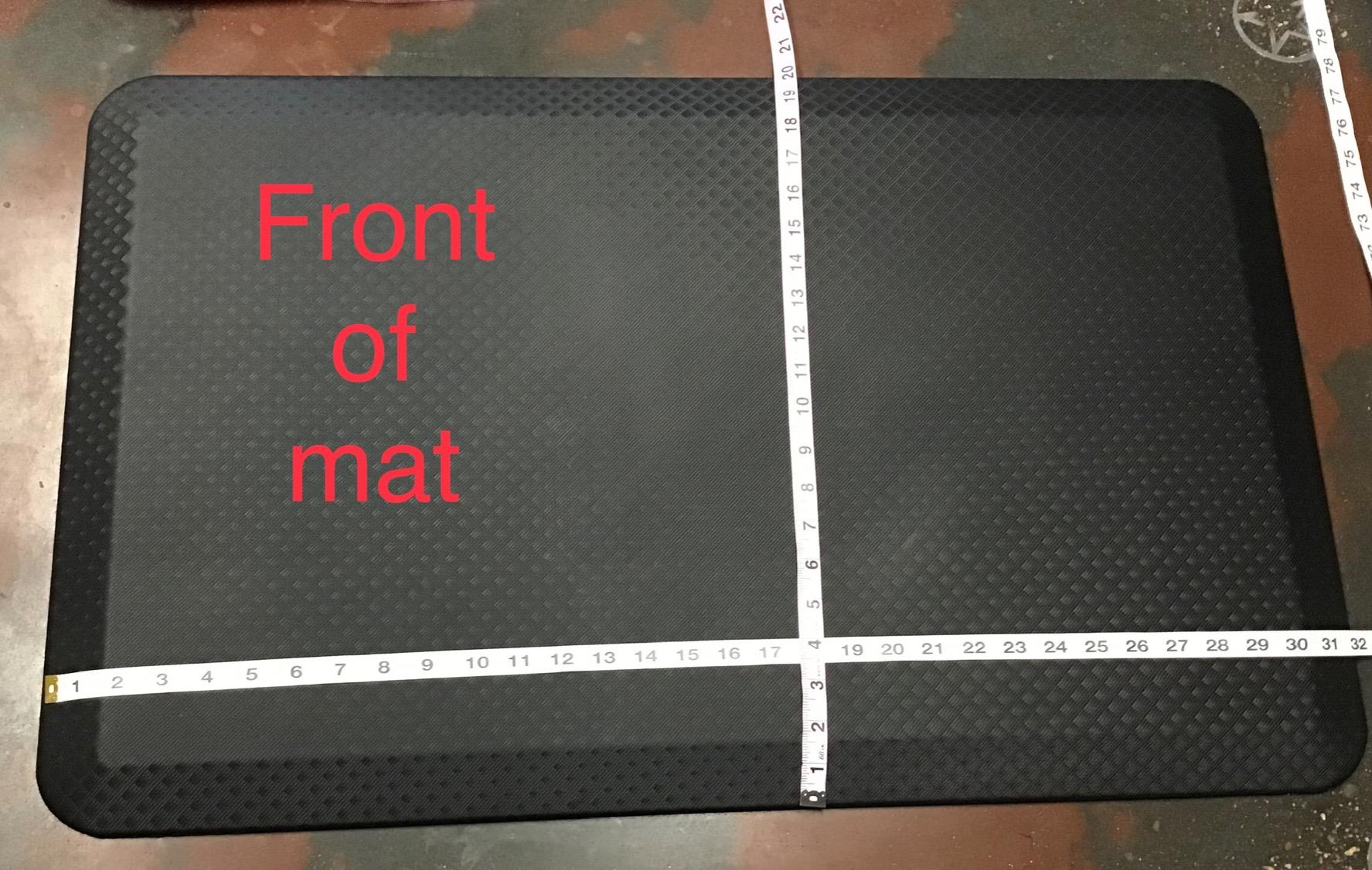
The Amazon Basics mat is the sleeper of this group and the one to buy if you want nothing to think about. It is a 32 by 20 inch rectangle of 3/4-inch high-grade foam with a solid black surface, and at 2.6 pounds it is one of the lighter options we looked at, so moving it when you sit down takes no thought at all.
Buyers comment on durable foam that holds its shape over time, on the light weight, and on styling that does not draw attention in a room where other things matter. It wipes clean with a damp cloth, and the same mat works at a service counter, a workshop or a standing desk, which is genuinely useful if your standing time is split between home and somewhere else.
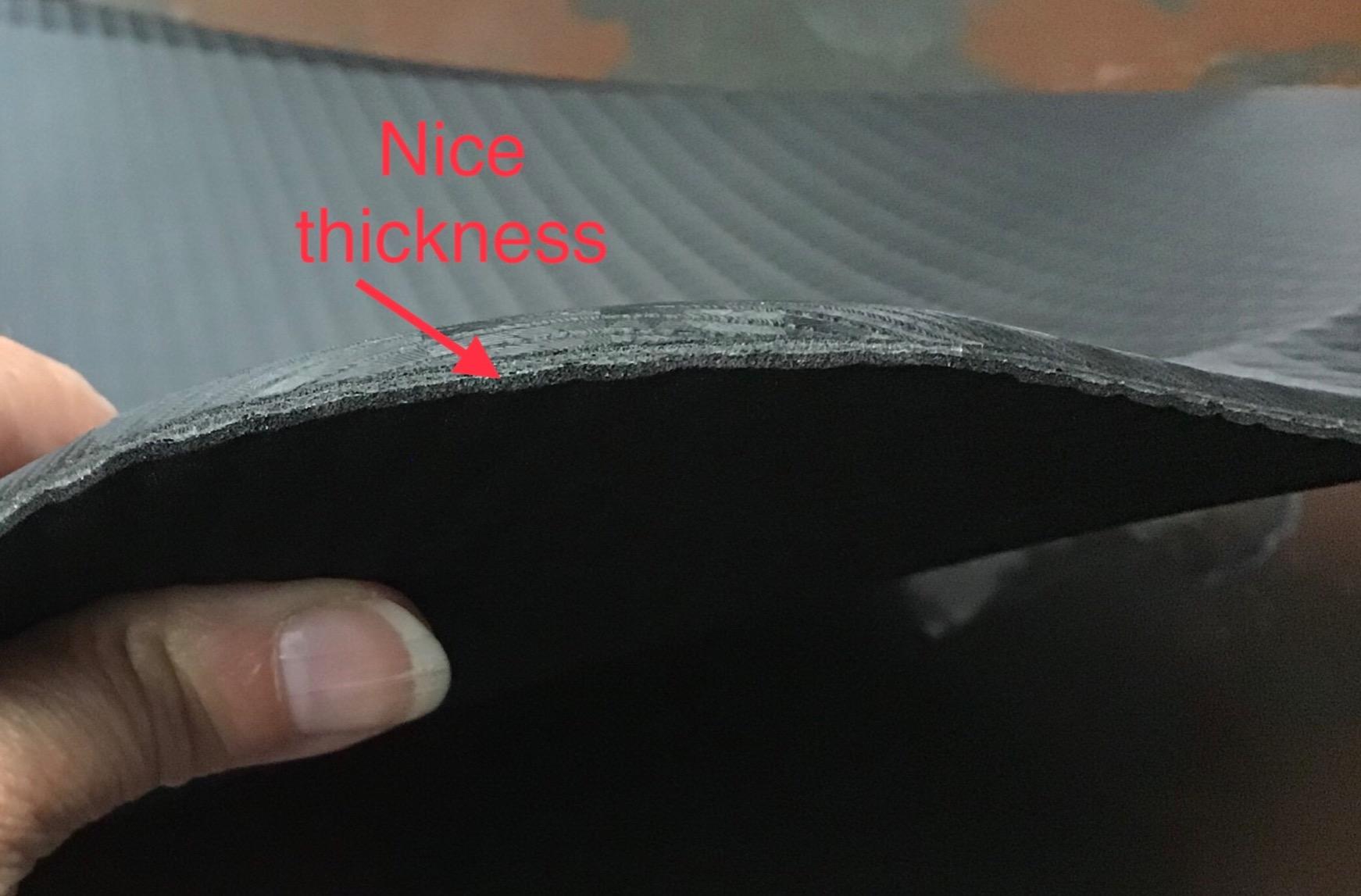
What you are giving up is refinement. This is standard foam cushioning rather than the sculpted or memory foam cores used by the premium picks, so it will not create any movement in your feet, and it will compress sooner than a polyurethane mat will. There is no sculpted terrain, no massage features, no carry handle and no special base design. It is a well-made rectangle of foam and nothing more.
The bigger caveat is the thinness of the feedback. At 408 reviews, this has far less published long-term durability data than the other mats in this roundup, so the claims about holding its shape are promising but not well documented the way the four-year reports on the ComfiLife are. If longevity is your main concern, you are buying more hope than evidence here.
Who the Amazon Basics mat suits best
It suits someone who stands an hour or two a day, has hard flooring, and does not want to research materials. It is the lowest-effort correct answer in this list, and the 2.6-pound weight means the sit-stand transition stays frictionless. The plain black surface is a sensible choice in a home office because it reads as floor covering rather than equipment.
It is also a good pick if your standing time is split between a home desk and a counter or workshop, since the same mat suits a service counter and a manufacturing floor as readily as a desk.
Who should skip the Amazon Basics mat
Skip it if you plan to stand six hours a day, because standard foam is the first thing to compress permanently under that kind of load. Skip it if you already have foot or lower-back discomfort, because a passive flat mat at this thickness will not change much. And skip it if durability proof matters to you more than convenience, because there is not enough long-term feedback to point to.
8. Art3d 1/2 Inch Anti Fatigue Mat: Budget Pick for Casual Standing
Art3d 1/2 Inch Comfort & Non‑Slip Anti‑Fatigue Mat, 17.3″ x 28″, Black
1/2 inch cushioned foam
17.3 x 28 inches
1.8 pounds
Waterproof, beveled edges
Pros
- Most affordable entry point here while still giving real cushioning
- Soft foam that gives with the feet and bounces back
- Waterproof surface you can wipe or vacuum
- Beveled edges and non-slip backing hold position
- Slim 1.8 pound build is easy to move
Cons
- Half inch is thin and marginal for heavier users
- Some variants take a long time to plump back up
- Weaker grip than thicker mats
- Rubber surface attracts static and holds pet hair
The Art3d is the thinnest mat here and it draws the lowest average rating in the group, and both facts trace back to one number: 1/2 inch. Many buyers are perfectly happy at that thickness. Reviewers above roughly 150 pounds consistently say the support is marginal, so your weight and your session length decide whether this works for you.
What it does well, it does cleanly. The foam gives with your feet and bounces back to shape, the surface is waterproof and can be wiped, swept or vacuumed, and the beveled edges with a non-slip backing hold position on hardwood and tile. At 1.8 pounds it is the lightest option we looked at, so the sit-stand transition is effortless. Sizes run from 17.3 by 28 up to 39 by 20.
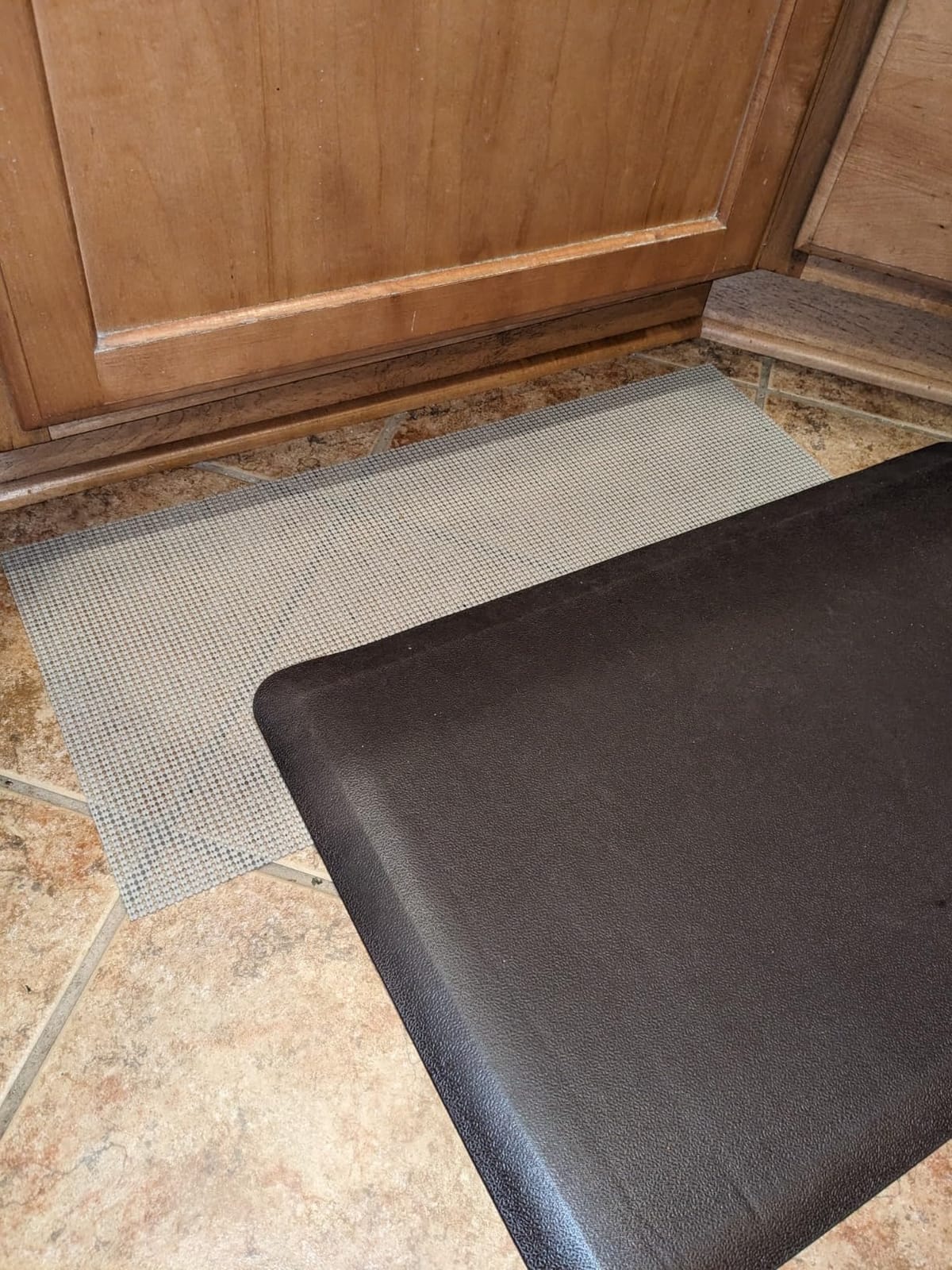
Value sentiment is otherwise strongly positive, and for short standing sessions the maths works in its favour. If you stand twenty or thirty minutes at a stretch twice an afternoon, a 1/2-inch foam mat removes enough pressure from a hard floor to make the session comfortable, and you are not being asked to pay for cushioning you will never use.
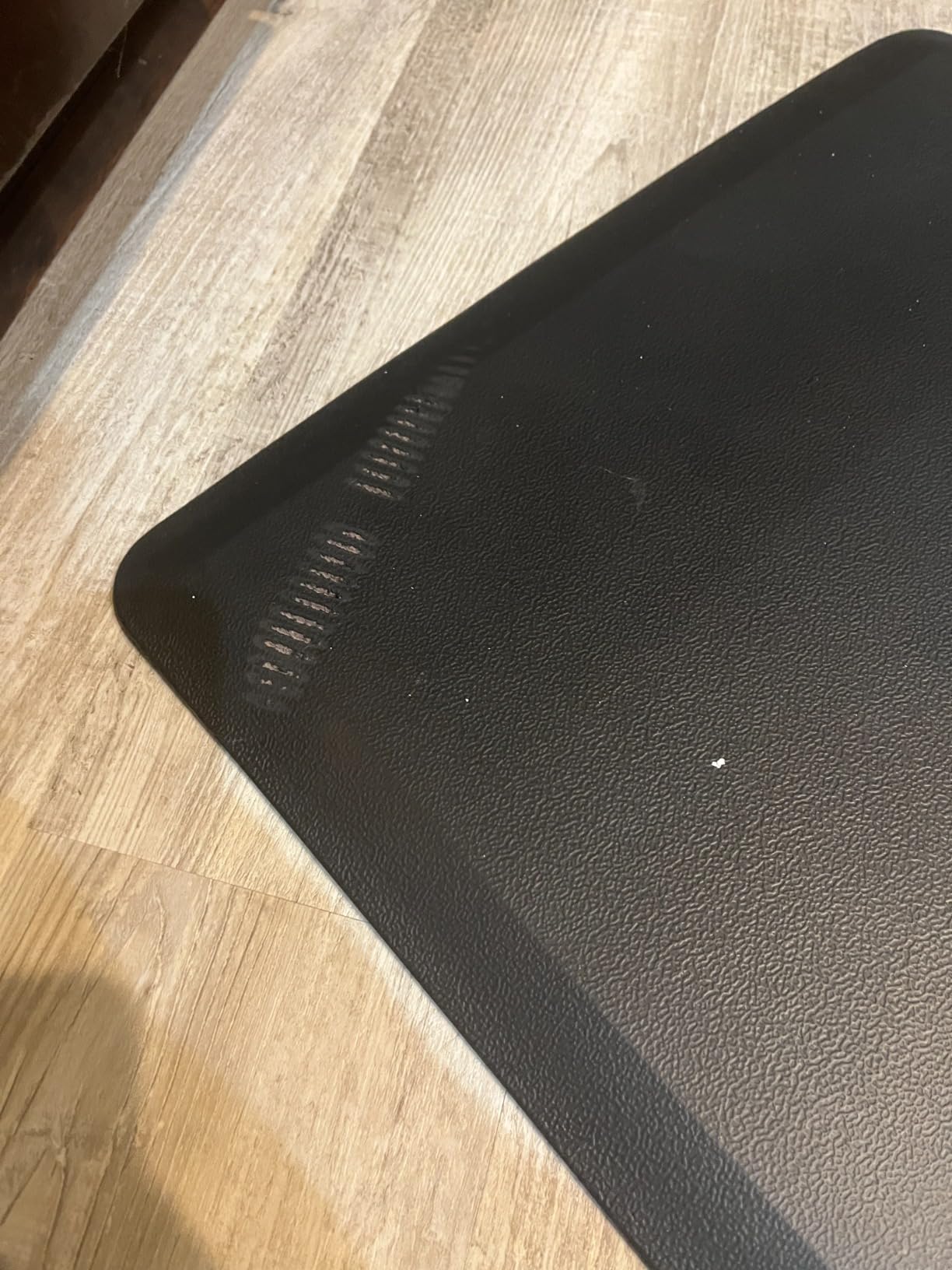
The complaints are consistent and predictable. Some variants take a long time to plump back up after being stood on. The rubber surface attracts static and holds onto pet hair, which is an annoyance in a home with animals. The grip is weaker than the thicker mats here, so it is more likely to creep on a smooth floor. At least one buyer also reported a strong new-plastic odor on arrival.
Who the Art3d suits best
It suits short sessions. If you are building tolerance to a standing desk, dipping in for half an hour a couple of times a day, and your floor is not the harshest surface, this removes the sting from a hard floor at very little cost. It is also a sensible second mat for a laundry room or a garage bench, where the same waterproof surface handles dirt and water.
For anyone who has a small budget and a genuine need, it is a reasonable first purchase rather than a compromise you will regret, as long as your standing sessions stay short.
Who should skip the Art3d
Skip it if you stand for hours. It is the thinnest mat in this roundup and the reviews are explicit that heavier users find it insufficient. Skip it if you have pet hair to contend with, given the static attraction. And skip it if you already own a mat that feels thin, because adding a second thin mat does not solve a thickness problem.
It is also not a mat for anyone who wants a surface that stays put on smooth flooring without help, or who has balance issues, since the thin beveled edge is the least forgiving of the group.
9. UKISS 9/10 Inch Extra Thick Anti Fatigue Mat: Best Deep Flat Cushion
UKISS 9/10″” Extra Thick Cushioned Anti Fatigue Kitchen Mat, Waterproof High Density Foam Standing Desk Mat, Non-Slip Ergonomic Comfort Mat for Kitchen, Office,Workstation (Black, 20″ X 32″)
9/10 inch memory foam
20 x 32 inches
3 pounds
Non-skid bottom, waterproof top
Pros
- 9/10 inch high-density memory foam in a mid-range build
- Non-skid bottom plus beveled edges keep it in place
- Waterproof surface wipes clean with a cloth or vacuum
- Sized for workstations
- counters
- salons and banks
Cons
- Small review base makes durability hard to judge
- Striped pattern is more decorative than the plain finishes elsewhere
- Care instructions call for hand washing rather than wiping
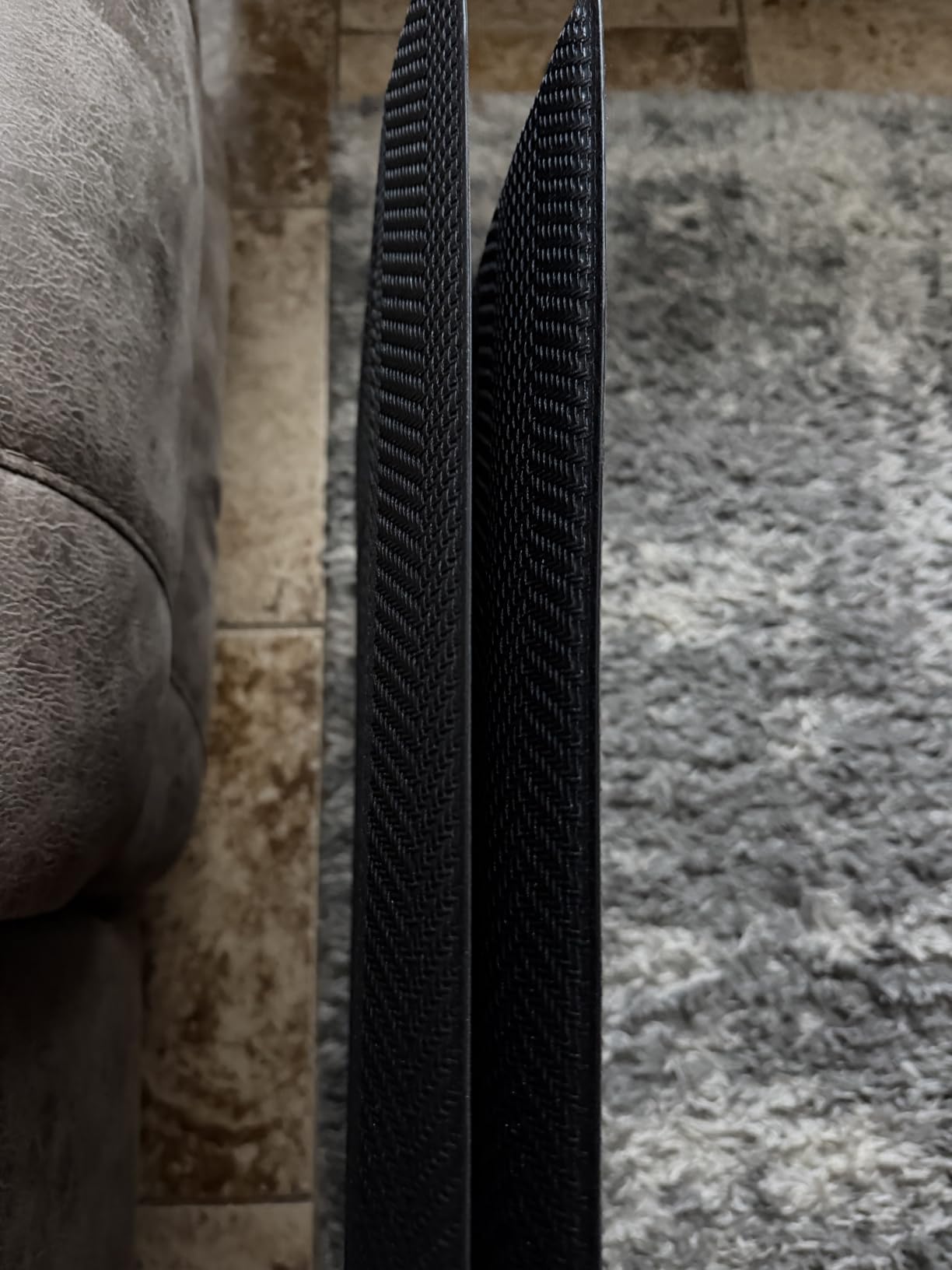
The UKISS is the deep-cushion specialist in this group. At 9/10 inch of high-density memory foam it delivers the same class of cushioning as the FEATOL on a slimmer build, and the feedback we saw was consistently positive on cushioning depth. The foam is designed to relieve pressure on feet, knees and joints, which is the whole job.
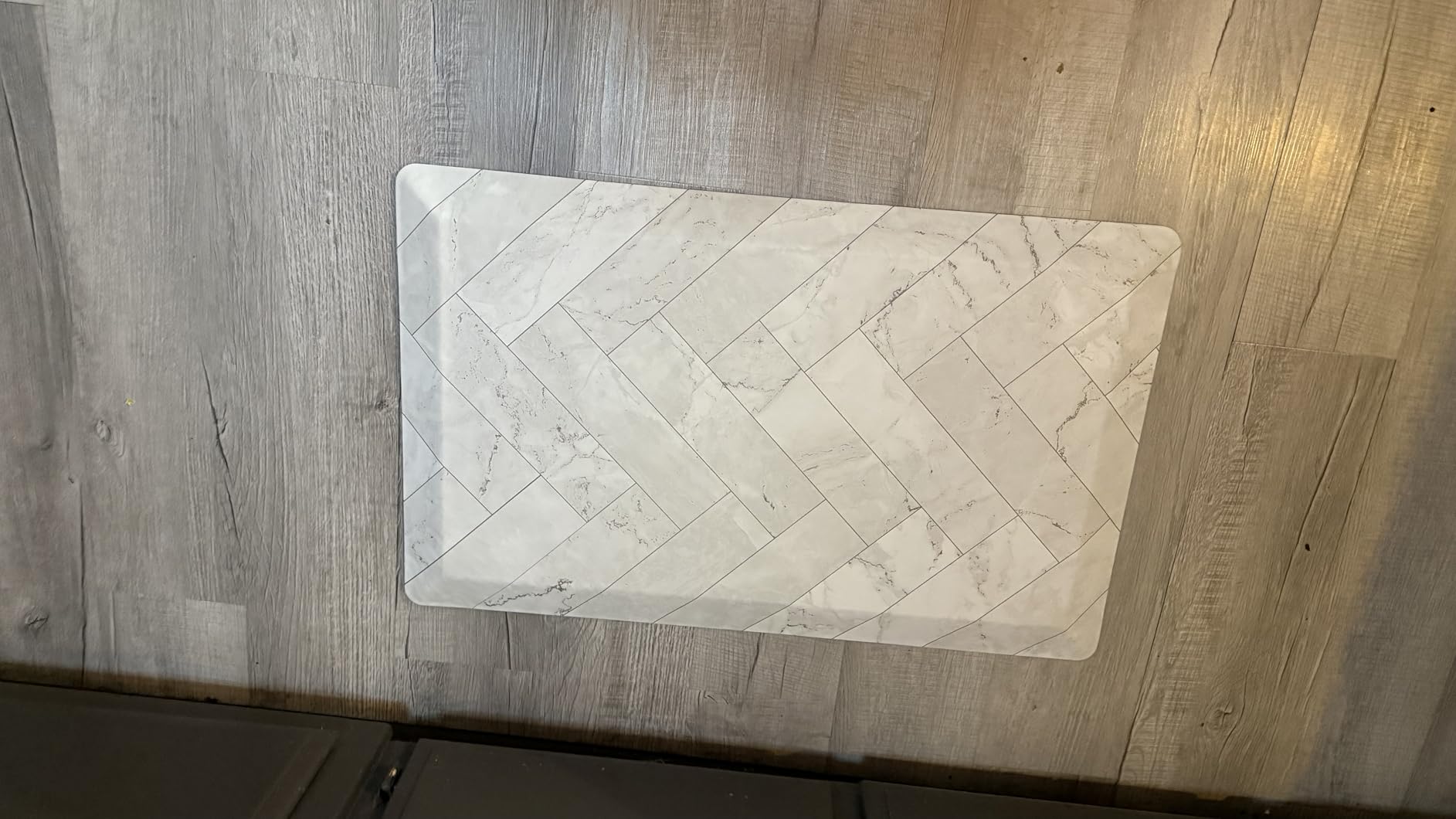
Grip is the practical strength. It has a non-skid bottom and a beveled edge design that keeps it in place and reduces tripping, which is the combination that matters most on a hard floor. The waterproof surface wipes down with a damp cloth or a hand vacuum. Sizes run from 20 by 32 up to 20 by 48, in black, grey, brown and teal.
Two caveats make this a considered choice rather than an automatic one. At 175 reviews it has a much smaller review base than the established brands here, so the available feedback is short-term and there is no meaningful long-term durability record. Buyers are reporting the product as new, which tells you less about year-three performance than the four-year reports on the ComfiLife do.
The care instructions also call for hand washing only, which is less convenient than the wipe-clean approach on most of the competing mats. And the striped surface pattern is more decorative than the plain solid finishes on the other picks, so it does not blend into a very considered home office.
Who the UKISS suits best
It suits people who want deep cushioning on a hard floor for multi-hour standing and do not want to pay for a contoured mat. It works well in front of a workstation or counter where you are on your feet for long stretches, and the colour range means it is less obviously a gym mat than an all-black foam slab.
It is also a good pick if you stand on tile or concrete, where a non-skid bottom and a deep foam core are both doing real work against a hard surface.
Who should skip the UKISS
Skip it if you want proof of long-term durability, because 175 reviews will not give you that. Skip it if you want to wipe the mat down casually, because hand washing is a step you will not do often enough. And skip it if your floor is carpet, where the 9/10-inch depth combined with an uneven base makes standing feel inconsistent.
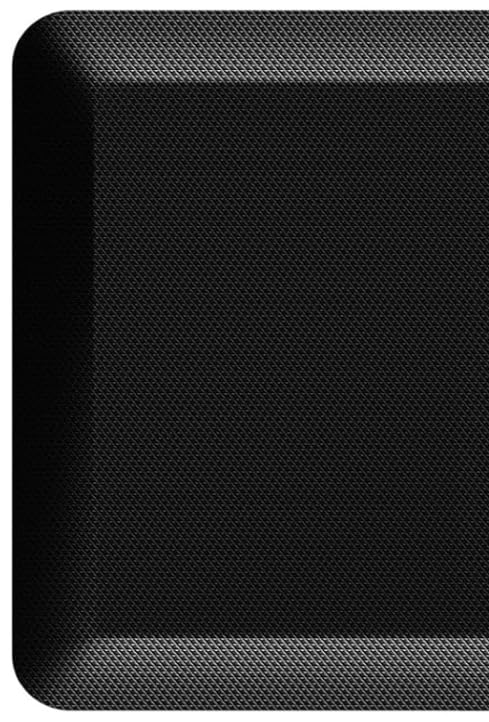
10. TranquilMoments 1 Inch Anti-Fatigue Mat: Best No-Odor Deep Cushion
1-Inch Thick Anti-Fatigue Mat for Kitchen and Standing Desk, 20″x32″, Black
1 inch high-density PVC foam
20 x 32 inches
Beveled waterproof surface
Anti-slip backing, no odor
Pros
- Deepest flat cushion here at a full inch
- Grippy backing that stays put better than thinner mats
- Waterproof and stain-resistant surface wipes down fast
- No odor out of the box
- Available in long lengths up to 20 x 94.5
Cons
- 20 inch width is narrow for lateral movement
- Black colorway shows everything dropped on it
- PVC foam is firmer and less springy than memory foam
- Small review base limits long-term data
The TranquilMoments is the deepest flat cushion in this group at a full inch, and owners describe standing on it as being like standing on cotton. Office buyers who moved to a standing desk say it made all-day standing practical, and gig workers use it for multi-hour standing shifts, which is a good indication of where the value sits.
The strongest repeated positive is grip. Owners consistently say it stays in place better than their previous mat, which is a real advantage given how often sliding is the top complaint about this category. The beveled edge design reduces trip risk, and the waterproof, stain-resistant surface wipes down quickly. Owners also single out the absence of any new-foam smell straight out of the box, which matters if you work in a closed room.
The catch is width and material. At 20 inches across, it is narrow for a desk, and buyers upgrading from a 24-inch-wide mat notice the difference immediately, because you move laterally at a desk and the mat has to let you. The black colorway also shows everything that gets dragged or dropped on it. Construction is high-density PVC foam, which is firmer and less springy than the memory foam competitors rather than more comfortable by default.
Like the UKISS, this has a small review base at 137, so there is limited long-term durability data to go on. It is available in lengths from 20 by 24 up to 20 by 94.5 in black, grey and khaki, which is where the extra lengths genuinely pay off if you stand along a counter rather than at a single desk position.
Who the TranquilMoments suits best
It suits people who want maximum cushion depth and care more about softness than about width, particularly if you stand along a long counter or a service station where the mat runs parallel to your work rather than under a desk. The no-odor claim is a genuine advantage for a home office, and the grippy backing makes it a good choice on smooth floors.
It is also the pick if you are sensitive to the rubbery smell that new foam can carry. That smell is a real complaint in reviews of the heavier polyurethane mats, and this one does not have it.
Who should skip the TranquilMoments
Skip it at a desk if you shift your stance laterally, because 20 inches is not enough width for that and the firmer PVC foam does not disguise the limitation. Skip it if you prefer a springy, memory-foam feel, because PVC is denser and less responsive underfoot than the memory foam options here.
Skip it if you are near 1 inch of added floor height already at your desk’s maximum, since this is the thickest flat option in the roundup. And skip it if you want long-term proof before committing, because 137 reviews is not a durability record.
Flat, Contoured or Balance Board: Which Standing Desk Mat Type Do You Need?
The session-duration rule is the fastest way to decide. Under about 45 minutes at a stretch, a flat high-density foam mat is genuinely enough, and any of the flat picks here will do. Above 45 minutes, a contoured topographic surface starts to earn its price because it keeps your feet moving rather than merely padded. If you want your legs working rather than just comfortable, you want a balance board, and no amount of foam will deliver that.
Flat foam is the right answer for a new stander, for anyone whose desk is close to its maximum height, and for anyone who paces or moves around while working. It is quiet, low-profile, easy to clean and cheap to replace. Its ceiling is that it does nothing for circulation beyond taking pressure off pressure points.
Contoured terrain is the right answer for long sessions, for anyone with existing foot, plantar fasciitis, hip or lower-back trouble, and for people who have already run through a flat mat and moved on. The mechanism is movement, and the cost is bulk: more height, more weight, and a surface that resists sliding under a desk.
A balance board is the right answer for restlessness rather than pain. It keeps the hips and calves working, it takes up almost no floor space, and it moves easily. It is the wrong answer for anyone doing fine work that needs a still surface, and it works best on hard level flooring rather than carpet.
One more comparison worth making, because it comes up constantly: a mat is for standing and a chair mat is for sitting. You use one or the other. Flat mats slide in and out of a desk position easily, contour mats stay put but take real effort to move, and running both at once means the chair mat fights the anti-fatigue mat for floor space every time you switch.
How to Size a Standing Desk Mat Without Ruining Your Desk Height
Width matters more than length, and this is where most people go wrong. Buy a kitchen mat and you get 20 inches, which is sized for a person standing in one spot facing a sink. At a desk you shift laterally, and 20 inches leaves your feet in a narrow channel. Aim for 24 inches wide as the minimum and 29 inches if your desk allows it.
Depth of 20 to 24 inches is the practical default. Deeper is better only if you take long lateral steps, which most people do not. Much longer than 32 inches stops being a desk mat and starts being a room rug, which is harder to clean and harder to move around.
Now the part almost nobody checks. Mat thickness adds directly to the height of your standing surface. A 3/4-inch flat mat raises your effective standing height by nearly an inch, and the contoured options in this roundup add 2 to 3 inches. If your desk tops out at a height that was already calibrated for you, a thick mat can push you into a forward lean, which makes the ergonomic equation worse rather than better. Measure your desk’s maximum standing height first, then recalibrate with the mat actually in place.
If you are still shopping for the desk, our standing desk guide for smaller budgets and our electric standing desk picks under 500 both cover the height ranges worth checking. Setting up the desk properly also matters for your neck and screen position, which is why we covered monitor arms for standing desks separately.
On flooring, the answer changes by surface. Hardwood and laminate need a proper non-slip base, and contoured mats with a silicone-style ring grip sit best on hard floors; if a flat mat creeps, add grip tape or non-skid strips to the bottom. Thick carpet is the awkward case, because a contoured surface on an uneven base feels inconsistent. Low-pile carpet is generally fine for any mat here.
What to Look for in a Standing Desk Mat: Material, Size and Edges
Material first, because it decides how long the mat lasts. If the product page does not say polyurethane or memory foam explicitly, assume it is basic foam. Basic foam can feel excellent on day one and compress permanently under a full standing day, so the mat quietly stops working while still looking fine. Polyurethane rebounds immediately and holds its shape for years. Memory foam sits in between, cushioning well but needing the thumb-rebound test after a year of use.
Size second, as covered above: 24 inches wide minimum, 20 to 24 inches deep, and a thickness near 3/4 inch is the practical sweet spot. Thinner than half an inch gives too little relief, and above roughly an inch the surface starts to feel soft and unstable rather than supportive. Material matters more than thickness, which is why 3/4 inch of polyurethane beats an inch of basic foam.
Edges third. Tapered or beveled edges that run down to the floor are what separate a safe mat from a trip hazard, and they are also what separates a long-lived mat from one whose perimeter starts peeling after a few years. One-piece molded edges beat cut-and-sewn ones for the same reason.
Fourth, the base. A mat that slides is worse than no mat at all, because a moving surface is a moving trip hazard, and dust from degrading foam can form a slick layer between mat and floor that is invisible from above. Look for a ridged or ring-style non-slip base, especially on hardwood.
Fifth, cleanability and warranty. Wipe-clean surfaces are dramatically easier to live with than anything that needs scrubbing, which matters in a room where you also eat lunch. Warranty length is a decent quality proxy in this category, since a manufacturer willing to commit seven years has usually built something that lasts seven years.
Who Should Skip a Standing Desk Mat
If you stand for less than about 30 minutes at a stretch, you do not need one. A session that short is better served by moving your feet and shifting your weight deliberately, and a mat is an unnecessary expense. This is not a rare position either: plenty of people get through a workday fine without one, and buying a mat out of anxiety rather than need is how people end up with a mat in a closet.
Skip a mat if your desk is already at its maximum standing height and you type with a forward lean. Adding cushion height there makes the problem worse, and the fix is a different desk rather than a thicker mat.
Skip a mat if you do fine work that requires a stable surface, and consider a footrest instead. A mat cannot make a bad workstation good, and if your real problem is the keyboard height or the monitor position, a mat will not touch it.
And if you already own a mat, test it before replacing it. Press your thumb into the foam and count the recovery time. Instant rebound means the core is healthy and you can keep using it. Three to five seconds means the foam has taken a compression set and is functionally dead, even if it looks clean. In that case replacing it is not about comfort, it is about the fact that the cushioning has already gone.
Frequently Asked Questions
Do you need an anti-fatigue mat for a standing desk?
Not below about 30 minutes at a stretch. A mat becomes increasingly useful above 45 minutes, and is close to essential for anyone standing six or more hours a day or already dealing with foot, hip or lower-back discomfort. A mat is also the cheapest fix available, costing a fraction of replacing the desk itself.
What kind of mat is best for using with a standing desk?
Contoured polyurethane terrain for sessions over 45 minutes, flat high-density foam for shorter sessions and tighter budgets, and a balance board if you want active engagement and have desk height to spare. Always go 24 inches wide or wider, because kitchen mats at 20 inches are too narrow for the lateral movement a desk invites.
Do anti-fatigue mats actually work?
Yes. They cushion the feet and introduce slight instability that forces continuous small muscle adjustments, which maintains circulation and redistributes pressure away from the fixed points that build up when you stand still on a hard floor. That mechanism is also why contoured terrain outperforms flat foam over long sessions.
What are the downsides of using anti-fatigue mats?
Three real ones. Budget foam compresses permanently within six to twelve months and stops providing relief while looking unchanged. Contoured mats add two inches or more of height, which can invalidate an already-calibrated desk height. And mats with poor bases slide on hardwood and develop lifted corners, which is a genuine trip hazard.
How thick should a standing desk mat be?
About three quarters of an inch is ideal. Thinner gives little relief, and above roughly an inch the surface starts to feel soft and unstable. Material matters more than thickness, so three-quarter inch polyurethane outperforms an inch of basic foam.
Can I use a kitchen mat as a standing desk mat?
Short term, yes. Kitchen mats are typically 20 inches wide and use lower-grade foam that compresses within six to twelve months of an eight-hour desk day. You will outgrow the width almost immediately, because desk users shift laterally rather than standing in one spot.
Does a standing desk mat work on hardwood floors?
Yes, provided it has a proper non-slip base. Contoured mats with a ring-style grip sit best on hard floors, while budget flat mats frequently travel on hardwood and need grip tape added if they creep. Contoured mats sit less predictably on thick carpet because of the uneven base underneath.
How long does a standing desk mat last?
It depends almost entirely on material. Basic foam degrades noticeably within six to twelve months of daily eight-hour use, while polyurethane holds its shape for years. Test yours by pressing a thumb in: polyurethane rebounds immediately, spent foam takes three to five seconds.
Should I stand on a balance board at a standing desk?
Only if you want your legs working rather than just cushioned. A balance board keeps the hips, calves and core active, but it is firm rather than padded, takes up a small footprint, and is best on hard level flooring. It suits people who fidget at a desk and stand for long stretches, not those whose problem is pressure pain.
Final Verdict on the Best Anti-Fatigue Mats for Standing Desks
The ComfiLife takes the top spot for good reason. A 3/4-inch high-density memory foam core, edges that taper to the floor, a base that does not slide and a review base large enough to document how it holds up over five years is a combination nothing else in this group matches. It is the pick we would buy without hesitating.
Buy something else when your situation is specific. If you stand past 45 minutes most days or have existing foot, hip or lower-back trouble, the Ergodriven Topo is the upgrade that actually changes the mechanism rather than just the comfort. If you want a thick cushion without a learning curve, the FEATOL gives you a seamless beveled edge that peels less than anything cheaper. If you are on hardwood and have had mats creep, the Oopsie’s ridged base is the answer. If you share a sit-stand desk, the Ergohead’s 1.9-pound body and carry handle are the whole reason to buy it. And if you want your legs working rather than just cushioned, the FEZIBO balance board is the only one of the ten that will do that.
Whichever you pick, check one thing before you order: your desk’s maximum standing height, minus the mat’s thickness. Calibrating with the mat in place is the one step that turns a mat from a comfort upgrade into a better workstation overall. Every pick above is rated and reviewed as of 2026, so check the current details before you buy.