
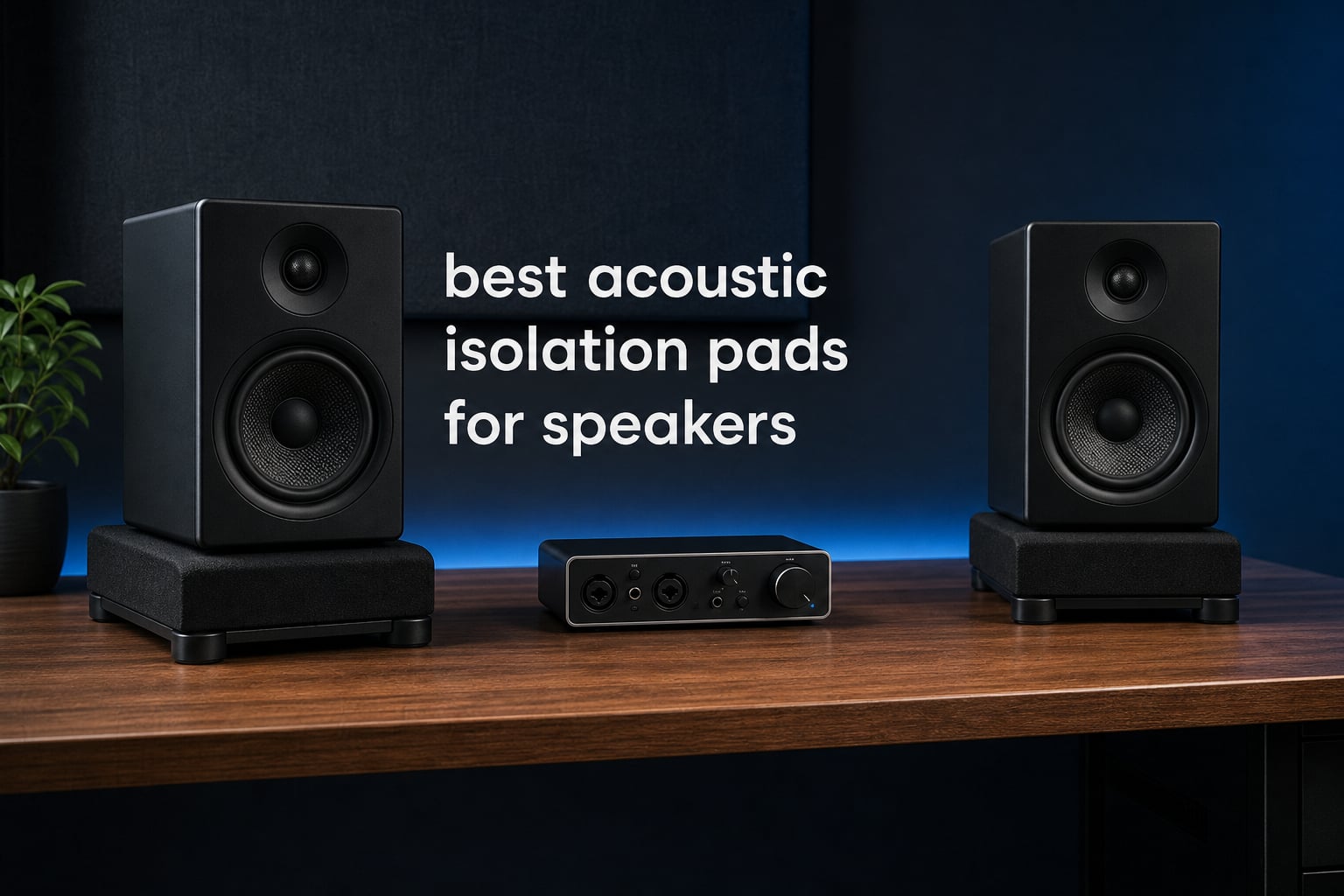
Acoustic isolation pads for speakers work by decoupling a speaker from its desk, stand, or floor. That buffer limits vibration transfer into the supporting surface and can reduce resonance that makes bass and midrange less defined, especially when studio monitors sit close to a desktop or wall.
They are not acoustic treatment, and they will not repair a poorly placed speaker or a room mode. They can stop the furniture or floor from joining in with the speaker, so you can judge the monitor with fewer mechanical distractions.
I compared the eight supplied options by stated material, footprint, load limit, angle choices, compatibility, rating, and review volume. Choose a wedge pad when the monitor also needs aiming, and choose feet when a level, low-profile contact point suits a bookshelf speaker, turntable, or compact subwoofer better.
Table of Contents
The top 3 acoustic isolation pad picks are JBER, Ekkogo, and Saiqiang
JBER takes the editor’s choice spot because its 50kg/m³ foam, five configurations, and stated 22 lb capacity suit many compact desktop monitors. Ekkogo is more targeted to a 5-inch monitor, while Saiqiang is a straightforward wedge-pad option for 3-5 inch speakers.
These are starting points rather than automatic fits. Measure the bottom of each cabinet and leave the whole base supported, because a pad that is too narrow can undo the stability you were trying to improve.

JBER 2 Pack Acoustic Isolation Pads
- 50kg/m3 foam
- Five configurations
- 22 lb stated capacity

Saiqiang Studio Monitor Isolation Pads
- For 3-5 inch speakers
- Adjustable angle
- 8 by 6.3 inch coverage
The best acoustic isolation pads for speakers in 2026 cover wedges, platforms, and feet
A foam wedge changes a monitor’s tilt as well as its contact with the desk. A platform adds a firmer layer below the damping material, while small feet preserve a level speaker position and work where a full pad would fit awkwardly.
The comparison includes four common monitor-pad footprints, a fixed-height platform, and two foot-style designs. Stated load capacity is useful, but it is not a substitute for checking that the entire speaker base sits securely and that the tweeters point toward your ears.
| Product | Specifications | Action |
|---|---|---|
| JBER 2 Pack Isolation Pads |
|
View on Amazon |
 Liquid Stands Monitor Pads Liquid Stands Monitor Pads |
|
View on Amazon |
| Saiqiang Monitor Pads |
|
View on Amazon |
 Ekkogo Vibredux HD Pads Ekkogo Vibredux HD Pads |
|
View on Amazon |
 AXA AXCESSABLES Pads AXA AXCESSABLES Pads |
|
View on Amazon |
 Sound Addicted VibeBoss P5 Sound Addicted VibeBoss P5 |
|
View on Amazon |
 TroyStudio Isolation Feet TroyStudio Isolation Feet |
|
View on Amazon |
 Sound Addicted s-Pods Sound Addicted s-Pods |
|
View on Amazon |
1. JBER 2 Pack is the best compact foam choice for 3-4.5 inch monitors
JBER 2 Pack Acoustic Isolation Pads, Studio Monitor Speaker Isolation Pads
50kg/m3 foam
8 by 6.3 by 1.4 in
22 lb stated capacity
Pros
- 50kg/m3 high-density foam
- Five angle configurations
- Fireproof polyurethane
- 902 reviews
Cons
- Limited to 3-4.5 inch monitors
- Small 6.3 inch depth
JBER is the clearest match when a small monitor needs an equally small base. Each pad measures 8 by 6.3 by 1.4 inches, uses 50kg/m³ polyurethane acoustic foam, and is stated to hold up to 22 lb without changing shape.
Its five-configuration layout is the practical attraction. I would use the level arrangement first, listen for a day, and change only the tilt if the tweeters are missing ear height; changing placement and angle at once makes it hard to know what helped.
The JBER fit is strongest for compact nearfield speakers
The listed fit is 3-4.5 inch monitors, including PreSonus Eris 3.5, M-Audio BX4, Edifier MR4, and Samson SAM30. Its 6.3-inch depth makes it a better match for compact cabinets than a deep 5-inch monitor with a wide rear edge.
The JBER setup check is weight and full base contact
At 4.8 from 902 reviews, this is the most widely reviewed foam wedge in the group. Confirm that the speaker pair stays within the stated capacity and press gently at each cabinet corner after setup; rocking calls for a wider pad rather than more volume.
2. Liquid Stands is the broad-base choice for an elevated desktop monitor
Liquid Stands Studio Monitor Sound Isolation Pads for Speakers 5″ High-Density Speaker Foam Pads that Prevents Vibrations Angled Speaker Riser – Acoustic Speakers Isolation Pad for Floor, Desktop
50kg/m3 foam
12 by 8 by 2 in
Five stated angles
Pros
- Broad 12 by 8 inch base
- Five stated angles
- Non-slip surface
- 50 kg stated capacity
Cons
- Listed fit focuses on compact monitors
- Check footprint for larger cabinets
Liquid Stands provides more real estate than the compact wedges. The supplied technical details list a 12 by 8 by 2 inch foam pad, 50kg/m³ density, and five positions at 0°, -5°, 5°, 10°, and -10°.
Its stated 50 kg load capacity is generous on paper, but footprint remains the first decision. I would treat the pad as a way to raise and aim a monitor, not as a reason to let a cabinet overhang a narrow desk or foam surface.
The Liquid Stands strength is a generous working surface
The 12 by 8 inch base gives more placement room than the smaller 8 by 6.3 inch products here. The listed compatibility calls out 3, 3.5, 4, and 4.5 inch monitors, so those sizes have a clear fit target.
The Liquid Stands decision point is listening height
Set the monitors symmetrically, then aim both tweeters at the listening position using the smallest tilt that works. Excessive tilt can make a small desk setup feel unstable, and it also makes a comparison with a level placement less useful.
3. Saiqiang is the simple adjustable pick for 3-5 inch speakers
2 Pack Studio Monitor Isolation Pads for Speakers 3-5 Inches Sound Insulation Studio Foam Prevents Vibrations Acoustic Speaker Isolation Pad High Density Fits Most Stands
8 by 6.3 by 1.4 in
For 3-5 inch speakers
Adjustable angle
Pros
- Fits 3-5 inch speakers
- Adjustable monitor angle
- High-density foam
- Two-year manufacturer warranty
Cons
- No stated load capacity
- Limited size options
Saiqiang takes the familiar foam-wedge formula and directs it at 3-5 inch speakers. Each pad covers 8 by 6.3 inches and is 1.4 inches thick, giving a compact desktop footprint without the extra structure of a platform.
The specifications call out high-density speaker isolation foam and an adjustable angle, while the listing also includes a two-year manufacturer warranty. Its 4.8 rating comes from 241 reviews, though the product data does not provide a stated load limit.
The Saiqiang fit is best when the cabinet footprint is modest
Measure width and depth on the speaker base rather than relying only on a driver-size label. A 5-inch woofer does not mean an 8 by 6.3 inch cabinet base, and a pad should support the cabinet instead of leaving a large edge unsupported.
The Saiqiang setup is easiest on a stable, level desk
Place both pads in the same orientation, then check that the monitors do not slide when cables are connected. Community discussions often mention foam-pad stability, so avoid a dusty, bowed, or glossy surface without first checking grip.
4. Ekkogo Vibredux HD is the focused option for 5-inch studio monitors
Ekkogo Studio Monitor Isolation Pads Premium Acoustic Foam Elevates Audio Ideal for 5 Inch Speakers Enhanced with Vibredux HD Foam for Superior Isolation
Vibredux HD foam
11 by 7.5 by 1.6 in
24 lb stated capacity
Pros
- Purpose-sized for 5 inch monitors
- Five angle settings
- 24 lb stated capacity
- 509 reviews
Cons
- Rating trails some foam rivals
- Check cabinet weight
Ekkogo is purpose-sized for the common 5-inch monitor category. The 11 by 7.5 by 1.6 inch pair uses what the brand calls Vibredux HD foam, holds up to 24 lb according to the supplied details, and separates into two components for five angle settings.
I would put this near the top for a Yamaha HS5, KRK Rokit 5 G4, JBL 305P MkII, Adam Audio T5V, Mackie, or M-Audio monitor after measuring the cabinet base. Those compatibility examples are supplied by the product, but base dimensions can vary across models.
The Ekkogo advantage is a 5-inch-monitor footprint
The 7.5-inch depth gives Ekkogo more support than a small 6.3-inch-deep wedge, and the listed 24 lb capacity gives a defined ceiling to work from. This is a useful step beyond generic foam when the monitor is a known 5-inch model.
The Ekkogo listening check is angle before isolation claims
Set the pads flat first and play familiar voice, kick, and bass material at a normal listening level. Then test one mild angle setting if the tweeter is not at ear level; this separates the benefit of proper aiming from the benefit of decoupling.
5. AXA AXCESSABLES is the non-slip 50kg/m³ foam alternative
AxcessAbles Studio Monitor Isolation Pads for 3-5 Inch Speakers | High-Density Acoustic Foam Speaker Risers | Angled Sound Isolation Pads for Recording, Mixing, DJ, Home Studio
50kg/m3 foam
10.8 by 7.3 by 1.9 in
Five angles
Pros
- 50kg/m3 high-density foam
- Non-slip surface
- Five angle options
- One-year warranty
Cons
- 4.6 rating from 139 reviews
- Check compatibility for 5 inch cabinets
AXA AXCESSABLES offers another high-density 50kg/m³ wedge design, sized 10.8 by 7.3 by 1.9 inches. Its listed non-slip surface and five angle options make it a candidate when you want a foam riser with more width than the small pads.
The supplied fit examples include Yamaha HS5, KRK Rokit 5, JBL 305P MkII, PreSonus Eris E3.5 and E4.5, plus Mackie CR3 and CR4. At 4.6 from 139 reviews, it has less review volume than several picks above, but detailed material and dimension information.
The AXA AXCESSABLES fit is for angled desktop monitoring
The listed positions are 0°, -5°, 5°, 10°, and -10°, covering usual desk-height corrections. Pick positive or negative tilt by tweeter location, not by the appearance of the foam; the target is a direct line from each tweeter to the listening position.
The AXA AXCESSABLES setup test is grip and symmetry
Non-slip material can help, but cable pull and an uneven desktop can still move a monitor. Route cables with enough slack, align both front edges to the same desk point, and recheck the angle after several listening sessions.
6. Sound Addicted VibeBoss P5 is the rigid-platform choice for 5-inch monitors
Sound Addicted VibeBoss P5 – Acoustic Isolation Platform Suitable for 5 inches Speakers (9.5” x 7” x 1.8”) 2Pcs
Foam EVA MDF platform
9.5 by 7 by 1.8 in
For 5 inch monitors
Pros
- Foam EVA and MDF construction
- 60 lb stated capacity
- Non-slip base
- For 5 inch monitors
Cons
- Fixed 1.8 inch height
- Only for 5 inch speakers
VibeBoss P5 differs from a pure foam wedge because it combines high-density foam, EVA material, and an MDF board. The pair measures 9.5 by 7 by 1.8 inches, is made for 5-inch monitors, and has a stated 60 lb load capacity.
That layered construction is worth considering when a soft wedge feels too compressible or the desk surface is not perfectly forgiving. The trade-off is fixed height: it raises the speaker 1.8 inches, but the supplied details do not list interchangeable angles.
The VibeBoss P5 benefit is a stable platform under a fixed-height monitor
The MDF component gives the speaker a firmer interface than foam alone, while the foam and EVA layers address vibration transfer. I would favor this layout when a monitor already points correctly at ear height and needs stable support rather than regular angle adjustment.
The VibeBoss P5 limitation is its dedicated 5-inch format
The stated dimensions and intended 5-inch fit narrow the use case. Check that the cabinet base sits fully on the 9.5 by 7 inch surface, and remember that the 1.8-inch rise can alter the vertical alignment of a desktop setup.
7. TroyStudio feet are the versatile adhesive option for varied equipment
TroyStudio Speaker Isolation Feet, 1.2″ (8 Pcs) EVA Acoustic Foam Pads for Studio Monitor Pair, Turntable Isolation Base to Reduce Vibration & Resonance, Non Slip Spikes for Desktop, Home Theater
Eight 1.2 inch EVA feet
33 lb stated capacity
Self-adhesive backing
Pros
- Works with speakers and turntables
- EVA vibration control
- 33 lb stated capacity
- Peel-and-stick application
Cons
- Adhesive may not be reusable
- Small contact points need careful placement
TroyStudio takes a different route: eight 1.2-inch EVA foam feet rather than two full wedges. The set has self-adhesive backing, a stated 33 lb capacity for all eight feet, and a listed use range that includes bookshelf speakers, studio monitors, turntables, subwoofers, and hi-fi systems.
This flexible format is useful when a full pad would block a cabinet vent, overhang furniture, or interfere with a turntable’s footprint. Placement matters more because each small foot creates one contact point rather than supporting the full cabinet base.
The TroyStudio fit is for low-profile decoupling without tilt
Use four feet per speaker, positioned near the corners but far enough inward that the cabinet remains supported. A level arrangement is suitable for bookshelf speakers already at the right height or for a turntable base that must remain level.
The TroyStudio caution is permanent placement planning
The self-adhesive backing makes setup easy, but the supplied details say it may not be reusable after removal. Clean and dry the contact surface, mark the placement first, and avoid attaching the feet until cable clearance and speaker position are final.
8. Sound Addicted s-Pods are the durable foot-style option for heavier pairs
Sound Addicted s-Pods Speaker and Studio Monitor Isolation Feet (Set of 8PCs)
Eight silicone metal feet
44 lb pair capacity
1 inch maximum height
Pros
- Silicone and metal construction
- 44 lb stated pair capacity
- Low 1 inch profile
- Designed for speaker decoupling
Cons
- No angle adjustment
- Metal may scratch surfaces
Sound Addicted s-Pods are a set of eight silicone-and-metal feet, built around a low 1-inch profile rather than foam-wedge geometry. The supplied details state that eight pods can isolate a pair of loudspeakers weighing up to 44 lb while aiming to reduce mechanical resonance and coloration.
This is the dedicated-foot choice for someone who does not need to lift or tilt the speaker. Silicone and metal change the setup compared with foam, so I would place protective material under the feet if the supporting furniture scratches easily.
The s-Pods fit is for level speakers with a defined total weight
The stated 44 lb capacity applies to the speaker pair across all eight pods, not automatically to a single speaker. Divide the set evenly, keep the cabinets level, and verify the pair’s total weight before making these the foundation of a desktop or stand setup.
The s-Pods decision is durability versus angle correction
Metal and silicone construction appeals when long-term foam compression is a concern cited in forum discussions. In return, the 1-inch height and foot format offer no wedge-style aiming, so use them where the stand or furniture already puts the tweeters in the right place.
The right isolation pad depends on speaker size, surface, and listening position
Start with the speaker’s base dimensions and total weight. A high-density foam pad can reduce vibration transfer only when the cabinet is fully supported; a larger driver size is a starting clue, not a measurement of the cabinet footprint.
The material choice is foam for tilt and feet for a low profile
Foam wedges such as JBER, Saiqiang, Ekkogo, Liquid Stands, and AXA AXCESSABLES combine decoupling with angle adjustment. Foam can compress over time, so look for stated density or capacity and inspect pads periodically if the speakers are heavy.
Foot-style products such as TroyStudio and s-Pods suit setups where a speaker should remain level or where a full pad is too large. VibeBoss P5 sits between the two approaches, using a foam, EVA, and MDF platform for a fixed-height base.
The pad size should support the cabinet without a stability compromise
Measure width and depth on the bottom of the speaker, including any feet or protrusions. Do not assume a product labelled for a 5-inch monitor fits every 5-inch monitor; check whether the cabinet is larger than the contact area and whether rear ports or cables need clearance.
After positioning, press gently on each cabinet corner and watch for rocking or sliding. Forum users flag stability with foam on some surfaces, so a sturdier stand or wider support can solve a physical issue better than changing foam density.
The installation sequence is level first, angle second, and listening third
First, place each pad or set of feet on a clean, stable surface and put both speakers at equal distances from the listening position. Second, begin with wedge pads flat, or with feet level, so the initial comparison is about vibration control rather than an accidental change in aim.
Third, play familiar material with speech, bass, and a centered vocal at normal level. Adjust the tilt only until the tweeters point toward ear height, then listen again; that simple process lets you use isolation pads for speakers without confusing placement changes with sound changes.
The floor and subwoofer case needs more contact area, not a small wedge
For a floor-standing speaker, use support sized for the full base and rated for the cabinet weight; none of the compact foam wedges here is presented as a floor-standing-speaker solution. A small adhesive foot can help on a compact subwoofer only when its stated capacity and adhesion suit the weight.
Expect a change only when vibration is entering the furniture or floor. Users often report cleaner bass after isolation, while others hear little change with basic foam; both outcomes make sense because the desk, floor, speaker placement, and playback level decide how much resonance exists to reduce.
The answers to common speaker isolation questions are below
Do isolation pads for speakers work?
Yes, when speaker vibration is exciting the desk, stand, or floor. Pads and feet decouple the cabinet from that surface, reducing vibration transfer and resonance that can blur bass and midrange. The result can be subtle on a rigid stand and more noticeable on a resonant desk.
What to use for speaker isolation?
Use a high-density foam wedge when you need to raise or angle a nearfield monitor, a firm platform when a fixed-height 5-inch monitor needs stable support, or isolation feet when the speaker must remain level. Match the contact area and stated load capacity to the actual cabinet.
How to use isolation pads for speakers?
Put the pads on a clean, stable surface, center each speaker on its pad, and begin with both speakers level. Check for rocking, then use the smallest angle adjustment that points the tweeters at ear height. Listen with familiar material after each single adjustment.
How to isolate speakers from the floor?
Place the speaker on a support that covers its full base and is rated for its weight. Compact foam wedges are intended for smaller monitors, not floor-standing cabinets. For heavy speakers or subwoofers, use a larger platform or feet made for the equipment mass and floor surface.
The best final choice is the pad that fits your speaker and desk
For compact nearfield monitors, JBER is the strongest all-around starting point; Ekkogo is more purpose-built for many 5-inch monitor setups; and TroyStudio or s-Pods make sense when full pads are not the right shape. The best acoustic isolation pads for speakers in 2026 are the ones that support the cabinet securely and solve a real vibration path.
Measure first, set both speakers level, and make one adjustment at a time. That gives you a fair chance to hear whether decoupling, speaker angle, or simple repositioning is doing the useful work.