
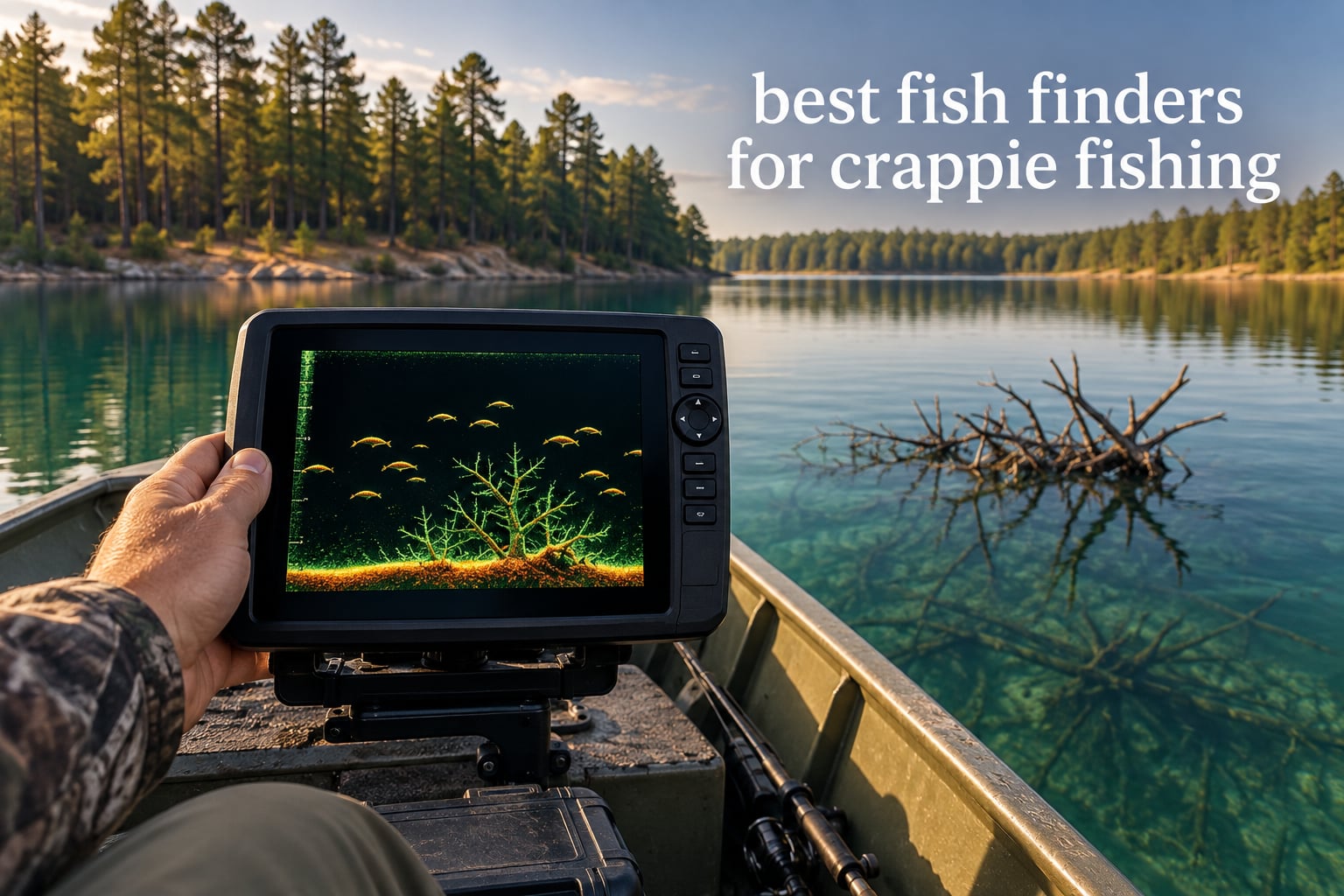
Crappie fishing is structure fishing, and that single fact drives every decision on this page. A crappie does not cruise open water looking for food. It hangs tight to a sunken brush pile, a stake bed, a stump field or a steep bank, and it stays there until something disturbs it. So the question is not which fish finder has the longest specification list. It is which unit shows you a brush pile at eight feet and separates the crappie sitting in front of it from the timber behind it.
Side scan or live sonar? For most crappie anglers, side scan plus CHIRP wins on value, and live sonar wins only once you have the budget and the patience to learn it. Live sonar lets you watch a fish react to your jig, but the honest truth from the crappie forums is that seeing fish does not automatically make them bite. Side imaging, especially MEGA Side Imaging, is what finds brush piles and stake beds at speed, and that is the job 90 percent of the time.
We compared eight fish finders for crappie fishing in 2026, from a 3.5-inch handheld to 10-inch touchscreen systems with 200-foot side imaging. Our scoring leaned 70 percent on how well a unit performs as a crappie structure finder and 30 percent on feature differentiation. We did not run all eight through a full season on the water, so treat our hands-on impressions as a mix of spec analysis, owner review patterns and forum reports. Specs, ratings and included accessories come straight from the manufacturer and verified buyer data.
For the broader market, read our general fish finder roundup and our GPS combo guide if you fish more than one species. If your boat is a kayak or a small jon, start here, because everything below is chosen with short boats in mind. We also link to our fishing kayak picks since platform choice and electronics choice go together.
Top 3 Picks for Crappie Fishing in 2026

Garmin STRIKER 4
- CHIRP traditional and ClearVu scanning sonar
- Built-in flasher for vertical jigging
- Waypoint map for marking brush piles
- 3.5 inch color LCD with keyed buttons

Garmin STRIKER Vivid 4cv
- CHIRP traditional plus CHIRP ClearVu scanning
- Vivid color palettes separate fish from cover
- Built-in Quickdraw Contours
- GT20 transducer included

Humminbird PiranhaMAX 4
- Dual Beam narrow and wide modes
- 600 foot maximum depth
- 4.3 inch LCD
- Tilt and swivel mount plus transom transducer
Best Fish Finders for Crappie Fishing in 2026
| Product | Specifications | Action |
|---|---|---|
| Garmin STRIKER 4 |
|
Check Latest Price |
| Garmin STRIKER Vivid 4cv |
|
Check Latest Price |
 Garmin STRIKER Cast Garmin STRIKER Cast |
|
Check Latest Price |
| Humminbird PiranhaMAX 4 |
|
Check Latest Price |
 Humminbird Helix 5 CHIRP GPS G3 Humminbird Helix 5 CHIRP GPS G3 |
|
Check Latest Price |
 Lowrance HOOK Reveal 5 SplitShot Lowrance HOOK Reveal 5 SplitShot |
|
Check Latest Price |
 Lowrance Elite FS 10-Inch Lowrance Elite FS 10-Inch |
|
Check Latest Price |
 Humminbird XPLORE 10-Inch Humminbird XPLORE 10-Inch |
|
Check Latest Price |
1. Garmin STRIKER 4: The Best Fish Finder for Crappie Fishing Overall
Garmin 010-01550-00 Striker 4 with Transducer, 3.5″ GPS Fishfinder with Chirp
3.5 inch color LCD
CHIRP plus ClearVu scanning
1600 feet freshwater depth
IPX7 water rating
Pros
- CHIRP continuous frequency sweep gives crisp arches and good target separation
- ClearVu scanning sonar shows near-photographic structure detail
- Built-in flasher supports vertical jigging over a stake bed
- Waypoint map lets you mark and return to brush piles
- Keyed buttons work with cold wet hands
Cons
- 3.5 inch screen is small when zoomed in on tight structure
- Sonar reading drops out at higher boat speeds
- Included power lead is thin and needs a solid connection
The Garmin STRIKER 4 is the unit we keep coming back to, and it is not a close call. It carries a 4.6 rating across more than 9,000 reviews, which is the largest review base of anything in this roundup, and it is the only sub-5-inch unit here that pairs CHIRP traditional sonar with ClearVu scanning sonar from a single included transducer.
That combination matters more for crappie than it does for bass. Crappie sit in the 6 to 12 foot range along banks and over shallow structure for most of the season, and separating a tight ball of fish from a stump is exactly what ClearVu is built for. The screen stays readable in full sun, and the keyed interface means you can change views one-handed while holding a rod.
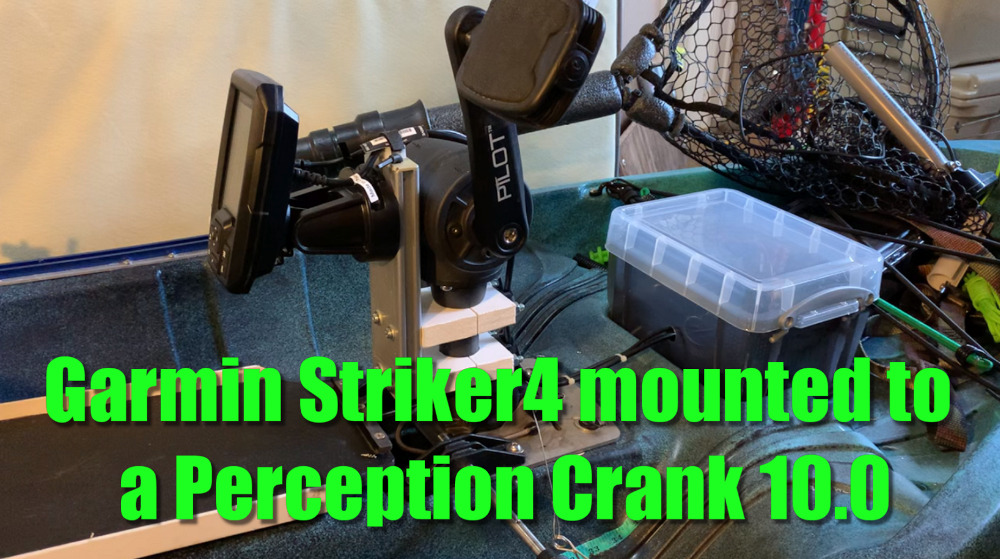
There is one crappie feature here that no other handheld in this list has, and it is the reason this unit wins. The built-in flasher display shows your jig and any crappie that drift into the cone in real time, which turns the unit into a vertical jigging tool as well as a fish finder. On a stake bed that you have already marked, that is the difference between fishing the spot and just being over the spot.
Owners also lean on the waypoint map. Mark the brush pile, kill the power, run to the next one, and come back next trip. Forum anglers who fish the same lake year after year treat saved spots as the most valuable feature on the unit, more than raw image quality.
What a STRIKER 4 is good for
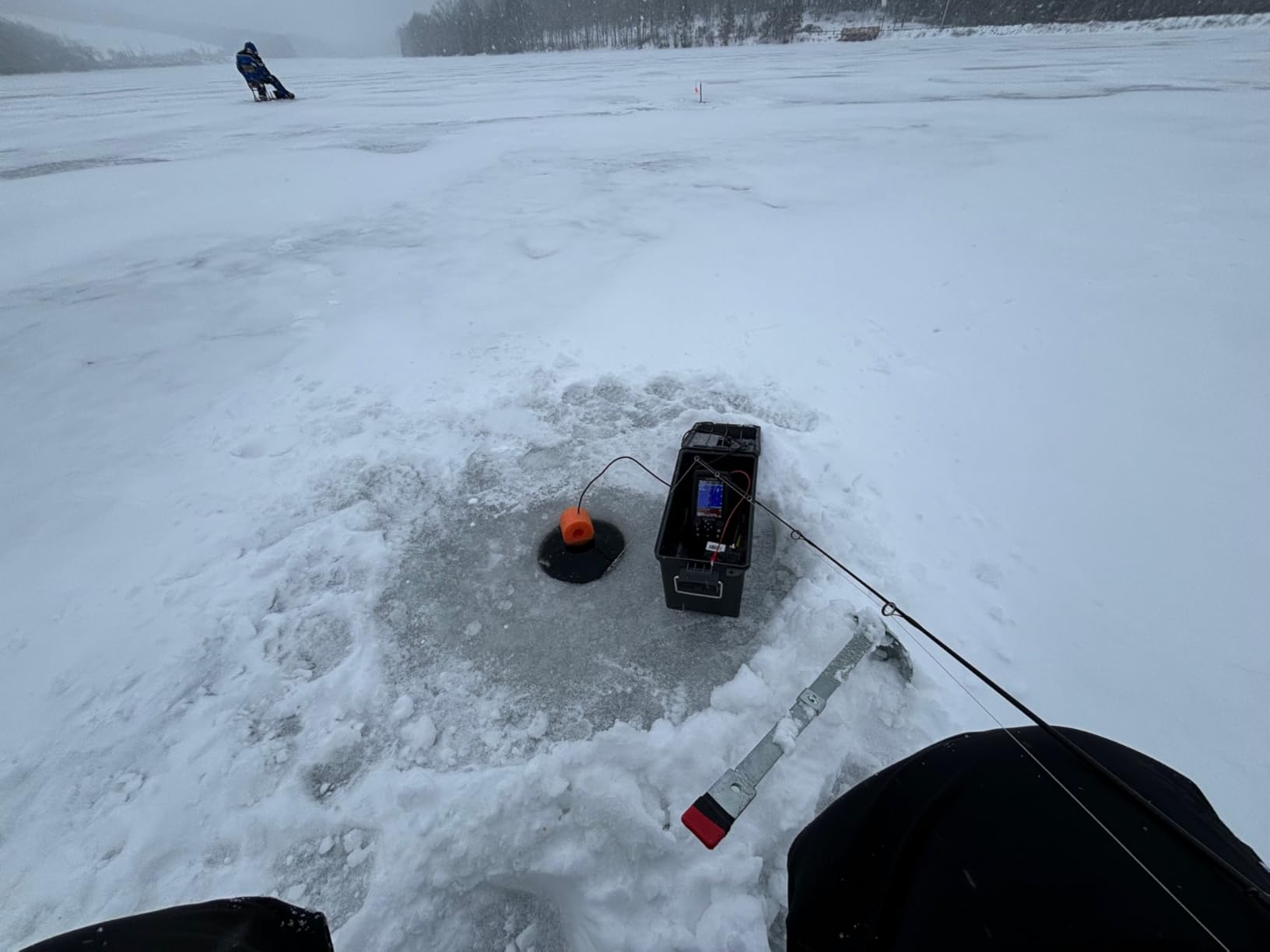
It suits a 14 to 18 foot jon boat or aluminum rig where console space is tight and the budget is real. The tilt and swivel mount included in the box clicks in and out, so you can remove the head in seconds and the transducer stays on the transom.
It also suits a first electronics purchase. Installation is genuinely simple, the transom and motor mounts are included, and current draw at 12V is 0.23 amp, so a small battery or a switch panel will not strain.
Where the STRIKER 4 falls short
Screen size is the honest limit. At 3.5 inches diagonal you get one view at a time, and crappie anglers who like to run side-by-side traditional and flasher views are forced to pick a view instead of seeing both.
The included power hookup wire is thin, and reviewers specifically flag it. Owners of aluminum boats have reported melted transducer connections on cheap aftermarket wiring, so we would plan on a proper fused run even with this unit.
2. Garmin STRIKER Vivid 4cv: Best Rated for Brush Pile Hunting
Garmin Striker Vivid 4cv Fishfinder with Transducer – 4-inch LCD Display – Easy-to-Use Scanning Sonar – Color Palettes, 11.2 Ounces (010-02550-00)
4 inch color LCD
GT20 CHIRP and ClearVu transducer
Quickdraw Contours built in
Two year warranty
Pros
- Highest average rating in the group at 4.7
- Color palettes make fish stand out against bottom structure
- Quickdraw Contours adds own mapping with no extra hardware
- High-sensitivity GPS handles waypoints and boat speed
- Tilt and swivel bailmount included
Cons
- 4 inch screen still feels small for close structure work
- No side imaging or live sonar
- No detailed preloaded charts out of the box
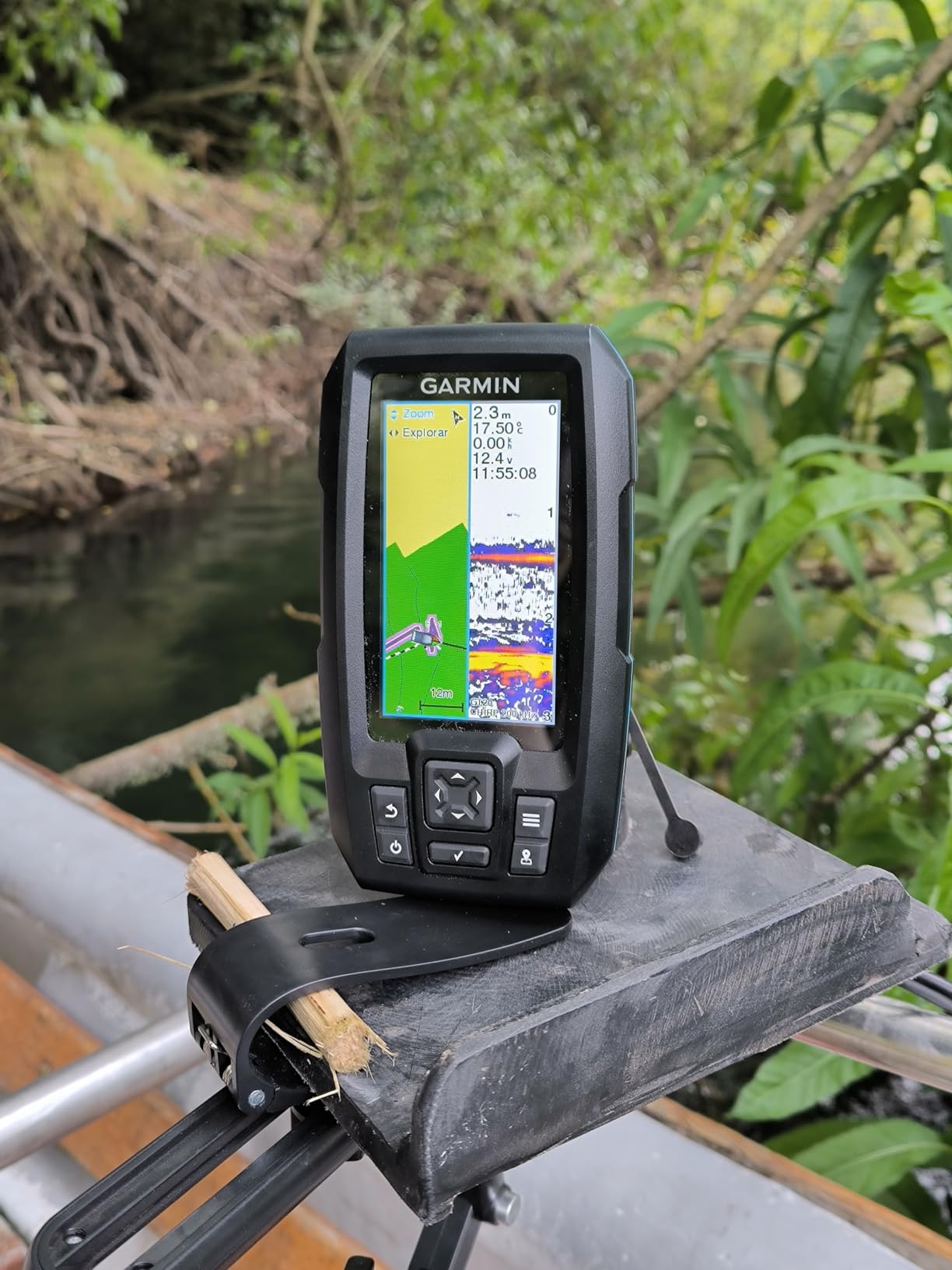
The Garmin STRIKER Vivid 4cv carries the highest average rating in this roundup at 4.7 across 1,861 reviews, and the Vivid color palette system is the reason. Traditional sonar prints everything in one shade, so a fish and a rock can look identical. Vivid palettes let you color the water column, the bottom and the returns differently, and crappie read as bright arches against a dark backdrop instead of a grey smudge.
The GT20 transducer in the box handles both CHIRP traditional and CHIRP ClearVu scanning, so the same hardware gives you the arch view for cruising and the detail view for picking apart a timber cluster. Quickdraw Contours is built in, which means the unit records your own depth contours as you run, and those contours become your crappie map for future trips.
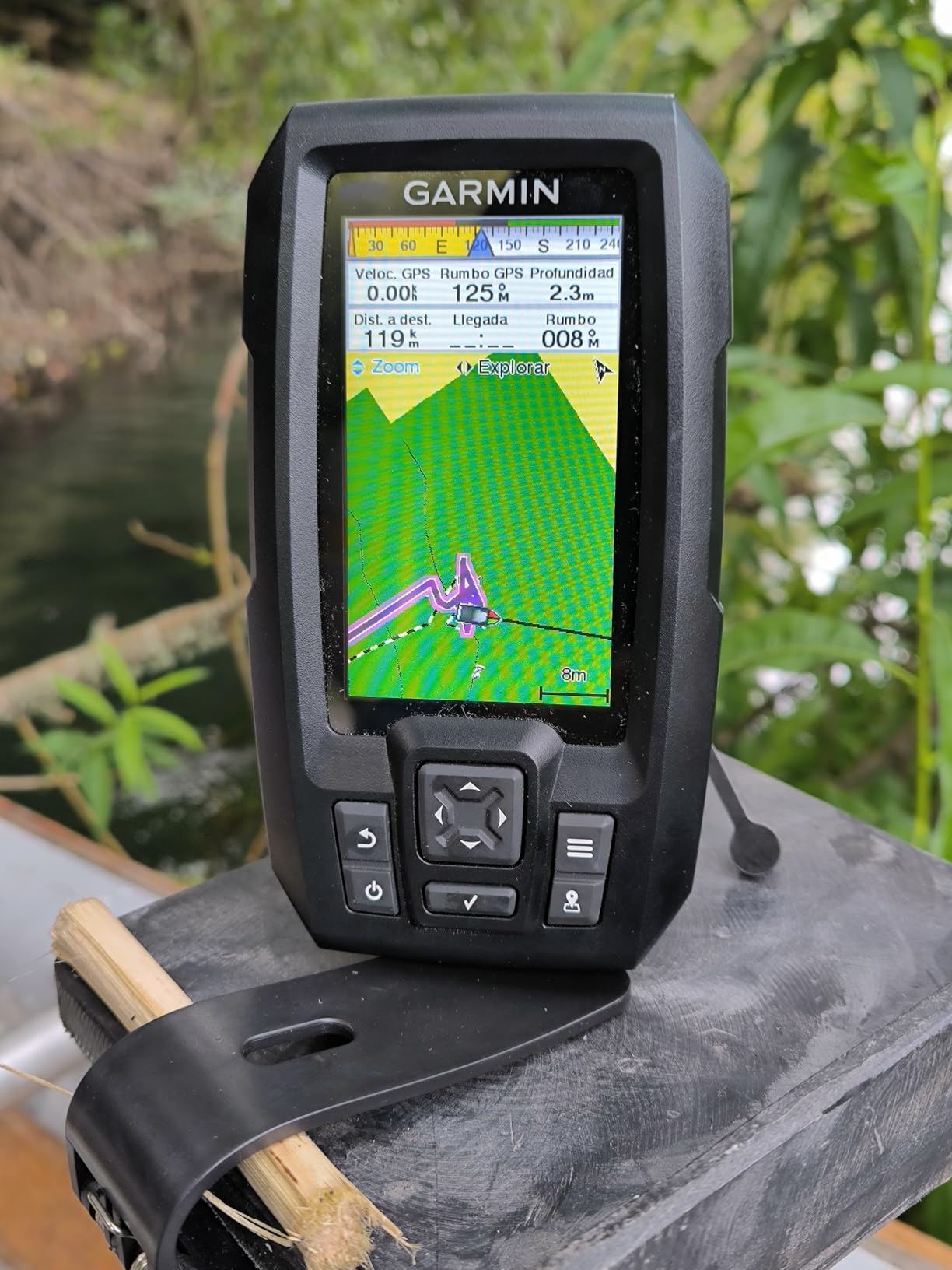
Owners of this unit specifically point at the separation between crappie and brush. That is the whole game. A stake bed produces a dense blob of return, and a school in front of it produces discrete arches. The Vivid palettes make the difference obvious at a glance, which speeds up the decision to drop a jig.
The unit also weighs just 11.2 ounces and runs on a bailmount bracket, so it moves easily between a jon boat console and a kayak track. For anglers who fish several boats, that portability has real value.
What a STRIKER Vivid 4cv is good for
This is the pick for an angler who wants color separation on a 4-inch screen and wants to build their own contour maps. It is also the safest mid-step from the STRIKER 4, adding palettes, a larger screen, better sonar and a longer warranty for a modest jump in spend.
It works well for a boat where a shallow bank run is the primary pattern, because the arch view plus waypoints is exactly what you need to mark and return to a productive edge.
Where the STRIKER Vivid 4cv falls short
There is no side imaging, so you are searching for brush piles with forward-looking sonar rather than scanning left and right. On wide timber fields that stretches the search, and it is the main reason buyers step up to a side imaging unit later.
It comes with no detailed preloaded charts, only the built-in basemap with Quickdraw. If you want to see creek channels and boat ramps without running your own survey, you will need a chart card or a few hours of recording.
3. Garmin STRIKER Cast: Best for Shore and Dock Crappie Fishing
Garmin Striker Cast, Castable Sonar with GPS, Pair with Mobile Device and Cast from Anywhere, Reel in to Locate and Display Fish on Smartphone or Tablet (010-02246-02)
Castable sonar with built-in GPS
Streams to phone or tablet
Maximum depth 200 feet
75 g with carrying bag
Pros
- No boat
- no wiring
- no permanent install
- Built-in GPS plus Quickdraw Contours builds custom maps
- Streams up to 200 feet to a phone or tablet
- 10+ hour rechargeable battery with automatic on and off
- IPX6 and IPX7 water resistance
Cons
- Requires a compatible phone or tablet and the free app
- 200 foot depth and streaming range are modest
- Casts with 20 lb test line or heavier only
The Garmin STRIKER Cast is the only unit here that is not mounted on a boat at all, and that changes who it is for. It is a puck-sized castable sonar with a built-in GPS that streams traditional 2D sonar and flasher views wirelessly to the free STRIKER Cast app on a phone or tablet. Cast it near a bank, let it sink, and watch the screen.
For crappie this is genuinely useful. The best bank and dock fishing happens in 4 to 8 feet of water, which is where a castable sonar is comfortable, and the flasher mode gives you a live view of a fish investigating a jig. The built-in GPS records your casts, so you can map a shoreline you are working and return to the same pocket next trip.
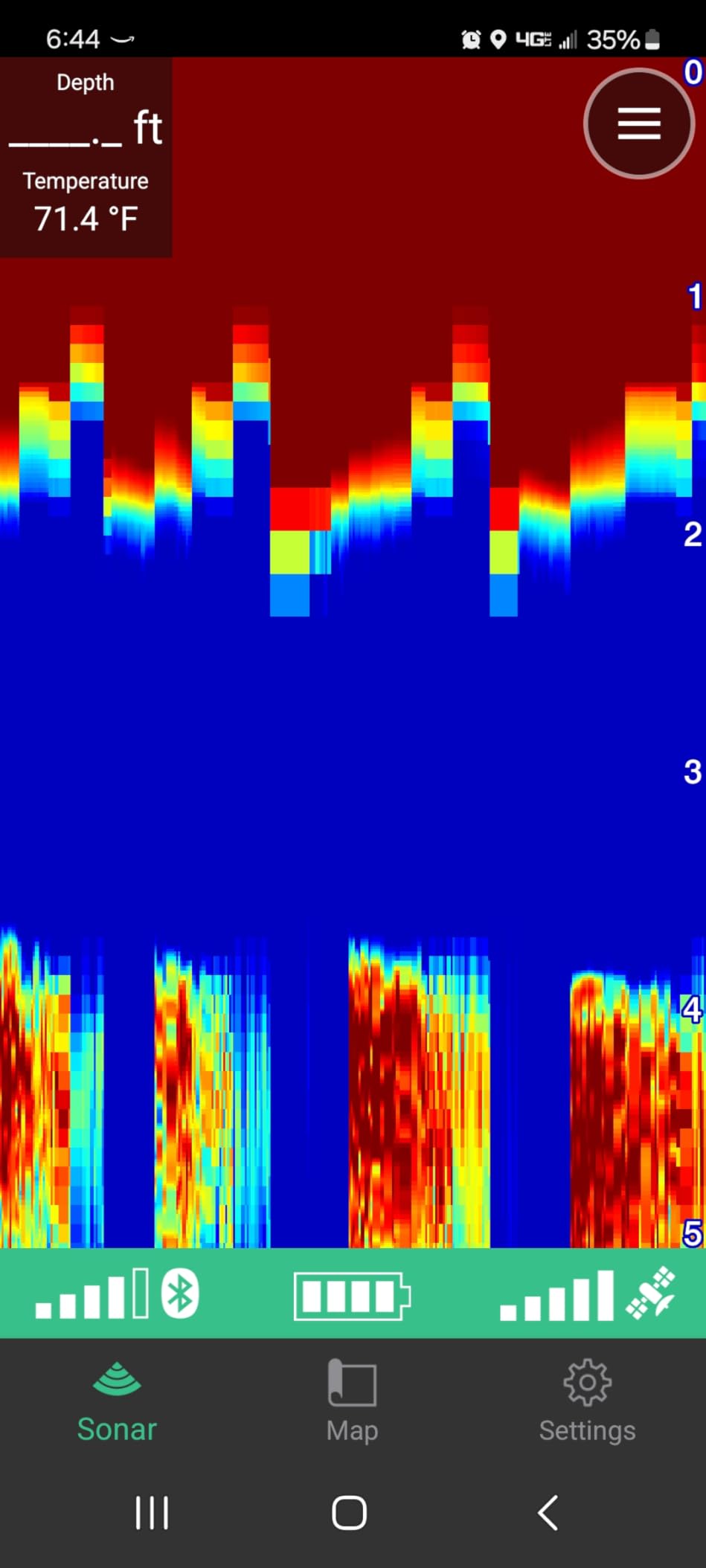
Owners highlight the recharge and the auto on and off behavior. The unit powers on when it is floating and off when you lift it, which means you are not reaching for a switch with cold hands, and the internal USB-rechargeable battery runs more than 10 hours. The included 20 foot tether keeps it attached while you fish.
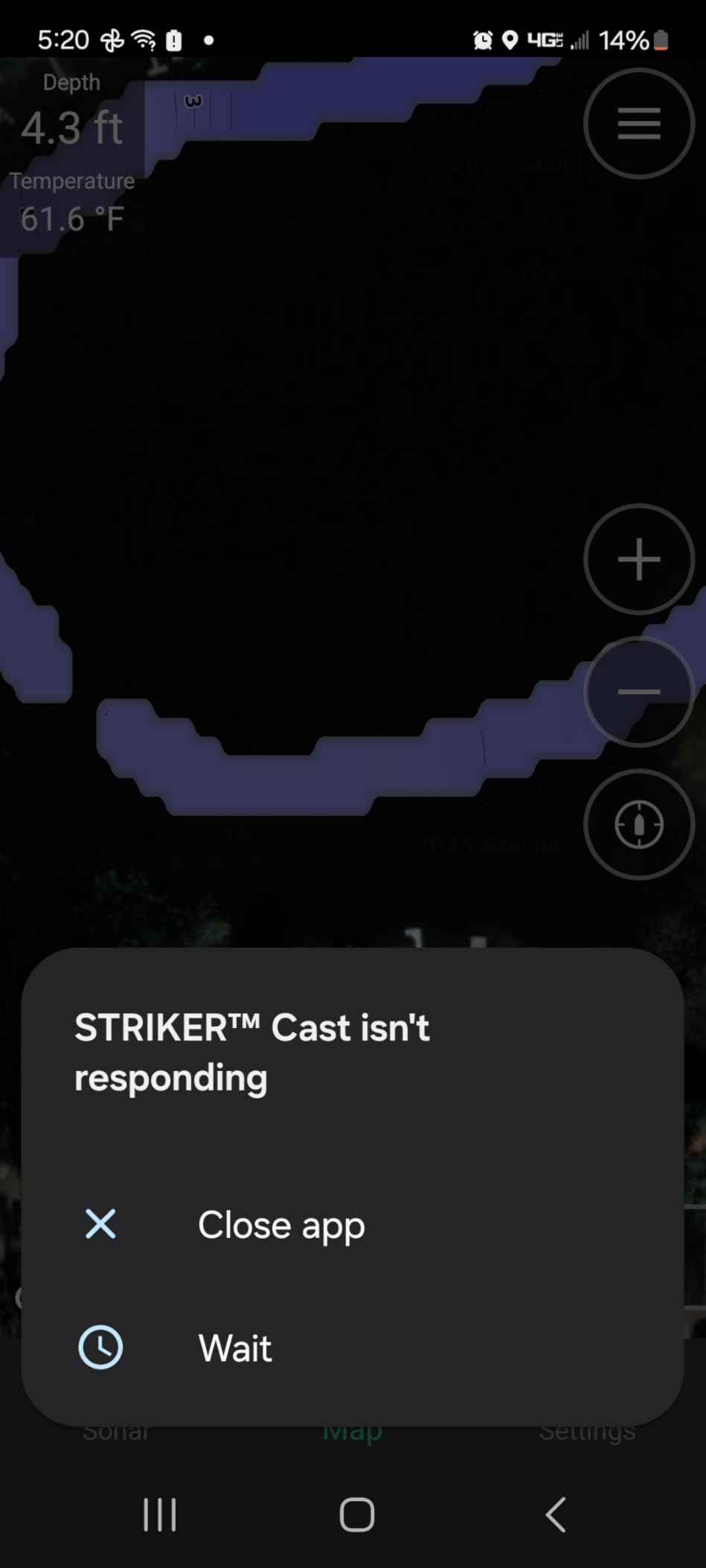
Quickdraw Contours records 1-foot contours as you work, and the app gives access to the Quickdraw community map library, so you can pull contours for a lake other people already surveyed. For a bank angler without a boat, that is the standout feature.
What a STRIKER Cast is good for
It is built for shore, dock, ice and small-boat anglers who want to find structure without rigging a battery and a transducer. It also works as a backup unit to keep in the console for scouting a spot before committing the boat.
It suits anyone who fishes water shallower than 200 feet, which covers the majority of crappie lakes and the majority of the season.
Where the STRIKER Cast falls short
You need a compatible phone or tablet and the free app for any viewing, and if the phone dies, the sonar dies. Reviewers who wanted a standalone screen should look elsewhere.
The 200 foot maximum depth and the 200 foot streaming range both cap the use case. Casting from a boat, you can only see what is within about 200 feet of the boat, so this is not a boat fishing tool. It also has 2D and flasher modes only, with no CHIRP scanning, no side imaging and no down imaging.
4. Humminbird PiranhaMAX 4: Best Value Backup Unit
Humminbird PiranhaMAX 4 Fish Finder with Transducer, Dual Beam Sonar
4.3 inch LCD
Dual Beam narrow and wide
600 foot maximum depth
2 pounds with transom mount
Pros
- Dual Beam lets you trade narrow detail for wide coverage
- 600 foot depth handles deep reservoirs
- Tilt and swivel mount adjusts viewing angle in seconds
- Transom transducer included in the box
- 1328 reviews at a 4.6 rating
Cons
- No CHIRP and no side or down imaging
- No GPS or chartplotter capability
- 4.3 inch screen limits detail
- Traditional sonar only
- no scanning modes
The Humminbird PiranhaMAX 4 is the simplest unit in the roundup, and simplicity is the point. It has no CHIRP, no mapping and no imaging. It gives you Dual Beam traditional sonar, a 4.3 inch screen and a transom-mount transducer, and owners rate it 4.6 across 1,328 reviews as a dependable first unit or a permanent backup.
Dual Beam is more useful for crappie than it sounds. The narrow beam gives you tight separation on a specific stake bed, and the wide beam lets you sweep a bank fast to see whether anything is holding on it. Switching between the two is a single button press, which matters when you are working a shoreline with the motor.
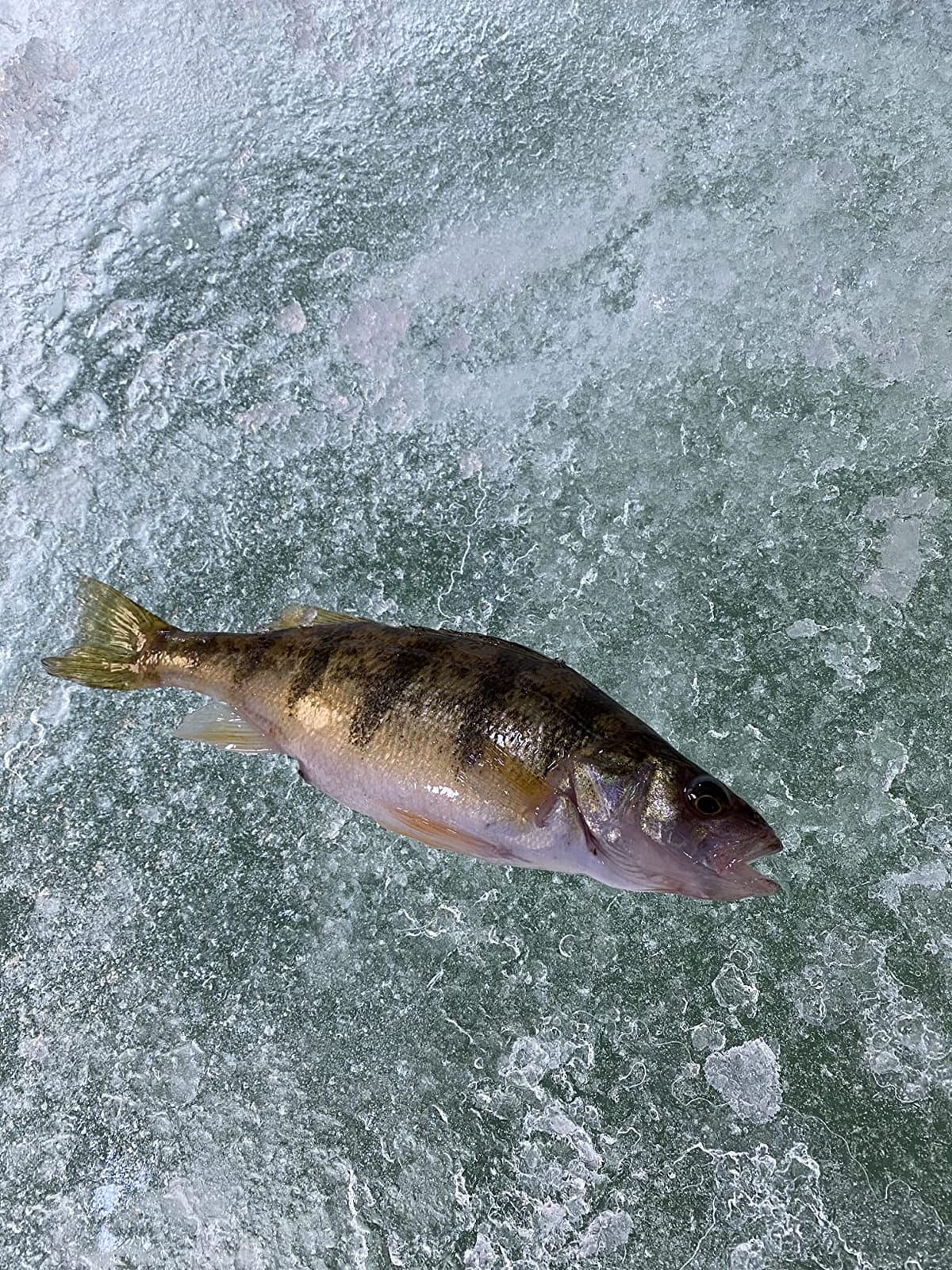
What you give up is memory. With no GPS, you cannot mark a brush pile and come back to it. That is a real limitation for the way most crappie anglers fish, and it is why we treat this as a backup or a shallow-water scout rather than a lake-wide tool.
The included XNT 9 28 T transom-mount transducer is a conventional unit with no CHIRP, and the 600 foot maximum depth covers any inland lake you will realistically fish. At 2 pounds, it is also a little heavier than the Garmin handhelds, which matters on a small boat with limited console space.
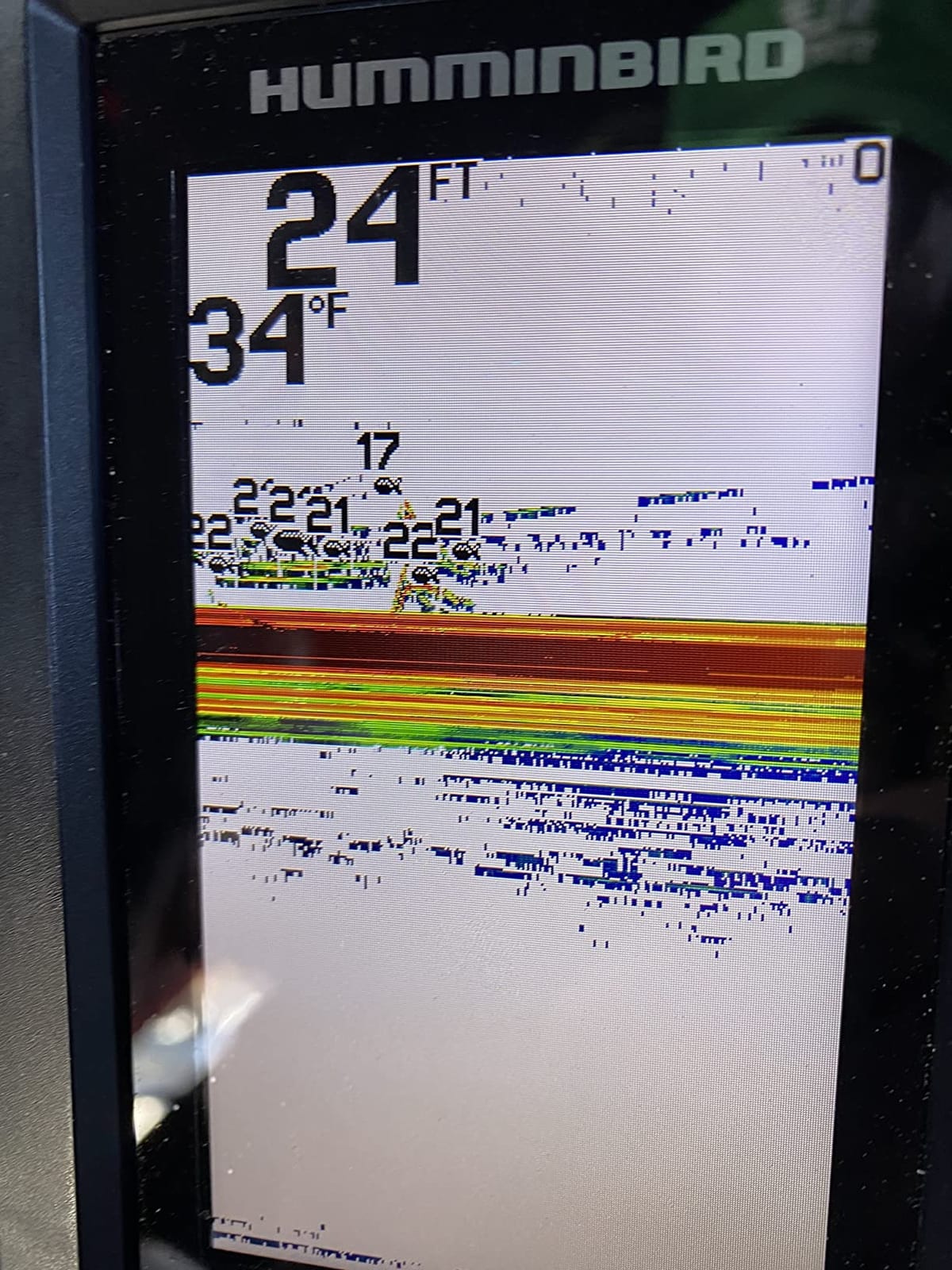
What a PiranhaMAX 4 is good for
It suits an angler who wants a reliable, cheap tool for finding depth and locating structure on a lake they already know, or a second unit for a second boat. The 4.3 inch screen is also physically larger than the 3.5-inch handhelds, so detail is a little better.
It works well for vertical work in the first year, because with no mapping to configure you can be reading fish in minutes instead of setting up menus.
Where the PiranhaMAX 4 falls short
No GPS is the big one. There is no waypoint map, so every trip starts from scratch and every productive spot lives in your head. Many crappie anglers fish the same water year after year precisely so they can leverage saved spots, and this unit cannot help with that.
The imagery is traditional and grayscale-style compared with the color scanning units. It finds fish and it finds bottom, but telling a crappie apart from a rock in a tight timber cluster is genuinely hard at this price and feature level.
5. Humminbird Helix 5 CHIRP GPS G3: Best for Building Your Own Crappie Map
Humminbird Helix 5 G3 GPS Fish Finder with Transducer & Dual Spectrum Chirp Sonar
5 inch color TFT
Dual Spectrum CHIRP wide and narrow
Low-Q transducer
AutoChart Live included
Pros
- Dual Spectrum CHIRP in wide and narrow modes
- Low-Q transducer gives precise 2D target separation
- Humminbird Basemap covers 10000+ lakes out of the box
- AutoChart Live records depth
- bottom hardness and vegetation maps
- Softkey keypad works reliably in wet weather
Cons
- No side imaging or down imaging on this model
- Power cable can be too short on small boats
- No 3 amp fuse or extra wiring in the box
The Humminbird Helix 5 CHIRP GPS G3 is the first unit on this list that treats crappie fishing as a mapping problem rather than a scanning problem. Dual Spectrum CHIRP runs in Wide mode for coverage or Narrow mode for detail, a Low-Q transducer handles target separation, and AutoChart Live records real-time depth contours, bottom hardness and vegetation with eight hours of built-in recording.
AutoChart Live is the feature crappie anglers should care about most. Bottom hardness readings tell you where rock transitions to sand and soft bottom, and vegetation maps put a visible layer over your contours that maps brush and weed habitat. After a few trips of recording, you have a personal map of the lake that no other angler has.
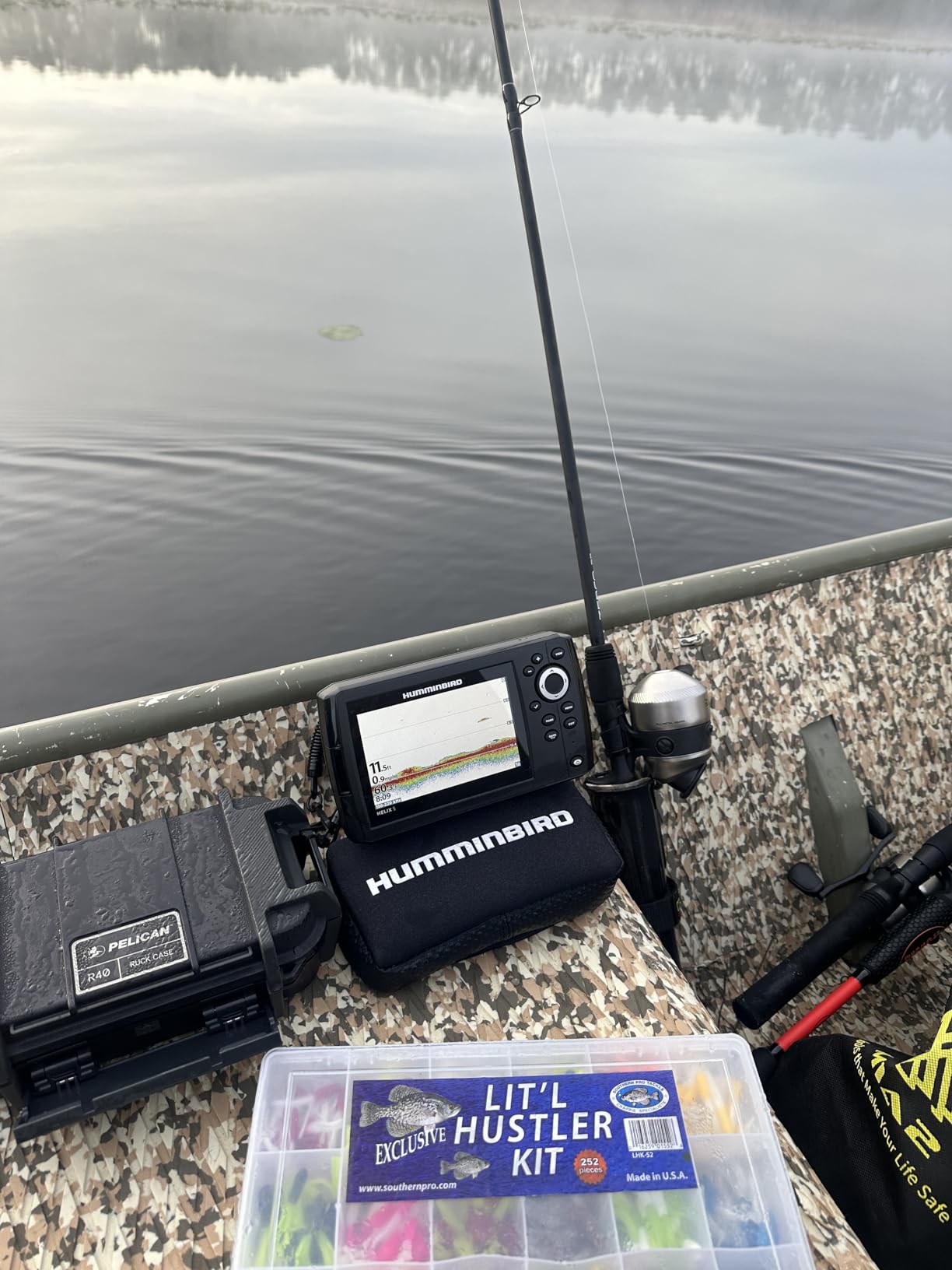
The 5-inch color TFT screen is the smallest here that reviewers describe as comfortable in direct sun, and the softkey keypad is a genuine advantage over touchscreens when your hands are wet and cold at 6 a.m. Owners on crappie.com frequently call this generation of Helix the value sweet spot in the Humminbird line, and the 4.4 rating across 488 reviews backs that up.
Note the ecosystem cost. The Humminbird Basemap covers more than 10,000 lakes, and the unit accepts LakeMaster, CoastMaster and Navionics cards plus AutoChart Zero Line SD cards. That is a strong upgrade path, and it is also a lock-in: transducers and cards do not cross over to Garmin or Lowrance.
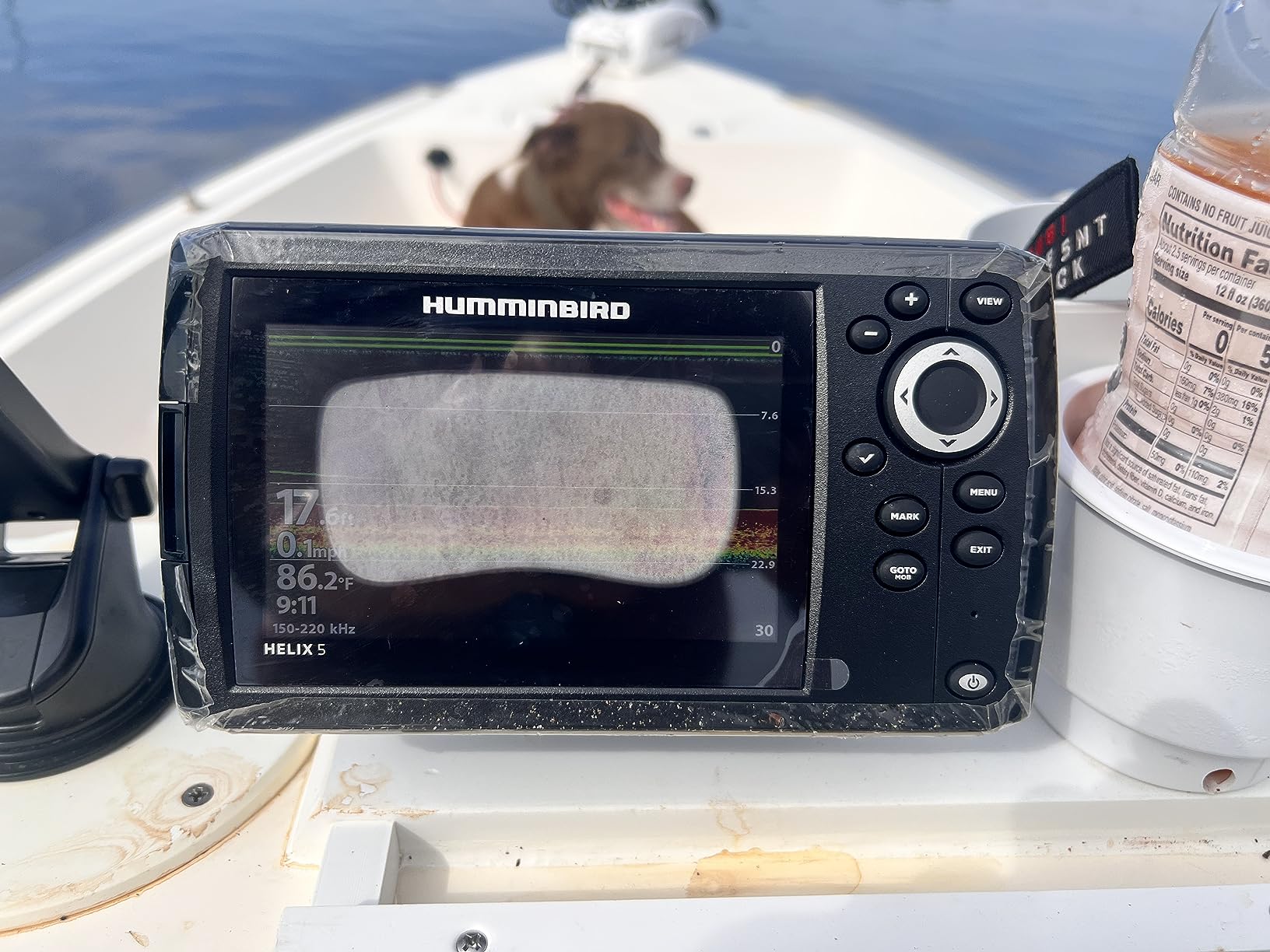
What a Helix 5 CHIRP G3 is good for
It suits an angler on a 16 foot jon boat who wants GPS, waypoints and self-generated mapping without stepping up to a side imaging console. The gimbal mounting bracket and transom transducer are included, so the install is straightforward.
It is also the pick for anyone who wants to learn AutoChart Live, because the recording process is simple and the payoff for crappie water is a habitat layer you cannot buy.
Where the Helix 5 CHIRP G3 falls short
There is no side imaging or down imaging on this model. You are still searching forward, so finding a wide field of brush piles means running more of the lake than you would with a Mega SI unit.
The install caveat is the most repeated complaint. The included power cable can be too short to reach the battery box on a small boat, and a 3 amp fuse and additional wiring are not in the box. Plan for that before the boat is in the water, because a loose or unfused connection on an aluminum hull is the failure mode forum anglers complain about most.
6. Lowrance HOOK Reveal 5 SplitShot: Best Down Imaging Value
Lowrance HOOK Reveal 5 SplitShot – 5-inch Fish Finder with SplitShot Transducer, Preloaded C-MAP US Inland Mapping
5 inch SolarMAX display
SplitShot CHIRP and DownScan
Preloaded C-MAP inland charts
Autotuning sonar
Pros
- SplitShot transducer gives wide CHIRP and DownScan from one unit
- Preloaded C-MAP charts cover nearly 4000 U.S. inland lakes
- FishReveal makes fish stand out against bottom structure
- Autotuning sonar adjusts settings as conditions change
- Genesis Live builds custom contour maps
Cons
- Several buyers report unit failures after short use
- Menus take study to learn
- Transducer cable routing in a small boat is awkward
- 5 inch screen is small for detailed structure work
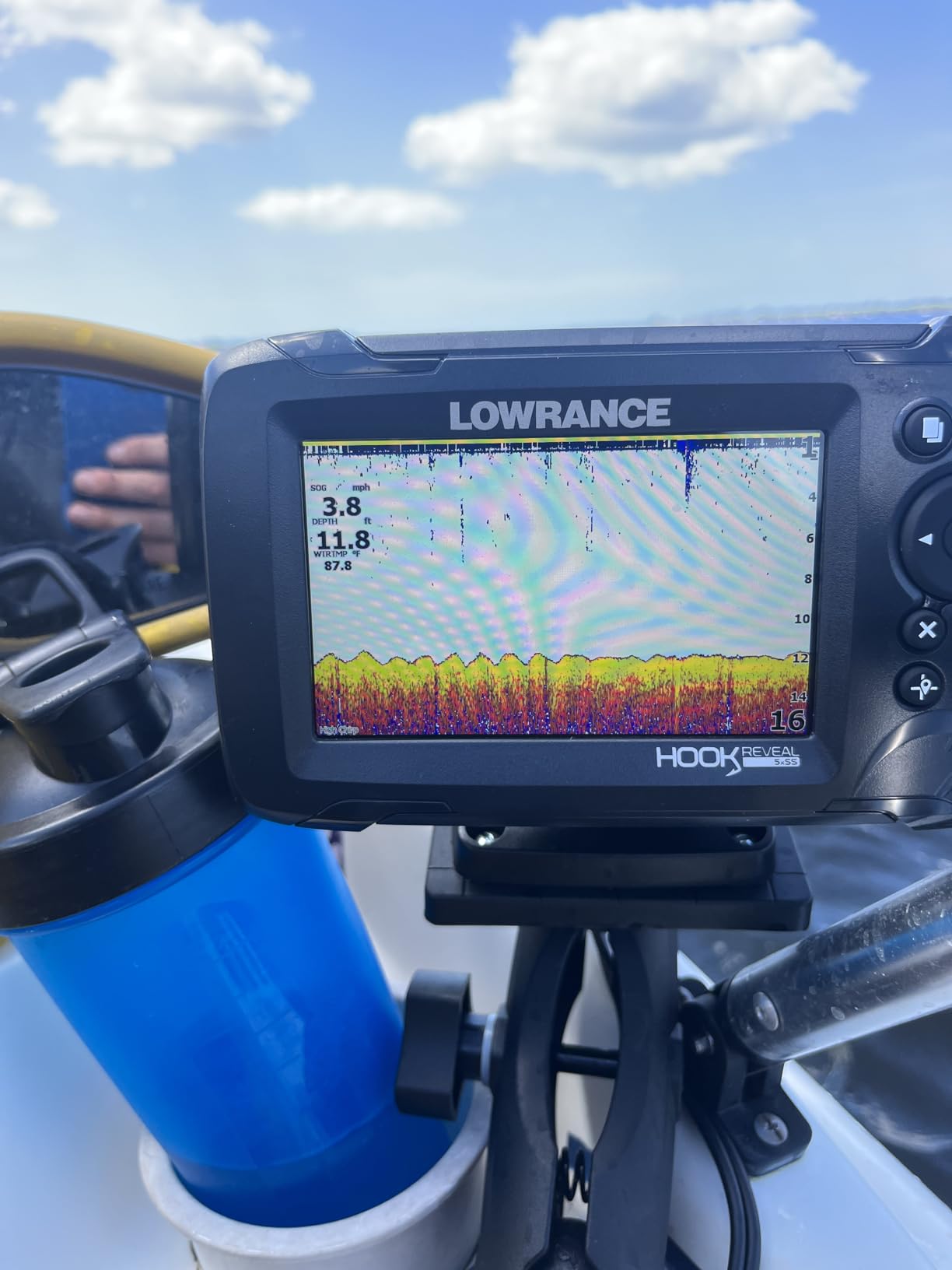
The Lowrance HOOK Reveal 5 SplitShot puts down imaging in reach for most crappie anglers, and that is the technology crappie fishing benefits from most after side scan. DownScan looks straight beneath the boat at high resolution, so suspended crappie over a flat and stumpy timber show up in a way that forward-looking traditional sonar can smear. Summer fish holding in the middle of a flat is exactly the situation where that matters.
The SplitShot transducer handles both wide-angle high CHIRP and DownScan from one mount, so you are not managing two units. FishReveal processing separates targets from background, autotuning sonar adjusts settings as conditions change, and the 5-inch SolarMAX screen is bright and crisp in direct sun.
Lowrance also preloads high-detail C-MAP charts of almost 4,000 U.S. inland lakes, which means the unit is useful on the first trip without a survey. Genesis Live adds your own contours on top of any map or GPS plotter, so the mapping story here is the strongest in the mid range alongside the Helix.
It is also the unit forum anglers most often recommend to people who are not tech savvy, because autotuning handles the settings that require menu work on other brands. The 4.2 rating across 424 reviews is the lowest in this roundup, and the reason is worth reading before you buy.
What a HOOK Reveal 5 SplitShot is good for
It suits a boat with a flush mounting location and a 12 volt DC panel, and the included mounting bracket, power cable, fuse and fuse holder mean the electrical side is closer to complete than most kits in this list. That fuse inclusion is a real advantage on an aluminum boat.
It is the value route to down imaging, and it works for anglers targeting suspended summer fish over open flats rather than only structure hugging.
Where the HOOK Reveal 5 SplitShot falls short
Reliability is the honest concern. Several buyers reported units failing after a short period of use, and the critical reviews mention warranty and return friction. Buy from a seller with a straightforward return process and test the unit the day it arrives.
Two smaller issues: sonar can default to off in the settings and must be switched on, which confuses new owners, and routing the transducer cable through boat wiring channels is awkward on a small aluminum hull. Owners also note the menus take study to learn.
7. Lowrance Elite FS 10-Inch: Best for Larger Boats and Full Connectivity
Lowrance Elite FS 7 Fish Finder with Active Imaging 3-in-1 Transducer, Preloaded C-MAP Contour+ Charts
10 inch multi-touchscreen
Active Imaging 3-in-1 with SideScan
C-MAP DISCOVER charts
1000 foot maximum depth
Pros
- Active Imaging 3-in-1 combines CHIRP
- SideScan and DownScan in one transducer
- Large 10 inch touchscreen runs sonar and charts side by side
- Preloaded C-MAP DISCOVER covers inland
- coastal and Canadian waters
- Live sonar ready for ActiveTarget 2 and 2 XL
- Wireless
- NMEA 2000 and Ethernet connectivity
Cons
- Premium tier cost versus entry fish finders
- ActiveTarget live sonar is a separate purchase
- Large console needs real mounting space
- Overkill for a small or simple setup
The Lowrance Elite FS is the pick for a boat with real console space. The 10-inch multi-touchscreen is the only display here large enough to run a side imaging view and a chart at the same time, and that side-by-side capability is what serious structure anglers want once they know what they are looking at. Owners rate it 4.6 across 515 reviews.
The Active Imaging 3-in-1 transducer handles CHIRP, SideScan and DownScan with FishReveal processing from a single mount, so scanning a brush pile from a passing boat and then dropping a waypoint on it is one continuous motion. SideScan is the mode that finds timber and rock edges you would have run over otherwise, which is the main reason it beats a 5-inch unit for finding unlocated structure.
It is live sonar ready, which matters if you plan to add ActiveTarget 2 or 2 XL later. That add-on is a separate purchase, but the Elite FS is the platform that lets you graduate to forward-facing sonar without replacing the whole system. Wireless, NMEA 2000 and Ethernet connectivity let displays and equipment share data across a full boat network.
The preloaded C-MAP DISCOVER charts cover inland, coastal and Canadian waters, and the 1,000 foot maximum depth handles deep reservoirs as well as shallow crappie lakes. The box includes the display, a 3-in-1 transducer, suncover, fuse and fuse holder, mounting bracket and power cable.
What a Lowrance Elite FS is good for
It suits an 18 to 22 foot boat with a console wide enough to hold a 10 inch display, and for anglers who run the same lake across many trips. Side-by-side sonar and chart means you can see a structure on the scan and drop a waypoint on it without switching views.
It is also the sensible platform if live sonar is on your horizon, because the display and network are already in place for an ActiveTarget module.
Where the Elite FS falls short
The step up in cost is large compared with entry units, and that gap is real money for a beginner who only needs CHIRP and a waypoint map. The 10-inch format is also unnecessary for a jon boat or a kayak.
Live sonar and some transducer packages require additional purchases. If your plan is only to find brush piles and vertical jig them, this is more console than the job needs.
8. Humminbird XPLORE 10-Inch: Longest Side Imaging Range in the Roundup
Humminbird XPLORE 9 GPS Fish Finder with Transducer, MEGA Side Imaging+ & HD Touchscreen
MEGA Side Imaging+ at 200 feet per side
MEGA Down Imaging+
10 inch HD touchscreen
Dual Spectrum CHIRP
Pros
- MEGA Side Imaging+ reaches 200 feet on each side of the boat
- MEGA Down Imaging+ adds 200 foot depth coverage
- Dual Spectrum CHIRP for fish detection and structure clarity
- Includes LakeMaster and CoastMaster VX map card
- Bluetooth anchor control and NMEA 2000 networking
- Three year warranty with registration
Cons
- The control head only configuration has no transducer included
- Highest cost in the roundup
- Only 49 customer reviews so far
- Large console needs substantial mounting space
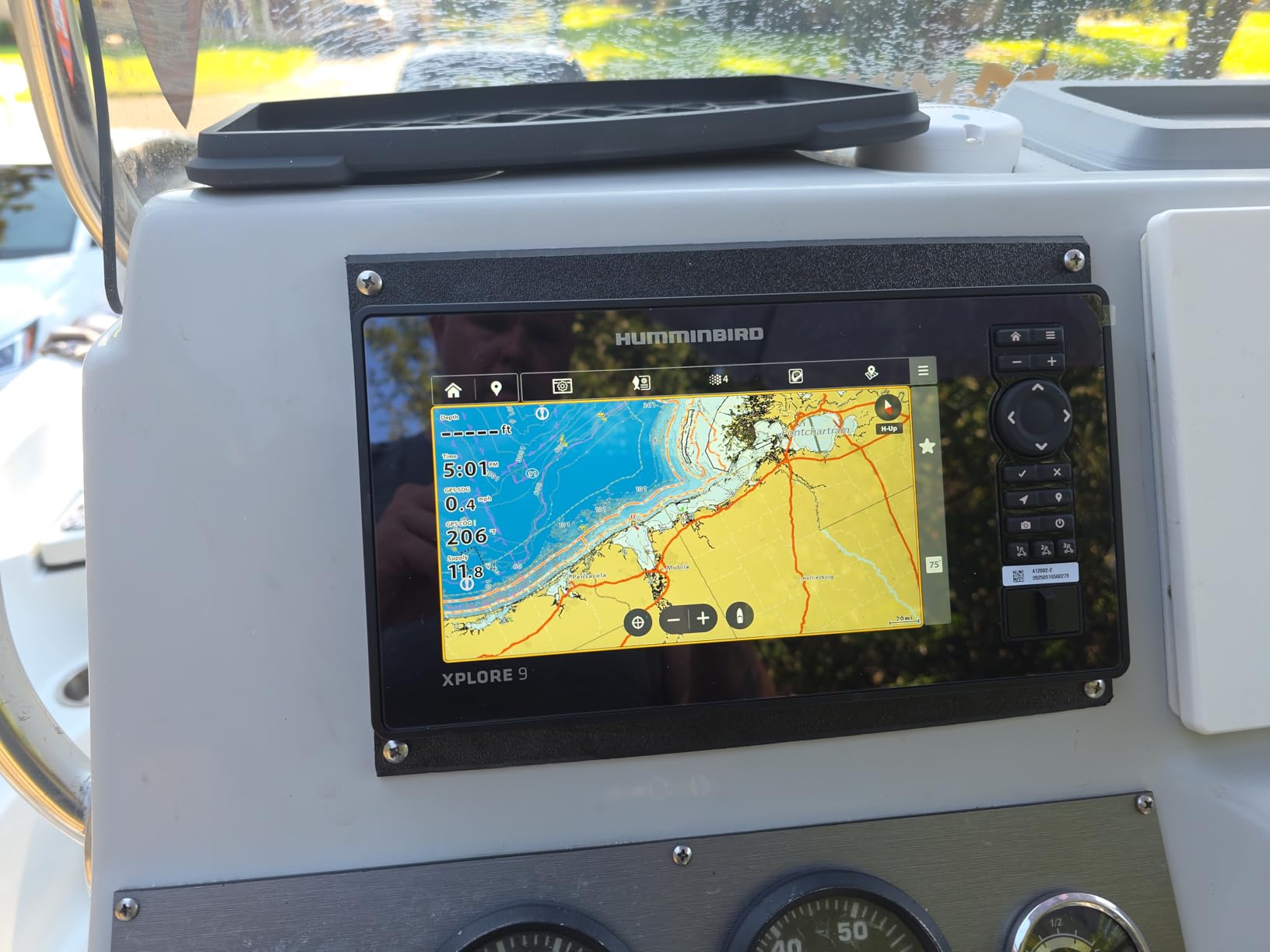
The Humminbird XPLORE 10-Inch is the most capable structure finder in this roundup, and it is also the newest with the thinnest review history. MEGA Side Imaging+ reaches 200 feet on each side of the boat, which is the longest scanning reach of any unit here, and MEGA Down Imaging+ adds 200 feet of depth coverage for vertical structure reading.
Range is what separates it for crappie. On a large reservoir, a 200 foot side imaging reach lets you scan a wide timber field in one pass instead of running it three times. On an inland lake it is more reach than most anglers need, but the detail at close range is where a stake bed separates into individual fish.
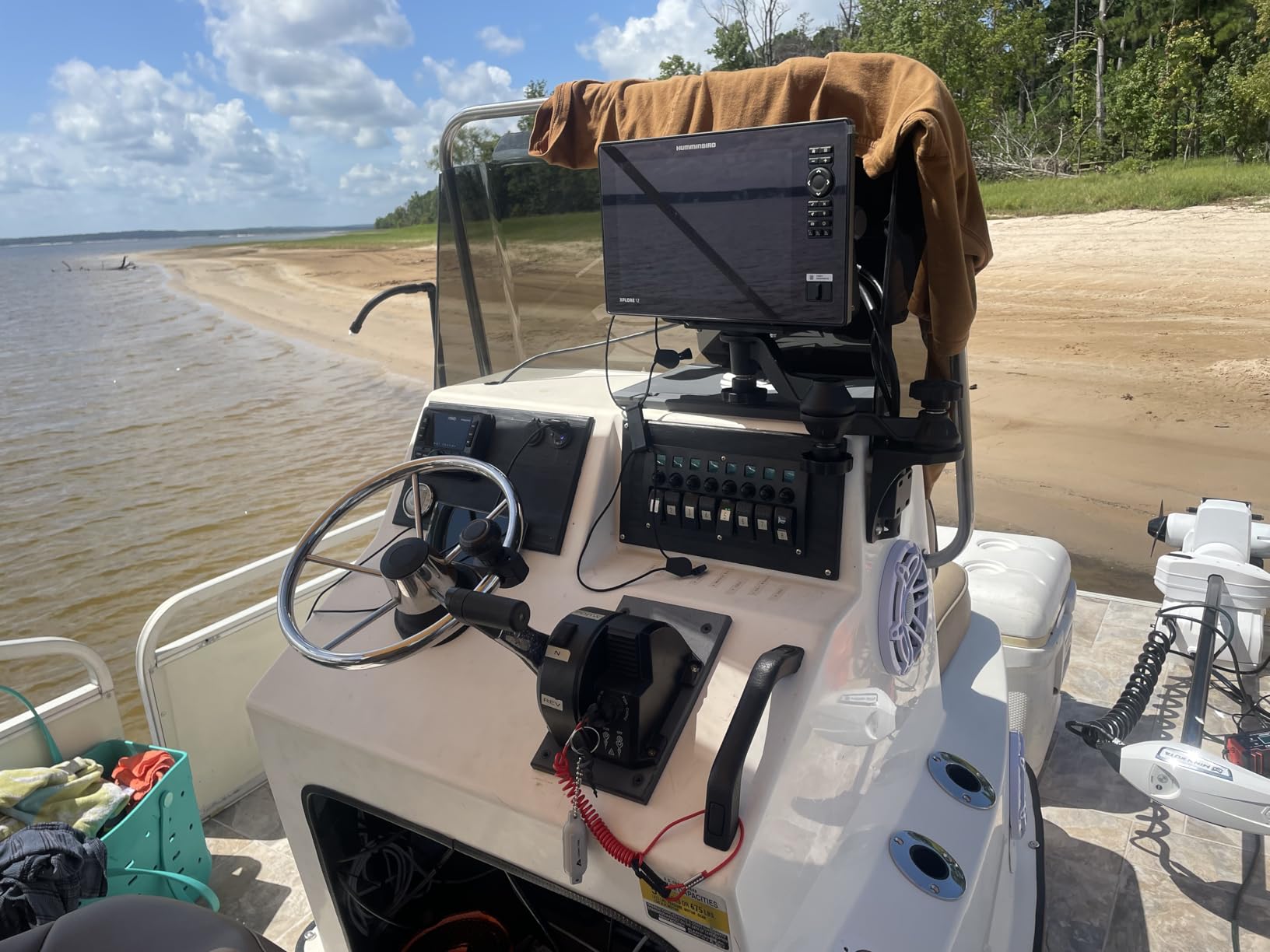
It also includes a LakeMaster and CoastMaster VX map card for U.S. and Canadian regions on top of the Humminbird Basemap, plus AutoChart Live for real-time contour, bottom hardness and vegetation recording. Bluetooth handles wireless anchor control and phone notifications, and NMEA 2000 with high-speed Ethernet supports full One-Boat Network integration with Minn Kota trolling motors.
The 10-inch HD touchscreen has keypad operation as backup, which is the right call on a boat that gets wet. The 4.7 rating is high, but it rests on 49 reviews, so treat long-term reliability as unproven rather than settled.
What a Humminbird XPLORE is good for
It suits a larger boat with a wide console and an angler who covers a lot of water per trip. If you are searching for unlocated structure rather than re-fishing known spots, side imaging range is the feature you are paying for.
It is also the natural pairing with a bow-mounted trolling motor, since the network integration ties the display to the motor for anchor control.
Where the Humminbird XPLORE falls short
Check the configuration carefully before buying. This is a control head only model and does not include a transducer, so you will be adding a transducer to get full function. That is a real cost on top of the highest price in this roundup.
Forty-nine reviews is not enough history to judge long-term durability, and a 10-inch console needs substantial mounting space. On a 16 foot jon boat, this is simply too much hardware for the hull.
How We Picked These Eight Fish Finders for Crappie
Our scoring put 70 percent of the weight on how a unit performs as a crappie structure finder and 30 percent on feature differentiation. In practice that meant asking the same questions of every unit: can it separate a fish from brush at 8 feet, can I mark the spot and return to it, is the screen readable at 6 a.m. on a bright lake, and will it mount on a small boat without a wiring project.
We want to be straight about what was hands-on. We did not fish a full season on all eight units. Our product facts, ratings and review counts come from manufacturer listings and verified buyer reviews, and our experience notes come from owner review patterns plus what anglers report on crappie.com, Reddit fishing communities and TnDeer threads. Treat the specifics as research-grade guidance rather than a season of personal logs.
What we can tell you is which failure modes recur. A 3.5-inch screen limits you. Thin power leads on aluminum hulls cause connection problems. Units with no GPS force you to rediscover the same brush pile every trip. And forward-facing live sonar raises your ability to find fish without a guaranteed rise in catch rate, which is the honest part of that conversation.
How to Choose a Fish Finder for Crappie: 6 Criteria
1. Sonar type. CHIRP traditional gives you a continuous frequency sweep, which means crisper arches and better target separation than fixed-frequency sonar. ClearVu on Garmin, Dual Spectrum on Humminbird and FishReveal on Lowrance are all scanning or CHIRP-based systems that separate fish from cover more reliably. For crappie, this is the single most important spec, because the fish are next to the structure and not out in open water.
2. Side imaging versus down imaging. Side scan finds brush piles, timber and rock edges out to the side while you run. Down imaging looks straight down and is better for suspended fish and vertical structure. Live sonar shows you the water in front of the boat in real time. Crappie anglers who can only buy one imaging mode should buy side scan, because finding the spot matters more than seeing the fish once you are there.
3. Target separation over image prettiness. Target separation is the ability to pick one fish out of a school and out of nearby cover. Look for CHIRP, a wide frequency range and processing features like FishReveal or MEGA imaging. Raw screen size and color count tell you very little about whether you can tell a crappie from a stump.
4. Screen size and sunlight readability. A 3.5 to 4.3 inch screen works for a single view and a keyed interface. A 5 inch screen is the practical minimum for comfortable split-screen work. A 10 inch screen is only worth it on a boat with real console space. Whatever the size, check whether the display stays readable in direct sun and through polarized sunglasses, because crappie fishing happens at noon as often as at dawn.
5. GPS, waypoints and mapping. Built-in GPS with waypoint marking is what lets you mark a brush pile, run to the next one and come back. Full chartplotter capability with preloaded inland charts or self-recording mapping adds a lot, and the ecosystem matters: transducers and map cards do not cross between Garmin, Humminbird and Lowrance, so decide on the brand with that in mind.
6. Mounting and budget tier. Transom mounts are the fastest install, trolling motor mounts put the transducer where you can see the screen, and flush mounts look cleaner but need a hole. On budget, a handheld with CHIRP and a flasher covers the core crappie job. In the mid range you add mapping and a bigger screen. At the top you gain side imaging range, networking and the option to add live sonar later. Depth range is the spec most anglers overrate, because crappie water is usually far shallower than the maximum on any of these units.
Side Scan vs Live Sonar vs Down Imaging for Crappie
Side scan is the better buy for most crappie anglers, and live sonar is the upgrade you make after you are already finding fish. Side imaging sweeps left and right at speed and paints brush piles, stake beds and rock edges in a way that tells you where to slow down. Live sonar looks forward in real time and shows you fish reacting to your jig, which is the most exciting thing in modern fishing electronics and the most demanding to learn.
Down imaging is the middle option. It looks straight down at high resolution and is excellent for reading suspended crappie over flats and for seeing the structure directly beneath the boat, but it does not tell you what is 60 feet off the beam. For a shoreline run, side scan wins. For vertical jigging over a spot you have already found, down imaging and flasher mode both serve you well.
Two crappie-specific details matter more than the specs. First, flasher mode on a handheld such as the STRIKER 4 or the STRIKER Cast shows your jig and any fish that enters the cone in real time, which makes vertical jigging far more precise. Second, crappie water is often shallower than 8 feet, and anglers have reported some electronics struggling in very shallow water. Ask about shallow-water performance before you buy, and test the unit in the shallows you fish.
On the value question, one angler on a crappie forum thread put it plainly: seeing fish does not make them bite. A forward-facing system improves your fish-finding ability far more reliably than it improves your catch rate, and on a lake that has been scanned by other live sonar anglers, that gap widens. If you are on pressured public water, a side imaging unit with waypoint capability is the smarter return.
Installing a Fish Finder on an Aluminum or Jon Boat
Forum anglers on small aluminum boats ask the same question repeatedly: transom mount or trolling motor mount? The transom mount is faster to install and the included cable run is shorter, which reduces failure points. A trolling motor mount puts the transducer where you are working and lets you raise it out of the water in shallow banks and weed beds, and it is the better choice if you run your motor in tight cover.
Cable routing is where most small-boat installs go wrong. On an aluminum hull, run the cable through a conduit or sheath, secure it with clamps away from sharp edges, and leave slack at both ends. Anglers have reported melted transducer connections on aluminum boats, and heat plus an unprotected connection is the usual cause. A 3 amp inline fuse close to the battery is cheap protection, and not every kit includes one, so check the box.
Position the transducer where the boat is actually plumbed at the transom, and check that the bracket keeps it level and clear of the prop. If the power lead in the box is too short to reach the battery box on a 16 foot boat, buy the extra wire and the fuse before you are at the lake, not at the ramp.
Reading the Screen: Gain, Palette and Structure ID
Start with gain. Turn it up until the bottom return is a solid band, then back it off slightly. Too much gain smears fish into the bottom, and too little loses the arches. Once gain is set, change one thing at a time, because crappie anglers who change five settings at once never learn what any of them did.
Color palette matters on the scanning units. The Vivid palettes on the STRIKER Vivid separate fish from structure by color, which is why owners of that unit specifically praise it for brush pile work. On a grayscale unit like the PiranhaMAX 4, you are reading brightness instead, which takes practice.
Then learn your two structures. A brush pile returns a dense, shapeless mass on side scan, and a stake bed returns discrete points in a line. Once you recognize both, you can mark them, drop a waypoint, and stop guessing. Crappie anglers who describe their screen-reading process this way catch more than anglers who keep scrolling through every zoom level.
One more buying path worth knowing: previous-generation units still make sense. An earlier Helix with side imaging or a first-generation ECHOMAP with a GT-series transducer gives you the core imaging you need for crappie structure at a fraction of a new flagship cost, and crappie.com threads regularly recommend the previous generation over a new entry unit. Confirm the transducer is included and that the unit powers on before you commit.
Frequently Asked Questions
What is the best fish finder for finding crappie?
For most crappie anglers the best fish finder for finding crappie is a unit with CHIRP sonar, a flasher or scanning mode for vertical jigging, and GPS waypoint marking so you can return to a brush pile. The Garmin STRIKER 4 covers all three in a small package, while anglers who need side imaging range should step up to a 10-inch system.
What is the best fish finder for a small boat?
On a 16 foot jon boat or a kayak, a 3.5 to 5 inch unit with a transom or bailmount bracket is the practical choice. Budget for a fused power run and cable protection, since aluminum hulls and thin included wires are the most common source of connection problems on small boats.
Is side scan or live sonar better for crappie?
Side scan is better for most crappie anglers because it finds brush piles, stake beds and timber edges at speed and is far easier to learn. Live sonar shows you fish reacting to your jig in real time, which improves fish-finding but comes with a learning curve and does not guarantee more fish in the boat.
Do you need a flasher for crappie fishing?
A flasher is very helpful if you vertical jig over stake beds and brush piles, because it shows your jig and any crappie entering the cone in real time. It is not necessary for locating structure, but for holding a spot over cover it turns blind fishing into contact fishing.
What depth range do I actually need for crappie fishing?
Most crappie water is far shallower than the maximum depth of any current fish finder, so depth range is one of the least important specs. Spend your money on sonar quality, target separation and waypoint memory instead, and choose a unit that performs reliably in the 4 to 12 foot range where crappie actually hold.
Final Verdict: Which Fish Finder Should You Buy in 2026
Buy the Garmin STRIKER 4 if you want one unit that does everything a crappie angler needs: CHIRP plus ClearVu scanning, a built-in flasher for vertical jigging, waypoint memory and a screen you can read in the sun. It is our pick for the best fish finders for crappie fishing in 2026 because it covers structure finding and jigging contact in a package that fits a jon boat.
Pick the Garmin STRIKER Vivid 4cv if you want color separation and your own contour maps in a slightly larger frame. Pick the Humminbird PiranhaMAX 4 if you want a simple, dependable backup with no menus to learn. Pick the Garmin STRIKER Cast if you fish from a bank or a dock with no boat at all.
Move up to the Humminbird Helix 5 CHIRP GPS G3 if mapping and AutoChart Live matter to you, and to the Lowrance Elite FS or Humminbird XPLORE if you run a bigger boat and want side imaging range plus the option to add live sonar later. Check the transducer package on any control head only configuration before you buy, and plan your wiring with a proper inline fuse. Compare prices on all eight picks below and pick the one that matches your hull and your water.