
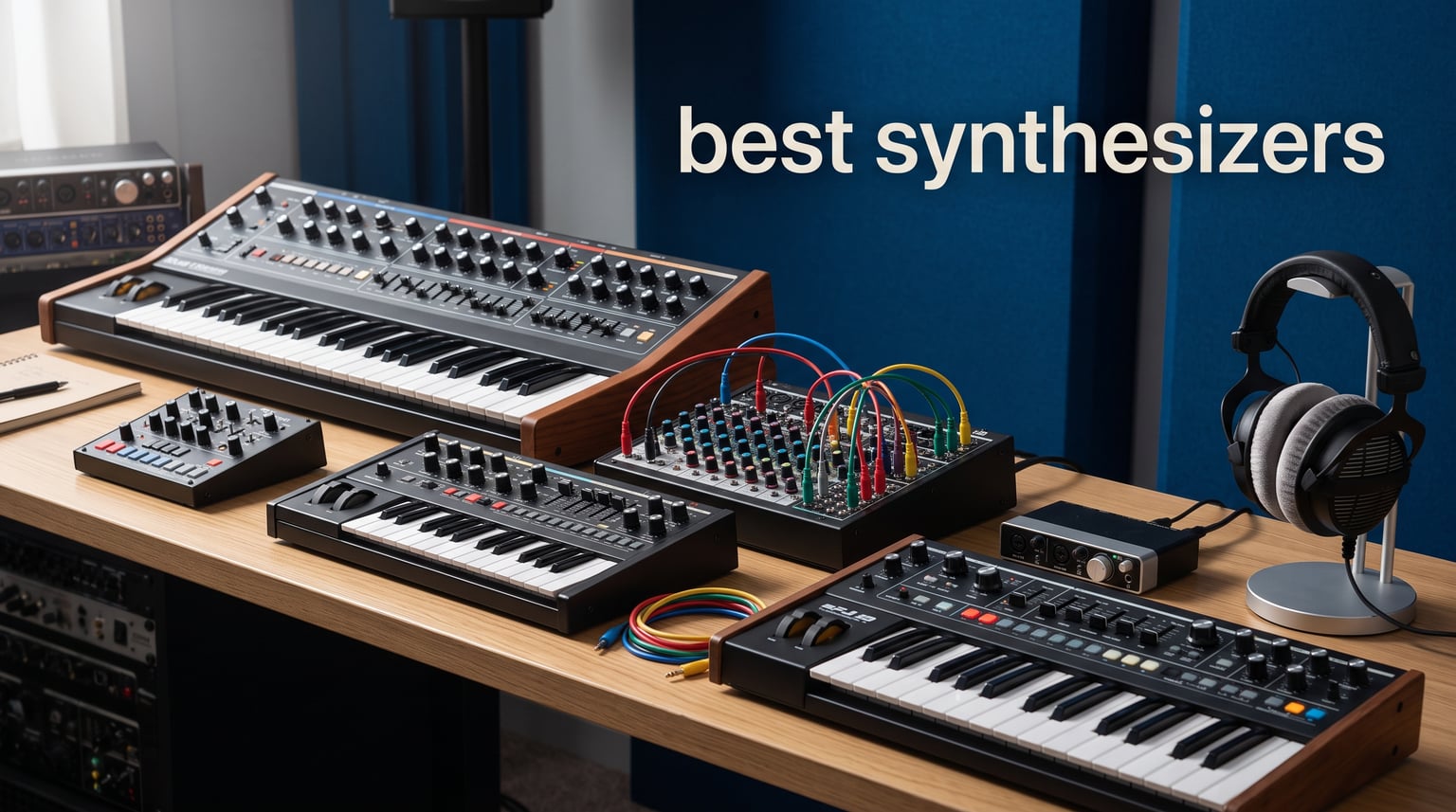
The best synthesizers 2026 do not all solve the same musical problem. An 88-key Yamaha performance instrument, a Moog monosynth, and a tiny battery-powered vector synth can all be excellent, but their sound engines, keys, controls, and musical roles are very different.
I narrowed this list by looking at what changes daily ownership: polyphony, oscillator or engine design, filter type, keybed, sequencing, patch storage, and connections. A synthesizer generates sound with analog circuitry or digital engines, then shapes it with filters, envelopes, modulation, and effects.
That practical view answers the concerns we see most often in synth discussions. Players care about key feel, dislike menus that break an idea, and usually find that hands-on control matters more than an intimidating number of presets.
New to the language of filters? Our explanation of filter cutoff and resonance makes the low-pass, ladder, and state-variable designs in this guide easier to understand.
Every product in the provided lineup appears below. There is a choice here for a pianist who needs weighted keys, a producer making bass lines, a performer who needs a broad sound library, and a beginner taking a first serious step into hardware synths.
These are the top 3 best synthesizers for 2026
The Yamaha MONTAGE M8X is the expansive 88-key performance choice, the Arturia MiniFreak is the compact hybrid pick for varied sound design, and the Behringer Pro VS Mini is the portable option for vector-style movement. Use the quick cards for direction, then read each full review to match the instrument to your actual parts.

A large keyboard is not automatically the better choice, and a compact synth is not automatically a compromise. The right format is the one that gives your hands and your workflow the most useful choices.
These 12 synthesizers cover the main needs in 2026
The comparison keeps the field in one place. It is a fast way to separate a polyphonic synthesizer for chords from a monosynth for bass and leads, or a ready-to-play digital keyboard from a patchable analog instrument.
| Product | Specifications | Action |
|---|---|---|
| Yamaha MONTAGE M8X |
|
View Product |
 Yamaha MODX M8 Yamaha MODX M8 |
|
View Product |
 MOOG Messenger MOOG Messenger |
|
View Product |
 Arturia MiniFreak Arturia MiniFreak |
|
View Product |
 Behringer Pro VS Mini Behringer Pro VS Mini |
|
View Product |
 Roland AIRA Compact S-1 Roland AIRA Compact S-1 |
|
View Product |
 Donner Essential B1 Donner Essential B1 |
|
View Product |
 Behringer PRO-800 Behringer PRO-800 |
|
View Product |
 KORG multi/poly KORG multi/poly |
|
View Product |
 MOOG Mavis MOOG Mavis |
|
View Product |
 Behringer JT Mini Behringer JT Mini |
|
View Product |
 Roland JUNO-D6 Roland JUNO-D6 |
|
View Product |
Listing ratings are included in the product cards, but they should not decide the purchase alone. Sound role, control method, and keybed fit tell you more about whether an instrument will remain useful after the first few sessions.
1. Yamaha MONTAGE M8X is the broadest performance synth pick
Yamaha Montage M8X 88-Key Flagship Music Synthesizer with GEX action featuring Polyphonic Aftertouch for New Sound Exploration and Expressive Control
400-note polyphony
3 engines
88-key poly aftertouch
Pros
- 400-note polyphony
- AN-X engine
- Seamless Sound Switching
- Polyphonic Aftertouch
- DAW plugin
Cons
- 61.9-pound body
- 88-key format
The MONTAGE M8X is for a player who needs one instrument to anchor a serious performance setup. Its 400-note total polyphony across three engines leaves room for complex layered sounds, and its AN-X engine supplies an analog-synth sound option with sophisticated modulation.
The headline feature is the GEX 88-key action with polyphonic aftertouch. Polyphonic aftertouch lets pressure change individual held notes, which is a more detailed gesture than a single global pressure response across a chord.
Seamless Sound Switching has obvious live value when a set moves between parts without an audible interruption. Dedicated Keyboard, Part, and Scene controls also point toward active performance rather than passive preset browsing.
Yamaha lists an Expanded Softsynth Plugin for DAW work, so the instrument has a documented hardware-to-software connection. Its 61.9-pound body and full dimensions make it a committed keyboard position rather than a casual desktop addition.
An 88-key expressive setup is where the M8X belongs
Choose it for piano-led arrangements, large sound layers, and players who use individual note pressure as an expressive tool. I would prioritize it where a stage or studio already has room for a full keyboard.
A compact one-voice rig is not what the M8X serves
Skip it if you only need bass, leads, or a small portable sound source. The weight, width, and full action are useful only when that comprehensive keyboard role is genuinely needed.
2. Yamaha MODX M8 is the weighted-key workstation alternative
Yamaha 88-Key Music Synthesizer, Graded Hammer Action, Realistic Feel, Performance Focused for Next Generation Sound Exploration, Expressive Control and Optimized Workflow MODX M8
3 engines
88 weighted keys
faders and Super Knob
Pros
- three sound engines
- Graded Hammer action
- eight faders
- Super Knob
- color touch screen
Cons
- 40.5-pound body
- full 88-key format
The MODX M8 combines a performance synthesizer with an 88-key Graded Hammer action that is heavier in the lower register and lighter higher up. That makes it a natural alternative for a piano-trained player who also needs synth, FM, and instrument sounds.
Its three engines cover classic analog-style sounds, modern FM synthesis, and realistic instruments. This is useful when one keyboard must move from piano to pad to a sharper electronic tone in the same set.
Eight physical faders and the Super Knob provide immediate performance control. The color touch screen and six dedicated display knobs support editing without making the physical surface feel disconnected from the sound.
The Expanded Softsynth Plugin replicates MODX M in a DAW workflow. At 40.5 pounds, it is lighter than the MONTAGE M8X but still a substantial 88-key instrument that deserves a stable place in the rig.
Weighted playing and varied sound roles suit the MODX M8
Choose this Yamaha if acoustic-piano-like response matters as much as broad synthesis. It fits performers who want faders and the Super Knob available while making changes on stage.
A small synth-action keyboard is not the MODX M8’s role
Pass if travel weight, a short key range, or a narrow desktop is the priority. The M8 is designed around a full-sized playing experience, not a compact production surface.
3. MOOG Messenger is the hands-on monophonic analog choice
MOOG Messenger Monophonic Analog Synthesizer
2 VCOs
32 full-size keys
64-step sequencer
Pros
- variable-shape VCOs
- RES BASS Compensation
- aftertouch keys
- 64-step sequencer
- CV and MIDI
Cons
- monophonic design
- 32-key range
The Messenger is a monosynth with a clear sound-design identity. Its two continuously variable-shape VCOs offer sync and frequency modulation, and a sub-oscillator adds weight for basses, leads, and single-note sequence parts.
The ladder filter has 2-pole and 4-pole low-pass modes plus band-pass and high-pass responses. RES BASS Compensation is designed to keep the low end more full-bodied as resonance rises, which is important for animated filter sweeps.
Its 32 semi-weighted full-size keys include velocity and aftertouch, while the panel uses a knob-per-function approach. That straightforward layout answers the menu-depth concern many players have when they first move to hardware.
A 64-step sequencer has probability behavior and parameter recording, and the arpeggiator has multiple patterns. Six CV patch points, external audio to the filter, pedal inputs, five-pin MIDI, and USB-C MIDI give it many studio and live connections.
A focused analog voice is why the Messenger excels
Choose it for physical bass lines, leads, and filter-driven sequences. It is a strong analog synthesizer for a producer who wants direct control and modern sequencing in one instrument.
Polyphonic chord parts are outside the Messenger’s brief
Do not choose it as your sole keyboard if pads and many-note chord voicings are central. Its monophonic design is a creative focus rather than a substitute for a polysynth.
4. Arturia MiniFreak is the compact hybrid sound-design pick
Arturia MiniFreak 37 Key Polyphonic 6-Voice Hybrid Synthesizer Keyboard (Standard, 37 Key)
6 voices
2 engines
37 aftertouch keys
Pros
- six-voice hybrid engine
- two sound engines
- aftertouch keys
- 64-step sequencer
- MiniFreak VST
Cons
- 37 slim keys
- compact key range
The MiniFreak combines two digital sound engines with an analog SVF filter in a six-voice hybrid architecture. That combination offers more starting points than a basic subtractive design while retaining a real filter stage for hands-on shaping.
Its 37 slim velocity keys include aftertouch, so it can be played as an instrument rather than treated only as a small module. I would use aftertouch here for a held note or chord that needs another layer of movement.
The 64-step sequencer turns a patch into a phrase quickly, and three effects give the sound another stage of treatment. The included MiniFreak VST counterpart creates a documented bridge between the hardware panel and DAW sessions.
Its compact format helps it fit a modest studio, but the two-engine approach still rewards learning. A beginner should expect to spend time with the engine choices, filter, sequence, and effects rather than only relying on presets.
Hybrid textures and compact chords are the MiniFreak’s strength
Choose it for evolving pads, rhythmic parts, unusual digital timbres, and six-voice chord writing. It is the most broadly experimental compact keyboard in this particular group.
Full-size piano technique is not what the MiniFreak targets
Look elsewhere if you need a 61- or 88-key full-size action. Its 37 slim keys favor portability and close-up production work over an acoustic-piano feel.
5. Behringer Pro VS Mini is the portable vector-synthesis sketchpad
Behringer Pro VS Mini Portable 5-Voice Hybrid Synthesizer with 4 Vector Morphing Oscillators Per Voice, Analog Low-Pass Filter, 16-Step Sequencer and Arpeggiator
4 vector oscillators
analog filter
16-step sequencer
Pros
- vector morphing oscillators
- analog low-pass filter
- 16-step sequencer
- arpeggiator
- battery or USB power
Cons
- 27-key layout
- short 16-step sequencer
The Pro VS Mini is about moving between oscillator characters. It has four vector-morphing oscillators per voice, wavetable synthesis, an analog low-pass filter, and envelope sections for the filter, amplifier, and oscillators.
That vector approach gives a sound a way to change rather than stay fixed on one oscillator color. It can suit shifting pads, metallic plucks, and small electronic textures that need more motion than a plain static waveform.
The 16-step sequencer and arpeggiator encourage quick repeating ideas. Battery or USB power, USB-C, Sync In, and 27 keys make it easy to position next to a laptop, a drum machine, or another keyboard.
I see this as a compact extra voice or a first hardware experiment, not a miniature workstation. Its small format is part of the appeal, but it sets sensible limits on long keyboard playing and sequence length.
Portable sound movement is where the Pro VS Mini fits
Choose it for vector-style textures, short sequences, and a small creative tool that travels well. The analog low-pass filter gives the digital oscillator sources a familiar final stage for tone shaping.
Long performances exceed the Pro VS Mini’s compact design
Skip it if you need full-size keys, spacious controls, or long pattern construction. The 27-key layout and 16-step sequencer are deliberate limits, not hidden workstation features.
6. Roland AIRA Compact S-1 is the battery-powered micro polysynth
Roland AIRA Compact S-1 Tweak Synth
4 voices
64-step sequencer
USB-C audio and MIDI
Pros
- four-voice polyphony
- D-Motion control
- 64-step sequencer
- USB-C audio and MIDI
- battery operation
Cons
- micro format
- compact controls
The Roland S-1 is a four-voice micro polysynth designed for small-space writing and quick manipulation. Its feature list includes D-Motion control, Osc Draw and Chop, a 64-step sequencer, USB-C audio and MIDI, and battery operation.
That combination makes it very different from a full-size keyboard. I would use it in a bag, connect it directly to a computer over USB-C, or add it to an already busy desk where a large instrument would get in the way.
Osc Draw and Chop offer ways to reshape the oscillator, while D-Motion adds another real-time control method. The 64-step sequencer can produce a more developed phrase than a short one-bar loop.
The tradeoff is physical scale. A micro layout can reward focused sessions, but it does not provide the widely spaced knobs and keybed room found on the larger Yamaha and Moog choices.
Mobile production is the S-1’s clearest use case
Choose it if portable power and USB-C audio matter in your computer or mobile setup. Four voices allow small chords, and the sequencer makes it useful even without another keyboard beside it.
Large controls are not part of the S-1 experience
Choose a larger instrument if a wide keybed and spacious panel are required for your live work. This is a compact instrument with a focused, portable workflow.
7. Donner Essential B1 is the focused analog bass and acid sequencer
Analog Bass Synthesizer and Sequencer, Donner Essential B1 with Intuitive User Interface, 128 Patterns Memory, Saturation & Delay Effects, Make for Classic Acid Sound
Analog signal path
128 patterns
saturation and delay
Pros
- fully analog path
- 128 pattern memory
- haptic pads
- step sequencer
- saturation and delay
Cons
- bass-focused sound role
- entry-level format
The Essential B1 has a tightly defined purpose: analog bass synthesis and programmed phrases. Its fully analog signal path, saturation, delay, haptic pads, and intuitive step sequencer point toward classic acid-style work rather than a broad keyboard role.
It stores 128 patterns, which helps preserve more than one good accident. Song Mode is listed for complex music phrases, allowing the player to connect patterns into a more complete form.
USB-C, two five-pin MIDI connections, and Sync I/O make it easier to connect within a rhythm-focused rig. Shared clock matters in this setting because drum machines, sequencers, and bass parts need to stay together.
I would use the saturation and delay as direct character tools for a line that needs to get moving quickly. Its lower-frequency-emphasized sound profile makes the B1’s intended role clear.
Acid lines and synchronized patterns suit the Essential B1
Choose it for a dedicated analog bass voice with pattern memory and direct sequencing. It belongs naturally beside drum machines and other sync-capable boxes.
Wide polyphonic arrangements are not the Essential B1’s job
Do not expect pads, large chord voicings, or a piano-style keybed. Its narrow focus is why it can work well for bass and repeating electronic phrases.
8. Behringer PRO-800 is the eight-voice analog module for chords
Behringer PRO-800 Classic Analog 8-Voice Polyphonic Synthesizer with 2 VCOs, Classic VCF, Arpeggiator, Sequencer and 400 Program Memories in Eurorack Format
8 voices
2 VCOs per voice
400 program memories
Pros
- eight-voice polyphony
- two VCOs per voice
- unison mode
- arpeggiator and sequencer
- 400 memories
Cons
- module format
- no built-in keyboard
The PRO-800 brings an eight-voice analog design to a module format. With two VCOs per voice, it can handle proper chord voicings while leaving room for detuning and thicker oscillator combinations.
Unison combines the available oscillators for broad lead and bass sounds. Saw, triangle, and pulse waveforms are listed for both oscillator sections, with a classic VCF shaping the harmonically rich starting point.
Its 400 program memories make repeatable patch recall possible, which is useful for a studio that needs to reopen a song later. The arpeggiator and sequencer add motion without requiring another machine immediately.
The supplied specifications do not list a built-in keyboard. That is ideal if you already own a controller you love, but it means a first-time buyer needs to plan the controller, MIDI route, and desk space too.
Eight analog voices make the PRO-800 good for chord parts
Choose it for pads, stacked chords, unison lines, and analog arrangements that benefit from patch recall. It is particularly logical with an existing MIDI controller or Eurorack-adjacent setup.
A self-contained keyboard rig needs more than the PRO-800
Pass if you want an integrated keybed in one box. Module format gives flexibility, but it also asks you to build the playing surface around it.
9. KORG multi/poly is the deep modern analog-modeling polysynth
Korg multipoly Analog Modeling Synthesizer w/Four Oscillators, 60 Voices and built-in KAOSS Pad
60 voices
4 oscillators
KAOSS Physics control
Pros
- 60 voices
- four oscillators
- dual filters
- five LFOs
- KAOSS Physics
Cons
- limited review sample
- deep feature set
The KORG multi/poly takes Mono/Poly-inspired analog modeling into a large modern engine. It has 60 voices, four oscillators, flexible cross-modulation and sync routing, plus round-robin oscillator triggering for changing results.
Its sound-shaping resources include dual filters, insert effects, four envelopes, five LFOs, and six modulation processors. That is a substantial toolset, so I would learn one modulation relationship at a time instead of treating every option as a task.
KAOSS Physics offers a distinctive performance-control method, while Layer Rotate and Motion Sequencing 2.0 can change a repeating part over time. Those functions suit modern electronic production where a loop should evolve without constant manual rewriting.
It has MIDI and quarter-inch jack connections listed and weighs 11.9 pounds. That is a manageable physical package for a 60-voice instrument, though it favors a player who enjoys deep exploration over a minimal panel.
Complex modulation is the multi/poly’s major attraction
Choose it when four-oscillator layers, motion sequencing, and many modulation sources sound inspiring. It suits producers building detailed pads, animated sequences, and virtual-analog textures.
A minimal learning curve is not the multi/poly’s strongest point
Pick a simpler analog monosynth if you want every main decision immediately visible. The multi/poly rewards deliberate learning because its documented architecture has real depth.
10. MOOG Mavis is the semi-modular analog learning instrument
MOOG Mavis Semi-Modular Analog Synthesizer
Semi-modular analog
2 oscillators
ladder filter
Pros
- 100 percent analog
- two oscillators with wavefolder
- ladder filter
- patch cables included
- Eurorack compatible
Cons
- assembly required
- compact built-in keyboard
The Moog Mavis is a semi-modular analog synthesizer kit that makes signal flow visible. It includes two oscillators with a diode wavefolder, a ladder filter, full ADSR envelope, sample and hold, glide, and a compact built-in keyboard.
You can start with its normal internal routing and use the supplied patch cables to change control or audio relationships. Hearing an envelope or sample-and-hold route immediately is a practical way to learn synthesis rather than memorizing terms.
Mavis is Eurorack compatible at 44HP, so it can become part of a larger modular collection. Its small size and listed 0.43-kilogram weight also make it easy to keep close as a specialized sound source.
Assembly is part of the experience. I would choose Mavis when building the kit feels like an enjoyable part of learning, not when the aim is instant full-keyboard practice.
Patchable analog lessons are the Mavis’s best reason to exist
Choose Mavis to learn wavefolding, filtering, envelopes, and patching through a physical analog instrument. The included cables offer a clear bridge from fixed routing to modular thinking.
Instant long-keyboard playing is not what Mavis offers
Skip it if assembly or the compact built-in keyboard would slow your music-making. This is an educational semi-modular voice, not a conventional polysynth keyboard.
11. Behringer JT Mini is the small three-voice analog entry point
Behringer JT Mini Polyphonic 3-voice Analog Synthesizer
3 analog voices
27 touch keys
16-step sequencer
Pros
- three-voice analog sound
- touch-sensitive keys
- state-variable VCF
- 16-step sequencer
- Sync I/O
Cons
- three-voice limit
- 27-key layout
The JT Mini gives three voices of analog synthesis in a very small instrument. Its supplied list is direct: 27 touch-sensitive keys, a state-variable VCF, a 16-step sequencer, and 3.5 mm Sync I/O.
Three voices permit compact chords and intervals, but they encourage intentional voicing rather than dense harmony. That constraint can help a beginner hear what each note contributes to a patch.
A state-variable filter broadens tone-shaping options at this scale. The sequencer and sync connections also allow the JT Mini to join a clocked hardware pattern setup instead of staying a casual standalone keyboard.
I would treat it as an accessible analog sketch tool. The compact layout makes the first steps clear, while the voice count and 27-key limit should be understood before expecting it to cover every role.
Compact analog chords and short sequences suit the JT Mini
Choose it for basic polyphonic analog sound, touch-sensitive playing, and a short sequencer in little space. It fits beginners exploring subtractive synthesis and producers adding a focused voice.
Wide voicings need more polyphony than the JT Mini has
Do not select it for complex chord extensions, dense pads, or long performance technique. Three voices and 27 keys define a concise but useful musical role.
12. Roland JUNO-D6 is the ready-to-play live keyboard choice
Roland JUNO-D6 Synthesizer, 61-Note Keyboard
61 synth-action keys
ZEN-Core
over 3800 sounds
Pros
- 61-note keybed
- ZEN-Core sound engine
- over 3800 sounds
- USB-C audio and MIDI
- WAV sample import
Cons
- synth-action keys
- limited review sample
The Roland JUNO-D6 gives a live player fast access to a large library. Its 61-note synth-action keyboard and ZEN-Core engine include over 3,800 onboard sounds for musicians who must move quickly among piano, pad, synth, and other parts.
It also supports WAV sample import for playing and editing user files. Roland Cloud Sound Packs and Wave Expansions give the owner a documented way to add content over time.
USB-C functions as an audio and MIDI interface for mobile devices and computers, and the JUNO-D6 supports USB-C mobile battery power. I would rate that highly for a player who wants fewer adapters between rehearsal, mobile writing, and computer recording.
The large sound count is useful, but it does not replace physical fit. The JUNO-D6 is strongest for broad ready-to-play coverage, not for a player who only wants a narrow analog knob panel.
Live repertoire is why the JUNO-D6 works as an all-round keyboard
Choose it when one 61-key instrument needs to cover many sound types quickly. ZEN-Core, sample import, and USB-C make it flexible for performers who switch styles often.
Weighted piano feel is not the JUNO-D6’s keybed experience
Pass if graded hammer action is essential to your technique. The synth-action format favors a lighter response and live versatility over acoustic-piano-style weight.
The right synthesizer follows your sound and playing goals
Start with the musical role rather than a long feature list. A monosynth such as Messenger handles one strong note at a time, while the PRO-800, MiniFreak, multi/poly, and Yamaha models can play several independent notes for chords and layered harmony.
Sound architecture should match the tone you want to shape
Analog synthesizers use analog circuitry in their listed signal path or oscillator and filter design. Messenger, Essential B1, Mavis, JT Mini, and PRO-800 take the more direct analog route here, though their polyphony and patching options differ sharply.
Digital engines can offer more oscillator types, modeled sounds, and stored content. The MiniFreak is hybrid because it pairs digital engines with an analog SVF filter, while multi/poly uses analog modeling with extensive modulation.
Filter labels alone do not make a decision for you. Listen for the response you enjoy when you change cutoff and resonance, then choose the instrument whose control path makes that response easy to reach.
Polyphony and keys should match the parts your hands will play
For bass, leads, and sequenced lines, a monosynth can be more satisfying than a big polysynth because every major control is focused on one voice. For pads, chord progressions, or two-handed arrangements, count available voices and assess the number and feel of the keys.
The M8X and MODX M8 suit piano-based playing with 88 weighted keys, while the JUNO-D6 offers 61 synth-action keys for broad live work. Compact 27- and 37-key models take less room, but they change how you voice and perform chords.
Aftertouch deserves a separate check. The M8X has polyphonic aftertouch for per-note pressure, while Messenger and MiniFreak list aftertouch on their keybeds; both add expression, but the polyphonic form is specifically note by note.
Direct controls should keep your ideas moving
The right workflow is often the one that prevents you from stopping to search. Messenger’s knob-per-function panel and Mavis’s patch points make cause and effect easy to follow, while MODX M8 uses faders, Super Knob, display knobs, and a touch screen for a more performance-oriented approach.
Deep instruments are not bad choices; they simply call for a different learning habit. Multi/poly and MONTAGE M8X have extensive engines, so master a few controls first rather than trying to use every modulation option at once.
Listen to real demonstrations when possible and see whether you can identify what changed when a control moves. That test is more useful than preset totals alone and reflects the long-term evidence players tend to value.
Connections should match the gear you already own
USB MIDI links a synth to a computer, while USB-C audio and MIDI on the S-1 and JUNO-D6 can simplify some recording setups. Yamaha’s Expanded Softsynth Plugin and MiniFreak VST offer stated software counterparts for owners who work both in hardware and a DAW.
Messenger’s CV points and Mavis and PRO-800 Eurorack compatibility matter to modular users. Five-pin MIDI and Sync I/O on the Essential B1, plus sync on compact Behringer models, matter when several pattern devices need a shared pulse.
Sequenced patterns have deep electronic-music roots. For context, read how the Roland TR-808 changed pop music and how the Roland TR-909 became the sound of house and techno shaped the way producers think about repeatable, synchronized parts.
A focused first synth is better than feature overload
A synthesizer for beginners should produce a useful sound quickly while leaving room to learn one new concept at a time. JT Mini is a compact analog entry point, MiniFreak offers six hybrid voices and sequencing, and Mavis teaches signal flow through patching when assembly is appealing.
Choose from the music you want to finish in the next few months. A bass writer may learn more from Essential B1 or Messenger than from a large workstation, while a songwriter needing chords and ready sounds may progress faster with JUNO-D6 or a Yamaha keyboard.
These answers settle common synthesizer questions
What are the best synthesizers for beginners in 2026?
The best beginner choice depends on the first musical task. Behringer JT Mini gives three analog voices, touch-sensitive keys, a state-variable filter, and a 16-step sequencer. Arturia MiniFreak is a better route for six voices, aftertouch, two engines, and a 64-step sequencer. Choose MOOG Mavis if patching and analog signal flow matter and assembly appeals.
What is the best analog synth in 2026?
MOOG Messenger is the strongest focused analog pick in this group for basses, leads, and sequences because it has two variable-shape VCOs, a sub-oscillator, a flexible ladder filter, full-size aftertouch keys, and a 64-step sequencer. For polyphonic analog parts, the eight-voice Behringer PRO-800 is more suitable. The answer depends on whether you need one note at a time or chords.
What is the best mini synth in 2026?
Behringer Pro VS Mini is the compact choice here for vector-style movement, with four vector-morphing oscillators per voice, an analog low-pass filter, a sequencer, and battery or USB power. Roland AIRA Compact S-1 is better for a four-voice micro polysynth with USB-C audio and MIDI plus a 64-step sequencer. Choose by sound approach, not size alone.
What is a strong keyboard synthesizer for a limited budget?
Arturia MiniFreak is a compelling keyboard synth in this group when you want six-voice hybrid synthesis, 37 aftertouch keys, dual engines, an analog filter, and a 64-step sequencer. Roland JUNO-D6 suits players who need 61 synth-action keys, a broad ZEN-Core library, sample import, and USB-C audio and MIDI. The better choice depends on sound-design depth or ready-to-play coverage.
Which synth is best for professionals?
Yamaha MONTAGE M8X is the professional performance choice here when an 88-key GEX action, polyphonic aftertouch, three engines, 400-note total polyphony, and Seamless Sound Switching matter. Yamaha MODX M8 is another strong direction for graded hammer action, three engines, physical faders, and a Super Knob. Choose by keybed, stage workflow, and sound role.
The strongest choice depends on how you create
The MONTAGE M8X is our broadest recommendation for players who need an expressive 88-key performance center. Choose MiniFreak for compact hybrid sound design, Messenger for a hands-on analog monosynth, PRO-800 for analog chords with an existing controller, or JUNO-D6 for broad ready-to-play live coverage.
The best synthesizers 2026 are the ones that make you want to turn a control, record a phrase, and return with another idea. Match the keybed, sound engine, and connection options to the music you actually make, then use the relevant product card above to check the current listing.