
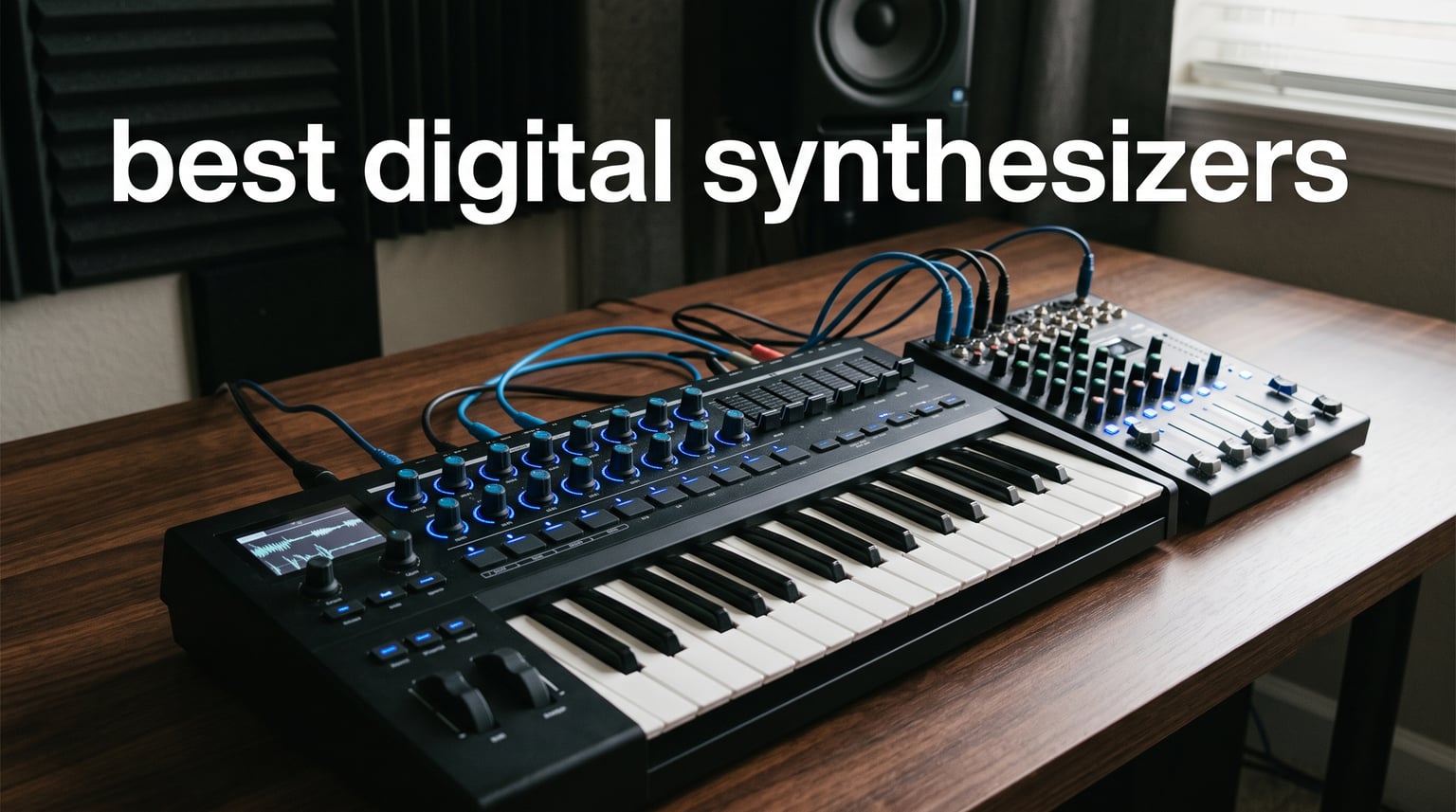
The best digital synthesizers give you a wide palette of sounds, dependable patch recall, and a workflow that fits the way you make music. For most players, I would start with the Arturia MiniFreak for its two engines, aftertouch-equipped 37-key layout, sequencer, effects, and included software counterpart; players who need weighted piano-style keys should look closely at Yamaha’s MODX M8.
A digital synthesizer uses digital signal processing to calculate sound with algorithms rather than electrical circuits. That can mean FM synthesis, wavetable synthesis, analog modeling, sample-based tones, or more than one approach in the same hardware synth.
I ranked these 12 instruments by the supplied specifications, control layout, keybed or pad format, sequencing and connectivity, verified listing ratings, and their likely role in studio production or live performance. If you want the larger story behind those instrument families, our guide to the evolution of synthesizers is useful context, while our electronic music production guides collect practical next steps.
One warning matters before you choose: a larger sound list does not automatically mean a better fit. Forum discussions repeatedly point to menu-heavy interfaces as a frustration, so I have called out hands-on controls, compact layouts, and software integration where the product data supports it.
Table of Contents
The top 3 picks are the MiniFreak, MODX M8, and MicroFreak
The MiniFreak is the strongest all-round digital and hybrid synth choice here, the MODX M8 is the pick for expressive weighted-key performance, and the MicroFreak puts experimental oscillator modes and modular-friendly connections into a very small instrument.

These 12 digital synthesizers cover portable, performance, and studio roles in 2026
This overview favors real product distinctions over vague rankings: keyboard feel, sound engine, sequencing, effects, and I/O decide more than a long feature list. The comparison below includes every instrument reviewed in this guide.
| Product | Specifications | Action |
|---|---|---|
| Arturia MiniFreak |
|
View on Amazon |
 Yamaha MODX M8 Yamaha MODX M8 |
|
View on Amazon |
 Arturia MicroFreak Arturia MicroFreak |
|
View on Amazon |
 Novation MiniNova Novation MiniNova |
|
View on Amazon |
 Yamaha reface DX Yamaha reface DX |
|
View on Amazon |
 Yamaha MX88 Yamaha MX88 |
|
View on Amazon |
 Yamaha PSR-E583 Yamaha PSR-E583 |
|
View on Amazon |
 Korg Volca FM2 Korg Volca FM2 |
|
View on Amazon |
 Roland AIRA Compact S-1 Roland AIRA Compact S-1 |
|
View on Amazon |
 Roland GO:KEYS 5 Roland GO:KEYS 5 |
|
View on Amazon |
 Roland E-X50 Roland E-X50 |
|
View on Amazon |
 Roland JUNO-D6 Roland JUNO-D6 |
|
View on Amazon |
1. Arturia MiniFreak is the most balanced hybrid choice
Arturia MiniFreak 37 Key Polyphonic 6-Voice Hybrid Synthesizer Keyboard (Standard, 37 Key)
6 voices
37 aftertouch keys
2 engines
64-step sequencer
Pros
- Hybrid six-voice design
- Aftertouch-equipped keys
- Two sound engines
- Sequencer and effects
- Software counterpart
Cons
- Slim keys are not full size
- Listings label it beginner level
I put the MiniFreak first because its supplied feature set answers the needs of a player who wants to create rather than merely scroll through presets. Its six-voice hybrid architecture, two engines, state-variable filter, three effects, and 64-step sequencer make it a compact instrument with room for melodic, rhythmic, and texture-focused work.
The 37 slim velocity-sensitive keys include aftertouch, which gives a performer an extra route for expression after a note is pressed. Its 4.7 rating from 140 reviews is a strong signal in this group, although a rating is not a substitute for deciding whether slim keys suit your hands.
The included MiniFreak VST counterpart matters if your ideas move between a desk and a DAW. I like that the listing describes USB connectivity and the software pairing together, because it points to a practical hardware-and-computer workflow rather than an isolated box.
For the best digital synthesizers category, it is the most complete starting point for people who want hybrid sound design, playable keys, and an onboard sequence tool in one unit. It does not ask you to commit to a single synthesis method before you know which sounds you enjoy making.
The MiniFreak suits producers who want one compact sound-design center
I would choose it for electronic music producers building basses, leads, animated pads, and sequences without taking up a full keyboard stand. The dual-engine design gives you a broader starting point than a single-method synth, while the 64-step sequencer supports sketches away from a computer.
It also fits players who value expressive control but do not need an 88-key instrument. Aftertouch is a useful feature to have when you want movement in sustained notes without changing your hand position.
The MiniFreak asks traditional pianists to accept slim keys
The main decision point is physical: these are 37 slim keys, not a weighted piano action. A pianist who practices two-handed repertoire may outgrow that span quickly, even if the sound engine is appealing.
The listing also identifies it as beginner level, so advanced users should inspect its workflow and depth in person rather than treating the label as a ceiling or guarantee.
2. Yamaha MODX M8 is the 88-key performance workstation choice
Yamaha 88-Key Music Synthesizer, Graded Hammer Action, Realistic Feel, Performance Focused for Next Generation Sound Exploration, Expressive Control and Optimized Workflow MODX M8
88 graded-hammer keys
3 sound engines
Super Knob
ESP integration
Pros
- Graded Hammer action
- Three sound engines
- Eight faders and Super Knob
- Touch display
- ESP DAW support
Cons
- Weighs 40.5 pounds
- Designed for professional players
The MODX M8 is the clear choice when expressive piano-style playing has equal status with synthesizer programming. Its 88-key Graded Hammer action, three sound engines, color touch screen, eight physical faders, and Super Knob put it in a different working category from the compact models.
I see its stated 40.5-pound weight as a serious planning detail, not a footnote. The listing calls it lightweight, but a player moving it alone should still consider the size of the instrument, the stand, and the travel route.
Yamaha also lists an Expanded Softsynth Plugin for MODX M as supported software. That makes the MODX M8 especially interesting for a producer who wants a hardware performance surface while maintaining a route into a DAW-based session.
Its verified listing rating is 4.9 from 13 reviews, which is encouraging but a small review base compared with several compact synths here. I would give more weight to the verified action, engine, fader, and integration specifications than to a small-sample rating.
The MODX M8 serves keyboard players who need sound range and weighted action
This is the one I would shortlist for stage parts that move from realistic instruments to FM, analog-style, and synth textures in the same set. The broad sound profile and performance controls support fast changes in a live context.
Studio players who record keys in layers also benefit from an 88-key range. The dedicated display knobs and faders suggest more immediate control than relying only on a screen.
The MODX M8 requires space and a deliberate transport plan
Its 57.5-inch depth-by-width listing footprint and 40.5-pound stated weight make this a substantial keyboard. It is better for a stable home setup or planned performance rig than for a player who needs to work from a very small desk.
Its professional skill-level label and deep engine count also mean that a first-time synth buyer may need time with the manual and the front panel before the full range becomes comfortable.
3. Arturia MicroFreak delivers experimental voices in a tiny format
Arturia MicroFreak Synthesizer Keyboard
17 oscillator modes
25 poly-aftertouch keys
analog filter
CV USB MIDI
Pros
- Seventeen oscillator modes
- Polyphonic aftertouch
- CV for modular gear
- Analog filter
- Sequencer modulation matrix
Cons
- Touch keyboard feels unfamiliar
- Feature depth rewards patience
The MicroFreak has a distinct identity: 17 paraphonic oscillator modes, a capacitive 25-key touch keyboard with polyphonic aftertouch, a resonant 12 dB SEM-style analog filter, and a 5-by-7 modulation matrix. I would choose it when unusual timbres and modulation ideas matter more than conventional key action.
Its oscillator list includes Arturia, Mutable Instruments, and Noise Engineering modes, which gives sound designers many sources to explore before the filter and matrix do their work. The Spice and Dice functions add variation to the sequencer, a helpful prompt when a loop is technically correct but too static.
CV outputs alongside USB and MIDI make it more flexible than its two-pound listed weight suggests. That is a real advantage for a hybrid synthesizer setup that includes modular gear as well as a computer.
The 4.6 rating across 869 reviews is the largest review base in this list, so there is more aggregate buyer feedback behind it than many newer models. Community discussion also praises its experimental scope, while the nontraditional keyboard remains the point to try before committing.
The MicroFreak works best for modular-minded sound explorers
I would place it beside a modular synth, a groovebox, or a DAW rig where CV, MIDI, and USB all have a role. Its touch surface and polyphonic aftertouch invite playing gestures that do not feel like standard keyboard performance.
It is also a strong fit for ambient music, unusual leads, percussion-like textures, and evolving sound effects. The modulation matrix gives a clear place to turn an interesting oscillator setting into a moving patch.
The MicroFreak does not replace a conventional keyboard
The PCB touch keyboard is intentionally different from a spring or weighted action. Players who need familiar velocity response under full-size keys should treat it as a specialist synth rather than their only controller.
Its advanced skill-level label is fair: the panel is approachable, but making the most of 17 modes, CV, and matrix routing takes curiosity and repeated listening.
4. Novation MiniNova makes vocal effects and presets easy to reach
Novation MiniNova Analog Modeling Synthesizer
18 voices
256 presets
VocalTune vocoder
8 Animate buttons
Pros
- Eighteen-voice engine
- Large preset library
- Vocoder and microphone
- Eight performance buttons
- MIDI and USB
Cons
- Plastic body
- Mini-key layout
The MiniNova is a compact analog-modeling synth with an Ultranova-derived engine and 18 voices. Its supplied 256 factory presets and 128 user slots make it a practical pick for a player who needs many immediate starting sounds but also wants room to save edited patches.
I think the included gooseneck microphone makes its vocoder and VocalTune capability the defining difference. A vocal effect is not an extra you will use once; for electronic hooks, processed spoken parts, or live transitions, it can shape the entire arrangement.
Five effects per voice layering and eight backlit Animate buttons add performance tools without asking you to bring external pedals. The 4.6 average from 277 reviews supports the impression of an established compact instrument.
The listing does specify a plastic body and the instrument is a mini-key synth. Those are reasonable tradeoffs for a six-pound unit, but they tell a different story from a metal-cased desktop instrument or a full-size keyboard.
The MiniNova favors performers who want a vocoder in the keyboard
I would pick the MiniNova for dance-pop, electro, and live electronic sets that use processed voice as a musical layer. The supplied mic and pitch-correcting vocal effect reduce the amount of gear needed to explore that route.
The Animate buttons also make sense for a player who wants obvious performance gestures rather than an interface built around deep patch construction.
The MiniNova suits preset-led players more than heavy keyboard technique
Its 256 onboard sounds, user storage, and effects layers make it easy to begin with a recognizable shape and refine it. That favors songwriters and producers who want a fast palette.
Players looking for a weighted action, full-size keys, or a metal chassis should continue to the Yamaha workstation and weighted-key options instead.
5. Yamaha reface DX makes four-operator FM portable
Yamaha REFACE DX Portable FM Synthesizer
4-operator FM
37 mini keys
phrase looper
battery-powered speakers
Pros
- Four-operator FM engine
- Built-in speakers
- Phrase looper
- Battery portability
- Thirty-two memory locations
Cons
- Mini keys
- Thirty-two memory locations only
The Yamaha reface DX makes FM synthesis less imposing by putting a four-operator engine, 37-key HQ mini keyboard, 32 voice memory locations, and phrase looper into a battery-powered format. FM builds tones by modulating one oscillator with another, producing bell-like, electric-piano, bass, metallic, and synthetic colors that subtractive designs do not naturally start with.
I like its built-in speaker system for a simple reason: it removes a barrier between an idea and hearing it. A small synth with speakers and battery power can be played in a room, on a couch, or away from a studio monitor chain.
The integrated phrase looper is also more useful than a static preset bank for learning FM. You can repeat a part, change an operator setting, and hear the result in context instead of judging a patch as a disconnected note.
It holds a 4.6 rating from 178 reviews. Its mini keys remain the decision point, since players with a traditional technique may enjoy the sound engine but want a larger controller for detailed parts.
The reface DX is a practical first hardware FM synth
I would choose it for a beginner who specifically wants to understand FM synthesis through a physical instrument, or for a producer who needs portable FM tones in a small rig. The all-skill-level designation, speakers, and looper support that use.
It also fits live electronic musicians who need a compact extra voice rather than another full-size keyboard. Battery operation and its six-pound listed weight make that plausible.
The reface DX limits long-term patch storage and key range
Thirty-two voice memory locations are enough for a focused set of patches, but not a huge personal library. Players who save many variations should adopt a sensible naming and backup habit.
The 37-key mini layout is comfortable for leads and compact chord shapes, yet it is not designed for broad two-handed arrangements.
6. Yamaha MX88 combines weighted keys with a Motif sound engine
Yamaha MX88 88-Key Weighted Action Synthesizer, MX88BK
88 weighted keys
Motif engine
128 voices
USB audio MIDI
Pros
- Weighted 88-key action
- Motif sound engine
- 128 voice polyphony
- USB audio and MIDI
- VCM effects
Cons
- Weighs 30.64 pounds
- Large physical footprint
The MX88 is a useful middle ground for a keyboard player who wants an 88-key weighted action and a broad digital sound source. Its Motif sound engine, 128-voice polyphony, vintage-effects modeling, and USB audio/MIDI features make it more than a piano-style controller.
I would pay attention to the phrase “dropout-free performance” in the supplied listing because layered sounds can test polyphony quickly. A 128-voice specification gives more headroom for sustained pads, complex chords, and instrument layers than the compact six-voice devices in this guide.
USB audio and MIDI help the MX88 serve a music production setup without requiring separate routing for basic recording and control tasks. Its 4.6 rating from 150 reviews gives it a solid verified-feedback base.
At 30.64 pounds, it is lighter than the MODX M8 but it is still an 88-key instrument. I would think of it as a permanent studio keyboard that can travel when necessary, not a grab-and-go synth.
The MX88 supports players who write with piano and layered sounds
This is a good match for a songwriter, arranger, or stage player who needs a familiar weighted range for both piano material and synthesized textures. The Motif engine makes a broad sound palette available from the same keyboard.
It also makes sense for DAW users who prefer one central keyboard rather than a separate piano controller and compact synth.
The MX88 trades compactness for a full playing surface
The 52-inch listed width dictates a real stand and a dedicated place in the room. If your work area is a desk with limited clearance, a smaller synth plus controller may be easier to live with.
Its value lies in the weighted action and polyphony; players who mostly sequence short monophonic lines may not need that form factor.
7. Yamaha PSR-E583 helps songwriters turn accompaniment into arrangements
Yamaha PSR-E583, 61-Key Touch-Sensitive Portable Keyboard with Premium Sound, Music Rest and Power Adapter
61 touch-sensitive keys
890 voices
345 styles
live controls
Pros
- Eight hundred ninety voices
- Three hundred forty-five styles
- Touch-sensitive keys
- Live Control Knobs
- Auto Chord Play
Cons
- More arranger than synth
- Small review base
The PSR-E583 is not a conventional deep-programming synth, but it belongs in this roundup for a musician who needs a digital keyboard that produces complete musical ideas quickly. It offers 61 touch-sensitive keys, 890 instrument voices, 345 accompaniment styles, live control knobs, wheels, and digital effects.
I see Auto Chord Play as the feature that clarifies its audience. It can support a player developing chord vocabulary, a songwriter auditioning progressions, or a performer building a backing arrangement without manually programming every accompaniment event.
The Mega Boost function and built-in speaker approach support immediate room playback. USB connectivity gives it a straightforward path to a computer, while the supplied music rest and power adapter mean the listed package is ready for basic use.
Its 4.6 rating comes from 22 reviews, so the sample is small. I would make the decision from its voice-and-style workflow rather than assuming it is a replacement for a dedicated wavetable or FM programming instrument.
The PSR-E583 helps beginners build full songs from chord ideas
I would recommend it to a newer player who wants feedback from a full accompaniment while learning keyboard parts. The large voice library and style count give many arrangement colors without requiring sound-design experience.
It can also work as a sketch keyboard for producers who want to record a progression before replacing or layering sounds in a DAW.
The PSR-E583 is not the choice for deep synth patch programming
Its strongest supplied features are voices, styles, performance-assisting tools, and accompaniment. A producer focused on oscillator design, modulation matrices, or FM operators will get more direct synthesis control from the Arturia, Korg, or Yamaha FM choices.
That distinction is not a flaw; it simply keeps the instrument in the right role.
8. Korg Volca FM2 puts six-voice FM sequencing in a desktop unit
Korg Volca FM2 Digital Synthesizer w/ 6 Voices and 16-step Sequencer
6-voice FM
16-step sequencer
motion sequence
battery power
Pros
- Six-voice FM
- Motion sequence recording
- Built-in chorus and reverb
- Sixteen-step sequencer
- Battery powered
Cons
- Tiny desktop layout
- No traditional keyboard
The Volca FM2 is the dedicated compact FM option: six voices, a 16-step sequencer, motion sequence recording, built-in chorus and reverb, MIDI, and battery power. It keeps the focus tight, which I find helpful for a musician who wants to make sequences rather than manage a massive workstation.
Motion sequencing records parameter movement, so a loop can change over time without external automation. That is a powerful way to introduce motion to FM sounds, whose harmonic character can respond dramatically to small parameter shifts.
At a listed 14.1 ounces with a metal body, it is remarkably easy to place in a small hardware rig. The supplied package includes six AA alkaline batteries, a sync cable, and parameter list, reinforcing its role as a portable sequence source.
The 4.5 rating from 250 reviews makes it one of the better-supported small desktop options here. Still, no traditional keyboard is specified, so it is best approached as a sequencer-driven module or companion to MIDI gear.
The Volca FM2 suits beat makers who want a focused FM voice
I would use it for electronic dance music patterns, digital percussion, sharp basses, and glassy chord loops. The 16-step sequencer and motion recording make it easy to build a repeating idea with changing tone.
It is especially logical beside other compact machines where MIDI and the included sync cable can coordinate a small performance setup.
The Volca FM2 needs external keys for traditional playing
This is not the unit for a pianist who wants to perform extended parts directly from a keyboard. Its strength is compact sequencing and FM texture, not a wide playing surface.
Its concise interface can also mean learning through the parameter list. That tradeoff is reasonable if you want a purpose-built desktop instrument, less so if you want immediate visual explanation.
9. Roland AIRA Compact S-1 is the pocket-sized sequencer synth
Roland AIRA Compact S-1 Tweak Synth
4 voices
D-Motion control
64-step sequencer
USB-C audio MIDI
Pros
- One-pound portable build
- D-Motion gestures
- Sixty-four-step sequencer
- USB-C audio and MIDI
- Battery operation
Cons
- Micro format controls
- Four voices
The Roland AIRA Compact S-1 is a four-voice micro polysynth with a 64-step sequencer, Osc Draw and Chop tools, D-Motion sound control, USB-C audio/MIDI, and a stated 4.5-hour battery. At one pound, it is the most travel-oriented digital synth in this collection.
I think D-Motion is its standout control concept because it turns physical movement into sound changes. That can be more inviting for performance gestures than a dense menu, particularly when you are trying to add variation to a sequence in real time.
USB-C audio and MIDI matter because this can connect directly to a mobile device or computer workflow without an additional audio interface for basic capture. Its 4.5 rating from 200 reviews suggests a useful body of buyer experience for such a compact design.
Four voices set a firm boundary: it can make chords, but dense sustained harmony will need careful voicing. I would treat it as a micro performance synth and sequence tool rather than an all-purpose keyboard.
The S-1 is best for mobile ideas and compact live rigs
I would choose it for travel, short writing sessions, or a hardware setup where every inch and pound matters. Battery operation, USB-C, and the 64-step sequencer all reinforce that purpose.
It also fits a producer who enjoys translating motion into modulation. The gesture-based D-Motion feature gives it a different physical relationship to sound than the knob-and-keyboard instruments above.
The S-1 demands comfort with a small control surface
A micro synth necessarily compresses its controls. Players who want a wide keyboard, lots of faders, or deep editing with every parameter visible will be more comfortable with the MiniFreak or a workstation.
The four-voice specification is also enough for compact musical ideas, but not a substitute for the expansive polyphony of the MX88.
10. Roland GO:KEYS 5 turns ZEN-Core sounds into easy song starts
Roland GO:KEYS 5 Music Creation Keyboard, 61-Note, Graphite
61 keys
ZEN-Core
1000 plus sounds
Bluetooth and mic input
Pros
- Over one thousand sounds
- Two hundred plus styles
- Bluetooth audio and MIDI
- Built-in speakers
- Microphone input
Cons
- Lower 4.3 rating
- Not a deep synth interface
The GO:KEYS 5 centers on immediate music creation with 61 notes, more than 1,000 Roland ZEN-Core sounds, more than 200 auto-accompaniment styles, built-in stereo speakers, Bluetooth audio/MIDI, and a mic input with effects. I would frame it as a song-building keyboard with genuine synth content rather than a bare synthesizer module.
Bluetooth audio lets you stream music into the instrument, while Bluetooth MIDI creates an accessible connection to compatible music apps. Those options can simplify practice and idea capture for a new producer who does not want a complex cable setup on day one.
The mic input with effects can turn this into a compact writing station for vocal ideas, not only keyboard parts. Its listing supports battery-powered or corded use, giving it more placement flexibility than a mains-only keyboard.
The verified rating is 4.3 across 156 reviews, lower than several alternatives here, and the supplied review data notes some reports of issues. I would weigh that signal carefully against how much you value speakers, Bluetooth, styles, and the ZEN-Core sound library.
The GO:KEYS 5 is strongest for accessible songwriting and practice
I would recommend it to a beginner, singer-songwriter, or family musician who wants to turn a chord progression into a fuller arrangement without learning a workstation immediately. Built-in speakers and accompaniment make that possible with minimal setup.
Its large Roland sound collection can also serve a producer who needs broad sketch sounds before finishing details in software.
The GO:KEYS 5 favors finished-song tools over synthesis depth
Its specified strengths are sounds, styles, Bluetooth, speakers, and vocal input. If your goal is to shape oscillators and modulation routes from scratch, the MicroFreak or MiniFreak gives a more direct sound-design path.
This is a good reminder that “digital synth” can describe very different workflows, even when both products make electronic sounds.
11. Roland E-X50 provides accompaniment and amplified keyboard performance
Roland E-X50 Electronic Arranger Keyboard – Easy-to-use | Stereo Speakers | Bluetooth | Professional Roland Sounds | Mic Input | Auto-accompaniment Function
61 keys
700 plus tones
300 styles
Bluetooth mic effects
Pros
- Professional Roland sounds
- Stereo speakers
- Over seven hundred tones
- Three hundred styles
- Bluetooth and mic effects
Cons
- 4.1 rating
- Arranger-focused workflow
The Roland E-X50 is an arranger keyboard designed around easy use, professional Roland sounds, onboard stereo speakers, Bluetooth, microphone input with effects, and auto-accompaniment. It adds nearly 700 additional tones, 300 music styles, and a recording feature to a 61-key format.
I would look at its independent woofer and tweeter arrangement if you plan to play without monitors. Speaker quality cannot be judged from a specification alone, but the dedicated two-part system is a meaningful design point compared with a keyboard that merely includes small speakers.
Rich acoustic pianos and broad accompaniment tools make the E-X50 suited to a player who performs complete keyboard parts, rather than a producer who only needs a compact sound module. Bluetooth audio and a mic input with effects extend that all-in-one role.
Its 4.1 average from 128 reviews is the lowest rating in the roundup. I would therefore choose it for its documented arranger and self-contained performance features, not simply because it is labeled with Roland sounds.
The E-X50 supports solo players who need backing and vocals
I would consider it for solo entertainment sets, rehearsal rooms, and home writing where keyboard parts, accompaniment, playback, and a microphone all need to coexist. The recording feature can also preserve an arrangement idea without a separate computer.
Its 300 styles make it more appropriate for a player who benefits from genre-aware backing than someone programming every note in a sequencer.
The E-X50 is less convincing as a specialist synth purchase
The feature list leads with accompaniment, tones, speakers, and vocal support rather than oscillator models or deep modulation. A dedicated synthesis learner will find more direct educational value in the reface DX, Volca FM2, or Arturia designs.
The 4.1 rating also merits a close read of current verified feedback before you decide that its all-in-one convenience fits your work.
12. Roland JUNO-D6 supplies a large ZEN-Core library for modern rigs
Roland JUNO-D6 Synthesizer, 61-Note Keyboard
61 synth-action keys
3800 plus sounds
USB-C audio MIDI
sample import
Pros
- More than 3800 sounds
- Sixty-one synth-action keys
- USB-C audio and MIDI
- Sample import
- Roland Cloud support
Cons
- 4.1 rating
- Small review base
The JUNO-D6 is a gig-ready 61-note synthesizer with synth-action keys, Roland’s ZEN-Core engine, more than 3,800 onboard sounds, USB-C audio/MIDI, sample import, and Roland Cloud support. I would shortlist it for a player who needs quick access to a very broad palette from a lightweight 12.79-pound keyboard.
Sample import is the feature that separates it from a fixed preset keyboard. It gives a producer a route to bring personal sounds into the instrument, while Sound Packs and Wave Expansions on Roland Cloud provide a path to expand the supplied library.
The USB-C audio/MIDI interface is useful for mobile devices and computers, and the listing says it supports USB-C mobile battery power. Those details make the JUNO-D6 more adaptable to current studio and stage connections than older keyboard designs.
Its 4.1 rating is based on 34 reviews, so I would call it a promising but relatively lightly reviewed option in this selection. The sound count and connectivity are verified listing strengths; long-term user consensus will need a larger review pool.
The JUNO-D6 suits performers who change sounds quickly
I would choose the JUNO-D6 for a covers player, worship musician, electronic performer, or producer who needs broad instrument categories in a single 61-key board. Instant access to essential sounds and a large ZEN-Core library suit that fast-switching job.
It is also a sensible candidate for a computer-centered rig, since USB-C handles both audio and MIDI while sample import keeps the palette personal.
The JUNO-D6 needs hands-on evaluation for its workflow depth
Its specifications suggest a modern, broad instrument, but a large sound library can still involve browsing and organization. Try its navigation if you are specifically trying to avoid menu diving.
The smaller 34-review base and 4.1 average mean I would prioritize a current hands-on trial and recent owner feedback over any simple rank number.
The right digital synthesizer depends first on synthesis and playing workflow
A digital synthesizer is best chosen by deciding what you need to make in the next session. Start with the sound method, then keyboard or desktop format, controls, sequencing, connectivity, and the role the instrument will play beside your DAW, speakers, or other hardware.
FM synthesis makes bright, precise, and evolving harmonic tones
FM synthesis uses one oscillator to modulate another, producing harmonic complexity that can feel crisp, metallic, bell-like, glassy, or distinctly electronic. The Yamaha reface DX makes this method portable with four operators and a looper, while the Korg Volca FM2 applies six-voice FM to a sequencer-led desktop format.
Choose FM when you want electric-piano colors, digital basses, percussion, or tones that change sharply as a modulation amount moves. It can be less intuitive at first than a filter-based subtractive synth, so a clearly focused interface and repeated listening matter.
Wavetable and hybrid designs make broad sound design easier to explore
Wavetable synthesis scans or moves through stored waveform shapes, creating timbral motion that suits pads, leads, basses, and experimental textures. The MicroFreak offers wavetable and other digital oscillator modes before its analog filter, while the MiniFreak combines two engines, a filter, effects, and a sequencer.
Choose a hybrid synthesizer when you do not want one method to define every patch. I find a dual-engine design useful for producers who alternate between conventional sounds and unusual textures in the same track.
Analog modeling and ZEN-Core engines favor wide preset palettes
Analog modeling uses digital processing to emulate aspects of analog-style sound behavior. The MiniNova’s Ultranova-derived engine, vocoder, presets, and Animate buttons create a performance-friendly version of that approach.
Roland’s ZEN-Core-based GO:KEYS 5 and JUNO-D6 instead emphasize broad sound libraries and practical creative tools. This can be the correct choice when you need pianos, synths, accompaniment, and effects in one board, but it is different from learning oscillator and filter design from the ground up.
Hands-on controls are the direct antidote to menu fatigue
Forum users repeatedly describe menu diving as a major digital-synth pain point. You can reduce it by identifying which changes you make most often and buying the interface that puts those changes within reach: the MODX M8 lists eight faders, a Super Knob, a touch screen, and dedicated display knobs; the MiniNova lists eight Animate buttons; the S-1 uses D-Motion.
A small display is not automatically a problem, and lots of knobs are not automatically simple. The useful question is whether you can change the sound, performance setting, or sequence step you care about without breaking the musical moment.
Keyboard action and note range decide whether an instrument becomes your main board
Choose the MODX M8 or MX88 when 88 weighted keys are central to your playing. Both Yamaha models give pianists room for two-handed arrangements; the MODX M8 adds three engines, faders, Super Knob control, and ESP integration, while the MX88 lists the Motif engine and 128-voice polyphony.
Choose 37-key models when you prioritize a smaller footprint for leads, chords, and focused parts. Mini keys on the MiniFreak, MiniNova, and reface DX save space, but they are a personal feel decision rather than a specification to overlook.
Desktop and micro models such as the Volca FM2 and AIRA Compact S-1 make the most sense when sequencing, MIDI input, or a portable setup matters more than traditional keyboard technique. The MicroFreak offers a third path with a 25-key touch plate and polyphonic aftertouch.
Sequencing and connectivity decide how the synth joins your existing setup
An onboard sequencer can turn a patch into a track idea without opening software. The MiniFreak and S-1 have 64-step sequencers, the Volca FM2 has 16 steps plus motion sequencing, and the MicroFreak adds Spice and Dice variation to its sequencer.
For a DAW-centered studio, USB MIDI is a baseline convenience, while USB audio can reduce routing friction. The MX88 lists USB audio/MIDI, the S-1 lists USB-C audio/MIDI, and the JUNO-D6 lists a USB-C audio/MIDI interface; check your computer and mobile-device ports before building your rig around one connection type.
For modular synth owners, the MicroFreak’s CV outputs deserve special attention. For writing tracks around bass movement, drops, and sound transitions, our tutorial on sound design techniques shows how a synth choice translates into an arrangement decision.
Genre fit should guide the first patch, not limit the instrument
For ambient music, I would start with the MiniFreak or MicroFreak because their engine variety and modulation options support evolving timbres. For FM bass, glassy keys, and rhythmic patterns, the reface DX and Volca FM2 are the natural short list.
For a complete live keyboard role, the MODX M8, MX88, and JUNO-D6 have the range and broad sound resources to cover many parts. For songwriting with accompaniment and vocals, the PSR-E583, GO:KEYS 5, and E-X50 provide more immediate backing tools.
Do not let genre labels trap you. The deciding test is whether the controls and sound engine help you finish the part you hear in your head.
These answers address the most common digital-synth questions
What is Hans Zimmer’s favorite synth?
The supplied research does not document one confirmed favorite synthesizer for Hans Zimmer. Rather than assign him a model without a verified source, choose a synth by its sound engine, key action, controls, and workflow.
What synth does Billie Eilish use?
The supplied research does not verify a particular synthesizer used by Billie Eilish. Her equipment choices should be confirmed from a reliable, current interview or official production credit instead of a product roundup.
What synth does Lady Gaga use?
The supplied research does not identify a verified synthesizer model used by Lady Gaga. A practical choice is to compare instruments by the sound and performance role you need, rather than copying an unverified celebrity gear claim.
What is the best synthesizer brand?
There is no single best synthesizer brand. Arturia is a strong fit for experimental hybrid sound design, Yamaha suits FM and weighted-key performance, Korg offers compact FM sequencing, Novation favors vocoder-led performance, and Roland provides broad ZEN-Core and arranger workflows.
The best choice is the synth that supports the parts you actually play
The Arturia MiniFreak is my all-round recommendation because it brings hybrid engines, aftertouch, effects, sequencing, and a software counterpart into one focused instrument. Choose the Yamaha MODX M8 when weighted 88-key performance and deep expression lead your priorities, or the MicroFreak when experimental oscillator modes and CV matter most.
The best digital synthesizers in 2026 are not interchangeable. Decide whether you need FM character, wavetable movement, a broad preset library, accompaniment tools, a sequencer, or a full piano-style keybed, then choose the product section above that matches your next piece of music.