
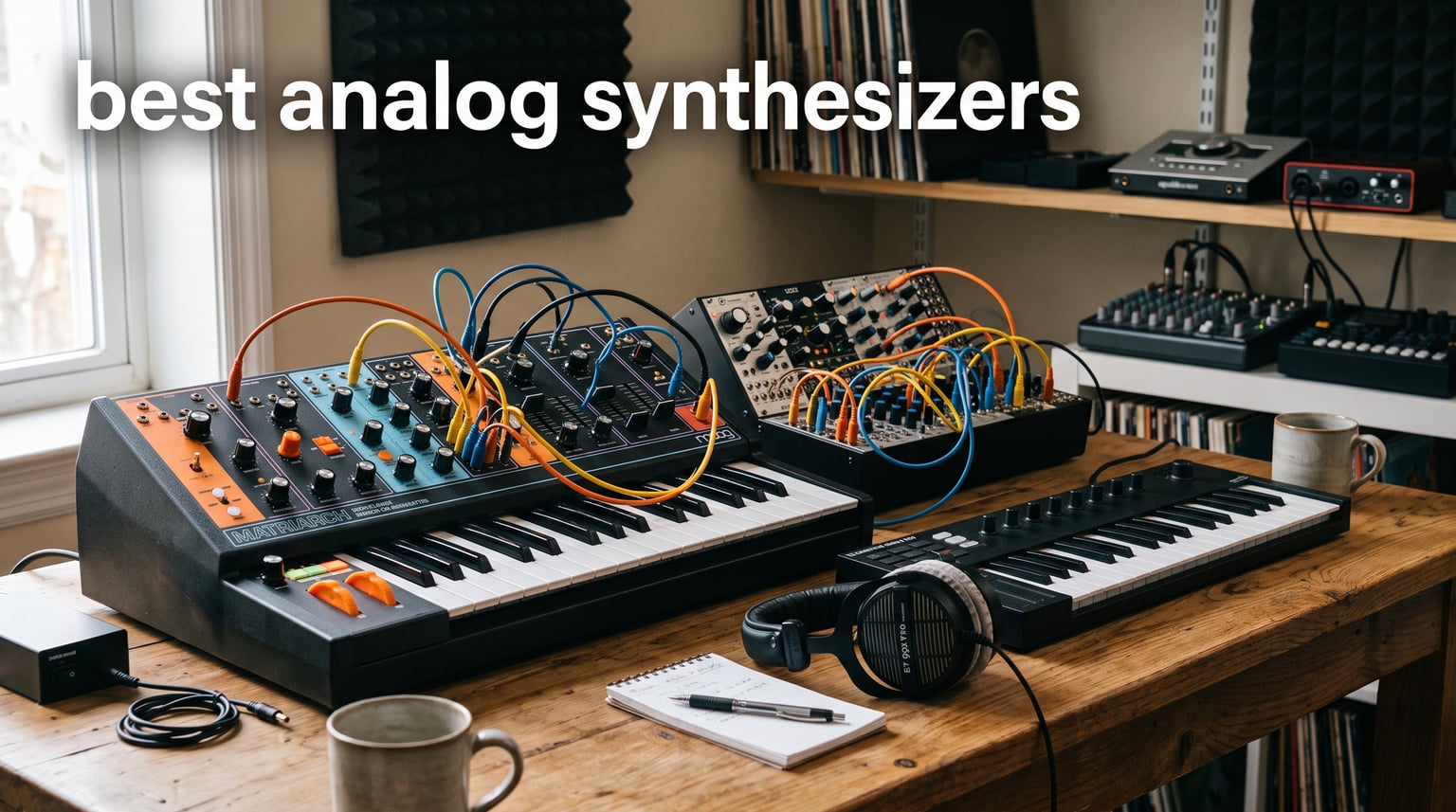
The best analog synthesizers make sound design feel physical: turn a cutoff knob, hear the filter move, and play the result rather than stare at a screen. This guide compares 12 current hardware choices, from a full-key monosynth to small battery-powered instruments and patchable semi-modular boxes.
Analog synthesis starts with voltage-controlled oscillators (VCOs), shapes those waveforms with a voltage-controlled filter (VCF), and controls loudness through a voltage-controlled amplifier (VCA). That signal path is why players talk about analog warmth, but the bigger draw for me is direct cause and effect between a control and the sound.
Not every pick here has the same architecture. A few combine digital oscillators or wavetable engines with an analog filter, so I call that out rather than treating every circuit path as identical. For some useful context on why these sounds remain part of electronic music, read our look at Roland TR-808’s impact on pop music.
The top 3 picks give most players a clear starting point in 2026
The MOOG Messenger is my first choice when you want full-size keys, presets, sequencing, and real CV patch points in one monophonic instrument. The Arturia MicroBrute UFO suits the player who learns by patching and turning dedicated controls, while the MicroKits Synth-a-Sette is the most playful small-scale way to hear basic analog behavior.
These recommendations are deliberately different. One is a performance-ready keyboard, one is a direct patchable sound-design tool, and one makes experimentation approachable through its touchpad, speaker, and alligator clips.

The best analog synthesizers in 2026 cover three distinct ways to play
Start with the overview if you already know whether you need keys, a sequencer, a patchbay, or a portable sketchpad. The feature labels describe what the analyzed product data confirms; they are a faster first filter than trying to compare every control at once.
| Product | Specifications | Action |
|---|---|---|
 MOOG Messenger MOOG Messenger |
|
Check Availability |
| Arturia MicroBrute UFO |
|
Check Availability |
 MicroKits Synth-a-Sette MicroKits Synth-a-Sette |
|
Check Availability |
 MOOG Labyrinth MOOG Labyrinth |
|
Check Availability |
 Donner Essential B1 Donner Essential B1 |
|
Check Availability |
 Stylophone GENX-2 Stylophone GENX-2 |
|
Check Availability |
 Behringer JT Mini Behringer JT Mini |
|
Check Availability |
 Behringer Pro VS Mini Behringer Pro VS Mini |
|
Check Availability |
 Roland AIRA Compact S-1 Roland AIRA Compact S-1 |
|
Check Availability |
 MOOG Mavis MOOG Mavis |
|
Check Availability |
 Behringer Grind Behringer Grind |
|
Check Availability |
 Stylophone Theremin Stylophone Theremin |
|
Check Availability |
1. MOOG Messenger is the strongest all-around hands-on monosynth
MOOG Messenger Monophonic Analog Synthesizer
32 keys
64-step sequencer
6 CV points
256 presets
Pros
- 32 semi-weighted keys
- Aftertouch
- Flexible filter
- USB-C and DIN MIDI
Cons
- Monophonic design
- 52 reviews
The Messenger is the clearest choice here for a player who wants an instrument-shaped synth rather than a compact desktop device. Its 32 semi-weighted full-size keys have velocity and aftertouch, so I would favor it for expressive bass lines, leads, and one-note melodic parts.
Its two continuously variable-shape VCOs support sync and frequency modulation, with a sub-oscillator adding lower weight. The filter can operate as low-pass, band-pass, or high-pass in either two- or four-pole modes, and the RES BASS switch is intended to keep the sound full.
There is a practical modern side too: 256 presets, two loopable ADSR envelopes, two LFOs, and a 64-step sequencer with probability-based generative behavior. I like that combination for someone who wants to save a dependable sound yet keep a sequence from repeating exactly the same way.
The Messenger fits players who want expressive keys and patch access
Six analog CV patch points make this more than a closed keyboard. They give a user a route into voltage control without requiring a large modular system, while five-pin DIN MIDI I/O and MIDI over USB-C keep it friendly to a computer or other current gear.
I would choose the Messenger for studio production that needs a substantial monophonic voice, then bring it to a live set when aftertouch and direct controls matter. The metal body and 5.14-kilogram listed weight point toward a more planted setup than a pocket instrument.
The Messenger is less suitable when chords are the main requirement
This is a monosynth, so it plays one note at a time rather than full multi-note chords. That is a strength for focused bass and lead work, but a player building pad sounds should begin with one of the polyphonic or hybrid options below.
The analyzed listing has 52 reviews, which is a smaller feedback pool than several compact picks in this guide. I would still treat the rating as one useful signal, then listen for whether its ladder-filter character fits your own tracks.
2. Arturia MicroBrute UFO is the most direct patchable analog learning tool
Arturia MicroBrute UFO Analog Synthesizer
Brute oscillators
Steiner-Parker filter
Patchable matrix
Sequencer
Pros
- 100 percent analog path
- Distinctive filter
- Stackable patch cables
- Dedicated controls
Cons
- Small review pool
- Limited listed stock
The MicroBrute UFO makes a compelling case for learning subtractive synthesis with your hands. Its stated 100 percent analog design pairs Brute oscillators with a Steiner-Parker filter, a combination that gives this compact instrument a recognizable voice rather than a generic starter sound.
The patchable modulation matrix is the major reason I would pick it over a simpler one-oscillator device. Stackable patch cables let you create modulation relationships that a fixed front panel cannot, which turns LFOs, envelopes, and control voltages into something you can hear and trace.
Arturia also lists a sequencer and arpeggiator, so this can make complete rhythmic sketches without becoming a deep-menu machine. That matters because community discussions often point to hands-on control as the part of analog hardware that keeps people experimenting.
The MicroBrute UFO suits sound designers who learn through routing
I would recommend this to someone who wants to see how modulation changes a sound one cable at a time. The matrix is a bridge between a fixed architecture and a more open modular habit, without needing a separate case to begin patching.
At 3.9 pounds and 12.79 by 8.7 by 2.36 inches, it is compact enough for a desk or a small performance station. Its mono line and headphone outputs give the core audio paths a player needs for practice or recording.
The MicroBrute UFO is less suitable when broad community feedback matters most
The analyzed data shows only 10 reviews, so there is less marketplace feedback than for several other instruments here. That does not change the stated hardware features, but I would put more weight on hearing demos and trying the filter response yourself.
The listing also flags limited stock, which can affect availability. Its focused design is another consideration: this is for shaping a strong single voice, not for playing layered chords with several independent notes.
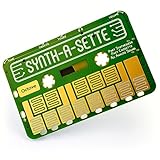
3. MicroKits Synth-a-Sette is the smallest playful entry into analog sound
MicroKits Synth-a-Sette: The Original Cassette Sized Analog Synthesizer
Cassette-sized
13-key touchpad
Speaker
Alligator clips
Pros
- Very small format
- Built-in speaker
- Line output
- Creative conductivity clips
Cons
- 13-key touchpad
- Basic control set
The Synth-a-Sette is not pretending to replace a keyboard workstation. It is a cassette-sized analog synth with a 13-key monophonic touchpad, and that narrow goal makes it one of the least intimidating ways to hear pitch, vibrato, octave changes, and simple tone behavior.
Its included alligator clips are the memorable feature. They let users connect conductive everyday objects to make their own keyboard, which turns a basic lesson about electricity and input into a hands-on musical experiment.
I would put this on a coffee table, in a classroom, or beside a larger studio rig as a quick source of strange sounds. The built-in speaker and line out mean it can work alone before you connect it to speakers, an interface, or a pedal chain.
The Synth-a-Sette fits curious beginners and hands-on educators
This is a good match when the goal is discovery rather than preset management. A player can hear the result quickly, and the touchpad avoids the physical bulk that can make a conventional hardware synthesizer feel like a serious commitment.
The listing reports a 4.7 rating from 237 reviews, a notably larger feedback sample than many niche synth devices. I see that as encouraging for an instrument aimed at playful experimentation, not as evidence that it has the depth of a full keyboard synth.
The Synth-a-Sette is less suitable for conventional keyboard performance
Its 13-key monophonic touchpad limits the range and playing feel. If you want two-handed technique, velocity response, chords, or a sequence with a larger control surface, move to the Messenger, JT Mini, or a device with a more developed sequencer.
The feature set is intentionally basic. There is an octave-up button and optional vibrato switch, but no stated patchbay, preset memory, or multi-voice architecture to grow into elaborate arrangements.
4. MOOG Labyrinth is the best semi-modular choice for evolving sequences
MOOG Labyrinth Semi-Modular Analog Synthesizer
Dual oscillators
Wavefolder
32 patch points
Dual sequencers
Pros
- Semi-modular routing
- Generative sequencers
- State-variable filter
- Extensive patchbay
Cons
- 30 reviews
- Patch cables help unlock it
The Labyrinth is built for movement rather than a traditional keyboard performance. Dual generative eight-step sequencers use corrupt controls, and the parallel approach can make patterns change in ways that are difficult to recreate by simply programming a static line.
Its sound sources include dual oscillators, a voltage-controlled wavefolder, ring modulation, and a variable-tone noise generator. I would reach for this when a sequence needs rough edges, harmonic shifts, or unstable textures instead of a polite preset sound.
The state-variable resonant VCF moves between low-pass and band-pass behavior. That one detail makes it easier to create a sweeping body or a narrower nasal focus, while the blending and signal-flow order switch invite further tone changes.
The Labyrinth fits players who want generative ideas without a computer
Two eight-step sequencers are a practical composition feature, not just a specification. I would use them to find a rhythmic starting point, then capture the output as audio or sync the instrument with the rest of a hardware setup.
The enclosure measures 5.63 by 12.83 by 4.21 inches and weighs 1.5 kilograms, making it easier to place beside drum machines and effects than a large keyboard. Patch cables are included, so the core semi-modular function is available from the start.
The Labyrinth is less suitable for immediate chord playing
There is no conventional keybed stated in the analyzed listing, and its design centers on sequencing and patching. A pianist who wants to play multi-note voicings live will find a keyboard-based instrument more natural.
The data shows 30 reviews, so long-term user feedback is still limited. Its 32 three-point-five-millimeter patch jacks also reward curiosity; someone who only wants to select presets may find the open-ended routing unnecessary.
5. Donner Essential B1 is the best compact choice for bass-driven sequences
Analog Bass Synthesizer and Sequencer, Donner Essential B1 with Intuitive User Interface, 128 Patterns Memory, Saturation & Delay Effects, Make for Classic Acid Sound
Analog signal path
128 presets
Step sequencer
MIDI I/O
Pros
- VCO VCF VCA path
- 128 presets
- Haptic pads
- Analog effects
Cons
- Firmware may be needed
- Small controller format
The Essential B1 focuses on the elements that make a bass sequence satisfying: one VCO, one VCF, one VCA, a step sequencer, and direct tone tools. Its listed sound profile emphasizes warm, rich lower frequencies, so I would place it first on a shortlist for acid-style patterns and low-end hooks.
It adds 128 preset locations, which helps when a good pattern appears and you want to recall it later. The haptic pads with changing backlights are a different approach from piano keys, but they make a small box easier to program in low light.
Analog saturation and delay are built in, and the eight-mode arpeggiator gives the instrument another route to motion. I appreciate when a compact device offers those tools internally because it can make a sketch feel complete before external processing enters the picture.
The Essential B1 fits producers who build tracks from repeating hooks
A direct sequencer workflow is the central appeal. I would use the B1 to establish a bassline, clock it with other hardware through sync I/O, then change cutoff, resonance, or effect level while recording a live pass.
USB Type-C, two full-size five-pin MIDI connections, and sync I/O cover several ways to join a studio. That mix is useful for players combining a DAW, old-style MIDI hardware, and a clock-based tabletop setup.
The Essential B1 is less suitable for traditional two-handed playing
The haptic-pad format prioritizes pattern programming over a piano-style keyboard technique. It can make fast bass work fun, but it is not the obvious pick if you expect wide melodic range or expressive key pressure.
The product data notes that a firmware update may be required for full features. I would check the current firmware process before setting up a session so the saved-preset and connectivity workflow matches the listing.
6. Stylophone GENX-2 is the most portable analog option with CV and Gate
Stylophone GENX-2 Portable Analogue Synthesizer with Built-in Speaker, LFO, Filter, Analogue Delay and CV/Gate Output | Synthesizer Keyboard | Synth Musical Instrument
Stylus keyboard
Analog delay
CV and Gate
Built-in speaker
Pros
- Battery operation
- Expression strip
- Two sub-octaves
- CV Gate outputs
Cons
- Two-octave range
- Stylus playing method
The GENX-2 is a portable analogue synth that asks you to play differently. A stylus-powered keyboard and finger-sensitive expression strip put pitch and inflection close together, which is why I see it as an expressive sketching instrument rather than a miniature piano.
Its resonant low-pass filter, square and triangle LFO waves, attack/decay envelope, pulse-width modulation, and built-in analogue delay give it a surprisingly complete tone-shaping list. Dual sub-octave switches are especially useful when a small device needs to make a bigger bass impression.
The unit runs on batteries and contains a speaker, headphones connection, and audio output. At 339 grams, it is one of the easiest options here to bring outside a fixed studio, then connect properly when you return.
The GENX-2 fits portable performers who also use modular gear
CV and Gate outputs are the decisive specification. I would choose this over a basic portable toy synth if I needed a compact voice that could later control or be controlled by a compatible modular or semi-modular system.
The expression strip adds a performance variable that regular fixed keys do not provide. It can reward slow pitch bends and filter sweeps, making it attractive for experimental leads, drones, and small live interludes.
The GENX-2 is less suitable for wide-range chord parts
The stated range is two octaves, and the stylus interface does not behave like full-size velocity-sensitive keys. Those limits matter less for monophonic riffs and bass, but they matter a lot when a part needs conventional chord shapes.
Its included outputs are useful, yet the small physical format leaves less room for extended control changes than the Messenger or MicroBrute UFO. I would treat its portability as the point, not expect a desktop panel full of large knobs.
7. Behringer JT Mini is the compact analog route to simple three-note chords
Behringer JT Mini Polyphonic 3-voice Analog Synthesizer
3 analog voices
27 touch keys
State-variable VCF
16-step sequencer
Pros
- Three-note chords
- Compact touch keys
- Flexible filter
- Sync I O
Cons
- Touch-key layout
- No Prime eligibility
The JT Mini earns its place because it is one of the few listed products described as a three-voice analog synthesizer. Three voices let you play basic chords and intervals rather than being limited to a single-note line, which changes what a compact instrument can contribute to a track.
Its state-variable VCF is another useful feature for a small synth. A state-variable filter gives more tonal range than a fixed filter type, and it pairs naturally with the 16-step sequencer for shifting chord stabs or repeating melodic cells.
The 27 touch-sensitive keys keep the device small. I would view them as a compact input method for ideas and short phrases, then use MIDI or another controller if my arrangement depended on more formal keyboard playing.
The JT Mini fits players who want compact analog harmony
Three-note polyphony is not enough for dense arrangements, but it is enough for triads, two-note intervals, and a bass note with a simple upper tone. That makes the JT Mini more chord-capable than a conventional monosynth.
Three-point-five-millimeter sync I/O gives it a role in a clocked tabletop rig. I would use the 16-step sequencer for a repeating part and let larger gear handle the main keyboard work.
The JT Mini is less suitable for expressive full-size-key technique
Touch-sensitive keys are not the same as a full keybed with velocity and aftertouch. Players who rely on dynamic finger response will want to confirm whether the compact interface suits their style before making it a main instrument.
The analyzed listing notes that it is not Prime eligible, which can affect fulfillment options. More importantly, three voices are a clear ceiling: sustained pads and complex chords will need more available notes.
8. Behringer Pro VS Mini is the portable hybrid pick for morphing textures
Behringer Pro VS Mini Portable 5-Voice Hybrid Synthesizer with 4 Vector Morphing Oscillators Per Voice, Analog Low-Pass Filter, 16-Step Sequencer and Arpeggiator
5 voices
Vector oscillators
Analog low-pass filter
16 steps
Pros
- Five voices
- Four oscillators per voice
- Analog filter
- Battery or USB power
Cons
- Temporarily unavailable
- Two-point-five-mm jacks
The Pro VS Mini is a hybrid rather than a pure analog synth, and that distinction is useful. It combines four vector-morphing oscillators per voice and wavetable synthesis with an analog low-pass filter, giving it a different palette from a single analog VCO design.
Five voices make it capable of multi-note parts, while vector morphing suggests changing among oscillator sources as a sound develops. I would choose it for bright, digital-leaning movement tempered by an analog filter instead of for a strict vintage monosynth experience.
A 16-step sequencer, arpeggiator, and filter, amplifier, and oscillator envelopes cover the core composition tools. Its small dimensions of 8.45 by 5.45 by 2.35 inches also make it realistic to add to a travel bag or crowded desktop.
The Pro VS Mini fits texture seekers who want more than one synthesis flavor
This is the compact choice I would consider when a mix needs shifting, layered digital sources but you still want to shape them with an analog low-pass filter. The five-voice count also opens simple chord and pad-like uses.
Battery or USB power supports mobile use, and Sync In lets it join a tempo-based setup. The marketplace data shows 144 reviews and a 4.6 rating, which gives more user feedback than several newer specialty products here.
The Pro VS Mini is less suitable for an all-analog signal path
Its oscillators are vector-morphing and it includes wavetable synthesis, so it does not meet a purist definition of an entirely analog architecture. That hybrid identity can be a feature, but it should be a deliberate choice.
The listing says it is temporarily out of stock and uses two-point-five-millimeter jack connectors, which may call for adapters. I would verify availability and the required cabling before planning around it as a central device.
9. Roland AIRA Compact S-1 is the micro polysynth for travel-ready sequences
Roland AIRA Compact S-1 Tweak Synth
4 voices
64-step sequencer
USB-C audio MIDI
4.5-hour battery
Pros
- Four voices
- Long sequencer
- USB-C audio
- Portable battery use
Cons
- Micro control surface
- Limited listed stock
The Roland AIRA Compact S-1 is listed as a four-voice ultra-portable micro polysynth. That means it belongs in this roundup as a compact hardware alternative for players who need several notes at once and a self-contained sequencer, even though its listed features do not describe a pure analog circuit path.
D-Motion Sound Control, Osc Draw, and Chop are its named performance features. I would treat those as tools for changing a sequence during playback, particularly when a small instrument needs to hold attention without a large panel of controls.
A 64-step sequencer, USB-C audio and MIDI, and a stated 4.5-hour battery give the S-1 a very practical portable setup. It can feed audio and MIDI to a computer through one connection, then run away from a desk when you want to sketch elsewhere.
The S-1 fits mobile writers who want a long pattern and four voices
Four voices provide more room for chords and overlapping notes than the JT Mini’s three. I would use it for compact chord sequences, melodic counterlines, and pattern development where a 64-step lane is more useful than a short loop.
At one pound, it is the least cumbersome option for a trip-focused setup. USB-C audio matters as well because it can reduce the need for a separate audio interface when recording a quick idea into compatible software.
The S-1 is less suitable for players who want an explicitly analog circuit description
The analyzed listing calls it a micro polysynth and describes its performance features, but it does not state an all-analog signal path. I would not buy it as a substitute for the Messenger, MicroBrute UFO, Mavis, or Labyrinth if your priority is explicitly analog hardware.
Its compact body also means compact controls, which can slow detailed edits compared with a larger knob-per-function design. The listing flags only four units left, so availability may change quickly.
10. MOOG Mavis is the build-and-patch choice for modular-minded beginners
MOOG Mavis Semi-Modular Analog Synthesizer
Analog oscillator
Ladder filter
Wavefolder
Eurorack integration
Pros
- All-analog design
- Eurorack compatible
- Full ADSR
- Complete kit
Cons
- Assembly required
- Limited listed stock
The Mavis is a standalone semi-modular analog synthesizer kit with a keyboard, and that kit format is part of the appeal. I would pick it when building an instrument is itself a useful way to learn how its oscillator, envelope, mixer, and control routing relate.
Its stated analog components include an oscillator and filter, a full ADSR envelope, ladder filter, diode wavefolder, sample and hold, attenuators, mixer, and mults. That is an unusually broad learning set for a compact device because it covers both the ordinary subtractive path and more unusual harmonic shaping.
The included package lists patch cables, power supply, calibration tool, and assembly guide, so the core setup is documented in the supplied components. I like that the instrument can work on its own first rather than forcing an immediate expansion into a larger system.
The Mavis fits builders who may expand into Eurorack later
Eurorack integration is the feature that gives the Mavis a longer horizon. It is a 44HP module, so I would see it as a standalone voice now and a potential part of a modular case if patching becomes the main creative method.
The built-in keyboard has glide and scaling, which gives immediate access to pitch control while you learn. The wavefolder adds harmonic material before the ladder filter, a useful contrast with an ordinary oscillator-to-filter-only path.
The Mavis is less suitable when assembly feels like a barrier
The product data specifically describes a DIY kit that requires assembly. That is a feature for a curious maker, but it is a poor fit for a player who wants to switch on a finished keyboard and start a session immediately.
The listed stock is limited, and the 0.43-kilogram device remains a compact module-style format. I would choose a larger keyboard synth for conventional performance, wide playing range, and a ready-made front-panel workflow.
11. Behringer Grind is the multi-engine choice with an analog ladder filter
Behringer Grind Semi-modular Hybrid Multi-engine Synthesizer
24 digital oscillators
Analog ladder filter
32 steps
14 synth engines
Pros
- Many sound engines
- Percussion engines
- 32-step sequencer
- Semi-modular design
Cons
- Hybrid architecture
- 32 reviews
The Grind is another hybrid entry, and it takes a broad approach rather than trying to imitate a classic one-voice analog circuit. It lists 24 digital oscillators, 14 synth engines, 10 percussion or noise engines, a 32-step sequencer, and an analog ladder filter LFO.
I would select it for a producer who wants one compact device to make tonal parts, percussive hits, and noisy material. The analog ladder filter can bring a familiar filter response to those digital sources, while the engine count gives it more variety than a focused monosynth.
Its semi-modular identity suggests room for flexible signal creation, though the analyzed feature list does not specify the exact patch-point count. The steel and metal construction and listed 1,502-gram weight suggest a desktop unit built for a more fixed setup than a pocket device.
The Grind fits producers who want rhythmic and tonal sound sources together
Ten percussion and noise engines make this a sensible companion to a sequencer-driven electronic setup. I would use the 32-step sequencer to make a pattern that includes more than a bassline, then carve its frequency content with the ladder filter.
Fourteen synth engines provide plenty of starting directions, which can help when genre-specific work moves from a lead part to a noisy transition or a rhythmic layer. Its MIDI connector gives it a route into a controller-based rig.
The Grind is less suitable for a strictly analog instrument collection
The 24 oscillators are explicitly digital, so the Grind should be chosen for its hybrid range and analog filter rather than for a pure VCO-to-VCF-to-VCA experience. Being clear about that difference prevents the wrong expectation.
The analyzed data shows 32 reviews and no Prime eligibility. I would also account for the multi-engine design: many options can be inspiring, but a simpler dedicated-control synth may be faster when you need one familiar sound immediately.
12. Stylophone Theremin is the expressive portable pick for experimental lines
Stylophone Theremin – Award-Winning Portable Touch-Sensitive Synthesizer with Retro Analog Sound, Built-In Speaker, Delay & Vibrato Effects, Slider Control, Compact Battery-Powered Design
Pitch antenna
Touch slider
Delay and vibrato
Battery speaker
Pros
- Distinctive pitch control
- Built-in speaker
- Headphone output
- Portable effects
Cons
- Plastic construction
- Unconventional playing method
The Stylophone Theremin is the most unusual choice in this group. It combines a pitch theremin antenna with a touch-sensitive slider, so I would approach it as an expressive sound source for glides, eerie melodies, and experimental gestures instead of a standard keyed synthesizer.
Delay and vibrato are built in, and the stated sound profile includes warm, distorted, experimental, lower-frequency character. Those effects suit the instrument’s performance method because a held note can evolve without needing a dense patch or external pedal board.
A built-in speaker, headphone output, and battery power make it simple to practice in different places. The listed 896-gram weight is still manageable for a portable unit, though it is larger than the cassette-sized Synth-a-Sette.
The Stylophone Theremin fits players seeking pitch movement and character
The antenna and slider put continuous pitch behavior at the center of the experience. I would use it for transitions, dramatic leads, sound effects, and parts where accuracy can give way to character and motion.
The marketplace data lists 89 reviews and a 4.2 rating. It is also ranked as a tabletop-synth bestseller in the supplied data, which suggests there is an audience for its deliberately nontraditional design.
The Stylophone Theremin is less suitable for exact chord voicings
There is no conventional multi-note keyboard in the stated design, and the antenna-based approach requires a different kind of pitch control. Players writing precise chord progressions will be better served by a polyphonic device with a familiar key layout.
The body material is listed as plastic, which may matter to players seeking a heavier metal chassis. I would think of this as a specialized color in a collection, not the only instrument for every role in an arrangement.
The right analog synthesizer depends first on voices and playing method
Choose monophonic when bass, leads, and one-note sequences are the priority. A monosynth can devote its full character to one note, and the Messenger, MicroBrute UFO, GENX-2, Mavis, and Labyrinth each approach that focused role differently.
Choose polyphony when you must play more than one note at once. The JT Mini has three analog voices, the Pro VS Mini has five hybrid voices, and the S-1 has four voices; each gives chords a place in a compact rig, although their sound-generation methods differ.
I would not dismiss monophonic gear just because it cannot play chords. A strong bass or lead is often more useful in a production than a complex pad, and a sequencer can turn a single well-shaped VCO into the part listeners remember.
Dedicated controls are the fastest route to learning subtractive synthesis
For a beginner, look for a clear oscillator, filter, envelope, and LFO layout. Oscillators create raw waves, the filter removes or emphasizes frequency areas, the envelope shapes change over time, and the LFO repeats a slower modulation movement.
The MicroBrute UFO is especially clear for this because its filter and patchable matrix put these relationships on the surface. The Messenger is also approachable for a player who wants knobs plus saved presets, while the Synth-a-Sette reduces the concept to a very small tactile experiment.
Sequencers turn a synth into a composition tool
A sequencer stores notes and plays them in order, often synchronized with drums or another clock source. Sixteen steps are enough for short repeating patterns, while 32 and 64 steps give a phrase more room to develop before it loops.
The Labyrinth takes a different path with two generative eight-step sequencers, while the Messenger uses a 64-step sequence with probability-based behavior. I would choose the former for surprise and evolving motion, and the latter when I want a more traditional keyboard-led instrument with deep sequence capacity.
CV and Gate matter when you want hardware to talk by voltage
CV, or control voltage, carries changing control information such as pitch or filter movement. Gate is a separate on-off style signal that tells a compatible envelope when to start, and together they are common in modular and semi-modular systems.
The Messenger offers six analog CV patch points, the GENX-2 has CV and Gate outputs, and the Mavis and Labyrinth are designed around semi-modular patching. I would prioritize those models when external voltage routing is part of the plan; regular MIDI alone may not cover that need.
MIDI and USB-C decide how easily a synth joins a modern setup
Five-pin DIN MIDI remains useful for standalone gear, while USB-C can connect MIDI and sometimes audio to a computer. The Messenger has both five-pin MIDI and MIDI over USB-C, the Essential B1 adds USB-C with two five-pin MIDI connections, and the S-1 states USB-C audio and MIDI.
Check connectors before choosing a portable synth. The Pro VS Mini uses two-point-five-millimeter jacks and may need adapters, while the JT Mini has three-point-five-millimeter sync I/O; the cable you already own can affect how effortless the first session feels.
Pure analog and hybrid designs answer different sound-design needs
A pure analog path uses analog circuits for its sound generation and shaping, while a hybrid design can combine digital oscillators, wavetables, or engines with an analog filter. Neither is automatically better; the real question is whether you want focused circuit behavior or wider source variety.
The Pro VS Mini and Grind are explicitly hybrid examples in the analyzed data. I would choose them for morphing, wavetable, or multi-engine range, then choose the Messenger, MicroBrute UFO, Mavis, or Labyrinth when the goal is a clearly stated analog voice and direct circuit-based shaping.
Portability changes both the sound source and the way you finish ideas
A built-in speaker and battery power remove the friction of setting up monitors, cables, and a desk. The Synth-a-Sette, GENX-2, Pro VS Mini, S-1, and Stylophone Theremin all support a more portable approach, although their input methods and connection options vary substantially.
For my own selection process, I would decide where the synth will live before comparing features. A small device that is always within reach can generate more finished ideas than a larger instrument that never leaves its case, but full-size keys can matter far more for a serious performance role.
Answers to common analog synthesizer questions clarify the best fit
What is the best analog synthesizer for beginners?
The Arturia MicroBrute UFO is the clearest beginner pick when you want to learn analog sound design through dedicated controls, a distinctive filter, and a patchable modulation matrix. Choose the MicroKits Synth-a-Sette instead when you want a tiny, playful first experiment with a touchpad, speaker, and conductive-object clips. Choose based on whether you want a full learning tool or a simple introduction.
Which synthesizer had the most impact on the community?
The Roland TR-808 had an enormous effect on electronic and pop music, although it is a drum machine rather than one of the keyboard and tabletop synths in this list. Its lasting influence helps explain why musicians still value immediate electronic controls and distinctive hardware sound. Among the products compared here, the most influential choice for you is the one that gets used regularly in your own writing and performance process.
Which compact analog synth offers a simple entry point?
The MicroKits Synth-a-Sette offers the simplest compact entry with a 13-key monophonic touchpad, built-in speaker, line output, and alligator clips for conductive-object experiments. The Stylophone GENX-2 adds a filter, LFO, analogue delay, and CV/Gate outputs when you want a portable instrument that can grow into a wider hardware setup. Neither replaces a full-size keyboard for conventional playing.
What hardware synths are actually worth owning?
A hardware synth is worth owning when its controls and connections match the role you need. The MOOG Messenger is a strong all-around monophonic keyboard with aftertouch, presets, sequencing, MIDI, and CV points; the MOOG Labyrinth favors generative patching; and the Donner Essential B1 targets bass sequences. Choose the instrument that solves a real musical job rather than collecting features you will not use.
Which analog synth is most iconic?
Iconic status usually comes from a recognizable voice, a simple interface, and years of use in records and live sets. The MOOG name is closely associated with classic ladder-filter sounds, while the Roland TR-808 remains a landmark hardware instrument in electronic music history. For a current purchase, focus less on an icon label and more on whether the synth offers the voices, controls, and connectivity your music needs.
The MOOG Messenger is our overall pick, but the right choice follows your workflow
The MOOG Messenger offers the most complete blend of expressive keys, a modern sequencer, saved presets, MIDI, and patch points, which is why it leads this list. Pick the MicroBrute UFO when patching teaches you fastest, the Labyrinth when evolving sequences are the goal, or the Essential B1 when bass patterns lead the track.
The best analog synthesizers in 2026 are not one-size-fits-all instruments. Compare the number of voices, hands-on controls, connection types, and physical playing method, then choose the device you will actually switch on and record with.