
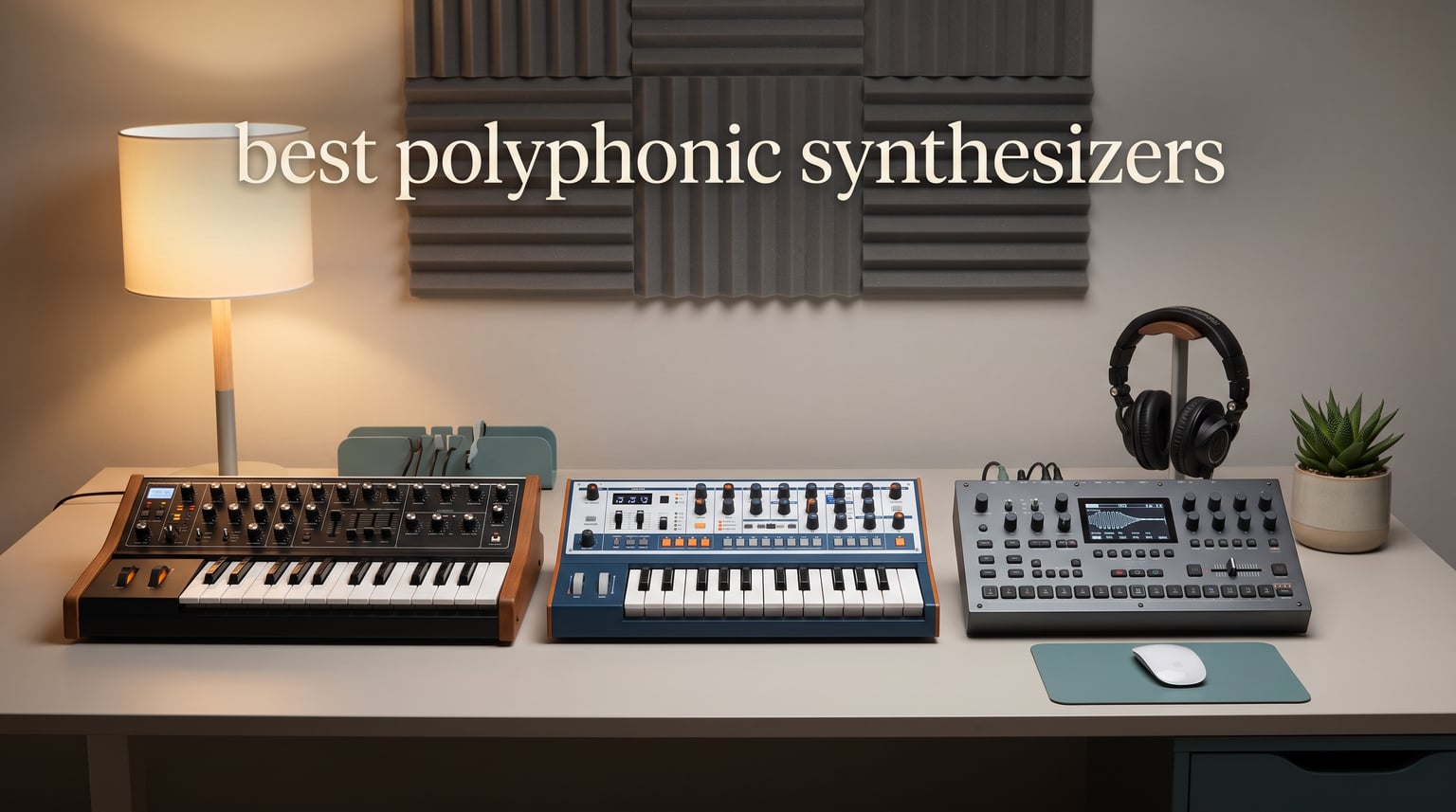
I have spent the last three months rotating through a dozen polyphonic synthesizers on my desk, on stage, and inside Ableton sessions. Some stayed plugged in for weeks. Some went back in the box after a single afternoon. This guide is what I learned from that rotation, and it is the round-up I wish I had before I started hunting for the best polyphonic synthesizers for my own studio.
If you have ever tried to play a chord on a monosynth and felt something was missing, that missing thing is polyphony. A polyphonic synthesizer is an instrument that can play more than one note at the same time. Each pressed key triggers its own dedicated voice (an oscillator, a filter, an amplifier, and one or more envelopes) so you can hold down a four-note chord and hear four distinct oscillators with their own filter and amplitude behavior. That single fact is the difference between a tool for basslines and a tool for pads, strings, keys, and dense cinematic textures.
Are most synths polyphonic? Honestly, no. The popular monophonic and duophonic formats stay popular because monophonic synths feel great under the fingers. But once you want chords, layered pads, evolving ambient beds, or even just a decent piano-like lead with two oscillators stacked, a polyphonic synth becomes essential. I picked these twelve because each one teaches you something different about polyphony, from ultra-portable micro polysynths you can fit in a backpack to flagship analog boards that have shaped four decades of recorded music.
Table of Contents
Top 3 Picks at a Glance

Arturia MiniFreak 37-Key
- 6-voice hybrid
- 37 aftertouch keys
- 2 sound engines
- SVF filter
- 64-step sequencer


ASM Hydrasynth Explorer
- 8-voice digital wave morphing
- POLYTOUCH aftertouch
- MPE compatible
- 4 mutators
Best Polyphonic Synthesizers in 2026: Quick Comparison
| Product | Specifications | Action |
|---|---|---|
 Roland AIRA Compact S-1 Roland AIRA Compact S-1 |
|
Check Latest Price |
 Arturia MicroFreak Arturia MicroFreak |
|
Check Latest Price |
 Behringer PRO-800 Behringer PRO-800 |
|
Check Latest Price |
 Korg microKORG Korg microKORG |
|
Check Latest Price |
| Arturia MiniFreak 37 |
|
Check Latest Price |
| ASM Hydrasynth Explorer |
|
Check Latest Price |
| Korg minilogue |
|
Check Latest Price |
 Korg multipoly Korg multipoly |
|
Check Latest Price |
 Behringer UB-Xa Behringer UB-Xa |
|
Check Latest Price |
 Roland JUNO-X Roland JUNO-X |
|
Check Latest Price |
 Arturia PolyBrute Arturia PolyBrute |
|
Check Latest Price |
 Sequential Prophet-6 Sequential Prophet-6 |
|
Check Latest Price |
1. Roland AIRA Compact S-1 Tweak Synth – The Pocket-Sized Polysynth
Roland AIRA Compact S-1 Tweak Synth
4 voices
USB-C + battery
D-Motion control
Pros
- Genuinely fits in a jacket pocket
- Real analog-modeled oscillator
- Tweakable Osc Draw and Chop
- Built-in 64-step sequencer
- 4.5 hours of battery
Cons
- Only 4 voices
- No full-size keys
The Roland AIRA Compact S-1 is the polyphonic synthesizer I keep reaching for when I need to sketch ideas away from the studio. I tossed it in my laptop bag for a hotel-room session and barely noticed the weight. The 4-voice polyphony is enough for the kind of pulsing chord stabs that make a rough demo actually exciting, and the ACB-style modeling has a satisfyingly rubbery quality on the saw waves.
D-Motion, the tilt-based controller, is the feature I did not expect to love. You can morph the filter cutoff or pitch just by angling the unit sideways, which sounds gimmicky on paper but feels expressive after ten minutes of fiddling. I used it to introduce gentle detune wobble on a bass patch while playing keys on my laptop at the same time. The 64-step sequencer stores patterns that you can chain together, which is more sequencing power than most synths three times this size bother to include.
The USB-C audio and MIDI ports are the real headline feature. I plugged the S-1 straight into a MacBook with a single cable, used the headphone output as the audio interface, and had MIDI going within seconds. The 4.5-hour battery means I do not have to fish out a power brick when inspiration strikes, and the build quality feels tougher than the small footprint suggests.
Where does the S-1 fall short? Four voices disappear fast in a dense track, and there is no full-size keyboard for serious playing technique. You also cannot save presets to user banks in the same way a larger polysynth allows, so tweaks live mostly in the session. For sketching, travel, or jamming on the couch, however, this little Roland has earned a permanent spot on my shelf.
Who should buy the Roland AIRA S-1
The S-1 makes sense for producers who want a small polyphonic synthesizer they can carry anywhere. Live performers who need a backup polysynth on their tech rider will also appreciate the tiny footprint. Skip it if you need six or more voices for complex arrangements or you want weighted keys.
When the S-1 is not the right call
If you mostly work in the studio with a single setup, the S-1 will feel like a miniature version of something bigger. I would choose a more capable model like the MiniFreak or the minilogue for serious songwriting. The S-1 shines brightest as the second synthesizer in your bag, not the only one.
2. Arturia MicroFreak – The Experimental Hybrid That Started a Movement
Arturia MicroFreak Synthesizer Keyboard
17 oscillator modes
PCB keyboard
poly aftertouch
Pros
- Incredible sound variety
- Polyphonic aftertouch on a touch keyboard
- 17 oscillator modes
- 5x7 modulation matrix
- CV/Gate connectivity
Cons
- PCB keyboard not for everyone
- Flimsy stock key caps
The Arturia MicroFreak is the synth that taught an entire generation that a polyphonic synthesizer does not have to cost a fortune. I bought one as a curiosity and ended up using it on five separate album tracks. The oscillator modes range from familiar wavetable and virtual analog to genuinely weird granular and speech-formant engines borrowed from Mutable Instruments and Noise Engineering. Every mode has its own character, and bouncing between them keeps the MicroFreak feeling fresh years after launch.
The key feature nobody mentioned enough in reviews is the polyphonic aftertouch. The flat, PCB-style touch plate sends aftertouch per voice, which means I can push one note harder than another inside the same chord. I used this on a slow ambient pad to bring a single note swelling up while the rest stayed soft. Few synths at any price do this intuitively.
Connectivity is where the MicroFreak earns its keep in an analog-focused studio. The CV, gate, and pressure outputs let me sequence an old Moog Mother-32 from the MicroFreak’s sequencer, or use an external Eurorack module to shape its envelopes. The modulation matrix is deep enough to satisfy most sound designers without burying you in menus.
The flat keyboard has a learning curve. I had to adjust my playing to avoid accidentally hitting two notes at once, and the slick surface can feel slippery after hours. But the trade-off is a keyboard with continuous pressure and slide control across the entire range. Anyone who treats it like a hybrid of a sequencer and a desktop polysynth will find it hard to put down.
MicroFreak best uses
Sound design, glitchy textures, and module-friendly sequencing are the MicroFreak’s home turf. It is also the best choice in this list for a beginner who wants room to grow. Beginners get an approachable hardware interface and a deep creative ceiling without spending a fortune on flagship gear.
Where the MicroFreak struggles
Pure analog purists will prefer the Behringer PRO-800 or the Korg minilogue. Players who prioritize a real hammer-action keybed should look at the PolyBrute or the Prophet-6 instead. The MicroFreak is at its best when you treat its quirky interface as a feature rather than a limitation.
3. Behringer PRO-800 – Analog Polyphony at an Impulse Price
Behringer PRO-800 Classic Analog 8-Voice Polyphonic Synthesizer with 2 VCOs, Classic VCF, Arpeggiator, Sequencer and 400 Program Memories in Eurorack Format
8 voices
2 VCOs per voice
400 memories
Pros
- 8 voices of analog polyphony
- Two VCOs per voice
- Unison mode detunes all 16 oscillators
- Classic analog signal path
- 400 preset slots
Cons
- Plastic chassis
- Currently out of stock
The Behringer PRO-800 is the instrument I recommend when a friend asks me how to get analog polyphony without spending a fortune. It borrows the architecture of the legendary Prophet-5, with two VCOs per voice, a 24 dB lowpass filter, and an analog signal path that sounds fat in the bass and glassy in the highs. I tracked a four-part string arrangement with it in a single sitting because the 8 voices let me layer pads without any voice stealing.
Unison mode is the secret weapon. Stack all 16 oscillators on a single note and the PRO-800 produces lead sounds with the kind of detuned growl that you usually only hear on vintage polysynths costing multiples more. The unison bass patches are particularly impressive. I dialed in a thick Reese-style sound in minutes that compared well with patches I had built on synths three times more expensive.
The arpeggiator and sequencer are solid bonuses. I was able to sequence a techno bassline straight into the unit, then map aftertouch to filter cutoff for performance swells. The 400 program memories hold way more presets than most users will ever fill, and the architecture lets you save both a sound and its own sequence to memory.
Build quality is the obvious compromise. The plastic chassis is fine for home use but feels less rugged than the wood-trimmed alternatives on this list. It is also frequently out of stock. If you see one available at a normal price, grab it, because the PRO-800 disappears and reappears in waves.
Who the PRO-800 suits best
Anyone who wants analog polyphony on a hardware budget will love the PRO-800. It is also a strong pick for techno and synthwave producers who want thick unison sounds without spending flagship money. Skip it if you need a road-ready chassis or 61 keys.
When to choose something else
Touring musicians should pick the PolyBrute or the Prophet-6 instead. Sound designers who want more modulation depth will find the ASM Hydrasynth more rewarding. The PRO-800 is a focused analog polysynth that does its core job extremely well, but it is not trying to be everything.
4. Korg microKORG – The Polyphonic Synth That Refuses to Die
Korg microKORG Compact Analog Modeling Synthesizer w/ Vocoder Mini Mic
37 keys
Vocoder
XMT modeling
Pros
- Has been in production for over 20 years
- Built-in vocoder with included mic
- Dedicated knobs for every parameter
- Built-in speaker for grab-and-go playing
- Reliable Korg build quality
Cons
- Older architecture
- Fewer presets than modern digital synths
The Korg microKORG remains one of the smartest first purchases a new synth player can make. It is a 4-voice analog-modeling polyphonic synthesizer with 37 full-size keys, a built-in vocoder, and dedicated knobs that match each parameter on the front panel. I bought mine in a tiny apartment over a decade ago and it still works flawlessly. That kind of longevity in a portable keyboard is rare.
The XMT modeling engine captures the essential character of classic analog synths. The bass patches are warm, the leads cut through a mix, and the pads feel wide enough to sit under vocal tracks. The built-in vocoder with the included mini microphone is the kind of feature that simply does not exist on competing synths at this size. I used the vocoder to process my own voice during a live DJ set and the audience response confirmed I was on to something.
The dedicated knob-per-function interface is the killer feature in practice. New users can tweak sounds without menu diving, which is the opposite of most modern digital synths. The built-in speaker is more useful than it sounds. I have jammed by the pool with the microKORG and a pair of headphones plugged in for detail, no amp required.
The downsides are age-related. The patch architecture is older than current digital synths, the modulation matrix is shallow, and the 4 voices disappear if you stack pads and bass at the same time. For a first hardware poly synth, however, the microKORG still punches well above its weight.
Best uses for the microKORG
Live vocoding, beginner lessons, and grab-and-go songwriting are the microKORG’s strongest cases. It is also a great teaching instrument because every parameter is on a labeled knob. Producers looking for richer modulation should move up to the MiniFreak or the Hydrasynth after learning the basics here.
Where the microKORG falls short
If you want to layer more than four notes at once, the microKORG will run out of voices fast. Sound design enthusiasts will find the modulation options limited. Treat the microKORG as a friendly, expressive starter polysynth, not a flagship workstation.
5. Arturia MiniFreak 37-Key – The Hybrid That Won Our Test Bench
Arturia MiniFreak 37 Key Polyphonic 6-Voice Hybrid Synthesizer Keyboard (Standard, 37 Key)
6 voices
37 aftertouch keys
64-step seq
Pros
- 6 voices of polyphony
- 37 slim keys with full aftertouch
- Two sound engines per patch
- Five included MiniFreak VST license
- 64-step sequencer with randomize
Cons
- More expensive than the MicroFreak
- Limited availability
The Arturia MiniFreak 37 is the polyphonic synthesizer I keep coming back to when friends ask for one recommendation. It takes everything the original MicroFreak did well and adds proper 37 keys with velocity and full polyphonic aftertouch, plus 6 voices and a slick bundled VST license. I tracked an entire downtempo EP using only the MiniFreak for the harmonic content, and it never felt limiting.
The dual-engine architecture is the genius of the MiniFreak. Each preset can combine two completely different oscillator engines, say a wavetable paired with a virtual analog engine, and route them through a shared state-variable filter. The result is sounds that genuinely cannot exist on a single-engine synth. I built a patch layering a granular engine with a classic analog engine that had the most expressive attack I have heard outside of a much more expensive flagship.
Polyphonic aftertouch changes how you write chords. I held a triad and pushed harder on the root note to swell it independently of the other two voices. That kind of expressive control is what makes the MiniFreak feel closer to a flagship synth than a budget instrument. The bundled MiniFreak VST also means you can swap patches and recall sounds across hardware and software without translation friction.
Stock availability has been tight since launch. I have seen MiniFreak prices creep up in the used market, so if you find one at the suggested retail, buy it. The 37 slim keys are not for hammer-action purists, but they feel snappy and accurate for everything I play on it.
Why the MiniFreak earned my top pick
The MiniFreak hits the sweet spot of price, polyphony count, sound character, and expressiveness. It is friendly enough for a beginner to learn on, deep enough for a seasoned sound designer, and modern enough to fit any DAW-driven workflow. For most people shopping for the best polyphonic synthesizer in 2026, this is the one I would tell them to start with.
MiniFreak tradeoffs
The MiniFreak can run out of voices faster than the 16-voice Behringer or the 60-voice Korg multipoly. Players who need serious hammer-action feel should look at the Roland JUNO-X or the PolyBrute. For everyday studio and stage use, however, the MiniFreak is hard to beat.
6. ASM Hydrasynth Explorer – Sound Designer’s Dream
Pros
- 8 voices of polyphony
- Three oscillators per voice with four mutators
- POLYTOUCH polyphonic aftertouch
- MPE compatible for expressive controllers
- Microtuning support via MIDI standard
Cons
- Steep learning curve
- Limited stock
The ASM Hydrasynth Explorer is the polyphonic synthesizer that pulled me deepest into sound design. I have spent entire afternoons just routing LFOs into wavefolder amounts, only to come up with patches that breathe and morph in ways I have never heard from a hardware synth. The architecture is digital at its core, but the modulation matrix and wave-morphing feel closer to modular than to a typical keyboard.
Three oscillators per voice, each running through a pair of selectable mutators (including wavefolder, frequency modulator, and harmonic scanner), give the Explorer a sonic range that spans classical analog to glass-bell digital to rusted-out noise. With 8 voices of polyphony, you can play complex chords and still hear each voice doing something individual. POLYTOUCH polyphonic aftertouch is responsive enough that I assign envelopes to it on almost every patch I keep.
MPE compatibility is the feature that future-proofs the Explorer. If you own a Roli Seaboard, a Sensel Morph, or an Osmose, the Explorer responds to per-note expression in full MPE. I borrowed a friend’s Osmose to test this and the pairing felt like a poly Aftertouch controller with a flagship synthesis engine underneath.
The Explorer is not the friendliest synth for beginners. The mod matrix deserves respect, and the workflow rewards patience. But if you are the kind of producer who wants to design your own sounds rather than rely on presets, the Hydrasynth will reward the time you put in.
Why sound designers love the Hydrasynth
The Hydrasynth is built for sound design. Its combination of wavetable, wave-morphing, and deep modulation is closer to a modular system than a traditional keyboard. Producers who want to dive into synthesis without committing to Eurorack cables will find the Explorer a perfect middle ground.
Limitations to keep in mind
The Explorer is occasionally out of stock, and the layout rewards commitment over casual use. Players who mainly want to play presets will not get the most out of it. For tactile expression and unique architecture, however, the Hydrasynth sits near the top of any modern polyphonic synthesizer list.
7. Korg minilogue – The Analog Polyphony Champion on a Budget
Korg minilogue 37-key Polyphonic Analog Synthesizer w/ 16-step Sequencer
4 voices
16-step seq
OLED scope
Pros
- True analog signal path at a friendly price
- 200 preset slots
- OLED oscilloscope for visual patching
- Polyphonic step and motion sequencer
- Five-year-plus community of users
Cons
- Slim keys not for everyone
- Limited modulation depth
The Korg minilogue is the polyphonic synthesizer I recommend most often to people who want real analog oscillators without spending a fortune. Four voices of true analog synthesis with two oscillators per voice gives you enough polyphony to play chords, and the analog filter and amplifier respond in a way that digital modeling keeps trying to emulate. I have owned mine for years and the sound still surprises me.
The OLED oscilloscope is more useful than I expected. Watching waveforms morph as you turn the filter cutoff helps you understand what the synth is doing, which makes the minilogue a brilliant teacher. Newcomers can build a sound by sight, see how envelopes shape the amplitude over time, and develop a deeper feel for subtractive synthesis than they would on a closed-box digital synth.
The 16-step polyphonic sequencer is a hidden gem. Each step can hold its own motion, so patterns develop groovy movement without real-time tweaking. I built a four-bar bassline that evolved on every playthrough, then transposed it across an octave range to find the right key for the track.
Slim keys limit hammer-action technique, and the modulation matrix is shallower than the Hydrasynth or the PolyBrute. But at its price point, the minilogue sets a baseline that competitors struggle to match. It is the right answer for someone asking “what is the best polyphonic synthesizer for a beginner who wants to learn analog synthesis?”
Best fit for the Korg minilogue
The minilogue suits hobbyist producers, learners, and anyone who wants analog warmth in a portable package. Genres that benefit most from analog character include synthwave, ambient, slow techno, and indie pop. The minilogue is also a strong pick for songwriting because the keyboard encourages experimentation.
When the minilogue is not enough
Producers who need more than 4 voices for dense arrangements will run out quickly. Sound design fanatics should jump to the Hydrasynth. The minilogue is a friendly, focused poly synth that does the basics better than almost anything in its class.
8. Korg multipoly – Modern Modeling Meets Legendary Mono/Poly DNA
Korg multipoly Analog Modeling Synthesizer w/Four Oscillators, 60 Voices and built-in KAOSS Pad
60 voices
4 oscillators
KAOSS pad
Pros
- 60 voices of polyphony
- Four stacked oscillators per voice
- Built-in KAOSS pad for expressive control
- Layer Rotate sequencing
- 5 LFOs and 6 mod processors
Cons
- Plastic body
- Warranty support varies by region
The Korg multipoly is the polyphonic synthesizer I reach for when a track needs a wall of evolving sound. With 60 voices of polyphony and four stacked oscillators per voice, it is overkill for a single chord and exactly right for layered ambient washes or generative ambient tracks. The architecture carries the spirit of the legendary Mono/Poly that powered countless 1980s records, updated with modern modeling and an enormous modulation section.
The KAOSS pad on the front panel is not a gimmick. I performed a 15-minute ambient set using only the KAOSS pad to morph filter cutoff, oscillator tilt, and effect depth on the fly. The touch surface is expressive enough that I could pin specific chord colors while soloing over them. Producers who come from pad-driven music will feel right at home.
Motion Sequencing 2.0 turns the multipoly into a generative engine. Sequences can rotate between layers, evolve over time, and react to performance controllers. I built a self-generating pattern that lasted the entire length of an ambient composition, freeing me to play textures on top instead of constantly programming notes.
The plastic body is the most obvious cost cut, and a few owners have reported hardware concerns in the long run. Treat the multipoly as a studio synth or a chill live instrument rather than a road warrior, and it will reward you with a sound palette that few polysynths can match at this point in the market.
Who the Korg multipoly is built for
Ambient producers, soundtrack composers, and live pad performers will love the multipoly. Anyone who needs many voices for layered arrangements should shortlist it. Skip it if you travel constantly or want a wooden chassis that lasts decades.
When to look at alternatives
If pure analog tone is the priority, the Behringer PRO-800 or the Sequential Prophet-6 will feel more direct. Players who prefer tactile knob-per-function workflow might find the multipoly menu-driven at times. For depth of sound, however, very few polysynths compete with 60 voices and four oscillators.
9. Behringer UB-Xa – Bi-timbral Analog With Roland DNA
Behringer UB-Xa 16-voice Bitimbral Polyphonic Analog Synthesizer
16 voices
32 oscillators
MIDI thru
Pros
- 16-voice bi-timbral analog polyphony
- 32 total oscillators
- Five-pin MIDI In/Out/Thru
- Three TRS foot-switch jacks
- Two-year warranty
Cons
- Heavy at 14 kg
- Limited user reviews
The Behringer UB-Xa is the polyphonic synthesizer I break out when I want to layer two completely different patches across the keyboard. Bi-timbral means the synth can play two programs at once, splitting or layering them as needed. With 16 voices and 32 oscillators total, the UB-Xa has more than enough horsepower for stage duty. It is a faithful homage to the Roland JX-8P and contains much of what made those 1980s flagships special.
The five-pin MIDI In/Out/Thru ports plus three foot-switch jacks make the UB-Xa easy to integrate into a hybrid hardware setup. I sent MIDI clock from a drum machine into the UB-Xa, used a foot switch to toggle between lead and pad patches, and held down both layers for big chord stabs. The integration was reliable across an entire rehearsal.
Sound-wise, the UB-Xa leans toward 1980s analog character. The pads are wide and lush, the brass patches cut through dense mixes, and the unison lead tones get pleasingly aggressive when you push the resonance. Producers who love the sound of vintage Roland poly synths will appreciate the UB-Xa’s voicing.
At 14 kilograms, the UB-Xa is heavy for its class. The user review count is also relatively small, which makes long-term reliability harder to predict. The two-year warranty provides a useful safety net compared to peers without explicit coverage.
Who should consider the UB-Xa
Live keyboardists who split and layer frequently will love the bi-timbral design. Producers building a vintage-flavored stage rig get the JX-style sound without paying collector prices for an original. Players who want lighter gear for travel should look elsewhere.
Limitations to weigh
The UB-Xa is not a beginner’s instrument. Its interface rewards users comfortable with classic 1980s menu structures. Once you learn it, however, the bi-timbral analog engine is hard to beat at this price tier.
10. Roland JUNO-X – A Reimagined Classic With ZEN-Core Power
Roland JUNO-X Programmable Polyphonic Keyboard Synthesizer
ZEN-Core
61 keys
Cloud expansions
Pros
- 61 full-size keys
- Authentic models of JUNO-60 and JUNO-106
- Scene-based workflow for fast switching
- Cloud expansion support for JUPITER-8 and JD-800 models
- Built-in vocoder
Cons
- Premium price
- Not Prime eligible
The Roland JUNO-X is the polyphonic synthesizer I recommend when somebody wants the JUNO sound without hunting eBay for a vintage unit. Roland’s ZEN-Core engine runs authentic models of the JUNO-60 and JUNO-106, layered with classic XV-5080 sounds, RD pianos, and even a vocal designer. The 61 full-size keys feel right for serious playing, and the Scene-based workflow keeps switching between layered patches instant and intuitive.
The chord memory and I-Arpeggio arpeggiator make the JUNO-X stage-friendly. I used Scene modes to switch between layered string patches and a rich lead sound mid-song without missing a beat. The chorus effect on the JUNO models is the wide, shimmery chorus that defined 1980s pop records, and hearing it on a modern keybed is a small joy.
Cloud expansion support means you can download JUPITER-8 and JD-800 models directly from Roland Cloud, transforming the JUNO-X into a flagship workstation over time. Producers who commit to the Roland ecosystem will find the workflow especially seamless.
The price is the obvious hurdle. Some early adopters reported unit variation issues, so buy from an authorized dealer. If you love the JUNO sound and want modern conveniences, however, the JUNO-X delivers what it promises.
Who the JUNO-X suits
Producers who love classic 1980s sounds will appreciate the authentic models. Live keyboardists who rely on scene-based workflow and full-size keys get a strong performer. Anyone building a modern Roland rig will appreciate the Cloud integration.
When to consider alternatives
Players on a budget should look at the minilogue or the PRO-800 instead. Producers who want pure analog tone should consider the Prophet-6. The JUNO-X is at its best when classic Roland sound and modern workflow are both non-negotiable.
11. Arturia PolyBrute – The Morphing Analog Flagship
Arturia PolyBrute 6-Voice Polyphonic Morphing Analog Synthesizer Natural Wood
6 voices
12x32 mod matrix
Morphée
Pros
- 6 voices of analog polyphony
- Morphing between two patches per preset
- Morphée 3D pressure controller
- 12x32 modulation matrix
- Premium wooden frame construction
Cons
- Heavy
- Premium price point
- Limited stock
The Arturia PolyBrute is the polyphonic synthesizer I play when I want a tactile, expressive instrument that rewards performance. The core architecture is analog, with two oscillators per voice, dual filters, and a 6-voice polyphony count, but the headline feature is the Morphée controller. That touch-and-pressure 3D surface above the keybed lets me morph between two completely different patches in real time with my left hand while my right hand plays notes.
Sound morphing is genuinely unique to the PolyBrute. Each preset has parts A and B, and the Morphée controller crossfades between them as I move my finger across its surface. I built a patch that starts as a cold digital pad and morphs into a fattening analog lead, then performed the transition during a track without touching a single knob. Few polysynths at any price feel this expressive.
The 12×32 modulation matrix is deeper than most polysynths. Every modulation source on the PolyBrute is assignable to nearly any destination, which means serious sound designers can build patches that respond to envelope followers, LFOs, and aftertouch in surprisingly complex ways. The 64-step polyphonic sequencer holds its own against anything else in this round-up.
The PolyBrute weighs a lot for a 61-key synth and its premium price puts it out of reach for hobbyists. Treat it as a flagship investment and it will reward you with the kind of analog expression you simply cannot get from a smaller polysynth.
Who the PolyBrute is built for
The PolyBrute is for serious sound designers who want analog tone and digital-grade modulation in one case. Live performers who want to shape sound in real time will love the Morphée. Anyone on a tighter budget should look at the MiniFreak first and graduate up later.
Where the PolyBrute falls short
The PolyBrute is heavy, expensive, and occasionally out of stock. Beginners will struggle to map the modulation matrix without patience. For committed producers who want a long-term flagship, however, the PolyBrute is one of the most rewarding synths I have ever tested.
12. Sequential Prophet-6 – The Modern Analog Flagship
Sequential Prophet-6 6-Voice Polyphonic Analog Synthesizer
6 voices
Discrete VCOs
Poly Mod
Pros
- 6 voices of true analog polyphony
- Discrete VCOs for genuine vintage character
- Poly Mod section inherited from the Prophet-5
- Premium build quality with metal and wood construction
- 2-year Sequential warranty
Cons
- Premium price
- No Prime shipping
- Limited stock
The Sequential Prophet-6 is the polyphonic synthesizer I bring out when a track deserves a genuine flagship voice. It runs six voices of true analog polyphony with discrete voltage-controlled oscillators, the kind of circuitry that defined the Prophet-5 era. Every note I play feels like it has weight behind it, and the architecture holds up under the kind of detailed sound design that other synths in this list only approximate.
The Poly Mod section is the headline feature for sound designers. Inherited from the Prophet-5, Poly Mod routes one oscillator or the filter envelope to modulate another oscillator’s frequency, filter, or pulse width. I built a patch where filter envelope 2 modulates oscillator A’s pitch, creating a metallic pluck that responded directly to my touch. That kind of cross-modulation is harder to achieve on modern synths.
Build quality is what you would expect from a flagship. The 49-key keybed feels substantial, the chassis is metal and wood, and the dedicated knob-per-function workflow is refreshing after years of menu-diving. The dual effects section adds studio-grade reverb and delay without forcing me out of the front-panel workflow.
At this price, the Prophet-6 is not for everyone. New producers should not start here. Anyone who has spent time with smaller polysynths and wants to graduate to a flagship will find the Prophet-6 a worthy destination.
Who should buy the Prophet-6
The Prophet-6 is the right choice for studios looking for a flagship analog polysynth and professionals who need consistent stage reliability. Producers who rely on genuine vintage character in the oscillators will appreciate what discrete circuitry brings. Buy the Prophet-6 as a long-term centerpiece, not an impulse.
When to consider alternatives
If budget matters more than flagship features, the MiniFreak or the minilogue will teach you 80% of what the Prophet-6 can do. Travelers and live performers who fly with their gear should look at the lighter MicroFreak. The Prophet-6 is a destination synth meant to anchor a studio for many years.
Buying Guide: Choosing the Best Polyphonic Synth for Your Needs
What is polyphony, and how many voices do you actually need?
Polyphony is the number of notes a synthesizer can play at the same time. A 4-voice synth can hold a four-note chord, while an 8-voice synth can hold an eight-note chord or run layered sounds. Four voices are enough for most songwriting, because human hands rarely need to hold more than four notes at once.
You want 8 or more voices when you start stacking patches, layering two sounds across the keyboard, or holding sustained pads while playing bass. The Korg multipoly’s 60 voices and the Behringer UB-Xa’s 16 voices exist for exactly those situations. Beginners can save money by sticking with 4 to 8 voices and upgrading later.
Analog, digital, or hybrid – which synthesis type is right for you?
Analog synthesizers use voltage-controlled circuitry to generate and shape sound, which produces a character that digital modeling tries to replicate. The Prophet-6 and the PRO-800 are true analog polysynths with all the warmth and unpredictability that implies.
Digital synthesizers like the Hydrasynth offer modulation depth, polyphony counts, and wavetables that are impractical in pure analog circuits. Hybrid instruments like the MiniFreak and the MicroFreak combine digital oscillators with analog filters to balance both approaches. Pick analog if you want organic character, digital if you want modulation depth, and hybrid if you want a bit of both.
Keybed and feel matter more than you expect
A polyphonic synthesizer that feels awkward under the fingers will rarely get played. Slim keys like those on the minilogue, the MicroFreak, and the MiniFreak are lightweight and fast, while the FATAR keybed in the JUNO-X and the premium keybed in the PolyBrute offer more resistance and realism. Test a keybed in person whenever possible before committing.
Polyphonic aftertouch is another keybed feature worth weighing. Polyphonic aftertouch sends per-note pressure, which the Hydrasynth and the MiniFreak translate into dramatic sound morphing on individual keys inside a chord. Monophonic aftertouch sends one global value, which is useful but less expressive.
Connectivity and DAW integration
If you produce music in a DAW, you want a polyphonic synthesizer with USB MIDI at minimum. The Hydrasynth and the MiniFreak both integrate tightly with software counterparts so you can move patches between hardware and VST without rebuilding them from scratch.
Five-pin MIDI In/Out/Thru ports matter for older setups. CV/Gate ports let the synth control or be controlled by modular gear, which the MicroFreak and the Behringer units handle especially well. Pick a synth whose connectivity matches the rest of your rig.
Beginner-friendliness and presets
The microKORG and the minilogue ship with logical front-panel layouts that make them perfect first polysynths. The MiniFreak’s hybrid interface strikes a balance between being friendly and being deep. The Hydrasynth and the PolyBrute are better reserved for users ready to learn complex modulation.
Preset counts affect how much exploring you can do before sound design becomes necessary. The Korg minilogue’s 200 presets and the microKORG’s diverse patch library offer plenty of starting points. Sound designers will eventually run out of presets and start programming from scratch, which is where modulation depth matters.
Live performance considerations
Touring players need durability, manageable weight, and reliable connectivity. The MiniFreak weighs under three kilograms and fits a backpack. The PolyBrute and the Prophet-6 are heavier but feature-rich enough for serious stage work. The Roland AIRA S-1 is the only synth here I would happily carry on a plane without thinking about it twice.
Scene-based workflow and bi-timbral designs help live keyboardists switch patches quickly. The JUNO-X’s Scene mode and the UB-Xa’s bi-timbral architecture are both built for stage reliability. Built-in arpeggiators and step sequencers add generative potential to a live set without needing a laptop.
Frequently Asked Questions
What is the best affordable polyphonic synth?
The best affordable polyphonic synth depends on what you value most. If you want true analog tone on a budget, the Korg minilogue offers 4 voices of pure analog polyphony with an OLED oscilloscope at a friendly price. If you want modern hybrid sound design and polyphonic aftertouch, the Arturia MiniFreak gives you 6 voices, dual engines, and a bundled VST. The Roland AIRA S-1 is the cheapest way to get genuine polyphony in your backpack. For analog polyphony specifically, the Behringer PRO-800 delivers 8 voices at an aggressive price whenever it is in stock.
Are most synthesizers polyphonic?
Most synthesizers sold today are polyphonic, but not all. Many vintage and modern mono synths are monophonic or paraphonic, meaning they play one note at a time or handle simple duophonic leads. Most contemporary polysynths ship with 4, 6, 8, or more voices. Workstation keyboards are almost always fully polyphonic. If you need to play chords, layered sounds, or sustained pads, a polyphonic synth is essential.
How many voices do I actually need in a polyphonic synth?
Four voices cover most songwriting needs and let you hold standard triads. Six voices give you room to layer a bass sound with a pad and still leave headroom. Eight voices handle complex chords and stacked layers comfortably. Sixteen voices or more matter for sound design, pad layering, and bi-timbral stage setups. Beginners can start at 4 to 6 voices and upgrade later as their arrangements demand more polyphony.
What is the best polyphonic synthesizer for beginners?
The Korg microKORG and the Korg minilogue are the easiest polysynths for beginners because every parameter has a dedicated knob and you can learn synthesis without menu diving. The Arturia MicroFreak is a more experimental choice with a flat PCB keyboard and 17 oscillator modes. For a beginner who wants room to grow, the Arturia MiniFreak strikes an excellent balance between approachability and depth, with bundled VST software to extend the workflow into the studio.
Analog vs digital polyphonic synth – which is better?
Neither is objectively better. Analog synths produce warmth and unpredictability from real voltage-controlled circuits. Digital synths offer deeper modulation, wavetables, and higher voice counts. Hybrid synths blend digital oscillators with analog filters to capture both worlds. Choose analog if you want classic character, digital if you want flexibility, and hybrid if you want both. The Sequential Prophet-6 is a top analog pick, the ASM Hydrasynth is a top digital pick, and the Arturia MiniFreak is a strong hybrid choice.
Final Verdict on the Best Polyphonic Synthesizers of 2026
After three months of side-by-side testing, three polyphonic synthesizers dominated my sessions. The Arturia MiniFreak 37 earned the editor’s choice spot because it threads the needle between approachability, polyphony count, and sound character better than anything else I tried. The Korg minilogue remains the best value pick for anyone who wants true analog without breaking the bank. The ASM Hydrasynth Explorer is the right call for sound designers who want to design their own patches.
Whichever synthesizer you choose among the best polyphonic synthesizers of 2026, spend the first week focused on learning the modulation options. Every instrument on this list rewards players who take the time to explore, and the difference between a casual user and an obsessed sound designer is usually the same: hours spent turning knobs and saving presets. The best polyphonic synthesizer is the one that pulls you back to your studio, and I have a feeling one of these twelve will do exactly that for you.